CONTEXTUALISING CLASSICS TEACHING IN MALAWI:
A COMPARATIVE STUDY
Steve Evans McRester Trinta Nyamilandu
A Thesis Submitted for the Degree of PhD
at the
University of Malawi
&
University of St Andrews
2016
Full metadata for this item is available in
Research@StAndrews:FullText
at:
http://research-repository.st-andrews.ac.uk/
Please use this identifier to cite or link to this item:
http://hdl.handle.net/10023/9427
This item is protected by original copyright
CONTEXTUALISING CLASSICS TEACHING IN MALAWI: A
COMPARATIVE STUDY
DOCTOR OF PHILOSOPHY (CLASSICS EDUCATION) THESIS
STEVE EVANS MCRESTER TRINTA NYAMILANDU
UNIVERSITY OF MALAWI AND UNIVERSITY OF ST ANDREWS
CONTEXTUALISING CLASSICS TEACHING IN MALAWI: A
COMPARATIVE STUDY
DOCTOR OF PHILOSOPHY (CLASSICS EDUCATION) THESIS
By
STEVE EVANS MCRESTER TRINTA NYAMILANDU
MA (Latin Language Education) -UNIMA; MA (Ancient Languages and
Cultures) - UNISA
Submitted in fulfilment for the degree of Doctor of Philosophy (Classics Education)
UNIVERSITY OF MALAWI
AND UNIVERSITY OF ST ANDREWS
DECLARATION
I the undersigned hereby declare that this thesis is my own original work which has
not been submitted to any other institution for similar purposes. Where other people’s
work has been used acknowledgements have been made.
STEVE EVANS MCRESTER TRINTA NYAMILANDU
________________________________________________________
Full Legal Name
____________________________________________________
Signature
______________________________________________________
CERTIFICATE OF APPROVAL
The undersigned certify that this thesis represents the student’s own work and effort
and has been submitted with our approval.
Signature:_____________________________ Date: ________________________
Moira Chimombo, EdD (Professor), University of Malawi
Main Supervisor (University of Malawi)
Signature: _____________________________ Date: ________________________
Roger Rees, PhD (Reader) School of Classics, University of St. Andrews
Main Supervisor (University of St. Andrews)
DEDICATION
I dedicate this work to: all those who teach Classics related subjects under challenging
contexts and to them I say ‘possunt quia posse videntur’; to the memory of my late
father Mcrester Trinta-Nyamilandu and to him I say ‘a farmer plants many trees
whose fruits he will not see’ (Agricola multas arbores serenat quarum fruges non
adspiciet). I also dedicate this work to my stoic mother, Patricia and my cheerful two
girls and two boys. Most importantly, I dedicate this work to the memory of Professor
Robert Ogilvie of the then School of Humanity, University of St. Andrews, Scotland,
UK from whose feasibility study on Classical Studies in Malawi, this work has drawn
great inspiration; and for me to have done this study at the same School of Classics, I
ACKNOWLEDGEMENTS
I have been able to fully accomplish this work because I have benefitted immensely
from the assistance of many people, not all of whom I can mention by name. I am
particularly grateful to the following people: To my two very helpful
joint-supervisors, Dr. Roger Rees (School of Classics, University of St. Andrews) and
Professor Emerita Moira Chimombo (University of Malawi) for their high
professional competencies in guiding me to this end. I will always cherish all those
frank comments and frequent discussions and guidance regarding my studies. The
nature of this study necessitated making contacts and meetings with people from
various institutions, either for purposes of collecting data or seeking guidance. My
profound gratitude go to the following: University of St. Andrews –Prof. Stephen
Halliwell (ex-Head of School), Dr. Jason Konig (current Head of School), Dr. Sian
Lewis, Dr. Rebecca Sweetman, Dr. Nikoletta Maniotti, Dr. Juan Coderch, Dr. Jon
Coulston, Dr. Ralph Anderson, Mrs Irene Poulton, Mrs Margaret Goudie, Prof.
Emeritus Adrian Gratwick (a contemporary of late Prof. Robert Ogilvie), fellow PGR
students, Mr. Andrew Lang (of St. Leonards School, St. Andrews) and all staff;
University of Glasgow – Dr. Luke Houghton, Dr. Ronald Knox and Mrs. Linda Knox;
University of Edinburgh – Dr. Lucy Grig; University of Liverpool – Prof. Bruce
Gibson; the Open University – Dr. Michael Chappell and Dr. Trevor Fear; University
of Vermont – Prof. Mark Usher; University of Yale – Prof. Emily Greenwood;
University of Peking, China – Prof. Raymond Hoffmann; University of Stellenbosch
Martine de Marre, Dr. Richard Evans; for administrative work in terms of teaching or
making provisions for me to collect data on Malawi secondary level Latin/Classics, I
thank the following people: Fr. Dr. G. Buleya (former Secretary General of Episcopal
Conference of Malawi), Fr. Chimwala, Fr. Chifukwa, Mr. Sengwa, Mr. Nangantani,
Mr. Gondwe of National Archives, Fr. P. Mulomole, Fr. M. Chimbwanya, Fr. C.
Kalawa, Fr. Nanyallo, Bro. G. Chatsira, Ms. Anissa Chitwanga and Mr. A.Goodson
(Kamuzu Academy). I also treasure the contribution of my fellow Classics teaching
staff during the period of data collection – Prof. J. Hoffmann, Mrs. E. Munthali, Mr.
O. Kadzitche, Mr. A. Chimombo, and Mr. J. Ngalauka.
This was a joint PhD study under Malawi-Scotland Partnership from which I received
support from both the University of Malawi and the University of St. Andrews. I
express my profound gratitude to the School of Classics for accepting my proposal
and Dr. Roger Rees for accepting to supervise my studies whole-heartedly. My
gratitude should also go to Dr. David Corner and Dr. David Hope Johnes who
facilitated the link on the Scottish side. I thank the following people in Malawi for
both coordinating and facilitating the link under sometimes challenging
circumstances: Prof. Z. Kadzamira, Prof. C. Kamlongera, Dr. E. Sambo, and Prof. B.
Uledi Kamanga. Finally, I acknowledge having benefitted from strong Divine
vii ABSTRACT
The thesis of this study is that Classical studies at the University of Malawi,
Chancellor College, has been taught with almost no reference to its African context,
yet the Classical world, as Ogilvie (1979:2) observed ‘is far removed in time,
geography, and philosophy from the world of Africa’. Classics in Malawi is currently
taught as in the West, with which it has immediate ties, but if there are to be
meaningful gains on the part of students learning Classics in Malawi, we need to
contextualise its teaching. The purpose of this study was to identify ways in which
Classics teaching at undergraduate level in Malawi might be strengthened in order to
make the learning of Classics more meaningful and relevant to the Malawian context,
by bridging the gaps between Classical Antiquity and African cultures. The
comparative approaches explored will facilitate revision of the University of Malawi
Classical Studies curriculum to fulfil the needs and interests of Malawians with the
main purpose of contextualising Classical Studies in Malawi. The thesis consists of
five chapters which deal with issues relating to Classics teaching in Malawi, namely:
the evolution of Classical Studies in Malawi and its challenges; the need to change
with the times; views of Latin/Classics teachers about Latin teaching at secondary
level; attitudes and perceptions of undergraduate Classics students at Chancellor
College to Classics, their perceptions about skills and Classics teaching in general;
and views from Classicists from other universities on Classics teaching in general.
The main comparative element in the thesis draws on analysis of similar issues in a
viii
Literature relating to Classics pedagogy and Comparative Education approaches,
specifically Bereday’s Model, has been reviewed. In addition, Classical Reception
theory and Social Constructivism theory, particularly with regard to pedagogy, have
been surveyed. The study used purposive sampling. Five types of samples and their
corresponding data capturing instruments were used, broken down in the following
categories: two types of interviews (one involving Malawian Latin or Classics
teachers at secondary level, and the other universities’ Classics lecturers); review of
various documents of international universities’ Classics programmes; lecture
observations for Classics; and student questionnaire interviews administered to
University of Malawi Classics students. The research was a mixed-method design,
combining both quantitative and qualitative data analysis, but overall, the study was
more qualitative than quantitative. Quantitative data were analysed using descriptive
statistics and qualitative data were analysed using the thematic analysis method.
These analyses were followed by discussions of the findings of both quantitative and
qualitative data. The major conclusions and implications of the study point to the need
for a curriculum review of all Classics courses to ensure that Classics becomes more
ix
TABLE OF CONTENTS
ABSTRACT vii
LIST OF TABLES ...xv
LIST OF APPENDICES ... xvii
CHAPTER ONE ...1
BACKGROUND TO THE STUDY ...1
1.1 Introduction ...1
1.1.1 Malawi as a country: A brief historical note...1
1.2 An Overview of Classical Studies in Malawi ...2
1.3 An Overview of Chancellor College, University of Malawi ...4
1.4 Classical Studies at the University of Malawi ...5
1.4.1 Classics courses at Chancellor College ...7
1.4.2 The course offerings for 2012-13 academic year ...8
1.4.3 Efforts to expand Classics courses ...9
1.4.4 Student numbers: A comparison...10
1.4.5 Challenges facing the Department of Classics ...11
1.4.6Threats about restructuring ...13
1.4.7 Justification for setting up Classics in Malawi ...16
1.5 Classics Programmes at International Universities Used for Comparison ...20
1.6 Statement of the Problem ...20
1.7 The Thesis of the Research ...22
1.7.1 General objective ...23
1.7.2 Purpose of the study ...23
x
1.8 Value of the research ...25
1.9 Limitations of the Study ...26
1.10 Definitions of Terms ...27
1.11 Conclusion ...29
CHAPTER TWO ...30
LITERATURE REVIEW ...30
2.1 Chapter Overview ...30
2.2 Attempts to Move with the Times ...30
2.3 Towards a Definition of Comparative Education ...44
2.3.1 Origins of Comparative Education ...45
2.3.2 Areas to be considered for analysis in Comparative Education ...46
2.3.3. Justification for methods used in Comparative Education ...47
2.3.4 Bereday’s Model...48
2.3.5 Purposes/objectives and scope of Comparative Education: ...50
2.3.6 Challenges ...54
2.3.7 Concluding remarks ...56
2.4 Classical Reception Theory: Definition, origin, application and relevance ...57
2.4.1 What is Classical Reception? ...57
2.5 Social Constructivism ...60
2.5.1 Application of Vygotsky’s theory ...61
2.6 Conclusion ...61
CHAPTER THREE ...63
RESEARCH DESIGN AND METHODOLOGY ...63
3.1 Introduction ...63
xi
3.2.1 Research design ...65
3.2.2 Quantitative and qualitative approaches ...66
3.3 Methodology ...70
3.3.1 Data collection ...70
3.3.2 Sample population and selection ...71
3.3.3 Representativeness of the samples ...73
3.3.4 Pre-testing the research instruments and piloting ...74
3.4 Procedures for Data Collection ...76
3.4.1 Data management ...79
3.5 Data Analysis Techniques ...80
3.5.1 Analysis of questionnaire data ...81
3.5.2Analysis of the structured and open ended responses on the questionnaires...87
3.5.3 Analysis of skills ...88
3.5.4 Analysis of data from interviews of Latin/Classics teachers at secondary level in Malawi ...89
3.5.5 Analysis of data derived from class observations ...90
3.5.6 Analysis of data obtained from interview schedules for Classics ...90
3.5.7 Analysis of documentary data from the various universities’ Classics programmes...91
3.6 Awareness of Pitfalls in Analysing and Interpreting Data ...93
3.7 Ethical Considerations...94
3.8 Scope and Limitations of the Study ...95
xii
CHAPTER FOUR ...96
RESULTS AND DISCUSSION OF THE FINDINGS ...96
4.1 Introduction ...96
4.2 Research Question 1 ...97
4.2.1 Themes in the interview schedule for Latin/Greek/Classics teachers in Malawi ...97
4.3 Research Question 2 ...104
4.3.1 Year One results ...104
4.3.2 Years Two-Four results ...105
4.3.3 Results of overall comparisons across all the Years ...105
4.4 Research Question 3 ...106
4.5 Research Question 4 ...109
4.5.1 The teaching and learning of Classics/Latin/Greek ...109
4.5.2 Thinking skills ...111
4.5.3 Communication skills ...115
4.5.4 Transferable skills ...116
4.5.5 Concluding remarks on Research Question 4...120
4.6 Research Question 5 ...120
4.6.1 On working atmosphere for both lecturer and students ...121
4.6.2 On teaching and learning setting or environment ...121
4.6.3 On teaching/learning resources and methods of lesson delivery ...121
4.7 Research Question 6 ...126
4.7.1 Theme A: Comparison of justifications for teaching Classics at the universities ...127
xiii
4.7.3 Theme C: Challenges for Classics ...135
4.7.4 Theme D: Types of courses that attract larger numbers ...137
4.7.5 Theme E: Extent of collaboration with scholars from overlapping disciplines ...137
4.7.6 Theme: F: Systems of following up Classics graduates in their job placements ...139
4.7.7 Theme G: Possible career paths for Classics students ...140
4.7.8 Theme H: How courses are currently taught ...140
4.7.9 New technologies used in teaching Classics ...142
4.7.10 Innovative educational methods and content for Classics ...142
4.7.11 Diversity of subject combinations ...143
4.8 Research Question 7 ...146
4.8.1 Comparison of UNIMA with selected Scottish universities ...147
4.8.2 Comparison of UNIMA with selected English universities ...159
4.8.3 Comparison of UNIMA with selected American universities...165
4.8.4 Comparisons of UNIMA with selected Asian universities ...169
4.8.5 Comparison of UNIMA with selected South African universities 172 4.9 Summary of Findings, Presented According to Research Questions ...174
4.9.1 Research Question 1 ...174
4.9.2 Research Question 2 ...176
4.9.3 Research Question 3 ...177
4.9.4 Research Question 4 ...178
4.9.5 Research Question 5 ...179
4.9.6 Research Question 6 ...180
xiv
4.10 Conclusion ...186
CHAPTER FIVE ...188
CONCLUSIONS, IMPLICATIONS AND RECOMMENDATIONS ...188
5.1 Introduction ...188
5.2 Conclusions and Implications ...190
5.3 Recommendations ...196
5.4 Further Research ...198
BIBLIOGRAPHY ...199
xv
LIST OF TABLES
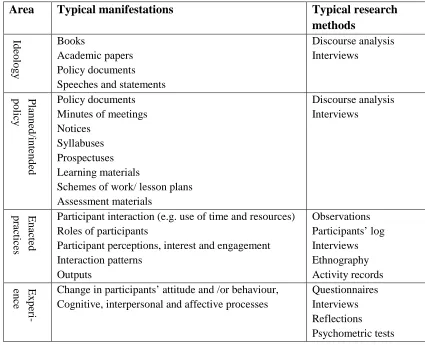
2.1 Areas, typical manifestations and their research methods...53
3.1 Three research paradigms...64
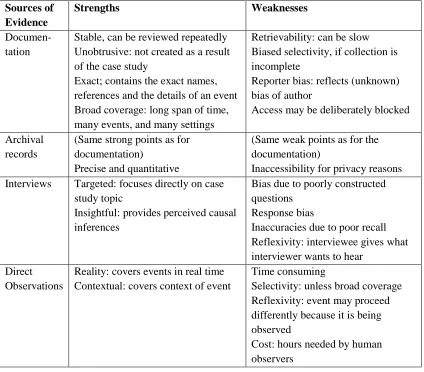
3.2 Six sources of evidence: strengths and weaknesses...70
3.3 Data collection instrument matrix...77
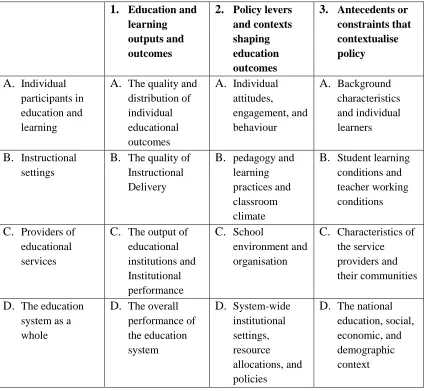
3.4 Matrix of the first two dimensions for OECD education indicators...92
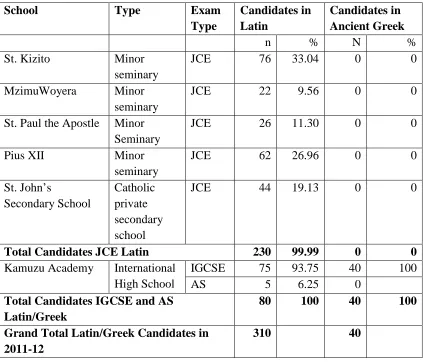
4.1 Summary of enrolments in Latin and Greek in Forms 1 and 2 at secondary schools in the 2011-12 Academic Year...98
4.2 Comparison of positive and negative attitudes Year One ...104
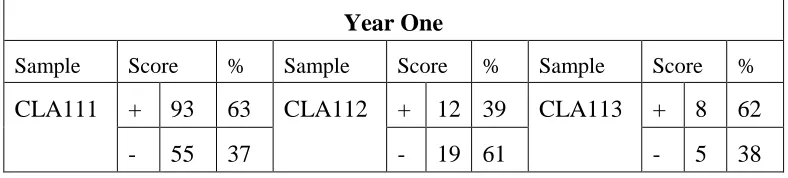
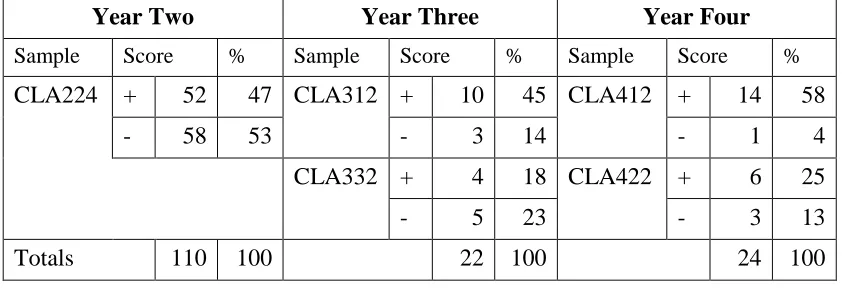
4.3 Comparison of positive and negative attitudes in Years Two-Four...105
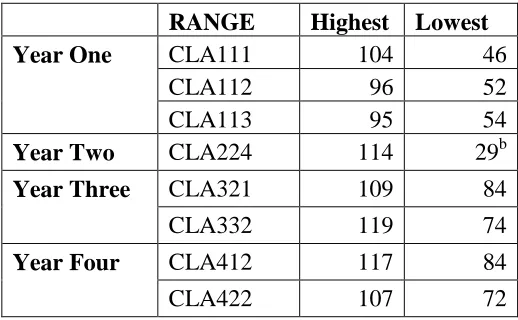
4.4 Summary of range of attitude scores...106
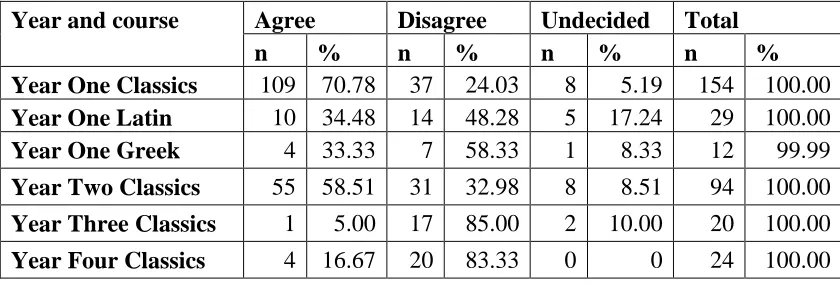
4.5 Sample response of Year One –Year Four Classics students to Research Question 3...107
4.6 I often have difficulties to understand what we have to learn in Classics ...110
4.7 I like the way Classic is taught...111
4.8 Classics/Latin/Greek teacher me to be a liberal thinker...112
4.9 Classics /Latin/Greek teaches me to be a critical thinker ...112
4.10 Classics has taught me to engage in analytical and evaluative thinking...112
4.11 The Subject will sharpen/has sharpened my analytical skills ...113
4.12 When I learn more Classics/Latin/Greek it will help me diversify my thinking /The progress in Classics improves the diversity of our understanding...114
xvi
4.14 The subject will improve/has improved my skill in written communication....115
4.15 Classics/Latin/Greek teaches /has taught me to present material orally
and in writing ...116
4.16 The subject helps /has helped me develop my ability to work as a team
member...117
4.17 Classics/Latin/Greek knowledge is important /essential for understanding
other courses...117
4.18 Classics/Latin/Greek helps me develop my ability to plan my work ...118
4.19 Classics has taught me to gather, memorise, organise and deploy
Information...119
4.20 Classics helps development of my conceptual skills...119
4.21 As a result of learning Classics I feel confident about bout tackling
unfamiliar problems...120
4.22 Response given by different Classicists from different universities’
Classics programmes...128
4.23 Comparison of UNIMA Classics with selected Classics programmes in
Universities in Scotland...148
4.24 Comparison of UNIMA Classics with selected Classics programmes in
Universities in England...160
4.25 Comparison of UNIMA Classics with selected Classics programmes in
In the United States of America...166
4.26 Comparison of UNIMA Classics with selected Classics programmes in
Asian Universities...171
4.27 Comparison of UNIMA Classics with selected Classics programmes in
xvii
LIST OF APPENDICES
Appendix A: Guide for Interviewing Latin/Classics Teachers in Malawi...223
Appendix B: Interview Schedule for Classics Lecturers...224
Appendix C: Student Questionnaire About Classics (A)……… …. 225
Appendix D: Student Questionnaire about Classics (B)………..……228
Appendix E: Consent Letter... 233
Appendix F: Brief Notes about the History of Latin and Current Position of Latin and Classics at secondary level in Malawi...234
Appendix G: Brief descriptions of Classics universities used in this study...244
1
CHAPTER ONE
BACKGROUND TO THE STUDY
1.1 Introduction
In this chapter, the general background to the study is provided, relating it to the
history of Latin and Classical studies in Malawi and the current situation of Latin and
Greek studies in Malawi as well as the status of Classical Studies at secondary school
and tertiary levels. Since tertiary level is the focus of this study, the chapter gives an
overview of Classical Studies at the University of Malawi, including the justification
for its establishment. Brief descriptions of the different Classics programmes at
selected universities, to be compared with that of the University of Malawi, are given.
The problem facing Classical Studies in Malawi is stated, followed by the thesis of
the research and its general objective. The purpose of the study, the research questions
addressed, and the anticipated value of the research are presented. Finally, the
limitations of the investigation and definitions of terms are given.
1.1.1 Malawi as a country: A brief historical note
Malawi, formerly Nyasaland, achieved its independence from British rule on 6th July
1964 under Dr. Hastings Kamuzu Banda, the first President of Malawi. Malawi
became a Republic exactly two years later. It was a one party state till 1994 when it
embraced a multi-party system of government. Malawi is landlocked, having borders
2
Zambia to the North West. It is an agro-based economy with tobacco as its main
export. Malawi ranks among the least developed countries in the world. Its foreign
policy is pro-Western.
1.2 An Overview of Classical Studies in Malawi
There is not much literature about Latin, Greek or Classics Teaching in Malawi in
general. The history of Classics in Malawi starts with Latin as an ancient Classical
language which was the first to be used in Malawi before the inception of pure
Classical Studies in the country.1
Roman Catholic Church orders, specifically the Montfort Fathers, were the first to use
Latin, in celebrating Mass in Nyasaland. But the year when the actual teaching of
Latin began in Malawi was 1924, when the oldest Catholic seminary (Nankhunda)
was opened for the purposes of training Malawian Catholic priests. Training for the
priesthood and Latin learning were inseparable.
The challenges facing Latin teaching in Malawi cited by the seminaries, specifically
on lack of teaching and learning materials and inadequate numbers of qualified Latin
teachers, are among the problems experienced by learning institutions in Malawi
generally, touching almost all subject areas.
Greek has been taught as a secondary school subject only at Kamuzu Academy (since
1995 a private High School). At least Ancient Greek in the form of New Testament
Greek shows signs of long term survival in Malawi through the theological colleges
1
3
and seminaries that will certainly continue to teach students as long as teachers
trained in ancient Greek are available.
Classical Studies in Malawi (both at Kamuzu Academy and the University of Malawi)
were largely promoted by Dr. Hastings Kamuzu Banda. It would therefore be
appropriate to briefly review Dr. Banda’s education so as to establish his Classics
motivation.
Dr. Banda cultivated his love for Classics during his first years in America when he
was a high school student. Short (1974:20) reports that at the African Methodist
Episcopal’s Wilberforce Institute near Ohio, Dr. Banda studied Latin in addition to
the normal high-school subjects’. He graduated with a BA in History in 1931, and
went on to graduate with a medical degree in 1937 at the University of Chicago. He
continued his studies at the University of Edinburgh in 1941 (Short, 1974; O’Maille,
1999). Thus, in all the places he studied there is no specific mention of him having
studied for a pure Classics degree. In that connection, Jenner (2001) quotes Caroline
Alexander, writing in 1991, who argued: ‘the depth of Banda’s knowledge of the
Classics is debatable (some Latin and less Greek?)… but [Banda’s] belief that it was
impossible to understand the mind of the West’s psychological and historical heritage
was genuine enough’. Nonetheless, he might have been influenced by the strong
culture of Classics in the universities in America and the United Kingdom and he
might have read in private several Classics books. It is also interesting to note that
prior to Banda’s return home to lead the liberation struggle, he had stayed in Ghana
where Barbara Goff (writing on the ‘Classics in the British Colonies of West Africa’)
indicates there was a strong culture of Classics by the middle of the nineteenth
4
education among indigenous West Africans’ (Goff, 2013:21). It might be safely
concluded that Dr. Banda was inspired by the feasibility of having Classical education
in an African culture through the Ghana (then Gold Coast) experience, where he went
to stay with his friend Kwame Nkrumah, and that could have propelled him to
promote Classical Studies in Malawi. We may get a cue from the last statement of the
paper which Prof. Wilfred Strol, a zealous supporter of the ‘living Latin’ tradition,
presented in pure Latin at Chancellor College and at Kamuzu Academy in 1988,
titled, De Latinis Litteris Hoc Tempore Docendis (‘The Importance of Latin Studies
for the Present Age’) that Dr. Banda was a Latinist: ‘Floreat Latinitas! Floreat cum
duce Latinissimo res publica Malavi!’ (May Latin flourish! May the Republic of
Malawi flourish with its Latinist leader!) (Strol, 1988:24).
1.3 An Overview of Chancellor College, University of Malawi
The University of Malawi (UNIMA) was founded in October 1964 and the University
opened its doors to its first entrants on 29th September, 1965. It was in 1967 that the
institute of Public Administration at Mpemba, Soche Hill College of Education, the
Polytechnic in Blantyre, Bunda College of Agriculture in Lilongwe and Chichiri
Campus were incorporated as constituent colleges of the University of Malawi. In
1973 three of the five constituent Colleges namely: Chichiri, Institute of Public
Administration and Soche Hill College of Education moved to Zomba to form what is
now known as Chancellor College. In 1979, Kamuzu College of Nursing was
established, followed by the College of Medicine in 1991.
Chancellor College is the largest constituent college, with five faculties: Humanities,
Science, Social Science, Law, and Education. The Department of Classics is in the
5
and Linguistics, English, Fine and Performing Arts, Language and Communication
Skills, Philosophy, and Theology and Religious Studies.
The vision for the University of Malawi is: ‘To be a centre of excellence in higher
education for sustainable development of Malawi and the [Sub-Saharan] region’
(UNIMA Strategic Plan 2011-2017, p.6).The mission statement for Chancellor
College is: ‘To advance knowledge and to promote wisdom and understanding by
engaging in teaching, research, consultancy, outreach and by making provision for the
dissemination, promotion and preservation of learning responsive to the needs of
Malawi and the World’ (Chancellor College website, 8th March 2013). It is therefore
expected that disciplines within the faculties of the University of Malawi will offer
courses to help to achieve the broad University of Malawi vision and the Mission
Statement of the Colleges. To that, we may also add the views as espoused by the
UNESCO Regional Office for Education in Africa (1998), regarding higher education
in Africa:
In Africa, it is now generally recognised that the contributions made by
higher education towards the various economic and social changes should
meet four requirements: relevance and quality, the mobilisation of
adequate and sustainable financial support and development of
inter-university co-operation (UNESCO Regional Office for Education in
Africa, 1998:10).
1.4 Classical Studies at the University of Malawi
It was the late Dr. Hastings Kamuzu Banda, the first President of the Republic of
Malawi, who promoted Classical Studies in Malawi. He was the Chancellor of the
University of Malawi when the then Vice Chancellor contracted Prof. Robert Ogilvie
6
to carry out a feasibility study on the viability of Classical Studies in Malawi. Ogilvie
(1979:2) opened his report as follows:
In May 1979, I was invited by the Vice-Chancellor of the University of
Malawi to serve as consultant to advise on Classical Studies at Chancellor
College. The original inspiration for the promotion of Classical Studies
was given by His Excellency the Life President, Ngwazi Dr. H. Kamuzu
Banda, and a resolution to implement this was passed by the Annual
Convention of the Malawi Congress Party in September 1978 which
called for the establishment of ‘a Department of Classical Studies at the
University of Malawi’.
But the fact that the resolution to establish Classical Studies at Chancellor College
was made at a party annual convention in September 1979 made the establishment of
Classical Studies political. After the feasibility study was undertaken and
recommendations made, it was now time to establish Classical Studies at Chancellor
College.
Classics at Chancellor College was first taught by Caroline Alexander who arrived in
Malawi in 1982 and started teaching in 1983 within the department of Philosophy. It
was not until 1st September 1985 that Classics was established as an independent
department, following a resolution at an extraordinary meeting of the Faculty of
Humanities on 5th June 1985. The then Dean of Humanities, Mr. (later Dr.) M.
Shumba, wrote to the Vice-Chancellor recommending to Senate that a Department of
Classics be established at Chancellor College from 1st September 1985(Dean of
7 1.4.1 Classics courses at Chancellor College
The nature of Classics courses has remained the way they were defined at the
inception of Classical Studies at Chancellor College: on the one hand, we have
Classical Civilisation courses (where no knowledge of Greek and Latin is required)
and, on the other, the ancient languages (Greek and Latin).
Some of the courses combined students from different years for two reasons: the
staffing situation, and the paucity of students.
Classical Civilisation Courses
YEAR 1: Ancient History
YEARS 2 AND 3: Latin literature in translation; Greek literature in translation; Greek
Tragedy; Satire and Comedy; Imperial Athens; the Roman Republic; Survey of Greek
and Roman Philosophy, from the Pre-Socratics through to Epicureans and Stoics;
Plato and Aristotle; sites of the ancient world
YEARS 3 AND 4: Homer and the Epic Tradition; the Art of Persuasion; Classical
Rhetoric and its Influence; the Ideal State; Alexander the Great and the Hellenistic
world; the Roman Empire; Pagan and Christian.
Latin
YEAR ONE: Beginning Latin
YEAR TWO: Intermediate Latin Literature (selections from Cicero –Pro Archia or in
Catilinam; Catullus; Livy; Petronius; and Vergil –selections from the Aeneid)
YEARS 3 AND 4 : Horace (selected odes); Pliny (selected Letters); Plautus (The
Amphitryo); Vergil (Georgics/Eclogues); Lucretius (De Rerum Natura); Tacitus
8 GREEK
YEAR ONE: Beginning Greek (selections from the New Testament and classical
authors).
YEAR 2: Intermediate Geek (selected readings from Herodotus Histories); Lysias;
Plato (Apology)
YEAR 3: The following authors were read: Homer, selections from Iliad; the Lyric
poets; Aeschylus (Prometheus Bound)
Those students who were interested to go beyond 3rd year were expected to make
special arrangements with the Department. It is worth noting that the courses stated
above were offered under a three term system running the whole year and students
were expected to sit for a final examination in addition to the end of term
examinations. But the system changed to a semester system in the late 1990s.
1.4.2 The course offerings for 2012-13 academic year
YEAR 1: Greek Politics and Society; Roman Politics and Society; Beginner’s Latin
(Wheelock as main text); Beginner’s Greek (Athenaze I);
YEAR 2: Greek and Roman Historiography (Semester 1, Herodotus and Thucydides;
Semester 2, Tacitus and Livy; Intermediate Latin (Cicero in Catilinam; Caesar de
Bello Gallico; Intermediate Greek (Athenaze II).
YEAR 3: Classical Literature in translation (Semester 1 selected Greek authors;
Semester2 selected Latin authors); Women in Antiquity; Greek and Roman
Philosophy; Latin Poetry; Greek New Testament.
YEAR 4: Archaeology, Greek and Roman Art and Architecture; Ancient Greek and
9
It is worth noting that currently the department does not have students registered for
the ancient languages beyond First year level. The 2012-13 numbers at first year
were: Greek 16 students and Latin 33 students.
1.4.3 Efforts to expand Classics courses
The range of courses started to widen during the tenure of Dr. Maryse Waegemann
and Jozef de Kuyper (1988-1994). The department had three complete undergraduate
courses from 1st to 4th Year. Latin and Greek went as far as 4th Year. The Classical
Civilisation stream had a more general course shared with the History Department
under the banner of Ancient History but taught by Classics. The course attracted large
numbers since all History students were compelled to take it at first year. A course on
Greek and Roman Art and Architecture was also introduced. Jozef de Kuyper
introduced a new course at 3rd Year titled: ‘Introduction to Computational Research’.
That was a unique innovation from Classics. The course attracted large numbers of
students from the whole faculty and numbers had to be trimmed so that students could
fit into the Mathematical Sciences computer laboratory, using borrowed computers.
That course afforded Humanities students the opportunity to touch a computer for the
first time. The course had to be shelved because it could not run on resources from
another department belonging to a different Faculty altogether.
During the period of Dr. Thomas Knight (1993-1996) course offerings were
expanded, including the introduction of: English Word Origins and Word Power
(which the researcher took over and developed further); Greek and Roman
10
Further expansions of courses were also carried out during the tenure of Prof. Joseph
Hoffmann, Edward Jenner and Dr. Michael Chappell, including: Roman Law; Black
Athena Controversy; and Greek Lyric Poetry. But the curriculum was not completely
revised. Furthermore, it is important to note that much as course offerings were
expanded, such courses disappeared with their originators when they left. Most such
courses were devised to suit the expertise of the course lecturers. Some were
introduced without the required teaching texts.2
1.4.4 Student numbers: A comparison
In his feasibility study, Ogilvie (1979:9) had estimated the total numbers would range
from ten to twenty at most per year, which was indeed the case, as Alexander
(1985:7) reported: when the department started to teach Classics courses, the total
number of students registered for various Classics courses was twelve, five in Year 1,
three in Year 2, and four in Year 3.
Those pursuing Bachelor of Education (Humanities or Social Studies) registered
greater numbers than those from pure Arts, since more students are registered in
Education. The Humanities Faculty shared a limited quota amongst the seven
departments that were there at that time.
As of the academic year 2012-13,a total of 419 students registered for courses in
Classics, a much higher figure than in 1985 when the department had just started. But
only ONE of these was a major, the rest were minors.
The increase of numbers for Classics students over the years can be explained as
follows:
11
1. The University of Malawi has expanded its student intake to various programmes.
2. In addition to the normal entry increase of intake, the University has encouraged
potential candidates to register on non-residential basis and they pay a higher
tuition fee.
3. Some new programmes have been introduced, e.g.: BA (Media Studies),
BA(Communication Studies), BA(Media for Development), BA(Theology), and
other BA mature entry programmes.
But even though the numbers appear to have risen tremendously, compared to when
the department started, it is still worrisome that we do not have a good record for
Classics majors at Year 4. The trend is that the numbers are very high at Years One
and Two and dwindle drastically at Years Three and Four. This is a serious
development that has not been looked into for a long time and is now amongst one of
the major reasons that have compelled the researcher to investigate why students do
not want to major in Classics at the University of Malawi, Chancellor College.
1.4.5 Challenges facing the Department of Classics
Challenges go back to the time when the department was established. Prof. Joseph
Hoffmann, the then Head of Classics, in 1998 summarised the challenges facing
Classics in his controversial memo to the Dean of Humanities, entitled: ‘The Status of
Classics within Chancellor College’:
The Department has no majors, a decreasing intake of students interested
in the ancient languages, and makes a minimal contribution to minor
subject-studies in BAH and BED Hum. It is unlikely for four reasons, that
the Department will attract greater numbers in future: (a) the virtual
discontinuation of Latin teaching in secondary schools and minor
seminaries in Malawi; (b) lack of A level Latin and Ancient history
12
increasingly pragmatic focus of entering students, who associate Classics
with the study of irrelevant and ‘dead’ civilisations; (d) the lack of
interdepartmental co-ordination, especially notable in content overlaps
between Classics 110 [Greek and Roman Politics and Society] and
History 200b [Ancient History offered by the History department] […]
and certain philosophy courses, and in the apparent lack of philological
interest in Greek studies in the Department of Theology and Religious
Studies from which the department once derived two-thirds of its
enrolment in language courses. […] It cannot be overlooked that Classics,
as taught at present in its ‘language/literature-based’ form, is of
decreasing importance and widely perceived to be irrelevant to the
educational and social needs of Malawi. The intake in core (ancient
language) courses in 1998 was fewer than eight students. The Department
relies heavily on expatriate staff (the total of the establishment of three
lecturers), most of whose time is spent teaching three or fewer students in
a tutorial mode.
Indeed it can be observed that some of the challenges spelt out by Hoffmann have
persisted but others have changed. For example, except for 2012-13 where Classics
registered a total of 49 students for Greek and Latin combined, few or none want to
take the ancient languages. Although Latin was discontinued in Government
secondary schools due to lack of teachers, it still persists in some seminaries where it
is taught up to JCE level to reasonable numbers (on average 230 sit for JCE per year).
Most of the potential students of Latin and Greek from Kamuzu Academy do not
register for Classics when they enter the University.
As for the two assertions that: (c) there is ‘the increasingly pragmatic focus of
entering students, who associate Classics with the study of irrelevant and ‘dead’
civilisations’ and (d) ‘Classics as taught at present in its ‘language/literature-based’
13
educational and social needs of Malawi’, these have formed part of core of the
researcher’s investigation.
The problem of lack of interdepartmental coordination cited in the memo persists .It is
interesting to note that Alexander (1985) decried the lack of serious interdepartmental
coordination with disciplines that had overlapping spheres of interest.
The other main challenge relates to staffing. The Classics Department at Chancellor
College has never had stable staffing levels for it has relied heavily on expatriate staff
who have proved difficult to recruit due to our terms of employment, in particular the
uncompetitive salaries. (See, e.g., Head, Classics, memo to Univ. Registrar, 29th
March 1995). In fact in 1997, given the circumstances on the ground, Dr. Henri de
Marcellus was compelled to recommend that Classics be merged with other
departments as a contingency plan based on lack of expatriate staff. The staffing crisis
prompted rumours amongst students that the department had been unsuccessful in its
recruiting efforts and would probably close, so that intending majors for Classics were
diverted to cognate fields.
1.4.6 Threats about restructuring
The attack on Classics for being remote, irrelevant and useless is just part
of the tendency of modern materialistic society to believe that nothing is
worth having if you cannot sell it for more than it cost you. Before long it
will be argued that all education is useless (Geoffrey Chapman, 1985:2).
On several occasions the Department of Classics and the Faculty of Humanities as a
whole has fought attempts to restructure departments arbitrarily. Realising that threats
of restructuring did not threaten the existence of Classics alone, but rather the Faculty
14
Restructuring Committee raising 22 arguments. But for the purposes of this report, I
will restate only four pertinent ones:
1. The faculty is convinced that the real aim of academic restructuring as presented
in the document is not to enhance the efficiency of services and quality of
programmes as claimed but rather to save costs. The Faculty believes that
Chancellor College should not compromise the academic integrity of the
Humanities for the mere sake of cost saving.
2. The Faculty observed that for a long time efforts had been made to merge
departments in the Faculty of Humanities, and wondered why this was not
happening to other faculties. Members therefore felt that they are victims of some
materialist conservative ideology that is against a liberal arts type of education.
3. There are efforts to merge departments such as English, French, African
languages and Linguistics and Classics among others, in Faculty of Humanities,
and the Faculty wonders why the same is not happening to the Faculty of Science,
especially the department of Chemistry, Biology and Physics which have a lot in
common. For example, in secondary school there is either General Science which
included all these subjects or there is Physical Science which combines Physics
with Chemistry. At the University, these subjects are separated for purposes of
greater specialisation. Why is it being assumed that the principle of specialisation
does not apply to disciplines in the Humanities?
4. What synergies are going to be among literature in different languages such as
Greek, Latin, French, Chichewa and English where the subjects are lumped
together in the proposed literature department? Literature in any language is a
product of its specific language, and it can only be accessed through that
15
its literature much as the appreciation of literature reflects mastery of its language.
The linguists in the 4 departments are really specialists only in their specific
languages, that is, French, English, Greek, Latin and Bantu languages. They may
have minimal theoretical similarities but the languages to which they apply the
theories are remarkably different from each other. The literature specialists only
share the name literature with specialists from other sections but the literatures
they teach are as different as the languages in which they are expressed. Therefore
there will be no meaningful synergy among the specialists in both linguistics and
literature because of the different languages involved.
The arguments advanced above by the whole Faculty of Humanities strongly
underscore the whole essence of a liberal arts education as corroborated by the
following observations put forward by Harvard College, on ‘The Value of a Liberal
Arts Education’:
A liberal education – that is, an education conducted in a spirit of free
inquiry undertaken without concern for topical relevance or vocational
utility. This kind of learning is not one of the enrichments of existence; it
is one achievement of civilisation. It heightens students’ awareness of the
human and natural worlds they inhabit. It makes them more reflective
about their beliefs and choices, more self-conscious and critical of their
suppositions and motivations, more creative in their problem solving,
more perceptive of the world around them, and more able to inform
themselves about the issues that arise in their lives, personally,
professionally, and socially. A liberal education is also a preparation for
the rest of life. The subjects that undergraduates study and, as importantly
the skills and habits of mind they acquire in the process, shape the lives
they will lead after they leave [college]. All of them will engage with
forces of change – cultural, religious, political, demographic,
technological, and planetary. All of them will have to assess empirical
16
their personal and professional lives. (The Task Force on General
Education
http://www.admissions.college.harvard.edu/about/learning/liberal-arts.html 2/13/2013)
By looking at the skills a liberal education is capable of giving learners, as succinctly
stated above, the researcher was prompted to find out whether Malawian Classics
learners at undergraduate level know about the skills they could achieve in the course
of learning Classics.
Let us briefly review the justification for Classical Studies put forward by the
consultant, Prof. Ogilvie, in 1979; the benefits to learners that Classics had set out to
achieve when first established at the University of Malawi and even after the
establishment of the department.
1.4.7 Justification for setting up Classics in Malawi
When Prof. Ogilvie was contracted to carry out a viability study of Classics at the
University of Malawi he raised four points as justification for instituting the
department. The researcher was interested to find out to what extent the initial
justifications for establishing Classical Studies at the University of Malawi have stood
the test of time, in other words, if the current undergraduate Classics students at
Chancellor College appreciate the importance/benefits of studying Classics.
Ogilvie (1979:2) recognised the fact that Classics would be taught in a different
culture when he pointed out that, ‘The classical world is far removed in time,
geography, and philosophy from the world of Africa’ yet it was still necessary to
17
advanced the following arguments as justifications for establishing Classical Studies
at the University of Malawi:
1. Structurally, Latin is a language of great clarity and knowledge of it can help
linguistic understanding not only of derivative languages such as English,
French, Spanish, Portuguese, and Italian, but of any language.
2. The study of Classics is demanding and requires high standards of accuracy
and application. The precision of thought and expression acquired through
studying Classics can be transferred, as has been seen throughout history, to
other fields – administration, law, business, government, and so on. This is an
important counterpart in University to courses of a more immediate practical
nature.
3. The social, political, and economic aspects of the ancient world, precisely
because they have both similarities and dissimilarities with the African scene,
are of great educational value as a comparison.
4. The modern world has inherited a great deal of philosophical, religious,
political, cultural, and artistic legacy from Greece and Rome and it is both of
intrinsic interest and of contemporary relevance to be able to go back to the
sources of that legacy, and to study them at first hand.
These four points of Classical Studies imply the overall skills that a Classics student is
anticipated to acquire after learning Classics: skills of transfer of learning and the
ability to understand, appreciate and apply the contributions of another culture to their
own culture as a comparison. To corroborate the gains of transferrable skills accrued
from learning Classics, one of the pioneer Classics students at Chancellor College,
18
undergraduate, welcoming the establishment of Classics, stating what he believed
were the skills or benefits to be accrued from the study of Classics as follows:
Classics helps us [Malawians] to discover much about ourselves and
human society and is therefore much needed in the educational system of
Malawi. Since the need is not for the one or even ten years immediately
ahead but for the rest of the future of Malawi, and [sic] Malawi’s youth
should be equipped with this knowledge. (Msamba, 1984:3)
Related to the above, also Classics at Chancellor College needs to be thought of in
terms of its fundamental role in the Humanities curriculum, as Terence Lockyer, a
then-third year student at the University of Natal Durban, South Africa),observed :
Classics is a subject at the very heart of the Humanities. Classicists are
students not only of language and history but also art, literature,
philosophy, religion, and almost every other area of human interest and
achievement. Classics therefore has something to offer all Humanities
students no matter what their particular fields of study (Lockyer, 1995: 6).
Even though the sentiments regarding the importance of Classics were made by two
scholars in their capacities as Classics students, both were in line with what Marciniak
(2013:233) clearly argued about the spirit of the liberal arts:
Young people educated in the spirit of ‘artes liberales’, i.e., learning all
that is worthy of free people, gain the competence – invaluable today – to
merge different disciplines and mediate in communication between
experts, not belittling the important role of experts in society. Moreover, a
broad outlook on the world and learning creative thinking from the
greatest artists of our civilisation, in a very practical sense enables
students following the path of ‘artes liberales’ not to be satisfied with
existing solutions or workplaces (of which there will never be enough to
go round anyway), but to create new ones that we as teachers may not
19
Although the study of Classics may be mistakenly identified with the study of ‘dead
languages,’ Latin and Greek, the field embraces the study of several areas: history,
linguistics, drama, art, religion, literature, among others. At a practical level, Classics
has something to offer to all humanities students taking different subjects at
Chancellor College. For example, Chancellor College Classics has contributed to the
teaching of other subjects from the beginning, as the following list of departmental
course offerings (offered at different times) and their related or cognate disciplines (in
brackets) indicates:
1. Greek and Roman History, Politics and Society (History, Political Science)
2. Greek and Roman Historiography (History)
3. Greek Mythology (English, African Oral Literature)
4. Greek Drama in Translation (English, Fine and Performing Arts)
5. Classics in Translation (English, Comparative Literature)
6. Latin and Greek Linguistics (Linguistics courses in general)
7. Introduction to Computational Research (all Humanities and Social Sciences
subjects)
8. Religions in Antiquity (Theology and Religious Studies)
9. Archaeology, Greek and Roman Art and Architecture (History, Fine Art)
10.Ancient Philosophy (Philosophy and Theology and Religious Studies)
As can be seen from the arguments above, even amidst some challenges, it is clear
that Classical Studies are necessary for Malawi and that there is need to foster the
studies, more so since Chancellor College is built on the foundation of a liberal arts
20
1.5 Classics Programmes at International Universities Used for Comparison
For purposes of making some comparisons specifically with the University of Malawi
undergraduate Classics programme, this research has used programmes from the
following universities:3
1. The three oldest Scottish universities (University of St. Andrews, School of
Classics; University of Edinburgh, School of History, Classics and Archaeology;
and University of Glasgow, School of Humanities);
2. Three English universities (Oxford, Faculty of Classics; Liverpool, School of
Archaeology, Classics and Egyptology; and the Open University, Classical
Studies Department);
3. Two American universities (Yale, Department of Classics; and University of
Vermont, Department of Classics);
4. Two Asian universities (one in Japan: International Christian University; and one
in China: Tsingua and Peking Universities); and finally,
5. Three South African Universities (University of South Africa, Department of
Classics and World Languages; Stellenbosch University, Department of Ancient
Studies; and University of Kwazulu-Natal, School of Religion, Philosophy and
Classics).
1.6 Statement of the Problem
When Prof. Ogilvie first recommended Classical Studies be established at the
University of Malawi, Chancellor College, amongst the justifications he put forward
was that, while mindful of the cultural differences, there are similarities between
ancient civilisations and the current happenings on the African scene (Ogilvie,
21
1979:3). But even though that should have formed the basis for Classics teaching in
Malawi, apparently the Department of Classics at Chancellor College has largely
operated with almost no reference to its African context.
Anecdotal evidence collected over the years from students, even those not taking
Classics, suggests that most of those who register for Classics do so simply for the
sake of fulfilling the number of credit hours, not with future plans to major. This
confirms the dismal numbers of real Classics majors on the ground –for example only
two in the 2011-12 Academic Year, and only one in the 2012-13 academic year.
Furthermore, there is a widespread misconception that Classics is only about the
teaching of the so called ‘dead’ languages (ancient Greek and Latin). The linguistic
technical term ‘dead’ is misconstrued to mean totally irrelevant and non-existent or
defunct. In addition to that, the skills that Classics students can achieve as a result of
learning Classics are not understood, and moreover, the overall legacy of Greek and
Roman civilisations to the modern world in several spheres–in philosophical,
religious, political, cultural and artistic life, is not understood. Yet Greek and Roman
civilisations have exerted an immeasurable impact on Western tradition that has in
turn had a positive impact on Africa. In order to understand the current problems of
aversion to Classics among Chancellor College undergraduates, there is need to
inquire into: their attitudes (perceptions) towards Classics; the teaching of Classics;
the skills they aspire to or have actually achieved; the relevance of the content of
Classics as a whole. It was equally vital, as a learning experience, to compare Malawi
undergraduate Classics programme with selected Classics programmes from
international universities in the United Kingdom, the United States of America, Asia
22
This study therefore is an attempt to address the misconceptions regarding the
relevance of Classical Studies in an African context by investigating ways of teaching
Classics in a more meaningful way. It is expected that valuable research evidence
derived will inform policy and practice, with the overarching aim to help shape the
future of Classics education in Malawi. Specifically, the study aspired to lay the
foundation for coming up with a Classical Studies programme that provides for
comparative approaches to enrich Malawian students’ appreciation of their cultural
heritage by making comparisons wherever possible with another culture – the
Greco-Roman culture – which process will assist in addressing the issues of quality and
relevance.
1.7 The Thesis of the Research
The thesis of this study is that Classical Studies at the University of Malawi,
Chancellor College, has been taught with almost no reference to its African context.
Classics in Malawi is currently taught as in the West, with which it has immediate
ties, but if there are to be meaningful gains on the part of students learning Classics in
Malawi, we need to contextualise its teaching. The Chancellor College Classics
programme, the teaching of Classics in general, and the Classical Civilisation courses
in particular, should be conducted in such a way that reference is made to the African
context as much as possible in order to make Classics more appealing to Malawian
23 1.7.1 General objective
The general objective of this research was to identify, by comparison with other
Classical Studies programmes, ways of contextualising the University of Malawi
Classical Studies curriculum to fulfil the needs and interests of Malawians, showing
them the relevance of Classics in Africa.
The objectives of the study centred on two aspects:
• To gauge the levels of undergraduate misconceptions towards Classics at tertiary level in Malawi with a view to analysing students’ awareness of their Classical
Studies needs.
• To gather information on how and what various African and non-African Classics departments teach at undergraduate level, so as to determine how that can be
related to the Malawian context.
1.7.2 Purpose of the study
The purpose of this study was to identify ways in which Classics teaching at
undergraduate level in Malawi might be strengthened in order to make the learning of
Classics more meaningful and relevant to the Malawian context, by bridging the gaps
between Classical Antiquity and African cultures.
Specifically the study aimed to find out:
1. How to motivate Classics students to realise the need for and importance of
learning Classics in terms of skills they can achieve and the relevance of Classics
24
2. How to contextualise and reshape Classical Studies to reclaim the foundational
importance it has had. Following three decades of change the field is no longer
what it was when Ogilvie filed his report in 1979;
3. How to respond to world academic trends in the study of Classics;
4. How to help Classics teachers with recommendations they can apply in their
classes by generating alternatives in Classics teaching in an African context; and
5. How to help education policy planners to formulate appropriate policies regarding
the teaching of Classics at university level.
1.7.3 Research questions
Research questions were formulated specifically touching on the current situation
regarding the teaching and learning of Classical Studies at the University of Malawi,
Chancellor College, and aspects of comparative education to be gained from other
Classics programmes internationally:
1. What is the current status of Latin/Greek /Classics teaching at secondary school
level in Malawi?
2. What are the attitudes of Malawian undergraduate Classics students in general to
Classics and at different levels of their education?
3. In what ways do students think that Classics is relevant to their culture?
4. What skills do Classics students anticipate achieving when learning Classics?
5. In which ways does the actual teaching setting at the University of St. Andrews,
School of Classics, compare with that at the University of Malawi, Classics
Department?
25
7. How does the Chancellor College Classics programme compare with other
Classics programmes in selected universities from the United Kingdom; the
United States of America; Asia; and other African countries?
The research questions above were considered appropriate for a qualitative research
enquiry, however quantitative analyses were also carried out to support the qualitative
analysis. In this regard, the items on the questionnaires that solicited attitudes of
learners demanded mostly quantitative analyses, whereas the rich data provided by
respondents in the open-ended questions generated mostly qualitative data.
1.8 Value of the Research
This research is intended to promote tasks in Classics curricula with specific reference
to Malawi. It is anticipated that such tasks will offer springboards for questions,
debates, sharing and discussions on the value and meaning of Classics and Classics
education in an African context. Furthermore, the results will add to the efforts to
justify the teaching of Classics in Africa in general, and Malawi in particular. The
study will especially help to define the need for Classics at Chancellor College by
highlighting ways it contributes to Chancellor College and, by extension, the
educational well-being of Malawi.
The overall value of the research will be a step towards the attainment of quality and
relevant Classics education in Malawi befitting the Malawian context. Currently there
is no research on classical education in Malawi at the tertiary level and as a result, it
has been difficult for the Ministry of Education and the University of Malawi to make
26
In addition to the above, it is expected that the findings will help sensitise students of
Classics and all those interested, to appreciate their own culture by looking at
interpretations of social and artistic life from another culture. It is expected that
Classics will be taught in a more meaningful way in an African context and that
Classics students at the tertiary level will widen their intellectual horizons by
meaningfully appreciating that the Greco-Roman tradition is an essential ingredient
even for Africa.
1.9 Limitations of the Study
The study limited itself to Classics at the undergraduate level. While studying
different Classics programmes in Africa, the United Kingdom, the United States of
America and Asia, the University of Malawi, Chancellor College, Faculty of
Humanities, being the sole university in Malawi offering Classics, was at centre-stage
of the investigation. The study was primarily exploratory in nature and it was intended
to provide descriptive data that may help identify ways of contextualising the
University of Malawi Classics programme to fulfil needs and interests of Malawians
by showing them the relevance of Classics in Africa, through comparisons with other
Classics programmes.
The study used only Classics undergraduate students at the University of Malawi,
Chancellor College. The research was not intended to evaluate the undergraduate
programmes of the other international universities, rather, selected aspects of their
programmes were compared with those of the University of Malawi so as to enable
the researcher to gather information on how and what they teach at undergraduate
27
The Universities of St. Andrews School of Classics, and Malawi, Chancellor College
Classics Department were the main bases for the study, especially to witness the
actual teaching component. As for the other universities, the researcher managed to
visit in person two in the UK: University of Glasgow (School of Humanities) and
University of Edinburgh (School of History, Classics and Archaeology), facilitated by
the School of Classics, University of St. Andrews; as well as the Classics Section of
the University of South Africa, as facilitated by UNISA Classics. The researcher was
unable to visit the other university sites, but all the same, the required information was
sourced through the contacts established while at St. Andrews during the first phase of
the split programme in 2011.
1.10 Definitions of Terms
Ancient History: Ancient History as a subject consists of the study of the political
and military history of the Ancient Greeks and Romans particularly through literary
and inscriptional evidence of the ancient Greeks and Romans.
Classics: Classics (Western Classics as described in Asia) is a conventional
designation for the culture of Greco-Roman antiquity, extending from the arrival of
the Greek speakers in mainland Greece around the beginning of the second
millennium BC to the end of the Western Roman Empire in the fifth century AD.
(The Higher Education Academy, Sep. 2006)
Latin: Latin consists of the study of the language, literature and civilisation of the