Experiments Using OSTIA for a Language Production Task
Dana Angluin and Leonor Becerra-Bonache
Department of Computer Science, Yale University P.O.Box 208285, New Haven, CT, USA
{dana.angluin, leonor.becerra-bonache}@yale.edu
Abstract
The phenomenon of meaning-preserving corrections given by an adult to a child involves several aspects: (1) the child produces an incorrect utterance, which the adult nevertheless understands, (2) the adult produces a correct utterance with the same meaning and (3) the child recognizes the adult utterance as having the same meaning as its previous utterance, and takes that as a signal that its previous ut-terance is not correct according to the adult grammar. An adequate model of this phe-nomenon must incorporate utterances and meanings, account for how the child and adult can understand each other’s mean-ings, and model how meaning-preserving corrections interact with the child’s in-creasing mastery of language production. In this paper we are concerned with how a learner who has learned to comprehend utterances might go about learning to pro-duce them.
We consider a model of language com-prehension and production based on finite sequential and subsequential transducers. Utterances are modeled as finite sequences of words and meanings as finite sequences of predicates. Comprehension is inter-preted as a mapping of utterances to ings and production as a mapping of mean-ings to utterances. Previous work (Castel-lanos et al., 1993; Pieraccini et al., 1993) has applied subsequential transducers and the OSTIA algorithm to the problem of learning to comprehend language; here we apply them to the problem of learning to produce language. For ten natural lan-guages and a limited domain of geomet-ric shapes and their properties and
rela-tions we define sequential transducers to produce pairs consisting of an utterance in that language and its meaning. Using this data we empirically explore the prop-erties of the OSTIA and DD-OSTIA al-gorithms for the tasks of learning compre-hension and production in this domain, to assess whether they may provide a basis for a model of meaning-preserving correc-tions.
1 Introduction
The role of corrections in language learning has recently received substantial attention in Gram-matical Inference. The kinds of corrections con-sidered are mainlysyntactic correctionsbased on proximity between strings. For example, a cor-rection of a string may be given by using edit distance (Becerra-Bonache et al., 2007; Kinber, 2008) or based on the shortest extension of the queried string (Becerra-Bonache et al., 2006), among others. In these approaches semantic in-formation is not used.
re-sults show that children can not only detect differ-ences between their own utterance and the adult reformulation, but that they do make use of that information.
Thus in some natural situations, corrections have asemanticcomponent that has not been taken into account in previous Grammatical Inference studies. Some interesting questions arise: What are the effects of corrections on learning syntax? Can corrections facilitate the language learning process? One of our long-term goals is to find a formal model that gives an account of this kind of correction and in which we can address these questions. Moreover, such a model might allow us to show that semantic information can simplify the problem of learning formal languages.
A simple computational model ofsemanticsand context for language learning incorporating se-mantics was proposed in (Angluin and Becerra-Bonache, 2008). This model accommodates two different tasks: comprehension and production. That paper focused only on the comprehension task and formulated the learning problem as fol-lows. The teacher provides to the learner several example pairs consisting of a situation and an ut-terance denoting something in the situation; the goal of the learner is to learn the meaning func-tion, allowing the learner to comprehend novel ut-terances. The results in that paper show that under certain assumptions, a simple algorithm can learn to comprehend an adult’s utterance in the sense of producing the same sequence of predicates, even without mastering the adult’s grammar. For exam-ple, receiving the utterancethe blue square above the circle, the learner would be able to produce the sequence of predicates (bl,sq,ab,ci).
In this paper we focus on the production task, using sequential and subsequential transducers to model both comprehension and production. Adult production can be modeled as converting a se-quence of predicates into an utterance, which can be done with access to the meaning transducer for the adult’s language.
However, we do not assume that the child ini-tially has access to the meaning transducer for the adult’s language; instead we assume that the child’s production progresses through different stages. Initially, child production is modeled as consisting of two different tasks: finding a correct sequence of predicates, and inverting the meaning function to produce a kind of “telegraphic speech”.
For example, from (gr, tr, le, sq) the child may producegreen triangle left square. Our goal is to model how the learner might move from this tele-graphic speech to speech that is grammatical in the adult’s sense. Moreover, we would like to find a formal framework in which corrections (in form of expansions, for example,the green triangle to the left of the square) can be given to the child dur-ing the intermediate stages (before the learner is able to produce grammatically correct utterances) to study their effect on language learning.
We thus propose to model the problem of child language production as a machine trans-lation problem, that is, as the task of translat-ing a sequence of predicate symbols (representtranslat-ing the meaning of an utterance) into a correspond-ing utterance in a natural language. In this pa-per we explore the possibility of applying existing automata-theoretic approaches to machine transla-tion to model language productransla-tion. In Sectransla-tion 2, we describe the use of subsequential transducers for machine translation tasks and review the OS-TIA algorithm to learn them (Oncina, 1991). In Section 3, we present our model of how the learner can move from telegraphic to adult speech. In Sec-tion 4, we present the results of experiments in the model made using OSTIA. Discussion of these re-sults is presented in Section 5 and ideas for future work are in Section 6.
2 Learning Subsequential Transducers
Subsequential transducers (SSTs) are a formal model of translation widely studied in the liter-ature. SSTs are deterministic finite state mod-els that allow input-output mappings between lan-guages. Each edge of an SST has an associated input symbol and output string. When an in-put string is accepted, an SST produces an put string that consists of concatenating the out-put substrings associated with sequence of edges traversed, together with the substring associated with the last state reached by the input string. Sev-eral phenomena in natural languages can be eas-ily represented by means of SSTs, for example, the different orders of noun and adjective in Span-ish and EnglSpan-ish (e.g., un cuadrado rojo - a red square). Formal and detailed definitions can be found in (Berstel, 1979).
the initial state as they can be. This is called an Onward Subsequential Transducer (OST).
It has been proved that SSTs are learnable in the limit from a positive presentation of sentence pairs by an efficient algorithm called OSTIA (On-ward Subsequential Transducer Inference Algo-rithm) (Oncina, 1991). OSTIA takes as input a fi-nite training set of input-output pairs of sentences, and produces as output an OST that generalizes the training pairs. The algorithm proceeds as fol-lows (this description is based on (Oncina, 1998)):
• A prefix tree representation of all the input sentences of the training set is built. Empty strings are assigned as output strings to both the internal nodes and the edges of this tree, and every output sentence of the training set is assigned to the corresponding leaf of the tree. The result is called atree subsequential transducer.
• An onward tree subsequential transducer equivalent to the tree subsequential trans-ducer is constructed by moving the longest common prefixes of the output strings, level by level, from the leaves of the tree towards the root.
• Starting from the root, all pairs of states of the onward tree subsequential transducer are considered in order, level by level, and are merged if possible (i.e., if the resulting trans-ducer is subsequential and does not contra-dict any pair in the training set).
SSTs and OSTIA have been successfully ap-plied to different translation tasks: Roman numer-als to their decimal representations, numbers writ-ten in English to their Spanish spelling (Oncina, 1991) and Spanish sentences describing simple visual scenes to corresponding English and Ger-man sentences (Castellanos et al., 1994). They have also been applied to language understanding tasks (Castellanos et al., 1993; Pieraccini et al., 1993).
Moreover, several extensions of OSTIA have been introduced. For example, OSTIA-DR incor-porates domain (input) and range (output) mod-els in the learning process, allowing the algorithm to learn SSTs that accept only sentences compat-ible with the input model and produce only sen-tences compatible with the output model (Oncina
and Varo, 1996). Experiments with a language un-derstanding task gave better results with OSTIA-DR than with OSTIA (Castellanos et al., 1993). Another extension is DD-OSTIA (Oncina, 1998), which instead of considering a lexicographic order to merge states, uses a heuristic order based on a measure of the equivalence of the states. Experi-ments in (Oncina, 1998) show that better results can be obtained by using DD-OSTIA in certain translation tasks from Spanish to English.
3 From telegraphic to adult speech
To model how the learner can move from tele-graphic speech to adult speech, we reduce this problem to a translation problem, in which the learner has to learn a mapping from sequences of predicates to utterances. As we have seen in the previous section, SSTs are an interesting approach to machine translation. Therefore, we explore the possibility of modeling language production using SSTs and OSTIA, to see whether they may pro-vide a good framework to model corrections.
As described in (Angluin and Becerra-Bonache, 2008), after learning the meaning function the learner is able to assign correct meanings to ut-terances, and therefore, given a situation and an utterance that denotes something in the situation, the learner is able to point correctly to the object denoted by the utterance. To simplify the task we consider, we make two assumptions about the learner at the start of the production phase: (1) the learner’s lexicon represents a correct meaning function and (2) the learner can generate correct sequences of predicates.
Therefore, in the initial stage of the production phase, the learner is able to produce a kind of “telegraphic speech” by inverting the lexicon con-structed during the comprehension stage. For ex-ample, if the sequence of predicates is (bl,sq,ler, ci), and in the lexiconblueis mapped tobl,square tosq, righttolerandcircletoci, then by invert-ing this mappinvert-ing, the learner would produceblue square right circle.
the learner must learn to include appropriate func-tion words. In other languages, the learner may have to learn a correct choice of words determined by gender, case or other factors. (Note that we are not yet in a position to consider corrections.)
4 Experiments
Our experiments were made for a limited domain of geometric shapes and their properties and re-lations. This domain is a simplification of the Miniature Language Acquisitiontask proposed by Feldman et al. (Feldman et al., 1990). Previous applications of OSTIA to language understanding and machine translation have also used adapta-tions and extensions of the Feldman task.
In our experiments, we have predicates for three different shapes (circle (ci), square (sq) and tri-angle (tr)), three different colors (blue (bl), green (gr) and red (re)) and three different relations (to the left of (le), to the right of (ler), and above (ab)). We consider ten different natural languages: Ara-bic, English, Greek, Hebrew, Hindi, Hungarian, Mandarin, Russian, Spanish and Turkish.
We created a data sequence of input-output pairs, each consisting of a predicate sequence and a natural language utterance. For example, one pair for Spanish is ((ci,re, ler,tr),el circulo rojo a la derecha del triangulo). We ran OSTIA on ini-tial segments of the sequence of pairs, of lengths
10,20,30, . . ., to produce a sequence of subse-quential transducers. The whole data sequence was used to test the correctness of the transducers generated during the process. An error is counted whenever given a data pair(x, y), the subsequen-tial transducer translatesxtoy0, andy0 6= y. We say that OSTIA hasconvergedto a correct trans-ducer if all the transtrans-ducers produced afterwards have the same number of states and edges, and 0 errors on the whole data sequence.
To generate the sequences of input-output pairs, for each language we constructed a meaning trans-ducer capable of producing the 444 different pos-sible meanings involving one or two objects. We randomly generated 400 unique (non-repeated) input-output pairs for each language. This process was repeated 10 times. In addition, to investigate the effect of the order of presentation of the input-output pairs, we repeated the data generation pro-cess for each language, sorting the pairs according to a length-lex ordering of the utterances.
We give some examples to illustrate the
trans-ducers produced. Figure 1 shows an example of a transducer produced by OSTIA after just ten pairs of input-output examples for Spanish. This transducer correctly translates the ten predicate se-quences used to construct it, but the data is not sufficient for OSTIA to generalize correctly in all cases, and many other correct meanings are still incorrectly translated. For example, the sequence (ci,bl) is translated asel circulo a la izquierda del circulo verde azulinstead ofel circulo azul.
The transducers produced after convergence by OSTIA and DD-OSTIA correctly translate all 444 possible correct meanings. Examples for Spanish are shown in Figure 2 (OSTIA) and Figure 3 (DD-OSTIA). Note that although they correctly trans-late all 444 correct meanings, the behavior of these two transducers on other (incorrect) predicate se-quences is different, for example on (tr,tr).
1 bl/ azul sq/ el cuadrado ci/el circulo a la izquierda del circulo verde
2 tr/ el triangulo
le/ ler/ re/ rojo a la derecha
del cuadrado
sq/ ci/ bl/ azul
gr/ ler/ a la derecha
del cuadrado
3 ab/
tr/ encima del triangulo ci/ verde encima del
[image:4.595.315.520.322.388.2]circulo azul bl/ re/ rojo
Figure 1: Production task, OSTIA. A transducer produced using 10 random unique input-output pairs (predicate sequence, utterance) for Spanish.
1 bl/ azul sq/ el cuadrado
2 le/ a la izquierda del
ler/ a la derecha del ab/ encima del
re/ rojo gr/ verde ci/ el circulo tr/ el triangulo
le/ a la izquierda del ler/ a la derecha del ab/ encima del
bl/ azul re/ rojo gr/ verde sq/ cuadrado
ci/ circulo tr/ triangulo
Figure 2: Production task, OSTIA. A transducer produced (after convergence) by using random unique inpoutput pairs (predicate sequence, ut-terance) for Spanish.
[image:4.595.312.517.478.590.2]1 bl/ azul re/ rojo gr/ verde sq/ el cuadrado
ci/ el circulo tr/ el triangulo
2 le/ a la izquierda del ler/ a la derecha del
ab/ encima del
[image:5.595.325.508.60.212.2]sq/ cuadrado ci/ circulo tr/ triangulo
Figure 3: Production task, DD-OSTIA. A trans-ducer produced (after convergence) using random unique inpoutput pairs (predicate-sequence, ut-terance) for Spanish.
Language # Pairs # Sorted Pairs
Arabic 150 200
English 200 235
Greek 375 400
Hebrew 195 30
Hindi 380 350
Hungarian 365 395
Mandarin 45 150
Russian 270 210
Spanish 190 150
[image:5.595.85.287.64.187.2]Turkish 185 80
Table 1: Production task, OSTIA. The entries give the median number of input-output pairs until con-vergence in 10 runs. For Greek, Hindi and Hun-garian, the median for the unsorted case is calcu-lated using all 444 random unique pairs, instead of 400.
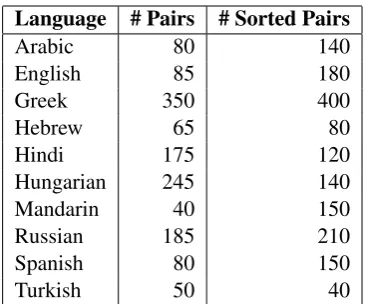
tasks (Oncina, 1998), we also tried using DD-OSTIA for learning to translate a sequence of predicates to an utterance. We used the same se-quences of input-output pairs as in the previous experiment. The results obtained are shown in Ta-ble 2.
We also report the sizes of the transducers learned by OSTIA and DD-OSTIA. Table 3 and Table 4 show the numbers of states and edges of the transducers after convergence for each lan-guage. In case of disagreements, the number re-ported is the mode.
To answer the question of whether production is harder than comprehension in this setting, we also considered the comprehension task, that is, to translate an utterance in a natural language into the corresponding sequence of predicates.
Language # Pairs # Sorted Pairs
Arabic 80 140
English 85 180
Greek 350 400
Hebrew 65 80
Hindi 175 120
Hungarian 245 140
Mandarin 40 150
Russian 185 210
Spanish 80 150
[image:5.595.91.275.269.420.2]Turkish 50 40
Table 2: Production task, DD-OSTIA. The entries give the median number of input-output pairs un-til convergence in 10 runs. For Greek, Hindi and Hungarian, the median for the unsorted case is cal-culated using all 444 random unique pairs, instead of 400.
Languages #states #edges
Arabic 2 20
English 2 20
Greek 9 65
Hebrew 2 20
Hindi 7 58
Hungarian 3 20
Mandarin 1 10
Russian 3 30
Spanish 2 20
[image:5.595.343.492.315.467.2]Turkish 4 31
Table 3: Production task, OSTIA. Sizes of trans-ducers at convergence.
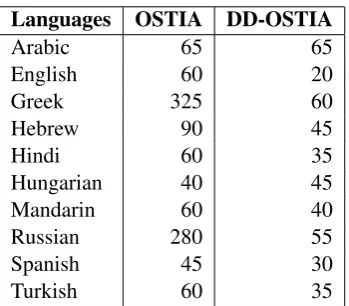
The comprehension task was studied by Oncina et al. (Castellanos et al., 1993). They used En-glish sentences, with a more complex version of the Feldman task domain and more complex se-mantic representations than we use. Our results are presented in Table 5. The number of states and edges of the transducers after convergence is shown in Table 6.
5 Discussion
al-Languages #states #edges
Arabic 2 17
English 2 16
Greek 9 45
Hebrew 2 13
Hindi 7 40
Hungarian 3 20
Mandarin 1 10
Russian 3 23
Spanish 2 13
[image:6.595.342.492.60.212.2]Turkish 3 18
Table 4: Production task, DD-OSTIA. Sizes of transducers at convergence.
Languages OSTIA DD-OSTIA
Arabic 65 65
English 60 20
Greek 325 60
Hebrew 90 45
Hindi 60 35
Hungarian 40 45
Mandarin 60 40
Russian 280 55
Spanish 45 30
Turkish 60 35
Table 5: Comprehension task, OSTIA and DD-OSTIA. Median number (in 10 runs) of input-output pairs until convergence using a sequence of 400 random unique pairs of (utterance, predicate sequence).
gorithms induces compression and generalization, and the interesting questions are how much data is required to achieve correct generalization, and how that quantity scales with the complexity of the task. This are very difficult questions to ap-proach analytically, but empirical results can offer valuable insights.
Considering the comprehension task (Tables 5 and 6), we see that OSTIA generalizes correctly from at most 15% of all 444 possible pairs except in the cases of Greek, Hebrew and Russian. DD-OSTIA improves the DD-OSTIA results, in some cases dramatically, for all languages except Hungarian. DD-OSTIA achieves correct generalization from at most 15% of all possible pairs for all ten lan-guages. Because the meaning function for all ten language transducers is independent of the state, in each case there is a 1-state sequential
trans-Languages #states #edges
Arabic 1 15
English 1 13
Greek 2 25
Hebrew 1 13
Hindi 1 13
Hungarian 1 14
Mandarin 1 17
Russian 1 24
Spanish 1 14
[image:6.595.107.257.60.213.2]Turkish 1 13
Table 6: Comprehension task, OSTIA and DD-OSTIA. Sizes of transducers at convergence using 400 random unique input-output pairs (utterance, predicate sequence). In cases of disagreement, the number reported is the mode.
ducer that achieves correct translation of correct utterances into predicate sequences. OSTIA and DD-OSTIA converged to 1-state transducers for all languages except Greek, for which they con-verged to 2-state transducers. Examining one such transducer for Greek, we found that the require-ment that the transducer be “onward” necessitated two states. These results are broadly compatible with the results obtained by Oncina et al. (Castel-lanos et al., 1993) on language understanding; the more complex tasks they consider also give evi-dence that this approach may scale well for the comprehension task.
Turning to the production task (Tables 1, 2, 3 and 4), we see that providing the random samples with a length-lex ordering of utterances has incon-sistent effects for both OSTIA and DD-OSTIA, sometimes dramatically increasing or decreasing the number of samples required. We do not fur-ther consider the sorted samples.
[image:6.595.95.270.264.417.2]sam-ples is in several cases (Greek, Hindi, Hungarian and Russian) a rather large fraction (40% or more) of all 444 possible pairs. Further experimentation and analysis is required to determine how these re-sults will scale.
Looking at the sizes of the transducers learned by OSTIA and DD-OSTIA in the production task, we see that the numbers of states agree for all lan-guages except Turkish. (Recall from our discus-sion in Section 4 that there may be differences in the behavior of the transducers learned by OSTIA and DD-OSTIA at convergence.) For the produc-tion task, Mandarin gives the smallest transducer; for this fragment of the language, the translation of correct predicate sequences into utterances can be achieved with a 1-state transducer. In contrast, English and Spanish both require 2 states to handle articles correctly. For example, in the transducer in Figure 3, the predicate for a circle (ci) is trans-lated asel circuloif it occurs as the first object (in state 1) and as circulo if it occurs as second ob-ject (in state 2) becausedelhas been supplied by the translation of the intervening binary relation (le,ler, orab.) Greek gives the largest transducer for the production task, with 9 states, and requires the largest number of samples for DD-OSTIA to achieve convergence, and one of the largest num-bers of samples for OSTIA. Despite the evidence of the extremes of Mandarin and Greek, the rela-tion between the size of the transducer for a lan-guage and the number of samples required to con-verge to it is not monotonic.
In our model, one reason that learning the pro-duction task may in general be more difficult than learning the comprehension task is that while the mapping of a word to a predicate does not depend on context, the mapping of a predicate to a word or words does (except in the case of our Mandarin transducer.) As an example, in the comprehension task the Russian wordstriugolnik,triugolnikaand triugonikomare each mapped to the predicatetr, but the reverse mapping must be sensitive to the context of the occurrence oftr.
These results suggest that OSTIA or DD-OSTIA may be an effective method to learn to translate sequences of predicates into natural lan-guage utterances in our domain. However, some of our objectives seem incompatible with the proper-ties of OSTIA. In particular, it is not clear how to incorporate the learner’s initial knowledge of the lexicon and ability to produce “telegraphic
speech” by inverting the lexicon. Also, the in-termediate results of the learning process do not seem to have the properties we expect of a learner who is progressing towards mastery of produc-tion. That is, the intermediate transducers per-fectly translate the predicate sequences used to construct them, but typically produce other trans-lations that the learner (using the lexicon) would know to be incorrect. For example, the intermedi-ate transducer from Figure 1 translintermedi-ates the predi-cate sequence (ci) asel circulo a la izquierda del circulo verde, which the learner’s lexicon indicates should be translated as (ci,le,ci,gr).
6 Future work
Further experiments and analysis are required to understand how these results will scale with larger domains and languages. In this connection, it may be interesting to try the experiments of (Castel-lanos et al., 1993) in the reverse (production) di-rection. Finding a way to incorporate the learner’s initial lexicon seems important. Perhaps by incor-porating the learner’s knowledge of the input do-main (the legal sequences of predicates) and using the domain-aware version, OSTIA-D, the interme-diate results in the learning process would be more compatible with our modeling objectives. Coping with errors will be necessary; perhaps an explic-itly statistical framework for machine translation should be considered.
If we can find an appropriate model of how the learner’s language production process might evolve, then we will be in a position to model meaning-preserving corrections. That is, the learner chooses a sequence of predicates and maps it to a (flawed) utterance. Despite its flaws, the learner’s utterance is understood by the teacher (i.e., the teacher is able to map it to the sequence of predicates chosen by the learner) and responds with a correction, that is, a correct utterance for that meaning. The learner, recognizing that the teacher’s utterance has the same meaning but a different form, then uses the correct utterance (as well as the meaning and the incorrect utterance) to improve the mapping of sequences of predicates to utterances.
of (predicate sequence, utterance) can be used to learn (via an appropriate variant of OSTIA) a per-fect production mapping. However, it seems very likely that corrections can make the process of learning a production mapping easier or faster, and finding a model in which such phenomena can be studied remains an important goal of this work.
7 Acknowledgments
The authors sincerely thank Prof. Jose Oncina for the use of his programs for OSTIA and DD-OSTIA, as well as his helpful and generous ad-vice. The research of Leonor Becerra-Bonache was supported by a Marie Curie International Fellowship within the 6th European Community Framework Programme.
References
Dana Angluin and Leonor Becerra-Bonache. 2008. Learning Meaning Before Syntax. ICGI, 281–292.
Leonor Becerra-Bonache, Colin de la Higuera, J.C. Janodet, and Frederic Tantini. 2007. Learning Balls of Strings with Correction Queries. ECML, 18–29.
Leonor Becerra-Bonache, Adrian H. Dediu, and Cristina Tirnauca. 2006. Learning DFA from Cor-rection and Equivalence Queries.ICGI, 281–292.
Jean Berstel. 1979. Transductions and Context-Free Languages. PhD Thesis, Teubner, Stuttgart, 1979.
Antonio Castellanos, Enrique Vidal, and Jose Oncina. 1993. Language Understanding and Subsequential Transducers. ICGI, 11/1–11/10.
Antonio Castellanos, Ismael Galiano, and Enrique Vi-dal. 1994. Applications of OSTIA to machine trans-lation tasks. ICGI, 93–105.
Michelle M. Chouinard and Eve V. Clark. 2003. Adult Reformulations of Child Errors as Negative Evi-dence.Journal of Child Language, 30:637–669.
Jerome A. Feldman, George Lakoff, Andreas Stolcke, and Susan Hollback Weber. 1990. Miniature Lan-guage Acquisition: A touchstone for cognitive sci-ence. Technical Report, TR-90-009. International Computer Science Institute, Berkeley, California. April, 1990.
Efim Kinber. 2008. On Learning Regular Expres-sions and Patterns Via Membership and Correction Queries. ICGI, 125–138.
Jose Oncina. 1991. Aprendizaje de lenguajes regu-lares y transducciones subsecuenciales. PhD Thesis, Universitat Politecnica de Valencia, Valencia, Spain, 1998.
Jose Oncina. 1998. The data driven approach applied to the OSTIA algorithm. ICGI, 50–56.
Jose Oncina and Miguel Angel Varo. 1996. Using do-main information during the learing of a subsequen-tial transducer. ICGI, 301–312.