On the complexity of alignment problems in two synchronous grammar
formalisms
Anders Søgaard∗ Center for Language Technology
University of Copenhagen [email protected]
Abstract
The alignment problem for synchronous grammars in its unrestricted form, i.e. whether for a grammar and a string pair the grammar induces an alignment of the two strings, re-duces to the universal recognition problem, but restrictions may be imposed on the align-ment sought, e.g. alignalign-ments may be 1 : 1, island-free or sure-possible sorted. The com-plexities of 15 restricted alignment problems in two very different synchronous grammar formalisms of syntax-based machine transla-tion, inversion transduction grammars (ITGs) (Wu, 1997) and a restricted form of range concatenation grammars ((2,2)-BRCGs) (Sø-gaard, 2008), are investigated. The universal recognition problems, and therefore also the unrestricted alignment problems, of both for-malisms can be solved in timeO(n6|G|). The complexities of the restricted alignment prob-lems differ significantly, however.
1 Introduction
The synchronous grammar formalisms used in syntax-based machine translation typically induce alignments by aligning all words that are recog-nized simultaneously (Wu, 1997; Zhang and Gildea,
∗
This work was done while the first author was a Senior Researcher at the Dpt. of Linguistics, University of Potsdam, supported by the German Research Foundation in the Emmy Noether project Ptolemaios on grammar learning from paral-lel corpora; and while he was a Postdoctoral Researcher at the ISV Computational Linguistics Group, Copenhagen Business School, supported by the Danish Research Foundation in the project Efficient syntax- and semantics-based machine
transla-tion.
2004). On a par with weak and strong generative ca-pacity, it is thus possible to talk about the alignment capacity of those formalisms. In this paper, two syn-chronous grammar formalisms are discussed, inver-sion transduction grammars (ITGs) (Wu, 1997) and two-variable binary bottom-up non-erasing range concatenation grammars ((2,2)-BRCGs) (Søgaard, 2008). It is known that ITGs do not induce the class of inside-out alignments discussed in Wu (1997). Another class that ITGs do not induce is that of alignments with discontinuous translation units (Sø-gaard, 2008). Søgaard (2008), on the other hand, shows that the alignments induced by (2,2)-BRCGs are closed under union, i.e. (2,2)-BRCGs induce all possible alignments.
The universal recognition problems of both ITGs and (2,2)-BRCGs can be solved in timeO(n6|G|).
This may come as a surprise, as ITGs restrict the alignment search space considerably, while (2,2)-BRCGs do not. In the context of the NP-hardness of decoding in statistical machine translation (Knight, 1999; Udupa and Maji, 2006), it is natural to ask why the universal recognition problem of (2,2)-BRCGs isn’t NP-hard? How can (2,2)-(2,2)-BRCGs in-duce all possible alignments and still avoid NP-hardness? This paper bridges the gap between these results and shows that when alignments are restricted to be 1 : 1, island-free or sure-possible sorted (see below), or all combinations thereof, the alignment problem of (2,2)-BRCGs is NP-hard. (2,2)-BRCGs in a sense avoid NP-hardness by giv-ing up control over global properties of alignments, e.g. any pair of words may be aligned multiple times in a derivation.
The alignment structures induced by synchronous grammars in syntax-based machine translation have the following property: If an alignment structure in-cludes alignments v|v′, v|w′ and w|w′, it also in-cludes the alignment w|v′, where w, w′, v, v′ are word instances.1 This follows from the fact that only words that are recognized simultanously, are aligned. Otherwise alignment structures are just a binary symmetric relation on two strings, a source and a target string, such that two words in the source, resp. target string, cannot be aligned. Maximally connected subgraphs (ignoring precedence edges) are called translation units.
The alignment problem can be formulated this way (withs, s′source and target sentence, resp.):
INSTANCE: G,hs, s′i.
QUESTION: DoesGinduce an alignment onhs, s′i?
The alignment problem in its unrestricted form reduces to the universal recognition problem (Bar-ton et al., 1987), i.e. whether for a grammar Gand a string pair hs, s′i it holds that hs, s′i ∈ L(G)? Of course the alignment may in this case be empty or partial. Both ITGs and (2,2)-BRCGs permit un-aligned nodes.
This paper investigates the complexity of re-stricted versions of the alignment problem for ITGs and (2,2)-BRCGs. A simple example, which can be solved in linear time for both formalisms, is the alignment problem wrt. alignments that consist of a single translation unit including all source and target words. It may be formulated this way:
INSTANCE: G,hs, s′i.
QUESTION: DoesGinduce an alignment that consists of a single translation unit with no unaligned words onhs, s′i? This can be solved for ITGs by checking if there is a production rule that introduces all the words in the right order such that:2
1w
|w′ is our short hand notation for saying thatw, a word in the source string, andw′, a word in the target string, have
been aligned. In the formal definition of alignments below, it is said thatw∈ Vs (wis a word in the source string),w′ ∈ Vt (w′is a word in the target string) and(w, w′) ∈ A, i.e.wis aligned tow′, and vice versa. Alignments are bidirectional in
what follows.
2In fact in normal form ITGs, we can simply check if there
• The LHS nonterminal symbol (possibly suf-fixed by the empty stringǫ) can be derived from the start symbol.
• The empty stringǫcan be derived from all RHS nonterminal symbols.
The only difference for (2,2)-BRCGs is that pro-duction rules are typically referred to as clauses in the range concatenation grammar literature.
This paper considers some more complex exam-ples; namely, the alignment problems wrt. 1 : 1 -alignments, (source-side and/or target-side) island-free alignments and sure-possible sorted alignments. The formal definitions of the three properties are as follows:
Definition 1.1. An alignment structure for a string
pair hw1. . . wn, v1. . . vmi is a graph D = hV, Ei whereV =Vs :{w1, . . . , wn} ∪Vt:{v1, . . . , vm} andE =Es:{wi ≺wj |i < j} ∪Et:{vi ≺vj |
i < j} ∪AwhereA ⊆ Vs×Vt. If(wi, vj) ∈ A, also written wi|vj, wi is said to be aligned to vj, and vice versa. An alignment structure is said to be wellformed iff for allwi, wj, vi′, vj′ it holds that
if wi|vi′, wi|vj′ and wj|vi′ are aligned then so are
wj|vj′. An alignment structure is said to be1 : 1iff
no word occurs in two distinct tuples inA. An align-ment structure is said to be island-free iff all words inV occur in some tuple inA; it is said to be source-side, resp. target-source-side, island-free if all words inVs, resp.Vt, occur in some tuple inA. The set of align-ments is divided into sure and possible alignalign-ments, i.e.A = S∪P (in most casesP = ∅). An align-ment structure is said to be sure-possible sorted iff if it holds that(wi, vj′)∈Sthen for allwj, vi′ neither
(wi, vi′) ∈ P nor(wj, vj′) ∈ P holds; similarly, if
it holds that(wi, vj′)∈P then for allwj, vi′ neither
(wi, vi′)∈Snor(wj, vj′)∈Sholds.
The precedence relations in E are not important for any of our definitions, but are important for meaningful interpretation of alignment structures. Note that synchronous grammars are guaranteed to induce wellformed alignment structures. Some brief motivation for the properties singled out:
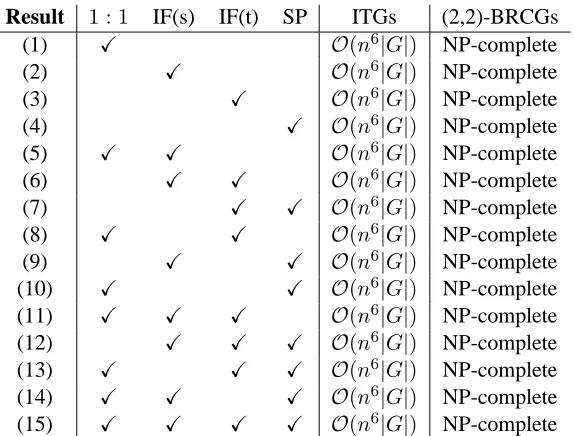
Result 1 : 1 IF(s) IF(t) SP ITGs (2,2)-BRCGs
(1) X O(n6|G|) NP-complete
(2) X O(n6|G|) NP-complete
(3) X O(n6|G|) NP-complete
(4) X O(n6|G|) NP-complete
(5) X X O(n6|G|) NP-complete
(6) X X O(n6|G|) NP-complete
(7) X X O(n6|G|) NP-complete
(8) X X O(n6|G|) NP-complete
(9) X X O(n6|G|) NP-complete
(10) X X O(n6|G|) NP-complete
(11) X X X O(n6|G|) NP-complete
(12) X X X O(n6|G|) NP-complete
(13) X X X O(n6|G|) NP-complete
(14) X X X O(n6|G|) NP-complete
[image:3.612.165.452.56.274.2](15) X X X X O(n6|G|) NP-complete
Figure 1: The complexity of restricted alignment problems for ITGs and (2,2)-BRCGs.
• 1 : 1-alignments have been argued to be ad-equate by Melamed (1999) and elsewhere, and it may therefore be useful to know if a grammar extracted from a parallel corpus produces1 : 1 -alignments for a finite set of sentence pairs.
• Island-free alignments are interesting to the ex-tent that unaligned nodes increase the chance of translation errors. An island threshold may for instance be used to rule out risky translations.
• The notion of sure-possible sorted alignments is more unusual, but can, for instance, be used to check if the use of possible alignments is consistently triggered by words that are hard to align.
The results for all cross-classifications of the four properties – 1 : 1, source-side island-free (IF(s)), target-side island-free (IF(t)) and sure-possible sorted (SP) – are presented in the table in Figure 1.3 Note that all (24 −1 = 15) combina-tions of the four properties lead to NP-hard align-ment problems for (2,2)-BRCGs. Consequently,
3
One of our reviewers remarks that the Figure 1 is ’artifi-cially blown up’, since all combinations have the same com-plexity. It cannot really be left out, however. The numbers in the figure’s left-most column serves as a reference in the proofs below. Since the 15 results derive from only four proofs, it is convenient to have a short-hand notation for the decision prob-lems.
while the unrestricted alignment problem for (2,2)-BRCGs can be solved inO(n6|G|), the alignment problem turns NP-hard as soon as restrictions are put on the alignments sought. So the extra expressivity of (2,2)-BRCGs in a way comes at the expense of control over the kind of alignments obtained.
On the structure of the paper: Sect. 2 and 3 briefly introduce, resp., ITGs and (2,2)-BRCGs. Sect. 4 presents three NP-hardness proofs from which the 15 results in Figure 1 can be derived. The three proofs are based on reconstructions of the Hamilton circuit problem, the 3SAT problem and the vertex cover problem (Garey and Johnson, 1979).
2 Inversion transduction grammars
Inversion transduction grammars (ITGs) (Wu, 1997) are a notational variant of binary syntax-directed translation schemas (Aho and Ullman, 1972) and are usually presented with a normal form:
A → [BC] A → hBCi
A → e|f A → e|ǫ A → ǫ|f
a subtree [[]B[]C]A, whereas the second produc-tion rule inverts the order in the target language, i.e.[[]C[]B]A. The universal recognition problem of ITGs can be solved in time O(n6|G|) by a CYK-style parsing algorithm with two charts.
Figure 1 tells us that all the restricted alignment problems listed can be solved in time O(n6|G|). The explanation is simple. It can be read off from the syntactic form of the production rules in ITGs whether they introduce1 : 1-alignments, island-free alignments or sure-possible sorted alignments. Note that normal form ITGs only induce1 : 1-alignments. Consider, for example, the following grammar, not in normal form for brevity:
(1) S → hASBi | hABi
(2) A → a|a
(3) A → a|ǫ
(4) B → b|b
Note that this grammar recognizes the transla-tion {hanbn, bnam | n ≥ m}. To check if for a string pair hw1. . . wn, v1. . . vmi this grammar in-duces an island-free alignment, simply remove pro-duction rule (3). It holds that only strings in the sub-language{hanbn, bnan | n≥ 1}induce island-free alignments. Similarly, to check if the grammar in-duces source-side island-free alignments for string pairs, no production rules will have to be removed.
3 Two-variable binary bottom-up non-erasing range concatenation grammars
(2,2)-BRCGs are positive RCGs (Boullier, 1998) with binary start predicate names, i.e.ρ(S) = 2. In RCG, predicates can be negated (for complementa-tion), and the start predicate name is typically unary. The definition is changed only for aesthetic rea-sons; a positive RCG with a binary start predicate nameS is turned into a positive RCG with a unary start predicate name S′ simply by adding a clause
S′(X1X2)→S(X1, X2).
A positive RCG is a 5-tupleG=hN, T, V, P, Si.
N is a finite set of predicate names with an arity functionρ:N →N,TandV are finite sets of, resp., terminal and variables.P is a finite set of clauses of the formψ0 →ψ1. . . ψm, where each of theψi,0≤
i≤m, is a predicate of the formA(α1, . . . , αρ(A)).
Eachαj ∈(T∪V)∗,1≤j≤ρ(A), is an argument.
S∈N is the start predicate name withρ(S) = 2. Note that the order of RHS predicates in a clause is of no importance. Three subclasses of RCGs are introduced for further reference: An RCG G =
hN, T, V, P, Si is simple iff for allc ∈ P, it holds that no variable X occurs more than once in the LHS of c, and if X occurs in the LHS then it oc-curs exactly once in the RHS, and each argument in the RHS ofc contains exactly one variable. An RCGG=hN, T, V, P, Siis ak-RCG iff for allA∈
N, ρ(A)≤k. Finally, an RCGG=hN, T, V, P, Si
is said to be bottom-up non-erasing iff for allc∈P
all variables that occur in the RHS ofcalso occur in its LHS.
A positive RCG is a (2,2)-BRCG iff it is a 2-RCG, if an argument of the LHS predicate contains at most two variables, and if it is bottom-up non-erasing.
The language of a (2,2)-BRCG is based on the notion of range. For a string pair hw1. . . wn, vn+2. . . vn+1+mi a range is a pair of indices hi, ji with 0 ≤ i ≤ j ≤ n or
n < i ≤ j ≤ n + 1 + m, i.e. a string span, which denotes a substringwi+1. . . wj in the source string or a substringvi+1. . . vj in the target string. Only consequtive ranges can be concatenated into new ranges. Terminals, variables and arguments in a clause are bound to ranges by a substitution mechanism. An instantiated clause is a clause in which variables and arguments are consistently replaced by ranges; its components are instantiated predicates. For example A(hg . . . hi,hi . . . ji) →
B(hg . . . hi,hi + 1. . . j − 1i) is an instantiation of the clause A(X1, aY1b) → B(X1, Y1) if the
target string is such that vi+1 = a and vj = b. A derive relation =⇒ is defined on strings of instantiated predicates. If an instantiated predicate is the LHS of some instantiated clause, it can be replaced by the RHS of that instantiated clause. The language of a (2,2)-BRCG G = hN, T, V, P, Si is the set L(G) = {hw1. . . wn, vn+2. . . vn+1+mi |
S(h0, ni,hn + 1, n + 1 + mi) =∗⇒ ǫ}, i.e. an input string pair hw1. . . wn, vn+2. . . vn+1+mi is recognized iff the empty string can be derived from
S(h0, ni,hn+ 1, n+ 1 +mi).
the right column their translations in simple (2,2)-BRCGs.
A→[BC] A(X1X2, Y1Y2)→B(X1, Y1)C(X2, Y2)
A→ hBCi A(X1X2, Y1Y2)→B(X1, Y2)C(X2, Y1)
A→e|f A(e, f)→ǫ A→e|ǫ A(e, ǫ)→ǫ A→ǫ|f A(ǫ, f)→ǫ
Consequently, (2,2)-BRCGs recognize all trans-lations recognized by ITGs. In fact the inclusion is strict, as shown in Søgaard (2008). The universal recognition problem of (2,2)-BRCGs can be solved in time O(n6|G|) by the CYK-style parsing
algo-rithm presented in Søgaard (2008).
Example 3.1. Consider the (2,2)-BRCG G =
h{Ss, S0, S0′, S1, S1′, A, B, C, D},{a, b, c, d},{X1,
X2, Y1, Y2}, P, Ssi with P the following set of clauses:
(1) Ss(X1, Y1) → S0(X1, Y1)S′0(X1, Y1)
(2) S0(X1X2, Y1) → S1(X1, Y1)D(X2)
(3) S1(aX1c, abY1) → S1(X1, Y1)
(4) S1(X1, Y1Y2) → B(X1)C(Y1)D(Y2)
(5) S′
0(X1X2, Y1) → S1′(X2, Y1)A(X1)
(6) S′
1(bX1d, Y1cd) → S1′(X1, Y1)
(7) S1′(X1, Y1Y2) → C(X1)A(Y1)B(Y2)
(8) A(aX1) → A(X1)
(9) A(ǫ) → ǫ
(10) B(bX1) → B(X1)
(11) B(ǫ) → ǫ
(12) C(cX1) → C(X1)
(13) C(ǫ) → ǫ
(14) D(dX1) → D(X1)
(15) D(ǫ) → ǫ
The string pairhabbcdd, abcdcdiis derived:
Ss(h0,6i,h0,6i)
=⇒ S0(h0,6i,h0,6i)S0′(h0,6i,h0,6i) (1)
=⇒ S1(h0,4i,h0,6i)D(h4,6i) (2)
S0′(h0,6i,h0,6i)
=⇒ S1(h0,4i,h0,6i)S0′(h0,6i,h0,6i) (14–15)
=⇒ S1(h1,3i,h2,6i)S0′(h0,6i,h0,6i) (3)
=⇒ B(h1,3i)C(h2,4i)D(h4,6i) (4) S0′(h0,6i,h0,6i)
=⇒ S0′(h0,6i,h0,6i) (10–15)
=⇒ S1′(h1,6i,h0,6i)A(h0,1i) (5)
=⇒ S′
1(h1,6i,h0,6i) (8–9)
=⇒ S′
1(h2,5i,h0,4i) (6)
=⇒ S′
1(h3,4i,h0,2i) (6)
=⇒ C(h3,4i)A(h0,1i)B(h1,2i) (7)
=⇒ ǫ (8–13)
Note that L(G) = {hanbmcndm,(ab)n(cd)mi |
m, n≥0}.
4 Results
4.1 Checking island-freeness and sure-possible sortedness
One possible way to check for island-freeness and sure-possible sortedness in the context of (2,2)-BRCGs is to augment the CYK-style algorithm with feature structures (Boolean vectors); all there is needed, e.g. to check sure-possible sortedness, is to pair up the nonterminals inserted in the cells of the chart with a flat feature structure of the form:
SURE1 val1
.. .
SUREnvaln
where n is the length of the source, resp. tar-get, string in the source, resp. tartar-get, chart, and 1 ≤ i ≤ n : vali ∈ {+,−}. When a clause ap-plies that induces a sure alignment between a word
wi and some word in the target, resp. source, string, the attributeSUREiis assigned the value +; if a pos-sible alignment is induced betweenwi and another word, the attribute is assigned the value -. This can all be done in constant time. A copying clause now checks if the appropriate nonterminals have been in-serted in the cells in question, but also that the as-sociated feature structures unify. This can be done in linear time. Feature structures can be used the same way to record what words have been aligned to check island-freeness. Unfortunately, this technique does not guarantee polynomial runtime. Note that there can be2nmany distinct feature structures for each nonterminal symbol in a chart. Consequently, whereas the size of a cell in the standard CYK algo-rithm is bounded by|N|, and in synchronous parsing by|N| ×(2n−1),4 the cells are now of exponential size in the worst case.
The following three sections provide three NP-hardness proofs: The first shows that the alignment
4
problem wrt.1 : 1-alignments is NP-hard for (2,2)-BRCGs and goes by reduction of the Hamilton cir-cuit problem for directed connected graphs. The sec-ond shows that the alignment problem wrt. source-or target-side island-free and sure-possible ssource-orted alignments is NP-hard for (2,2)-BRCGs and goes by 3SAT reduction. The third proof is more general and goes by reduction of the vertex cover problem. All three formal decision problems are discussed in detail in Garey and Johnson (1979). All 15 results in Figure 1 are derived from modifications of these proofs.
4.2 NP-hardness of the1 : 1restriction for (2,2)-BRCGs
Theorem 4.1. The alignment problem wrt. 1 : 1 -alignments is NP-hard for (2,2)-BRCGs.
Proof. An instance of the Hamilton circuit problem for directed connected graphs is simply a directed connected graph G = hV, Ei and the problem is whether there is a path that visits each vertex exactly once and returns to its starting point? Consider, for instance, the directed connected graph:
1 2
3
4 5
It is easy to see that there is no path in this case that visits each vertex exactly once and returns to its starting point. The intuition behind our reconstruc-tion of the Hamilton circuit problem for directed connected graphs is to check this via alignments be-tween a sequence of all the vertices in the graph and itself. The grammar permits an alignment between two wordsw|vif there is a directed edge between the corresponding nodes in the graph, e.g.(w, v) ∈ E. The alignment structures below depict the possible alignments induced by the grammar obtained by the translation described below for our example graph:
1 2 3 4 5
1 2 3 4 5
1 2 3 4 5
1 2 3 4 5
1 2 3 4 5
1 2 3 4 5
1 2 3 4 5
1 2 3 4 5
Since no alignment above is 1 : 1, there is no solution to the corresponding circuit problem. The translation goes as follows:
• Add a rule S(X1, Y1) → {Svi(X1, Y1) | ∀vi.∃vj.(vi, vj)∈E}.
• For each edge (vi, vj) ∈ E add a rule Svi(X1viX2, Y1vjY2) → ⊤(X1)⊤(X2)⊤(X3)⊤(X4).5
• For allvi ∈V add a rule⊤(viX1)→ ⊤(X1).
• Add a rule⊤(ǫ)→ǫ.
The grammar ensures source-side island-freeness, and therefore if there exists a1 : 1-alignment of any linearization ofV and itself, by connectivity of the input graph, there is a solution to the Hamilton cir-cuit problem for directed connected graphs.
4.3 NP-hardness of island-freeness and sure-possible sortedness for (2,2)-BRCGs
Theorem 4.2. The alignment problem wrt.
target-side island-free and sure-possible sorted alignments is NP-hard for (2,2)-BRCGs.
Proof. An instance of the 3SAT problem is a propo-sitional logic formula φ that is a conjunction of clauses of three literals connected by disjunctions, and the problem whether this formula is satisfiable, i.e. has a model? Sayφ=p∨q∨r∧p¯∨q¯∨¯r. For our reconstruction, we use the propositional variables inφas source string, andφ itself with∧’s omitted and conjuncts as words as the target string. One of the representations of a solution constructed by the translation described below is the following align-ment structure:
p q r
p∨q∨r p¯∨q¯∨r¯
Solid lines are sure alignments; dotted lines are possible alignments. The intuition is to use sure alignments to encode true assignments, and possi-ble alignments as false assignments. The alignment
5
above thus corresponds to the model {p,r¯}, which clearly satisfiesφ.
For the translation, assume that each 3SAT in-stance, over a set of propositional variables PROP, consists of a set of clauses c1. . . cm that are sets of literals of size 3. For any literallj, if lj = ¯pj then
pos(lj) = pj andlit(lj) = −; and iflj = pj then
pos(lj) = pj and lit(lj) = +. If lj is a literal in
ci, we write lj ∈ ci. First add the following four clauses:
Ss(X1, Y1) → Ss(X1, Y1)|Sp(X1, Y1)
Sp(X1, Y1) → Ss(X1, Y1)|Sp(X1, Y1)
• If lj ∈ ci and lit(lj) = −, add
Sp(X1pos(lj)X2, Y1ciY2) → ⊤(X1)⊤(X2)
⊤(Y1)⊤(Y2).
• If lj ∈ ci and lit(lj) = +, add
Ss(X1pos(lj)X2, Y1ciY2) → ⊤(X1)⊤(X2)
⊤(Y1)⊤(Y2).
• For allpj, add⊤(pjX1)→ ⊤(X1).
• For allci, add⊤(ciX1)→ ⊤(X1).
• Add a rule⊤(ǫ)→ǫ.
It is easy to see that the first rule adds at most 7m clauses, which for the largest non-redundant formulas equals 7((2|PROP|)3). The second rule adds at most2|PROP|clauses; and the third at most
m≤(2|PROP|)3 clauses. It is also easy to see that the grammar induces a target-side island-free, sure-possible sorted alignment if and only if the 3SAT in-stance is satisfiable. Note that the grammar does not guarantee that all induced alignments are target-side island-free. Nothing, in other words, corresponds to conjunctions in our reconstruction. This is not necessary as long as there is at least one target-side island-free alignment that is induced.
Note that the proof also applies in the case where it is the source side that is required to be island-free. All needed is to make the source string the target string, and vice versa. Note also that the proof can be modified for the case where both sides are island-free: Just add a dummy symbol to the clause side and allow (or force) all propositional variables to be aligned to this dummy symbol. Consequently, if
there is a target-side (clause-side) island-free align-ment there is also an island-free alignalign-ment. Re-versely, if there is an island-free alignment there is also a target-side island-free alignment of the string pair in question.
Note also that a more general proof can be ob-tained by introducing a clause, similar to the clause introduced in the first bullet point of the Hamil-ton circuit reduction in the proof of Theorem 4.1:
S(X1, Y1) → {Sci(X1, Y1) | 1 ≤ i ≤ m}. The four rules used to change between sure and pos-sible alignments then of course need to be copied out for all Sci predicates, and the LHS predicates, except ⊤, of the other clauses must be properly subscripted. Now the grammar enforces target-side island-freeness, and sure-possible sortedness is the only restriction needed on alignments. Conse-quently, this reduction proves (4) that the alignment problem wrt. sure-possible sortedness is NP-hard for (2,2)-BRCGs.
4.4 NP-hardness of island-freeness for (2,2)-BRCGs
Theorem 4.3. The alignment problem wrt.
island-free alignments is NP-hard for (2,2)-BRCGs.
Proof. An instance of the vertex problem is a graph
D = hV, Ei and an integer k, and the prob-lem whether there exists a vertex cover of D of size k? Say D = hV = {a, b, c, d}, E =
{(a, c),(b, c),(b, d),(c, d)}i and k = 2. The trans-lation described below constructs a sentence pair
hρ1ρ2ρ3ρ4uuδδδδ, aaaabbbbccccddddi
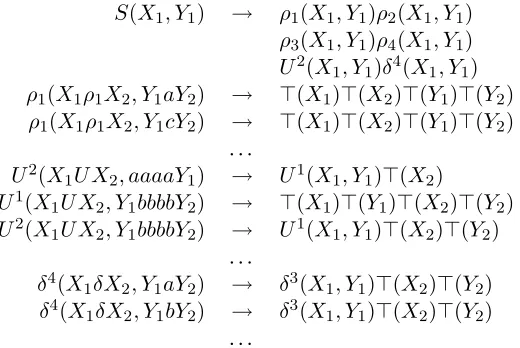
for this instance, and a (2,2)-BRCG with the clauses in Figure 2. Note that there are four kinds of clauses:
• A clause with anS predicate in the LHS. In general, there will be one such clause in the grammar constructed for any instance of the vertex cover problem.
• 8 clauses withρipredicates in the LHS. In gen-eral, there will be 2|E| many clauses of this form in the grammars.
• 16 clauses with δ1 predicates in the LHS. In general, there will be(|E| × |V| − |E| − |E| ×
(|V| −k))× |V|many clauses of this form in the grammars.
For an instance hD = hV, Ei, ki, the translation function in general constructs the following clauses:
S(X1, Y1) → {ρi(X1, Y1)|1≤i≤ |E|}∪
{U|V|−k(X1, Y1)}∪
{δ|E|×|V|−|E|−|E|×(|V|−k)(X 1, Y1)} and for all1≤i≤ |E|iffei ∈E = (e, e′):
ρi(X1ρiX2, Y1eY2) → ⊤(X1)⊤(X2)⊤(Y1)⊤(Y2)
ρi(X1ρiX2, Y1e′Y2) → ⊤(X1)⊤(X2)⊤(Y1)⊤(Y2) For all2≤i≤ |V| −kand for allv ∈V:
Ui(X
1U X2, Y1v . . . vY2) → Ui−1(X1, Y1)
⊤(X2)⊤(Y2) where |v . . . v| = |E|. For the caseU1, add the
clauses for allv∈V:
U1(X
1U X2, Y1v . . . vY2) → ⊤(X1)⊤(Y1)
⊤(X2)⊤(Y2) The string pair is constructed this way:
hρ1. . . ρ|E|U1. . . U|V|−k
δ1. . . δ|E|×|V|−|E|−|E|×(|V|−k), σi
Finally, for all wordswin this string pair, add:
⊤(wX1) → ⊤(X1)
Since this translation is obviously polynomial, it follows that the alignment problem wrt. island-free alignments for (2,2)-BRCGs is NP-hard.
Note that the proof also applies if only the source, resp. target, side is required to be island-free, since the grammar restricts the alignments in a way such that if one side is island-free then so is the other side. This gives us results (2) and (3).
It is not difficult to see either that it is possible to convert the grammar into a grammar that induces 1 : 1-alignments. This gives us results (5), (8) and (11). Of course by the observation that all the gram-mars only use sure alignments, it follows that the alignment problems in (7), (9–10) and (12–15) are also NP-hard.
5 Conclusion
The universal recognition problems of both ITGs and (2,2)-BRCGs can be solved in timeO(n6|G|).
This may come as a surprise, as ITGs restrict the alignment space considerably, while (2,2)-BRCGs induce all possible alignments. In the context of the NP-hardness of decoding in statistical machine translation (Knight, 1999; Udupa and Maji, 2006), it is natural to ask why the universal recognition problem of (2,2)-BRCGs isn’t NP-hard? This pa-per bridges the gap between these results and shows that when alignments are restricted to be 1 : 1, island-free or sure-possible sorted, or all combi-nations thereof, the alignment problem of (2,2)-BRCGs is NP-hard. Consequently, while the un-restricted alignment problem for (2,2)-BRCGs can be solved inO(n6|G|), the alignment problem turns NP-hard as soon as restrictions are put on the align-ments sought. So the extra expressivity in a way comes at the expense of control over the kind of alignments obtained. Note also that an alignment of two words may be enforced multiple times in a (2,2)-BRCGs parse, since two derivation trees that share leaves on both sides can align the same two words.
S(X1, Y1) → ρ1(X1, Y1)ρ2(X1, Y1)
ρ3(X1, Y1)ρ4(X1, Y1)
U2(X
1, Y1)δ4(X1, Y1)
ρ1(X1ρ1X2, Y1aY2) → ⊤(X1)⊤(X2)⊤(Y1)⊤(Y2)
ρ1(X1ρ1X2, Y1cY2) → ⊤(X1)⊤(X2)⊤(Y1)⊤(Y2)
. . .
U2(X
1U X2, aaaaY1) → U1(X1, Y1)⊤(X2)
U1(X1U X2, Y1bbbbY2) → ⊤(X1)⊤(Y1)⊤(X2)⊤(Y2)
U2(X1U X2, Y1bbbbY2) → U1(X1, Y1)⊤(X2)⊤(Y2)
. . .
δ4(X1δX2, Y1aY2) → δ3(X1, Y1)⊤(X2)⊤(Y2)
δ4(X1δX2, Y1bY2) → δ3(X1, Y1)⊤(X2)⊤(Y2)
[image:9.612.178.438.58.232.2]. . .
Figure 2: A (2,2)-BRCG for the instance of the vertex cover problemhh{a, b, c, d},{(a, c),(b, c),(b, d),(c, d)}i,2i.
References
Alfred Aho and Jeffrey Ullman. 1972. The theory of parsing, translation and compiling. Prentice-Hall,
London, England.
Edward Barton, Robert Berwick, and Erik Ristad. 1987.
Computational complexity and natural language. MIT
Press, Cambridge, Massachusetts.
Pierre Boullier. 1998. Proposal for a natural language processing syntactic backbone. Technical report, IN-RIA, Le Chesnay, France.
Michael Garey and David Johnson. 1979. Computers
and intractability. W. H. Freeman & Co., New York,
New York.
Kevin Knight. 1999. Decoding complexity in word-replacement translation models. Computational
Lin-guistics, 25(4):607–615.
Dan Melamed. 1999. Bitext maps and alignment via pattern recognition. Computational Linguistics,
25(1):107–130.
Anders Søgaard. 2008. Range concatenation gram-mars for translation. In Proceedings of the 22nd
International Conference on Computational Linguis-tics, Companion Volume, pages 103–106, Manchester,
England.
Raghavendra Udupa and Hemanta Maji. 2006. Compu-tational complexity of statistical machine translation. In Proceedings of the 11th Conference of the European
Chapter of the Association for Computational Linguis-tics, pages 25–32, Trento, Italy.
Dekai Wu. 1997. Stochastic inversion transduction grammars and bilingual parsing of parallel corpora.
Computational Linguistics, 23(3):377–403.
Hao Zhang and Daniel Gildea. 2004. Syntax-based alignment: supervised or unsupervised? In
Proceed-ings of the 20th International Conference on Compu-tational Linguistics, pages 418–424, Geneva,