Constructing a Practical Constituent Parser from a Japanese Treebank with
Function Labels
Takaaki Tanaka and Masaaki Nagata
NTT Communication Science Laboratories
Nippon Telegraph and Telephone Corporation
{
tanaka.takaaki, nagata.masaaki
}
@lab.ntt.co.jp
Abstract
We present an empirical study on construct-ing a Japanese constituent parser, which can output function labels to deal with more de-tailed syntactic information. Japanese syn-tactic parse trees are usually represented as unlabeled dependency structure between bun-setsu chunks, however, such expression is in-sufficient to uncover the syntactic information about distinction between complements and adjuncts and coordination structure, which is required for practical applications such as syn-tactic reordering of machine translation. We describe a preliminary effort on constructing a Japanese constituent parser by a Penn Tree-bank style treeTree-bank semi-automatically made from a dependency-based corpus. The eval-uations show the parser trained on the tree-bank has comparable bracketing accuracy as conventional bunsetsu-based parsers, and can output such function labels as the grammatical role of the argument and the type of adnominal phrases.
1
Introduction
In Japanese NLP, syntactic structures are usually represented as dependencies between grammatical chunks called bunsetsus. A bunsetsu is a grammat-ical and phonologgrammat-ical unit in Japanese, which con-sists of an independent-word such as noun, verb or adverb followed by a sequence of zero or more dependent-words such as auxiliary verbs, postposi-tional particles or sentence final particles. It is one of main features of Japanese that bunsetsu order is much less constrained than phrase order in English.
Since dependency between bunsetsus can treat flexi-ble bunsetsu order, most publicly availaflexi-ble Japanese parsers including CaboCha (Kudo et al., 2002) and KNP (Kawahara et al., 2006) return bunsetsu-based dependency as syntactic structure. Such bunsetsu-based parsers generally perform with high accuracy and have been widely used for various NLP applica-tions.
However, bunsetsu-based representations also have serious shortcomings for dealing with Japanese sentence hierarchy. The internal structure of a bun-setsu has strong morphotactic constraints in contrast to flexible bunsetsu order. A Japanese predicate bunsetsu consists of a main verb followed by a se-quence of auxiliary verbs and sentence final parti-cles. There is an almost one-dimensional order in the verbal constituents, which reflects the basic hi-erarchy of the Japanese sentence structure including voice, tense, aspect and modality. Bunsetsu-based representation cannot provide the linguistic structure that reflects the basic sentence hierarchy.
Moreover, bunsetsu-based structures are unsuit-able for representing such nesting structure as co-ordinating conjunctions. For instance, bunsetsu rep-resentation of a noun phrase “技術-の (technology-GEN) / 向上-と (improvement-CONJ) / 経済-の (economy-GEN) / 発展 (growth) ” technology
im-provement and economic growth does not allow
us to easily interpret it, which means
((technol-ogy improvement) and (economic growth)) or (tech-nology (improvement and economic growth)),
be-cause bunsetsu-based dependencies do not con-vey information about left boundary of each noun phrase (Asahara, 2013). This drawback complicates
operating syntactically meaningful units in such ap-plications as statistical machine translation, which needs to recognize syntactic units in building a trans-lation model (e.g. tree-to-string and tree-to-tree) and in preordering source language sentences.
Semantic analysis, such as predicate-argument structure analysis, is usually done as a pipeline pro-cess after syntactic analysis (Iida et al., 2011 ; Hayashibe et al., 2011 ); but in Japanese, the dis-crepancy between syntactic and semantic units cause difficulties integrating semantic analysis with syn-tactic analysis.
Our goal is to construct a practical constituent parser that can deal with appropriate grammatical units and output grammatical functions as semi-semantic information, e.g., grammatical or seman-tic roles of arguments and gapping types of relative clauses. We take an approach to deriving a grammar from manually annotated corpora by training prob-abilistic models like current statistical constituent parsers of de facto standards (Petrov et al., 2006; Klein et al., 2003 ; Charniak, 2000; Bikel, 2004). We used a constituent-based treebank that Uematsu et al. (2013) converted from an existing bunsetsu-based corpus as a base treebank, and retag the non-terminals and transform the tree structures in de-scribed in Section 3. We will present the results of evaluations of the parser trained with the treebank in Section 4, and show some analyses in Section 5.
2
Related work
The number of researches on Japanese constituent-based parser is quite few compared to that of bunsetsu-dependency-based parser. Most of them have been conducted under lexicalized grammatical formalism.
HPSG (Head-driven Phrase Structure Gram-mar) (Sag et al., 2003 ) is a representative one. Gunji et al. (1987) proposed JPSG (Japanese Phrase Structure Grammar) that is theoretically precise to handle the free word order problem of Japanese. Na-gata et al. ( 1993 ) built a spoken-style Japanese grammar and a parser running on it. Siegel et al ( 2002 ) constructed a broad-coverage linguistically precise grammar JACY, which integrates semantics, MRS (Minimal Recursion Semantics) (Copestake, 2005). Bond et al. ( 2008 ) built a large-scale
Japanese treebank Hinoki based on JACY and used it for parser training.
Masuichi et al.(2003) developed a Japanese LFG (Lexicalized-Functional Grammar) (Kaplan et al., 1982) parser whose grammar is sharing the de-sign with six languages. Uematsu et al. (2013) constructed a CCG (Combinatory Categorial Gram-mar) bank based on the scheme proposed by Bekki (2010), by integrating several corpora includ-ing a constituent-based treebank converted from a dependency-base corpus.
These approaches above use a unification-based parser, which offers rich information integrating syntax, semantics and pragmatics, however, gener-ally requires a high computational cost. We aim at constructing a more light-weighted and practical constituent parser, e.g. a PCFG parser, from Penn Treebank style treebank with function labels. Gab-bard et al. (2006) introduced function tags by modi-fying those in Penn Treebank to their parser. Even though Noro et al. (2005) built a Japanese corpus for deriving Japanese CFG, and evaluated its grammar, they did not treat the predicate-argument structure or the distinction of adnominal phrases.
This paper is also closely related to the work of Korean treebank transformations (Choi et al., 2012). Most of the Korean corpus was built using grammat-ical chunks eojeols, which resemble Japanese bun-setsus and consist of content words and morphemes that represent grammatical functions. Choi et al. transformed the eojeol-based structure of Korean treebanks into entity-based to make them more suit-able for parser training. We converted an existing bunsetsu-based corpus into a constituent-based one and integrating other information into it for training a parser.
3
Treebank for parser training
In this section, we describe the overview of our tree-bank for training a parser.
3.1 Construction of a base treebank
S
IP-MAT[nad]:A
VP[nad]:A
VP[nad]:A
AUX
た
-PAST
VB[nad]
与え
give
PP-OBJ
PCS
を
-ACC
NN
本
book
PP-OB2
PCS
に
-DAT
NN
生徒
student
S
IP-MAT[nad]:A
VP[nad]:A
AUX
た
-PAST
VB[nad]
与え
give
PP-OBJ
PCS
を
-ACC
NN
本
book
PP-OB2
PCS
に
-DAT
NN
生徒
student
(I) gave the student a book.
[image:3.612.99.472.76.233.2]binary tree n-ary (flattened) tree
Figure 1: Verb Phrase with subcategorization and voice information
NN General noun
NNP Proper noun
NPR Pronoun
NV Verbal noun
NADJ Adjective noun
NADV Adverbial noun (incl. temporal noun)
NNF Formal noun (general)
NNFV Formal noun (adverbial)
PX Prefix
SX Suffix
NUM Numeral
CL Classifier
VB Verb
ADJ Adjective
ADNOM Adnominal adjective
ADV Adverb
PCS Case particle
PBD Binding particle
PADN Adnominal particle
PCO Parallel particle
PCJ Conjunctive particle
PEND Sentence-ending particle
P Particle (others)
AUX Auxiliary verb
CONJ Conjunction
PNC Punctuation
PAR Parenthesis
SYM Symbol
FIL Filler
Table 1: Preterminal tags
automatically converted from dependency structure to phrase structure by the previously described method (Uematsu et al., 2013), and conversion er-rors of structures and tags were manually corrected. We adopted the annotation schema used in Japanese Keyaki treebank (Butler et al., 2012) and Annotation Manual for the Penn Historical Corpora and the PCEEC (Santorini, 2010) as reference to re-tag the nonterminals and transform the tree struc-tures.
The original Kyoto Corpus has fine-grained part-of-speech tags, which we converted into simpler preterminal tags shown in Table 1 for training by lookup tables. First the treebank’s phrase tags ex-cept function tags are assigned by simple CFG rule sets, then, function tags are added by integrating the information from the other resources or manually annotated. We integrate predicate-argument infor-mation from the NAIST Text Corpus (NTC) (Iida et al., 2007 ) into the treebank by automatically con-verting and adding tag suffixes (e.g. -SBJ,-ARG0
described in section 3.3) to the original tags of the argument phrases. The structure information about coordination and apposition are manually annotated.
3.2 Complementary information
We selectively added the following information as tag suffixes and tested their effectiveness.
(no label) base form
cont continuative form
attr attributive form
neg negative form
hyp hypothetical form
imp imperative form
stem stem
Table 2: Inflection tag suffixes
on their modifying words and phrases (e.g. noun and verb phrases). Symbols in Table 2 are attached to tagsVB,ADJand AUX, based on their inflection form. The inflection information is propagated to the phrases governing the inflected word as a head. We adopted these symbols from the notation of Japanese CCG described in (Bekki, 2010).
Subcategorization and voice Each verb has a subcategorization frame, which is useful for build-ing verb phrase structure. For instance, 掴む
tsukamu “grasp” takes two arguments, nominative
and accusative cases, 与える ataeru “give” takes
three arguments: nominative, accusative and dative cases. We also added suffixes to verb tags to de-note which arguments they require (n:nominative,
a:accusative and d: dative). For instance, the verb与える“give” takes three arguments (nomina-tive, accusative and dative cases), it is tagged with
VB[nad].
We retrieve this information from a Japanese case frame dictionary, Nihongo Goitaikei (Ikehara et al., 1997), which has 14,000 frames for 6,000 verbs and adjectives. As an option, we also added voice infor-mation (A:active,P:passive and C:causative) to the verb phrases, because it effectively helps to discrim-inate cases.
3.3 Annotation schema
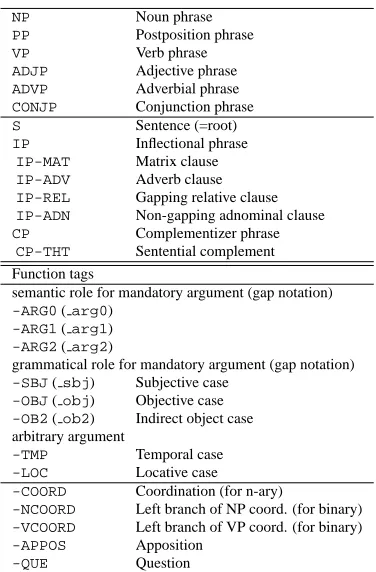
We introduce phrase and function tags in Table 3 and use them selectively based on the options described below.
Tree Structure We first built a treebank with bi-nary tree structure (except the root and terminal nodes), because it is comparably easy to convert the existing Japanese dependency-based corpus to it. We converted the dependency-based corpus by a previously described method in (Uematsu et al., 2013). The binary tree’s structure has the
follow-NP Noun phrase
PP Postposition phrase
VP Verb phrase
ADJP Adjective phrase
ADVP Adverbial phrase
CONJP Conjunction phrase
S Sentence (=root)
IP Inflectional phrase
IP-MAT Matrix clause
IP-ADV Adverb clause
IP-REL Gapping relative clause
IP-ADN Non-gapping adnominal clause
CP Complementizer phrase
CP-THT Sentential complement Function tags
semantic role for mandatory argument (gap notation)
-ARG0(arg0)
-ARG1(arg1)
-ARG2(arg2)
grammatical role for mandatory argument (gap notation)
-SBJ(sbj) Subjective case
-OBJ(obj) Objective case
-OB2(ob2) Indirect object case arbitrary argument
-TMP Temporal case
-LOC Locative case
-COORD Coordination (for n-ary)
-NCOORD Left branch of NP coord. (for binary)
-VCOORD Left branch of VP coord. (for binary)
-APPOS Apposition
[image:4.612.327.515.70.356.2]-QUE Question
Table 3: Phrase tags
ing characteristics about verb phrase (VP) and post-position phrase (PP): VP from the same bunsetsu is a left-branching subtree and the PP-VP structure (roughly corresponding to the argument-predicate structure) is a right-branching subtree. Pure binary trees tend to be very deep and difficult to annotate and interpret by humans. We also built an n-ary tree version by flattening these structures.
The predicate-argument structure, which is usu-ally represented by PPs and a VP in the treebank, particularly tends to be deep in binary trees based on the number of arguments. To flatten the structure, we remove the internal VP nodes by intermediately re-attaching all of the argument PPs to the VP that dominates the predicate. Figure 1 shows an example of flattening the PP-VP structure.
[image:4.612.326.513.78.359.2]IP-MAT
VP
VP
P
た
-PAST
VB
追いかけ
chase
PP-OBJ
PCS
を
-ACC
NN
猫
cat
PP-SBJ
PCS
が
-NOM
NN
犬
dog
NP
NP
NN
犬
dog
IP-REL sbj
VP
P
た
-PAST
VB
追いかけ
chase
PP-OBJ
PCS
を
-ACC
NN
猫
cat
NP
NP
NN
写真
photo
IP-ADN
VP
VP
AUX
いる
-PROG
VP
P
て
VB
追いかけ
chase
PP-OBJ
PCS
を
-ACC
NN
猫
cat
PP-SBJ
PCS
が
-NOM
NP
犬
dog
[image:5.612.88.529.71.254.2]The dog chased the cat. The dog that chased the cat The photo of a dog chasing a cat
Figure 2: Leftmost tree shows annotation of grammatical roles in a basic inflectional phrase. Right two trees show examples of adnominal phrases.
Predicates and arguments The predicate’s argu-ment is basically marked with particles, which rep-resent cases in Japanese; thus, they are reprep-resented as a postpositional phrase, which is composed of a noun phrase and particles. The leftmost tree in Figure 2 is an example of the parse result of the following sentence: 犬-がinu-ga “dog-NOM” 猫 -をneko-o “cat-ACC”追いかけたoikaketa “chased”
(The dog chased the cat.)
We annotated predicate arguments by two dif-ferent schemes (difdif-ferent tag sets) in our treebank: grammatical roles and semantic roles. In using a tag set based on grammatical roles, the arguments are assigned with the suffixes based on their syntactic roles in the sentence, like Penn Treebank:SBJ (sub-ject),OBJ(direct object), andOB2(indirect object). Figure 2 is annotated by this scheme.
Alternatively, the arguments are labeled based on their semantic roles from case frame of predicates, like PropBank (Palmer et al., 2005 ):ARG0,ARG1
andARG2. These arguments are annotated by con-verting semantic roles defined in the case frame dic-tionary Goitaikei into simple labels, the labels are not influenced by case alternation.
In both annotation schemes, we also annotated two types of arbitrary arguments with semantic role labels: LOC(locative) and TMP (temporal), which can be assigned consistently and are useful for vari-ous applications.
Adnominal clauses Clauses modifying noun phrases are divided into two types: (gapping) rela-tive and non-gapping adnominal clauses. Relarela-tive clauses are denoted by adding function tag-RELto phrase tag IP. Such a gap is directly attached to
IP-RELtag as a suffix consisting of an underscore and small letters in our treebank, e.g.,IP-REL sbj
for a subject-gap relative clause, so that the parser can learn the type of gap simultaneously, unlike the Penn Treebank style, where gaps are marked as trace ‘*T*’. For instance, note the structure of the following noun phrase, which is shown in the middle tree in Figure 2: 猫-をneko-o “cat-ACC”
追いかけた oikake-ta “to chase” 犬 inu “dog”
“neko-o (cat-ACC) oikaketa (chase) inu” (The dog
that chased the cat.). We also adopt another type of
gap notation that resembles the predicate-argument structure: semantic role notation. In the example above, tagIP-REL arg0is attached to the relative clause instead.
We attach tag IP-ADN to another type of ad-nominal clauses, which has no gap, the modified noun phrase is not an argument of the predicate in the adnominal clause. The rightmost in Figure 2 is an example of a non-gapping clause: 犬-がinu-ga
“dog-NOM” 猫-をneko-o “cat-ACC” 追いかけて
いる oikake-teiru “chasing” 写真 shashin “photo”
Coordination and apposition The notation of such parallel structure as coordination and apposi-tion differs based on the type of tree structure. For binary trees, the coordination is represented by a left-branching tree, which is a conjunction or a junction particle that first joined a left hand con-stituent; the phrase is marked as a modifier consist-ing of coordination (-NCOORD and -VCOORD for NP and VP coordinations), as shown on the left side of Figure 3. On the other hand, in n-ary trees, all the coordination elements and conjunctions are aligned flatly under the parent phrase with suffix-COORD. The apposition is represented in the same way using tag-APPOSinstead.
Phrase and sentential elements Since predicate arguments are often omitted in Japanese, discrimi-nation between the fragment of larger phrases and sentential elements is not clear. In treebank, we em-ploy IP and CP tags for inflectional and comple-mentizer phrases, assuming that tags with function tag suffixes to the phrase correspond to the max-imum projection of the predicate (verb or adjec-tive). The matrix phrase and the adverbial phrase haveIP-MATandIP-ADVtags respectively. This annotation schema is adopted based on the Penn Historical Corpora (Santorini, 2010) and Japanese Keyaki treebank (Butler et al., 2012) as previously described, while IP in our treebank is not so flat as them.
Such sentential complements as that-clauses in English are tagged with CP-THT. In other words, the sentential elements, which are annotated with SBAR, S, and trace *T* in the Penn Treebank, are tagged withCPorIPin our treebank.
4
Evaluation
The original Kyoto Corpus has 38,400 sentences and they were automatically converted to constituent structures. The function tags are also added to the corpus by integrating predicate-argument informa-tion in the NAIST Text corpus. Since the conver-sion contains errors of structures and tags, about half of them were manually checked to avoid the effects of the conversion errors.
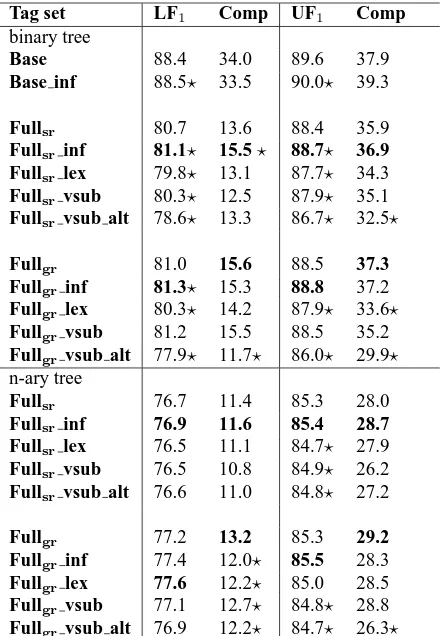
We evaluated our treebank’s effectiveness for parser training with 18,640 sentences, which were divided into three sets: 14,895 sentences for a
train-Tag set LF1 Comp UF1 Comp
binary tree
Base 88.4 34.0 89.6 37.9 Base inf 88.5⋆ 33.5 90.0⋆ 39.3
Fullsr 80.7 13.6 88.4 35.9 Fullsr inf 81.1⋆ 15.5⋆ 88.7⋆ 36.9 Fullsr lex 79.8⋆ 13.1 87.7⋆ 34.3 Fullsr vsub 80.3⋆ 12.5 87.9⋆ 35.1 Fullsr vsub alt 78.6⋆ 13.3 86.7⋆ 32.5⋆
Fullgr 81.0 15.6 88.5 37.3 Fullgr inf 81.3⋆ 15.3 88.8 37.2 Fullgr lex 80.3⋆ 14.2 87.9⋆ 33.6⋆ Fullgr vsub 81.2 15.5 88.5 35.2 Fullgr vsub alt 77.9⋆ 11.7⋆ 86.0⋆ 29.9⋆ n-ary tree
Fullsr 76.7 11.4 85.3 28.0 Fullsr inf 76.9 11.6 85.4 28.7 Fullsr lex 76.5 11.1 84.7⋆ 27.9 Fullsr vsub 76.5 10.8 84.9⋆ 26.2 Fullsr vsub alt 76.6 11.0 84.8⋆ 27.2
[image:6.612.314.534.175.493.2]Fullgr 77.2 13.2 85.3 29.2 Fullgr inf 77.4 12.0⋆ 85.5 28.3 Fullgr lex 77.6 12.2⋆ 85.0 28.5 Fullgr vsub 77.1 12.7⋆ 84.8⋆ 28.8 Fullgr vsub alt 76.9 12.2⋆ 84.7⋆ 26.3⋆
Table 4: Parse results displayed by labeled and unla-beled F1metrics and proportion of sentences completely
NP
NN
利益
interest
PP
PADN
の
-GEN
NP
NNP
B社
B Company
PP-NCOORD
PCJ
と
CONJ
NNP
A社
A Company
NP
NN
利益
interest
PP
PADN
の
-GEN
NP-COORD
NNP
B社
B Company
PCJ
と
CONJ
NNP
A社
A Company
[image:7.612.100.458.77.225.2]the interests of A Company and B Company
Figure 3: Noun phrase coordination
tag set UAS binary tree
Base 89.1 Base inf 89.4
Fullsr 87.9 Fullsr inf 88.3 Fullgr 88.0 Fullgrinf 88.5⋆ n-ary (flattened) tree Fullsr 82.8 Fullsr inf 83.3 Fullgr 82.9 Fullgrinf 83.0
Table 5: Dependency accuracies of the results converted into bunsetsu dependencies.
ing set, 1,860 sentences for a test set, and the re-mainder for a development set.
The basic evaluations were under the condition of using the original tag sets: the basic set Base, which contains all the preterminal tags in Table 1 and the phrase tags in Table Table 3, except the IP and CP tags, and the full set Full, which has Base + IP, CP tags, and all the function tags. The basic set Base is provided to evaluate the constituent parser perfor-mance in case that we need better perforperfor-mance at the cost of limiting the information.
We used two types of function tag sets: Fullsrfor
semantic roles and Fullgrfor grammatical roles.
We added the following complementary informa-tion to the tags and named the new tag sets Base or
Full and suffix:
inf: add inflection information to the POS tag (verbs, adjectives, and auxiliary verbs) and the phrase tags (Table 2).
lex: lexicalize the closed words, i.e., auxiliary verbs and particles.
vsub: add verb subcategorization to the verb and verb phrase tags.
vsub alt: add verb subcategorization and case al-ternation to the verb and verb phrase tags.
In comparing the system output with the gold stan-dard, we remove the complementary information to ignore different level of annotation, thus, we do not discriminate between VB[na] and VB[nad] for example.
We used the Berkeley parser (Petrov et al., 2006) for our evaluation and trained with six iterations for latent annotations. In training the n-ary trees, we used a default Markovization parameter (h= 0, v= 1), because the parser performed the best with the development set.
[image:7.612.131.254.280.442.2]As for additional information, the inflection suf-fixes slightly improved the F1-metrics. This is mainly because the inflection information gives the category of the attached phrase (e.g., the attributive form for noun phrases). The others did not provide any improvement, even though we expected the sub-categorization and case alternation information to help the parser detect and discriminate the grammat-ical roles, probably because we simply introduced the information by concatenating the suffixes to the base tags to adapt an off-the-shelf parser in our eval-uation. For instance,VB[n]andVB[na]are rec-ognized as entirely independent categories; a sophis-ticated model, which can treat them hierarchically, would improve the performance.
For comparison with a bunsetsu-based depen-dency parser, we convert the parser output into unla-beled bunsetsu dependencies by the following sim-ple way. We first extract all bunsetsu chunks in a sentence and find a minimum phrase including each bunsetsu chunk from a constituent structure. For each pair of bunsetsus having a common parent phrase, we add a dependency from the left bunsetsu to the right one, since Japanese is a head-final lan-guage.
The unlabeled attachment scores of the converted dependencies are shown as the accuracies in Table 5, since most bunsetsu-based dependency parsers out-put only unlabeled structure.
The Base inf results are comparable with the bunsetsu-dependency results (90.46%) over the same corpus (Kudo et al., 2002)1, which has only the same level of information. Constituent parsing with treebank almost matched the current bunsetsu parsing.
5
Analysis
In this section, we analyze the error of parse results from the point of view of the discrimination of gram-matical and semantic roles, adnominal clause and coordination.
Grammatical and semantic roles Predicate argu-ments usually appeared as PP, which is composed of noun phrases and particles. We focus on PPs with function labels. Table 6 shows the PP results with
1The division for the training and test sets is different.
tag P R F1 PP-ARG0 64.9 75.0 69.6
PP-ARG1 70.6 80.1 75.1
PP-ARG2 60.3 68.5 64.1
PP-TMP 40.1 43.6 41.8
PP-LOC 23.8 17.2 20.0
tag P R F1 PP-SBJ 69.6 81.5 75.1
PP-OBJ 72.6 83.5 77.7
PP-OB2 63.6 71.4 67.3
PP-TMP 45.0 48.0 46.5
[image:8.612.354.489.75.250.2]PP-LOC 21.3 15.9 18.2
Table 6: Discrimination of semantic role and grammati-cal role labels (upper: semantic roles, lower: grammatigrammati-cal role)
system\gold PP-SBJ PP-OBJ PP-OB2
PP-SBJ *74.9 6.5 2.3
PP-OBJ 5.8 *80.1 0.5
PP-OB2 1.7 0.3 *68.5
PP-TMP 0.2 0.0 0.5
PP-LOC 0.2 0.0 0.4
PP 6.5 2.0 16.8
other labels 0.5 0.2 0.3
no span 10.2 10.9 11.0
system\gold PP-TMP PP-LOC
PP-SBJ 4.7 4.1
PP-OBJ 0.0 0.0
PP-OB2 6.0 13.8
PP-TMP *43.6 2.8
PP-LOC 2.0 *17.2
PP 37.6 49.7
other labels 1.4 5.0
[image:8.612.317.522.311.520.2]no span 4.7 7.4
Table 7: Confusion matrix for grammatical role labels (recall). Figures with ‘*’ indicate recall.(binary tree, Fullgr)
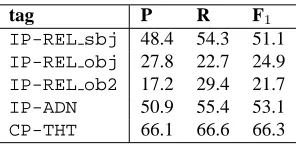
tag P R F1 IP-REL sbj 48.4 54.3 51.1
IP-REL obj 27.8 22.7 24.9
IP-REL ob2 17.2 29.4 21.7
IP-ADN 50.9 55.4 53.1
CP-THT 66.1 66.6 66.3
[image:8.612.347.495.579.652.2]grammatical and semantic labels under the Fullsr
and Fullgrconditions respectively.
The precision and the recall of mandatory argu-ments did not reach a high level. The results are related to predicate argument structure analysis in Japanese. But, they cannot be directly compared, because the parser in this evaluation must output a correct target phrase and select it as an argument, al-though most researches select a word using a gold standard parse tree. Hayashibe et al. ( 2011 ) re-ported the best precision of ARG0 discrimination to be 88.42 % 2, which is the selection results from the candidate nouns using the gold standard parse tree of NTC. If the cases where the correct candi-dates did not appear in the parser results are ex-cluded (10.8 %), the precision is 72.7 %. The main remaining error is to label to non-argument PP with suffix -ARG0(17.0%), thus, we must restrain the overlabeling to improve the precision.
The discrimination of grammatical role is higher than that of semantic role, which is more directly es-timated by case particles following the noun phrases. The confusion matrix for the recall in Table 7 shows main problem is parse error, where correct phrase span does not exist (no span), and marks 10-11%. The second major error is discrimination from bare PPs (PPs without suffixes), mainly because the clues to judge whether the arguments are mandatory or ar-bitrary lack in the treebank. Since even the manda-tory arguments are often omitted in Japanese, it is not facilitate to identify arguments of predicates by using only syntactic information.
Adnominal phrases We need to discriminate be-tween two types of adnominal phrases as described in Section 3.3: IP-REL and IP-ADN. Table 8 shows the discrimination results of the adnominal phrase types. The difference between IP-REL
(gapped relative clauses) andIP-ADNis closely re-lated to the discrimination of the grammatical role: whether the antecedent is the argument of the head predicate of the relative clause.
Table 8 shows the discrimination results of the adnominal phrases. The results indicate the diffi-culties of discriminating the type of gaps of
rela-2The figure is calculated only for the arguments that appear
as the dependents of predicates, excluding the omitted argu-ments.
tive clause IP-REL. The confusion matrix in Ta-ble 9 shows that the discrimination between gaps and non-gaps, i.e.,IP-RELandIP-ADN, is moder-ate as for IP-REL sbjand IP-REL obj. How-ever, IP-REL ob2is hardly recognized, because it is difficult to determine whether the antecedent, which is marked with particle ‘ni’, is a mandatory ar-gument (IP-REL ob2) or not (IP-ADN). Increas-ing trainIncreas-ing samples would improve the discrimina-tion, since there are only 290IP-REL ob2tags for 8,100IP-ADNtags in the training set.
Naturally discrimination only by syntactic infor-mation has limitation; this baseline can be improved by incorporating semantic information.
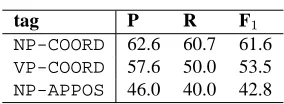
Coordination Figure 10 shows the coordination results, which are considered the baseline for only using syntactic information. Improvement is possi-ble by incorporating semantic information, since the disambiguation of coordination structure essentially needs semantic information.
6
Conclusion
We constructed a Japanese constituent-based parser to be released from the constraints of bunsetsu-based analysis to simplify the integration of syntactic and semantic analysis. Our evaluation results indicate that the basic performance of the parser trained with the treebank almost equals bunsetsus-based parsers and has the potential to supply detailed syntactic information by grammatical function labels for se-mantic analysis, such as predicate-argument struc-ture analysis.
Future work will be to refine the annotation scheme to improve parser performance and to eval-uate parser results by adapting them to such NLP applications as machine translation.
Acknowledgments
system\gold IP-REL sbj IP-REL obj IP-REL sbj *55.0 30.3
IP-REL obj 8.5 *33.3
IP-REL ob2 0.5 0.0
IP-ADN 10.0 9.0
IP-ADV 0.3 0.0
VP 8.5 7.6
other labels 1.2 6.2
no span 16.0 13.6
system\gold IP-REL ob2 IP-ADN
IP-REL sbj 29.4 7.5
IP-REL obj 0.0 0.6
IP-REL ob2 *11.8 0.0
IP-ADN 23.5 *57.3
IP-ADV 0.5 0.3
VP 17.6 9.3
other labels 5.4 3.0
[image:10.612.90.290.142.355.2]no span 11.8 22.0
Table 9: Confusion matrix for adnominal phrases (recall). Figures with ‘*’ indicate recall.(binary tree, Fullgr)
tag P R F1 NP-COORD 62.6 60.7 61.6
VP-COORD 57.6 50.0 53.5
NP-APPOS 46.0 40.0 42.8
Table 10: Results of coordination and apposition (binary tree, Fullgr)
References
Masayuki Asahara. 2013. Comparison of syntactic de-pendency annotation schemata . In Proceedings of the 3rd Japanese Corpus Linguistics Workshop, In Japanese.
Daisuke Bekki. 2010. Formal theory of Japanese syntax. Kuroshio Shuppan, In Japanese.
Daniel M. Bikel. 2004. A distributional analysis of a lexicalized statistical parsing model. In Proceedings of Empirical Methods in Natural Language Processing (EMNLP 2004), Vol.4, pp. 182–189.
Francis Bond, Sanae Fujita and Takaaki Tanaka. 2008. The Hinoki syntactic and semantic treebank of Japanese. In Journal of Language Resources and Evaluation, Vol.42, No. 2, pp. 243–251
Alastair Butler, Zhu Hong, Tomoko Hotta, Ruriko Otomo, Kei Yoshimoto and Zhen Zhou. 2012. Keyaki Treebank: phrase structure with functional informa-tion for Japanese. In Proceedings of Text Annotainforma-tion Workshop.
Eugene Charniak. 2000. A maximum-entropy-inspired parser. In Proceedings of the 1st North American chapter of the Association for Computational Linguis-tics conference, (NAACL 2000), pp. 132–139. DongHyun Choi, Jungyeul Park and Key-Sun Choi.
2012. Korean treebank transformation for parser train-ing. In Proceedings of the 50th Annual Meeting of the Association for Computational Linguistics (ACL 2012), pp. 78-88.
Ann Copestake, Dan Flickinger, Carl Pollard and Ivan A. Sag. 2005. Minimal recursion semantics: an introduc-tion. Research on Language and Computation, Vol. 3, No. 4, pp. 281-332.
Ryan Gabbard, Mitchell Marcus and Seth Kulick. 2006. Fully parsing the Penn Treebank. In Proceedings of the Human Language Technology Conference of the North American Chapter of the Association of Compu-tational Linguistics (HLT-NAACL 2006), pp. 184–191. Takao Gunji. 1987 Japanese phrase structure grammar:
a unification-based approach. D.Reidel.
Yuta Hayashibe, Mamoru Komachi and Yujzi Mat-sumoto. 2011. Japanese predicate argument struc-ture analysis exploiting argument position and type. In Proceedings of the 5th International Joint Conference on Natural Language Processing (IJCNLP 2011), pp. 201-209.
Ryu Iida, Mamoru Komachi Kentaro Inui and Yuji Mat-sumoto. 2007. Annotating a Japanese text corpus with predicate-argument and coreference relations. In Pro-ceedings of Linguistic Annotation Workshop, pp. 132– 139.
[image:10.612.120.262.532.584.2]of the 49th Annual Meeting of the Association for Computational Linguistics: Human Language Tech-nologies (ACL-HLT 2011), pp. 804-813.
Satoru Ikehara, Masahiro Miyazaki, Satoshi Shirai, Akio Yokoo, Kentaro Ogura, Yoshifumi Ooyama and Yoshi-hiko Hayashi. 1998. Nihongo Goitaikei. Iwanami Shoten, In Japanese.
Ronald M. Kaplan and Joan Bresnan. 1982. Lexical-Functional Grammar: a formal system for grammat-ical representation. In the Mental Representation of Grammatical Relations (Joan Bresnan ed.), pp. 173– 281. The MIT Press.
Daisuke Kawahara and Sadao Kurohashi. 2006. A fully-lexicalized probabilistic model for Japanese syn-tactic and case structure analysis. In Proceedings of the Human Language Technology Conference of the North American Chapter of the Association of Compu-tational Linguistics (HLT-NAACL 2006), pp. 176–183. Dan Klein and Christopher D. Manning. 2003. Fast exact inference with a factored model for natural language processing. Advances in Neural Information Process-ing Systems, 15:3–10.
Taku Kudo and Yuji Matsumoto. 2002. Japanese de-pendency analysis using cascaded chunking. In Pro-ceedings of the 6th Conference on Natural Language Learning (CoNLL-2002), Volume 20, pp. 1–7. Sadao Kurohashi and Makoto Nagao. 2003. Building a
Japanese parsed corpus – while improving the parsing system. In Abeille (ed.), Treebanks: Building and us-ing parsed corpora, Chap. 14, pp. 249–260. Kluwer Academic Publishers.
Mitchell P. Marcus, Beatrice Santorini, Mary Ann Marcinkiewicz. 1993. Building a large annotated cor-pus of English: the Penn Treebank. In Journal of Com-putational Linguistics. Vol.19, No.2, pp. 313–330. Hiroshi Masuichi, Tomoko Okuma, Hiroki Yoshimura
and Yasunari Harada. 2003 Japanese parser on the ba-sis of the Lexical-Functional Grammar formalism and its evaluation. In Proceedings of the 17th Pacific Asia Conference on Language, Information and Computa-tion (PACLIC 17), pp. 298-309.
Masaaki Nagata and Tsuyoshi Morimoto,. 1993. A unification-based Japanese parser for speech-to-speech translation. In IEICE Transaction on Informa-tion and Systems. Vol.E76-D, No.1, pp. 51–61. Tomoya Noro, Taiichi Hashimoto, Takenobu Tokunaga
and Hotsumi Tanaka. 2005. Building a large-scale Japanese syntactically annotated corpus for deriving a CFG. in Proceedings of Symposium on Large-Scale Knowledge Resources (LKR2005), pp..159 – 162. Matha Palmer, Daniel Gildea and Paul Kingsbury. 2005.
The Proposition Bank: n annotated corpus of semantic roles. Computational Linguistics, Vol.31 No. 1, pp. 71–106.
Slav Petrov, Leon Barrett, Romain Thibaux and Dan Klein.. 2006. Learning accurate, compact, and in-terpretable tree annotation. In Proceedings of the 21st International Conference on Computational Linguis-tics and the 44th Annual Meeting of the Association for Computational Linguistics (COLING-ACL 2006), pp. 433-440.
Ivan A. Sag, Thomas Wasow and Emily M. Bender,. 2003. Syntactic theory: a formal introduction. 2nd Edition, CSLI Publications.
Beatrice Santorini. 2010. Annotation manual for the Penn Historical Corpora and the PCEEC (Release 2). Department of Linguistics, University of Pennsylva-nia.
Melanie Siegel and Emily M. Bender. 2002. Efficient deep processing of Japanese. In Proceedings of the 3rd Workshop on Asian Language Resources and In-ternational Standardization at the 19th InIn-ternational Conference on Computational Linguistics, Vol. 12, pp. 1–8.