Linguistic Linked Data for Sentiment Analysis
Paul Buitelaar, Mihael Arcan
Carlos A. Iglesias,
J. Fernando Sánchez-Rada Carlo Strapparava DERI, Unit for NLP, Dept. Ing. Sist. Telemáticos, Human Language Technology National University of Ireland, Galway Univ. Politécnica de Madrid,
Spain FBK, Italy
{
p aul.buitelaar, mihael.arcan} @deri.org {c if, jfernando} @gsi.dit.upm.es [email protected]
1
Introduction
In this paper we describe the specification of a model for the semantically interoperable represen-tation of language resources for sentiment analysis. The model integrates ‘lemon’, an RDF-based model for the specification of ontology-lexica (Buitelaar et al. 2009), which is used increasingly for the representation of language resources as Linked Data, with 'Marl', an RDF-based model for the representation of sentiment annotations (West-erski et al., 2011; Sánchez-Rada et al., 2013).
In the EuroSentiment project, the lemon/Marl model will be used to represent lexical resources for sentiment and emotion analysis such as Senti-WordNet (Baccianella et al. 2010) and Senti-WordNet Affect1 (Strapparava and Valitutti 2004), as well as other language resources such as sentiment anno-tated corpora, in a semantically interoperable way, using Linked data principles.
The representation of WordNet resources in lemon depends on a straightforward conversion of the WordNet data model, but importantly we intro-duce the use of URIs to uniquely and formally de-fine structure and content of this WordNet based language resource. URIs are adopted from existing Linked Data resources, thereby further enhancing semantic interoperability. We further integrate a notion of domains into this representation in order to enable domain-specific definition of polarity for each lexical item.
The lemon model allows for the representation of all aspects of lexical information, including lexi-cal sense (word meaning) and polarity, but also morphosyntactic features such as part-of-speech, inflection, etc. This kind of information is not pro-vided by WordNet Affect but will be available from other language resources, including those available at EuroSentiment partners that can be
1http://wndomains.fbk.eu/wnaffect.html
easily integrated with the WordNet Affect informa-tion using lemon.
The representation of sentiment polarity uses concepts from Marl.
2
Motivation
Sentiment analysis is now an established field of research and a growing industry (Po et al. 2008). However, language resources for sentiment analy-sis are being developed by individual companies or research organisations and are normally not shared, with the exception of a few publicly available re-sources such as WordNet Affect and SentiWord-Net. Domain-specific resources for multiple lan-guages are potentially valuable but not shared, sometimes due to IP and licence considerations, but often because of technical reasons, including interoperability.
In the EuroSentiment project we envision in-stead a pool of semantically interoperable language resources for sentiment analysis, including do-main-specific lexicons and annotated corpora. Sen-timent analysis applications will be able to: access domain-specific polarity scores for individual lexi-cal items in the context of semantilexi-cally defined sentiment lexicons and corpora, or access and inte-grate complete language resources. Access may be restricted according to commercial considerations, with payment schedules in place, or may be par-tially free. A semantic service access layer will be put in place for this purpose.
3
The lemon Model
The lexicon model for ontologies (lemon) builds on previous work on standards for the representa-tion of lexical resources, i.e., the Lexical Markup Framework (LMF2
) but extends the underlying for-mal model and provides a native integration of lex-ica with domain ontologies. The lemon model is
described in detail in the lemon cookbook (McCrae et al. 2010). Here we provide a summary of its most prominent features, starting with the lemon core, which is organized around a core path as fol-lows:
• Ontology Entity: URI of an ontology element to which a Lexical Form points, providing a possible linguistic realisation for that Ontology Entity • Lexical Sense: functional object that links a Lexical Entry to an Ontology Entity, providing a sense-disambiguated interpretation of that Lexical Entry
• Lexical Entry: morpho-syntactic normalisation of one or more Lexical Form
• Lexical Form: morpho-syntactic variant of a Lexical Entry, including inflection, declination and syntactic variation
• Representation: standard written or phonetic representation for a Lexical Form
In addition, lemon has a number of modules that allow for further modelling. Currently defined modules are: linguistic description, phrase struc-ture, morphology, syntax and mapping, variation. The linguistic description module is concerned with the use of ISOcat data categories for describ-ing lemon elements. Although lemon itself is a meta-model and therefore agnostic as regards the specific data category set used, we use a specific set of data categories in particular instances of the lemon model, such as LexInfo (Cimiano et al. 2011).
The phrase structure module is concerned with the modelling of lexical entries that are syntacti-cally complex, such as phrases and clauses. The module provides tokenisation and phrase structure analysis to enable representation of the syntactic structure of such lexical entries.
The morphology module is concerned with the analysis and representation of inflectional and ag-glutinative morphology. The module allows the specification of regular inflections of words by use of Perl-like regular expressions, which greatly sim-plifies the creation of lexical entries for highly syn-thetic and inflectional languages.
The syntax and mapping module is concerned with a description of lexical ’predicates’ (subcate-gorisation frames with syntactic arguments) and semantic predicates (properties with subject/object) on the ontology side and the mapping between them. The module allows a mapping to be speci-fied as a one-to-one correspondence.
The variation module is concerned with a de-scription of the relationships between the elements of a lemon lexicon, which are split into three classes: sense relations, lexical variations, form variations. Sense relations require a semantic con-text, such as translation. Lexical variations require a morphosyntactic context, such as plural. Form variations are all other variations, such as homo-graphs.
An interesting aspect of lemon-based ontology lexicalisation is the use of URIs for uniquely iden-tifying all objects defined by the lemon model (lex-icons, lexical entries, words, phrases, forms, vari-ants, senses, references, etc.), which can be linked and maintained in a flexible, modular and distrib-uted way. The lemon model can therefore contrib-ute significantly to the development of Lexical Linked Data (McCrae et al. 2011, Nuzzolese et al. 2011, McCrae et al. 2012), which in turn will greatly enhance distributed development, ex-change, maintenance and use of lexical resources as well as of ontologies as they will be increasingly tightly integrated with lexical knowledge.
In the context of the EuroSentiment project we will exploit the lemon model exactly for this pur-pose: representing language resources for senti-ment analysis in a Linked Data conform way (RDF-native form), enabling leverage of existing Semantic Web technologies (SPARQL, OWL, RIF etc.).
4
The Marl Sentiment Ontology
Marl is an ontology for annotating sentiment ex-pressions, which will be used by the EuroSenti-ment service layer to describe the output of senti-ment analysis services as well as by the resource layer to describe the sentiment properties of lexical entries. For this latter purpose in particular, the Marl ontology is used in combination with lemon as illustrated above.
The Marl ontology is a vocabulary designed for annotation and description of subjective opinions expressed in text. The goals of the Marl ontology are to:
• enable publishing raw data about opinions and the sentiments expressed in them
• interconnect opinions by linking them to con-textual information expressed from other popular ontologies or specialised domain ontologies.
The Marl ontology has been extended according to the needs of the EuroSentiment project. In par-ticular, the main extension has been its alignment with the PROV-O Ontology (Lebo, 2013) in order to support provenance modelling. The PROV-O ontology is part of the PROV Family (Groth, 2012; Gil, 2012) that provides support for modelling and interchange of provenance on the Web and Infor-mation Systems.
Provenance is information about entities, activi-ties and people involved in producing a piece of data or thing, which can be used to form assess-ment about its quality, reliability and trustworthi-ness. The main concepts of PROV are entities, ac-tivities and agents. Entities are physical or digital assets, such as web pages, spell checkers or, in our case, dictionaries or analysis services. Provenance records describe the provenance of entities, and an entity's provenance can refer to other entities. For example, a dictionary is an entity whose prove-nance refers to other entities such as lexical entries. Activities are how entities come into existence. For example, starting from a web page, a sentiment analysis activity creates an opinion entity describ-ing the extracted opinions from that web page. Fi-nally, agents are responsible for the activities and can be a person, a piece of software, an organisa-tion or other entities. The Marl ontology has been aligned with the PROV ontology so that prove-nance of language resources can be tracked and shared.
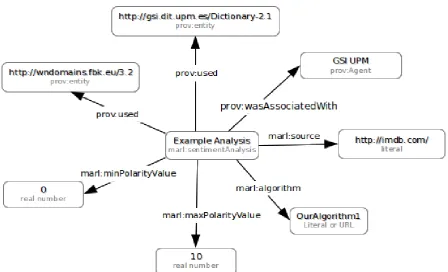
Sentiment Analysis is an Activity that analyses a Source text according to an algorithm and pro-duces an opinion about the entities described in the source text. The main features of the extracted opinion are the polarity (positive, neutral or nega-tive), the polarity value or strength whose range is defined between a min and max value, and the de-scribed entity and feature of that opinion. Opinions can also be aggregated opinions of a set of users.
For a better understanding of the ontology itself, we present below the main classes and properties that form the ontology:
• Opinion: a subclass of the Provenance Entity that represents the results of a Sentiment Analysis process. Among its classes we find:
• describesObject: property that points to the ob-ject the opinion refers to.
• describesObjectPart: optional property, used whenever the opinion specifies the part of the ob-ject it refers to, not only the general obob-ject.
• describesObjectFeature: aspect of the object or part that the user is giving an opinion of.
• hasPolarity: polarity of the opinion itself, to be chosen from the available Opinion individuals. • polarityValue: degree of the polarity. In other words, it represents how strong the opinion (inde-pendently of the polarity) is.
• algorithmConfidence: rating the analysis algo-rithm has given to this particular result. Can be in-terpreted as the accuracy or trustworthiness of the information
• extractedFrom: original source text or resource from which the opinion was extracted.
• opinionText: part of the source that was used in the sentiment analysis. That is, the part of the source that contained sentiment information. • domain: context domain of the result. The same source can be analysed in different domains, which would lead to different results.
• AggregatedOpinion: when several opinions are equivalent, we can opt to aggregate them into an “AggregatedOpinion”, which in addition to the properties we already covered, it presents these properties:
• opinionCount: the number of individual opin-ions this AggregatedOpinion represents.
• Polarity: base class to represent the polarity of the opinion. In every opinion, we will use an in-stance of this class. The base Marl ontology comes with three instances: Positive, Negative, Neutral • SentimentAnalysis: in Marl, the process of sen-timent analysis is also represented semantically, which allows us to understand the opinion data, trace it and keep several results by different algo-rithms, linking all of them to the process that cre-ated them. The main properties of each Sentiment-Analysis class are: minPolarityValue: lower limit for polarity values in the opinions extracted via this analysis activity; maxPolarityValue: upper limit for polarity values in the opinions extracted via this analysis activity.
• Algorithm: algorithm that was used in the anal-ysis. Useful to group opinions by extraction algo-rithm and compare them.
opin-ions from IMDB) and treating and interpreting opinions from the same source in the same manner. An example application of the Marl ontology for a sentiment analysis service is shown in the Ap-pendix. It is split in two: a view of the representa-tion of the analysis (Fig 1), and a representarepresenta-tion of the result (Fig 2).
5
Representation of WordNet Affect
In this section we describe how language re-sources based on the Princeton WordNet model (Miller 1995) such as WordNet Affect can be rep-resented using lemon.
WordNet Affect is an extension of the WordNet database, including a subset of synsets suitable to represent affective concepts. Similarly to the ex-tension related to domain labels, one or more af-fective labels (a-labels) are assigned to a number of WordNet synsets. In particular, the affective con-cepts representing emotional state are individuated by synsets marked with the a-label ‘emotion’. The emotional categories are hierarchically organized in order to specialize synsets with a-label emotion and to distinguish synsets according to emotional valence. There are also other a-labels for concepts representing moods, situations eliciting emotions, or emotional responses3
.
Unique and independently established URIs for WordNet synsets allow for a distributed represen-tation that enable Semantic Web based linking be-tween and integration of WordNet based as well as other language resources. We illustrate this here with an example from WordNet Affect, using Eng-lish based WordNet 3.0 URIs as defined by the Eu-ropeana project.
Consider the following example for the English noun ‘fear’ in WordNet and equivalent Italian syn-onyms taken from the Italian WordNet (i.e. this holds for any English aligned Wordnet) in Word-Net Affect:
Princeton WordNet:
n#05590260 12 n 03 fear 0 fearfulness 0 fright 0 017 @ 05560878 n 0000 ! 05595229 n 0101 = 00080744 a 0000 = 00084648 a 0000 ~ 05590744 n 0000 ~ 05590900 n 0000 ~ 05591021 n 0000 ~ 05591212 n 0000 ~ 05591290 n 0000 ~ 05591377 n 0000 ~ 05591481 n 0000 ~ 05591591 n 0000 ~
3
A SKOS version of WordNet Affect is available from
http://gsi.dit.upm.es/ontologies/wnaffect/
05591681 n 0000 ~ 05591792 n 0000 ~ 05592739 n 0000 ~ 05593389 n 0000 %p 10337259 n 0000 | an emotion experienced in anticipation of some specific pain or danger (usually accompanied by a desire to flee or fight)
WordNet Affect:
n#05590260 fifa paura spavento terrore timore | "una emozione che si prova prima di qualche specifico dolore o pericolo"
n#05590260 affective-label="negative-fear" n#05590260 domain-label="Psychological_Fea-tures"
lemon transformation & integration:
Using lemon we can represent and integrate in-formation on the Italian synonyms, their links to the English based synset using Princeton WordNet URIs, and sentiment properties using Marl. main properties will be based on WordNet Do-mains4
. The example illustrates the positive polar-ity of ‘fear’ in English (and ‘fifa, paura, spavento, terrore’ in Italian) in the context of ‘horror movies’ and negative polarity in the context of ‘children movies’.
Declaration of namespaces used – wn declares WordNet 3.0 synsets, lemon declares the core lemon lexicon model, lexinfo declares specific properties for part-of-speech etc., wd declares do-main categories, marl declares sentiment proper-ties:
@prefix wn:
<http://semanticweb.cs.vu.nl/europeana/lod/purl/vo-cabularies/princeton/wn30/> .
@prefix lemon: <http://www.monnet-project.eu/lemon#> .
@prefix lexinfo:
<http://www.lexinfo.net/ontology/2.0/lexinfo#> . @prefix wd: <http://www.eurosentiment.eu/wndo-mains/> .
@prefix marl: <http://purl.org/marl/ns#> .
Declaration of lexicon identifier, language and lex-ical entries:
:lexicon a lemon:Lexicon ; lemon:language "it" ; lemon:entry :fifa,
:paura, :spavento, :terrore.
Declaration of lemma, sense (link to synset in WordNet 3.0, polarity and domain context) and part-of-speech of ‘fifa’:
:fifa a lemon:Lexicalentry ;
lemon:canonicalForm [ lemon:writtenRep "fifa"@it ] ;
lemon:sense [ lemon:reference wn:synset-fear-noun-1; marl:polarityValue 0.375 ;
marl:hasPolarity marl:positive ; lemon:context wd:horror_movies ] ;
lemon:sense [ lemon:reference wn:synset-fear-noun-1; marl:polarityValue 0.375 ;
marl:hasPolarity marl:negative ; lemon:context wd:children_movies ]; lexinfo:partOfSpeech lexinfo:noun .
Declarations of lemma and part-of-speech of ‘paura, spavento, terrore, timore’:
:paura a lemon:Lexicalentry ;
lemon:canonicalForm [ lemon:writtenRep "paura"@it ] ;
lexinfo:partOfSpeech lexinfo:noun .
:spavento a lemon:Lexicalentry ;
lemon:canonicalForm [ lemon:writtenRep "spavento"@it ] ;
lexinfo:partOfSpeech lexinfo:noun .
:terrore a lemon:Lexicalentry ;
lemon:canonicalForm [ lemon:writtenRep "terrore"@it ] ;
lexinfo:partOfSpeech lexinfo:noun .
:timore a lemon:Lexicalentry ;
lemon:canonicalForm [ lemon:writtenRep "timore"@it ] ;
lexinfo:partOfSpeech lexinfo:noun .
Declarations of sense equivalence (synonymy) of ‘paura, spavento, terrore, timore’ with ‘fifa’:
:paura a lemon:LexicalSense ; lemon:equivalent :fifa.
:spavento a lemon:LexicalSense ; lemon:equivalent :fifa.
:terrore a lemon:LexicalSense ; lemon:equivalent :fifa.
:timore a lemon:LexicalSense ; lemon:equivalent :fifa..
6
Representation of Lexical and
Senti-ment Features
The examples discussed in the previous section showed the representation of WordNet based lan-guage resources with lemon. However also many other types of language resources exist, including sentiment dictionaries maintained by the EuroSen-timent use case partners that define domain words with their polarity scores as well as inflectional variants, part-of-speech, etc. We can also represent such language resources using lemon combined with Marl, thereby making them interoperable with the lemon version of WordNet Affect as well as other lemon based language resources.
Consider the following example for the German noun ‘Einschlag’ (‘impact’) with lexical features (inflection, part-of-speech) and polarity score:
Einschlag Einschlag NN negative -/-0.0048/- L Einschlages Einschlag NN negative -/-0.0048/- L Einschlags Einschlag NN negative -/-0.0048/- L Einschläge Einschlag NN negative -/-0.0048/- L Einschlägen Einschlag NN negative -/-0.0048/- L
Using lemon and Marl we can represent this and integrate it with additional information as follows:
Declaration of namespaces used – wn declares WordNet 3.0 synsets, lemon declares the core lemon lexicon model, isocat declares specific properties for part-of-speech etc. (isocat is part of the lexinfo model used in the previous example), marl declares sentiment properties:
@prefix wn:
<http://semanticweb.cs.vu.nl/europeana/lod/purl/vo-cabularies/princeton/wn30/> .
@prefix lemon: <http://www.monnet-project.eu/lemon#> .
@prefix isocat: <https://catalog.clarin.eu/isocat/inter-face/index.html> .
@prefix marl:
<http://gsi.dit.upm.es/ontologies/marl/ns#> .
Declaration of lexicon identifier, language and lex-ical entry:
:lexicon a lemon:Lexicon ; lemon:language "de" ; lemon:entry :Einschlag.
Declaration of lemma, sense (link to synset in WordNet 3.0, polarity), alternate forms (inflec-tional variants with features), part-of-speech and sentiment polarity:
lemon:canonicalForm [
lemon:writtenRep "Einschlag"@de ; isocat:DC-1297 isocat:DC-1883 ; # gender=masculine
isocat:DC-1298 isocat:DC-1387 ; # number=singular
isocat:DC-2720 isocat:DC-1331 ] ; # case=nominative
lemon:sense [ lemon:reference wn:synset-impact-noun-1; marl:polarityValue 0.0048; marl:hasPolarity marl:negative ] ; lemon:altForm
[ lemon:writtenRep "Einschlages"@de ; isocat:DC-1297 isocat:DC-1883 ; # gender=masculine
isocat:DC-1298 isocat:DC-1387 ; # number=singular
isocat:DC-2720 isocat:DC-1293 ] ; # case=genitive
[ lemon:writtenRep "Einschlags"@de ; isocat:DC-1297 isocat:DC-1883 ; # gender=masculine
isocat:DC-1298 isocat:DC-1387 ; # number=singular
isocat:DC-2720 isocat:DC-1293 ] ; # case=genitive
[ lemon:writtenRep "Einschläge"@de ; isocat:DC-1297 isocat:DC-1883 ; # gender=masculine
isocat:DC-1298 isocat:DC-1354 ; # number=plural
isocat:DC-2720 isocat:DC-1331 ] ; # case=nominative
[ lemon:writtenRep "Einschlägen"@de ; isocat:DC-1297 isocat:DC-1883 ; # gender=masculine
isocat:DC-1298 isocat:DC-1354 ; # number=plural
isocat:DC-2720 isocat:DC-1265 ] ; # case=dative
isocat:DC-1345 isocat:DC-1333. # partOfSpeech=noun.
7
Ongoing and Future Work
Sentiment Analysis aims at determining the atti-tude of the writer to some topic (positive, negative, neutral). Emotion analysis goes one step further and aims at determining the emotional or affective state of the writer when writing. In EuroSentiment, we have defined two vocabularies for annotating sentiment and emotion expressions, called Marl and Onyx, respectively. In this paper we focused on the representation of sentiment annotations with
Marl. The definition and representation of emotion expressions with Onyx is ongoing work, with the objective of covering different theoretical models of emotions (Sánchez-Rada et al., 2013). Onyx will support the representation and use of several emo-tion taxonomies such as WordNet Affect or Emo-tionML
Our ongoing and future work is concerned also with the definition and implementation of a work flow that will enable the generation of domain-spe-cific semantically interoperable lexica for senti-ment analysis. The work flow will use lemon and Marl for the representation and integration of:
• WordNet Domains information on domain(s) • domain entity information from DBpedia and/or
other relevant semantic resources
• WordNet Affect information on synsets (using Onyx)
• morphosyntactic information (part-of-speech, inflection, …) from other language resources in the EuroSentiment Language Resource Pool • SentiWordNet scores and/or automatically
ex-tracted domain sentiment scores
Given a particular sentiment analysis task do-main, the approach is based on the analysis of a representative text collection for the purpose of en-tity identification, synset disambiguation, mor-phosyntactic analysis, and domain-specific polarity value extraction.
8
Conclusions
We presented a model for the specification, inte-gration and use of language resources for senti-ment analysis based on Linked Data principles.
The presented model is based directly on the lemon and Marl ontologies for the representation of Linked Data based lexical resources and senti-ment expressions respectively. This work is now being extended so that emotion analysis is also ad-dressed.
Acknowledgments
This work was partially funded by the EC for the FP7 project EuroSentiment under Grant Agree-ment 296277 and in part by a research grant from Science Foundation Ireland (SFI) under Grant Number SFI/12/RC/2289 for the INSIGHT project.
References
Baccianella, Stefano, Andrea Esuli and Fabrizio Sebas-tiani, “SENTIWORDNET 3.0: An Enhanced Lexical Re-source for Sentiment Analysis and Opinion Min-ing”, Proc. of LREC, 2010.
Buitelaar, Paul, Philipp Cimiano, Peter Haase, and Michael Sintek. "Towards linguistically grounded ontologies." In The Semantic Web: Research and Ap-plications, pp. 111-125. Springer Berlin Heidelberg, 2009.
Cimiano, Philipp, Paul Buitelaar, John McCrae, and Michael Sintek. "LexInfo: A declarative model for the lexicon-ontology interface." Web Semantics: Sci-ence, Services and Agents on the World Wide Web 9, no. 1 (2011): 29-51.
Ekman, Paul. "Basic emotions." Handbook of cognition and emotion 98 (1999): 45-60.
Gil, Yolanda and Simon Miles, “PROV Model Primer”, W3C Working Draft, 11th December 2012, available at http://www.w3.org/TR/2012/WD-prov-primer-20121211/.
Groth, Paul and Luc Moreau, “PROV Overview”, W3C Working Draft, 11th December 2012, available at http://www.w3.org/TR/2012/WD-prov-overview-20121211/.
Lebo, Timothy, Satya Sahoo and Deborah McGuinness, “PROV-O: The PROV Ontology”, W3C Recommen-dation, 30th April 2013, available at http://www.w3.org/TR/prov-o/, 2013.
McCrae, John, Guadalupe Aguado-de-Cea, Paul Buite-laar, Philipp Cimiano, Thierry Declerck, Asunción Gómez-Pérez, Jorge Gracia et al. "Interchanging lexi-cal resources on the semantic web." Language Re-sources and Evaluation 46, no. 4 (2012): 701-719. McCrae, John, Dennis Spohr, and Philipp Cimiano.
"Linking lexical resources and ontologies on the se-mantic web with lemon." In The Sese-mantic Web: Re-search and Applications, pp. 245-259. Springer Berlin Heidelberg, 2011.
McCrae, John, Guadalupe Aguado-de-Cea, Paul Buite-laar, Philipp Cimiano, Thierry Declerck, Asunción
Gómez Pérez, Jorge Gracia et al. "The lemon cook-book." (2010).
Miller, George A. "WordNet: a lexical database for English." Communications of the ACM 38.11 (1995): 39-41.
Nuzzolese A, Gangemi A, Presutti V (2011) Gathering lexical linked data and knowledge patterns from framenet. In: Proceedings of the sixth international conference on Knowledge capture, ACM, pp 41–48. Pang, Bo and Lee, Lillian, “Opinion mining and
senti-ment analysis” Foundations and trends in information retrieval, 2008.
Prinz, Jesse. Gut Reactions: A Perceptual Theory of Emotion (Oxford: Oxford University Press, 2004): page 157
Sánchez-Rada, J. Fernando, Onyx Ontology Specifica-tion, V1.2 July 2013, available at http://www.gsi.dit.upm.es/ontologies/onyx/
Strapparava, Carlo, and Alessandro Valitutti. "Word-Net-Affect: an affective extension of WordNet." In Proceedings of LREC, vol. 4, pp. 1083-1086. 2004. Westerski, Adam, Carlos A. Iglesias and Fernando
Tapia, “Linked Opinions: Describing Sentiments on the Structured Web of Data.” In Proceedings of the 4th International Workshop Social Data on the Web, 2011.
Figure 1: Example of a Sentiment Analysis activity representation
[image:8.595.84.533.407.679.2]