Proceedings of the 3rd Workshop on EVENTS at the NAACL-HLT 2015, pages 1–10,
Translating Granularity of Event Slots into Features
for Event Coreference Resolution.
Agata Cybulska
VU University Amsterdam De Boelelaan 1105 Amsterdam, 1081HV [email protected]
Piek Vossen
VU University Amsterdam De Boelelaan 1105 Amsterdam, 1081HV [email protected]
Abstract
Using clues from event semantics to solve coreference, we present an “event template” approach to cross-document event coreference resolution on news articles. The approach uses a pairwise model, in which event infor-mation is compared along five semantically motivated slots of an event template. The templates, filled in on the sentence level for every event mention from the data set, are used for supervised classification. In this study, we determine granularity of events and we use the grain size as a clue for solv-ing event coreference. We experiment with a newly-created granularity ontology employ-ing granularity levels of locations, times and human participants as well as event durations as features in event coreference resolution. The granularity ontology is available for re-search. Results show that determining granu-larity along semantic event slots, even on the sentence level exclusively, improves precision and solves event coreference with scores com-parable to those achieved in related work.
1 Introduction
Event coreference resolution is the task of determin-ing whether two event mentions refer to the same event instance. This paper explores cross-document resolution of coreference between events in a news corpus. We use granularity as an indication of event coreference. Our approach renders the semantic structure of event descriptions into arrangement of features for machine learning.
We use the granularity of events as a clue for event coreference resolution. The intuition behind this ap-proach is, that an event with a longer duration, that
happens on a bigger area and with multiple partic-ipants involved (for instancea war between Russia and Ukraine) might be related to but will probably not fully corefer with a “lower level” event of shorter duration and with single participants involved (e.g.
A Russian soldier has shot dead a Ukrainian naval officer).
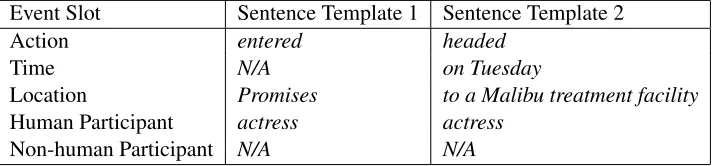
Event Slot Sentence Template 1 Sentence Template 2
Action entered headed
Time N/A on Tuesday
Location Promises to a Malibu treatment facility
Human Participant actress actress
[image:2.612.129.488.72.155.2]Non-human Participant N/A N/A
Table 1: Sentence templates ECB topic1, text 7, sentences 1 and 2.
The “American Pie” actress has entered Promises for undisclosed reasons. The actress, 33, reportedly headed to a Malibu treatment facility on Tuesday.
Figure 1: Topic 1, text 7, ECB (Bejan and Harabagiu, 2010).
event information over the five event slots (as anno-tated in the ECB+) in the two example sentences. In the event template approach different kinds of event information are contrasted per slot of the template (Table 3).
We determine the grain-size within slots of the event template. The idea is to represent the grain size of the event action as well as of the entities in-volved with it by means of granularity features. To capture granularity we employ durations of event ac-tions (Gusev et al., 2011) and granularity levels of event participants, time and locations. To determine granularity levels, a new granularity ontology con-sisting of 15 semantic classes is used. The 15 pre-defined semantic classes represent different granu-larity levels, which are defined over 434 hypernyms in WordNet, covering 11979 WordNet synsets. We make the granularity ontology available for research. This work sheds light on the task of cross-document resolution of coreference between men-tions of events in text. This study explores the ac-tual task of resolution of coreference between two event descriptions, without letting topic classifiers first solve most of event ambiguity (following the insights of Cybulska and Vossen (2014b)). The two main contributions of this study are: (1) a new gran-ularity ontology of event participants, times and lo-cations and (2) a new “sentence template” approach to event coreference resolution that solves event coreference along five slots of an event template. To
the best of our knowledge granularity of locations, times and human participants of events as well as durations of event actions has not been used before to solve event coreference.
We will first take a closer look at the notion of granularity and the new granularity ontology in sec-tion 2. We delineate our approach in secsec-tion 3. Section 4 reports on the experiments with the new method the results of which are compared with re-lated work in section 5. We conclude in section 6.
2 Granularity
The notion of granularity was described by (Keet, 2008) as the ability to represent and operate on different levels of detail in data, information, and knowledge.Granularity deals with organizing data, information, and knowledge in greater or lesser de-tail that resides in a granular level or level of gran-ularity and which is granulated according to certain criteria, which thereby give a[granular]perspective (...) on the subject domain. (Keet, 2008). A lower granularity level captures a more detailed data rep-resentation than a more abstract higher level, which leaves out some details.
People view the world at different granularities. Humans are able to switch among different granu-larities of world conceptualizations (Hobbs, 1985). In a reasoning process a granularity level is distin-guished, depending on what is relevant for a partic-ular situation. Hobbs presented a framework for a theory of granularity.
nominaliza-eng-30-08160276-n,gran group,”citizenry 1,people 2”
eng-30-10638385-n,gran person,”spokesperson 1,interpreter 3,representative 2,voice 8” eng-30-15235126-n,gran second,”second 1,sec 1”
eng-30-15234942-n,gran min,”quarter 4” eng-30-15117516-n,gran hr,”hours 2”
eng-30-15163005-n,gran day,”day of the week 1”
eng-30-15136147-n,gran week,”week 3,calendar week 1” eng-30-15209706-n,gran month,”Gregorian calendar month 1” eng-30-15239579-n,gran season,”season 1”
eng-30-15203791-n,gran year,”year 1”
eng-30-15231415-n,gran thousands years,”Bronze Age 1” eng-30-03449564-n,gran street,”government building 1” eng-30-08537837-n,gran city,”city district 1”
eng-30-08898002-n,gran country,”Upper Egypt 1” eng-30-08699426-n,gran continent,”East Africa 1”
Figure 2: Example entries from the granularity ontology file.
tions. Change in granularity was considered as a special case of abstraction in which elements, which are indistinguishable in a particular context, are col-lapsed. Mani focused on grain-size shifts amongst polysemous events.
Mulkar-Mehta et al. (2011b) describe event gran-ularity as the concept of breaking down a higher-level event into smaller parts, fine-grained events such that each smaller granule plays a part in the higher level whole. Relation types that can exist between the objects at coarse and fine granularity are part-whole relationships amongst entities and events, and causal relationships. Based on annota-tion of granularity relaannota-tions in text, the authors con-clude that part-whole and causal relations are a good indication of shifts in granularity.
In this study we focus on the notion of granularity in event descriptions. We present a new granular-ity ontology, which is an attempt at capturing grain-size of events explicitly for the purpose of usage in NLP applications. We use a taxonomy based ontol-ogy to distinguish between coarse- and fine-grained granularities of different parts of event descriptions. We apply shifts in granularity to resolution of event coreference. The motivation behind this approach is an expected correlation between agreement or disagreement in grain-size levels and the notion of coreference. Agreement or small granularity differ-ences are expected to indicate coreference. Bigger
distance in granularity is expected to be a negative indicator of coreference or to indicate other event relations as scriptal or event membership. In the ex-periments described in this paper, we let a machine learning algorithm learn the relationships between different granularities and the notion of coreference. To capture differences in grain-size of events we em-ploy both: (1) conceptual granularity clues being a manifestation of granularity in the form of inherent properties of word meanings, as well as (2) lexical grain-size indication expressed in number and mul-tiplication. The intrinsic, conceptual granularity is captured by means of a number of granularity levels defined in the granularity ontology. Furthermore, we use durations of events as indication of grain size for event actions.
2.1 Granularity Ontology
relations by Winston et al. (1987). Granularity levels of the human participant slot are contained within Winston’s et al. Member-Collection rela-tions. Our temporal granularity levels make part of Winston’s Portion-Mass relationships and our loca-tional levels are in line with Place-Area relations in Winston’s taxonomy.
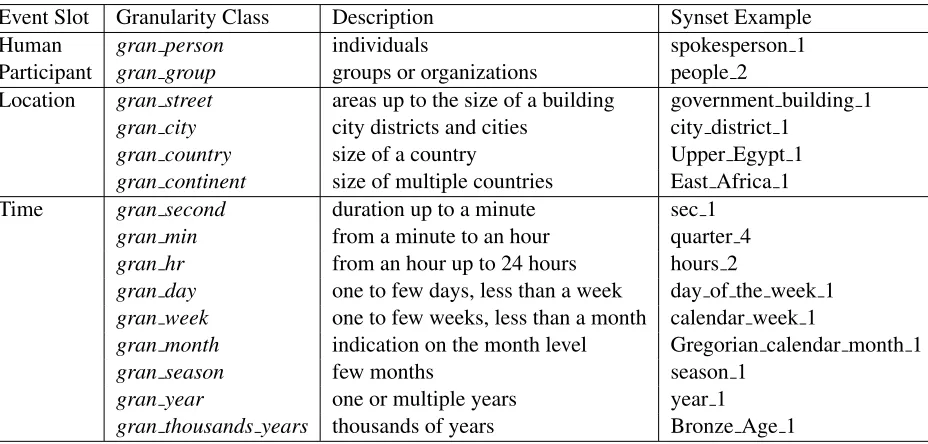
Figure 2 presents a fragment of the granularity ontology with synset examples for every ontology class. The file is comma separated. In the first col-umn synsets from WordNet 3.0 are indicated. In the second column the granularity levels are captured and the third one indicates the synset IDs as stored in the Natural Language Toolkit (NLTK, (Bird et al., 2009)). The choice of the 15 granularity classes was motivated by an analysis of event descriptions in the news. We intended to capture shifts in granularity that seemed meaningful for event coreference reso-lution on a news corpus such as the ECB or ECB+. We manually assigned the semantic classes to 434 hypernyms in WordNet which are linked to 11979 synsets. We recognize a number of granularity levels per event slot: nine grain levels for time expressions, four for locations and two for human participants, as presented in Table 2.
2.2 Lexical Granularity Clues
On top of granularity levels, we also account for lex-ical granularity clues within a level such as num-ber indication and multiplications. At this point we only make a distinction betweensingleandmultiple
“items” within a concept type (based on POS clues and occurrence of multiplications). Three kinds of parts of speech are used to determine number of a mention: (1) nominal tags: NN, NNS, NNP, NNPS, (2) personal pronouns tagged by the NLTK’s default POS tagger as PRP and (3) numbers with tag CD. For instance the phrase twenty soldiersis POS-tagged as follows: [(‘20’, ‘CD’), (‘soldiers’, ‘NNS’)]. The nominal POS tag NNS is considered to indicate plural nouns. Additionally, if there is a number indication in a mention (POS-tag CD and lemma other thanone), the phrase would be assigned plural number by default. If there are multiple nouns in a mention, we assign the number of the major-ity of nouns. If there is a tie, the number of the last noun in a mention would be decisive. For ex-ample[(‘20’, ‘CD’), (‘soldiers’, ‘NNS’)] would be
assigned the granularity levelgran personand num-berplural. Whileone soldierwould trigger the fol-lowing analysis: [(‘one’, ‘CD’), (‘soldier’, ‘NN’)], also assigned the granularity levelgran personbut numbersingular. Since there are often multiple in-stances of an event slot in the sentence, there can be multiple granularity levels to consider. We calculate cosine similarity of granularity and number indica-tions per event slot (if instantiated in the sentence) for two compared events. In the future, we will ex-periment with expressing the grain-size by means of numeric estimates of number of participants, dura-tion and size of an area on which an event happened, e.g. indicating that the Boston area is ca. 125 km2 and the country of France of ca. 551500 km2.
2.3 Event Durations
To capture granularity of event actions (in Winston et al. (1987) Feature-Activity relation) we employ duration distributions from the database of event du-rations by Gusev et al. (2011). The lexicon of event durations (http://cs.stanford.edu/ people/agusev/durations/) captures dura-tions for events (with or without syntactic objects) inferred by means of web query patterns. Duration distributions were learned with an unsupervised ap-proach. Eight duration levels are considered: sec-onds, minutes, hours, days, weeks, months, years
and decades. The durations database covers the 1000 most frequent verbs with 10 most frequent grammatical objects of each verb from a newspaper corpus from the New York Times. For our granu-larity experiments we used duration distributions as determined for these 10000 events. A binary feature indicates whether there is overlap in most frequent duration levels of two events. Currently, since our approach does not consider syntactic dependencies, the duration feature is specified when disregarding the syntactic objects.
3 The Approach
We experimented with a decision-tree (hereafter also
Event Slot Granularity Class Description Synset Example
Human gran person individuals spokesperson 1
Participant gran group groups or organizations people 2
Location gran street areas up to the size of a building government building 1
gran city city districts and cities city district 1
gran country size of a country Upper Egypt 1
gran continent size of multiple countries East Africa 1 Time gran second duration up to a minute sec 1
gran min from a minute to an hour quarter 4
gran hr from an hour up to 24 hours hours 2
gran day one to few days, less than a week day of the week 1
gran week one to few weeks, less than a month calendar week 1
gran month indication on the month level Gregorian calendar month 1
gran season few months season 1
gran year one or multiple years year 1
[image:5.612.79.543.92.314.2]gran thousands years thousands of years Bronze Age 1
Table 2: Granularity ontology classes.
Template Slot Feature Explanation
Action Active mention Lemma overlap (L) Numeric feature: overlap percentage. coreference is Duration overlap (G) Binary: overlap in most frequent level. solved for Synset overlap (S) Numeric: overlap percentage.
Discourse location (D) Location within discourse. Binary: - document - the same document or not - sentence - the same sentence or not. Other sentence Lemma overlap (L) Numeric: overlap percentage. mentions Synset overlap (S) Numeric: overlap percentage. Location Lemma overlap (L) Numeric: overlap percentage.
Granularity & num. overlap (G) Numeric: cosine similarity. Synset overlap (S) Numeric: overlap percentage. Time Lemma overlap (L) Numeric: overlap percentage.
Granularity & num. overlap (G) Numeric: cosine similarity. Synset overlap (S) Numeric: overlap percentage. Human Participant Lemma overlap (L) Numeric: overlap percentage.
Granularity & num. overlap (G) Numeric: cosine similarity. Synset overlap (S) Numeric: overlap percentage. Non-Human Participant Lemma overlap (L) Numeric: overlap percentage. Synset overlap (S) Numeric: overlap percentage.
[image:5.612.80.536.385.665.2]but the decision-tree classifier outperformed both of them. We trained the DT classifier on an unbalanced training set of positive and negative samples.
In the experiments different features were as-signed values per event slot. Table 3 presents all fea-tures that we experimented with. The lemma over-lap feature (L) expresses a percentage of overover-lap- overlap-ping lemmas between two instances of an event slot (after removal of skip words), if instantiated in the sentence. Features indicating granularity and num-ber compatibility of an event slot (G), are specified for every location, time and human participant men-tion in the sentence. Frequently, one ends up with multiple entity mentions from the same sentence for an action mention (the relation between an event and entities involved with it is not annotated in ECB+). To express the degree of overlap in grain size of mentions we used cosine similarity. For the action slot overlap in duration level of the active mentions is considered as a binary feature. For all five slots a percentage of synset overlap is calculated (S). Fi-nally there are two features indicating mentions lo-cation within the discourse (D), specifying if men-tions come from the same sentence or document.
Prior to being fed to the classifier, numeric fea-ture vectors were normalized (missing values were imputed). We used grid search with ten fold cross-validation to optimize the depth of the decision-tree algorithm (entropy was used as the criterion).
Pairs of event templates were classified by means of the DT classifier when employing features from Table 3. To identify the final equivalence classes of corefering event mentions, mentions were grouped based on corefering pair overlap.
4 Experiments 4.1 Corpus
For the experiments we used the true mentions from the ECB+ corpus (Cybulska and Vossen, 2014b) which is an extended and re-annotated version of the ECB corpus (Bejan and Harabagiu, 2010). The ECB+ corpus contains a new corpus component, consisting of 502 texts, describing different in-stances of event types that were already captured by the 43 topics of the ECB.
As recommended by the authors in the release notes, for experiments on event coreference we used a
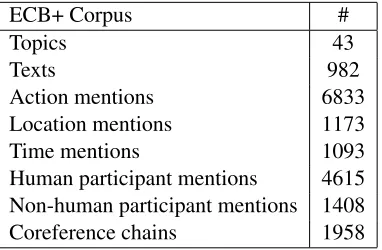
sub-set of ECB+ annotations (based on a list of 1840 selected sentences), that were additionally reviewed with focus on coreference relations. Table 4 presents information about the data set used for the exper-iments. We divided the corpus into a training set (topics 1-35) and test set (topics 36 - 45).
4.2 Experimental Set Up
The ECB+ texts are available in the XML format. The texts are tokenized, hence no sentence segmen-tation nor tokenization needed to be done. We POS-tagged and lemmatized the corpus sentences. For the experiments we used tools from the Natural Lan-guage Toolkit (Bird et al., 2009)1: the NLTK’s
de-fault POS tagger, and WordNet lemmatizer2as well
as WordNet synset assignment by the NLTK3. For
machine learning experiments we used scikit-learn (Pedregosa et al., 2011).
4.3 Singleton Baseline
As a baseline we consider event coreference evalu-ation scores generated taking into account all event mentions as singletons. In the singleton baseline re-sponse there are no “coreference chains” of more than one element. First row of Table 5 presents the singleton baseline results (BL) in terms of re-call (R), precision (P) and F-score (F) by employ-ing the coreference resolution evaluation metrics: MUC (Vilain et al., 1995), B3 (Bagga and Baldwin, 1998), mention-based CEAF (Luo, 2005), BLANC (Recasens and Hovy, 2011), and CoNLL F1
(Prad-1NLTK version 2.0.4
2www.nltk.org/_modules/nltk/stem/
wordnet.html
3http://nltk.org/_modules/nltk/corpus/
reader/wordnet.html
ECB+ Corpus #
Topics 43
Texts 982
Action mentions 6833
Location mentions 1173
Time mentions 1093
[image:6.612.333.524.578.703.2]Human participant mentions 4615 Non-human participant mentions 1408 Coreference chains 1958
Heuristic Features MUC B3 CEAF BLANC CoNLL
R P F R P F F R P F F
BL - 0 0 0 45 100 62 45 50 50 50 39
DT L 43 77 55 58 86 69 58 60 69 63 64
DT LG 36 77 49 55 90 68 56 56 74 60 60
DT LGD 28 77 42 52 93 67 55 55 77 58 57
DT LGDS 16 76 27 49 96 65 52 52 68 54 50
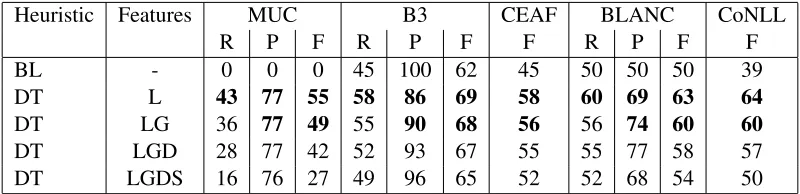
Table 5: Sentence template approach to event coreference resolution evaluated on the ECB+ corpus in MUC, B3, mention-based CEAF, BLANC and CoNLL F in comparison to the singleton baseline BL.
Approach Data Model MUC B3 CEAF BLANC CoNLL
R P F R P F F R P F F
BL ECB+ - 0 0 0 45 100 62 54 50 50 50 39
B&H ECB HDp 52 90 66 69 96 80 71 NA NA NA NA
Lee ECB LR 63 63 63 63 74 68 34 68 79 72 55
STA - L ECB+ DT 43 77 55 58 86 69 66 60 69 63 64
[image:7.612.106.506.71.168.2]STA - LG ECB+ DT 36 77 49 55 90 68 63 56 74 60 60
Table 6: Best scoring STA approaches using feature sets L and LG evaluated in MUC, B3, entity-based CEAF, BLANC and CoNLL F; in comparison with related studies and the BL baseline. Note that the STA uses gold and related approaches system mentions.
han et al., 2011). When discussing event corefer-ence scores must be noted that some of the com-monly used metrics depend on the evaluation data set. This results in scores going up or down with the number of singleton items in the data (Recasens and Hovy, 2011). Our singleton baseline gives us zero scores in MUC, which is due to the fact that the MUC measure promotes longer chains. B3 on the other hand seems to give additional points to responses with more singletons, hence the remark-ably high scores achieved by the baseline BL in B3. CEAF and BLANC as well as the CoNLL measures (the latter being an average of MUC, B3 and entity CEAF) give more realistic results.
4.4 Results
We evaluate the system output produced by the decision-tree classifier after merging pairs of event mentions with common elements into equivalence classes. The response chains generated with: (1) lemma feature set L, (2) lemma and granularity LG, (3) lemma, granularity and discourse LGD, and (4) lemma, granularity, discourse and synset features LGDS are evaluated in Table 5 in terms of R, P and F-score by employing the MUC, B3, mention-based
CEAF, BLANC and CoNLL F1 metrics.
The highest F scores reached the event clusters created by the decision-tree classifier employing feature set L (marked in bold in the table). We ob-serve a 13% improvement over the baseline BL in mention-based CEAF F and in BLANC F and a 25% gain in CoNLL F.
Addition of granularity features (LG) increases the precision scores in B3 and BLANC by 4-5%. The recall scores decrease but the F scores in most measures (except for MUC) are between 56-68%. Employing discourse with lemma and granularity features (LGD) gives us some extra precision points but costs us even more recall. Synset features lower precision and recall.
fea-tures). We will also investigate the influence of syn-tactic features on the results.
5 Related Work
Granularity shifts and structures were recently in-vestigated in the context of NLP applications by Mulkar-Mehta et al. (2011b). In their follow-up work (Mulkar-Mehta et al., 2011a) they describe an algorithm for extracting causal granularity structures from text and its possible applications in question answering and text summarization.
Howald and Abramson (2012) successfully used granularity types as features for prediction of rhetor-ical relations with a 37% performance increase.
As for event coreference resolution, Humpreys et al. (1997) performed coreference merging between event template structures. Our event template how-ever is much more restricted (five slots only) and it is filled and compared at the level of sentence while Humpreys et al. consider discourse events and enti-ties for event coreference resolution. No coreference evaluation scores are reported.
Considering the limitations of the event corefer-ence resolution measures, for the sake of a mean-ingful comparison, it is important to consider sim-ilar data sets. The ECB and ECB+ are the only available resources annotated with both: within- and cross-document event coreference. We were unable to run our experiments on the ECB corpus, because no specific entity types are annotated in the ECB and our work depends on those for granularity es-timates.4 To the best of our knowledge, no baseline
has been set yet for event coreference resolution on the ECB+ corpus. Accordingly we will look at re-sults achieved in cross-document event coreference resolution on the ECB corpus which is a subset of ECB+, and so the closest to the data set used in our experiments. For the sake of convenience, in Table 6 we compare the best results by the sentence tem-plate approach (when using lemma features STA -Land a combination of lemma and granularity fea-turesSTA - LG) with the results achieved in related studies. B&Hstands for the approach of Bejan and Harabagiu (2010) using HDp - hierarchical Dirichlet
4In the future we will look into extracting the specific entity
types so that they can be used for event coreference resolution, regardless of data annotation.
process andLeerefers to the approach of Lee et al. (2012) using LR - linear regression. BLdenotes the results by the singleton baseline.
In comparison to related studies, the best results achieved with sentence template classification (fea-ture set L and LG) on the ECB+ are comparable to results achieved in related work on the ECB. The ap-proach of Lee et al. (2012) reached 55.9% CoNLL-F5 on the ECB but on a more difficult task
entail-ing mention extraction. Another study reportentail-ing the CoNLL F score was done by Cybulska and Vossen (2013) who reached 69.8% CoNLL F1 on the ECB with a component similarity method but on a simpler - within topic task.
Note that the sentence template approach results were generated on the ECB+ corpus extended with texts capturing an additional layer of event instances from the ECB topics. Consequently, the intra-topic ambiguity in the ECB+ is higher than in the ECB. We did not perform topic clustering before com-paring event mentions at the sentence level which makes it the task of the coreference resolver to solve intra- and cross-topic ambiguity between event men-tions.
6 Conclusion and Future Work
This paper presents a new approach to event coref-erence resolution. Instead of performing topic clas-sification before solving coreference between event mentions, as most approaches do, the event template approach compares event mentions at the sentence level. In so doing, the approach focuses on solving coreference between different slots of event descrip-tions, without relying on topic classification for con-text disambiguation. As such, this heuristic, which on itself is computationally expensive, can also be used after the primary step of topic classification. Especially in case of data sets with high within topic ambiguity where there are multiple event instances described from the same event type (for instance var-ious instances of ameetingevent). In the future, we will experiment with combining topic classification with the sentence template approach.
This is the only study which we are aware that em-ploys granularity for event coreference resolution. 5The CoNLL F measure was used for comparison of
For the purpose of this task a new granularity on-tology was created. As our method does not employ POS and syntactic role information and no anaphora resolution or topic classification was performed to aid coreference resolution, the results are highly en-couraging. In our future work we will look at possi-bilities of extending the granularity ontology learn-ing granularity levels from corpora to overcome the low coverage limitation following from the usage of a WordNet based taxonomy. We will also augment the ontology to cover the non-human participant slot and experiment with other ways to represent event granularity with features.
Acknowledgments
This work has been carried out within the News-Reader project supported by the EC within the 7th framework programme under grant agreement nr. FP7-ICT-316404. We are grateful for the feedback from the anonymous reviewers. All mistakes are our own.
References
Amit Bagga and Breck Baldwin. 1998. Algorithms for scoring coreference chains. InProceedings of the In-ternational Conference on Language Resources and Evaluation (LREC).
Cosmin Adrian Bejan and Sanda Harabagiu. 2010. Un-supervised event coreference resolution with rich lin-guistic features. In Proceedings of the 48th Annual Meeting of the Association for Computational Linguis-tics, Uppsala, Sweden.
Steven Bird, Ewan Klein, and Edward Loper. 2009. Nat-ural Language Processing with Python. O’Reilly Me-dia Inc., http://nltk.org/book.
Agata Cybulska and Piek Vossen. 2013. Semantic re-lations between events and their time, locations and participants for event coreference resolution. In Pro-ceedings of recent advances in natural language pro-cessing (RANLP-2013).
Agata Cybulska and Piek Vossen. 2014a. Guidelines for ECB+ annotation of events and their coreference. Technical Report NWR-2014-1, VU University Ams-terdam.
Agata Cybulska and Piek Vossen. 2014b. Using a sledge-hammer to crack a nut? Lexical diversity and event coreference resolution. InProceedings of the Interna-tional Conference on Language Resources and Evalu-ation (LREC 2014).
Agata Cybulska and Piek Vossen. 2015. “Bag of events” approach to event coreference resolution. Su-pervised classification of event templates. In Interna-tional Journal of ComputaInterna-tional Linguistics and Ap-plications (IJCLA).
Andrey Gusev, Nathanael Chambers, Pranav Khaitan, Divye Khilnani, Steven Bethard, and Dan Jurafsky. 2011. Using query patterns to learn the duration of events. InProceedings of the Ninth International Con-ference on Computational Semantics (IWCS11). Jerry R. Hobbs. 1985. Granularity. InProceedings of
the Ninth International Joint Conference on Artificial Intelligence.
Blake Stephen Howald and Martha Abramson. 2012. The use of granularity in rhetorical prediction. In Pro-ceedings of the First Joint Conference on Lexi-cal and Computational Semantics (*SEM).
Kevin Humphreys, Robert Gaizauskas, and Saliha Az-zam. 1997. Event coreference for information ex-traction. InANARESOLUTION ’97 Proceedings of a Workshop on Operational Factors in Practical, Robust Anaphora Resolution for Unrestricted Texts.
Catharina Maria Keet. 2008. A formal theory of granu-larity. toward enhancing biological and applied life sci-ences information systems with granularity. InPh.D. thesis, Faculty of Computer Science, Free University of Bozen-Balzano, Italy.
LDC. 2005. ACE (Automatic Content Extraction) English Annotation Guidelines for Events ver. 5.4.3 2005.07.01. InLinguistic Data Consortium.
Heeyoung Lee, Marta Recasens, Angel Chang, Mihai Surdeanu, and Dan Jurafsky. 2012. Joint entity and event coreference resolution across documents. In Proceedings of the 2012 Conference on Empirical Methods in Natural Language Processing and Natural Language Learning (EMNLP-CoNLL).
Xiaoqiang Luo. 2005. On coreference resolution per-formance metrics. In Proceedings of the Human Language Technology Conference and Conference on Empirical Methods in Natural Language Processing (EMNLP-2005).
Inderjeet Mani. 1998. A theory of granularity and its application to problems of polysemy and under-specification of meaning. InIn Principles of Knowl-edge Representation and Reasoning: Proceedings of the Sixth International Conference (KR-98).
Rutu Mulkar-Mehta, Jerry R. Hobbs, and Eduard Hovy. 2011a. Applications and discovery of granularity structures in natural language discourse. In Proceed-ings of The Tenth International Symposium on Logi-cal Formalizations of Commonsense Reasoning at the AAAI Spring Symposium, Palo Alto.
Proceedings of International Conference on Computa-tional Semantics.
Fabian Pedregosa, Gal Varoquaux, Alexandre Gram-fort, Vincent Michel, Bertrand Thirion, Olivier Grisel, Mathieu Blondel, Peter Prettenhofer, Ron Weiss, Vin-cent Dubourg, Jake Vanderplas, Alexandre Passos, David Cournapeau, Matthieu Brucher, Matthieu Per-rot, and douard Duchesnay. 2011. Scikit-learn: Ma-chine learning in Python. Journal of Machine Learn-ing Research, 12:2825–2830.
Sameer Pradhan, Lance Ramshaw, Mitchell Marcus, Martha Palmer, Ralph Weischedel, and Nianwen Xue. 2011. CoNLL-2011 shared task: Modeling unre-stricted coreference in ontonotes. In Proceedings of CoNLL 2011: Shared Task.
Marta Recasens and Eduard Hovy. 2011. BLANC: Im-plementing the rand index for coreference evaluation.
Natural Language Engineering, 17(4):485–510. Marc Vilain, John Burger, John Aberdeen, Dennis
Con-nolly, and Lynette Hirschman. 1995. A model theo-retic coreference scoring scheme. InProceedings of MUC-6.