Distributed Word Representations Improve NER for e-Commerce
Mahesh Joshi
[email protected] [email protected] Hart
Mirko Vogel
[email protected] [email protected] Ruvini
eBay Inc. 2065 Hamilton Ave San Jose, CA, 95125, USA
Abstract
This paper presents a case study of using distributed word representations,word2vec
in particular, for improving performance of Named Entity Recognition for the e-Commerce domain. We also demonstrate that distributed word representations trained on a smaller amount of in-domain data are more ef-fective than word vectors trained on very large amount of out-of-domain data, and that their combination gives the best results.
1 Introduction
On-line commerce has gained a lot of popularity over the past decade. Large on-line C2C market-places like eBay, Alibaba, and Amazon feature a very large and long-tail inventory with millions of items(product offers) entered into the marketplace every day by a large variety of sellers.
To manage items effectively and provide the best user experience, it is critical for these marketplaces to structure their inventory into descriptive name-value pairs (calledproperties) and ensure that items of the same kind (digital cameras, for instance) are described using a unique set of properties (brand name, model number, zoom, resolution, etc.). This is important for recommendations in merchandising, providing faceted navigation, and assisting business intelligence applications.
While some sellers (generally large, professional retailers) provide rich, structured descriptions of their products (using schemas or global trade item numbers), the vast majority of sellers only provide unstructured natural language descriptions. In the
latter case, one solution to the problem of structuring e-commerce inventory is to use techniques such as Named-Entity Recognition (NER) to extract proper-ties from the textual description of the items. The scale at which on-line marketplaces operate makes it impractical to solve this problem manually.1
This paper focuses on NER, generally defined as the task of classifying elements of text into predefined categories (often referred to as entity types or entities). Entities usually include names of persons, organizations, locations, times, and quantities (CoNLL-2003 dataset), as well as na-tionalities or religious groups, products (vehicles, weapons, foods, etc.), and titles of books or songs (Ontonotes 5.0dataset).
In the e-commerce domain, these entities are item properties such as brand name,
color, material, clothing size, golf club type, makeup shade code, sun protection factor, etc. Another important specificity of the e-commerce domain with respect to NER is that the sentences are usually much shorter than in other applications and don’t exhibit the grammatical structure of natural language.
This paper investigates whether distributed word vectors benefit NER in the e-commerce domain. Distributed word representations based on neural networks from unlabeled text data have proven use-ful for many natural language tasks, including NER. In fact, Passos et al. (2014) reported results
compa-1For instance, in late 2014, eBay.com reported 800 million available items at any given time and more than 25 million sell-ers. Alibaba.com reported 8.5 million sellsell-ers. Amazon.com has not disclosed similar information.
rable to state-of-the-art for the CoNLL 2003 NER task using such representations. In this paper, we evaluate distributed word vectors with a focus on us-ing in–domain data for their trainus-ing.
In the remainder of this paper, we first explain the specificity of NER in the e-commerce domain and describe the approach we use for performing the task. In Section 3, we describe our datasets. In Sec-tion 4, we describe the setting of the experiments we have conducted and discuss the results in Section 5. Finally, we review related works in Section 6.
2 NER for e-Commerce
The e-commerce domain raises specific challenges for NER. This section describes in detail the task, and the methodology we have chosen to tackle it.
2.1 Description of the task
We consider the task of named entity recognition (NER) on text from the e-commerce domain. The text data associated with an e-commerce item usu-ally consists of two parts: thetitleand the descrip-tion. In the current work, we focus only on item titles since item descriptions are often optional, vary greatly from seller to seller and between market-places, and are not shown on the search results page. The item title is a short sentence usually consisting of a sequence of approximately 10 to 35 nouns, ad-jectives, and numbers. They rarely contain verbs, pronouns, or determiners. The title is mandatory for most marketplaces, as it is indexed by the search en-gine and searched against by users of the website. Snippets shown in search result pages are generated from the titles of the items in the search result set.
Table 1 shows some examples of item titles (rows 1, 3, 5) from various online marketplaces. These examples show that sellers use capitalization and special characters as visual features in a manner not necessarily consistent with conventional English grammar rules. Besides their limited grammatical structure and the lack of contextual information due to their length, titles also contains typographical er-rors and abbreviations. While many abbreviations are standard in the e-commerce domain and used across all marketplaces (such as “w/” for “with”, “NIB” for “new in box”, “BNWT” for “brand new with tag”, etc.), some are seller specific and are often
difficult to decipher.
Performing NER for e-commerce involves classi-fying the various tokens in the title of an item into property names (entities) relevant to that item. Ta-ble 1 also shows the annotated entities (rows 2, 4, 6) for each of the titles. Section 3 provide details about the e-commerce categories, and the empirically de-fined entities within each of those categories. Next, we describe the approach that we use for NER.
2.2 Approach
Following current best practices, we approach NER as a sequence labeling problem. We use linear– chain Conditional Random Field (CRF) (Lafferty et al., 2001) which has been shown to achieve the best performance for many applications of NER (Suzuki and Isozaki, 2008; Lin and Wu, 2009; Passos et al., 2014), including NER for the e-commerce do-main (Putthividhya and Hu, 2011).
We use a fairly standard set of lexical features used in most NER systems, including character af-fixes. Our features are detailed in Section 4.
In addition to the lexical features, modern NER systems also attempt to leverage some form of vec-tor representation of the syntactic and semantic properties of the tokens. While discrete word rep-resentations derived from word clusters have been shown to be very beneficial to NER (Miller et al., 2004; Lin and Wu, 2009; Ratinov and Roth, 2009; Turian et al., 2010), more and more attention is be-ing paid to distributed word representations since the introduction of efficient algorithms to produce them (Mikolov et al., 2013). Passos et al. (2014), for in-stance, reported performance comparable to state-of-the-art NER systems using a modified skip–gram model trained to predict membership of words to a domain specific lexicon.
1: Apple iPhone 6 - 16GB - Space Grey ( Unlocked ) Smartphone
2: b p p d c c a t
3: Cole Haan Men ’s Carter Grand Cap Oxford
4: b b g g p p t
5: Womens CRISTINALOVE SHOULDER DRESS - Size XL - L@@K
[image:3.612.78.455.57.132.2]6: b t t s
Table 1: Examples of annotated titles for different e-commerce categories from various online marketplaces. Entity types are denoted by the single letters: “a”– “contract,” “b”– “brand name,” “c”– “color,” “d”– “dimension,” “g”– “gender,” “p”– “product name or number,” “t”– “type,” “s”– “size.”
this paper, we investigate whether useful distributed representations can be learned from fairly unstruc-tured, short, ungrammatical documents such as e-commerce titles and capture enough e-e-commerce se-mantics to benefit NER. We also study how they compare to distributed vectors trained from a non e-commerce corpus.
3 Data
To make discovering and browsing the inventory easy, most on-line marketplaces organize their in-ventory into a category structure similar to a topic hierarchy. eBay and Alibaba hierarchies comprise around 40 top level nodes, called categories, and more than 10,000 leaf nodes. The goods from differ-ent categories are usually very differdiffer-ent in nature as exemplified by eBay categories such as “Antiques,” “Clothing, Shoes & Accessories,” and “Toys & Hob-bies,” to name a few.
3.1 Data Selection
The models trained for our experiments focus on a subset of five popular categories, namely Cellphones (CELLPH), Cellphone Accessories (CELLACC),
Men’s Shoes (MSHOES), Watches (WATCHES), and
Women’s Clothing (WCLOTH). Our datasets consist
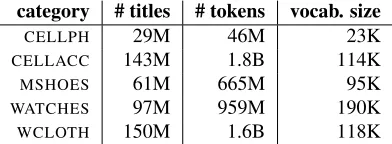
of user-defined e-commerce item titles. Table 2 pro-vides statistics about these titles. Titles were tok-enized using CoreNLP (Manning et al., 2014).
3.2 Training and testing data
Training and testing data for CRF was produced by manually labeling data. Based on the labeling re-sources available, we sampled 2,000 titles for most categories. Splitting these samples resulted in the training and test splits shown in Table 3.
category # titles # tokens vocab. size
CELLPH 29M 46M 23K
CELLACC 143M 1.8B 114K
MSHOES 61M 665M 95K
[image:3.612.329.525.195.267.2]WATCHES 97M 959M 190K WCLOTH 150M 1.6B 118K
Table 2: Approximate statistics for the in-domain titles (B: billion, M: million, K: thousand). The vocabulary size is based on a minimum count of 50.
category titles tokens vocab
CELLPH 1500 / 500 20776 / 7056 3806 / 1647 CELLACC 1330 / 443 18650 / 6195 4964 / 2261 MSHOES 1485 / 494 19278 / 6373 5424 / 2513 WATCHES 1339 / 495 15735 / 5828 5176 / 2487 WCLOTH 3098 / 500 39196 / 6279 7576 / 2621
Table 3: Training / test data splits (titles, token count, vocabulary size) for each category.
3.3 Entity Types
An important step in preparing the data was de-termining which properties of the items are most important to each category (concretely, which en-tities should be targeted). Because items across categories are quite different and can vary greatly in nature, a unique set of entities was used for each category, though several entities are com-mon across categories (e.g. brand, color). For example, a title in WCLOTH might contain
the propertiesbrand, type, size, style, colorwhereas a title inCELLPHmight describe an
[image:3.612.316.545.321.394.2]this does not scale well and makes the annotation task more difficult. Table 4 shows the set of entities used for each category and the distribution of enti-ties over the individual tokens within each category.
3.4 Annotation Procedure
Titles in Table 3 were annotated by two language specialists. Annotators had access to the listing page of the item in question to use as a reference. This page typically includes some pictures as well as a description of the item which may provide informa-tion about a particular token and reduce the amount of research required to correctly label a token (e.g. an obscure brand name). The two annotators re-grouped after tagging to resolve disagreements be-tween the individually tagged data sets. Agreement scores between the annotators were calculated using unweighted Cohen’s Kappa with the following re-sults: CELLPH: .92, CELLACC: .82, MSHOES: .78, WATCHES: .81, WCLOTH: .93. BIO encoding was
not used for these datasets, but experimenting with it is important, and we plan do so in future work.
3.5 word2vectraining data
For training the category–specific in–domain word vector representations, the set of tokenized titles referred to in Table 2 are used for the respec-tive category. Section 4 provides details about the
word2vectraining process.
4 Experiments
We now present our experimental results for NER on e-commerce item titles. The goal of our work is not necessarily to present the best possible results for this task. Instead, our experiments are driven by the following two questions: (1) Are distributed word representations created from highly unstruc-tured data (namely, e-commerce item titles) bene-ficial for the task of named entity recognition on the same kind of unstructured data? (2) How do distributed word vector representations created from out-of-domain (namely, non e-commerce data) com-pare with those created from in-domain data?
4.1 Training
We use the CRFsuite package (Okazaki, 2007) for our experiments. Following Turian et al. (2010), we use stochastic gradient descent (SGD) for our
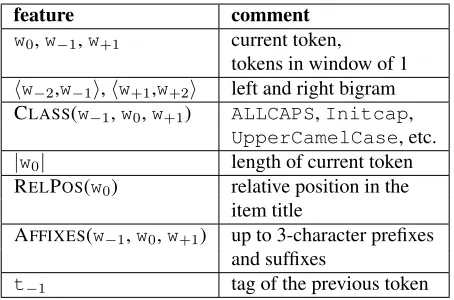
feature comment
w0,w−1,w+1 current token,
tokens in window of 1
hw−2,w−1i,hw+1,w+2i left and right bigram
CLASS(w−1,w0,w+1) ALLCAPS,Initcap,
UpperCamelCase, etc.
|w0| length of current token RELPOS(w0) relative position in the
item title
AFFIXES(w−1,w0,w+1) up to 3-character prefixes
and suffixes
[image:4.612.314.541.56.206.2]t−1 tag of the previous token
Table 5: Table shows the features that we use for our baseline.
training, and allow negative state features and nega-tive transition features. Thel2regularization hyper– parameter (c2for CRFsuite) is tuned using a ran-domly chosen subset of 30% sentences (item ti-tles) held out as the development set during ing. The final model is retrained on the entire train-ing set ustrain-ing the best value ofc2(which varies de-pending on the feature configuration). The set of
c2values we tried is{0.001, 0.005, 0.01, 0.05, 0.1, 1, 2, 5, 10, 50, 100}.
4.2 Baseline Features
Table 5 shows the features that we use for our base-line. We refer to this feature set by the nameBASE
in our results section.
We also experimented with larger window sizes (two and three) for all of the windowed features listed in Table 5, however, the performance degraded for larger window sizes. We believe this is due to the highly unstructured nature of text in the item titles.
4.3 Distributed Word Vector Features
We explored two different types of sources of text for the generation of distributed word representa-tions for our task. First, we used word vectors trained by Baroni et al. (2014) — in particular, the “best predict vectors” made available by the au-thors2. These are, for our purposes, vectors trained on out-of-domain text corpora. Results using fea-tures based on these word vectors are denoted by the nameBASE+GEN. In our experiments, features
based on word vectors are always added on top of
Category Tag
CELLPH Product Name 17.8%, Brand 11.3%, Dimension 7.4%, Color 5.2%, Contract 3.8%, Operating Sys-tem 2.1%, Location 0.4%, no tag 52.0%
CELLACC Product Name 25.6%, Type 19.4%, Brand 7.3%, Feature 3.8%, Material 2.4%, Color 2.3%, Style 1.2%, Connectivity 1.1%, Pattern 0.6%, Battery Capacity 0.4%, Location 0.4%, Finish 0.3%, Fit 0.3%, Storage Capacity 0.3%, Storage Format 0.2%, Sports Team 0.2%, no tag 34.2%
MSHOES Product Line 28.2%, Brand 11.4%, Color 8.8%, Size 6.9%, Type 5.6%, Gender 3.9%, Pur-pose/Occasion/Activity 2.9%, Material 2.2%, Height 1.3%, Style 1.1%, Pattern 0.4%, no tag 27.3% WATCHES Product Name 13.8%, Brand 9.3%, Type 7.4%, Feature 5.1%, Gender 4.7%, Material 4.0%, Color 3.1%, Movement 2.9%, Component 2.9%, Style/Purpose/Occasion 2.9%, Size 1.1%, Display Type 0.8%, Location 0.8%, Purity/Quality 0.3%, Shape 0.2%, Closure 0.1%, no tag 40.6%
WCLOTH Type 16.0%, Brand 8.3%, Size 7.3%, Color 4.0%, Material 3.8%, Purpose/Occasion/Activity 3.2%, Style 2.1, Pattern 1.5%, Location 0.8%, no tag 53.0%
Table 4: The entities targeted by our NER system and their distributions over total tokens for each category.
our baseline features (BASE). Second, we used word
vectors trained on a large set of in-domain data for each of the five categories, namely e-commerce item titles for the respective categories. The word vec-tors for each category were trained separately, in or-der to provide the “purest” form of in–domain data. Results using features based on these word vectors are denoted by the nameBASE+DOM. Additionally,
we also conduct experiments using features based on both the in–domain as well as out–of–domain word vectors. Results using this combined set of word vector features are denoted byBASE+ALL.
Word vector features are computed for w0, w−1,
andw+1— that is, for the current token and its two
surrounding tokens. Here too, we experimented with larger window sizes, but that resulted in a lower overall performance.
4.4 word2vec
Both the out–of–domain and the in–domain word vectors that we train are trained using the
word2vec toolkit3 (Mikolov et al., 2013). De-tails of how the out–of–domain word vectors were trained is provided by Baroni et al. (2014) — their 400–dimensional word vectors were trained on ap-proximately 2.8 billion tokens using word2vec’s continuous bag–of–words (cbow) representation, with a window size of five.
Initially, we experimented with several parame-ter choices for training our word2vecmodels. In particular, we tried the following grid of values: representation: skip-gram, continuous bag–of–
3https://code.google.com/p/word2vec
words (cbow); context window size:{2,5}, down– sampling parameter: {1e-3, 1e-4, 1e-5}; hier-archical softmax: {off, on}; # of negative sam-ples: {5, 10}; word frequency cutoff: {10, 50}; and word vector dimensionality: {50, 100, 200,
300, 400, 500}. Based on this parameter sweep, we found that the following parameters worked best overall for our task: representation: skip-gram, con-text window size: 2, down–sampling parameter:
1e-3, hierarchical softmax: off, # negative sam-ples: 10, word frequency cutoff: 50. These are the settings we use for all the results reported in this paper. As for the word vector dimensionality, we tuned it based on our validation set (similar to thec2
parameter for CRFsuite), using the following set of values: {50, 100,200,300,400, 500}). In our results we will report the best word vector dimen-sionality when features based on in–domain word vectors are used.
Theskip-gramrepresentation worked better in our experiments for capturing semantics of the word co-occurrences in the item titles. This is consistent with the comparative analysis published by Mikolov et al. (2013) betweenskip-gramandcbow mod-els — thecbowmodels were found to be better for syntactic tasks while theskip-grammodels were better for semantic tasks. A narrower context win-dow is better for our highly unstructured data.
5 Results and Discussion
config prec. rec. F1 # dims
C
E
L
L
PH BASE+BASEDOM .9505 .9497 .9501.9590 .9590 .9590 100NA BASE+GEN .9560 .9554 .9557 NA BASE+ALL .9604 .9599 .9601 300
C
E
L
L
A
C
C BASE .8571 .8567 .8569 NA
BASE+DOM .8723 .8731 .8727 500 BASE+GEN .8648 .8649 .8648 NA BASE+ALL .8806 .8812 .8809 300
M
SH
O
E
S BASE .8248 .8213 .8230 NA BASE+DOM .8491 .8486 .8488 100 BASE+GEN .8376 .8338 .8357 NA BASE+ALL .8581 .8550 .8565 200
W
A
T
C
H
E
S BASE .8243 .8210 .8227 NA BASE+DOM .8382 .8384 .8383 200 BASE+GEN .8386 .8372 .8379 NA BASE+ALL .8496 .8480 .8488 200
W
C
L
O
T
[image:6.612.71.299.56.317.2]H BASE .8600 .8619 .8609 NA BASE+DOM .8874 .8882 .8878 400 BASE+GEN .8752 .8732 .8742 NA BASE+ALL .8883 .8892 .8887 400
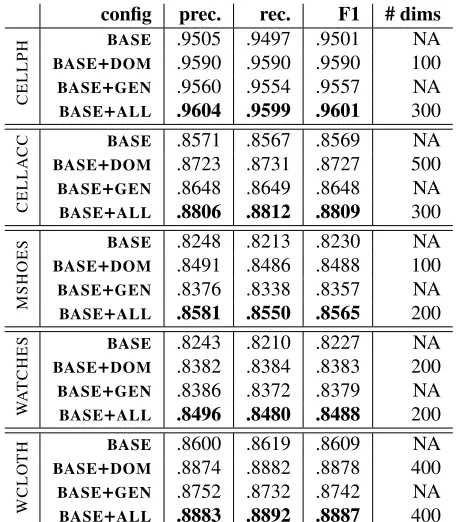
Table 6: Table shows the full set of results (weighted pre-cision, recall, and F1) for each of the five e-Commerce categories we experiment with. The last column shows the best (tuned)word2vec dimensionality for the in– domain word vectors.
P
t∈{tags}p(t)F1(t), where p(t) is the relative
fre-quency of tag t in the test set and F1(t) is the F1 score for tagt.
Several trends are clear from the results. First, the combined feature set based on in–domain and out–of–domain word vectors (BASE+ALL) gives the
best performance for all categories, with a boost of 2+ percentage points over BASE for all categories
except CELLPH. Second, most of the improvement
over the baseline (BASE) is achieved by the in–
domain word vector features (BASE+DOM). Except
for theWATCHEScategory, the out–of–domain word
vector features by themselves are less useful com-pared to the in–domain vectors. This is not entirely surprising. However, it is worth noting for a cou-ple of reasons: (1) The in–domain data we have, as mentioned earlier, is highly unstructured, and it is not obvious that word vectors trained on such data will be meaningful, let alone useful in a quantitative evaluation like the one we have presented. (2) The in–domain data that we use for word vector train-ing is, in most cases, significantly smaller than the dataset used for training the out–of–domain word
vectors. While we directly use the word vectors from Baroni et al. (2014) as our out–of–domain vec-tors (since they have been shown to perform well across a range of semantic relatedness tasks), in the future it might be worth tuning the out–of–domain word vectors specifically for our task.
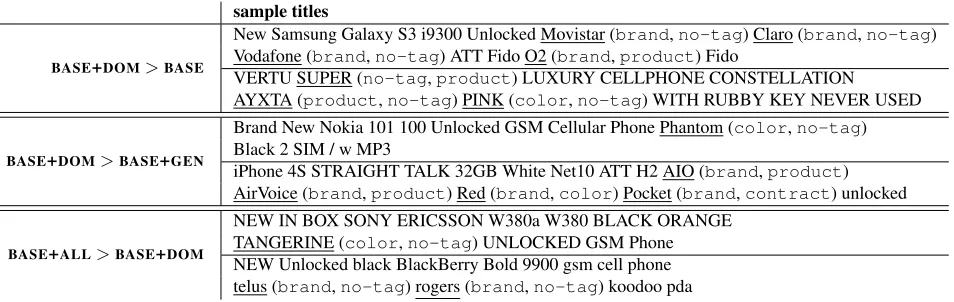
In order to gain an understanding of where the distributed word representations are useful, we per-formed an error analysis on the predictions from our various models. Table 7 shows several differ-ent item titles where our trained models differed. The table shows, for example, that theBASE+DOM
model is able to identify “Movistar” as a brand
correctly, while the BASE model is not. This is
in-teresting because “Movistar” does not appear in our training data at all. However, it does have a rep-resentation in our word2vecmodel, and thus the
BASE+DOM model is able to correctly tag it. The BASE+DOM model also correctly tags both tokens
in “Red Pocket” as abrand, unlike theBASE+GEN
model, which tags them ascolorandcontract
incorrectly. This shows that the in–domain se-mantic representation for the token “Red” is more useful compared to its out–of–domain representa-tion. Finally, there are also cases where the out–of– domain semantic representation adds value: “TAN-GERINE”, for example, is correctly predicted as a
colorbyBASE+ALL, but not byBASE+DOM
be-cause it is not present in our in–domain vectors.
6 Related Work
6.1 Word representations
The problem of modeling the meaning of words in text has been approached in various ways includ-ing distributional semantics (see Turney and Pan-tel (2010), Erk (2012) for surveys), word cluster-ing (Brown et al., 1992; Lin and Wu, 2009), and, more recently, distributed representations (Mnih and Hinton, 2007; Collobert and Weston, 2008).
sample titles
BASE+DOM>BASE
New Samsung Galaxy S3 i9300 Unlocked Movistar (brand,no-tag) Claro (brand,no-tag) Vodafone (brand,no-tag) ATT Fido O2 (brand,product) Fido
VERTU SUPER (no-tag,product) LUXURY CELLPHONE CONSTELLATION
AYXTA (product,no-tag) PINK (color,no-tag) WITH RUBBY KEY NEVER USED
BASE+DOM>BASE+GEN
Brand New Nokia 101 100 Unlocked GSM Cellular Phone Phantom (color,no-tag) Black 2 SIM / w MP3
iPhone 4S STRAIGHT TALK 32GB White Net10 ATT H2 AIO (brand,product) AirVoice (brand,product) Red (brand,color) Pocket (brand,contract) unlocked
BASE+ALL>BASE+DOM
[image:7.612.75.552.57.208.2]NEW IN BOX SONY ERICSSON W380a W380 BLACK ORANGE TANGERINE (color,no-tag) UNLOCKED GSM Phone NEW Unlocked black BlackBerry Bold 9900 gsm cell phone telus (brand,no-tag) rogers (brand,no-tag) koodoo pda
Table 7: A small sample of errors made by our various models on theCELLPHcategory. The first column shows the models being compared (“>” stands for “better than”). The predictions of the models differ for the underlined tokens. In parentheses, the prediction from the correct model is shown first, followed by the prediction of the incorrect model.
comparable to state-of-the-art NER systems using a modified skip-gram model trained to predict mem-bership of words to a domain specific lexicon.
6.2 E-Commerce
E-commerce has recently garnered attention in the natural language processing research community.
Ghani et al. (2006) and Putthividhya and Hu (2011) also address the problem of structuring items in the e-commerce domain through NER and present experimental results on data similar to ours, but do not leverage word vector representations. Mauge et al. (2012) presents an unsupervised approach for identifying attribute names and values from unstruc-tured natural language listings seen in e-commerce sites. Finally, unrelated to NER, Shen et al. (2012) proposed a method for hierarchical classification of product offers which they validated on eBay data.
7 Conclusions
Distributed word representations have been used successfully for improving performance on sev-eral natural language processing tasks in the recent past, including the task of named entity recognition (NER). Much of the work, however, has focused on learning these word representations from corpora that consist of relatively well–formed, grammatical language. Moreover, the NER tasks that used these word representations were also based on similar well–formed language. In this work we explore dis-tributed word representations based on e-commerce domain item titles, which are highly unstructured in
nature. We also evaluate our constructed word vec-tors on the task of NER for these item titles.
Our experiments show the following: (1) It is possible to learn useful (as evaluated quantitatively on an NER task) distributed word representations based on unstructured e-commerce item title data. (2) The word representations that we train on a rel-atively small amount of in–domain data are, in gen-eral, more useful than word representations trained on very large out–of–domain data. (3) The combi-nation of in–domain and out–of–domain word rep-resentations gives the best result, adding domain– knowledge where necessary, while also using back-ground general knowledge from out–of–domain rep-resentations.
References
Marco Baroni, Georgiana Dinu, and Germ´an Kruszewski. 2014. Don’t count, predict! a systematic compari-son of context-counting vs. context-predicting seman-tic vectors. InProceedings of the 52nd Annual Meet-ing of the Association for Computational LMeet-inguistics (Volume 1: Long Papers), pages 238–247.
Peter F. Brown, Peter V. deSouza, Robert L. Mercer, Vin-cent J. Della Pietra, and Jenifer C. Lai. 1992. Class-based n-gram models of natural language. Computa-tional Linguistics, 18(4):467–479.
Ronan Collobert and Jason Weston. 2008. A unified ar-chitecture for natural language processing: Deep neu-ral networks with multitask learning. In Proceed-ings of the 25th International Conference on Machine Learning, ICML ’08, pages 160–167.
Paramveer Dhillon, Dean P Foster, and Lyle H. Ungar. 2011. Multi-view learning of word embeddings via cca. In J. Shawe-Taylor, R.S. Zemel, P.L. Bartlett, F. Pereira, and K.Q. Weinberger, editors, Advances in Neural Information Processing Systems 24, pages 199–207.
Katrin Erk. 2012. Vector space models of word meaning and phrase meaning: A survey. Language and Lin-guistics Compass, 6(10):635–653.
Rayid Ghani, Katharina Probst, Yan Liu, Marko Krema, and Andrew Fano. 2006. Text mining for product at-tribute extraction.SIGKDD Explorations, 8:41–48. John D. Lafferty, Andrew McCallum, and Fernando C. N.
Pereira. 2001. Conditional random fields: Probabilis-tic models for segmenting and labeling sequence data. In Proceedings of the Eighteenth International Con-ference on Machine Learning, ICML ’01, pages 282– 289.
Dekang Lin and Xiaoyun Wu. 2009. Phrase clustering for discriminative learning. InProceedings of the Joint Conference of the 47th Annual Meeting of the ACL and the 4th International Joint Conference on Natural Lan-guage Processing of the AFNLP: Volume 2 - Volume 2, ACL ’09, pages 1030–1038.
Christopher D. Manning, Mihai Surdeanu, John Bauer, Jenny Finkel, Steven J. Bethard, and David McClosky. 2014. The Stanford CoreNLP natural language pro-cessing toolkit.
Karin Mauge, Khash Rohanimanesh, and Jean-David Ru-vini. 2012. Structuring e-commerce inventory. In Proceedings of the 50th Annual Meeting of the Association for Computational Linguistics: Long Papers -Volume 1, pages 805–814.
Tomas Mikolov, Kai Chen, Greg Corrado, and Jeffrey Dean. 2013. Efficient estimation of word represen-tations in vector space. InProceedings of Workshop at ICLR.
Scott Miller, Jethran Guinness, and Alex Zamanian. 2004. Name tagging with word clusters and discrim-inative training. In Daniel Marcu Susan Dumais and Salim Roukos, editors,HLT-NAACL 2004: Main Pro-ceedings, pages 337–342.
Andriy Mnih and Geoffrey Hinton. 2007. Three new graphical models for statistical language modelling. In Proceedings of the 24th International Conference on Machine Learning, ICML ’07, pages 641–648. Naoaki Okazaki. 2007. Crfsuite: a fast implementation
of conditional random fields (crfs).
Alexandre Passos, Vineet Kumar, and Andrew McCal-lum. 2014. Lexicon infused phrase embeddings for named entity resolution. InProceedings of the Eigh-teenth Conference on Computational Natural Lan-guage Learning (CoNLL 2014), pages 78–86.
Duangmanee Putthividhya and Junling Hu. 2011. Boot-strapped named entity recognition for product attribute extraction. InEMNLP, pages 1557–1567.
Lev Ratinov and Dan Roth. 2009. Design challenges and misconceptions in named entity recognition. In Pro-ceedings of the Thirteenth Conference on Computa-tional Natural Language Learning, CoNLL ’09, pages 147–155.
Dan Shen, Jean-David Ruvini, and Badrul Sarwar. 2012. Large-scale item categorization for e-commerce. In CIKM, pages 595–604.
Jun Suzuki and Hideki Isozaki. 2008. Semi-supervised sequential labeling and segmentation using giga-word scale unlabeled data. InProceedings of ACL-08: HLT, pages 665–673.
Joseph Turian, Lev-Arie Ratinov, and Yoshua Bengio. 2010. Word representations: A simple and general method for semi-supervised learning. In Proceed-ings of the 48th Annual Meeting of the Association for Computational Linguistics, pages 384–394.