Coreference Annotator
A new annotation tool for aligned bilingual corpora
Mara Tsoumari School of English Faculty of Philosophy Aristotle University of Thessaloniki 54 124, P.O. Box 58, Thessaloniki, Greece
[email protected], [email protected]
Georgios Petasis
Software and Knowledge Engineering Laboratory Institute of Informatics and Telecommunications
National Centre for Scientific Research (N.C.S.R.) “Demokritos” GR-153 10, P.O. BOX 60228, Aghia Paraskevi, Athens, Greece
Abstract
This paper presents the main features of an annotation tool, the Coreference Annota-tor, which manages bilingual corpora con-sisting of aligned texts that can be grouped in collections and subcollections accord-ing to their topics and discourse. The tool allows the manual annotation of cer-tain linguistic items in the source text and their translation equivalent in the target text, by entering useful information about these items based on their context.
1 Introduction
The annotation tool, Coreference Annotator, has been developed within the framework of wider re-search in the analysis of parallel texts from a trans-lation point of view. More specifically, the re-search attempts a theoretical classification of the translation of European Union texts in the light of Relevance Theory (Tsoumari, 2008), and exam-ines a special use monodirectional bilingual cor-pus consisting of aligned English (originals/source texts) and Greek (translations/target texts) ver-sions of press releases of the European Commis-sion.
The aim of the annotation tool is for the re-searcher to trace and annotate manually certain linguistic items in the source text and their transla-tion equivalent in the target text, by entering use-ful information about these items based on their context. The focus for this study is on identify-ing discourse markers and conjunctions that ex-press concession/contrast/adversity in the source
text and then locating their translation equiva-lent in the target text. To the group of markers mentioned above, the conjunction ‘and’ has been added. Cases of omission of source text tions or discourse markers, or addition of conjunc-tions or discourse markers in the target text are also marked.
2 Motivation
The scope of the research that motivated the cre-ation of this tool combines mainly translcre-ation, par-allel corpora (original-source texts and translation-target texts), semantics, pragmatics, and discourse. A parallel aligned corpus of press releases of the European Commission is examined both trans-lationally and linguistically to reach conclusions about how certain linguistic items are translated, potentially reflecting the intention of the authors; the expectations of the readers; whether intention-ality and expectations change when moving from the source text to the target text; and effects from genre, discourses depending on the topics of the documents, public sentiment or culture.
2.1 Translation in the EU
There is an intriguing matter in the translation of European Union documents into all or some of the official languages of the European Union. On the one hand, there are rules and regulations govern-ing the operation of European countries together as a whole, as a single unity forming the Euro-pean Union, and EU culture and mentality. On the other hand, the European countries-member states maintain their national cultures and mental-ities. Research has shown that the culture of the
EU edifice is different from national cultures, has a culture of its own, despite the likely blurred bor-derlines between them (Koskinen, 2001; Koski-nen, 2004). EU texts and their translation serve a primary communicative situation, since origi-nal texts are written to be translated so as to help EU (source text) authors reach different national (target) language users. Some of the characteris-tics of EU texts are that they are often produced and translated almost at the same time (Koutsivi-tis, 1994); translation may constitute the starting point to improve the ‘original’ (Koutsivitis, 2003); the writers are usually a group of people or a com-mittee; most source texts are written in English and to a lesser degree in French and German (three procedural languages); the authors are not neces-sarily native speakers of the language they use for writing; source texts may not always be written in one language and have special linguistic, syntacti-cal and stylistic characteristics syntacti-called Eurojargon, Eurobabble or Eurospeak (Trosborg, 1997). Thus the translation process, strategies and methods are also affected by the particular circumstances of the production of target texts.
2.2 Press releases of the European Commission
EU press releases are one of the types of doc-uments produced in the framework of the Euro-pean Union and are distinct from non-EU press releases. The reason is that if we accept that the European Union has a culture of its own, as Kosk-inen (2001; KoskKosk-inen (2004) argues, then it is only normal to expect the production of EU culture-specific texts and genres. EC (European Commis-sion) press releases are produced under the same EU-specific conditions as most EU documents are, i.e. multiple versions drafted and translated at the same time, non-native speakers drafting the doc-uments etc. Culture has its own manner to con-struct and partition reality which is mirrored in its discourses, that is “modes of talking and thinking which can become ritualised” (Hatim and Mason, 1990). EU culture is no exception to that. In a corpus of aligned EC press releases an issue worth examining is whether the translation is affected by the different topics and discourses of the press re-leases.
2.3 Connectives: Relevance theory and Sentiment analysis
Connectives have been selected to be examined because they draw attention due to their status. According to Relevance Theory (Wilson and Sper-ber, 2002), the author produces his/her speech in such a way so that the reader will reach the speaker-intended interpretation with the least pro-cessing effort. The speaker, in order to achieve this, makes certain assumptions about the reader’s background knowledge and, thus, expectations, and based on these assumptions formulates his/her discourse. From a relevance-theoretic perspective (Wilson and Sperber, 1993; Blakemore, 1987), connectives are not linking items, but devices whose meaning plays a part in the interpretation of an utterance. Among the different interpreta-tions available, the hearer will decide which the speaker-intended one is, and connectives can fa-cilitate the elimination of some of the available in-terpretations in order to achieve optimal relevance (Rouchota, 1998), i.e. the best possible interpre-tation for the hearer in terms of processing effort and effect.
Connectives have also been discussed in senti-ment analysis. There is research which uses lin-guistic analysis and techniques to explore the sen-timent of each sentence or phrase in a document. Meena and Prabhakar (2007) addressed the effects of conjunctions and sentence constructions in ex-tracting sentiments associated with the phrases or sentences of reviews. Conjunctions are seen as crucial constituents when determining the polar-ity of a sentence. They found that, usually, either they alter the sentiment orientation to the opposite direction or they enhance the sentiment of the sen-tence.
Agarwal et al. (2008) involved in automatic sen-timent analysis at sentence level in movie, car and book reviews observed that sentence structure has a fair contribution towards sentiment determina-tion; conjunctions play a major role in defining the sentence structure. Their basic assumption is: “Not all phrases joined by a conjunct have same level of significance in overall sentiment determi-nation”.
3 Related tools
mul-tilingual parallel texts.
Callisto is a multilingual, multiplatform tool providing a set of “annotation services” (Day et al., 2004). Its standard components are textual annotation view and a configurable table display. Some of the tasks performed are automatic content extraction entity and relation detection, character-ization and co-reference, temporal phrase normal-ization, named entity tagging, event and temporal expression tagging etc.
The IAMTC Project combines already existing facilities and newly developed ones and has devel-oped an annotation tool for text manipulation. The Project involves the creation of multilingual par-allel corpora with semantic annotation to be used in natural language applications (Farwell et al., 2008). Annotation includes dependency parsing, associating semantic concepts with lexical units, and assigning theta roles.
MULTEXT (Ide and V´eronis, 1994) is a project involving the development of tools on the basis of ”software reusability”, and multilingual paral-lel corpora. It combines NLP and speech, and ex-amines the possibilities for such a combination by harmonizing tools and methods from both areas. The annotation is performed with a segmenter, a morphological analyser, a part of speech disam-biguator, an aligner, a prosody tagger, and post-editing tools. Thus, the annotated data provide in-formation about syntax, morphology, prosody and the alignment of parallel texts.
Propbank is a project where a corpus is anno-tated with semantic roles for verb predicates (Choi et al., 2010). Annotation is performed with the help of Jubilee by simultaneously presenting syn-tactic and semantic information. The process is facilitated by Cornerstone, a user-friendly xml ed-itor, customized to allow frame authors to create and edit frameset files.
Finally, there is ParaConc (Barlow, 2002) whose main characteristics are an alignment func-tion, concordance search, search for specific words and their possible translations, corpus fre-quency and collocate frefre-quency. But the tool has no annotating function.
These tools cannot fully meet the particularities of this research for the reasons discussed next.
4 Need for a new tool
The underlying factor that can bring the above dif-ferent aspects and approaches together is an
of the linguistic items and their translation equiv-alents, and the frequency of the items added in the target text; i) providing statistics based on the re-lationship of the source text entry and its target text equivalent where each result is fully and di-rectly traceable in the corpus not only in terms of which pair of aligned texts it is found in but also in terms of its exact location in the pair, thus keeping track of text meaning and structure, and discourse; j) providing detailed statistics which al-lows the grouping of information of the profile of the entries for specialized analysis of results; k) producing tables of statistics exportable to widely commercial formats e.g. excel for further process-ing, e.g. SPSS. Such a sophisticated annotation tool allows multidisciplinary analysis. Finally, the tool has been implemented as a component of the Ellogon language engineering platform (Petasis et al., 2002), making extensive use of its infrastruc-ture for the easy creation of annotation tools.
5 Corpus of Collections
This tool has been tested with a corpus of English-Greek press releases issued by the European Com-mission from 1/1/2007 to 1/1/2009. The cor-pus was drawn from the electronic text library of all EU press releases (RAPID)1. The criteria for text selection of that corpus are the availabil-ity of a Greek version and the currency of top-ics. The corpus consists of three thematic col-lections: the Environment, Agriculture, and Pres-idency Conclusions, which are further subdivided into thematic subcollections within each collection to make transparent the different discourses. The corpus has been aligned using the WinAlign align-ment tool – an application of the SDL Trados 2007 suite. Exporting the aligned corpus in plain text format made it an appropriate input for the anno-tation tool which has been adapted to accommo-date such input. The use of a long-standing pro-fessional alignment tool aims at achieving effec-tive performance in the segmentation of the paral-lel texts at the level of equivalent sentences or text segments, i.e. translation units (SDL, 2007).
6 Annotation scheme
Annotation is conducted by associating attributes to the linguistic items. The annotation tool con-tains three sections of attribute fields. The first section is general and the most frequently used.
1http://europa.eu/rapid/searchAction.do
In the first section, the focus is on the source text entry (ST EN) and the target text entry (TT EL) where the latter is considered the translation equivalent of the former in that context. The ST EN fields that follow relate to accompanying in-formation of that token based on the particular context. The same goes for the TT EL fields. The next section, TT Addition, involves the ad-dition of the items in question in the target texts. The third section, Context, involves the context of the texts. The original concept of that sec-tion is an attempt to map the differences emerging from the translation process between the two texts. There is great flexibility in designing the annota-tion scheme since using xml language allows the creation of different attributes and values or sec-tions of attributes or the change of the existing at-tributes and values or sections of atat-tributes.
6.1 Toolbar
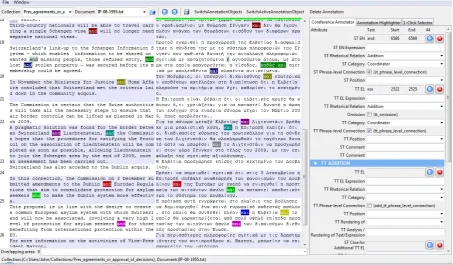
The toolbar is on the top of the screen (see Fig-ure 1) where the collections and the filenames of the aligned documents of each collection are found. The arrow icons guide the annotator to the next or previous document of the collection. Few more icons facilitate managing the documents.
After selecting a collection and an aligned doc-ument, on the left side of the tool we can see the document in an aligned form – one column with the source text (ST) and one column with the tar-get text (TT). The aligned document is presented in translation units, i.e. linked source and target text segments, with serial numbers for each unit for easier reference/retrieval when analysing a cor-pus. Also, to facilitate the visual separation of the translation units the background colour of the units alternates between white and light blue.
6.2 First section of attributes – General
Figure 1: Toolbar and first section of Coreference Annotator – General.
EL equivalent entry. The fields ST EN/TT EL Ex-pression accommodate cases where the ST EN/TT EL entries are part of an expression or form a col-location with the surrounding words. Each entry is also annotated for its rhetorical relation and cate-gory in that particular context. The values in these fields have been selected in relation to the connec-tives and discourse markers of interest. For cases where the discourse marker or connective has an-other function besides the linking one, the value “0” in the ST/TT Rhetorical Relation fields and the value “Other” in the ST/TT Category fields have been provided. There is also provision if a punctuation mark is in place of a TT EL entry. The checkbox of the ST/TT Phrase-level connec-tion provides informaconnec-tion about how often the ST and TT markers/connectives in question link pred-icates or non-predpred-icates (noun phrases, adjectival phrases etc.) in their language respectively. Dif-ference in the type of connection between the ST EN entry and its TT EL equivalent entry manifests different syntactic structures, and perhaps partici-pant roles in the source and target languages. This in turn may reflect translation strategies e.g. shifts, transpositions, modulations etc. The ST/TT Posi-tion fields relate to the distribuPosi-tion of the tokens. When the ST EN entry and its TT EL equivalent are seen in parallel and a change in position is
noted, then different thematic and rhematic struc-tures, and focus may be reflected in the two lan-guages. Omission of an ST EN entry in the tar-get text is also checked. The last two fields, “ST Comment” and “TT Comment”, allow comments by the annotator of the corpus that can be used ei-ther in revising or in analysing the corpus annota-tion.
An example can be a token of the additive con-junction ‘and’ (see Figure 1): This entry involves the token ‘and’, highlighted with blue colour in the translation unit 20. Based on its attributes, it is a conjunction of addition (ST Rhetorical Rela-tion = “AddiRela-tion”), a coordinator in particular (ST Category = “Coordinator”), and connects phrases (non-predicates) (“ST Phrase-level Connection” box checked). The token acting as its equiva-lent in the target text isκαι (kae) ‘and’, which is also a conjunction of addition (TT Rhetorical Re-lation = “Addition”), a coordinator (TT Category = “Coordinator”), and connects non-predicates (“TT Phrase-level Connection” box checked).
6.3 Second section of attributes – TT Addition
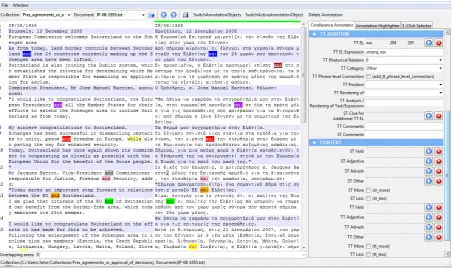
Figure 2: TT Addition.
as in the first section of attributes. Because in this section of attributes the starting point is the tar-get text, a couple of extra fields of attributes have been added: the “TT Rendering of” field which at-tempts to classify the category of the word/phrase in the ST, if any, that motivated the addition of the discourse marker/connective in the TT; the “TT Analysis/Rendering of Text/Expression” field where the ST word/phrase is entered. Finally, there is one more field, ST Clue for Additional TT EL. Practically, this and the previous field have a similar function. An example can be found in translation unit 5 (see Figure 2): According to the annotation, the TT EL entry και (kae) ‘and’ was added in translation unit 5, is not used as a con-junction (TT Rhetorical Relation=0) and performs a different function from coordination in the struc-ture of the sentence (TT Category=Other).
6.4 Third section – Context
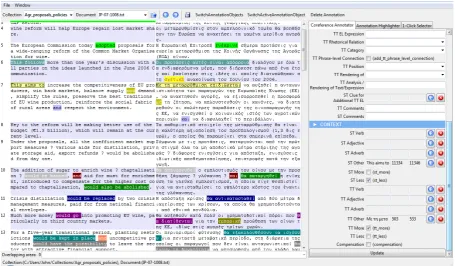
The third section involves the context of the texts (see Figure 3). The original concept of that section is an attempt to map the differences that emerge from the translation process. These differences can be grammatical e.g. a change in the tense of a verb form, semantic e.g. the choice of a slightly/a lot different semantically TT EL equivalent, prag-matic e.g. the choice of a completely different
Figure 3: Context.
or effect in some part of the sentence in another part of that sentence or in a contiguous sentence (Newmark, 1988). This box is checked when the difference in context in the two texts is due to the translation strategy of compensation.
An example can be in translation unit 7 (see Figure 4): According to the annotation, the ST phrase ‘This aims to’ in translation unit 7, entered in the ST Other field is classified as ST Less com-pared to its TT equivalent phrase Με τη
μεταρ-ρύθμιση επιδιώκεται (Mae ti metarythmisi epid-ioketai) ‘With the reform it is aimed’. The rea-son is the act of referring in the English segment where the demonstrative pronoun ‘This’, a lexi-calized deictic element or indexical, is clarified in the Greek segment with the nominal referent μεταρρύθμιση(metarythmisi) ‘reform’. So the TT phrase is more informative than the ST phrase. Be-cause the foregrounded nominal in the TT phrase Με τη μεταρρύθμιση (Mae ti metarythmisi epid-ioketai) ‘With the reform it is aimed’ refers to the pronominal fronted in the ST, this is another fac-tor which enhances the effect of the referring act in relation to the transposition between active and passive voice. Thus, the referring act prevails and classifies the TT phrase as TT More.
7 Statistics
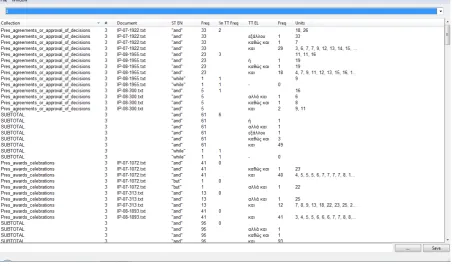
Detailed statistics tables are produced covering all possible search criteria. The findings are eas-ily traceable in the corpus in terms of collection, aligned text and position of the translation unit where the item is found in the aligned text. In par-ticular, three tables are generated. The first table (see Figure 4) presents all the source text tokens of interest per aligned document and collection, their frequency, their translation equivalents along with their own frequency, and cases of omission of the source text connectives/discourse markers in the target text. At the end of each collection, there is the subtotal of the frequency of source text connectives/discourse markers and their trans-lation equivalents. After all the collections have been examined the table presents the total results of the total of collections. An important element is that next to each result there are the numbered translation units where the source text connec-tive/discourse marker and its target text equiva-lent are found. This last feature allows easy re-trieval of the translation unit, which ensures keep-ing track of text meankeep-ing and structure, and flow of discourse.
at-Figure 4: Statistics Table 1.
[image:8.595.74.526.436.705.2]tributes. It includes the elements of the first statistics table enriched with the accompanying at-tributes of both source and target text entries. The results present linearly, focusing on the ST entry – TT equivalent entry pair, the attributes which ac-company the pair. Every time an attribute of the pair changes, there is a different entry in the re-sults. Again, information on the document, collec-tion and translacollec-tion unit where the pairs with the specific attributes are found satisfies any search criteria.
The third statistics table involves results from the second section of attributes – TT Addition. It follows the rationale of statistics table 2 (Figure 5) but it focuses only on the target text items that have been added without being a translation equivalent of the source text items in question. Statistics for the third section of attributes about Context has not been designed yet because this section of attributes has not been fully tested in the corpus.
8 Conclusion
The Coreference Annotator is an annotation tool which is user friendly in its operation. It gives the researcher the advantage of selecting an exter-nal alignment tool for aligning a corpus of parallel texts according to his/her needs. It allows great flexibility in the study of various linguistic items and the translation process at the same time pro-viding, therefore, multiple levels of analysis. Thus the researcher works with a tool that is easily ad-justable to his/her varied needs in relation with the annotation of bilingual data.
References
Ritesh Agarwal, T V Prabhakar, and Sugato Chakrabarty. 2008. “I Know What You Feel”: Analyzing the Role of Conjunctions in Automatic Sentiment Analysis. GoTAL, 5221(1):28–39.
Michael Barlow. 2002. ParaConc: concordance soft-ware for multilingual parallel corpora. In Pro-ceedings of the 3rd International Conference on
Language Resources and Evaluation (LREC 2002),
pages 20–24, Las Palmas, Canary Islands, Spain, May 29–31. European Language Resources Associ-ation.
Diana Blakemore. 1987. Semantic constraints on rele-vance. Blackwell.
Jinho D. Choi, Claire Bonial, and Martha Palmer. 2010. Multilingual propbank annotation tools: Cor-nerstone and jubilee. InProceedings of the NAACL
HLT 2010 Demonstration Session, HLT-DEMO ’10,
pages 13–16, Stroudsburg, PA, USA. Association for Computational Linguistics.
David Day, Chad McHenry, Robyn Kozierok, and Lau-rel Riek. 2004. Callisto : A configurable annotation workbench. In Maria Teresa Lino, Maria Francisca Xavier, Fatima Ferreira, Rute Costa, and Raquel Silva, editors,Proceedings of the 4th International Conference on Language Resources and Evaluation
(LREC) 2004, pages 2073–2076, Lisbon, Portugal,
5. ELRA, European Language Resources Associa-tion.
D. Farwell, S. Helmreich, B. Dorr, R. Green, F. Reeder, K. Miller, L. Levin, T. Mitamura, E. Hovy, O. Ram-bow, N. Habash, and A. Siddharthan, 2008. Inter-lingual Annotation of MultiInter-lingual Text Corpora and
FrameNet. Moutin de Gruyter, Berlin.
Basil Hatim and Ian Mason. 1990. Discourse and the translator. Language in social life series. Longman.
Nancy Ide and Jean V´eronis. 1994. Multext: Multi-lingual text tools and corpora. InProceedings of the 15th conference on Computational linguistics -
Vol-ume 1, COLING ’94, pages 588–592, Stroudsburg,
PA, USA. Association for Computational Linguis-tics.
Kaisa Koskinen. 2001. How to research EU transla-tion? Perspectives, 9(4):293–300.
Kaisa Koskinen. 2004. Shared culture?: Reflec-tions on recent trends in translation studies. Target, 16(1):143–156.
Vasilis Koutsivitis. 1994. Theoria tis Metafra-sis. Ellinikes Panepistimiakes Ekdoseis, Athens, Greece.
Vasilis Koutsivitis. 2003. I proklisi tis polyglossias sti dievrimeni Evropaiki Enosi. In Speech at the 4th Conference on Hellenic Language and Terminology, Athens, Las Palmas, Canary Islands, Spain, October 30–31 and November 1st.
Arun Meena and T. V. Prabhakar. 2007. Sentence level sentiment analysis in the presence of conjuncts using linguistic analysis. InProceedings of the 29th
Eu-ropean conference on IR research, ECIR’07, pages
573–580, Berlin, Heidelberg. Springer-Verlag.
Peter Newmark. 1988. A Textbook of Translation. Prentice-Hall International, New York.
Georgios Petasis, Vangelis Karkaletsis, Georgios Paliouras, Ion Androutsopoulos, and Constantine D. Spyropoulos. 2002. Ellogon: A New Text En-gineering Platform. In Proceedings of the 3rd In-ternational Conference on Language Resources and
Evaluation (LREC 2002), pages 72–78, Las Palmas,
Villy Rouchota. 1998. Connectives, coherence and rel-evance. In Villy Rouchota and Andreas H. Jucker, editors, Current Issues in Relevance Theory, Prag-matics & Beyond New Series, volume 58, pages 11– 58. John Benjamins Publishing Company.
SDL International, 2007. WinAlign User Guide 2007.
Anna Trosborg, editor. 1997. Text Typology and
Trans-lation. Benjamins Translation Library, 26. John
Benjamins, Philadelphia.
Mara Tsoumari. 2008. The translation of EU texts and relevance. In E. Walaszewska, M. Kisielewska-Krysiuk, A. Korzeniowska, and M. Grzegorzewska, editors, Relevant Worlds: Current Perspectives on
Language, Translation and Relevance Theory, pages
188–205. Cambridge Scholars Publishing, Newcas-tle, UK.
Deirdre Wilson and Dan Sperber. 1993. Linguistic form and relevance. Lingua, 90.