READ–IT:
Assessing Readability of Italian Texts with a View to Text Simplification
Felice Dell’Orletta, Simonetta Montemagni and Giulia Venturi Istituto di Linguistica Computazionale “Antonio Zampolli” (ILC–CNR)
via G. Moruzzi, 1 – Pisa (Italy)
{felice.dellorletta,simonetta.montemagni,giulia.venturi}@ilc.cnr.it
Abstract
In this paper, we propose a new approach to readability assessment with a specific view to the task of text simplification: the intended audience includes people with low literacy skills and/or with mild cognitive impairment. READ–IT represents the first advanced read-ability assessment tool for what concerns Ital-ian, which combines traditional raw text fea-tures with lexical, morpho-syntactic and syn-tactic information. In READ–IT readability assessment is carried out with respect to both documents and sentences where the latter rep-resents an important novelty of the proposed approach creating the prerequisites for align-ing the readability assessment step with the text simplification process. READ–IT shows a high accuracy in the document classification task and promising results in the sentence clas-sification scenario.
1 Introduction
Recently, there has been increasing interest in the exploitation of results from Natural Language Pro-cessing (NLP) for the development of assistive tech-nologies. Here, we address this topic by reporting the first but promising results in the development of a software architecture for the Italian language aimed at assisting people with low literacy skills (both native and foreign speakers) or who have lan-guage disabilities in reading texts.
Within an information society, where everyone should be able to access all available information, improving access to written language is becoming more and more a central issue. This is the case, for
instance, of administrative and governmental infor-mation which should be accessible to all members of the society, including people who have reading dif-ficulties for different reasons: because of a low edu-cation level or because of the fact that the language in question is not their mother tongue, or because of language disabilities. Health related information represents another crucial domain which should be accessible to a large and heterogenous target group. Understandability in general and readability in par-ticular is also an important issue for accessing infor-mation over the web as stated in the Web Content Accessibility Guidelines (WCAG) proposed by the Web Accessibility Initiative of the W3C.
In this paper, we describe the approach we devel-oped for automatically assessing the readability of newspaper texts with a view to the specific task of text simplification. The paper is organized as fol-lows: Section 2 describes the background literature on the topic; Section 3 introduces the main features of our approach to readability assessment, with Sec-tion 4 illustrating its implementaSec-tion in the READ-IT prototype; Sections 5 and 6 describe the experi-mental setting and discuss achieved results.
2 Background
Readability assessment has been a central research topic for the past 80 years which is still attracting considerable interest nowadays. Over the last ten years, within the NLP community the automatic as-sessment of readability has received increasing at-tention: if on the one hand the availability of sophis-ticated NLP technologies makes it possible to moni-tor a wide variety of facmoni-tors affecting the readability
of a text, on the other hand there is a wide range of both human- and machine-oriented applications which can benefit from it.
Traditional readability formulas focus on a lim-ited set of superficial text features which are taken as rough approximations of the linguistic factors at play in readability assessment. For example, the Flesch-Kincaid measure (the most common reading difficulty measure still in use, Kincaid (1975)) is a linear function of the average number of syllables per word and of the average number of words per sentence, where the former and latter are used as simple proxies for lexical and syntactic complexity respectively. For Italian, there are two readability formulas: an adaptation of the Flesh-Kincaid for En-glish to Italian known as the Flesch-Vacca formula (Franchina and Vacca, 1986); the GulpEase index (Lucisano and Piemontese, 1988), assessing read-ability on the basis of the average number of char-acters per word and the average number of words per sentence.
A widely acknowledged fact is that all traditional readability metrics are quick and easy to calculate but have drawbacks. For example, the use of sen-tence length as a measure of syntactic complexity as-sumes that a longer sentence is more grammatically complex than a shorter one, which is often but not always the case. Word syllable count is used start-ing from the assumption that more frequent words are more likely to have fewer syllables than less fre-quent ones (an association that is related to Zipf’s Law, Zipf (1935)); yet, similarly to the previous case, word length does not necessarily reflects its difficulty. The unreliability of these metrics has been experimentally demonstrated by several recent stud-ies in the field: to mention only a few Si and Callan (2001), Petersen and Ostendorf (2006), Feng (2009). On the front of the assessment of the lexical dif-ficulty of a given text, a first step forward is rep-resented by vocabulary-based formulas such as the Dale-Chall formula (Chall and Dale, 1995), using a combination of average sentence length and word frequency counts. In particular, for what concerns the latter it reconstructs the percentage of words not on a list of 3000 “easy” words by matching its own list to the words in the material being evalu-ated, to determine the appropriate reading level. If vocabulary-based measures represent an
improve-ment in assessing the readability of texts which was possible due to the availability of frequency dictio-naries and reference corpora, they are still unsatis-factory for what concerns sentence structure.
Over the last ten years, work on readability de-ployed sophisticated NLP techniques, such as syn-tactic parsing and statistical language modeling, to capture more complex linguistic features and used statistical machine learning to build readability as-sessment tools. A variety of different NLP-based approaches to the automatic readability assessment has been proposed so far, differing with respect to: a) the typology of features taken into account (e.g. lexical, syntactic, semantic, discourse), and, for each type, at the level of the inventory of used individual features; b) the intended audience of the texts under evaluation, which strongly influences the readability assessment, and last but not least c) the application within which readability assessment is carried out.
Interesting alternatives to static vocabulary-based measures have been put forward by Si and Callan (2001) who used unigram language models com-bined with sentence length to capture content in-formation from scientific web pages, or by Collins-Thompson and Callan (2004) who adopted a sim-ilar language modeling approach (Smoothed Uni-gram model) to predict reading difficulty of short passages and web documents. These approaches can be seen as a generalization of the vocabulary-based approach, aimed at capturing finer-grained and more flexible information about vocabulary usage. If un-igram language models help capturing important content information and variation of word usage, they do not cover other types of features which are reported to play a significant role in the assessment of readability. More recently, the role of syntac-tic features started being investigated (Schwarm and Ostendorf, 2005; Heilman et al., 2007; Petersen and Ostendorf, 2009): in these studies syntactic structure is tracked through a combination of features from n-gram (trin-gram, bin-gram and unin-gram) language mod-els and parse trees (parse tree height, number of noun phrases, verb phrases and subordinated clauses or SBARs) with more traditional features.
play-ing a central role in determinplay-ing the readplay-ing diffi-culty of a text. More recent approaches esplored the role of these features in readability assessment: this is the case, for instance, of Barzilay and Lap-ata (2008) or Feng (2010). The last few years have been characterised by approaches based on the com-bination of features ranging over different linguistic levels, namely lexical, syntactic and discourse (see e.g. Pitler and Nenkova (2008), Kate (2010)).
Another important factor determining the typol-ogy of features to be considered for assessing read-ability has to do with the intended audience of readers: it is commonly agreed that reading ease does not follow from intrinsic text properties alone, but it is also affected by the expected audience. Among the studies addressing readability with re-spect to specific audiences, it is worth mentioning here: Schwarm and Ostendorf (2005) and Heilman et al. (2007) dealing with language learners, or Feng (2009) focussing on people with mild intellectual disabilities. Interestingly,Heilman et al. (2007) dif-ferentiate the typology of used features when ad-dressing first (L1) or second (L2) language learn-ers: they argue that grammatical features are more relevant for L2 than for L1 learners. Feng (2009) propose a set of cognitively motivated features op-erating at the discourse level specifically addressing the cognitive characteristics of the expected users. When readability is targeted towards adult compe-tent language users a more prominent role is played by discourse features (Pitler and Nenkova, 2008).
Applications which can benefit from an automatic readability assessment range from the selection of reading material tailored to varying literacy levels (e.g. for L1/L2 students or low literacy people) and the ranking of documents by reading difficulty (e.g. in returning the results of web queries) to NLP tasks such as automatic document summarization, machine translation as well as text simplification. Again, also the application making use of the read-ability assessment, which is in turn strictly related to the intended audience of readers, strongly influences the typology of features to be taken into account.
Advanced NLP–based readability metrics devel-oped so far typically deal with English, with a few attempts devoted to other languages, namely French (Collins-Thompson and Callan, 2004), Portuguese (Aluisio et al., 2010) and German (Br¨uck, 2008).
3 Our Approach
Our approach to readability assessment was devel-oped with a specific application in mind, i.e. text simplification, and addresses a specific target audi-ence of readers, namely people characterised by low literacy skills and/or by mild cognitive impairment. Following the most recent approaches, we treat read-ability assessment as a classification task: in partic-ular, given the available corpora for the Italian lan-guage as well as the type of target audience, we re-sorted to a binary classification aimed at discerning easy–to–read textual objects from difficult–to–read ones. The language dealt with is Italian: to our knowledge, this is the first attempt of an advanced methodology for readability assessment for this lan-guage. Our approach focuses on lexical and syntac-tic features, whose selection was influenced by the application, the intended audience and the language dealt with (both for its intrinsic linguistic features and for the fact of being a less resourced language). Following Roark (2007), in the features selection process we preferred easy-to-identify features which could be reliably identified within the output of NLP tools. Last but not least, as already done by Aluisio et al. (2010) the set of selected syntactic features also includes simplification oriented ones, with the final aim of aligning the readability assessment step with the text simplification process.
tences. Since there are no training data at the sen-tence level, it becomes difficult – if not impossible – to evaluate the effectiveness of our approach, i.e. erroneous readability assessments within the class of difficult-to-read texts may either correspond to those easy–to–read sentences occurring within com-plex texts or represent real classification errors. In order to overcome this problem in the readability as-sessment of individual sentences, we introduced a notion of distance with respect to easy-to-read sen-tences. In this way, the prerequisites are created for the integration of the two processes of readability as-sessment and text simplification. Before, text read-ability was assessed with respect to the entire doc-ument and text simplification was carried out at the sentence level: due to the decoupling of the two pro-cesses, the impact of simplification operations on the overall readability level of the text was not always immediately clear. With sentence-based readability assessment, this should be no longer a problem.
4 READ–IT
Our approach to readability assessment has been im-plemented in a software prototype, henceforth re-ferred to as READ–IT. READ–IT operates on syn-tactically (i.e. dependency) parsed texts and it as-signs to each considered reading object - either a document or a sentence - a score quantifying its readability. READ–IT is a classifier based on Sup-port Vector Machines using LIBSVM (Chang and Lin, 2001) that, given a set of features and a training corpus, creates a statistical model using the feature statistics extracted from the training corpus. Such a model is used in the assessment of readability of unseen documents and sentences.
The set of features used to build the statistical model can be parameterized through a configura-tion file: as we will see, the set of relevant fea-tures used for readability assessment at the docu-ment level differs from the those used at the sen-tence level. This also creates the prerequisites for specialising the readability assessment measure with respect to more specific target audiences: as pointed out in Heilman et al. (2007) different types of fea-tures come into play e.g. when addressing L1 or L2 language learners. Here follows the complete list of features used in the reported experiments.
4.1 Features
The features used for predicting readability are or-ganised into four main categories: namely, raw text features, lexical features as well as morpho-syntactic and syntactic features. This proposed four–fold par-tition closely follows the different levels of linguis-tic analysis automalinguis-tically carried out on the text be-ing evaluated, i.e. tokenization, lemmatization, PoS tagging and dependency parsing. Such a partition was meant to identify those easy to extract features with high discriminative power in order to reduce the linguistic pre-processing of texts guaranteeing at the same time a reliable readability assessment.
Raw Text Features
They refer to those features typically used within tra-ditional readability metrics. They includeSentence Length, calculated as the average number of words per sentence, andWord Length, calculated as the av-erage number of characters per words.
Lexical Features
Basic Italian Vocabulary rate features: these fea-tures refer to the internal composition of the vocab-ulary of the text. To this end, we took as a refer-ence resource the Basic Italian Vocabulary by De Mauro (2000), including a list of 7000 words highly familiar to native speakers of Italian. In particular, we calculated two different features corresponding to: i) the percentage of all unique words (types) on this reference list (calculated on a per–lemma basis); ii)the internal distribution of the occurring basic Italian vocabulary words into the usage clas-sification classes of ‘fundamental words’ (very fre-quent words), ‘high usage words’ (frefre-quent words) and ‘high availability words’ (relatively lower fre-quency words referring to everyday objects or ac-tions and thus well known to speakers). Whereas the latter represents a novel feature in the readability assessment literature, the former originates from the Dale-Chall formula (Chall and Dale, 1995) and, as implemented here, it can be seen as the complement of the type out-of-vocabulary rate features used by Petersen and Ostendorf (2009).
disorder as shown in Wright (2003) for adults and in Retherford (2003) for children, has already been used for readability assessment purposes by Aluisio et al. (2010). Due to its sensitivity to sample size, this feature has been computed for text samples of equivalent length.
Morpho–syntactic Features
Language Model probability of Part-Of-Speech unigrams: this feature is based on a unigram lan-guage model assuming that the probability of a token is independent of its context. The model is simply defined by a list of types (POS) and their individual probabilities. This feature has already been shown to be a reliable indicator for automatic readability assessment (see, for example, Pitler and Nenkova (2008) and Aluisio et al. (2010)).
Lexical density: this feature refers to the ratio of content words (verbs, nouns, adjectives and adverbs) to the total number of lexical tokens in a text. Con-tent words have already been used for readability as-sessment by Aluisio et al. (2010) and Feng (2010).
Verbal mood: this feature refers to the distribution of verbs according to their mood. It is a novel and language–specific feature exploiting the predictive power of the Italian rich verbal morphology.
Syntactic Features
Unconditional probability of dependency types: this feature refers to the unconditional probability of different types of syntactic dependencies (e.g. sub-ject, direct obsub-ject, modifier, etc.) and can be seen as the dependency-based counterpart of the ‘phrase type rate’ feature used by Nenkova (2010).
Parse tree depth features: parse tree depth can be indicative of increased sentence complexity as stated by, to mention only a few, Yngve (1960), Frazier (1985) and Gibson (1998). This set of features is meant to capture different aspects of the parse tree depth and includes the following measures: a) the
depth of the whole parse tree, calculated in terms of the longest path from the root of the dependency tree to some leaf; b) theaverage depth of embedded com-plement ‘chains’ governed by a nominal head and including either prepositional complements or nomi-nal and adjectival modifiers; c) theprobability distri-bution of embedded complement ‘chains’ by depth. The first feature has already been used in
syntax-based readability assessment studies (Schwarm and Ostendorf, 2005; Heilman et al., 2007; Nenkova, 2010); the latter two are reminiscent of the ‘head noun modifiers’ feature used by Nenkova (2010).
Verbal predicates features: this set of features cap-tures different aspects of the behaviour of verbal predicates. They range from thenumber of verbal roots with respect to number of all sentence roots occurring in a text to their arity. Thearity of verbal predicatesis calculated as the number of instanti-ated dependency links sharing the same verbal head (covering both arguments and modifiers). Although there is no obvious relation between the number of verb dependents and sentence complexity, we be-lieve that both a low and a high number of depen-dents can make sentence readability quite complex, although for different reasons (elliptical construc-tions in the former case, a high number of modifiers in the latter). Within this feature set we also con-sidered thedistribution of verbal predicates by arity. To our knowledge, this set of features has never been used so far for readability assessment purposes.
Subordination features: subordination is widely acknowledged to be an index of structural complex-ity in language. As in Aluisio et al. (2010), this set of features has been introduced here with a specific view to the text simplification task. A first feature was meant to measure the distribution of subordi-nate vs main clauses. For subordinates, we also considered their relative ordering with respect to the main clause: according to Miller and Weinert (1998), sentences containing subordinate clauses in post–verbal rather than in pre–verbal position are easier to read. Two further features were intro-duced to capture the depth of embedded subordinate clauses since it is a widely acknowledged fact that highly complex sentences contain deeply embedded subordinate clauses: in particular, a) the average depth of ‘chains’ of embedded subordinate clauses
and b) theprobability distribution of embedded sub-ordinate clauses ‘chains’ by depth.
dependency length is measured in terms of the words occurring between the syntactic head and the depen-dent. This feature is the dependency-based counter-part of the ‘phrase length’ feature used for readabil-ity assessment by Nenkova (2010) and Feng (2010).
5 The Corpora
One challenge in this work was finding an appropri-ate corpus. Although a possibly large collection of texts labelled with their target grade level (such as the Weekly Reader for English) would be ideal, we are not aware of any such collection that exists for Italian in electronic form. Instead, to test our ap-proach to automatically identify the readability of a given text, we used two different corpora: a news-paper corpus, La Repubblica (henceforth, “Rep”), and an easy–to–read newspaper, Due Parole (hence-forth, “2Par”) which was specifically written for an audience of adults with a rudimentary literacy level or with mild intellectual disabilities. The articles in 2Par were written by Italian linguists expert in text simplification using a controlled language both at the lexicon and sentence structure levels (Piemon-tese, 1996) .
There are different motivations underlying the se-lection of these two corpora for our study. On the practical side, to our knowledge 2Par is the only available corpus of simplified texts addressing a wide audience characterised by a low literacy level. So, the use of 2Par represented the only possible op-tion on the front of simplified texts. For the selecop-tion of the second corpus we opted for texts belonging to the same class, i.e. newspapers: this was aimed at avoiding interferences due to textual genre varia-tion in the measure of text readability. This is con-firmed by the fact that the two corpora show a sim-ilar behaviour with respect to a number of different parameters, which according to the literature on reg-ister variation (Biber, 2009) are indicative of textual genre differences: e.g. lexical density, the noun/verb ratio, the percentage of verbal roots, etc. On the other hand, the two corpora differ significantly with respect to the distribution of features typically cor-related with text complexity, e.g. the composition of the used vocabulary (e.g. the percentage of words belonging to theBasic Italian Vocabularyin Rep is 4.14% and in 2Par is 48.04%) or, from the syntactic
point of view, the average parse tree height (which in Rep is 5.71 and in 2Par 3.67), the average number of verb phrases per sentence (which in Rep is 2.40 and in 2Par 1.25), the depth of nested structures (e.g. the average depth of embedded complement ‘chains’ in Rep is 1.44 and in 2Par is 1.30), the proportion of main vs subordinate clauses (in Rep main and sub-ordinate clauses represent respectively 65.11% and 34.88% of the cases; in 2Par there is 79.66% of main clauses and 20.33% of subordinate clauses).
The Rep/2Par pair of corpora is somehow remi-niscent of corpora used in other readability studies, such as Encyclopedia Britannica and Britannica El-ementary, but with a main difference: whereas the English corpora consist of paired original/simplified texts, which we might define as “parallel monolin-gual corpora”, the selected Italian corpora rather present themselves as “comparable monolingual corpora”, without any pairing of the full–simplified versions of the same article. Comparability is guar-anteed here by the inclusion of texts belonging to the same textual genre: we expect such comparable cor-pora to be usefully exploited for readability assess-ment because of the emphasis on style over topic.
Although these corpora do not provide an ex-plicit grade–level ranking for each article, broad categories are distinguished, namely easy–to–read vs difficult–to–read texts. The two paired com-plex/simplified corpora were used to train and test different language models described in Section 6. As already pointed out, such a distinction is reliable in a document classification scenario, while at the sentence classification level it poses the remarkable issue of discerning easy–to–read sentences within difficult–to–read documents (i.e. Rep).
6 Experiments and Results
to–read texts.
For what concerns the document classification subtask, we used a corpus made up of 638 docu-ments of which 319 were extracted from 2Par (taken as representative of the class easy–to–read texts) and 319 from Rep (representing the class of difficult– to–read texts). We have followed a 5–fold cross– validation process: the corpus was randomly split into 5 training and test sets. The test sets consisted of 20% of the individual documents belonging to the two considered readability levels, with each docu-ment being included in one test set only. With re-gard to the sentence classification subtask, we used a training set of about 3,000 sentences extracted from 2Par and of about 3,000 sentences from Rep and a test corpus of 1,000 sentences of which 500 were ex-tracted from 2Par (hereafter,2Par test set) and 500 from Rep (hereafter, Rep test set). In the third ex-periment, readability assessment was carried out by READ–IT with respect to a much bigger corpus of 2,5 milion of words extracted from the newspaper
La Repubblica (hereafter, Rep 2.5), for a total of 123,171 sentences, with the final aim of detecting easy–to–read sentences.
All the experiments were carried out using four different readability models, described as follows:
1. Base Model, usingraw textfeatures only;
2. Lexical Model, using a combination of raw textandlexicalfeatures;
3. MorphoS Model: using raw text, lexical and
morpho–syntacticfeatures;
4. Syntax Model: combining all feature types, namelyraw text,lexical,morpho–syntacticand
syntacticfeatures.
Note that in the Lexical and Syntax Models, dif-ferent sets of features were selected for the subtasks of document and sentence classification. In particu-lar, for sentence–based readability assesment we did not take into account the Type/Token Ratio feature, all features concerning the distribution of ‘chains’ of embedded complements and subordinate clauses and the distribution of verbal predicates by arity.
Since, to our knowledge, a machine learning read-ability classifier does not exist for the Italian lan-guage we consider theBase Modelas our baseline:
this can be seen as an approximation of the Gul-pEase index, which is based on the same raw text features (i.e. sentence and word length).
6.1 Evaluation Methodology
Different evaluation methods have been defined in order to assess achieved results in the three afore-mentioned experiment sets. The performance of both document and sentence classification experi-ments have been evaluated in terms of i) overall Ac-curacy of the system and ii) Precision and Recall.
In particular, Accuracy is a global score referring to the percentage of documents or sentences cor-rectly classified, either as easy–to–read or difficult– to–read objects. Precision and Recall have been computed with respect to two the target reading lev-els: in particular, Precision is the ratio of the number of correctly classified documents or sentences over the total number of documents and sentences classi-fied by READ–IT as belonging to the easy–to–read (i.e. 2Par) or difficult–to–read (i.e. Rep) classes; Re-call has been computed as the ratio of the number of correctly classified documents or sentences over the total number of documents or sentences belonging to each reading level in the test sets. For each set of experiments, evaluation was carried out with respect to the four models of the classifier.
sentences with respect to the monitored features. The same notion of distance has also been used to test which model was more effective in predicting the readability of n–word long sentences.
6.2 Results
In Table 1, the Accuracy, Precision and Recall scores achieved with the different READ–IT models in the document classification subtask are reported. It can be noticed that theBase Modelshows the lowest per-formance, while the MorphoS Model outperforms all other models. Interestingly, the Lexical Model
shows a high accuracy for what concerns the doc-ument classification subtask (95.45%), by signifi-cantly improving the accuracy score of the Base Model(about +19%). This result demonstrates that for assessing the readability of documents a combi-nation of raw and lexical features provides reliable results which can be further improved (about +3%) by also taking into account morpho-syntax.
2Par Rep
Model Accuracy Prec Rec Prec Rec
Base 76.65 74.71 80.56 78.91 72.73
Lexical 95.45 95.60 95.30 95.31 95.61
MorphoS 98.12 98.12 98.12 98.12 98.12
[image:8.612.326.545.46.121.2]Syntax 97.02 97.17 96.87 96.88 97.18
Table 1: Document classification results
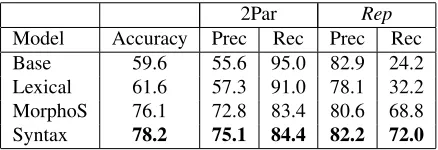
Consider now the sentence classification subtask. Table 2 shows that in this case the most reliable re-sults are achieved with theSyntax Model. It is inter-esting to note that the morpho–syntactic and syntac-tic features allow a much higher increment in terms of Accuracy, Precision and Recall scores than in the document classification scenario: i.e. the difference between the performance of theLexical Modeland the best one in the document classification experi-ment (i.e. the MorphoS Model) is equal to 2.6%, while in the sentence classification case (i.e.Syntax Model) is much higher, namely 17% .
In Table 3, we detail the performance of the best READ–IT model (i.e. the Syntax Model) on the
Rep test set. In order to evaluate those sentences which were erroneously classified as belonging to 2Par, we calculated the distance between 2Par and i) these sentences (140 sentences referred to aswrong
in the Table), ii) the correctly classified sentences
2Par Rep
Model Accuracy Prec Rec Prec Rec
Base 59.6 55.6 95.0 82.9 24.2
Lexical 61.6 57.3 91.0 78.1 32.2
MorphoS 76.1 72.8 83.4 80.6 68.8
Syntax 78.2 75.1 84.4 82.2 72.0
Table 2: Sentence classification results
(360 sentences, referred to ascorrectin the Table), iii) the wholeRep test set. As we can see, the dis-tance between thewrongsentences and 2Par is much lower than the distance holding between 2Par and the correcly classified sentences (correct). This en-tails that the sentences which were erroneously clas-sified as easy–to–read sentences (i.e. belonging to 2Par) are in fact more readable than the correctly classified ones (as belonging to Rep).It is obvious that theRep test set, which contains bothcorrectand
wrongsentences, has an intermediate distance value with respect to 2Par.
Distance
Correct 52.072
Rep test set 45.361
[image:8.612.81.322.330.406.2]Wrong 37.843
Table 3: Distances between 2Par and Rep on the basis of theSyntax Model
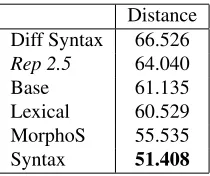
In Table 4, the percentage of Rep 2.5 sentences classified as difficult–to–read is reported. The re-sults show that theSyntax Modelclassifies the higher number of sentences as difficult–to–read, but from these results we cannot say whether this model is the best one or not sinceRep 2.5sentences are not anno-tated with readability information. Therefore, in or-der to compare the performance of the four READ– IT models and to identify which is the best one, we computed the distance between the sentences clas-sified as easy–to–read and 2Par, which is reported, for each model, in Table 5. It can be noticed that theSyntax Modelappears to be the best one since it shows the lowest distance with respect to 2Par; on the other hand, the wholeRep 2.5 corpus shows a higher distance since it contains both difficult– and easy–to–read sentences. Obviously, the sentences classified as difficult–to–read by theSyntax Model
[image:8.612.370.486.339.391.2]Accuracy
Base 0.234
Lexical 0.387
MorphoS 0.705
[image:9.612.145.244.46.108.2]Syntax 0.755
Table 4: Accuracy in sentence classification ofRep 2.5.
Distance Diff Syntax 66.526 Rep 2.5 64.040
Base 61.135
Lexical 60.529
MorphoS 55.535
Syntax 51.408
Table 5: Distance between 2Par and i) difficult–to–read sentences according to theSyntax Model, ii)Rep 2.5, iii) easy–to–read sentences by the four models.
[image:9.612.321.542.52.274.2]In order to gain an in–depth insight into the different behaviour of the four READ–IT models, we evaluated their performances for sentences of a fixed length. We considered sentences whose length ranges between 8 and 30. For every set of sentences of the same legth, we compared the easy–to-read sentences of Rep 2.5classified by the four models with respect to 2Par. In Figure 1, each point rep-resents the distance between a set of sentences of the same length and the same n–word long set of sentences in the 2Par corpus. As it can be seen, the bottom line which represents the sentences classified as easy–to–read by the Syntax Modelis the closest to the 2Par sentences of the same length. On the contrary, the line representing the sentences classi-fied by theBase Modelis the most distant amongst the four READ–IT models. Interestingly, it over-laps with the line representing theRep 2.5sentences: this suggests that a classification model based only on raw text features (i.e. sentence and word length) is not able to identify easy–to–read sentences if we consider sets of sentences of a fixed length. Obvi-ously, the line representing the sentences classified as difficult–to–read by theSyntax Modelshows the broadest distance. This experiment has shown that linguistically motivated features (and in particular syntactic ones) have a fundamental role in the sen-tence readability assessment subtask.
Figure 1: Distance between 2Par and i) difficult–to–read sentences according to theSyntax Model, ii)Rep 2.5, iii) easy–to–read sentences by the four models for sets of sen-tences of fixed length
7 Conclusion
[image:9.612.142.247.153.241.2]Acknowledgements
The research reported in the paper has been partly supported by the national project “Migrations” of the National Council of Research (CNR) in the framework of the line of research Advanced tech-nologies and linguistic and cultural integration in the school. In particular the authors would like to thank Eva Maria Vecchi who contributed to the prerequisites of the proposed readability assessment methodology reported in the paper.
References
Sandra Aluisio, Lucia Specia, Caroline Gasperin and Carolina Scarton. 2010. Readability assessment for text simplification. In Proceedings of the NAACL HLT 2010 Fifth Workshop on Innovative Use of NLP for Building Educational Applications, pp. 1–9.
Giuseppe Attardi. 2006. Experiments with a multilan-guage non-projective dependency parser. In Proceed-ings of the Tenth Conference on Computational Nat-ural Language Learning (CoNLL-X ’06), New York City, New York, pp. 166–170.
Regina Barzilay and Mirella Lapata. 2008. Modeling local coherence: An entity-based approach. In Com-putational Linguistics, 34(1), pp. 1–34.
Douglas Biber and Susan Conrad. 2009.Register, genre, and style. Cambridge, Cambridge University Press. Tim vor der Br¨uck, Sven Hartrumpf, Hermann Helbig.
2008. A Readability Checker with Supervised Learn-ing usLearn-ing Deep Syntactic and Semantic Indicators. In Proceedings of the 11th International Multiconference: Information Society - IS 2008 - Language Technolo-gies, Ljubljana, Slovenia, pp. 92–97.
Jeanne S. Chall and Edgar Dale. 1995. Readability Revisited: The New Dale–Chall Readability Formula. Brookline Books, Cambridge, MA.
Chih-Chung Chang and Chih-Jen Lin. 2001. LIB-SVM: a library for support vector machines. Soft-ware available at http://www.csie.ntu.edu. tw/˜cjlin/libsvm
Kevyn Collins-Thompson and Jamie Callan. 2004. A language modeling approach to predicting reading dif-ficulty. In Proceedings of the HLT / NAACL, pp. 193– 200.
Felice Dell’Orletta. 2009. Ensemble system for Part-of-Speech tagging. In Proceedings of Evalita’09, Eval-uation of NLP and Speech Tools for Italian, Reggio Emilia, December.
Tullio De Mauro. 2000. Il dizionario della lingua ital-iana. Torino, Paravia.
Lijun Feng, Martin Jansche, Matt Huenerfauth and No´emie Elhadad. 2010. A comparison of features for automatic readability assessment. In Proceedings of the 23rd International Conference on Computational Linguistics (COLING 2010), pp. 276–284.
Lijun Feng, No´emie Elhadad and Matt Huenerfauth. 2009. Cognitively motivated features for readability assessment. In Proceedings of the 12th Conference of the European Chapter of the Association for Compu-tational Linguistics (EACL ’09), pp. 229–237. V. Franchina and Roberto Vacca. 1986. Adaptation of
Flesh readability index on a bilingual text written by the same author both in Italian and English languages. In Linguaggi (3), pp. 47–49.
Lyn Frazier. 1985. Syntactic complexity. In D.R. Dowty, L. Karttunen and A.M. Zwicky (eds.),Natural Language Parsing, Cambridge University Press, Cam-bridge, UK.
Edward Gibson. 1998. Linguistic complexity: Locality of syntactic dependencies. InCognition, 68(1), pp. 1-76.
Michael J. Heilman, Kevyn Collins and Jamie Callan. 2007. Combining Lexical and Grammatical Features to Improve Readability Measures for First and Second Language Texts. In Proceedings of the Human Lan-guage Technology Conference, pp. 460–467.
Michael J. Heilman, Kevyn Collins and Maxine Eske-nazi. 2008. An analysis of statistical models and fea-tures for reading difficulty prediction. In Proceedings of the Third Workshop on Innovative Use of NLP for Building Educational Applications (EANL ’08), pp. 71–79.
Rohit J. Kate, Xiaoqiang Luo, Siddharth Patwardhan, Martin Franz, Radu Florian, Raymond J. Mooney, Salim Roukos, Chris Welty. 2010. Learning to Pre-dict Readability using Diverse Linguistic Features. In Proceedings of the 23rd International Conference on Computational Linguistics (COLING 2010), pp. 546– 554.
J. Peter Kincaid, Lieutenant Robert P. Fishburne, Richard L. Rogers and Brad S. Chissom. 1975. Derivation of new readability formulas for Navy enlisted person-nel. Research Branch Report, Millington, TN: Chief of Naval Training, pp. 8–75.
George Kingsley Zipf. 1988.The Psychobiology of Lan-guage. Houghton–Miflin, Boston.
Dekan Lin. 1996. On the structural complexity of nat-ural language sentences. In Proceedings of COLING 1996, pp. 729–733.
Ryan McDonald and Joakim Nivre. 2007. Character-izing the Errors of Data-Driven Dependency Parsing Models. In Proceedings of EMNLP-CoNLL, 2007, pp. 122-131.
Jim Miller and Regina Weinert. 1998. Spontaneous spo-ken language. Syntax and discourse. Oxford, Claren-don Press.
Ani Nenkova, Jieun Chae, Annie Louis, and Emily Pitler. 2010.Structural Features for Predicting the Linguistic Quality of Text Applications to Machine Translation, Automatic Summarization and Human–Authored Text. In E. Krahmer, M. Theune (eds.),Empirical Methods in NLG, LNAI 5790, Springer-Verlag Berlin Heidel-berg, pp. 222–241.
Sarah E. Petersen and Mari Ostendorf. 2006. A machine learning approach to reading level assessment. Uni-versity of Washington CSE Technical Report.
Sarah E. Petersen and Mari Ostendorf. 2009. A ma-chine learning approach to reading level assessment. In Computer Speech and Language (23), pp. 89–106. Maria Emanuela Piemontese. 1996. Capire e farsi
capire. Teorie e tecniche della scrittura controllata Napoli, Tecnodid.
Emily Pitler and Ani Nenkova. 2008. Revisiting read-ability: A unified framework for predicting text qual-ity. In Proceedings of the 2008 Conference on Em-pirical Methods in Natural Language Processing, pp. 186–195.
Kristine Retherford. 2003. Normal development: a database of communication and related behaviors. Eau Claire, WI: Thinking Publications.
Brian Roark, Margaret Mitchell and Kristy Hollingshead. 2007. Syntactic complexity measures for detecting mild cognitive impairment. In Proceedings of the Workshop on BioNLP 2007: Biological, Translational, and Clinical Language Processing, pp. 1–8.
Sarah E. Schwarm and Mari Ostendorf. 2005. Read-ing level assessment usRead-ing support vector machines and statistical language models. In Proceedings of the 43rd Annual Meeting on Association for Compu-tational Linguistics (ACL 05), pp. 523–530.
Luo Si and Jamie Callan. 2001. A statistical model for scientific readability. In Proceedings of the tenth in-ternational conference on Information and knowledge management, pp. 574–576.
Adam Skory and Maxine Eskenazi. 2010. Predicting cloze task quality for vocabulary training. In Proceed-ings of the NAACL HLT 2010 Fifth Workshop on In-novative Use of NLP for Building Educational Appli-cations, pp. 49–56.
Victor H.A. Yngve. 1960.A model and an hypothesis for language structure. In Proceedings of the American Philosophical Society, pp. 444-466.