Do wordnets also improve human performance on NLP tasks?
Kristiina Muhonen and Krister Lind´en Department of Modern Languages
University of Helsinki
[email protected] [email protected]
Abstract
FinnWordNet is a wordnet for Finnish that complies with the format of the Princeton WordNet (PWN) (Fellbaum, 1998). It was built by translating the Princeton WordNet 3.0 synsets into Finnish by human transla-tors. It is open source and contains 117000 synsets. The Finnish translations were in-serted into the PWN structure resulting in a bilingual lexical database.
In natural language processing (NLP), wordnets have been used for infusing com-puters with semantic knowledge assum-ing that humans already have a sufficient amount of this knowledge.
In this paper we present a case study of using wordnets as an electronic dictio-nary. We tested whether native Finnish speakers benefit from using a wordnet while completing English sentence com-pletion tasks. We found that using ei-ther an English wordnet or a bilingual English-Finnish wordnet significantly im-proves performance in the task. This should be taken into account when setting standards and comparing human and com-puter performance on these tasks.
1 Introduction
Wordnets are lexical databases that group words of a language into synonym sets called synsets, pro-vide general definitions of the synsets and encode the semantic relations between the synsets. Typi-cally they are monolingual, but efforts have been made to produce multilingual wordnets as well, see e.g. Vossen (1998).
1.1 Building a New Wordnet
A wordnet for a new language can be constructed in several ways. First, it can be built from scratch.
This requires extracting the synsets automatically from corpora or defining them manually. In order to ensure that the most common words of the lan-guage are actually present in the automatically col-lected synsets, a common strategy is to use a list with the central vocabulary of the language. Not only do the actual synsets need to be automatically extracted, also the semantic relations between the synsets must be encoded from the very beginning. Second, the new wordnet can be translated from an existing wordnet. Translating a wordnet ig-nores the idea of every language being so different with such varying synonym groups and hierarchies that they have to be constructed separately for ev-ery language. However, like Lind´en and Carlson (2010) note, most of the words in a language ac-tually describe entities and phenomena present in most languages, although there are language spe-cific differences in which nuances of a concept get a specific word capturing the distinctions in mean-ing.
The third way to construct a wordnet is a com-bination of automatic extraction and translation. First, the core of the new wordnet is built by trans-lating 5000 central concepts from the PWN. This core can be extended with e.g. a thesaurus of the target language. Vossen (2004) describes how bas-ing the wordnet on a common core enables link-ing wordnets to each other via the Inter-Lingual-Index.
1.2 The Finnish Wordnet
and Carlson, 2010).
Choosing translation as the means of build-ing FiWN has the downside of includbuild-ing many English-specific terms and concepts in the Finnish wordnet. However, English-specific or rare words in general are all welcome in an electronic ver-sion. Some synsets may seem problematic from a cultural perspective, e.g. independence dayas synonymous with4th of July. In such cases, the less general concept can be made a hyponym with corresponding culture-specific terms as sister con-cepts.
1.3 Using Wordnets
Generally the research around wordnets revolves around NLP applications and less emphasis has been put on wordnets aiding human users. The usability of wordnets as lexical resources for NLP applications has long been established. In particu-lar, wordnets have been found useful in improving the performance of systems for word sense disam-biguation, information retrieval and automatic text classification, see e.g. Tan´acs et al. (2007).
The usability of wordnets for human users is a rather neglected topic. Since creating a wordnet consumes a lot of time and resources, the usabil-ity of wordnets should also be considered from a human perspective. The benefits humans get from an intuitively structured lexical database should be considered a prerequisite, not merely a positive side effect of the various wordnet projects imple-mented for different languages.
The focus of our study is to examine the usabil-ity of wordnets from a human perspective. We want to see how human users benefit from using wordnets as a lexical resource and compare the benefits they get from a regular electronic dictio-nary and first, a monolingual wordnet, and second, a bilingual one. We want to demonstrate that even a monolingual wordnet helps a non-native English speaker complete a sentence completion task at least as much as a regular dictionary does.
2 Method
The purpose of our study is to examine how word-nets aid human users. The experiment is con-ducted by asking Finnish native speakers to carry out sentence completion tasks in English using dif-ferent lexical resources for assistance.
The test consists of SAT Reasoning Test style multiple choice sentence completion tasks. We
decided on using sentence completion rather than translation because it is more straightforward to assess the correctness of the answers. Had we chosen a translation task, we would have first had to decide what the ultimately best translation of a given English passage is, which is a complex issue reaching far beyond the scope of this paper.
We sought out the sample questions from a set of training questions for the SAT test1. We
esti-mated that SAT-level English is sufficiently diffi-cult for Finnish university students, so that the tes-tees would not be able to get full scores on the test without using any help.
Sentence completions measure the testees vo-cabulary and understanding of sentence structure and require the testee to select one or two words that best complete the sentence. The questions are multiple choice and there are five options to choose from. In Figure 1 we display an example question from the test.
1. by nature, Jones spoke very little even to his own family members.
A. garrulous B. equivocal C. taciturn D. arrogant E. gregarious
Figure 1: A sample question
There are 40 questions randomly grouped into sets of ten. Each set is completed with the help of a different aid.
2.1 Lexical Resources
The purpose of the experiment is to see which lex-ical aid helps the testee the most. In order to see this, we ask the testees to use three different tools: an electronic English dictionary, PWN and FiWN. One set of questions is answered without using any help so that we can establish the English vocabu-lary skills of the answerer.
2.1.1 Merriam-Webster
We chose the Merriam-Webster2 English
from a regular dictionary without Finnish transla-tions. We assume this to be the most typical kind of lexical aid used. An abridged dictionary entry for ”equivocal”3can be seen in Figure 2 with the
boldface words being links to other entries.
equiv·o·cal 1.
a: subject to two or moreinterpretationsand usually used to mislead or confuse<an equivocal statement>
b: uncertain as an indication or sign<equivocal evidence> 2.
a: of uncertain nature or classification<equivocal shapes> b: of uncertaindispositiontoward a person or thing : unde-cided<an equivocal attitude>
c: of doubtful advantage, genuineness, or moralrectitude
<equivocal behavior> Examples ofEQUIVOCAL
He responded to reporters’ questions withequivocalanswers. The experiment producedequivocalresults.
Figure 2: A truncated Merriam-Webster dictio-nary entry
Merriam-Webster also includes information about the etymology of the word and a list of syn-onyms and antsyn-onyms. For conciseness sake we do not repeat the information here.
2.1.2 PWN
The second resource we use is the PWN.4We give
a truncated PWN search result for the word equiv-ocal5in Figure 3.
Overview of adj equivocal
The adj equivocal has 3 senses (first 1 from tagged texts) 1. (1) equivocal,ambiguous– (open to two or more inter-pretations; or of uncertain nature or significance; or (often) intended to mislead; ”an equivocal statement”; [...]) 2. equivocal – (open to question; ”aliens of equivocal loy-alty”; [...])
3. equivocal – (uncertain as a sign or indication; ”the evi-dence from bacteriologic analysis was equivocal”)
Figure 3: A truncated PWN entry: Overview
If the user only uses the ”Overview” mode of the PWN, the use of the wordnet resembles that of a regular dictionary. Only when the user also views the ”Similarity” information of the word, 3http://www.merriam-webster.com/dictionary/equivocal 4http://wordnet.princeton.edu/
5
http://www.ling.helsinki.fi/cgi-bin/fiwn/search?wn=en&w=equivocal&t=all&sm=Search
does the structure of the wordnet benefit the user. This can be seen in Figure 4. The boldfaced words are again links to other entries.
Similarity of adjequivocal
Sense 1equivocal(vs.unequivocal),ambiguous
=>double,forked
=>evasive
=>indeterminate
Also See->ambiguous#2 Sense 2equivocal
=>questionable(vs.unquestionable) Sense 3equivocal
=>inconclusive(vs.conclusive)
Figure 4: A truncated PWN entry: Similarity
It is also possible to view e.g. antonyms, per-tainyms, derived forms and the polysemy count of the word, but for the task at hand the information presented in Figures 4 and 3 suffices.
We assume that using the English wordnet yields at least slightly better results in the sentence completion task than using an electronic dictio-nary. The assumption based on the intuitive group-ing of the synsets.
2.1.3 FiWN
The third tool to be used in the test is the PWN with the Finnish translations visible, FiWN6. The
search results are identical to the PWN, only the Finnish translations are added. The glosses and examples are still only in English. The overview of the translated adjective equivocalis shown in Figure 5.
Overview of adj equivocal
The adj equivocal has 3 senses (first 1 from tagged texts) 1. (1) equivocal [kaksiselitteinen],ambiguous[ monik¨asit-teinen, ep¨aselv¨a, monimerkityksinen] – (open to two or more interpretations; or of uncertain nature or significance; or (often) intended to mislead; ”an equivocal statement”; [...]) 2. equivocal [ep¨avarma,kyseenalainen] – (open to ques-tion; ”aliens of equivocal loyalty”; [...])
3. equivocal [ep¨avarma,kyseenalainen] – (uncertain as a sign or indication; ”the evidence from bacteriologic analysis was equivocal”)
Figure 5: A truncated FiWN entry with transla-tions: Overview
Correspondingly, Figure 6 shows the synsets with the Finnish equivalents.
We want to see whether the results get signifi-cantly better when the testee gets to use a bilingual wordnet. At first guess it can be assumed that the translations speed up the test taking and improve
Similarity of adjequivocal
Sense 1 equivocal [kaksiselitteinen] (vs. unequivocal
[vastaansanomaton, selke¨a]), ambiguous [ monik¨asit-teinen,ep¨aselv¨a,monimerkityksinen]
=>double[kaksimielinen],forked[kaksimielinen] =>evasive[v¨alttelev¨a,kartteleva]
=>indeterminate[ep¨am¨a¨ar¨ainen]
Also See-> ambiguous#2 [monik¨asitteinen, ep¨aselv¨a,
monimerkityksinen]
Sense 2equivocal[ep¨avarma,kyseenalainen]
=> questionable [kyseenalainen] (vs. unquestionable
[kiistaton])
Sense 3equivocal[ep¨avarma,kyseenalainen]
=> inconclusive [ei ratkaiseva] (vs. conclusive
[ratkaiseva])
Figure 6: A truncated FiWN entry with transla-tions: Similarity
the results. Since we do not time the test taking, it is only possible to see whether the results get better.
2.2 The Test in Practice
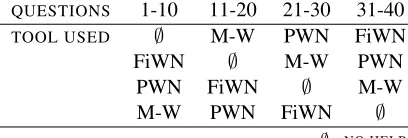
[image:4.612.335.500.295.363.2]We want to make sure that the randomly chosen questions are equally difficult and that the results are not influenced by one set of questions being easier or harder than the other. To ensure this, we circulate the tool used for each group as shown in Table 1.
QUESTIONS 1-10 11-20 21-30 31-40
TOOL USED ∅ M-W PWN FiWN
FiWN ∅ M-W PWN
PWN FiWN ∅ M-W
M-W PWN FiWN ∅
∅=NO HELP
M-W= MERRIAM-WEBSTER
Table 1: Tool circulation
The test is conducted as an online query. The questions are organized in e-forms which are di-vided into four parts depending on what type of help the answerer can use. Due to the tool circula-tion, there are four different e-forms, the order of the tools corresponding to the lines in Table 1.
The test is conducted without supervision or timing. The lack of supervision is due to practi-cal issues; the number of answers is higher when the testees can complete the task whenever it suits them best. This, however, means that the results can be faked. In order to make cheating in the task less tempting, the test is submitted anonymously.
3 Results
We got 34 responses to our query during three weeks with only one reminder. Though the num-ber of testees is fairly small, we can still make gen-eral remarks on the usefulness of the three lexical aids as well as on their statistical significance.
Based on the 34 answers we can show that even using an English dictionary significantly improves the performance of the testee. This is a rather pre-dictable outcome. The more interesting question is, whether using PWN as a dictionary improves the results further. And finally, whether a bilin-gual English-Finnish wordnet brings any further assistance compared to the English one.
Table 2 summarizes the results by showing the average of correct answers per tool. The maxi-mum score is 10.
TOOL MEAN MEDIAN MODE
∅ 6.99 7 8
M-W 8.57 9 9
PWN 8.91 9 9
FWN 8.73 9 9
Table 2: Results per tool
Table 2 shows how different tools help users in completing the task. At first look it can already be seen that using any of the chosen tools improves the results, and that the difference between the tools is small.
From Table 3 we can deduce that the difficulty level of the groups is relatively even although the third group seems to have been slightly harder than the rest.
Based on this sample, we cannot draw any con-clusions on whether the order of the tools used as an aid makes a difference to the result. We can only state that the results without any aid are al-ways poorer than the results when the testees could use one of the given tools.
The slightly poorer average of the third group, WN-FW-∅-MW, can possibly be explained by the the most difficult question set (21-30) being an-swered without any help.
[image:4.612.94.298.423.492.2]QUESTION GROUPS
N 1-10 11-20 21-30 31-40 MEAN(TOOLS)
∅-MW-PWN-FIWN 4 8 9 8.75 8.75 8.63
FIWN-∅-MW-PWN 7 9.14 6.86 8.43 9.43 8.47
PWN-FIWN-∅-MW 10 8.4 8.5 5.7 8 7.65
MW-PWN-FIWN-∅ 13 8.85 9.08 8.54 7.38 8.46
MEAN(QUESTIONS) 8.6 8.36 7.86 8.39
[image:5.612.139.471.57.190.2]∅=NO HELP MW= MERRIAM-WEBSTER N= NUMBER OFANSWERS
Table 3: Results per question group and tool order
From this test set-up, however, we can draw conclusions on the usefulness of the tools. On the average, all testees got 6.99/10 questions correct without using any aids. The number tells us that the difficulty level of the questions is apt; in fact only 4 testees got a full score without using any help.
Using the Merriam-Webster dictionary im-proved most testees’ performance. The number of perfect answers rises up to 10 when the testees get to use a dictionary as their aid.
Using the monolingual PWN as assistance, yields highest results. On the average the testees got 8.9/10 with the help of PWN. 12 of the an-swers were perfect. Based on the test, getting the Finnish translations alongside the English PWN does not improve performance on the sentence completion task. The number of perfect answers is 11 with the help of FiWN. We conclude that the translations do not provide additional value to the PWN in this type of a task.
3.1 The Wilcoxon Two Sample Test
We choose the Wilcoxon Two Sample Test7as the
means for calculating statistical significance of the results. We want to see whether there is a signif-icant difference in the way the testees performed while using different aids. The Wilcoxon Test fits our need because it does not assume the data to be normally distributed and yields accurate results with even small data.
We run the Wilcoxon Test on the material pair-wise to see which tools differ from each other sig-nificantly. The test is performed for all possible pairings of the tools, as shown below. With the Wilcoxon test we can assume that if p<0.05, it is 7http://www.fon.hum.uva.nl/Service/Statistics/Wilcoxon Test.html
not likely that the two groups have the same dis-tribution and median making the difference statis-tically significant.
a) ∅vs. Merriam-Webster
b) ∅vs. PWN
c) ∅vs. FiWN
d) Merriam-Webster vs. PWN
e) Merriam-Webster vs. FiWN
f) PWN vs. FiWN
We formulate the null hypothesis in the follow-ing way:
H0: The data in groups x and y are indepen-dent samples from iindepen-dentical continuous distribu-tions with equal medians.
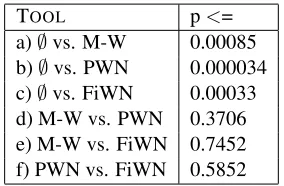
We carry out the Wilcoxon tests to see whether we have to reject the null hypothesis at the 5% sig-nificance level. The results are given in Table 4.
TOOL p<=
a)∅vs. M-W 0.00085 b)∅vs. PWN 0.000034
c)∅vs. FiWN 0.00033
d) M-W vs. PWN 0.3706 e) M-W vs. FiWN 0.7452 f) PWN vs. FiWN 0.5852
Table 4: Results of the Wilcoxon Two Sample test
[image:5.612.347.489.528.621.2]assume that any of our chosen tools significantly helps the testee in completing the task.
Currently, the small number of responses pre-vents us from drawing firm conclusions on the sig-nificance of the difference between using wordnets and regular electronic dictionaries. However, the average performance using either of the two word-nets was better than using only an electronic dic-tionary.
4 Discussion and further work
The test gives us an insight into the usage of word-nets as dictionaries and into the way they can com-pete with traditional electronic dictionaries. The advantages a human user get from using a wordnet instead of a dictionary has so far not been widely studied.
We should extend the test with a larger sam-ple of respondents to determine the significance of the improvement using wordnets over regular electronic dictionaries. Our number of responses is too small for making conclusions on which tool helps the testee most. Based on the experiment it is clear, however, that using any of our chosen tools helps the testee perform better.
Based on our study, it remains an open ques-tion whether the translaques-tions available in the FiWN bring any additional value to the testee. This could be better tested with a translation task, where the translated wordnet would probably be the most helpful tool. However, assessing the quality of the translations is difficult.
The average reported SAT results8 in 2010 for
the Critical Reading9part of the test for test takers
with English as their first language are 64 percent. Our sample consisted mainly of language stu-dents at the University of Helsinki and the sample performance of 69.9 percent on average conforms to the expectations when using no aids or tools. An initial concern that the performance boost is rele-vant only for non-native speakers therefore seems not to be the case.
Our experiment provided us feedback for de-velopment of the test and FiWN. After complet-ing the test, the testees had the chance of leavcomplet-ing open feedback on both the testing method and the 8 http://professionals.collegeboard.com/profdownload/2010-total-group-profile-report-cbs.pdf
9The results for sentence completion are not given sepa-rately, so we have to compare our results to the Critical Read-ing section consistRead-ing of sentence completions and readRead-ing comprehension.
tools. Most testees found the translated wordnet most helpful, their gut feeling was that that us-ing it would yield best results. Only a few tes-tees preferred using Merriam-Webster over using either one of the wordnets.
Typically NLP applications that use wordnets for semantic classification use human performance as the gold standard when evaluating the results. This is the case e.g. in Turney and Littman (2005). The authors implement an algorithm for corpus-based learning of analogies and semantic relations and compare the results against human perfor-mance in the SAT analogy questions. There sys-tem correctly answers 47% of the questions where the average SAT test taker gets about 57% of the questions right.
We have established that human performance on tasks like sentence completion significantly im-proves if wordnets can be used as lexical aids. This most likely also applies to solving verbal analo-gies, since they are even more context-sensitive. We therefore suggest that NLP applications using wordnets should in fact be compared with human performance when humans use the same lexical resources.
To conclude, some studies have used wordnets to boost computer program performance on word sense disambiguation. Our study suggests that hu-man users should perhaps be given a similar ad-vantage if we wish to compare the results in a fair way.
5 Conclusion
Typically wordnets are used as lexical resources in various NLP applications. Using wordnets as lex-ical databases for other information systems has been studied widely, but the advantage wordnet provides to a human user as an electronic dictio-nary has received less interest.
En-glish vocabulary skills, one set of questions was answered without any help.
The experiment sought to give insight on how useful wordnets are to a human user. The testees used both the English wordnet, and the bilingual FiWN so that we could test whether the transla-tions bring any additional help to a non-native En-glish speaker.
We found that a wordnet significantly improves the performance of a human user on a sentence completion task and we found weak indications that a wordnet may be slightly better than a reg-ular electronic dictionary for this purpose. This sets new standards for what we should require from computers on similar tasks when comparing them with humans if we boost the computer per-formance with wordnets or other lexical resources.
References
Christiane Fellbaum, editor. 1998.WordNet: An
Elec-tronic Lexical Database. The MIT Press, Cam-bridge/London/England.
Krister Lind´en and Lauri Carlson. 2010. FinnWordNet
– WordNet p˚a finska via ¨overs¨attning.
Lex-icoNordica – Nordic Journal of Lexicography, 17:119–140.
Attila Tan´acs, D´ora Csendes, Veronika Vincze, Chris-tiane Fellbaum, and Piek Vossen, editors. 2007. Proceedings of the Fourth Global WordNet Confer-ence. University of Szeged.
Peter D. Turney and Michael L. Littman. 2005.
Corpus-based learning of analogies and semantic
re-lations.Machine Learning, 60:251–278.
Piek Vossen, editor. 1998. EuroWordNet: a
multi-lingual database with lexical semantic networks for European Languages. Kluwer, Dordrecht.
Piek Vossen. 2004. EuroWordNet: a
multilin-gual database of autonomous and language-specific
wordnets connected via an inter-lingual-index.