Integrating Knowledge Resources and Shallow Language Processing for
Question Classification
Maheen Bakhtyar Department of CSIM,
Asian Institute of Technology, Thailand. Department of CS&IT,
University of Balochistan, Pakistan.
Asanee Kawtrakul
Department of Computer Engineering, Kasetsart University,Thailand.
NECTEC, Pathumthani, Thailand.
asanee [email protected]
Abstract
Typically, Question Classification (QC) is the first phase in Question Answer-ing (QA) systems. This phase is respon-sible for finding out the type of the ex-pected answer by having the answer space reduced by pruning out the extra infor-mation that is not relevant for the answer extraction. This paper focuses on some Location based questions and some En-tity type questions. Almost all the previ-ous QC algorithms evaluated their work by using the classes defined by Li and Roth (2002). The coarse grained classes Loca-tionandEntityboth have fine grained class Other. In this paper we target and present the mechanism to create new classes to re-place the Other classes in Location and Entityclass. Additionally, we also present an automatic hierarchy creation method to add new class nodes using the knowledge resources and shallow language ing. We also show how language process-ing and knowledge resources are impor-tant in the question processing and its ad-vantage on Answer Extraction phase.
1 Introduction
Usually people are interested in the exact answer and do not desire to look for the answer them-selves in long list of documents. Exact answer is more interesting and useful than getting a list of documents.
Query analysis, processing or classification phase have been always emphasized. The follow-ing examples1show the importance of this phase
with respect to the Answer Extraction.
Example 1: Who was the first American to walk
1Questions and answer sentence taken from TREC-10 Text-REtrieval-Conference-10 (2001)
in space?. The answer sentence obtained is “In 1965 astronaut Edward White became the first American to “walk” in space during the flight of Gemini 4”2. Suppose the question is classified as
Human:Individual by some classification mecha-nism. We notice that the answer line contains the matching string “first American to walk in space” therefore, the answer to the question is to be se-lected from the remaining part “1965”, “Edward White” or “Gemini 4”. Correct classification now leads us to the answerEdward White.
Example 2: What day and month did John Lennon die?. If this question is classified as Num-ber:Date, it means that only date type will be tar-geted from the text. This implies that the question when correctly classified will give a hint about the answer which helps the system in judging and ex-tracting the answer from the corpus.
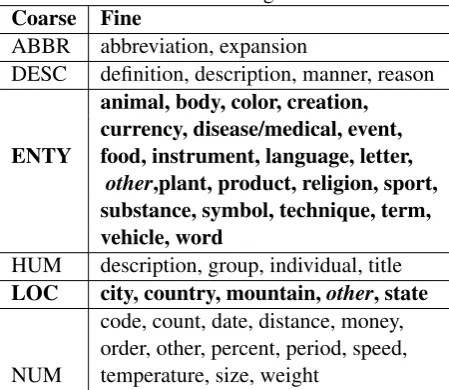
The questions can be categorized mainly in two ways i.e. considering the question word and sec-ond the answer type. Ray et al. (2010) categorizes the factoid questions first in the categories such as“who”, “why”, “what”, “where”, “how” and “when”and classify them based on the two level hierarchy of classes defined by Li and Roth (2002) and shown in Table 1.
2 Problem Statements
Question Classification is important and helpful for extracting the answers. A correct and meaning-ful classification will lead the system to more ef-ficient and correct answer extraction mechanisms. On the other hand, a wrong or meaningless classi-fication will not improve the answer extraction and might become a cause of inaccurate final results.
2This line is taken from the document numberDOCNO:
AP890527-0145and contains the answer to this question
Table 1: Coarse and Fine grained classes Coarse Fine
ABBR abbreviation, expansion
DESC definition, description, manner, reason
ENTY
animal, body, color, creation, currency, disease/medical, event, food, instrument, language, letter,
other,plant, product, religion, sport, substance, symbol, technique, term, vehicle, word
HUM description, group, individual, title LOC city, country, mountain,other, state
NUM
code, count, date, distance, money, order, other, percent, period, speed, temperature, size, weight
2.1 Insufficient classes in the taxonomy Question classes defined and labeled in UIUC3
dataset by Li and Roth (2002) are most widely used in the previous work (Quan et al. (2011), Song et al. (2011), Yu et al. (2010), Buscaldi et al. (2010), Huang et al. (2007) and Boldrini et al. (2009)). Many of the researchers developed their systems using these classes and the labeled question dataset. In the labeled dataset, if a ques-tion is not mapped to some class, it is placed into the fine grained classOther. Assigning to a class Other is not very helpful in the answer extrac-tion. For example, in case of Location category, Location:Other will only prune outcity, country, mountain andstateas possible answer categories. Therefore, a close analysis of questions belonging to this class is needed and a new set of classes is required to overcome this deficiency.
We currently focus on two of the coarse grained classes; Location and Entity; and all their fine grained classes. It is also observed that many of the fine grained classes are missing in the exist-ing class hierarchy which needs to be mapped to the questions. For instance, the classriver,lakeor any otherwater bodyis not present in the existing class taxonomy whereas some questions require such classes e.g. the questionWhat body of water are the Canary Islands in ? is currently placed in classLOC:Otherby Li and Roth (2002). This as-signed class neither gives an exact hint nor helps to filter the candidate answers. Whereas, mapping it to a class such aswaterbodymakes it more
mean-3http://cogcomp.cs.illinois.edu/Data/QA/QC/
ingful and easier to find the answers. Similarly, the question “what is Bill Gates of Microsoft e-mail address” ? is labeled as LOC:Other by the authors. If this question is searched using a search engine, a lot of documents will be returned having all the key concepts in the question. A chunk of text containing the answer is as follows, “All the Good Emails get sent to another Bill Gates Email Address, which he checks twice a week. Because He knows everyone will be looking for his email address under @microsoft.com. The Employees who checks his email under [email protected] send it to the one he checks” 4. This chunk
from the document contains all the question key-words. Without the classes defined, we do not know which part of the chunk is more important. Whereas, if we determine that the answer should be an email address, then we only need to target the email addresses in the text without taking care of the rest of the document. Therefore, the detail of classes and subclasses is needed to cover more and more questions instead of assigning them to theLOC:Otherclass.
Li and Roth (2002) show that among500 ques-tions in TREC 10, 62%of the location questions belong to the class Other. The highest number of questions lie under the location categoryOther which is actually not very helpful or meaningful in extracting the answer. It means that about62% of the location questions will be answered during the answer extraction phase without making use of the classes, despite the efforts put into classifi-cation phase. Similarly, 13% of the entity ques-tions belong to the class Other. Entity class has 22 fine grained classes and the large number of questions are mapped to Other after animal and substance. Later, Li and Roth (2006) again gave a statistics of distribution of questions in each class of TREC 10 and 11 Text-REtrieval-Conference (1999 to 2007) questions, collectively. They ob-served that out of 1000 questions, 195(19.5%) areLocation based. InLocation based questions, there are 22.6% questions mapped to class city, 10.8%questions about classcountry,2.6%about mountain, 58.5% are mapped to classother, and 5.6%questions are mapped to classstate.
One of the main advantage of replacing the class Otherwith fine grained classes is that it makes as-signment of a single question to multiple
classes/-4 http://email.about.com/b/2009/05/30/how-can-i-email-bill-gates-what-is-bill-gatess-email-address.htm
fication scheme but initially only for the specific pattern of questions as discussed earlier.
Answer extraction phase requires the question to be classified in some manner. If a classifica-tion mechanism is developed by using our set of classes, then answer extraction technique be more helpful to extract the answer.
5 Conclusion and Future Work
We propose a new hierarchy for the questions that earlier belonging to the classLocation:Other or Entity:Other . We show that classifying the questions into “Other” is not very useful for the answer extraction phase. These two classes are now represented as a hierarchy which is popu-lated using some NLP techniques and knowledge resources i.e. WordNet and DBPedia. We also an-alyzed how the new hierarchy helped to prune out the extra unnecessary details for efficient answer extraction.
This is the initial work carried out with ex-tremely limited questions. We only focused on the question with a specific pattern for generat-ing the new hierarchy usgenerat-ing knowledge resources. We plan to work on the remaining question types and patterns in the future. Moreover, we also plan to target the other coarse classes, “NUM” having sub-type “Other”.
Additionally, we plan to label the questions and publish with the hierarchy obtained for all the questions set so a new set of classes is obtained and is comparable for the other researchers.
References
E. Boldrini, S. Ferr´andez, R. Izquierdo, D. Tom´as, O. Ferr´andez, and J. L. Vicedo. 2009. A proposal of expected answer type and named entity annota-tion in a quesannota-tion answering context. In Proceed-ings of the 2nd conference on Human System In-teractions, HSI’09, pages 315–319, Piscataway, NJ, USA. IEEE Press.
Davide Buscaldi, Paolo Rosso, Jos´e Manuel G´omez-Soriano, and Emilio Sanchis. 2010. Answering questions with an n-gram based passage retrieval en-gine. J. Intell. Inf. Syst., 34:113–134, April.
Peng Huang, Jiajun Bu, Chun Chen, and Guang Qiu. 2007. An effective feature-weighting model for question classification. InProceedings of the 2007 International Conference on Computational Intelli-gence and Security, CIS ’07, pages 32–36, Washing-ton, DC, USA. IEEE Computer Society.
Xin Li and Dan Roth. 2002. Learning question clas-sifiers. In Proceedings of the 19th international
conference on Computational linguistics, pages 1–
7, Morristown, NJ, USA. Association for Computa-tional Linguistics.
Xin Li and Dan Roth. 2006. Learning question clas-sifiers: the role of semantic information. Natural
Language Engineering, 12(03):229–249.
George A. Miller. 1995. Wordnet: A lexical database for english. Communications of the ACM, 38:39–41.
Xiaojun Quan, Liu Wenyin, and Bite Qiu. 2011. Term weighting schemes for question categoriza-tion. IEEE Trans. Pattern Anal. Mach. Intell., 33(5):1009–1021.
Santosh Kumar Ray, Shailendra Singh, and B.P. Joshi. 2010. A semantic approach for question classifica-tion using wordnet and wikipedia. Pattern Recog-nition Letters, 31(13):1935 – 1943. Meta-heuristic Intelligence Based Image Processing.
Vincent Schickel-Zuber and Boi Faltings. 2007. Oss: a semantic similarity function based on hierarchical ontologies. InProceedings of the 20th international joint conference on Artifical intelligence, pages 551– 556, San Francisco, CA, USA. Morgan Kaufmann Publishers Inc.
Wanpeng Song, Liu Wenyin, Naijie Gu, Xiaojun Quan, and Tianyong Hao. 2011. Automatic categorization of questions for user-interactive question answering.
Inf. Process. Manage., 47:147–156, March.
Text-REtrieval-Conference-10. 2001. Trec-10 ques-tion answering data.
Text-REtrieval-Conference. 1999 to 2007. Trec qa main page.