Chart 1
Synthetic Applications of Zinc Borohydride
S. Narasimhan* and R. Balakumar
SPIC Science Foundation
Centre for Agrochemical Research
Mount View, 110, Mount Road
Guindy, Madras 600 032, India
Outline
1. Introduction
2. Preparation of Zn(BH4)2 3. Synthetic Applications
3.1. Tandem Reduction-Hydroboration of Esters
3.2. Reductions
3.2.1. Reduction of Carboxylic Acids
3.2.2. Reduction of Amino Acids 3.2.3. Reduction of Amides 3.3 Hydroborations
3.3.1. Hydroboration of Simple Olefins
3.3.2. Hydroboration of Dienes 3.3.3. Hydroboration of Cyclic
Olefins
3.3.4. Hydroboration of Alkynes 4. Conclusion
5. Acknowledgments 6. References
1. Introduction
Although numerous literature references are available on the synthetic applications of various metal borohydrides,1 only sodium
borohydride has gained commercial status, in spite of its poor solubility in organic solvents and lesser reactivity. Moreover, the reagent is inevitably used in excess quantities. To overcome these drawbacks, soluble metal borohydrides such as lithium borohydride,2
calcium borohydride,2 and zinc borohydride
have been developed. Among these reagents zinc borohydride is unique because: (i) Zn2+ is
a soft Lewis acid as compared to Ca2+, Li+, and
Na+ which are hard acids, and (ii) Zn2+ has a
better coordinating ability and is thus ex-pected to impart selectivity in hydride trans-fer reactions. Indeed, literature reports on Zn(BH4)2 indicate that the chemoselective reduction of β-keto esters to the correspond-ing β-hydroxy esters can be easily achieved with better isomeric control because of the better coordinating ability of zinc with the carbonyl group of the ester.3 This reaction
has been utilized in the synthesis of certain natural products and in prostaglandin
synthesis. Ranu4 has reported Zn(BH 4)2 to be
a mild reducing agent capable of reducing aldehydes in the presence of ketones,5 and
ketones in the presence of enones.6 Under
these conditions, Zn(BH4)2 does not reduce carboxylic acids or esters. However, in the presence of trifluoroacetic anhydride, Zn(BH4)2 reduces carboxylic acids but not esters.7 The reduction of esters by Zn(BH
4)2
requires longer reaction times (24 h) and the influence of ultrasonic irradiation. Under-standably, aromatic esters and benzyl esters are not at all reduced under these conditions thus allowing selectivity in the reduction of esters.8 Furthermore, Zn(BH
4)2–silica reduces
enones to the corresponding allylic alcohols9
and epoxides to alcohols.10
It would appear from the preceding re-ports that Zn(BH4)2 is a mild reagent with only a limited scope. However, the unique properties of Zn(BH4)2 come to light when subjected to tandem reduction-hydroboration, discovered by Brown and Narasimhan.11,12 In
this reaction, when an unsaturated ester is treated with a metal borohydride, the ester group is reduced much faster than that of a saturated ester, and the double bond also gets hydroborated. However, this depends on the extent of polarization of the borohydride ion by the counter ion. The feasibility of the tandem reduction-hydroboration reaction can
be inferred from the reaction of the borohy-dride reagent with methyl 10-undecenoate which would be rapidly converted to 1,11-undecanediol. Exploring this reaction with Zn(BH4)2 has enhanced the potential of this reagent in synthetic applications.
2. Preparation of Zn(BH
4)
213,14In a typical procedure, a 500-mL round-bottom flask, equipped with a magnetic pel-let and fitted with a reflux condenser carrying a take-off adapter, is flame-dried while a stream of nitrogen is passed through the sys-tem. The assembly is allowed to cool to room temperature while the flow of nitrogen is maintained. Freshly fused ZnCl2 (18g;125mmol) is added followed by NaBH4 (11g ; 291mmol). 250 mL of dry THF is then added through a double-ended needle and the contents are stirred at room temperature for
B
H
Zn
H
H
B
H
H
H
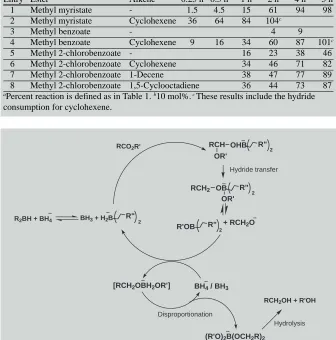
Scheme 1. Mechanism of alkene-catalyzed reduction of esters.
72 hours. The clear supernatant layer is used as such for reactions after estimating its hy-dride strength (4.4 M in H–). The absence of
chloride is confirmed as reported earlier.15
Atomic absorption measurements indicate the presence of Na+, in addition to zinc and
boron, and confirm the analogous results re-ported in the literature.15 Zn(BH
4)2 can be
thought of as a complex having the structure shown in Chart 1.
Interestingly, the 11B NMR spectrum shows
a quintet at δ = –45 corresponding to the BH4–
ion when BF3 • Et2O is used as the external standard. The reagent is stable over a period of 6 months when stored under nitrogen at room temperature.
3. Synthetic Applications
3.1. Tandem Reduction–
Hydroboration of Esters
Earlier reports have indicated that the re-duction of aliphatic esters by Zn(BH4)2 in DME is very slow. However, under vigorous conditions, it is possible to reduce aliphatic esters in the presence of aromatic esters. In addition, Zn(BH4)2 in THF reduces esters in the following order: unsaturated ester >> ali-phatic ester >> aromatic ester (Table 1).16
These rate differences have been exploited in the facile reduction of a number of aliphatic esters in the presence of aromatic esters under simple reaction conditions and without em-ploying ultrasonic irradiation (Table 2). The intermediate borate esters can also be oxi-dized to the corresponding aldehydes (entries 8 and 9).17
Interestingly, the rapid reduction of the unsaturated ester methyl 10-undecenoate in-dicated autocatalysis; this meant that the ad-dition of olefin might catalyze the reduction of esters. When this idea was applied to the reduction of methyl benzoate, a remarkable rate enhancement was observed (Table 3).18
The 11B NMR spectrum of the reaction
mix-ture indicated that hydroboration of the olefin occurred prior to reduction of the ester; i.e., the propensity of Zn(BH4)2 to hydroborate the alkene was greater than its propensity to re-duce the ester. The peak at δ = 56 indicated that the hydroboration of cyclohexene led to a dialkylboron species which could catalyze the reduction of the ester as depicted in Scheme 1.
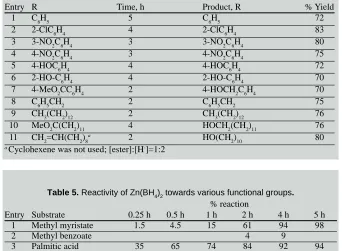
Consequently, several aromatic esters were reduced in good yields and the reduction was tolerant of other reducible groups such as chloro, bromo, nitro, etc. (Table 4).16 The
[image:2.612.213.553.57.135.2]organoboron intermediates can also be oxidized with dichromate solution to the cor-responding aldehydes providing a one-pot conversion of esters to aldehydes. This
Table 1. Reduction of esters by Zn(BH4)2 in THF.
% reactiona
Entry Methyl Ester 0.25 h 0.5 h 1 h 2 h 4 h 5 h
1 Myristate 1.5 4.5 15 61 94 98
2 Benzoate - - - 4 9
3 Pivalate 4 8 27 46 71 93b
4 10-Undecenoate - gel 98
aPercent reaction is the number of mmoles of ester that were reduced divided by the
number of mmoles of ester used. It was determined by analysis of residual hydride in the reaction mixture and by assuming an uptake of two hydrides per ester reduced. bafter 8 h.
Table 2. Facile reduction of aliphatic esters by Zn(BH4)2.
Entry Estera Time, h Product % Yield
1 Methyl 10-undecenoate 1 1,11-Undecanediol 90 2 Dimethyl brassylateb 6 1,13-Tridecanediol 74
3 Methyl nonanoate 5 1-Nonanol 75
4 Methyl myristate 5 1-Tetradecanol 85
5 Methyl pivalate 6 2,2-Dimethyl-1-propanol 75 6 Methyl 3-bromopropionate 2 3-Bromo-1-propanol 79 7 Methyl phenylacetate 5 Phenethyl alcohol 75
8 Methyl myristate 6 1-Tetradecanal 80
9 Methyl phenylacetate 6 Phenylacetaldehyde 76
[image:2.612.214.550.371.711.2]a[ester]:[H-]=1:2. b[ester]:[H-]=1:4
Table 3. Alkene-catalyzed reduction of esters with Zn(BH4)2.
% reactiona
Entry Ester Alkeneb 0.25 h 0.5 h 1 h 2 h 4 h 5 h
1 Methyl myristate - 1.5 4.5 15 61 94 98
2 Methyl myristate Cyclohexene 36 64 84 104c
3 Methyl benzoate - 4 9
4 Methyl benzoate Cyclohexene 9 16 34 60 87 101c
5 Methyl 2-chlorobenzoate - 16 23 38 46
6 Methyl 2-chlorobenzoate Cyclohexene 34 46 71 82 7 Methyl 2-chlorobenzoate 1-Decene 38 47 77 89 8 Methyl 2-chlorobenzoate 1,5-Cyclooctadiene 36 44 73 87
aPercent reaction is defined as in Table 1. b10 mol%. c These results include the hydride
consumption for cyclohexene.
R2BH + BH4 BH3 + H2B
RCH2OH + R'OH R"
2
RCH OR'
OHB R" 2
RCH2 OB OR'
R" 2
R'OB R" + RCH2O
2
[RCH2OBH2OR'] BH4 / BH3
(R'O)2B(OCH2R)2
Hydrolysis Disproportionation
Hydride transfer
Table 4. Reduction of methyl esters, RCO2Me, by Zn(BH4)2 in refluxing THF catalyzed by cyclohexene.
Entry R Time, h Product, R % Yield
1 C6H5 5 C6H5 72
2 2-ClC6H4 4 2-ClC6H4 83
3 3-NO2C6H4 3 3-NO2C6H4 80
4 4-NO2C6H4 3 4-NO2C6H4 75
5 4-HOC6H4 4 4-HOC6H4 72
6 2-HO-C6H4 4 2-HO-C6H4 70
7 4-MeO2CC6H4 2 4-HOCH2C6H4 70
8 C6H5CH2 2 C6H5CH2 75
9 CH3(CH2)12 2 CH3(CH2)12 76
10 MeO2C(CH2)11 4 HOCH2(CH2)11 76 11 CH2=CH(CH2)8a 2 HO(CH
2)10 80
[image:3.612.59.401.81.332.2]a Cyclohexene was not used; [ester]:[H-]=1:2
Table 5. Reactivity of Zn(BH4)2 towards various functional groups.
% reaction
Entry Substrate 0.25 h 0.5 h 1 h 2 h 4 h 5 h
1 Methyl myristate 1.5 4.5 15 61 94 98
2 Methyl benzoate 4 9
3 Palmitic acid 35 65 74 84 92 94
4 Benzoic acid 46 51 56 61 85 92
5 1-Dodecene 72 80 96 98 99
Table 6. Competitive studies of the reduction of various substrates with zinc borohydride.
Entry Substrate Pair k1/k2a
1 Methyl myristate/Methyl benzoate 100 2 Methyl myristate/Methyl benzoateb 12
3 Palmitic acid/Benzoic acid 13 4 Palmitic acid/Methyl myristate 100 5 1-Dodecene/Methyl myristate 2.7 6 1-Dodecene/Palmitic acid 1.7
ak
1 and k2 are calculated using the Ingold-Shaw
equation. bThe reduction was carried out in the
[image:3.612.59.225.496.654.2]presence of 10 mol % of cyclohexene as catalyst.
Table 7. Relative reactivity of functional groups towards Zn(BH4)2.
Relative Entry Functional Group Reactivity
1 Methyl benzoate 1 2 Methyl myristate 12 3 Benzoic acid 96 4 Palmitic acid 1200 5 1-Dodecene 2040
methyl myristate, methyl benzoate, palm-itic acid, benzoic acid and 1-dodecene indicated that hydroboration of the olefin is much faster than reduction (Table 5).19
To elucidate the spectrum of reactiv-ity of Zn(BH4)2, competitive experiments were performed. In a typical procedure, to an equimolar mixture of methyl myristate and methyl benzoate was added just enough hydride to react with only one of the substrates. The products were analyzed by GLC and the relative reactiv-ity obtained by using the Ingold-Shaw equation (Table 6).20 The results
indi-cated that the aliphatic ester was reduced much faster than the aromatic ester. Similarly, the aliphatic acid, palmitic acid, was reduced more rapidly than benzoic acid. This allowed us to determine the order of reactivity of the other substrates relative to that of methyl ben-zoate (Table 7): olefin > aliphatic CO2H > aromatic CO2H > aliphatic ester > aromatic ester. This spectrum of reactivity of Zn(BH4)2 indicates that it prefers to attack a nucleophilic carbon rather than an electrophilic one. This is contrary to the reactivity pattern of other metal borohydrides, which are nucleophilic species and prefer to attack an electrophilic carbon and seldom hydroborate olefins. This boranelike characteristic of Zn(BH4)2 offers an alternative to borane–methyl sulfide (BMS) in organic synthesis.
3.2. Reductions
3.2.1. Reduction of Carboxylic
Acids
A number of carboxylic acids were re-duced to the corresponding alcohols in good yields and using only stoichiometric quanti-ties of zinc borohydride (Table 8).21 These
facile reductions are thought to take place as shown in Scheme 2.
3.2.2. Reduction Of Amino
Acids
Chiral amino alcohols are useful in, among others, asymmetric synthesis,22 peptide and
pharmaceutical chemistry,23 and the
synthe-sis of insecticidal compounds.24 Earlier
pre-parative methods used reduction of esters of amino acids by sodium in ethanol.25
Subse-quently, LiAlH426 and NaBH 4
27 were used for
the reduction of esters. Moreover, reduction of amino acids directly to the amino alcohols was accomplished using LiAlH428 or BMS in
the presence of BF3• Et2O.29 Metal
borohy-drides do not reduce amino acids; however, LiBH4 with Me3SiCl reduces amino acids to the corresponding alcohols.30,31 Similarly,
NaBH4 in the presence of BF3• Et2O also reduces amino acids.32 The reduction in these
cases is by borane which is generated in situ. Recently, NaBH4–H2SO4 and NaBH4–I2 were used for the reduction of amino acids and derivatives.33,34 Reductions of 1kg-scale
quan-tities are effected with either BMS or LiAlH4. However, the methods suffer from high cost, inflammability of the reagents used, and la-borious isolation procedures. In the case of amino acids, it is necessary to use an excess of 1 molar equivalent of borane to compensate for complexation of the reducing agent with the amino group (eq 1).
Since Zn(BH4)2 had been shown to reduce carboxylic acids to the corresponding alcohols in excellent yields,21 and in view of its basic
nature, it was reasoned that such amine-bo-rane complexation was not likely to occur and hence excess reagent might not be required. Thus, the reduction of amino acids to amino alcohols utilizing only stoichiometric quanti-ties of zinc borohydride proceeded to comple-tion (Table 9).35 With excess hydride, no
significant change in the reaction time or yield of the product was observed. Moreover, the excess hydride was liberated instanta-neously during hydrolysis. These observations led to the conclusion that there was no strong coordination between boron and nitrogen, as is observed in the case of trivalent borane reagents. The intermediate obtained is pre-sumably oxazaborolidine, which is highly useful in the enantioselective reduction of prochiral ketones.
Scheme 2. Mechanism of the reduction of acids with zinc borohydride.
The intermediate boroxazoles from chiral amino acids are optically active and are use-ful in asymmetric synthesis. The amino alcohols are obtained by simple hydrolysis of the boroxazoles. The method offers a simple and rapid conversion of amino acids to amino alcohols in excellent yields.
3.2.3. Reduction of Amides
Reduction of carboxylic acid amides can lead to the formation of aldehydes or alcohols by cleavage of the C-N bond, or amines by cleav-age of the C-O bond. All three product types have been observed when boron reagents were employed as reducing agents (Table 10).
Metal borohydrides do not reduce amides. However, the combination of metal borohy-dride and an electrophile has been used to effect this transformation. Thus, NaBH4 re-duces amides in the presence of carboxylic acids,36 sulfonic acids,37 and Lewis acids.38
The mechanism of the reaction is believed to involve coordination of the metal with
oxy-gen, rather than in situ generation of borane. Interestingly, Zn(BH4)2 can be used to reduce amides without the use of excess reagent. Thus, reduction of acetanilides by Zn(BH4)2 results in the evolution of one equivalent of hydrogen. Further reaction results in com-plete reduction to afford the amine.39 A series
of amides were reduced to yield the corre-sponding N-ethylanilines (Table 11). The products were isolated by simple hydrolysis of the reaction mixture (eq 2).
3.3. Hydroborations
[image:4.612.216.551.56.274.2]The electrophilic nature of the reagent shows potential for use in hydroboration re-actions. The important features to be consid-ered in hydroboration reactions are stoichi-ometry and regio- and stereoselectivity. Thus, while three equivalents of olefin are hydroborated by one molar equivalent of bo-rane, controlled hydroboration to dialkyl or
Table 9. Reduction of amino acids by Zn(BH4)2.a
Rotation of Entry Substrate Time (h) Product % Yield Amino Alcohol
1 Glycine 7 2-Aminoethanol 70
2 L-Phenylalanine 5 L-Phenylalaninol 87 -21.7º (c = 1.7, EtOH)
3 L-Leucine 4 L-Leucinolb 85 +4.2º (c = 0.9, EtOH)
4 L-Isoleucine 3 L-Isoleucinolb 85 +6.7º (c = 1.0, EtOH)
5 L-Valine 4 L-Valinol 85 +8.7º (c = 1.1, EtOH) 6 L-Proline 3 L-Prolinol 85 +37.0º (c = 1.0, EtOH) a[substrate]:[H-] = 1:3 ; in refluxing THF; no catalyst was used. bThe reported values are: L-leucinol
[+4° (c = 9, EtOH)] and L-isoleucinol[+5.4° (c = 1.6, EtOH)] . The Aldrich Catalog/Handbook of Fine Chemicals, 1996-1997 ed.; Aldrich Chemical Co.: Milwaukee, WI; pp 895 and 872.
Table 10. Reduction of carboxylic acid amides with various boron reagents.a
Entry Substrate Reagent Product
1 RCONH2 Borane-THF, BMS RCH2NH2
2 RCONHR Borane-THF, BMS RCH2NHR
3 RCONR2 Borane-THF, BMS RCH2NR2
4 RCONR2 Sia2BHb RCHO
5 RCONH2 Sia2BHb
-6 RCONR2 9-BBN RCH2OH
7 RCONH2 9-BBN stops at deprotonation stage
aFor a review, see Pelter, A.; Smith, K.; Brown, H.C. Borane Reagents; Academic Press:
London, UK, 1988; pp 138-140. bSia
2BH is disiamylborane.
RCOOH + Zn(BH4)2 RCOOBH3Zn(BH4) + H2
Table 8. Reduction of carboxylic acids with Zn(BH4)2.a
Entry Substrateb Time, h Product % Yieldc
1 Benzoic acid 6 Benzyl alcohol 90
2 Palmitic acid 6 Cetyl alcohol 95
3 Palmitic acidd 6 Hexadecanal 90
4 Valeric acid 3 Amyl alcohol 95
5 2-Chlorobenzoic acid 6 2-Chlorobenzyl alcohol 90 6 4-Nitrobenzoic acid 4 4-Nitrobenzyl alcohol 90 7 3-Nitrobenzoic acid 4 3-Nitrobenzyl alcohol 90 8 3-Bromopropionic acid 6 3-Bromo-1-propanol 75 9 3,4,5-Trimethoxybenzoic acid 5 3,4,5-Trimethoxybenzyl alcohol 70
10 Pivalic acid 2 Neopentyl alcohol 70
11 Phenylacetic acid 3 Phenethyl alcohol 95 12 Phenylacetic acid 3 Phenylacetaldehyde 90 13 Cinnamic acide 5 3-Phenylpropanediolf 90
14 2-Hydroxybenzoic acide 4 no reaction
15 Acetylsalicylic acid 3 2-Hydroxybenzyl alcohol 85 16 10-Undecenoic acide 1 1,11-Undecanediol 90
17 Brassylic acidg 4 1,13-Tridecanediol 70
18 Terephthalic acidg 5 1,4-Benzenedimethanol 70 aAll reactions were carried out at reflux in THF; no catalyst was used. b[acid]:[H-]=5:16.5. cIsolated crude product. dOxidized using aqueous acidic sodium dichromate solution in CHCl
3. e[acid]:[H-]=5:22. fMixture of 1,2-diol and 1,3-diol (3:2) by 1H NMR. g[acid]:[H-]=5:33.
eq 1
NH2 + BH3 H2N BH3
B H
Zn H
H B H
H
H H
O C O
R
RCOOBH2 + HZnBH4
RCH2OB=O H2O
[image:4.612.39.553.312.537.2] [image:4.612.221.547.602.708.2]eq 2
eq 3 Table 12. Hydroboration of alkenes: species and stoichiometry.a
Alkene/BH4– 11B NMR
Entry Ratio δ(ppm)b Alkene Consumed/BH
4 –
1 1 32 & 55 1
2 2 33 & 54 1.8
3 3 54 & 80 2.4
4 4 54 & 86 3.0
aBased on GC analysis, on a 2-m 3% OV-17 column, after 4 h of reflux. bWith reference
to BF3•OEt2.
Table 13. Comparison of the relative reactivities of terminal and internal alkenes (kt/ki) towards hydroboration with various boron reagents.
Boron Reagent 9-BBN ThxBHCl HBBr2 BMS Zn(BH4)2 Ca(BH4)2–
Entry Alkene .SMe2 .SMe2 EtOAc
1 180 9.1 5.0 2.8 6.5 9.0
[image:5.612.58.402.129.736.2]2 1.0 1.0 1.0 1.0 1.0 1.0
Table 11. Reduction of anilides by Zn(BH4)2.
Entry Substrate Time, h Product % Yield
1 Acetanilide 5 N-Ethylaniline 90
2 3'-Chloroacetanilide 4 N-Ethyl-3-chloroaniline 85 3 4'-Chloroacetanilide 4 N-Ethyl-4-chloroaniline 85 4 4'-Bromoacetanilide 4 N-Ethyl-4-bromoaniline 85 5 4'-Methoxyacetanilide 6 N-Ethyl-4-methoxyaniline 70 6 2'-Nitroacetanilide 8 N-Ethyl-2-nitroaniline 30a
7 3',4'-Dichloroacetanilide 5 N-Ethyl-3,4-dichloroaniline 80 8 4'-Bromo-3'-chloroacetanilide 5 N-Ethyl-4-bromo-3-chloroaniline 75
9 Benzanilide 7 N-Benzylaniline 70
10 2'-(Carbomethoxy)acetanilide 4 2-(Ethylamino)benzyl alcohol 80
a70% of unreacted anilide was recovered. [anilide]:[H-]=5:11
3.3.1. Hydroboration of Simple
Olefins
It is well-known that hydroboration of simple, linear, terminal alkenes using borane leads to the formation of trialkylboron species. However, it should be noted that mono- and dialkylboranes would also be present in the reaction mixture depending on the structure of the alkene and its concentration. The nature of the organoborane species formed and hence the stoichiometry of the reaction can be deter-mined by 11B NMR and hydride analysis
stud-ies. The results are presented in Table 12. Zn(BH4)2 is able to hydroborate a terminal olefin leading to the formation of a trialkylboron species (which is evident from the peak at δ = 83) with excess alkene. This reduction may be utilized for the conversion of alkenes to alcohols whereby maximum use is made of the reagent. Interestingly, dialkylborinate is the major product when a starting ratio of two equivalents of alkene per borohydride ion is used. The dialkylborinate species is very valuable in the preparation of symmetrical ketones.
3.3.2. Hydroboration of Dienes
Regioselectivity is one of the major inter-ests in hydroboration reactions. While a number of reagents are known to be more selective towards the terminal carbon atom, it was felt that if Zn(BH4)2 were to exhibit even marginal regioselectivity it might be very useful synthetically in view of the simplicity of its workup procedure. Accordingly, to elucidate the regioselectivity of the reagent, a competitive experiment was performed be-tween a terminal olefin, 1-dodecene, and an internal olefin, 5-decene, with just enough hydride to hydroborate one of them (eq 3). From the Ingold-Shaw equation, the relative reactivity of the terminal versus internal double bond towards hydroboration was cal-culated as kt /ki = 5.9. This result indicates that Zn(BH4)2 exhibits a selectivity comparable to that of dibromoborane (Table 13).41 This
improved selectivity, as compared with that of BH3•THF or BMS, can be taken advantage of in the hydroboration of dienes containing both terminal and internal double bonds.
An immediate synthetic application of this result was realized in the regioselective hydroboration of 1,11-dienes to produce (Z)-11-alken-1-ols, which are pheromone com-ponents for many species (eq 4).42 The results
are comparable to those of other hydroboration methods. Although 9-BBN, a dialkylborane species, shows excellent terminal carbon selectivity, its use yields only 68% of the required alkenol and suffers from contamina-tion by cyclooctanediol. On the other hand,
eq 4
CH3CH2NHAr
CH3 C NHAr
O
1. 2.
Zn(BH4)2
H2O
CH3(CH2)nCH CH(CH2)8CH
Zn(BH4)2
CH2 CH3(CH2)nCH CH(CH2)10OH
(i)
(ii) reflux, 4h
Oxidation CH3(CH2)7
C C Bun H
Bun H
monoalkyl species can be achieved with hin-dered alkenes. In the case of LiBH4/ether40
and Ca(BH4)2/THF in the presence of ethyl acetate,41 tandem reduction-hydroboration
results in the formation of dialkylborinate species indicating two equivalents of alkene
uptake per BH4– ion. Such controlled
hydroboration products are very useful as synthetic intermediates. Hence it is impor-tant to determine the number of alkenes that can be hydroborated with one molar equiva-lent of BH4– ion.
CH3(CH2)3CH CH(CH2)3CH3
CH3(CH2)9CH CH2
CH3(CH2)3CH2CH(CH2)3CH3
OH
CH3(CH2)11OH
+ Zn(BH4)2 +
H2O2/NaOH
70%
12%
Scheme 3. In situ micellization during the hydroboration of long-chain dienes.
use of Zn(BH4)2 produces the terminal alcohol in good yield without the compli-cation of side products. Interestingly, the organoboron intermediate was oxidized with sodium dichromate directly to (Z)-11-hexadecenal (eq 5). 9-BBN and the other selective reagents produce additional side products.
As indicated earlier, in order to derive the maximum utility from the reagent, two equivalents of diene were re-acted with 1 equivalent of BH4–.
Interestingly, 11B NMR analysis
of the quenched reaction mix-ture indicated the formation of monoalkyl boronates in major quantities. A possible in situ micellization of the intermedi-ate could explain this observa-tion. When hydroborated, a simple hydrocarbon diene would become bipolar in nature and hence result in aggregation of monomers (Scheme 3). Conse-quently, the rate of further hydroboration by the mono-hydroborated species would be very much reduced.
3.3.3. Hydroboration
of Cyclic Olefins
Cyclic olefins such as cyclohexene pos-sess an internal double bond. Thus, hydro-boration of these systems should stop at the dialkylboron stage due to steric hindrance. Indeed, hydroboration of cyclohexene by Zn(BH4)2 stops at the dialkylboron stage (δ = 53, using BF3•Et2O as external standard). This dialkylboron intermediate can be con-verted to symmetrical ketones by treatment with CHCl3 and NaOMe (eq 6).43
Hydroboration of 1,5-cyclooctadiene by simple borane reagents leads to the formation 9-borabicyclo[3.3.1]nonane (9-BBN), a highly selective hydroborating and reducing agent. Under the present reaction conditions, 1,5-cyclooctadiene is hydroborated intramo-lecularly and isomerizes to the stable 9-borabicyclo[3.3.1]nonane product (eq 7). This should be quite useful in the in situ generation of 9-BBN. A considerable amount of trialkylboron species is also observed by 11B
NMR, indicating further hydroboration of the cyclooctadiene by 9-BBN (eq 8).44
Substituted cyclic olefins such as 1-methylcyclohexene and α-pinene are easily hydroborated to the corresponding dialkyl-borinate species (eq 9).
It should be pointed out that, in the case of
α-pinene, the dialkylborinate intermediates can react with prochiral substrates such as
eq 5
eq 6
eq 7
eq 8
eq 9
CH3(CH2)3CH CH(CH2)8CH CH2 CH3(CH2)3CH CH(CH2)9CHO
(i)Zn(BH4)2
Na2Cr2O7
(ii)
reflux, 4h
Aggregate of
Polar Head Group
Nonpolar Tail Polar Head Group
Nonpolar Tail
Aggregate of
Zn(BH4)2
reflux, 5h
)2BH (i)MeOH
(ii)CHCl3, NaOMe
C O
Zn(BH4)2
BH
THF, reflux 5 h
B H
Zn(BH4)2
THF, reflux
90%
60%
80%
+
BH B
Zn(BH4)2 THF, reflux
5 h
activated ketones to produce optically active reduction products as reported in the literature using diisopinocampheylborane45 or
diisopino-campheylchloroborane (DIP-Chloride™)46
(eq 10). Thus, this approach can offer a one-pot process for asymmetric synthesis.
Recently, B-hydroxydiisopinocampheyl-borane (Ipc2BOH), prepared by the hydrolysis of the hydrido compound, has been employed as a chemoselective reducing agent for alde-hydes over ketones.47 Oxidation of the
organoboron afforded isopinocampheol in excellent yield. Curiously, β-pinene produces a triorganoborane with Zn(BH4)2 as indicated by the 11B NMR spectra of the reaction mixture
(eq 11). Oxidation of the triorganoborane intermediate affords myrtanol.
Hydroboration of limonene also produced a significant amount of the corresponding trialkylborane. Presumably, the cyclic dihydroboration took place first resulting in a R2BH species, which then hydroborated one more equivalent of limonene selectively at the terminal position (eq 12). On oxidation, the intermediate trialkylborane yields limonene-2,9-diol and minor amounts of p-menth-1-en-9-ol.
Interestingly, ethylidenecyclohexane, a sterically hindered substrate, also produced a significant amount of the trialkylboron inter-mediate. Upon oxidation, a small amount (10%) of the rearranged alcohol, 2-cyclohexyl-ethanol, was also observed spectroscopically. It is likely that the initial organoboron inter-mediate underwent partial isomerization to the terminal position and yielded the isomer-ized trialkylborane as a minor product (Scheme 4). At high temperature such isomerism—to the terminal position thereby relieving the steric strain—has been observed with disiamylborane. These intermediates can be utilized in several synthetic transforma-tions following the methods given in the lit-erature. The simple application of the present method is summarized in Table 14.
3.3.4. Hydroboration of
Alkynes
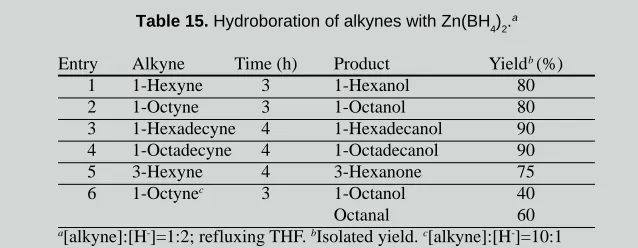
Alkynes undergo dihydroboration with Zn(BH4)2 giving rise to dibora adducts. Oxi-dation with alkaline hydrogen peroxide pro-duces the corresponding alcohols in 40-90% yields (eq 13 & Table 15).19
Generally, in the presence of excess alkyne, monohydroboration results. Unlike other metal borohydrides, and although Zn(BH4)2 is a basic reagent, it is still able to hydroborate without the addition of any Lewis acid or ester. Presumably, the soft Lewis acid nature of Zn2+ ion polarizes the borohydride ion and
generates an electrophilic species which then reacts with the double bond.
eq 11
eq 10
eq 12
[image:7.612.59.401.62.593.2]Scheme 4
Table 14. Alcohols obtained by hydroboration of olefins with Zn(BH4)2.
Entry Substratea Time, h Product % Yieldb
1 1-Dodecene 3 1-Dodecanol 90
2 1-Decene 3 1-Decanol 92
3 5-Decene 4 5-Decanol 85
4 Cyclohexene 4 Cyclohexanol 90
5 1,5-Cyclooctadiene 4 1,5-Cyclooctanediol 85c
4-Cycloocten-1-ol (90:10)
6 1,7-Octadiene 3 1,8-Octanediol 90
7 Ethylidenecyclohexane 4 1-Cyclohexylethanol 85c
2-Cyclohexylethanol (90:10) 8 1-Methylcyclohexene 4 2-Methylcyclohexanol 90c
cis:trans=85:15
9 α-Pinene 4 Isopinocampheol 90
10 β-Pinene 4 Myrtanol 85
11 Limonene 4 Limonene-2,9-diol 85
a[alkene]:[H-]=1:2; in refluxing THF. The oxidations were carried out with H
2O2/NaOH. bIsolated yield based on reacted olefin. cYield of the mixture.
eq 13
Zn(BH4)2
)2BH )2BCl
dry HCl
THF, reflux
90%
Zn(BH4)2
CH2)3B
THF, reflux
85% B
Zn(BH4)2 THF, reflux
85%
Zn(BH4)2 CHCH3
CH2CH2B CH)2BH
CH3
CH2CH2OH
CH CH2
HB
+
[O]
RC CH R
B
B H2O2/NaOH RCH2CH2OH
Zn(BH4)2
RCH2 H
4. Conclusion
In conclusion, Zn(BH4)2 can be used for the selective reduction of functional groups under various conditions. The reagent also offers an alternative to BMS in hydroboration reactions. Its remarkable regioselectivity, coupled with a simple workup procedure, makes it more advantageous to use than other selective reagents such as 9-BBN in the syn-thesis of several pheromones.
5. Acknowledgments
It is a pleasure to thank Professor T.R. Govindachari, our advisor, and earlier co-workers—Drs. K. Ganeshwar Prasad and S. Madhavan and Mr. Prem Palmer. We also thank all those who have contributed to the chemistry reviewed here and whose names appear in the cited references.
6. References
(1) James, B.D.; Wallbridge, M.G.M. Progr. Inorg. Chem. 1970, 11, 99.
(2) An excellent review is available on hydride reduction by Brown, H.C.; Krishnamurthy,S. Tetrahedron 1979, 35, 567, and references therein.
(3) Oishi, T.; Nakata, T. Acc. Chem. Res. 1984, 17, 338.
(4) Ranu, B.C. Synlett 1993, 885.
(5) Ranu, B.C.; Chakraborty, R. Tetrahedron Lett. 1990, 31, 7663.
(6) Sarkar, D.C.; Das, A.R.; Ranu, B.C. J. Org. Chem. 1990, 55, 5779.
(7) Ranu, B.C.; Das, A.R. J. Chem. Soc., Perkin Trans. 1 1992, 1561.
(8) Ranu, B.C.; Basu, M.K. Tetrahedron Lett.
1991, 32, 3243.
(9) Ranu, B.C.; Das, A.R. J. Org. Chem. 1991, 56, 4796.
(10) Ranu, B.C; Das, A.R. J. Chem. Soc., Chem. Commun. 1990, 1334.
(11) Brown, H.C.; Narasimhan, S. J. Org. Chem.
1984, 49, 3891.
(12) Brown, H.C.; Narasimhan, S. J. Org. Chem.
1982, 47, 1604.
(13) Gensler,W.J.; Johnson, F.; Sloan, A.D.B. J. Am. Chem. Soc. 1960, 82, 6074.
(14) Crabbe, P.; Garcia, G.A; Rius, C. J. Chem. Soc., Perkin Trans. I 1973, 810.
(15) Yoon, N.M.; Lee, H.J.; Kim, H.K.; Kang, J. J. Korean Chem. Soc. 1976, 20, 59. (16) Narasimhan,S.; Madhavan, S.; Ganeshwar
Prasad, K. Synth. Commun. 1997, 27, 385. (17) Narasimhan, S.; Palmer, P. Ind. J. Chem.
1992, 31, 701.
(18) Narasimhan, S.; Palmer, P.; Ganeshwar Prasad, K. Ind. J. Chem. 1991, 30B, 1150. (19) Narasimhan, S.; Madhavan, S.; unpublished
results.
(20) Ingold, C. K.; Shaw, F. R. J. Chem. Soc.
1927, 2918.
(21) Narasimhan, S.; Madhavan, S.; Ganeshwar Prasad, K. J. Org. Chem. 1995, 60, 5314. (22) Zhang, Y.-W.; Shen, Z.-X.; Liu, C.-L.; Chen,
W.-Y. Synth. Commun. 1995, 25, 3407. (23) TenBrink, R.E. J. Org. Chem. 1987, 52, 418. (24) Wu, S.; Takeya, R.; Ito, M.; Tomizawa, C.J.
J. Pestic. Sci. 1987, 12, 221.
(25) Karrer, P.; Karrer, W.; Thomann, H.; Horlacher, F.; Mader, W. Helv. Chim. Acta
1921, 4, 76.
(26) Karrer, P.; Portmann, P.; Suter, M. Helv. Chim. Acta 1948, 31, 1617.
(27) Seki, H.; Koga, K.; Matsuo, H.; Ohiki, S.; Mutsuo, I.; Yamada, S. Chem. Pharm. Bull.
1965, 13, 995.
(28) Dickman, D.A.; Meyers, A.I.; Smith, G.A.; Gawley, R.E. In Organic Syntheses; Freeman, J.P., Ed.; Wiley: New York, 1990; Coll. Vol. 7, p 530.
(29) Smith, G.A.; Gawley, R.E. Org. Synth. 1985, 63, 136.
(30) Giannis, A.; Sandhoff, K. Angew. Chem., Int. Ed. Engl. 1989, 28, 218.
(31) Dharanipragada, R.; Alarcon, A.; Hruby,V.J. Org. Prep. Proc. Int. 1991, 23, 396. (32) Boesten, W.H.J.; Schepers, C.H.N.; Roberts,
M.J.A. Eur. Pat. EPO322982, 1989; Chem. Abstr. 1989, 111, 233669a.
(33) Abiko, A.; Masamune, S. Tetrahedron Lett.
1992, 33, 5517.
(34) McKennon, M.J.; Meyers, A.I.; Drauz, K.; Schwarm, M. J. Org. Chem. 1993, 58, 3568. (35) Narasimhan, S.; Madhavan, S.; Ganeshwar Prasad, K. Synth. Commun. 1996, 26, 703. (36) Umino, N.; Iwakuma,T.; Itoh, N. Tetrahedron
Lett. 1976, 763.
(37) Wann, S.R.; Thorsen, P.T.; Kreevoy, M.M. J. Org. Chem. 1981, 46, 2579.
[image:8.612.47.366.57.181.2](38) Brown, H.C.; Subba Rao, B.C. J. Am. Chem. Soc. 1956, 78, 2582.
Table 15. Hydroboration of alkynes with Zn(BH4)2.a
Entry Alkyne Time (h) Product Yieldb (%)
1 1-Hexyne 3 1-Hexanol 80
2 1-Octyne 3 1-Octanol 80
3 1-Hexadecyne 4 1-Hexadecanol 90 4 1-Octadecyne 4 1-Octadecanol 90
5 3-Hexyne 4 3-Hexanone 75
6 1-Octynec 3 1-Octanol 40
Octanal 60
a[alkyne]:[H-]=1:2; refluxing THF. bIsolated yield. c[alkyne]:[H-]=10:1
(39) Narasimhan, S.; Madhavan, S.; Balakumar, R.; Swarnalakshmi, S. Synth. Commun.
1997, 27, 391.
(40) Brown, H.C. Narasimhan, S. Organo-metallics 1982, 1, 762.
(41) Narasimhan, S.; Ganeshwar Prasad, K.; Madhavan, S. Tetrahedron. Lett. 1995, 36, 1141.
(42) Narasimhan, S.; Ganeshwar Prasad, K. Org. Prep. Proced. Intl. 1993, 25, 108.
(43) Periasamy, M.; Satyanarayana, M. Tetrahedron Lett. 1984, 25, 2501.
(44) Liotta, R.; Brown, H.C. J. Org. Chem. 1977, 42, 2836.
(45) Brown, H.C.; Mandal, A.K. J. Org. Chem.
1977, 42, 2996.
(46) Brown, H.C.; Chandrasekharan, J.; Ramachandran, P.V. J. Am. Chem. Soc. 1988, 110, 1539.
(47) Cha, J.S.; Kim, E.J.; Kwon, O.O.; Kwon, S.Y.; Seo, W.W.; Chang, S.W. Org. Prep. Proc. Intl. 1995, 27, 541.
DIP-Chloride is a trademark of Sigma-Aldrich Co.
About the Authors
Dr. S. Narasimhan received his Ph.D. de-gree in 1978 from Madras University under the guidance of Prof. N. Venkatasubramanian. From 1979 to 1982, he worked as a Postdoctoral Research Associate with Prof. H.C. Brown at Purdue University. He then returned to India and accepted the position of Scientist at IDL Nitro Nobel Basic Re-search Institute in Bangalore. He joined the Centre for Agrochemical Research in 1988 and was promoted recently to Deputy Di-rector and Head of the laboratory. His re-search interests are focused on developing pheromone technology and new synthetic methods using organoboron chemistry. He has developed a number of commercial plant-protection formulations based on natu-ral product extracts and has received a Tech-nology Transfer Award from SPIC. He has authored more than 60 publications and trained 5 Ph.D.'s. He is currently develop-ing novel chiral oxazaborolidines and do-ing pioneerdo-ing work in the application of pheromone technology to control serious crop pests in India.