IMPROVEMENTS IN THE PROCESSING AND PERFORMANCE OF VARIOUS CRYSTALLINE FORMS OF NITROGUANIDINE
Theodore S. Sumrall Sverdrup Technology, Inc.
Eglin AFB, Florida, USA
Carl M. Rector and William H. Graham Thiokol Corp. (Ret)
Huntsville Division, AL
1.0 ABSTRACT
PBX development efforts with High Bulk Density Nitroguanidine HBDNQ (≈180µm) have historically revealed a high degree of non-ideal behavior. Theoretically, NQ should be very ideal in terms of performance and in fact under certain conditions does detonate at near ideal conditions. Factors which can influence the degree of ideal behavior that an explosive will exhibit include:
• Density/Porosity
• Surface Area/Particle Size • Charge Diameter/Confinement • Shock Input/Support
Improved performance may be achieved by substituting RDX for NQ, however, at the expense of sensitivity.
By varying molecular explosive (i.e. NQ/RDX) content and/or particle size, it should be possible to vary the critical diameter, the shock initiation pressures and achieve superior performance.
Four crystalline configurations of NQ were available at the time this research was being conducted from domestic and international producers. Various crystalline forms of NQ (Low Bulk Density Nitroguanidine (LBDNQ), High Bulk Density Nitroguanidine (HBDNQ), Cubical Nitroguanidine (CNQ) and Spherical Nitroguanidine (SNQ)) were evaluated from a number of different aspects (i.e. processing, sensitivity, performance, cost, etc.).
Due to the lower costs associated with LBDNQ, steps were taken to improve the degree of ideal performance of LBDNQ. LBDNQ was reported to have a high degree of ideal behavior, however, it is very un-processable in typical PBX formulations. LBDNQ has a very high length to diameter (L/D) ratio. The typical diameter is approximately 3µm however, the length can exceed 100µm. LBDNQ is very fibrous with a consistency of cotton and occasionally, the needles are hollow. The bulk density of LBDNQ is ≈0.17g/cm3
developed during this research, it has been possible to process significant percentages (14% +) of LBDNQ with a total solids content (84% +) while retaining low viscosities (<2 kp.)
2.0 INTRODUCTION
In a study conducted by Price and Clairmont [1], they concluded that HBDNQ exhibited a critical diameter about 3 times that of the LBDNQ, but that NQ was not a Group 2 explosive such as AP. Nevertheless, the only attributable differences between HBDNQ and LBDNQ are the crystalline forms and surface area. Walker [2] showed that, although AP is also a “non-ideal” explosive, by reducing the AP particle size, ideal behavior can be achieved. By detonating 5µm AP in nitromethane, Walker observed that complete reaction occurred; but when 200µm AP was employed, the AP appeared to only be about 30% reacted initially.
These two factors tended to support the theory that NQ behavior, like AP, is particle size dependent. Therefore, in order to improve the degree of performance associated with earlier developed PBX compositions, it was decided to incorporate pulverized HBDNQ (PNQ =125µm) into compositions containing a thermoplastic binder. Earlier efforts to incorporate this smaller diameter NQ into a PBX binder were unsuccessful due to the lower particle diameter, higher surface area and higher viscosity associated with the smaller diameter NQ. A highly fluid thermoplastic binder overcame the processing problems and reduced potential manufacturing costs significantly.
3.0 BACKGROUND/APPROACH
At the time this research was being conducted, there was a strong belief in the energetic materials development community that insensitivity correlated well with explosive physical property strain characteristics. Specifically, explosives with high stress/strain ratios would be more sensitive to mechanical shock (i.e. TNT) than explosives that had lower stress/strain ratios (i.e. Plastic Bonded Explosives). Data also appeared to support this correlation as the TNT (with a somewhat high stress/strain ratio) based explosive H-6 failed a number of sensitivity tests (such as bullet impact) while the equally energetic HTPB bonded PBX-109 (with a lower stress/strain ratio) passes bullet impact. Other lower stress strain explosives (although of lower performance) also pass a number of the impact type sensitivity tests.
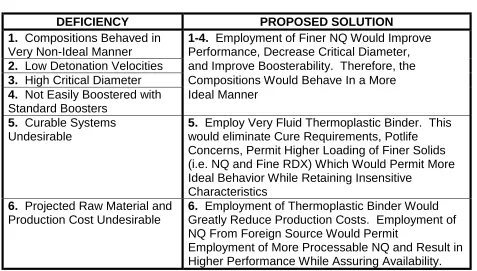
Achieving performance higher than that achieved during the research undertaken earlier proved elusive at first. It was theorized and later proven that smaller diameter NQ behaved in a more ideal manner than larger diameter NQ. However, in order to process NQ at smaller diameters the earlier composition with PPG binder (and even with HTPB binder) became too viscous to process in steam kettle equipment. It became imperative that a new binder system be developed which would allow processing of smaller particle size NQ. In addition to this, other binder qualities were desirable which would overcome deficiencies identified earlier. These deficiencies and proposed solutions are detailed in Table 3.0-1 and in Figure 3.0-1.
Table 3.0-1
Deficiencies of Previously Developed PBX Compositions
DEFICIENCY PROPOSED SOLUTION
1. Compositions Behaved in Very Non-Ideal Manner
1-4. Employment of Finer NQ Would Improve Performance, Decrease Critical Diameter,
2. Low Detonation Velocities and Improve Boosterability. Therefore, the
3. High Critical Diameter Compositions Would Behave In a More
4. Not Easily Boostered with Standard Boosters
Ideal Manner
5. Curable Systems Undesirable
5. Employ Very Fluid Thermoplastic Binder. This would eliminate Cure Requirements, Potlife Concerns, Permit Higher Loading of Finer Solids (i.e. NQ and Fine RDX) Which Would Permit More Ideal Behavior While Retaining Insensitive
Characteristics
6. Projected Raw Material and Production Cost Undesirable
6. Employment of Thermoplastic Binder Would Greatly Reduce Production Costs. Employment of NQ From Foreign Source Would Permit
Employment of More Processable NQ and Result in Higher Performance While Assuring Availability.
As TPE’s also proved to be incapable of processing significant quantities of high surface area solids, it was decided to challenge the “conventional wisdom” associated with the necessity of low stress/strain ratios and evaluate the sensitivity and performance of “Thermo Plastic Bonded Explosives” or TPBXs.
two binders. Polybutadiene has the structure (H2C-HC=CH-CH2)n and is much more reactive, by virtue of the presence of unsaturated double bonds which are quite reactive relative to polyethylene which has no unsaturation (H2C-CH2) n. Therefore, when the PE eventually does ignite in a cook-off situation, the oxidation of the fuel should be kinetically much less reactive.
It was also anticipated that (due to the excellent improvement in sub-scale sensitivity characteristics) that employment of the very fluid thermoplastic binder would result in an improvement in shock sensitivity from the standpoint of physical impact of an object with the TPBX. It was postulated that the very fluid binder was much more able to coat the solids such as AP, RDX, Aluminum and NQ. By coating and thus physically isolating the oxidizer (for example) from the more reactive fuels, the composition should be much less reactive to physical shock.
3.1 Nitroguanidine Screening and Selection
As previously stated, earlier PBX development efforts with 180µm NQ revealed a high degree of non-ideal behavior. Theoretically, NQ should be very ideal in terms of performance and in fact under certain conditions does detonate at near ideal conditions. Factors which can influence the degree of ideal behavior that an explosive will exhibit are:
• Density/Porosity
• Surface Area/Particle Size • Charge Diameter/Confinement • Shock Input/Support
Improved performance may be achieved by substituting RDX for NQ, however, at the expense of sensitivity.
By varying molecular explosive (i.e. NQ/RDX) content and/or particle size, it should be possible to vary the critical diameter, the shock initiation pressures and achieve superior performance.
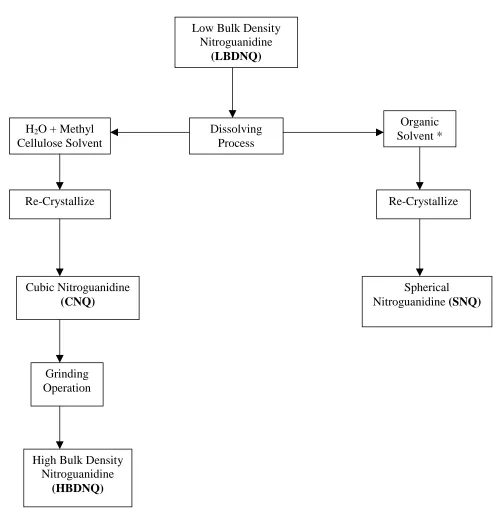
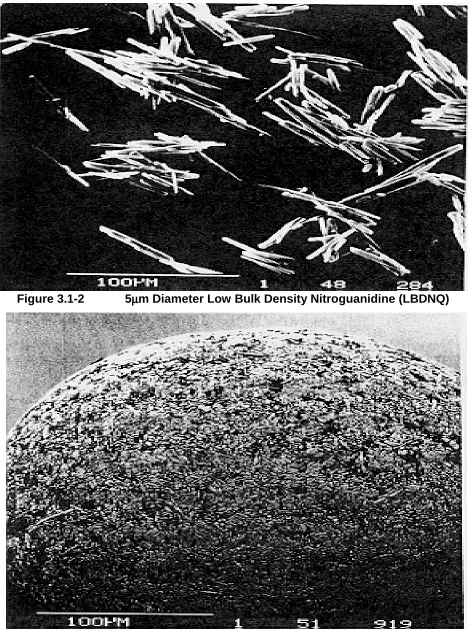
Four crystalline configurations of NQ were available at the time this research was being conducted from domestic and international producers. (Figure 3.1-1) details the production differences of these four crystalline types. Low Bulk Density Nitroguanidine (LBDNQ), has a very high length to diameter (L/D) ratio. The typical diameter is approximately 3µm however, the length can exceed 100µm (Figure 3.1-2). The LBDNQ is very fibrous with a consistency of cotton and occasionally, the needles are hollow. The bulk density of the LBDNQ is ≈0.17g/cm3
However, by virtue of the very fluid nature of the thermoplastic binder developed during this phase of research, it has been possible to process significant percentages (14% +) of LBDNQ with a total solids content (84% +) while retaining low viscosities (<2 kp.) This was very attractive due to the facts that LBDNQ:
• Costs =50% less than HBDNQ • Is highly available in the US
• Behaves ideally in a Detonation Reaction
• Improves Physical Properties by Virtue of the Fibrous Nature
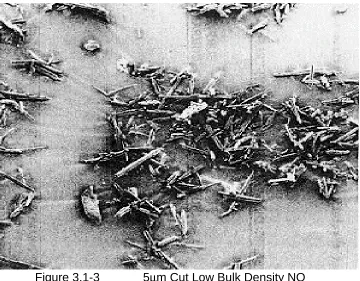
It was possible to “Cut” the LBDNQ to a length approximately 1/3 the normal length. This resulted in a more uniform length and therefore improved processing characteristics. The composition manufactured was identified as DTS-12986 and was tested for sensitivity later in the program but was too shock sensitive, possibly due to entrained air in the LBDNQ needle (Figure 3.1-3).
Dissolving LBDNQ in a solution of water and methyl cellulose, followed by re-crystallization results in a much larger (≈150-300 µm) and more processable crystalline form of NQ. This material is referred to as “Cubical Nitroguanidine” (CNQ) or “Un-pulverized Nitroguanidine” with a bulk density of ≈ 0.9g/cm3
. This is the material which was evaluated in the PBX compositions discussed earlier. (Figure 3.1-4)
CNQ is subsequently pulverized to a particle size of ≈80-120 µm and after this process is termed “High Bulk Density Nitroguanidine” (HBDNQ). This process increases the bulk density of the NQ to a bulk density of ≈0.4g/cm3
for HBDNQ. Depending on the manufacturer, the particle sizes of HBDNQ vary. (Figure 3.1-5)
The fourth crystalline form of NQ is termed “Spherical Nitroguanidine” (SNQ). (Figure 3.1-6) This material is manufactured in a manner similar to CNQ, however, the re-crystallization solvent is an organic solvent rather than water. Typical solvents for LBDNQ (which will permit precipitation of the SNQ geometry) are N-methyl-pyrolidone or di-methyl formamide. Although slightly more ideal in behavior with regards to a detonation reaction (+ 3-4%), the yield is quite low compared to CNQ (18% vs. 86%) and therefore the cost is quite high.
It was estimated that it would take 5-7 years to modernize the NQ plant in the USA to meet production quantities of HBDNQ. The projected costs of re-crystallized HBDNQ was quoted at $15.75/lb. These factors led to the decision to procure NQ from a foreign source, NIGU-Chemie, located in Walkreiburg, West Germany. NIGU's parent company, SKW Chemical, committed to supply any NQ quantities required and also committed to build a plant: in the US within one year after orders totaling M1 lbs. were received. At the time this research was being conducted, NIGU was capable of producing M0.8 lbs/year of HBDNQ at a quoted cost of $6.5/lb. Additionally, NIGU was capable of producing 50µm NQ (Figure 3.1-7) which was much more uniform than HBDNQ ground in house to 40µm (Figure 3.1-5) or the PNQ which was pulverized to a mean particle diameter of 114µm (Figure 3.1-8).
Table 3.1-2 compares the relative surface areas of various particle sizes of NQ.
Table 3.1-2
Geometric Dimensions Of NQ Crystals
PARTICLE SIZE SURFACE AREA (m2/g) SURFACE AREA RATIO COMPARED TO LBDNQ
3 µm x 60 µm 0.779 1.0
50 µm 0.0702 11.1
125 µm 0.0281 27.7
184 µm 0.0195 39.9
250 µm 0.0140 55.5
By replacing 180 µm HBDNQ with 50 µm NQ, the surface area of the NQ crystals is increased by a factor of ≈4. The 50 µm NQ still has a surface area ratio of 1:11 when compared to the more ideal behaving LBDNQ, but this is much lower than the ratio that CNQ has of 1:40. A third crystalline form of NQ is also available, spherical NQ (SNQ). SNQ (Figure 3.1-6) is apparently an agglomeration of LBDNQ in a spherical arrangement. SNQ was considered too limited and too expensive for consideration in this project.
By virtue of the high cost associated with cast /cure propellant technology, ground nitramines, and domestic NQ, the cost of the Plastic Bonded Explosive approach was well above levels deemed acceptable to production operations. By procurement of foreign NQ which would be manufactured within the US upon sufficient market demand and incorporation of an inexpensive thermoplastic binder, total explosive raw material cost is anticipated to be much lower than the PBX explosives previously investigated.
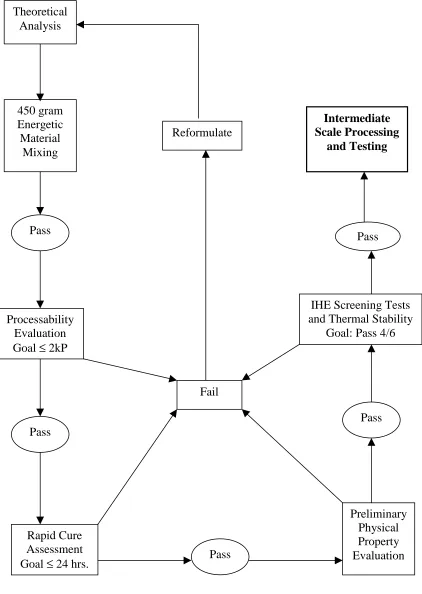
Small scale processing and testing followed the matrix identified in Figure 3.2-1. Twenty-four lbs. of CNQ (Figure 3.1-4) employed during earlier research was ground on a fluid energy mill (in house) to ≈40µm. Microscopic examination revealed that a somewhat shredded material was produced due to grinding (Figure 3.1-5), very similar in appearance to PNQ (Figure 3.1-8). Microscopic examination of the NIGU 50µm NQ (Figure 3.1-7) revealed a much more regular un-shredded appearance that is due to NIGU proprietary grinding methods.
In order to evaluate the approximate degree of performance improvement explosive compositions would yield due to incorporating NQ with a smaller particle size, a composition 12817) similar to a previously manufactured PBX composition (DTS-12557) was manufactured. This former composition (DTS-12817) differed only from the latter version in that it contained 50µm NQ (rather than 180µm NQ) and employed a thermoplastic binder rather than a cast cure binder. The two mixes are compared below in Table 3.2-1.
Table 3.2-1
Formulation Manufactured with Smaller Diameter NQ
FORMULATION →→→→ DTS-12557 DTS-12817
INGREDIENTS ↓ Wt. %
PPG Binder 16 0
Thermoplastic Binder 0 16
NQ 46 (180µm) 46 (50 µm)
RDX (16 µm) 18 18
Al (15 µm) 20 20
A 7.62 cm diameter unconfined charge of composition DTS-12557 was tested earlier during the PBX phase of research. Although boostered with a 272 kbar booster, the charge decayed to a complete halt and did not completely react. However, composition DTS-12817, which was identical to DTS-12557 (with the exception of NQ particle size and binder type), was tested at less than half the diameter (3.66 cm), completely reacted, and punched a hole in the witness plate. As the charges were the same length, this is considered satisfactory evidence that more ideal behavior is occurring with the smaller diameter NQ. (Figure 3.2-2)
While composition DTS-12817 showed improved ideal behavior, due to the incorporation of smaller particle size NQ, the composition exhibited an end of mix viscosity of approximately 8 kP, well above the desired goal of ≤ 2kP. Therefore, composition DTS-12817 was modified to permit better viscosity characteristics.
The second baseline formulation (DTS-12920) was also very similar to composition DTS-12817, but contained ground (3 µm) and unground (180 µm) RDX as the sensitizer in order to improve processing characteristics and decrease production costs as grinding introduces an extra process. Composition DTS-12920 was also manufactured with both dry NQ and water wet NQ. Although the water wet NQ was completely dry by the time ingredients other than NQ and lecithin were added, it was desirable to determine if the wet NQ (as shipped from Germany) could be processed directly without having to go through a drying stage. This was successfully accomplished with “high shear mixers” at 82°C. However, the mixture was too viscous to permit in mixer water removal in low shear steam kettles.
A third baseline composition was eventually manufactured and identified as DTS-13034. While the solids type was essentially the same as for 12817, composition DTS-13034 employed unground RDX and no ground nitramine. Also, for the fine fraction, a finer particle size of Aluminum powder was employed (7µm). This permitted the complete elimination of ground nitramine as data revealed that only about 20 cards sensitivity difference existed over the range of 5µm -180µm RDX.
3.2-1 Small Scale Sensitivity Test Results
The compositions DTS-12870, DTS-12920 and DTS-13034 (Tables 3.2.1-1 and 3.3-1) passed all of the small scale sensitivity screening tests with the exception of the DTA test. While earlier PBX compositions failed both friction and DTA, the compositions manufactured with the thermoplastic binder did not show a friction reaction at 250 lb. Force. The reasons for this difference are two fold. First, neither 12870, DTS-12920, nor DTS-13034 contained any oxidizer. Research with these baselines was terminated prior to testing with oxidizer. In addition, the particles were coated and much better protected with the thermoplastic binder material thus protecting the ingredients from frictional exposure.
Table 3.2.1-1
Small Scale Screening Tests
TEST TYPE REQUIREMENT DTS-12870 DTS-12920 DTS-13034
Impact < Explosive D Pass Pass Pass
Friction No Reaction at 250 lb. F Pass Pass Pass DTA 1st Exotherm< 250ºC Fail
(200°C) Fail(200°C) Fail(200°C) Small Scale
Burn
No Detonation or Violent Reaction
Pass Pass Pass
Spark Test > 0.25 Joules Pass Pass Pass
Intermediate scale processing and testing followed the matrix identified in Figure 3.3-1. Compositions DTS-12870 and DTS-12920 were considered sufficiently safe to scale up to 10 lbs. and samples were loaded for performance (detonation velocity) and sensitivity testing. The final composition was designated DTS-13034 was developed after test results from DTS-12870 and DTS-12920 were generated.
The compositions containing small diameter NQ that were scaled up are identified with their respective formulations in Table 3.3-1.
Table 3.3-1
TPX Mixes Manufactured With Smaller Diameter NQ
COMPOSITION TYPE →→→→ DTS-12870 DTS-12920 DTS-13034 INGREDIENTS ↓↓↓↓
TP Binder 18 14 14
Al 20 (38 µm) 20 (38 µm) 15 (7 µm)
RDX 17 (2.5 µm) 17/5(3µm/180µm) 18 (180µm)
CPX 0-20 0 0
PNQ (40µm) 25-45 0 0
CNQ (50µm) 0 44 53
3.3.1 Intermediate Scale Performance Test Results
Figure 3.3.1-1 details detonation velocity measurements for composition DTS-12920 compared with earlier PBX compositions. By comparing the velocities of compositions manufactured during the PBX phase of research (containing 180µm NQ) with composition DTS-12920 (containing 50µm NQ) it is evident that an improvement in detonation velocity has occurred.
Further evidence of improved performance was that the TPBX compositions appeared to be running up while the PBX compositions appear to be degrading.
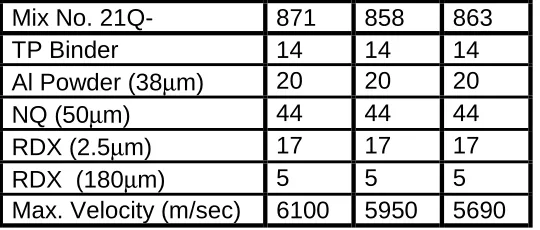
One composition manufactured with wet 50µm HBDNQ was tested for detonation velocity, (21Q858). It was noted that an identical composition containing dry NQ (2lQ863/Table 3.3.1-1) had a comparable velocity, although slightly lower. The explanation for these results is not clear since the water content at the end of mix was measured at < 0.01%. by Karl-Fisher titration. However, it may be that insufficient run distance was the reason. Figure 3.3.1-1 indicates that the water wet composition was still increasing in slope and that a run-up” was occurring and had the charge been longer, a higher velocity may have been achieved. A second mix incorporating dry NQ had an end of charge velocity of 5950 m/sec. This mix (21Q858) and the other mix with dry NQ (21Q-871) bracketed the mix manufactured with wet NQ.
[image:10.612.167.437.446.561.2]A summary of DTS-12920 compositions tested for detonation velocity is presented in Table 3.3.1-1.
Composition DTS-12870 was not tested for detonation velocity due to excessively high card gap values as will be noted later. DTS-13034 was also tested for detonation velocity, but with only two probes over a length of 1 meter. The average detonation velocity for DTS-13034 was 6264 m/sec.
Table 3.3.1-1
Detonation Velocity Performance for Composition DTS-12920
Mix No. 21Q- 871 858 863
TP Binder 14 14 14
Al Powder (38µm) 20 20 20
NQ (50µm) 44 44 44
RDX (2.5µm) 17 17 17
RDX (180µm) 5 5 5
Max. Velocity (m/sec) 6100 5950 5690
3.3.2 Intermediate Scale Sensitivity Test Results
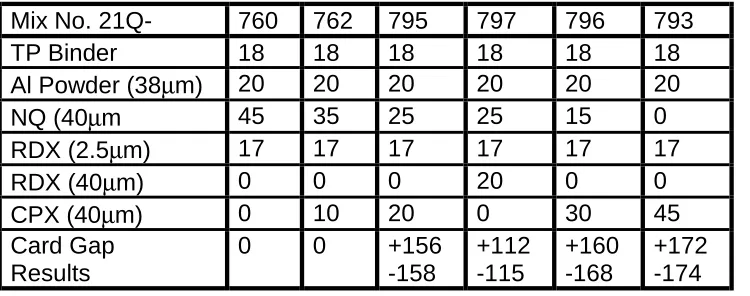
A number of mixes of composition DTS-12870 were manufactured with up to 27% nitramine while still maintaining 0 cards (1.44” ID). Seventeen percent (2.5µm) RDX was included in Mix 2lQ762 (Table 3.3.2-1) along with 10% of a material known as “Co-Product Explosive” (CPX). CPX is an unrefined combination of ≈ 70% RDX and ≈30% HMX with a particle diameter of ≈ 40µm.
Many advantages would be associated with the successful replacement of RDX with CPX in an explosive composition, specifically:
• Greater Availability
• Higher Energy and Density • Lower Cost
• Good Particle Fit
[image:11.612.128.503.536.684.2]However, when the CPX content was increased to 20%, (37% total nitramine) the card gap values shot up to 156/158 go/no go values (Mix 21Q795). Later when 3µm RDX was used in place of the 2.5µm RDX, results were quite different and only 22% nitramine could be loaded into the composition (21Q-814) before the limit of 70 cards was exceeded (Table 3.3.2-2). This indicates that there is a sharp sensitivity break between 2.5µm and 3µm RDX. Velocity measurements were not available due to the limited quantity of 42µm NQ. The sensitivity results of compositions manufactured with CPX are detailed in Table 3.3.2-1. Note that mix 21Q795 and 21Q-797 were essentially identical, but the latter formulation contained no CPX (baseline) for comparative purposes. At this level of nitramine loading, the composition with only RDX was approximately 20 cards lower in sensitivity than an identical composition with CPX.
Table 3.3.2-1
Card Gap Sensitivity Results of DTS-12870 and RDX Baseline
Mix No. 21Q- 760 762 795 797 796 793
TP Binder 18 18 18 18 18 18
Al Powder (38µm) 20 20 20 20 20 20
NQ (40µm 45 35 25 25 15 0
RDX (2.5µm) 17 17 17 17 17 17
RDX (40µm) 0 0 0 20 0 0
CPX (40µm) 0 10 20 0 30 45
Card Gap Results
0 0 +156
-158
+112 -115
+160 -168
Some water wet 50µm HBDNQ was received from NIGU and compositions similar to those detailed in Table 3.3.2-1 were manufactured but with unground RDX substituted for CPX. The plan which was followed was to employ unground RDX until a semi-final candidate was selected and compared with compositions containing CPX to validate the expected performance and economic improvements. No sensitivity increase was
expected by virtue of the presence of the HMX in the CPX.
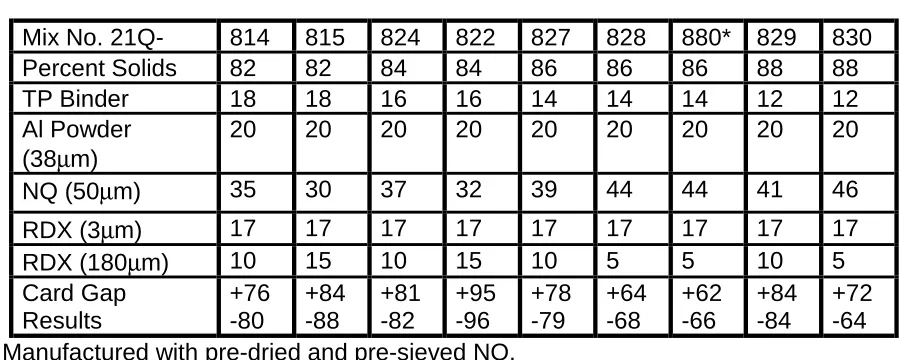
[image:12.612.79.533.438.618.2]Results from the mixes were encouraging since the water wet NQ was successfully processed and the water removed during mixing by adding the lecithin and wet NQ to the mixer bowl and mixing at 82°C under full vacuum for 4-6 hours. Table 3.3.2-2 details the mixes manufactured and the results. A number of card gap tubes were loaded with compositions containing from between 82 and 88 percent solids. In order to verify that processing of wet NQ would not abnormally affect the sensitivity of the compositions, a mix was made with pre-dried NQ as well (Mix 21Q-880). The composition manufactured with dry NQ was only slightly less sensitive and well within statistical or test error such that it could be safely concluded that there was no negligible difference in sensitivity between compositions manufactured with either wet or dry NQ. A summary of the compositions manufactured and tested is detailed in Table 3.3.2-2. Plots of the data reveal some interesting observations. First, plots of compositions 21Q-814, 21Q-824, 21Q-827, and 21Q-829 (manufactured with the same content of RDX but increasing contents of solids (as 50µm NQ) reveals only a slight increase in sensitivity (6 cards) as solids content increases from 82% to 88% (Figure 3.3.2-1).
Table 3.3.2-2
Summary of Compositions DTS-12920
Mix No. 21Q- 814 815 824 822 827 828 880* 829 830
Percent Solids 82 82 84 84 86 86 86 88 88
TP Binder 18 18 16 16 14 14 14 12 12
Al Powder
(38µm) 20 20 20 20 20 20 20 20 20
NQ (50µm) 35 30 37 32 39 44 44 41 46
RDX (3µm) 17 17 17 17 17 17 17 17 17
RDX (180µm) 10 15 10 15 10 5 5 10 5
Card Gap Results +76 -80 +84 -88 +81 -82 +95 -96 +78 -79 +64 -68 +62 -66 +84 -84 +72 -64 * Manufactured with pre-dried and pre-sieved NQ.
It was theorized that by reducing the aluminum content to ≈15%, a performance improvement (in terms of detonation velocity) of ≈7-10% was expected. Data from the earlier PBX effort verified that addition of aluminum severely retards detonation velocity. The PBX composition DTS-12555, which detonated at a velocity of ≈7200 m/s, decreased in velocity over 27% when 20% aluminum was substituted for NQ. Cook [7] showed that aluminum actually acts superior to an ideal diluent in explosive compositions and that a baseline composition to which 10% NaCl was added performed better than the same baseline to which 10% aluminum was added. Wise [8] documented an inverse/linear relationship between Al content and TNT detonation velocity.
Composition DTS-12920 (Table 3.3.2-1) was therefore modified by: 1) reduction of aluminum content from 20% to ≈15%; 2) replacement of ground RDX with 7µm aluminum and; 3) employing unground RDX as the sensitizer. Testing occurred in 2” confined charges. By confining the test article, a further detonation velocity of ≈7-10% was expected. By replacing ground (≈3µm) RDX with unground RDX (≈180µm) as the sensitizer which, based on data generated, does not seem to show a very significant degree of sensitivity increase, and employing 7µm aluminum for the fine fraction (both of which were commercially available in production quantities), major raw material limitations are resolved resulting in a composition which would be immediately capable of manufacturing in quantities of up to M15 lb./year.
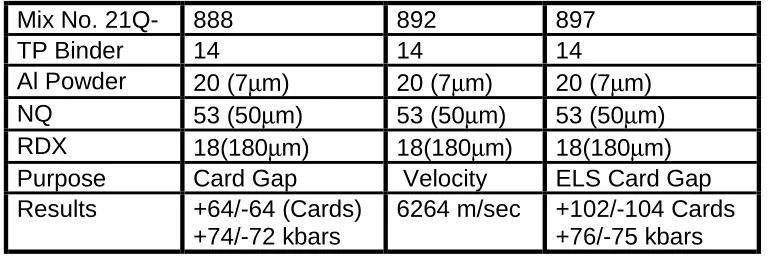
[image:13.612.114.500.478.606.2]The modified composition was identified as DTS-13034. Small scale sensitivity and performance results were previously reported. A summary of the sensitivity and performance characteristics of DTS-13034 are detailed in Table 3.3.2-3 below.
Table 3.3.2-3
Summary of Performance and Sensitivity Characteristics of DTS-13034
Mix No. 21Q- 888 892 897
TP Binder 14 14 14
Al Powder 20 (7µm) 20 (7µm) 20 (7µm)
NQ 53 (50µm) 53 (50µm) 53 (50µm)
RDX 18(180µm) 18(180µm) 18(180µm)
Purpose Card Gap Velocity ELS Card Gap Results +64/-64 (Cards)
+74/-72 kbars
6264 m/sec +102/-104 Cards +76/-75 kbars
ovens. Overall raw material and production costs would be over 20% less than for the cast cure PBX compositions.
Unfortunately, when this composition was scaled and even tested in a confined condition, negligible performance improvement was noted. The highest detonation velocity noted (at the end of the charge) was only 6264 m/sec, well below the target goal of approximately 7470 m/sec. It was determined, based on prior research, that addition of oxidizers would only result in decreased detonation velocity performance, therefore, compositions with AP were not manufactured during this phase.
However, the composition showed negligible increase in sensitivity at larger diameters. The composition DTS-13034 was subjected to Expanded Large Scale Gap Testing (ELSGT), and no significant sensitivity increase was observed. The ELSGT has dimensions twice the dimensions of the typical Card Gap Test. Previous research with non-ideal energetic materials indicated a sensitivity increase as diameter also increases. The ELSGT is an excellent indicator of how an energetic material will react under heavily confined. While the number of cards increased when DTS-13034 was tested at expanded conditions, as Figure 3.3.2-3 shows, this translates to ≈77 kbars. As noted in Table 3.3.2-2, the 3.66 cm diameter card gap for DTS-13034 had an initiation pressure of 72 kbars.
4.0 NQ Approach Summary
The thermoplastic binder developed during this phase of research permitted a number of prior formulation deficiencies to be overcome. Specifically, incorporation of a much lower particle size NQ was possible by virtue of the very fluid nature of the thermoplastic binder. A correlation between NQ diameter and more ideal behavior was established thus resulting in higher performance, easier boostering and lower critical diameter. The effect on small scale sensitivity characteristics (Impact, Friction, and ESD) when the cured binder (PPG) was replaced with the thermoplastic binder was phenomenal. While an exact quantitative difference was not possible, due to the fact that the equipment was not able to generate sufficient energy to result in a reaction. However, the qualitative differences were quite obvious.
humidities) showed no explosive degradation predicting that the explosive would easily meet the 20 year shelf life goals.
While most of the goals were met during this phase of research, performance was still a concern. A detonation pressure improvement of almost only ≈ 9% (162 kbars (DTS-13034) vs. 149 kbars (DTS-12557) was observed relative to similar compositions developed earlier. Thus, while some improvement in performance was achieved without a noticeable increase in sensitivity, performance was still of concern.
5.0 Conclusions for NQ Approach
Employment of high surface area solids at high contents (88%+) was determined to be possible by employment of the thermoplastic binder system developed during this phase of research. Numerous disadvantages associated with cast/cure technology (PBX) were eliminated. A correlation between the degree of ideal behavior and particle size of HBDNQ was established. Incorporation of 50µm HBDNQ from NIGU Chemie resulted in a 9% improvement performance over similar compositions developed earlier which contained 180µm NQ without any significant sensitivity increase.
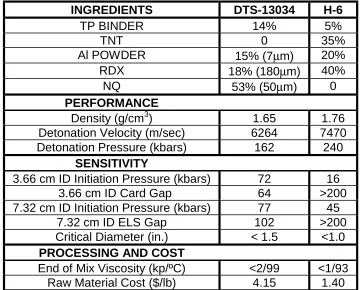
The formulation that was down selected for advance sensitivity testing was designated as DTS-13034. The formulation for this composition (and associated characteristics) with a comparison to H-6 is shown below in Table 5.0-1. When this composition was scaled up and tested in a confined condition, a detonation velocity improvement of 20% was noted (relative to the oxidizer containing composition developed previously (DTS-12558)). However, while the highest detonation velocity noted (at the end of the charge) was 6264 m/sec, this was well below the target goal of approximately 7470 m/sec. It was determined, based on prior research, that addition of oxidizers would only result in decreased detonation velocity performance, therefore, compositions with AP were not manufactured.
However, the composition DTS-13034 was subjected to Expanded Large Scale Gap Testing (ELSGT), and no significant sensitivity increase was observed.
Overall, this phase of the research project was quite successful and the following goals were met. The most significant achievements during this phase of research were:
1) the development of an thermoplastic binder with the following characteristics: • Has a binder raw material cost less than $0.92/lb.
• Employs a binder which is immediately available in production quantities • Is very fluid (<2kp at 99 ºC & 88% solids)
• Solidifies at temperatures < 80ºC • Has very low shrinkage properties
• Measured a detonation velocity 106% of Tritonal ρ=1.68 • Has a critical diameter less than 1.5” (unconfined)
• Has a go/no go card gap (1.44” ID) value of ≈ 64 cards
• Contains raw materials currently available in production quantities (M15lb/yr.) • Has a raw material cost of ≈$4.25/lb in production quantities
• Processable standard steam kettle equipment
• Is very insensitive with regards to IHE screening criteria
[image:16.612.113.473.312.602.2]However, despite this very desirable insensitivity, due to the poor performance associated with NQ, a decision was made to abandon this approach and evaluate a second more energetic insensitive molecular explosive known as 3-Nitro-1,2,4-triazol-5-one (NTO) in place of NQ.
Table 5.0-1
Comparison Of DTS-13034 Properties With H-6
INGREDIENTS DTS-13034 H-6
TP BINDER 14% 5%
TNT 0 35%
Al POWDER 15% (7µm) 20%
RDX 18% (180µm) 40%
NQ 53% (50µm) 0
PERFORMANCE
Density (g/cm3) 1.65 1.76
Detonation Velocity (m/sec) 6264 7470 Detonation Pressure (kbars) 162 240
SENSITIVITY
3.66 cm ID Initiation Pressure (kbars) 72 16 3.66 cm ID Card Gap 64 >200 7.32 cm ID Initiation Pressure (kbars) 77 45
7.32 cm ID ELS Gap 102 >200 Critical Diameter (in.) < 1.5 <1.0
PROCESSING AND COST
6.0 ACKNOWLEDGMENTS:
Gratitude is expressed to the US Government and to Thiokol Corporation (where the author was previously employed) who jointly funded this research and authorized its publication in open literature.
7.0 REFERENCES:
1. Price, D., and Clairmont, A., “The Response of Nitroguanidine to a Strong Shock,” NOLTR 67-169 (U) (1968)
2. Walker, F.E., “Performance of Non-Ideal High Explosives, UCID-16557 (U) (1974) and UCID-16439 (1973)
3. Sumrall, T.S., “Performance Test Results of a Melt Castable, General Purpose, Insensitive High Explosive”, Journal of Japan Explosives Society, 58,6 (1997)
4. Sumrall, T.S., “Large Scale Thermal Sensitivity Results of a Melt Castable, General Purpose, Insensitive High Explosive”, 23rd International Pyrotechnics Seminar, Tsukuba Japan (Oct. 1997)
5. Sumrall, T.S., “Large Scale Fragment Impact Sensitivity Results of a Melt Castable, General Purpose, Insensitive High Explosive”, Propellants, Pyrotechnics, and Explosives, 24, 30-36 (1999).
6. Sumrall, T.S. and Graham, W.H., “Formulation of a Melt Castable, General Purpose, Insensitive High Explosive”, Journal of Japan Explosives Society (58,2) (1997)
7. Cook, M.A., “The Science of High Explosives,” Reinhold Publishing, New York, NY, (1959)
* Either n-methylpyrolidone or di-methylformamide
Figure 3.1-1
Nitroguanidine Crystalline Forms and Manufacturing Sequence
Low Bulk Density Nitroguanidine
(LBDNQ)
Dissolving Process H2O + Methyl
Cellulose Solvent
Re-Crystallize Re-Crystallize
Organic Solvent *
Cubic Nitroguanidine
(CNQ)
Spherical Nitroguanidine (SNQ)
Grinding Operation
High Bulk Density Nitroguanidine
Figure 3.1-2 5µµµµm Diameter Low Bulk Density Nitroguanidine (LBDNQ)
Figure 3.1-3 5µm Cut Low Bulk Density NQ
[image:20.612.147.520.373.705.2]Figure 3.2-1
Small Scale Processing And Testing Matrix
450 gram Energetic Material
Mixing
Processability Evaluation Goal ≤ 2kP
IHE Screening Tests and Thermal Stability
Goal: Pass 4/6
Rapid Cure Assessment Goal ≤ 24 hrs.
Preliminary Physical Property Evaluation Pass
Pass
Pass
Pass Pass
Intermediate Scale Processing
and Testing
Fail Reformulate Theoretical
7.62 cm Unconfined Charge 3.66 cm Unconfined Charge
Figure 3.2-2
Figure 3.3-1
Intermediate Scale Energetic Material Testing Matrix
4.5 Kg Mixing and
Curing
3.65 cm Card Gap and Critical
Diameter
Detonation Velocity and Sub-Scale Slow
Cook-Off
Cap Test and ELSG (7.31 cm)
Test Pass
Pass
23 Kg Mixing and Curing Large Scale Performance
and Safety Testing Data Analysis and Reporting Reformulate
Pass Fail
Pass Pass
Small Scale Phase 25 kg Processing