Towards Broad-coverage Meaning Representation: The Case of
Comparison Structures
Omid Bakhshandeh University of Rochester
James F. Allen
University of Rochester / IHMC
1 Introduction
Representing the underlying meaning of text has been a long-standing topic of interest in computa-tional linguistics. Recently there has been a renewed interest in computational modeling of meaning for various tasks such as semantic parsing (Zelle and Mooney, 1996; Berant and Liang, 2014). Open-domain and broad-coverage semantic representation (Banarescu et al., 2013; Bos, 2008; Allen et al., 2008) is essential for many language understanding tasks such as reading comprehension tests and ques-tion answering.
One of the most common way for expressing eval-uative sentiment towards different entities is to use comparison. Comparison can happen in very sim-ple structures such as‘John is taller than Susan’, or more complicated constructions such as‘The table is longer than the sofa is wide’. So far the compu-tational semantics of comparatives and how they af-fect the meaning of the surrounding text has not been studied effectively. That is, the difference between the existing semantic and syntactic representation of comparatives has not been distinctive enough for en-abling deeper understanding of a sentence. For in-stance, the general logical form representation of the sentence‘John is taller than Susan’using the Boxer system (Bos, 2008) is the following:
named(x0, john, per)
&named(x1, susan, nam)
&than(taller(x0), x1) (1)
Clearly, the above meaning representation does
My Mazda drove faster than his Hyundai Self_mover Self_motion Manner
Figure 1: The frame-semantic parsing of the sen-tenceMy Mazda drove faster than his Hyundai.
not fully capture the underlying semantics of the ad-jective ‘tall’ and what it means to be ‘taller’. A hu-man reader can easily infer that the ‘height’ attribute of John is greater than Susan’s. Capturing the under-lying meaning of comparison structures, as opposed to their surface wording, is crucial for accurate eval-uation of qualities and quantities. Consider a more complex comparison example,‘The pizza was great, but it was still worse than the sandwich’. The state-of-the-art sentiment analysis system (Manning et al., 2014) assigns an overall ‘negative’ sentiment value to this sentence, which clearly lacks the understand-ing of the comparison happenunderstand-ing in the sentence.
As another example, consider the generic mean-ing representation of the sentence‘My Mazda drove faster than his Hyundai’, according to frame seman-tic parsing using Semafor1tool (Das et al., 2014) as depicted in Figure 1. It is evident that this meaning representation does not fully capture how the seman-tics of the adjectivefastrelates to thedrivingevent, and what it actually means for a car to drivefaster thananother car. More importantly, there is an ellip-sis in this sentence, the resolution of which results in complete reading of‘My Mazda drove faster than his Hyundai drove fast’, which is in no way captured in Figure 12.
1http://demo.ark.cs.cmu.edu/parse
2The same shortcomings are shared among other generic
meaning representations such as LinGO English Resource
Although the syntax and semantics of compari-son in language have been studied in linguistics for a long time (Bresnan, 1973; Cresswell, 1976; Von Ste-chow, 1984), so far, computational modeling of the semantics of comparison components of natural lan-guage has not been developed fundamentally. The lack of such a computational framework has left the deeper understanding of comparison structures still baffling to the currently existing NLP systems. In this paper we summarize our efforts on defin-ing a joint framework for comprehensive semantic representation of the comparison and ellipsis con-structions. We jointly model comparison and ellip-sis as inter-connected predicate-argument structures, which enables automatic ellipsis resolution. In the upcoming sections we summarize our main contri-butions to this topic.
2 A Comprehensive Semantic Framework for Comparison and Ellipsis
We introduce a novel framework for modeling the semantics of comparison and ellipsis as inter-connected predicate-argument structures. Accord-ing to this framework, comparison and ellipsis op-erators are the predicates, where each predicate has a set of arguments called itssemantic frame. For ex-ample, in the sentence‘[Sam] is the tallest [student] [in the gym]’, the morpheme-estis the comparison operator (hence, the comparison predicate) and the entities in the brackets are the arguments.
2.1 Comparison Structures 2.1.1 Predicates
We consider two main categories of compar-ison predicates (Bakhshandeh and Allen, 2015; Bakhshandeh et al., 2016), Ordering and Extreme, each of which can grade any of the four parts of speech including adjectives, adverbs, nouns, and verbs.
• Ordering: Shows the ordering of two or more entities on a scale, with the following subtypes:
– Comparatives expressed by the morphemes more/-erandless, with ‘>’, ‘<’ indicating that one degree is greater or lesser than the other.
(1) The steak is tastier than the potatoes.
Grammar (ERG) (Flickinger, 2011), Boxer (Bos, 2008), or AMR (Banarescu et al., 2013), among others.
Superlative+
Joe is the most eager boy ever.
Figure Scale/+
Domain Domain-specifier
Figure 2: An example predicate-argument structure consisting of superlative predicate type and its cor-responding semantic frame of arguments.
– Equatives expressed byasin constructions such asas talloras much, with ‘≥’ indicating that one degree equals or is greater than another.
(2) The Mazda drives as fast as the Nissan.
– Superlatives expressed by most/-est and least, indicates that an entity or event has the ‘highest’ or ‘lowest’ degree on a scale.
(3) That chef made the best soup.
The details of the Extreme type can be found in the earlier work (Bakhshandeh and Allen, 2015; Bakhshandeh et al., 2016).
2.1.2 Arguments
Each predicate takes a set of arguments that we re-fer to as the predicate’s ‘semantic frame’. Following are the main arguments included in our framework:
– Figure (Fig): The main role which is being com-pared.
– Ground: The main role Figure is compared to. – Scale: The scale for the comparison, such as length, depth, speed. For a more detailed study on scales please refer to the work on learning adjective scales (Bakhshandeh and Allen, 2015).
Our framework also includes ‘Standard’, ‘Differ-ential’, ‘Domain’, and ‘Domain Specifier’ argument types. Figure 2 shows an example meaning repre-sentations based on our framework.
2.2 Ellipsis Structures
struc-tures (Bakhshandeh et al., 2016): ‘VP-deletion’, ‘Stripping’3, ‘Pseudo-gapping’, ‘Gapping’, ‘Sluic-ing’, and ‘Subdeletion’. Ellipsis more often occurs in comparative and equative comparison construc-tions. A few examples of ellipsis in comparative constructions are as follows:
• Comparatives: Ellipsis site is the dependent clause headed bythan. Three ellipsis possibilities for these clauses resuming (4) are shown below. The elided materials are written in subscript.
(4) Mary drank more tea...
– VP-deletion (aka ‘Comparative Deletion’): ... than John diddrink coffee.
– Stripping (aka ‘Phrasal Comparative’): ... than Johndrank coffee.
– Gapping:
... than John,drankhow-muchcoffee.
– Pseudogapping:
... than John diddrankcoffee.
Furthermore, we define three argument types for ellipsis, which help thoroughly construct the an-tecedent of the elided material by taking into ac-count the existing words of the context sentence: Reference, Exclude, and How-much.
3 Data Collection Methodology
Given the new semantic representation, we aim at annotating corpora which then enables developing and testing models. The diversity and comprehen-siveness of the comparison structures represented in our dataset is dependent on the genre of sen-tences comprising it. Earlier, we had experimented with annotating semantic structures on OntoNotes dataset (Bakhshandeh and Allen, 2015). Recently (Bakhshandeh et al., 2016), We have shifted our fo-cus to actual product and restaurant reviews, which include many natural comparison instances. For this purpose we mainly use Google English Web Tree-bank4 which comes with gold constituency parse trees. We augment this dataset with the Movie Re-views dataset (Pang and Lee, 2005), where we use Berkeley parser (Petrov et al., 2006) to obtain parse trees.
We trained linguists by asking them to read the semantic framework annotation manual as
summa-3VP-deletion and stripping are the more frequent types. 4https://catalog.ldc.upenn.edu/
[image:3.612.314.542.62.131.2]LDC2012T13
Figure 3: The number of various predicate types across different resources.
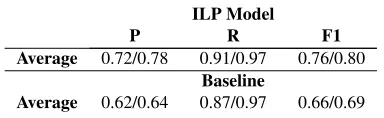
ILP Model
P R F1
Average 0.72/0.78 0.91/0.97 0.76/0.80 Baseline
Average 0.62/0.64 0.87/0.97 0.66/0.69 Table 1: Predicate prediction Precision (P), Recall (R) and F1 scores on test set, averaged across all predicate types. Each cell contains scores according to Exact/Head measurement.
rized in Section 2. The annotations were done via our interactive two-stage tree-based annotation tool. For this task, the annotations were done on top of constituency parse trees. This process yielded a to-tal of 2,800 annotated sentences. Figure 3 visual-izes the distribution of predicate types from the var-ious resources. As this Figure shows, reviews are indeed a very rich resource for comparisons, having more comparison instances than any other resource of even a bigger size. There are a total of 5,564 com-parison arguments in our dataset, with ‘scale’ and ‘figure’ being the majority types. The total number of ellipsis predicates is 240, with 197 Stripping, 31 VP-deletion and 12 Pseudo-gapping.
4 Predicting Semantic Structures
We model the prediction problem as a joint predicate-argument prediction of comparison and el-lipsis structures. In a nutshell, we define a glob-ally normalized model for the probability distribu-tion of comparison and ellipsis labels over all parse tree nodes as follows:
pC(c|v, T, θC)∝exp(fC(c, T)TθC) (2)
pAc(ac|c, e, v, T, θac)∝exp(fAC(c, e, T) Tθ
ac) (3) whereT is the underlying constituency tree, pC is
[image:3.612.330.522.174.233.2]ILP Model(Exact/Head) ILP No Constraints(Exact/Head) Baseline(Exact/Head)
P R F1 P R F1 P R F1
[image:4.612.84.528.63.100.2]Average 0.37/0.61 0.54/0.87 0.43/0.71 0.01/0.01 0.86/1.00 0.10/0.10 0.20/0.42 0.36/0.73 0.25/0.52 Table 2: Results of argument prediction on test set, averaged across various argument types.
each of the above equations, f is the correspond-ing feature function. For predicates and the argu-ments the main features are lexical features and bi-gram features, among many others. θC, θE, θac is the parameters of the log-linear model. We calculate these parameters using Stochastic Gradient Descent algorithm.
For inference, we model the problem as a struc-tured prediction task. Given the syntactic tree of a given sentence, for each node we first select the predicate type with the highest pC. Then for each
selected comparison predicate, we find the corre-sponding ellipsis predicate that has the highest pE
probability. We tackle the problem of argument assignment by Integer Linear Programming (ILP), where we pose domain-specific linguistic knowl-edge as constraints. Any specific comparison label calls for a unique set of constraints in the ILP for-mulation, which ensures the validity of predictions5. The details of this modeling can be found in earlier work (Bakhshandeh et al., 2016).
5 Experimental Results
We trained our ILP model on the train-dev part of the dataset (70%), and tested on the test set (30%). Evaluation is done against the reference gold anno-tation, with Exact and partial (Head) credits to an-notating the constituency nodes. We mainly report on two models: our comprehensive ILP model (de-tailed in Section 4), and a rule-based baseline. In short, the baseline encodes the same linguistically motivated ILP constraints via rules and uses a few pattern extraction methods for finding comparison morphemes.
The average results on predicate prediction (across all types) is shown in Table 1. As the re-sults show, overall, the scores are high for predict-ing the predicates, what is not shown here is ellipsis predicates being the most challenging. The baseline
5For instance, theSuperlativepredicate type never takes
anyGroundarguments, or the argumentStandardis only ap-plicable to the excessive predicate type.
is competitive, which shows that the linguistic pat-terns can capture many of the predicate types. Our model performs the poorest onEquatives, achiev-ing 71%/73% F1 score, which is a complex mor-pheme used in various linguistic constructions. Our analysis shows that the errors are often due to inac-curacies in automatically generated parse trees6. As you can see in Table 2, The task of predicting argu-ments is a more demanding task. The baseline per-forms very poorly at predicting the arguments. Our comprehensive ILP model consistently outperforms theNo Constraintsmodel, showing the effectiveness of our linguistically motivated ILP constraints.
6 Conclusion
In this work we summarized our work which fo-cuses on an aspect of language with a very rich semantics: Comparison and Ellipsis. The current tools and methodologies in the research community are not able to go beyond surface-level shallow rep-resentations for comparison and ellipsis structures. We have developed widely usable comprehensive semantic theory of linguistic content of comparison structures. Our representation is broad-coverage and domain-independent, hence, can be incorporated as a part of any broad-coverage semantic parser (Ba-narescu et al., 2013; Allen et al., 2008; Bos, 2008) for augmenting their meaning representation.
Acknowledgment
We thank the anonymous reviewers for their com-ments. This work was supported in part by Grant W911NF-15-1-0542 with the US Defense Advanced Research Projects Agency (DARPA) and the Army Research Office (ARO).
References
James F. Allen, Mary Swift, and Will de Beaumont. 2008. Deep semantic analysis of text. InProceedings
6For example, challenging long review sentences with
of the 2008 Conference on Semantics in Text Process-ing, STEP ’08, pages 343–354, Stroudsburg, PA, USA. Association for Computational Linguistics.
Omid Bakhshandeh and James Allen. 2015. Semantic framework for comparison structures in natural lan-guage. In Proceedings of the 2015 Conference on Empirical Methods in Natural Language Processing, pages 993–1002, Lisbon, Portugal, September. Asso-ciation for Computational Linguistics.
Omid Bakhshandeh, Alexis Cornelia Wellwood, and James Allen. 2016. Learning to jointly predict ellip-sis and comparison structures. InProceedings of The 20th SIGNLL Conference on Computational Natural Language Learning, pages 62–74, Berlin, Germany, August. Association for Computational Linguistics. Laura Banarescu, Claire Bonial, Shu Cai, Madalina
Georgescu, Kira Griffitt, Ulf Hermjakob, Kevin Knight, Philipp Koehn, Martha Palmer, and Nathan Schneider. 2013. Abstract meaning representation for sembanking. InProceedings of the 7th Linguistic Annotation Workshop and Interoperability with Dis-course, pages 178–186, Sofia, Bulgaria, August. As-sociation for Computational Linguistics.
Jonathan Berant and Percy Liang. 2014. Semantic pars-ing via paraphraspars-ing. In Association for Computa-tional Linguistics (ACL).
Johan Bos. 2008. Wide-coverage semantic analysis with boxer. In Johan Bos and Rodolfo Delmonte, editors, Semantics in Text Processing. STEP 2008 Conference Proceedings, Research in Computational Semantics, pages 277–286. College Publications.
Joan Bresnan. 1973. Syntax of the comparative clause construction in English.Linguistic Inquiry, 4(3):275– 343.
Max Cresswell. 1976. The semantics of degree.Barbara Hall Partee (ed.), pages 261–292.
Dipanjan Das, Desai Chen, AndrÃl’ F. T. Martins, Nathan Schneider, and Noah A. Smith. 2014. Frame-semantic parsing.Computational Linguistics, 40:1:9–56. Dan Flickinger. 2011. Accuracy vs. robustness in
gram-mar engineering. In Emily M. Bender and Jennifer E. Arnold, editors,Language from a Cognitive Perspec-tive: Grammar, Usage and Processing, number 201, pages 31–50. CSLI Publications, Stanford.
Christopher Kennedy. 2003. Ellipsis and syntactic rep-resentation. In Kerstin Schwabe and Susanne Win-kler, editors,The Interfaces: Deriving and Interpret-ing Omitted Structures, number 61 in Linguistics Ak-tuell, pages 29–54. John Benjamins.
Christopher D. Manning, Mihai Surdeanu, John Bauer, Jenny Finkel, Steven J. Bethard, and David McClosky. 2014. The Stanford CoreNLP natural language pro-cessing toolkit. InProceedings of 52nd Annual
Meet-ing of the Association for Computational LMeet-inguistics: System Demonstrations, pages 55–60.
Jason Merchant. 2013. Voice and ellipsis. Linguistic Inquiry, 44(1):77–108.
Bo Pang and Lillian Lee. 2005. Seeing stars: Exploiting class relationships for sentiment categorization with respect to rating scales. InProceedings of ACL, pages 115–124.
Slav Petrov, Leon Barrett, Romain Thibaux, and Dan Klein. 2006. Learning accurate, compact, and inter-pretable tree annotation. InProceedings of the 21st In-ternational Conference on Computational Linguistics and the 44th Annual Meeting of the Association for Computational Linguistics, ACL-44, pages 433–440, Stroudsburg, PA, USA. Association for Computational Linguistics.
Arnim Von Stechow. 1984. Comparing semantic theo-ries of comparison.Journal of Semantics, 3(1):1–77. Masaya Yoshida, Chizuru Nakao, and Ivà ˛an
Ortega-Santos. 2016. Ellipsis. Routledge Handbook of Syn-tax, London, UK.