Email Formality in the Workplace: A Case Study on the Enron Corpus
Kelly Peterson, Matt Hohensee, and Fei Xia Linguistics Department
University of Washington Seattle, WA 98195
{kellypet, hohensee, fxia}@uw.edu
Abstract
Email is an important way of communication in our daily life and it has become the subject of various NLP and social studies. In this pa-per, we focus on email formality and explore the factors that could affect the sender’s choice of formality. As a case study, we use the En-ron email corpus to test how formality is af-fected by social distance, relative power, and the weight of imposition, as defined in Brown and Levinson’s model of politeness (1987). Our experiments show that their model largely holds in the Enron corpus. We believe that the methodology proposed in the paper can be applied to other social media domains and be used to test other linguistic or social theories.
1 Introduction
Email has become an important way of communica-tion in our daily life. Because of its wide usage, it has been the subject of various studies such as social network analysis (e.g., (Leuski, 2004; Dies-ner et al., 2005; Carvalho et al., 2007)), deception detection (e.g., (Zhou et al., 2004; Keila and Skill-corn, 2005)), information extraction (e.g., (Culotta et al., 2004; Minkov et al., 2005)), and topic discov-ery (e.g., (McCallum et al., 2007)). In this study, we focus on email formality in various social settings; that is, we want to determine whether the choice of formality in email communication is affected by fac-tors such as the social distance and relative power between the senders and the recipients.
While an early perspective of email communica-tion held that email is a lean medium which lacks vi-tal social cues (Daft and Lengel, 1986), other work
has shown that senders of email exhibit a wide range of language and form choices which vary in differ-ent social contexts (Orlikowski and Yates, 1994). Through various theories of sociolinguistics, it is proposed that these changes take place in a pre-dictable manner.
Brown and Levinson (1987) have proposed a model where in order to save the “face” or public self image of the hearer of a message, a speaker can employ a range of verbal strategies. Their model of politeness states that in social situations there are three factors which are considered in a decision whether or when to use communication techniques such as formality:
1. The “social distance” between the participants as a symmetric relation
2. The relative “power” between the participants as an asymmetric relation
3. The weight of an imposition such as a request
Abdullah (2006) examines email interactions from the perspective of Brown and Levinson’s po-liteness model in a Malaysian corporation from over 180 participants and a corpus of 770 email mes-sages. This work directly examines the factors men-tioned previously which influence email formality. Unfortunately, the methodology and data were not provided for this study.
The goal of our work is to test whether Brown and Levinson’s model holds in a real setting with a much larger data set. In this study, we chose the En-ron Email Corpus as our dataset. We first built two classifiers: one labels an email asformalorinformal
and the other determines whether an email contains a request. Next, we used the classifiers to label ev-ery email in the Enron corpus. Finally, we tested whether the three factors in Brown and Levinson’s theory indeed affect formality in email communica-tion. While we consider the work a case study, we believe that the methodology proposed in the paper can be applied to other social media domains and be used to test other linguistic or social theories.1
2 Overview of the Enron email corpus
The Enron email corpus, which consists of hundreds of thousands of emails from over a hundred Enron employees over a period of 3.5 years (1998 to 2002), was made public during the US government’s legal investigation of Enron. The corpus was first pro-cessed and released by Klimt and Yang (2004) at Carnegie Mellon University (CMU), and this CMU dataset has later been re-processed by several other research groups. In this section, we briefly introduce the datasets that we used in our experiments.
2.1 The ISI dataset
The CMU dataset contains many duplicates. It was later processed and cleaned by Shetty and Adibi at ISI and released as a relational database. The ISI database comprises 252,759 messages from the email folders of 150 employees (Shetty and Adibi, 2004).2 We use the ISI dataset as the starting point for all of our experiments except for the one in Sec-tion 5.1.
2.2 The Sheffield dataset
The Enron email corpus contains both personal and business emails. In 2006, Jabbari and his colleagues at the University of Sheffield manually annotated a subset of the emails in the CMU dataset with “Business” or “Personal” categories (Jabbari et al., 2006). The subset contains 14,818 emails and 3,598 of them (24.2%) are labeled as “personal”.3 We use this dataset in the personal vs. business experiment
1
Our data including annotations and results can be found at http://students.washington.edu/kellypet/enron-formality/
2
The dataset can be downloaded from http://www.isi.edu/˜adibi/Enron/Enron.htm
3
The dataset is available at
http://staffwww.dcs.shef.ac.uk/people/L.Guthrie/nlp/research.htm.
as described in Section 5.1.4
2.3 The ISI Enron employee position table
In addition to the ISI database, ISI also provided a table of 161 employees and their positions in the company.5 In Section 5.3, we study the effect of seniority on the formality of a message, and we use this table to determine the relative seniority between senders and recipients of a given email.
3 Creating the gold standard
In this study, we build two classifiers: a formality classifier that determines whether an email is formal, and a request classifier that determines whether an email contains a request. In order to train and eval-uate the classifiers, 400 email messages were ran-domly chosen from the Enron corpus and manually labeled for formality and request.
3.1 Formality annotation
Formality is a concept which is difficult to define precisely and human judgment on whether an email is formal can be subjective. To determine how much human annotators can agree on the concept, we asked three annotators to label 100 out of the 400 emails with four labels: “very formal”, “somewhat formal”, “somewhat informal”, and “very informal”. Because formality is hard to define, we did not give annotators a concrete definition. Instead, we provided a few guidelines and asked annotators to follow the guidelines and their intuition. One of these guidelines was that the formality of an email should not necessarily be dictated by the relationship between the sender and the recipient if their rela-tionship can be inferred from the message. Another guideline stressed that the nature of an email being business or personal should not necessarily dictate its formality. Other than these guidelines, annota-tors were asked to come up with their own criteria for formality while doing the annotation.
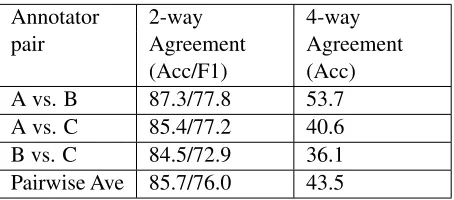
Table 1 shows the agreement between each anno-tator pair and the average score of the three pairs. For agreement, we calculated the accuracy, which
4The ISI dataset and the Sheffield dataset contain significant
overlap as both were derived from the CMU dataset, but the former is not necessarily a superset of the latter.
5
Annotator 2-way 4-way pair Agreement Agreement
[image:3.612.73.300.53.153.2](Acc/F1) (Acc) A vs. B 87.3/77.8 53.7 A vs. C 85.4/77.2 40.6 B vs. C 84.5/72.9 36.1 Pairwise Ave 85.7/76.0 43.5
Table 1: Inter-annotator agreement for formality annota-tion
is the percentage of emails that receive the same label from the two annotators. 2-way agreement
means the agreement is calculated after the label
very formalhas been merged withsomewhat formal, and very informalwith somewhat informal; 4-way agreement means that the agreement is calculated with the four formality labels used by the annota-tors. With the 2-way distinction (formal vs. infor-mal), we also calculate the f-score for identifying
informalemails, treating one annotation as the gold standard and the other as the system output. This table shows that, although the concept of formality is intuitive, the inter-annotator agreement on formal-ity is pretty low (especially when making the 4-way distinction).
Finally, Annotator A, who had the highest agree-ment with other annotators, annotated the remain-ing 300 emails, and his annotation was treated as the gold standard for our formality classifier.
3.2 Request annotation
In order to train and evaluate our request classifier, we asked two annotators to go over the same 400 emails and label each message ascontaining-request
orno-request. A message is considered to contain a request if it is clear that the sender of the message expects the recipient to take some action to respond to the message. For instance, if a message includes a question such aswhat do you think? or a request such as please call me tomorrow, it should be la-beled ascontaining-requestas the sender expects the recipient to call the sender or answer the question. Our definition is slightly different from the defini-tion of request used in speech acts, and it can be seen as a synonym ofrequire-action.
While some emails clearly contain requests and others clearly do not, there is some gray area in
be-tween, which results in the disagreement between the annotators. Many of the disagreed emails in-clude sentences such as Let me know if you have any questions. This very commonly used expression is itself ambiguous between the meanings“Let me know whether you have any questions”and“If you have any questions, please inform me of that fact”. Furthermore, this sentence often appears as a marker of politeness or an offer to clarify further, rather than a request for action. So the correct label of an email containing this expression depends on the context. For the 400 messages, the two annotators agreed on 361 messages, for an inter-annotator agreement of 90.3% and a F1-score of 87.9% for identifying emails that contain requests.
4 Building classifiers
In this section, we discuss the feature sets used for the two classifiers and report their performances.
4.1 Data pre-processing
Before forming the feature vectors for the classi-fiers, we preprocessed all the emails in the ISI and Sheffield dataset in several steps. First, we removed any replied or forwarded message from the email body as we want to use only the text written by the sender. If the email body becomes empty after this step, the email is excluded from the analysis con-ducted in Section 5. After this step, the size of the ISI dataset reduces from 252,759 to 232,815 emails, and the size of the Sheffield dataset changes from 14,818 to 13,882 emails. Second, the email mes-sages were segmented into sentences and tokenized with tools in the NLTK package (Bird et al., 2009).
4.2 Formality classifier
For the formality classifier, we use two labels: for-malandinformal.
4.2.1 Features for formality
emails:6
F1: Informal Word Features, which check the oc-currences ofinformal words(see the next sec-tion for detail)
F2: Punctuation Features:
• Exclamation Points (‘!’)
• Absence of sentence final punctuation
• Frequency of ellipsis (‘. . . ’)
F3: Case features:
• All lowercase Subject line
• Frequency of sentences which were en-tirely lower case
• Frequency of sentences whose first word is lower case
4.2.2 Informal words
We designed a simple heuristic method to ex-tract a list of informal words from the Enron cor-pus. First, we collect all the unigrams in the Enron corpus. Second, we retrieve the information about each unigram from Wordnik,7 a website that
pro-vides access to retrieve word definitions from mul-tiple source dictionaries. Among the several dictio-naries crawled by Wordnik, we find Wiktionary to be the best source for our task since its labels on word definitions such as ‘informal’, ‘offensive’, ‘vulgar’, ‘colloquial’ and ‘misspelling’ were the most con-sistent and relevant to our definition of “formality”. In addition to these labels, the part of speech cate-gory for ‘interjection’ was also used to determine if a word might be considered informal in email com-munication. Third, we use the gathered word defini-tions to determine whether a word isinformal.
One issue with the last step is that words often have multiple meanings and some meanings are in-formal and others are not. For instance, the word
bloody can be formal or informal depending on which meaning is used in an email. As word sense disambiguation is out of the scope of this work, we use some simple heuristics to determine whether a word should be treated as informal or not. In essence, the process treats a word as informal if a
6We did not use ngram features as they might be too specific
to the small training data we have and might not work well when applied to other emails in the Enron corpus or emails in other domain.
7http://www.wordnik.com
large percentage of definitions for the word have cer-tain labels (e.g., vulgar, offensive, andmisspelling) or certain part-of-speech tags (e.g.,interjection).8
4.2.3 Performance of the formality classifier
We trained a Maximum Entropy (MaxEnt) classi-fier in the Mallet package (McCallum, 2002). Table 2 shows classification accuracy and precision, recall, and F1-score for identifying informal emails. The baseline system labels every email asformalbecause 62.7% of the emails in the dataset were annotated as formal; its F1-score is zero as the recall is zero. The numbers for the inter-annotator agreement row are copied from the pairwise average of the 2-way agreement in Table 1. The table shows that, with very few features, the performance of the formal-ity classifier is much better than the baseline and is close to inter-annotator agreement. All three types of features beat the baselines and combining them provides additional improvement.
Acc Prec Rec F1
Baseline 62.7 - -
-Inter-annotator agreement
85.7 89.5 66.8 76.0
F1: Informal words 69.2 75.0 26.7 39.3 F2: Punctuation 74.4 82.5 45.8 58.9 F3: Case features 69.7 80.0 26.5 39.8 F1+F2 76.4 77.3 51.1 61.5 F1+F3 72.8 74.3 39.4 51.5 F2+F3 80.3 85.2 59.7 70.2 F1+F2+F3 80.6 85.7 62.1 72.0
Table 2: Performance of the formality classifier. We use 10-fold cross validation on the 400 emails. Baseline: la-bel every email asformal.
4.3 Request classifier
The request classifier uses two labels: containing-requestandno-request.
8
0.60 0.65 0.70 0.75 0.80 0.85 0.90 0.95 1.00
1-gram 2-gram 3-gram 4-gram 5-gram
Top 5000 Top 1000 At least 5 At least 10 Baseline
Figure 1: Accuracy of the request classifier with different feature sets
4.3.1 Features for request
There has been considerable research into cate-gorizing email messages by function. Cohen, Car-valho, and Mitchell (2004) described the classifica-tion of email into ‘email speech acts’, building on the speech act theory of Searle (1975). Carvalho and Cohen (2006) achieved high-precision results cate-gorizing messages into categories such as ’request’ and ’proposal’ when preprocessing the text in cer-tain ways and using unigram, bigram, and trigram features only.
Unlike formality, which is more about the style of the messages (e.g., whether the email is all in lower-case), the content words are more relevant for iden-tifying requests. Following the work in (Carvalho and Cohen, 2006), we used word ngrams as features. To prevent the features from being too specific to the small training data, we experimented with two ways of feature selection: by feature counts and by chi-square scores. N-grams were extracted from the email body only. For pre-processing, in addition to the pprocessing step mentioned in 4.1, we also re-placed some name entities (e.g., numbers and dates) with special labels and lowercased the text.
4.3.2 Performance of the request classifier
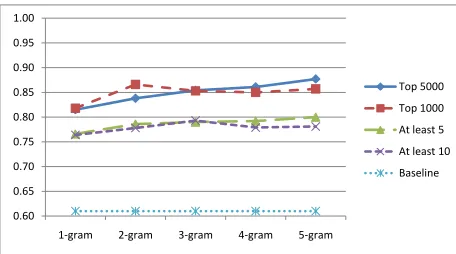
We trained a MaxEnt classifier and ran 10-fold cross validation on the 400-email dataset. Figure 1 shows the accuracy of the classifier with differ-ent feature sets. The bottom dotted line is the base-line result. In the 400 emails, 244 are labeled as no-request, so a baseline system that labels everything asno-requesthas an accuracy of 61%. The middle two lines are the accuracy with features that occur no
[image:5.612.73.301.55.182.2]fewer than 5 or 10 times. For the top two curves, fea-tures are sorted according to the chi-square scores, and the top one thousand or five thousand are kept. X-axis shows the value ofnfor word ngrams; e.g., 3-gram means features include word unigrams, bi-grams, and trigrams. Figure 1 shows that chi-square scores outperform feature counts for feature selec-tion, and varying the value ofndoes not affect the accuracy very much.
Table 3 shows classification accuracy and preci-sion, recall, and F1-score for identifying request-containing emails when n is set to 3. The table shows that our classifier, regardless of methods used for feature selection, greatly outperforms the base-line system, and there is a small gap between the performance of our classifier and the inter-annotator agreement. For the rest of our experiment, we will use 3-gram, Top5000 as the feature set for the re-quest classifier.
Acc Prec Rec F1
Baseline 61.0 - -
-Inter-annotator agreement
90.3 90.4 85.5 87.9
Using all features 79.5 76.8 68.0 72.1 At least 5 79.0 75.7 68.0 71.6 At least 10 79.3 75.9 68.6 72.1 Top1000 85.5 88.3 72.4 79.6 Top5000 85.5 88.3 72.4 79.6
Table 3: Performance of the request classifier with 3-gram features: We use 10-fold cross validation on the 400 emails. Baseline: label every email asno-request.
5 Factors influencing formality
As mentioned in Section 1, Brown and Levinson (1987) proposed three factors that influence commu-nication choices such as formality: social distance, relative power, and the weight of an imposition. In this section, we test whether these factors indeed af-fect formality in emails.
related social properties in absence of data which outlines the social distance of all Enron employees. For relative power, we use the rank difference of the positions that the sender and the recipient held in Enron. Since relative power is complex to define without more data, this definition of rank difference serves as one dimension in which we can study rel-ative power. For the weight of imposition, we com-pare emails that contain requests and the ones that do not.
5.1 Social distance: Personal vs. Business
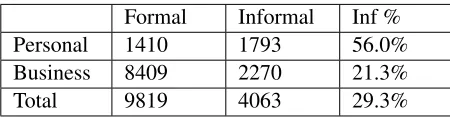
In general, friends, family and other such personal contacts are presumably closer in social distance than business colleagues. Therefore, it is possible that email messages of a personal nature will be more likely to be informal than those of a business nature. To test the hypothesis, we compare the de-gree of formality in business vs. personal emails. We use the Sheffield dataset, which contains 13,822 non-empty emails that have been manually labeled as “personal” or “business”. We ran the formality classifier on the data, and the results are in Table 4. The first and second columns show the number of emails that are labeled asformalorinformalby our formality classifier, and the last column shows the percentage of emails in that row that are labeled in-formal(a.k.a.the rate of informality).
The table demonstrates that the rate of informal-ity in personal emails (56.0%) is indeed much higher than that of business emails (21.3%). We have run the Chi-square test and G test with the counts in the table, and both tests indicate that formality (formal vs. informal) is not independent from the business nature of an email message (business vs. personal) at p=0.0001. The same is true for formality and other social factors that we tested in this section (see Ta-bles 5, 7, 8, and 9).9
9There are two caveats for using these statistical tests to
de-termine whether two random variables (formality and a social factor) are independent. First, the counts in the tables are based on the output of the two classifiers, which could be different from the real counts. Second, the data points in some experi-ments were not chosen randomly from the whole email corpus; for instance, the emails in Table 7 were from a small set of peo-ple whose ranks at Enron were known.
[image:6.612.313.538.53.112.2]Formal Informal Inf % Personal 1410 1793 56.0% Business 8409 2270 21.3% Total 9819 4063 29.3%
Table 4: Formality in personal vs business emails, p< 0.0001
5.2 Social distance: Amount of contact
Besides the difference in personal and business mat-ters, another way to measure social distance is the amount of contact that two individuals have with each other. People with more email exchange are likely to be closer in social distance than those with less email exchange, and are therefore likely to have a higher rate of informality. To test this hypothesis, we started with the ISI dataset and looked at the sub-set of emails where an email has exactly one recipi-ent, and both the sender and the recipient are in the enron.com domain. The emails were then grouped into several buckets based on the number of emails from a sender to a recipient.
The results are in Table 5. The first column is the range of the numbers of emails from a sender to a recipient, and the last column is the number of (sender, recipient) pairs where the number of emails that the sender sent to the recipient is in the range specified in the first column. The second column is the total number offormalemails from the senders to the recipients in those pairs. The third column is defined similarly, and the 4th column is the rate of informality. Note that the rates of informality in the first two rows are about the same; it might be due to the fact that the Enron corpus contains emails only in a 3.5-year period. The rate of formality does go up in the third and fourth rows.
Emails sent from A to B
Formal Inf Inf % # of pairs 1 to 10 23,423 7,566 24.4% 14,877 11 to 50 11,484 3,558 23.7% 737 51 to 100 3,236 1,363 29.6% 66 101 or more 2,114 1,271 37.5% 21 Total 40,257 13,758 25.5% 15,701
5.3 Relative power: Rank difference
Another factor that could affect the sender’s choice of formality is the relative difference in power or rank between sender and recipient. For example, if a manager sends an email to the CEO of an organi-zation, the email is more likely to be formal than if the recipient has a lower rank than the sender.
To investigate this, we started with the emails in the ISI dataset whose senders are employees appear-ing in the ISI Enron employee position table and re-cipients are in the enron.com domain. We grouped the emails by the sender’s position and calculated the rate of informality in each group. The results are in Table 6: the first two columns are the title and the rank of the positions in Enron; the third column is the number of employees with that position; the fourth column is the total number of emails sent by these employees; the fifth column is the rate of infor-mality; the last column is the percentage of emails that contain requests according to our request classi-fier. It is interesting to see that the rates of informal-ity and request vary a lot for different positions; for instance, lawyers are more formal and make more requests than traders.
Position Rank # of emp
Emails sent
Inf %
Req % CEO 6 4 836 19.4% 21.7% President 5 4 2,680 34.3% 19.3% VP 4 28 11,425 22.2% 18.1% Manag
Dir
3 6 4,953 14.0% 14.7%
Director 2 22 1,879 29.4% 15.2% Manager 1 13 6,563 12.4% 25.3% In-house
lawyer
0 3 1,548 7.0% 26.9%
Trader 0 12 1,743 33.1% 13.4% Employee 0 38 11,770 19.1% 19.1% Total - 130 43,397 22.0% 19.2%
Table 6: The set of Enron employees used in the formality vs. rank study
To study the effect of rank difference on formal-ity, we used the first six rows in Table 6 as the rel-ative ranks of the next three rows are not so clearly defined (Diesner et al., 2005). In total, there are 77 employees with rank 1-6, and we call this set of
peo-pleRankSet. We then extracted from the ISI dataset only those emails that have exactly one recipient and both sender and recipient are members ofRankSet. We grouped this small set, 3999 emails in total, ac-cording to the rank difference (which is defined to be the rank of the recipient minus the rank of the sender). The results are in Table 7: the last column is the number of (sender, recipient) pairs with that rank difference. For instance, the -2 row indicates that, among those messages addressed two ranks lower in the organizational hierarchy, 24.7% are informal.
In general, Table 7 shows a lower rate of informal-ity when an email is addressed to a recipient of su-perior rank. For example, the informality rate of an email addressed to someone 4 or more ranks higher than the sender (15.6%) is less than half that of an email addressed to someone 4 or more ranks lower (31.6%). We do not know what causes the increase of informality from +1 to +2; nevertheless, from +2 to +4 (in emails addressing someone 2-4 ranks higher), there is another decrease in informality rate.
Rank diff Formal Inf Inf % # of pairs -4 or less 39 18 31.6% 16
-3 84 32 27.6% 32
-2 226 74 24.7% 56
-1 499 141 22.0% 82
0 989 275 21.8% 190
+1 784 175 18.2% 95
+2 270 121 30.9% 58
+3 125 38 23.3% 46
+4 or more 92 17 15.6% 29 Total 3108 891 22.3% 604
Table 7: Formality and rank difference, p<0.0001.Rank diffis equal to recipient rank minus sender rank.
5.4 Weight of imposition: Requests
According to Brown and Levinson’s model of polite-ness, the greater weight of an imposition, the greater the usage of polite speech acts including formality. In this model, a request is one of the most imposing speech acts. Therefore, when a request is made, we would expect a lower rate of informality.
rate of informality for request and no-request emails. Table 8 shows that there is indeed a lower rate of informality when a request is being made.
Formal Informal Inf % Request 42,313 9,928 19.0% No-request 128,958 51,616 28.6% Total 171,271 61,544 26.4%
Table 8: Formality and request, p<0.0001
5.5 Number of recipients
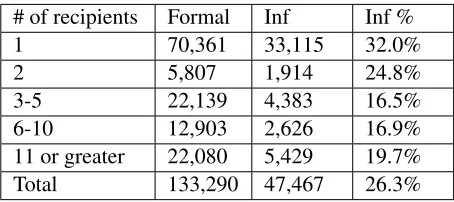
Another hypothesis we considered is the assumption that a sender is less likely to be informal when there are more recipients on an email since he does not want to broadcast a style which is more personal and could be perceived as unprofessional. To test this hypothesis, we started with the ISI dataset and looked at the subset of emails where an email has at least one recipient.10 The emails were then grouped
based on the number of recipients in the emails. Table 9 shows the rate of informality with differ-ent numbers of recipidiffer-ents. For the most part in these results, a greater number of recipients results in a lower rate of informality. For instance, the rate of informality is nearly cut in half when there are 3 to 5 recipients as opposed to a single recipient. However, at the upper end of this scale, the rate of informality rises again slightly. One possible explanation is that when an email is addressed to a very large number of recipients, the strategies employed (e.g., the model of saving face) might differ from those employed in an email addressed to a small audience.
6 Discussion
In this study, we explored the relation between for-mality and five factors: (1) personal vs. business, (2) amount of contact, (3) rank difference, (4) re-quest, and (5) number of recipients. The experi-ments show that the general patterns between the rate of informality and the five factors are consistent with Brown and Levinson’s model and our intuition;
10Some emails in the ISI dataset do not contain any
recipi-ent information. We suspect that the recipirecipi-ent information has been somehow removed before the data was released to the pub-lic. With the at-least-one-recipient requirement, the number of non-empty emails in the ISI dataset is reduced from 232,815 to 180,757.
# of recipients Formal Inf Inf % 1 70,361 33,115 32.0%
2 5,807 1,914 24.8%
3-5 22,139 4,383 16.5% 6-10 12,903 2,626 16.9% 11 or greater 22,080 5,429 19.7% Total 133,290 47,467 26.3%
Table 9: Formality and the number of recipients, p< 0.0001
for instance, an email tends to be more formal if it is about business matter, it is sent to someone with a higher rank, or it contains a request. But the ex-periments did produce some unexpected results; for instance, the rate of informality increased slightly when the number of recipients is more than 10.
There are several possible reasons for the unex-pected results. One is due to the limitation of our dataset. For instance, the social interaction between two people could easily go beyond the 3.5 years cov-ered by the Enron corpus, and people could choose other ways of communication besides email. There-fore, the Enron corpus alone may not be sufficient to capture the social distance between two people in the corpus. Another possible reason is that the errors made by our classifiers could contribute to some of the unexpected results.
The third possible reason, the one that is most in-teresting to us, is that there are indeed some inter-esting phenomena which can explain away the un-expectedness of the results. For instance, an email sent to a large number of strangers (e.g., an adver-tisement sent to a large mailing list) may choose to use an informal and entertaining style in order to catch the recipients’ attention. Therefore, a theory that intends to account for people’s email behavior may need to distinguish emails sent to a large num-ber of strangers from those sent to a small group of friends. The benefit of a study like ours is that it allows researchers to test a linguistic or social the-ory on a large data set in a real setting. The study can either provide supporting evidence for a theory or reveal certain discrepancies between the predic-tion made by the theory and the statistics in the real data, which could lead to revision or refinement of the theory.
communication, it would be interesting to study for-mality behavior in other communication media such as Facebook and Twitter. By applying our method-ology to other media, it would be possible to deter-mine whether there are other social factors that in-fluence formality on these media. For example, it would be useful to determine whether there is a dif-ference in formality with respect to the number of ’friends’ or ’followers’ that a person has. Similarly, it would be interesting to examine correlations on the basis of whether a Facebook profile is config-ured as ’public’ or ’private’ since the potential view-ing audience would be reduced in the case of ’pri-vate’ profiles. Since Facebook also contains profiles which are associated with both individuals and busi-nesses, it would be interesting to compare these as we did with personal and business emails. Finally, it remains to be seen whether requests could be exam-ined in these media but other social factors (includ-ing whether posts related to personal matters, social causes, or event promotion) could be explored to ex-amine formality behavior.
7 Conclusions and Future Work
We believe that NLP techniques can be used to test linguistic or social theories. As a case study, we choose Brown and Levinson’s model of politeness (1987), which states that three factors are considered in a decision whether or when to use communication techniques such as formality. We test the theory on the Enron email corpus, and our experimental results are largely consistent with the theory and human in-tuition.
For future work, we plan to improve the perfor-mance of our formality and request classifier by adding additional features such as the ones that look at the layout and zoning of an email (e.g., greetings and signoffs). We also plan to apply our methodol-ogy to other genres of data (e.g., blogs, Facebook, Twitter) or to test other theories.
Another direction for future work is to explore what communication techniques such as formality can reveal about thecultureof a particular social net-work. For instance, among all the positions listed in the ISI Enron employee position table, lawyers have the lowest rate of informality (7.0%), compared to other positions (e.g., 33.1% for traders). This
im-plies that the workplace behavior of lawyers (at least with respect to emails) is very different from that of traders. It will be interesting to compare the be-haviors of people from different occupations or from different social networks. Furthermore, if we could define the norm of behavior within a social group, we could then identify the outliers who might de-serve special attention for various reasons.
AcknowledgmentWe would like to thank Todd
Lin-gren, Chris Rogers and three anonymous reviewers for helpful comments and Katherine Coleman, Car-men Harris and David Horton for providing email annotation. Special thanks are extended to Drew Marr`e for his insight in application of this data.
References
Nor Azni Abdullah. 2006. Constructing Business Email Messages: A Model of Writer’s Choice. ESP Malaysia, 12:53–63.
Steven Bird, Edward Loper, and Ewan Klein. 2009. Nat-ural Language Processing with Python. O’Reilly Me-dia Inc.
Penelope Brown and Stephen C. Levinson. 1987. Po-liteness: Some Universals in Language Usage. Cam-bridge: Cambridge University Press.
Vitor R. Carvalho and William W. Cohen. 2006. Improv-ing “email speech acts” analysis via n-gram selection. InProceedings of the Analyzing Conversations in Text and Speech (ACTS) Workshop at HLT-NAACL 2006, pages 35–41, New York.
Vitor R. Carvalho, Wen Wu, and William W. Cohen. 2007. Discovering leadership roles in email work-groups. InProc. of the 4th Conference on Email and Anti-Spam (CEAS 2007).
William W. Cohen, Vitor R. Carvalho, and Tom M. Mitchell. 2004. Learning to classify email into “speech acts”. In Proceedings of the EMNLP-2004, Barcelona, Spain.
A. Culotta, R. Bekkerman, and A. McCallum. 2004. Ex-tracting social networks and contact information from email and the web. In Proc. of the Conference on Email and Anti-Spam (CEAS 2004).
Richard L. Daft and Robert H. Lengel. 1986. Organi-sational Information Requirements, Media Richness, and Structural Determinants. Management Science, 32:554–571.
Computational & Mathematical Organization Theory, 11(3):201–228.
Sanaz Jabbari, Ben Allison, David Guthrie, and Louise Guthrie. 2006. Towards the Orwellian nightmare: separation of business and personal emails. In Pro-ceedings of the COLING/ACL 2006 Main Conference Poster Sessions, pages 407–411.
Parambir S. Keila and David B. Skillcorn. 2005. Detect-ing unusual and deceptive communication in email. Technical report, Queens University, Ontario, Canada. Brian Klimt and Yiming Yang. 2004. Enron corpus: A new data set for email classification research. Techni-cal report, Carnegie Mellon University.
Anton Leuski. 2004. Email is a stage: Discovering peo-ple roles from email archives. In Proc. of the 27th Annual International ACM SIGIR Conference on Re-search and Development in Information Retrieval (SI-GIR 2004), pages 502–503.
Andrew McCallum, Xuerui Wang, and Andres Corrada-Emmanuel. 2007. Topic and role discovery in so-cial networks with experiments on enron and academic email. Journal of Artificial Intelligence Research, 30:249–272.
Andrew McCallum. 2002. Mallet: A machine learning for language toolkit. http://mallet.cs.umass.edu. Einat Minkov, Richard C. Wang, and WilliamW. Cohen.
2005. Extracting personal names from email: Apply-ing named entity recognition to informal text. InProc. of EMNLP-2005.
Wanda Orlikowski and JoAnne Yates. 1994. Genre repertoire: The structuring of communicative practices in organizations. Administrative Science Quarterly, 39(4):541–574.
John R. Searle. 1975. A taxonomy of illocutionary acts. In K. Gunderson, editor,Language, Mind, and Knowl-edge, pages 344–369. Minneapolis.
Jitesh Shetty and Jafar Adibi. 2004. The enron email dataset database schema and brief statistical report. Technical report, Information Sciences Institute at University of South California.