BioNLP Shared Task 2011: Supporting Resources
Pontus Stenetorp: Goran Topi´c Sampo Pyysalo Tomoko Ohta Jin-Dong Kim; and Jun’ichi Tsujii$
Tsujii Laboratory, Department of Computer Science, University of Tokyo, Tokyo, Japan :Aizawa Laboratory, Department of Computer Science, University of Tokyo, Tokyo, Japan
;Database Center for Life Science,
Research Organization of Information and Systems, Tokyo, Japan $Microsoft Research Asia, Beijing, People’s Republic of China
{pontus,goran,smp,okap}@is.s.u-tokyo.ac.jp
[email protected] [email protected]
Abstract
This paper describes the supporting resources provided for the BioNLP Shared Task 2011. These resources were constructed with the goal to alleviate some of the burden of sys-tem development from the participants and al-low them to focus on the novel aspects of con-structing their event extraction systems. With the availability of these resources we also seek to enable the evaluation of the applicability of specific tools and representations towards im-proving the performance of event extraction systems. Additionally we supplied evaluation software and services and constructed a vi-sualisation tool, stav, which visualises event extraction results and annotations. These re-sources helped the participants make sure that their final submissions and research efforts were on track during the development stages and evaluate their progress throughout the du-ration of the shared task. The visualisation software was also employed to show the dif-ferences between the gold annotations and those of the submitted results, allowing the participants to better understand the perfor-mance of their system. The resources, evalu-ation tools and visualisevalu-ation tool are provided freely for research purposes and can be found at http://sites.google.com/site/bionlpst/
1 Introduction
For the BioNLP’09 Shared Task (Kim et al., 2009), the first in the ongoing series, the organisers pro-vided the participants with automatically generated syntactic analyses for the sentences from the anno-tated data. For evaluation purposes, tools were made
publicly available as both distributed software and online services. These resources were well received. A majority of the participants made use of one or more of the syntactic analyses, which have remained available after the shared task ended and have been employed in at least two independent efforts study-ing the contribution of different tools and forms of syntactic representation to the domain of informa-tion extracinforma-tion (Miwa et al., 2010; Buyko and Hahn, 2010). The evaluation software for the BioNLP’09 Shared Task has also been widely adopted in subse-quent studies (Miwa et al., 2010; Poon and Vander-wende, 2010; Bj¨orne et al., 2010).
The reception and research contribution from pro-viding these resources encouraged us to continue providing similar resources for the BioNLP Shared Task 2011 (Kim et al., 2011a). Along with the parses we also encouraged the participants and ex-ternal groups to process the data with any NLP (Nat-ural Language Processing) tools of their choice and make the results available to the participants.
We provided continuous verification and evalua-tion of the participating systems using a suite of in-house evaluation tools. Lastly, we provided a tool for visualising the annotated data to enable the par-ticipants to better grasp the results of their experi-ments and to help gain a deeper understanding of the underlying concepts and the annotated data. This paper presents these supporting resources.
2 Data
This section introduces the data resources provided by the organisers, participants and external groups for the shared task.
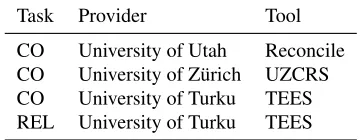
Task Provider Tool CO University of Utah Reconcile CO University of Z¨urich UZCRS CO University of Turku TEES REL University of Turku TEES
Table 1: Supporting task analyses provided, TEES is the Turku Event Extraction System and UZCRS is the University of Z¨urich Coreference Resolution System
2.1 Supporting task analyses
The shared task included three Supporting Tasks: Coreference (CO) (Nguyen et al., 2011), Entity lations (REL) (Pyysalo et al., 2011b) and Gene re-naming (REN) (Jourde et al., 2011). In the shared task schedule, the supporting tasks were carried out before the main tasks (Kim et al., 2011b; Pyysalo et al., 2011a; Ohta et al., 2011; Bossy et al., 2011) in order to allow participants to make use of analy-ses from the systems participating in the Supporting Tasks for their main task event extraction systems.
Error analysis of BioNLP’09 shared task sub-missions indicated that coreference was the most frequent feature of events that could not be cor-rectly extracted by any participating system. Fur-ther, events involving statements of non-trivial rela-tions between participating entities were a frequent cause of extraction errors. Thus, the CO and REL tasks were explicitly designed to support parts of the main event extraction tasks where it had been suggested that they could improve the system per-formance.
Table 1 shows the supporting task analyses pro-vided to the participants. For the main tasks, we are currently aware of one group (Emadzadeh et al., 2011) that made use of the REL task analyses in their system. However, while a number of systems in-volved coreference resolution in some form, we are not aware of any teams using the CO task analyses specifically, perhaps due in part to the tight sched-ule and the somewhat limited results of the CO task. These data will remain available to allow future re-search into the benefits of these resources for event extraction.
2.2 Syntactic analyses
For syntactic analyses we provided parses for all the task data in various formats from a wide range of parsers (see Table 2). With the exception of the Pro3Gres1 parser (Schneider et al., 2007), the parsers were set up and run by the task organisers. The emphasis was put on availability for research purposes and variety of parsing models and frame-works to allow evaluation of their applicability for different tasks.
In part following up on the results of Miwa et al. (2010) and Buyko and Hahn (2010) regarding the impact on performance of event extraction systems depending on the dependency parse representation, we aimed to provide several dependency parse for-mats. Stanford Dependencies (SD) and Collapsed Stanford Dependencies (SDC), as described by de Marneffe et al. (2006), were generated by convert-ing Penn Treebank (PTB)-style (Marcus et al., 1993) output using the Stanford CoreNLP Tools2into the two dependency formats. We also provided Confer-ence on Computational Natural Language Learning style dependency parses (CoNLL-X) (Buchholz and Marsi, 2006) which were also converted from PTB-style output, but for this we used the conversion tool3 from Johansson and Nugues (2007). While this conversion tool was not designed with convert-ing the output from statistical parsers in mind (but rather to convert between treebanks), it has previ-ously been applied successfully for this task (Miyao et al., 2008; Miwa et al., 2010).
The text from all documents provided were split into sentences using the Genia Sentence Splitter4 (Sætre et al., 2007) and then postprocessed using a set of heuristics to correct frequently occurring er-rors. The sentences were then tokenised using a to-kenisation script created by the organisers intended to replicate the tokenisation of the Genia Tree Bank (GTB) (Tateisi et al., 2005). This tokenised and sentence-split data was then used as input for all parsers.
We used two deep parsers that provide phrase structure analysis enriched with deep sentence
struc-1
https://files.ifi.uzh.ch/cl/gschneid/parser/ 2http://nlp.stanford.edu/software/corenlp.shtml 3
http://nlp.cs.lth.se/software/treebank converter/ 4
Name Format(s) Model Availability BioNLP’09 Berkeley PTB, SD, SDC, CoNLL-X News Binary, Source No
C&C CCG, SD Biomedical Binary, Source Yes Enju HPSG, PTB, SD, SDC, CoNLL-X Biomedical Binary No GDep CoNLL-X Biomedical Binary, Source Yes McCCJ PTB, SD, SDC, CoNLL-X Biomedical Source Yes Pro3Gres Pro3Gres Combination – No Stanford PTB, SD, SDC, CoNLL-X Combination Binary, Source Yes
Table 2: Parsers, the formats for which their output was provided and which type of model that was used. The availability column signifies public availability (without making an explicit request) for research purposes
tures, for example predicate-argument structure for Head-Driven Phrase Structure Grammar (HPSG). First we used the C&C Combinatory Categorial Grammar (CCG) parser5 (C&C) by Clark and Cur-ran (2004) using the biomedical model described in Rimell and Clark (2009) which was trained on GTB. Unlike all other parsers for which we supplied SD and SDC dependency parses, the C&C output was converted from its native format using a separate conversion script provided by the C&C authors. Re-grettably we were unable to provide CoNLL-X for-mat output for this parser due to the lack of PTB-style output. The other deep parser used was the HPSG parser Enju6by Miyao and Tsujii (2008), also trained on GTB.
We also applied the frequently adopted Stanford Parser7 (Klein and Manning, 2003) using a mixed model which includes data from the biomedical do-main, and the Charniak Johnson re-ranking parser8 (Charniak and Johnson, 2005) using the self-trained biomedical model from McClosky (2009) (McCCJ). For the BioNLP’09 shared task it was observed that the Bikel parser9 (Bikel, 2004), which used a non-biomedical model and can be argued that it uses the somewhat dated Collins’ parsing model (Collins, 1996), did not contribute towards event extraction performance as strongly as other parses supplied for the same data. We therefore wanted to supply a parser that can compete with the ones above in a do-main which is different from the biomedical dodo-main to see whether conclusions could be drawn as to the
5
http://svn.ask.it.usyd.edu.au/trac/candc/ 6
http://www-tsujii.is.s.u-tokyo.ac.jp/enju/ 7http://nlp.stanford.edu/software/lex-parser.shtml 8
ftp://ftp.cs.brown.edu/pub/nlparser/ 9
http://www.cis.upenn.edu/dbikel/software.html
importance of using a biomedical model. For this we used the Berkeley parser10 (Petrov et al., 2006). Lastly we used a native dependency parser, the GE-NIA Dependency parser (GDep) by Sagae and Tsujii (2007).
At least one team (Choudhury et al., 2011) per-formed experiments on some of the provided lexi-cal analyses and among the 14 submissions for the EPI and ID tasks, 13 submissions utilised tools for which resources were provided by the organisers of the shared task. We intend to follow up on whether or not the majority of the teams ran the tools them-selves or used the provided analyses.
2.3 Other analyses
The call for analyses was open to all interested par-ties and all forms of analysis. In addition to the Sup-porting Task analyses (CO and REL) and syntactic analyses provided by various groups, the University of Antwerp CLiPS center (Morante et al., 2010) re-sponded to the call providing negation/speculation analyses in the BioScope corpus format (Szarvas et al., 2008).
Although this resource was not utilised by the par-ticipants for the main task, possibly due to a lack of time, it is our hope that by keeping the data available it can lead to further development of the participat-ing systems and analysis of BioScope and BioNLP ST-style hedging annotations.
3 Tools
This section presents the tools produced by the or-ganisers for the purpose of the shared task.
10
1 10411007-E1 Regulation <Exp>regulate[26-34] <Theme>TNF-alpha[79-88] ê
ë<Excerpt>[regulate] an enhancer activity in the third intron of [TNF-alpha]
2 10411007-E2 Gene_expression <Exp>activity[282-290] <Theme>TNF-alpha[252-261] ê
ë<Excerpt>[TNF-alpha] gene displayed weak [activity]
[image:4.612.101.264.164.235.2]3 10411007-E3 +Regulation <Exp>when[291-295] <Theme>E2 <Excerpt>[when]
Figure 1: Text output from the BioNLP’09 Shared Event Viewer with line numbering and newline markings
Figure 2: An illustration of collective (sentence 1) and distributive reading (sentence 2). “Theme” is abbreviated as “Th” and “Protein” as “Pro” when there is a lack of space
3.1 Visualisation
The annotation data in the format specified by the shared task is not intended to be human-readable – yet researchers need to be able to visualise the data in order to understand the results of their experi-ments. However, there is a scarcity of tools that can be used for this purpose. There are three available for event annotations in the BioNLP ST format that we are aware of.
One is the BioNLP’09 Shared Task Event Viewer11, a simple text-based annotation viewer: it aggregates data from the annotations, and outputs it in a format (Figure 1) that is meant to be further pro-cessed by a utility such asgrep.
Another is What’s Wrong with My NLP12, which visualises relation annotations (see Figure 3a) – but is unable to display some of the information con-tained in the Shared Task data. Notably, the distribu-tive and collecdistribu-tive readings of an event are not dis-tinguished (Figure 2). It also displays all annotations on a single line, which makes reading and analysing longer sentences, let alone whole documents, some-what difficult.
The last one is U-Compare13 (Kano et al., 2009),
11
http://www-tsujii.is.s.u-tokyo.ac.jp/GENIA/SharedTask/ downloads.shtml
12
http://code.google.com/p/whatswrong/ 13
http://u-compare.org/bionlp2009.html
which is a comprehensive suite of tools designed for managing NLP workflows, integrating many avail-able services. However, the annotation visualisation component, illustrated in Figure 3b, is not optimised for displaying complex event structures. Each anno-tation is marked by underlining its text segment us-ing a different colour per annotation type, and a role in an event is represented by a similarly coloured arc between the related underlined text segments. The implementation leaves some things to be desired: there is no detailed information added in the display unless the user explicitly requests it, and then it is displayed in a separate panel, away from the text it annotates. The text spacing makes no allowance for the annotations, with opaque lines crossing over it, with the effect of making both the annotations and the text hard to read if the annotations are above a certain degree of complexity.
As a result of the difficulties of these existing tools, in order to extract a piece of annotated text and rework it into a graph that could be embedded into a publication, users usually read off the annota-tions, then create a graph from scratch using vector drawing or image editing software.
To address these issues, we created a visualisa-tion tool named stav(stav Text Annotation Visual-izer), that can read the data formatted according to the Shared Task specification and aims to present it to the user in a form that can be grasped at a glance. Events and entities are annotated immediately above the text, and the roles within an event by labelled arcs between them (Figure 3c). In a very complex graph, users can highlight the object or association of interest to follow it even more easily. Special fea-tures of annotations, such as negation or speculation, are shown by unique visual cues, and more in-depth, technical information that is usually not required can be requested by floating the mouse cursor over the annotation (as seen in Figure 5).
(a) Visualisation using What’s Wrong with My NLP
(b) Visualisation using U-Compare
[image:5.612.78.539.107.199.2](c) Visualisation usingstav
Figure 4: A screenshot of thestavfile-browser
keep them away from the text itself, in order to main-tain text readability. The text is spaced to accommo-date the annotations between the rows. While this does end up using more screen real-estate, it keeps the text legible, and annotations adjacent to the text. The text is broken up into lines, and each sentence is also forced into a new line, and given a numer-ical identifier. The effect of this is that the text is laid out vertically, like an article would be, but with large spacing to accomodate the annotations. The arcs are similarly continued on successive lines, and can easily be traced – even in case of them spanning multiple lines, by the use of mouseover highlight-ing. To preserve the distributionality information of the annotation, any event annotations are duplicated for each event, as demonstrated in the example in Figure 2.
stavis not limited to the Shared Task datasets with appropriate configuration settings, it could also vi-sualise other kinds of relational annotations such as: frame structures (Fillmore, 1976) and dependency parses (de Marneffe et al., 2006).
To achieve our objectives above, we use the Dy-namic Scalable Vector Graphics (SVG) functional-ity (i.e. SVG manipulated by JavaScript) provided by most modern browsers to render the WYSIWYG (What You See Is What You Get) representation of the annotated document. An added benefit from this technique is that the installation process, if any, is very simple: although not all browsers are cur-rently supported, the two that we specifically tested
against are Safari14 and Google Chrome15; the for-mer comes preinstalled with the Mac OS X oper-ating system, while the latter can be installed even by relatively non-technical users. The design is kept modular using a dispatcher pattern, in order to al-low the inclusion of the visualiser tool into other JavaScript-based projects. The client-server archi-tecture also allows centralisation of data, so that ev-ery user can inspect an uploaded dataset without the hassle of downloading and importing into a desktop application, simply by opening an URL which can uniquely identify a document, or even a single an-notation. A screenshot of thestav file browser can be seen in Figure 4.
3.2 Evaluation Tools
The tasks of BioNLP-ST 2011 exhibit very high complexity, including multiple non-trivial subprob-lems that are partially, but not entirely, independent of each other. With such tasks, the evaluation of par-ticipating systems itself becomes a major challenge. Clearly defined evaluation criteria and their precise implementation is critical not only for the compari-son of submissions, but also to help participants fol-low the status of their development and to identify the specific strengths and weaknesses of their ap-proach.
A further challenge arising from the complexity of the tasks is the need to process the relatively in-tricate format in which annotations are represented, which in turn carries a risk of errors in submissions. To reduce the risk of submissions being rejected or the evaluation showing poor results due to format-ting errors, tools for checking the validity of the file format and annotation semantics are indispensable.
For these reasons, we placed emphasis in the or-ganisation of the BioNLP-ST’11 on making tools for format checking, validation and evaluation available to the participants already during the early stages of system development. The tools were made avail-able in two ways: as downloads, and as online ser-vices. With downloaded tools, participants can per-form per-format checking and evaluation at any time without online access, allowing more efficient op-timisation processes. Each task in BioNLP-ST also
14
http://www.apple.com/safari 15
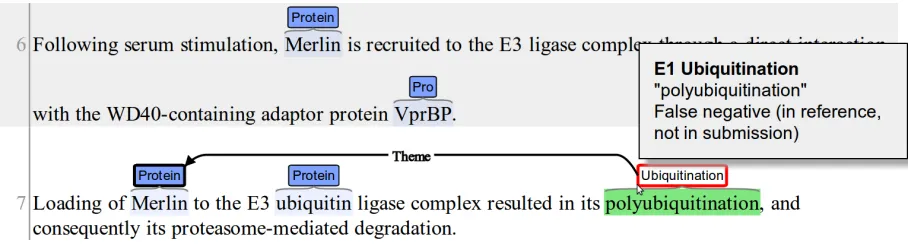
Figure 5: An example of a false negative illustrated by the evaluation tools in co-ordination withstav
maintained an online evaluation tool for the develop-ment set during the developdevelop-ment period. The online evaluation is intended to provide an identical inter-face and criteria for submitted data as the final on-line submission system, allowing participants to be better prepared for the final submission. With on-line evaluation, the organisers could also monitor submissions to ensure that there were no problems in, for example, the evaluation software implemen-tations.
The system logs of online evaluation systems show that the majority of the participants submit-ted at least one package with formatting errors, con-firming the importance of tools for format checking. Further, most of the participants made use of the on-line development set evaluation at least once before their final submission.
To enhance the evaluation tools we drew upon the stavvisualiser to provide a view of the submitted re-sults. This was done by comparing the submitted results and the gold data to produce a visualisation where errors are highlighted, as illustrated in Fig-ure 5. This experimental featFig-ure was available for the EPI and ID tasks and we believe that by doing so it enables participants to better understand the per-formance of their system and work on remedies for current shortcomings.
4 Discussion and Conclusions
Among the teams participating in the EPI and ID tasks, a great majority utilised tools for which re-sources were made available by the organisers. We hope that the continued availability of the parses will encourage further investigation into the applicability of these and similar tools and representations.
As for the analysis of the supporting analyses pro-vided by external groups and the participants, we are so far aware of only limited use of these resources among the participants, but the resources will re-main available and we are looking forward to see future work using them.
To enable reproducibility of our resources, we provide a publicly accessible repository containing the automated procedure and our processing scripts used to produce the released data. This repository also contains detailed instructions on the options and versions used for each parser and, if the software li-cense permits it, includes the source code or binary that was used to produce the processed data. For the cases where the license restricts redistribution, in-structions and links are provided on how to obtain the same version that was used. We propose that us-ing a multitude of parses and formats can benefit not just the task of event extraction but other NLP tasks as well.
We have also made our evaluation tools and visu-alisation tool stavavailable along with instructions on how to run it and use it in coordination with the shared task resources. The responses from the par-ticipants in relation to the visualisation tool were very positive, and we see this as encouragement to advance the application of visualisation as a way to better reach a wider understanding and unification of the concept of events for biomedical event extrac-tion.
Acknowledgements
We would like to thank Jari Bj¨orne of the Uni-versity of Turku BioNLP group; Gerold Schneider, Fabio Rinaldi, Simon Clematide and Don Tuggener of the Univerity of Zurich Computational Linguis-tics group; Roser Morante of University of Antwerp CLiPS center; and Youngjun Kim of the Univer-sity of Utah Natural Language Processing Research Group for their generosity with their time and exper-tise in providing us with supporting analyses.
This work was supported by Grant-in-Aid for Specially Promoted Research (MEXT, Japan) and the Royal Swedish Academy of Sciences.
References
Daniel M. Bikel. 2004. Intricacies of Collins’ Parsing Model.Computational Linguistics, 30(4):479–511. J. Bj¨orne, F. Ginter, S. Pyysalo, J. Tsujii, and
T. Salakoski. 2010. Complex event extraction at PubMed scale. Bioinformatics, 26(12):i382.
Robert Bossy, Julien Jourde, Philippe Bessi`eres, Marteen van de Guchte, and Claire N´edellec. 2011. BioNLP Shared Task 2011 - Bacteria Biotope. InProceedings of the BioNLP 2011 Workshop Companion Volume for Shared Task, Portland, Oregon, June. Association for Computational Linguistics.
S. Buchholz and E. Marsi. 2006. CoNLL-X shared task on multilingual dependency parsing. In Proceed-ings of the Tenth Conference on Computational Nat-ural Language Learning, pages 149–164. Association for Computational Linguistics.
E. Buyko and U. Hahn. 2010. Evaluating the impact of alternative dependency graph encodings on solv-ing event extraction tasks. In Proceedings of the 2010 Conference on Empirical Methods in Natural Language Processing, pages 982–992. Association for Computational Linguistics.
Eugene Charniak and Mark Johnson. 2005. Coarse-to-Fine n-Best Parsing and MaxEnt Discriminative Reranking. InProceedings of the 43rd Annual Meet-ing of the Association for Computational LMeet-inguistics (ACL’05), pages 173–180.
Pallavi Choudhury, Michael Gamon, Chris Quirk, and Lucy Vanderwende. 2011. MSR-NLP entry in BioNLP Shared Task 2011. In Proceedings of the BioNLP 2011 Workshop Companion Volume for Shared Task, Portland, Oregon, June. Association for Computational Linguistics.
S. Clark and J.R. Curran. 2004. Parsing the WSJ us-ing CCG and log-linear models. In Proceedings of
the 42nd Annual Meeting on Association for Compu-tational Linguistics, page 103. Association for Com-putational Linguistics.
Michael John Collins. 1996. A new statistical parser based on bigram lexical dependencies. In Proceed-ings of the 34th Annual Meeting of the Association for Computational Linguistics, pages 184–191, Santa Cruz, California, USA, June. Association for Compu-tational Linguistics.
Marie-Catherine de Marneffe, Bill MacCartney, and Christopher D. Manning. 2006. Generating Typed Dependency Parses from Phrase Structure Parses. In
Proceedings of the Fifth International Conference on Language Resources and Evaluation (LREC’06), pages 449–454.
H.L. Dickensheets, C. Venkataraman, U. Schindler, and R.P. Donnelly. 1999. Interferons inhibit activation of STAT6 by interleukin 4 in human monocytes by in-ducing SOCS-1 gene expression. Proceedings of the National Academy of Sciences of the United States of America, 96(19):10800.
Ehsan Emadzadeh, Azadeh Nikfarjam, and Graciela Gonzalez. 2011. A generalizable and efficient ma-chine learning approach for biological event extraction from text. InProceedings of the BioNLP 2011 Work-shop Companion Volume for Shared Task, Portland, Oregon, June. Association for Computational Linguis-tics.
Charles J. Fillmore. 1976. Frame semantics and the na-ture of language. Annals of the New York Academy of Sciences, 280(1):20–32.
R. Johansson and P. Nugues. 2007. Extended constituent-to-dependency conversion for English. In
Proc. of the 16th Nordic Conference on Computational Linguistics (NODALIDA).
Julien Jourde, Alain-Pierre Manine, Philippe Veber, Kar¨en Fort, Robert Bossy, Erick Alphonse, and Philippe Bessi`eres. 2011. BioNLP Shared Task 2011 - Bacteria Gene Interactions and Renaming. In Pro-ceedings of the BioNLP 2011 Workshop Companion Volume for Shared Task, Portland, Oregon, June. As-sociation for Computational Linguistics.
Yoshinobu Kano, William Baumgartner, Luke McCro-hon, Sophia Ananiadou, Kevin Cohen, Larry Hunter, and Jun’ichi Tsujii. 2009. U-Compare: share and compare text mining tools with UIMA. Bioinformat-ics, 25(15):1997–1998, May.
Jin-Dong Kim, Sampo Pyysalo, Tomoko Ohta, Robert Bossy, and Jun’ichi Tsujii. 2011a. Overview of BioNLP Shared Task 2011. In Proceedings of the BioNLP 2011 Workshop Companion Volume for Shared Task, Portland, Oregon, June. Association for Computational Linguistics.
Jin-Dong Kim, Yue Wang, Toshihisa Takagi, and Aki-nori Yonezawa. 2011b. Overview of the Genia Event task in BioNLP Shared Task 2011. In Proceedings of the BioNLP 2011 Workshop Companion Volume for Shared Task, Portland, Oregon, June. Association for Computational Linguistics.
D. Klein and C.D. Manning. 2003. Fast exact infer-ence with a factored model for natural language pars-ing. Advances in neural information processing sys-tems, pages 3–10.
M.P Marcus, B. Santorini, and M.A Marcinkiewicz. 1993. Building a large annotated corpus of English: The Penn Tree Bank. Computational Linguistics, pages 313–318.
D. McClosky. 2009. Any Domain Parsing: Automatic Domain Adaptation for Natural Language Parsing. Ph.D. thesis, Ph. D. thesis, Department of Computer Science, Brown University.
M. Miwa, S. Pyysalo, T. Hara, and J. Tsujii. 2010. Eval-uating Dependency Representation for Event Extrac-tion. InIn the 23rd International Conference on Com-putational Linguistics (COLING 2010), pages 779– 787.
Y. Miyao and J. Tsujii. 2008. Feature forest models for probabilistic HPSG parsing. Computational Linguis-tics, 34(1):35–80.
Yusuke Miyao, Rune Sætre, Kenji Sagae, Takuya Mat-suzaki, and Jun’ichi Tsujii. 2008. Task-oriented eval-uation of syntactic parsers and their representations. In
Proceedings of ACL-08: HLT, pages 46–54, Colum-bus, Ohio, June. Association for Computational Lin-guistics.
R. Morante, V. Van Asch, and W. Daelemans. 2010. Memory-based resolution of in-sentence scopes of hedge cues.CoNLL-2010: Shared Task, page 40. Ngan Nguyen, Jin-Dong Kim, and Jun’ichi Tsujii. 2011.
Overview of the Protein Coreference task in BioNLP Shared Task 2011. InProceedings of the BioNLP 2011 Workshop Companion Volume for Shared Task, Port-land, Oregon, June. Association for Computational Linguistics.
Tomoko Ohta, Sampo Pyysalo, and Jun’ichi Tsujii. 2011. Overview of the Epigenetics and Post-translational Modifications (EPI) task of BioNLP Shared Task 2011. InProceedings of the BioNLP 2011 Workshop Companion Volume for Shared Task, Portland, Oregon, June. Association for Computational Linguistics.
S. Petrov, L. Barrett, R. Thibaux, and D. Klein. 2006. Learning accurate, compact, and interpretable tree an-notation. In Proceedings of the 21st International Conference on Computational Linguistics and the 44th annual meeting of the Association for Computational Linguistics, pages 433–440. Association for Computa-tional Linguistics.
H. Poon and L. Vanderwende. 2010. Joint inference for knowledge extraction from biomedical literature. InHuman Language Technologies: The 2010 Annual Conference of the North American Chapter of the As-sociation for Computational Linguistics, pages 813– 821. Association for Computational Linguistics. Sampo Pyysalo, Tomoko Ohta, Rafal Rak, Dan
Sul-livan, Chunhong Mao, Chunxia Wang, Bruno So-bral, Jun’ichi Tsujii, and Sophia Ananiadou. 2011a. Overview of the Infectious Diseases (ID) task of BioNLP Shared Task 2011. In Proceedings of the BioNLP 2011 Workshop Companion Volume for Shared Task, Portland, Oregon, June. Association for Computational Linguistics.
Sampo Pyysalo, Tomoko Ohta, and Jun’ichi Tsujii. 2011b. Overview of the Entity Relations (REL) sup-porting task of BioNLP Shared Task 2011. In Pro-ceedings of the BioNLP 2011 Workshop Companion Volume for Shared Task, Portland, Oregon, June. As-sociation for Computational Linguistics.
Laura Rimell and Stephen Clark. 2009. Porting a lexicalized-grammar parser to the biomedical domain.
Journal of Biomedical Informatics, 42(5):852 – 865. Biomedical Natural Language Processing.
R. Sætre, K. Yoshida, A. Yakushiji, Y. Miyao, Y. Matsub-yashi, and T. Ohta. 2007. AKANE system: protein-protein interaction pairs in BioCreAtIvE2 challenge, PPI-IPS subtask. In Proceedings of the Second BioCreative Challenge Workshop, pages 209–212. Kenji Sagae and Jun’ichi Tsujii. 2007. Dependency
pars-ing and domain adaptation with LR models and parser ensembles. InProceedings of the CoNLL 2007 Shared Task.
G. Schneider, M. Hess, and P. Merlo. 2007. Hybrid long-distance functional dependency parsing. Unpub-lished PhD thesis, Institute of Computational Linguis-tics, University of Zurich.
G. Szarvas, V. Vincze, R. Farkas, and J. Csirik. 2008. The BioScope corpus: annotation for negation, uncer-tainty and their scope in biomedical texts. In Proceed-ings of the Workshop on Current Trends in Biomedical Natural Language Processing, pages 38–45. Associa-tion for ComputaAssocia-tional Linguistics.