RegMT System for Machine Translation, System Combination, and
Evaluation
Ergun Bic¸ici Koc¸ University
34450 Sariyer, Istanbul, Turkey [email protected]
Deniz Yuret Koc¸ University
34450 Sariyer, Istanbul, Turkey [email protected]
Abstract
We present the results we obtain using our RegMT system, which uses transductive re-gression techniques to learn mappings be-tween source and target features of given par-allel corpora and use these mappings to gen-erate machine translation outputs. Our train-ing instance selection methods perform fea-ture decay for proper selection of training in-stances, which plays an important role to learn correct feature mappings. RegMT uses L2
regularized regression as well asL1
regular-ized regression for sparse regression estima-tion of target features. We present transla-tion results using our training instance selec-tion methods, translaselec-tion results using graph decoding, system combination results with RegMT, and performance evaluation with the F1measure over target features as a metric for
evaluating translation quality.
1 Introduction
Regression can be used to find mappings between the source and target feature sets derived from given parallel corpora. Transduction learning uses a sub-set of the training examples that are closely related to the test set without using the model induced by the full training set. In the context of statistical ma-chine translation, translations are performed at the sentence level and this enables us to select a small number of training instances for each test instance to guide the translation process. This also gives us a computational advantage when considering the high dimensionality of the problem as each sentence can be mapped to many features.
The goal in transductive regression based ma-chine translation (RegMT) is both reducing the com-putational burden of the regression approach by re-ducing the dimensionality of the training set and the feature set and also improving the translation quality by using transduction.
We present translation results using our training instance selection methods, translation results us-ing graph decodus-ing, system combination results with RegMT, and performance evaluation with the F1
measure over target features as a metric for eval-uating translation quality. RegMT work builds on our previous regression-based machine translation results (Bicici and Yuret, 2010) especially with in-stance selection and additional graph decoding ca-pability. We present our results to this year’s chal-lenges.
Outline: Section 2 gives an overview of the RegMT model. In section 3, we present our train-ing instance selection techniques and WMT’11 sults. In section 4, we present the graph decoding re-sults on the Haitian Creole-English translation task. Section 5 presents our system combination results using reranking with the RegMT score. Section 6 evaluates theF1 measure that we use for the
auto-matic evaluation metrics challenge. The last section present our contributions.
2 Machine Translation Using Regression
Let X and Y correspond to the sets of tokens that can be used in the source and target strings, then, m training instances are represented as (x1,y1), . . . ,(xm,ym) ∈ X∗ ×Y∗,where(xi,yi) corresponds to a pair of source and target language
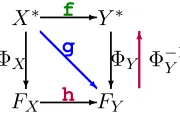
token sequences for1≤i≤m. Our goal is to find a mappingf :X∗ → Y∗that can convert a source sentence to a target sentence sharing the same mean-ing in the target language (Figure 1).
X∗ -Y∗
? R ?
-FX FY
g
ΦX ΦY6Φ−Y1
f
[image:2.612.147.237.112.169.2]h
Figure 1: String-to-string mapping.
We define feature mappers ΦX : X∗ → FX = RNX andΦY : Y∗ → FY = RNY that map each string sequence to a point in high dimensional real number space. Let MX ∈ RNX×m and M
Y ∈
RNY×m such that M
X = [ΦX(x1), . . . ,ΦX(xm)] and MY = [ΦY(y1), . . . ,ΦY(ym)]. The ridge re-gression solution usingL2regularization is found by
minimizing the following cost:
WL2= arg min
W∈RNY×NX
kMY −WMXk2F +λkWk
2
F . (1)
Two main challenges of the regression based ma-chine translation (RegMT) approach are learning the regression function, h : FX → FY, and solving the pre-image problem, which, given the features of the estimated target string sequence,
h(ΦX(x)) = ΦY(ˆy), attempts to find y ∈ Y∗: y = arg miny∈Y∗||h(ΦX(x)) − ΦY(y)||2.
Pre-image calculation involves a search over possible translations minimizing the cost function:
f(x) = arg min
y∈Y∗
kΦY(y)−WΦX(x)k2 . (2)
2.1 L1Regularized Regression
String kernels lead to sparse feature representations andL1regularized regression is effective to find the
mappings between sparsely observed features.We would like to observe only a few nonzero target efficients corresponding to a source feature in the co-efficient matrix. L1 regularization helps us achieve
solutions close to permutation matrices by increas-ing sparsity (Bishop, 2006) (page 145). In contrast,
L2regularized solutions give us dense matrices.
WL2 is not a sparse solution and most of the coef-ficients remain non-zero. We are interested in pe-nalizing the coefficients better; zeroing the
irrele-vant ones leading to sparsification to obtain a solu-tion that is closer to a permutasolu-tion matrix. L1norm
behaves both as a feature selection technique and a method for reducing coefficient values.
WL1 = arg min
W∈RNY×NX
kMY −WMXkF2 +λkWk1. (3)
Equation 3 presents thelasso(Tibshirani, 1996) so-lution where the regularization term is now the L1
matrix norm defined as kWk1= Pi,j|Wi,j|. WL2 can be found by taking the derivative but since
L1 regularization cost is not differentiable, WL1 is found by optimization or approximation techniques. We use forward stagewise regression (FSR) (Hastie et al., 2006), which approximateslassoforL1
regu-larized regression.
2.2 Related Work:
Regression techniques can be used to model the relationship between strings (Cortes et al., 2007). Wang et al. (2007) applies a string-to-string map-ping approach to machine translation by using ordi-nary least squares regression andn-gram string ker-nels to a small dataset. Later they useL2regularized
least squares regression (Wang and Shawe-Taylor, 2008). Although the translation quality they achieve is not better than Moses (Koehn et al., 2007), which is accepted to be the state-of-the-art, they show the feasibility of the approach. Serrano et al. (2009) use kernel regression to find translation mappings from source to target feature vectors and experiment with translating hotel front desk requests. Locally weighted regression solves separate weighted least squares problems for each instance (Hastie et al., 2009), weighted by a kernel similarity function.
3 Instance Selection for Machine Translation
improve the coverage of correct features to build a regression model.
We use two techniques for this purpose: (1) Feature Decay Algorithm (FDA), which optimizes source languge bigram coverage to maximize the target coverage, (2)dice. Feature decay algorithms (FDA) aim to maximize the coverage of the tar-get language features (such as words, bigrams, and phrases) for the test sentences. FDA selects training instances one by one updating the coverage of the features already added to the training set in contrast to the features found in the test sentence.
We also use a technique that we call dice, which optimizes source language bigram coverage such that the difficulty of aligning source and target fea-tures is minimized. We define Dice’s coefficient score as:
dice(x, y) = 2C(x, y)
C(x)C(y), (4)
where C(x, y) is the number of times x andy co-occurr and C(x) is the count of observing x in the selected training set. Given a test source sen-tence,SU, we can estimate the goodness of a train-ing sentence pair, (S, T), by the sum of the align-ment scores:
φdice(SU, S, T) =
X
x∈X(SU) |T|
X
j=1
X
y∈Y(x)
dice(y, Tj)
|T|log|S| ,
(5) where X(SU) stores the features of SU and Y(x) lists the tokens in featurex. The difficulty of word aligning a pair of training sentences,(S, T), can be approximated by|S||T|. We use a normalization fac-tor proportional to|T|log|S|.
The details of both of these techniques and further results can be found in (Bicici and Yuret, 2011).
3.1 Moses Experiments on the Translation Task
We have used FDA and dice algorithms to select training sets for the out-of-domain challenge test sets used in (Callison-Burch et al., 2011). The par-allel corpus contains about1.9million training sen-tences and the test set contain3003sentences. We built separate Moses systems using all of the paral-lel corpus for the language pairs en-de, de-en, en-es, and es-en. We created training sets using all
en-de de-en en-es es-en
BLEU
ALL .1376 .2074 .2829 .2919 FDA .1363 .2055 .2824 .2892 dice .1374 .2061 .2834 .2857
words
ALL 47.4 49.6 52.8 50.4 FDA 7.9 8.0 8.7 8.2
dice 6.9 7.0 3.9 3.6
[image:3.612.319.536.54.166.2]%ALL FDA 17 16 16 16 dice 14 14 7.4 7.1
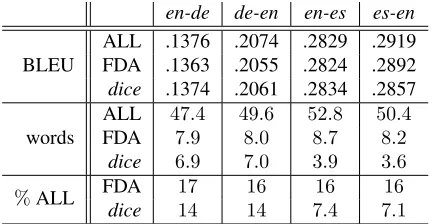
Table 1: Performance for the out-of-domain task of (Callison-Burch et al., 2011). ALL corresponds to the baseline system using all of the parallel corpus. words list the size of the target words used in millions.
of the features of the test set to select training in-stances. The results given in Table 1 show that we can achieve similar BLEU performance using about 7%of the parallel corpus target words (200,000 in-stances) usingdiceand about16%using FDA. In the out-of-domain translation task, we are able to reduce the training set size to achieve a performance close to the baseline. We may be able to achieve better performance in this out-of-domain task as well as explained in (Bicici and Yuret, 2011).
4 Graph Decoding for RegMT
We perform graph-based decoding by first generat-ing a De Bruijn graph from the estimatedˆy(Cortes et al., 2007) and then finding Eulerian paths with max-imum path weight. We use four features when scor-ing paths: (1) estimation weight from regression, (2) language model score, (3) brevity penalty as found byeα(lR−|s|/|path|)forl
Rrepresenting the length ra-tio from the parallel corpus and|path|representing the length of the current path, (4) future cost as in Moses (Koehn et al., 2007) and weights are tuned using MERT (Och, 2003) on thede-en devset.
We demonstrate that sparseL1regularized
regres-sion performs better thanL2regularized regression.
Graph based decoding can provide an alternative to state of the art phrase-based decoding system Moses in translation domains with small vocabulary and training set size.
4.1 Haitian Creole to English Translation Task with RegMT
us-ing the options as described in section 3.1. Moses achieves 0.3186 BLEU on this task. We observed that graph decoding performs better where target coverage is high such that the bigrams used lead to a connected graph. To increase the connec-tivity, we have included Moses translations in the training set and performed graph decoding with RegMT. RegMT with L2 regularized regression
achieves 0.2708 BLEU with graph decoding and
lassoachieves0.26BLEU.
Moses makes use of a number of distortion pa-rameters and lexical weights, which are estimated using all of the parallel corpus. Thus, our Moses translation achieves a better performance than graph decoding with RegMT using100training instances for translating each source test sentence.
5 System Combination with RegMT
We perform experiments on the system com-bination task for the English-German, German-English, English-Spanish, and Spanish-English lan-guage pairs using the training corpus provided in WMT’11 (Callison-Burch et al., 2011). We have tokenized and lowercased each of the system out-puts and combined these in a singleN-best file per language pair. We use theseN-best lists for rerank-ing by RegMT to select the best translation model. Feature mappers used are2-spectrum counting word kernels (Taylor and Cristianini, 2004).
We rerankN-best lists by a linear combination of the following scoring functions:
1. RegMT: Regression based machine translation scores as found by Equation 2.
2. CBLEU: Comparative BLEU scores we obtain by measuring the average BLEU performance of each translation relative to the other systems’ translations in theN-best list.
3. LM: We calculate 5-gram language model scores for each translation using the language model trained over the target corpus provided in the translation task.
Since we do not have access to the reference trans-lations nor to the translation model scores each sys-tem obtained for each sentence, we estimate trans-lation model performance (CBLEU) by measuring
the average BLEU performance of each translation relative to the other translations in theN-best list. Thus, each possible translation in theN-best list is BLEU scored against other translations and the av-erage of these scores is selected as the CBLEU score for the sentence. Sentence level BLEU score calcu-lation avoids singularities in n-gram precisions by taking the maximum of the match count and2|1s
i|for |si|denoting the length of the source sentencesias used in (Macherey and Och, 2007).
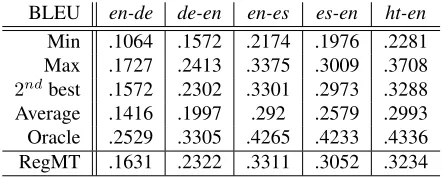
Table 2 presents reranking results on all of the lan-guage pairs we considered, using RegMT, CBLEU, and LM scores with the same combination weights as above. We also list the performance of the best model (Max) as well as the worst (Min). We are able to achieve close or better BLEU scores in all of the listed systems when compared with the per-formance of the best translation system except for theht-enlanguage pair. The lower performance in theht-enlanguage pair may be due to having a sin-gle best translation system that outperforms others significantly. This happens for instance when an un-constrained model use external resources to achieve a significantly better performance than the second best model.2nd best in Table 2 lists the second best model’s performance to estimate how much the best model’s performance is better than the rest.
BLEU en-de de-en en-es es-en ht-en Min .1064 .1572 .2174 .1976 .2281 Max .1727 .2413 .3375 .3009 .3708 2ndbest .1572 .2302 .3301 .2973 .3288
[image:4.612.316.537.435.524.2]Average .1416 .1997 .292 .2579 .2993 Oracle .2529 .3305 .4265 .4233 .4336 RegMT .1631 .2322 .3311 .3052 .3234
Table 2: System combination results.
The existence of complementing SMT models is important for the reranking approach to achieve a performance better than the best model, as there is a need for the existence of a model performing bet-ter than the best model on some test sentences. We can use the competitive SMT model to achieve the performance of the best with a guarantee even when a single model is dominating the rest (Bicici and Kozat, 2010). For competing translation systems in an on-line machine translation setting adaptively learning of model weights can be performed based on the previous transaltion performance (Bicici and Kozat, 2010).
6 TargetF1as a Performance Evaluation
Metric
We use target sentence F1 measure over the
tar-get features as a translation performance evaluation metric. We optimize the parameters of the RegMT model with the F1 measure comparing the target
vector with the estimate we get from the RegMT model. F1 measure uses the 0/1-class predictions
over the target feature with the estimate vector, ΦY(ˆy). Let TP be the true positive, TN the true neg-ative, FP the false positive, and FN the false negative rates, we use the following measures for evaluation:
prec= TP
TP+FP, BER= ( FP TN+FP+
FN
TP+FN)/2(6)
rec= TP
TP+FN, F1=
2×prec×rec
prec+rec (7)
where BER is the balanced error rate, prec is pre-cision, and rec is recall. The evaluation techniques measure the effectiveness of the learning models in identifying the features of the target sentence mak-ing minimal error to increase the performance of the decoder and its translation quality.
We use gapped word sequence kernels (Taylor and Cristianini, 2004) when usingF1for evaluating
translations since a given translation system may not be able to translate a given word but can correctly identify the surrounding phrase. For instance, let the reference translation be the following sentence:
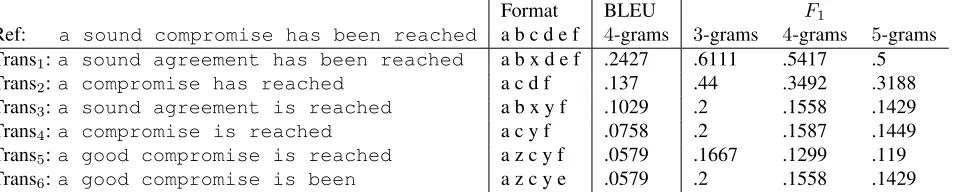
a sound compromise has been reached
Some possible translations for the reference are given in Table 3 together with their BLEU (Papineni et al., 2001) andF1scores for comparison.F1score
does not have a brevity penalty but a brief transla-tion is penalized by a low recall value. We use up to3tokens as gaps. F1 measure is able to increase
the ranking of Trans4 by using a gapped sequence
kernel, which can be preferrable to Trans3.
We note that a missing token corresponds to vary-ing decreases in the n-gram precision used in the BLEU score. A sentence containingm tokens has
m1-grams,m−1 2-grams, andm−n+ 1n-grams. A missing token degrades the performance more in higher ordern-gram precision values. A missing to-ken decreases n-gram precision by m1 for 1-grams and by m−nn+1 for n-grams. Based on this obser-vation, we use F1 measure with gapped word
se-quence kernels to evaluate translations. Gapped fea-tures allows us to consider the surrounding phrase for a missing token as present in the translation.
Let the reference sentence be represented with a b c d e fwhere a-f, x, y, z correspond to to-kens in the sentence. Then, Trans3 has the form
a b x y f, and Trans4 has the forma c y f.
Then,F1ranks Trans4higher than Trans3for orders
greater than3as there are two consecutive word er-rors in Trans3. F1 can also prefer a missing token
rather than a word error as we see by comparing Trans4 and Trans5 and it can still prefer
contigu-ity over a gapped sequence as we see by comparing Trans5 and Trans6in Table 3.
We calculate the correlation ofF1with BLEU on
theen-dedevelopment set. We use5-grams with the
F1 measure as this increases the correlation with
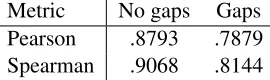
4-gram BLEU. Table 4 gives the correlation results us-ing both Pearson’s correlation score and Spearman’s correlation score. Spearman’s correlation score is a better metric for comparing the relative orderings.
[image:5.612.359.494.541.581.2]Metric No gaps Gaps Pearson .8793 .7879 Spearman .9068 .8144
Table 4:F1correlation with4-gram BLEU using blended 5-gram gapped word sequence features on the develop-ment set.
7 Contributions
tar-Format BLEU F1
Ref: a sound compromise has been reached a b c d e f 4-grams 3-grams 4-grams 5-grams Trans1:a sound agreement has been reached a b x d e f .2427 .6111 .5417 .5
Trans2:a compromise has reached a c d f .137 .44 .3492 .3188
Trans3:a sound agreement is reached a b x y f .1029 .2 .1558 .1429
Trans4:a compromise is reached a c y f .0758 .2 .1587 .1449
Trans5:a good compromise is reached a z c y f .0579 .1667 .1299 .119
[image:6.612.82.559.55.153.2]Trans6:a good compromise is been a z c y e .0579 .2 .1558 .1429
Table 3: BLEU vs.F1on sample sentence translation task.
get features of given parallel corpora and use these mappings to generate machine translation outputs. We also present translation results using our train-ing instance selection methods, translation results using graph decoding, system combination results with RegMT, and performance evaluation with F1
measure over target features. RegMT work builds on our previous regression-based machine transla-tion results (Bicici and Yuret, 2010) especially with instance selection and additional graph decoding ca-pability.
References
Ergun Bicici and S. Serdar Kozat. 2010. Adaptive model weighting and transductive regression for pre-dicting best system combinations. In Proceedings of the ACL 2010 Joint Fifth Workshop on Statistical Ma-chine Translation and Metrics MATR, Uppsala, Swe-den, July. Association for Computational Linguistics. Ergun Bicici and Deniz Yuret. 2010. L1regularized
re-gression for reranking and system combination in ma-chine translation. In Proceedings of the ACL 2010 Joint Fifth Workshop on Statistical Machine Transla-tion and Metrics MATR, Uppsala, Sweden, July. Asso-ciation for Computational Linguistics.
Ergun Bicici and Deniz Yuret. 2011. Instance selec-tion for machine translaselec-tion using feature decay al-gorithms. InProceedings of the EMNLP 2011 Sixth Workshop on Statistical Machine Translation, Edin-burgh, England, July.
Christopher M. Bishop. 2006. Pattern Recognition and Machine Learning. Springer.
Chris Callison-Burch, Philipp Koehn, Christof Monz, Kay Peterson, and Omar Zaidan, editors. 2011. Pro-ceedings of the Sixth Workshop on Statistical Machine Translation. Edinburgh, England, July.
Corinna Cortes, Mehryar Mohri, and Jason Weston. 2007. A general regression framework for learn-ing strlearn-ing-to-strlearn-ing mapplearn-ings. In Gokhan H. Bakir,
Thomas Hofmann, and Bernhard Sch editors, Predict-ing Structured Data, pages 143–168. The MIT Press, September.
Trevor Hastie, Jonathan Taylor, Robert Tibshirani, and Guenther Walther. 2006. Forward stagewise regres-sion and the monotone lasso. Electronic Journal of Statistics, 1.
Trevor Hastie, Robert Tibshirani, and Jerome Friedman. 2009. The Elements of Statistical Learning: Data Mining, Inference and Prediction. Springer-Verlag, 2nd edition.
Philipp Koehn, Hieu Hoang, Alexandra Birch, Chris Callison-Burch, Marcello Federico, Nicola Bertoldi, Brooke Cowan, Wade Shen, Christine Moran, Richard Zens, Chris Dyer, Ondrej Bojar, Alexandra Con-stantin, and Evan Herbst. 2007. Moses: Open source toolkit for statistical machine translation. In Annual Meeting of the Assoc. for Computational Linguistics, pages 177–180, Prague, Czech Republic, June. Wolfgang Macherey and Franz Josef Och. 2007. An
empirical study on computing consensus translations from multiple machine translation systems. In Pro-ceedings of the 2007 Joint Conference on Empir-ical Methods in Natural Language Processing and Computational Natural Language Learning (EMNLP-CoNLL), pages 986–995, Prague, Czech Republic, June. Association for Computational Linguistics. Franz Josef Och. 2003. Minimum error rate training in
statistical machine translation. Association for Com-putational Linguistics, 1:160–167.
Kishore Papineni, Salim Roukos, Todd Ward, and Wei-Jing Zhu. 2001. BLEU: a method for automatic evalu-ation of machine translevalu-ation. InACL ’02: Proceedings of the 40th Annual Meeting on Association for Compu-tational Linguistics, pages 311–318, Morristown, NJ, USA. Association for Computational Linguistics. Nicolas Serrano, Jesus Andres-Ferrer, and Francisco
Robert J. Tibshirani. 1996. Regression shrinkage and selection via the lasso. Journal of the Royal Statistical Society, Series B, 58(1):267–288.
Zhuoran Wang and John Shawe-Taylor. 2008. Kernel regression framework for machine translation: UCL system description for WMT 2008 shared translation task. In Proceedings of the Third Workshop on Sta-tistical Machine Translation, pages 155–158, Colum-bus, Ohio, June. Association for Computational Lin-guistics.