Identifying Argument Components through TextRank
Georgios Petasis and Vangelis Karkaletsis Software and Knowledge Engineering Laboratory
Institute of Informatics & Telecommunications
National Center for Scientific Research (N.C.S.R.) “Demokritos” Athens, Greece.
{petasis,vangelis}@iit.demokritos.gr
Abstract
In this paper we examine the application of an unsupervised extractive summari-sation algorithm, TextRank, on a differ-ent task, the iddiffer-entification of argumdiffer-enta- argumenta-tive components. Our main motivation is to examine whether there is any poten-tial overlap between extractive summari-sation and argument mining, and whether approaches used in summarisation (which typically model a document as a whole) can have a positive effect on tasks of ar-gument mining. Evaluation has been per-formed on two corpora containing user posts from an on-line debating forum and persuasive essays. Evaluation results sug-gest that graph-based approaches and ap-proaches targeting extractive summarisa-tion can have a positive effect on tasks re-lated to argument mining.
1 Introduction
Argumentation is a branch of philosophy that stud-ies the act or process of forming reasons and of drawing conclusions in the context of a discussion, dialogue, or conversation. Being an important el-ement of human communication, its use is very frequent in texts, as a means to convey meaning to the reader. As a result, argumentation has at-tracted significant research focus from many dis-ciplines, ranging from philosophy to artificial in-telligence. Central to argumentation is the no-tion of argument, which according to (Besnard and Hunter, 2008) is a set of assumptions (i.e. infor-mation from which conclusions can be drawn), to-gether with a conclusion that can be obtained by one or more reasoning steps (i.e. steps of deduc-tion). The conclusion of the argument is often called the claim, or equivalently the consequent
or the conclusion of the argument. The assump-tions are called the support, or equivalently the premises of the argument, which provide the rea-son (or equivalently the justification) for the claim of the argument. The process of extracting conclu-sions/claims along with their supporting premises, both of which compose an argument, is known as argument mining (Goudas et al., 2015; Goudas et al., 2014) and constitutes an emerging research field.
Several approaches have been already presented for addressing various subtasks of argument min-ing, including the identification of argumentative sentences (i.e. sentences that contain argumenta-tion components such as claims and premises), ar-gumentation components, relations between such components, and resources for supporting argu-ment mining, like discourse indicators and other expressions indicating the presence of argumen-tative components. Proposed methods mostly re-late to supervised machine learning exploiting a plethora of features (Goudas et al., 2015), includ-ing the combination of several techniques, such as the work presented in (Lawrence and Reed, 2015). One of the difficulties associated to argument mining relates to the fact that the identification of argument components usually depends on the context in which they appear in. The locality of this context can vary significantly, based not only on the domain, but possibly even to personal writing style. On one hand, discourse indicators, markers and phrases can provide a strong and lo-calised contextual information, but their use is not very frequent (Lawrence and Reed, 2015). On the other hand, the local context of a phrase may indicate that the phrase is a fact, suggesting low or noargumentativenessat all, while at the same time, the same phrase may contradict to another phrase several sentences before or after the phrase in question, constituting the phrase under
tion an argumentative component (Carstens and Toni, 2015). While it is quite easy to handle local context through suitable representations and learn-ing techniques, complexity may increase signifi-cantly when a broader context is required, espe-cially when relations exist among various parts of a document.
In this paper we want to examine approaches that are able to handle interactions and relations that are not local, especially the ones that can model a document as a whole. An example of a task where documents are modelled in their en-tirety, is document summarisation (Giannakopou-los et al., 2015). Extractive summarisation typ-ically examines the importance of each sentence with respect to the rest of the sentences in a docu-ment, in order to select a small set of sentences that are more “representative” for a given document. A typical extractive summarisation system is ex-pected to select sentences that contain a lot of in-formation in a compact form, and capture the dif-ferent pieces of information that are expressed in a document. The main idea behind this paper is to examine whether there is any potentialoverlap be-tween these sentencesthat summarise a document, andargumentation componentsthat can exist in a document. Assuming that in a document the au-thor expresses one or more claims, which can be potentially justified through a series of premises or support statements, it will be interesting to ex-amine whether any of these argumentation com-ponents will be assessed as significant enough to be included in an automatically generated sum-mary. Will a summarisation algorithm capture at least the claims, and characterise them as impor-tant enough to be included in the produced sum-mary?
In order to examine if there is any overlap between extractive summarisation and argument mining (at least the identification of sentences that contain some argumentation components, such as claims), we wanted to avoid any influence from the documents and the thematic domains under ex-amination. Ruling out supervised approaches, we examined summarisation algorithms that are ei-ther unsupervised, or can be trained in different domains than the ones they will be applied on. Finally, we opted for an unsupervised algorithm, TextRank (Mihalcea and Tarau, 2004), a graph-based ranking model, which can be applied on ex-tractive summarisation by exploiting “similarity”
among sentences, based on their content overlap. We conducted our study on two corpora in En-glish. The first one is a corpus of user generated content, compiled by Hasan and Ng (2014) from online debate forums on four topics: “abortion”, “gay rights”, “marijuana”, and “Obama”. The second corpus, compiled by Stab and Gurevych (2014), contains 90 persuasive essays on various topics. Initial results are promising, suggesting that there is an overlap between extractive sum-marisation and argumentation component identi-fication, and the ranking of sentences from Tex-tRank can help in tasks related to argument min-ing, possibly as a feature in cooperation with an argumentation mining approach.
The rest of the paper is organised as fol-lows: Section 2 presents an brief overview of ap-proaches related to argument mining, while sec-tion 3 presents our approach on applying Tex-tRank for identifying sentences that contain argu-mentation components. Section 4 presents the ex-perimental setting and evaluation results, with sec-tion 5 concluding this paper and proposing some directions for further research.
2 Related Work
A plethora of approaches related to argument min-ing consider the identification of sentences con-taining argument components or not as a key step of the whole process. Usually labeled as “argu-mentative” sentences, these approaches model the process of identifying argumentation components as a two-class classification problem. In this cat-egory can be classified approaches like (Goudas et al., 2015; Goudas et al., 2014; Rooney et al., 2012), where supervised machine learning has been employed in order to classify sentences into argumentative and non-argumentative ones.
starting point till the next ending word.
Another interesting approach was proposed by Graves et al. (2014), who explored potential sources of claims in scientific articles based on their title. They suggested that if titles contain a tensed verb, then it is most likely (actually almost certain) to announce the argument claim. In con-trast, when titles do not contain tensed verbs, they have varied announcements. According to their analysis, they have identified three basic types in which articles can be classified according to genre, purpose and structure. If the title has verbs then the claim is repeated in the abstract, introduction and discussion, whereas if the title does not have verbs, then the claim does not appear in the title or introduction but appears in the abstract and dis-cussion sections.
Another field of argument mining that has re-cently attracted the attention of the research com-munity, is the field of argument mining from on-line discourses. As in most cases of argument mining, the lack of annotated corpora is a lim-iting factor. In this direction, Hasan and Ng (2014), Houngbo and Mercer (2014), Aharoni et al. (2014), Green (2014), Stab and Gurevych (2014), and Kirschner et al. (2015) focused on pro-viding corpora spanning from online posts to sci-entific publications that could be widely used for the evaluation of argument mining techniques. In this context, Boltuˇzi´c and ˇSnajder (2014) collected comments from online discussions about two spe-cific topics and created a manually annotated cor-pus for argument mining. In addition, they used a supervised model to match user-created com-ments to a set of predefined topic-based argu-ments, which can be either attacked or supported in the comment. In order to achieve this, they used textual entailment features, semantic text similar-ity features, and one “stance alignment” feature.
One step further, Trevisan et al. (2014) de-scribed an approach for the analysis of Ger-man public discourses, exploringsemi-automated
argument identification by exploiting discourse analysis. They focused on identifying conclusive connectors, substantially adverbs (i.e. “hence”, “thus”, “therefore”), using a multi-level anno-tation. Their approach consists of three steps, which are performed iteratively (manual discourse linguistic argumentation analysis, semi-automatic text mining (PoS-tagging and linguistic multi-level annotation) and data merge) and their
re-sults show the argument-conclusion relationship is most often indicated by the conjunction because followed by “since”, “therefore” and “so”.
Ghosh et al. (2014) attempted to identify the ar-gumentative segments of texts in online threads. Expert annotators have been trained to recognise argumentative features in full-length threads. The annotation task consisted of three subtasks: In the first subtask, annotators had to identify “Argumen-tative Discourse Units” (ADUs) along with their starting and ending points. Secondly, they had to classify the ADUs according to the “Pragmatic Argumentation Theory” (PAT) into “Callouts” and “Targets”. As a final step, they indicated the link between the “Callouts” and “Targets”. In addi-tion, a hierarchical clustering technique has been proposed that assess how difficult it is to identify individual text segments as “Callouts”.
Levy et al. (2014) defined the task of automatic claim detection in a given context and outlined a preliminary solution, aiming to automatically pinpoint context dependent claims (CDCs) within topic-related documents. Their supervised learn-ing approach relies on a cascade of classifiers. As-suming that the articles examined are relatively small set of relevant free-text articles, they pro-vided either manually or automatic retrieval meth-ods. More specifically, the first step of their ap-proach is to identify sentences containing CDCs in each article. As a second step a classifier is used in order to identify the exact boundaries of the CDCs in sentences identified as containing CDCs. As a final step, each CDC is ranked in order to iso-late the most relevant CDCs to the corresponding topic.
Finally, Carstens and Toni (2015) focus on ex-tracting argumentative relations, instead of identi-fying the actual argumentation components. De-spite the fact that few details are provided and their approach seems to be concentrated in pairs of sentences, the presented approach is similar to the approach presented in this paper in the sense that both concentrate on relations as the primary starting point for performing argument mining.
3 Extractive Summarisation and Argumentative Component Identification
3.1 The TextRank Algorithm
processing applications, where knowledge drawn from an entire document is used in making local ranking/selection decisions” (Mihalcea and Tarau, 2004). The main idea behind TextRank is to ex-tract a graph from the text of a document, using textual fragments as vertices. What constitutes a vertex depends on the task the algorithm is applied on. For example, for the task of keyword extrac-tion vertices can be words, while for summarisa-tion the vertices can be whole sentences. Once the vertices have been defined, edges can be added be-tween two vertices according to the “similarity” among text units represented by vertices. Again, “similarity” depends on the task. As a last step, an iterative graph-based ranking algorithm (a slightly modified version of the PageRank algorithm (Brin and Page, 1998)) is applied, in order to score ver-tices, and associate a value (score) to each vertex. These values attached to each vertex are used for the ranking/selections decisions.
In the case of (extractive) summarisation, Tex-tRank can be used in order to extract a set of sen-tences from a document, which can be used to form a summary of the document (either through post-processing of the extracted set of sentences, or by using the set of sentences directly as the sum-mary). In such a case, the following steps are ap-plied:
• The text of a document is tokenised into words and sentences.
• The text is converted into a graph, with each sentence becoming a vertex of the graph (as the goal is to rank entire sentences).
• Connections (edges) between sentences are established, based on a “similarity” relation. The edges are weighted by the “similarity” score between the two connected vertices. • The ranking algorithm is applied on the
graph, in order to score each sentence. • Sentences are sorted in reversed order of their
score, and the top ranked sentences are se-lected for inclusion into the summary. The notion of “similarity” in TextRank is defined as the overlap between two sentences, which can be simply determined as the number of common words between the two sentences. Formally, given two sentencesSiandSj, of sizesN andM
respec-tively, with each sentence being represented by a set of wordsW such asSi=W1i, W2i, ..., WNi and
Sj =W1j, W2j, ..., WMj , the similarity betweenSi
and Sj can be defined as (Mihalcea and Tarau,
2004):
Similarity(Si, Sj) = |Wlogk|W(|Sk∈Si&Wk∈Sj| i|) +log(|Sj|)
In our experiments we have used a slightly mod-ified similarity measure which employs TF-IDF (Manning et al., 2008), as implemented by the open-source TextRank implementation that can be found at (Bohde, 2012).
3.2 Argumentative Component Identification
The main focus of this paper is to evaluate whether there is any overlap between argument mining and automatic summarisation. An automatic sum-marisation algorithm such as TextRank is ex-pected to rank highly sentences that are “recom-mended” by the rest of the sentences in a docu-ment, where “recommendation” suggests that sen-tences address similar concepts, and the sensen-tences recommended by other sentences are likely to be more informative (Mihalcea and Tarau, 2004), thus more suitable for summarising a document. In a similar manner, a claim is expected to share similar concepts with other text fragments that ei-ther support or attack the claim. At the same time, these fragments are related to the claim with re-lations such as “support” or “attack”. Thus, there seems to exist some overlap between how argu-ments are expressed and how TextRank selects and scores sentences. In the work presented in this pa-per we will try to exploit this similarity, in order to use TextRank for identifying sentences that con-tain argumentation components.
In its initial form for the summarisation task, TextRank segments text into sentences, and uses sentences as the text unit to model the given text into a graph. In order to apply TextRank for claim identification, we assume that an argument component can be contained within a single sen-tence, essentially ignoring components that are ex-pressed in more than one sentences. A component can also be expressed as a fragment smaller than a sentence: in this case we want to identify whether a sentence contains a component or not. As a re-sult, we define the task of component identifica-tion as the identificaidentifica-tion of sentences that contain an argumentation component.
sen-tences. If the document contains an argumentation component, we expect the sentence containing the component to be included in the small set of sen-tences extracted by TextRank.
4 Empirical Evaluation
In order to evaluate our hypothesis, that there is a potential overlap between automatic summarisa-tion (as represented by extractive approaches such as TextRank) and argument mining (at least claim identification), we have applied TextRank on two corpora written in English. The first corpus has been compiled from online debate forums, con-taining user posts concerning four thematic do-mains (Hasan and Ng, 2014), while the second corpus contains 90 persuasive essays on various topics (Stab and Gurevych, 2014).
4.1 Experimental Setup
The first corpus that has been used in our study has been compiled and manually annotated as de-scribed in (Hasan and Ng, 2014). User gener-ated content has been collected from an online debate forum1. Debate posts from four popular
domainswere collected: “abortion”, “gay rights”, “marijuana”, and “Obama”. These posts are ei-ther in favour or against the domain, depending on whether the author of the post supports or opposes abortion, gay rights, the legalisation of marijuana, or Obama respectively. The posts were manually examined, in order to identify thereasonsfor the stance (in favour or against) of each post. A set of 56 reasons were identified for the four domains, which were subsequently used for annotating the posts: for each post, segments that correspond to any of these reasons were manually annotated.
We have processed the aforementioned corpus, and we have removed the posts where the anno-tated segments span more than a single sentence, keeping only the posts where the annotated seg-ments are contained within a single sentence. The resulting number of posts for each domain are shown in Table 1. The TextRank implementation used in the evaluation has been written in Python2, and is publicly available through (Bohde, 2012).
Each post is associated with one (and in some cases more than one) segment that expresses the
1http://www.createdebate.com/ 2http://www.python.org/
main reason for the author to be in favour or against the domain. In order to examine whether there is an overlap between argument mining and summarisation, we have applied TextRank on each post, and we have examined whether the single, top ranked sentence by TextRank, contains the segment marked as the reason. In case the segment is contained in the top ranked sentence returned by TextRank, the post is classified as correctly identi-fied. If the reason segment is not contained in the returned sentence, the post is characterised as an error. Evaluation results are reported through ac-curacy(proportion of true results among the total number of cases examined).
Finally, two experiments were performed, with the only difference being the number of sentences selected from TextRank to form the summary. During the first experiment (labelled asE1), only a
single sentence was selected (the top-ranked sen-tence as determined by TextRank), while during the second experiment (labelled as E2) we have
selected thetwotop-ranked sentences.
aver-“abortion” “gay rights” “marijuana” “Obama” all domains
Number of posts 398 403 352 298 1451
[image:6.595.80.519.62.121.2]Mean post size (in sentences) 11.15 8.22 6.52 6.50 8.25 Mean argumentative sentences number 1.80 1.65 1.97 1.39 1.71
Table 1: Number of posts per domain in the first corpus used for evaluation (Hasan and Ng, 2014).
Domain Total Posts E1 Correct Posts E1 Accuracy E2Correct Posts E2Accuracy
“abortion” 398 150 0.37 226 0.57
“gay rights” 403 160 0.40 235 0.58
“marijuana” 352 168 0.47 239 0.68
“Obama” 298 159 0.53 208 0.70
[image:6.595.75.287.289.362.2]all domains 1451 631 0.44 919 0.63
Table 2: Baseline results (for experimentsE1 andE2) – first evaluation corpus (Hasan and Ng, 2014).
Experiment Total Correct Essays Accuracy
E1 90 3 0.03
E2 90 10 0.11
E1 (all claims) 90 30 0.33
E2 (all claims) 90 48 0.53
Table 3: Baseline results (for experiments E1
and E2) – second evaluation corpus (Stab and
Gurevych, 2014).
age post size of 8.25 sentences of the first corpus (Table 1). As a result, the second corpus that will be used for evaluation (Stab and Gurevych, 2014) provides the opportunity to evaluate TextRank on larger documents, where the selection of the sen-tence that represents the “major” claim is poten-tially more difficult, as the set of potential candi-date sentences is larger. Finally, there is a single “major” claim for each persuasive essay, and the mean number of all claims (including the “major” claim) is 5.64 per persuasive essay.
4.2 Baseline
As a baseline approach, a simple random sentence extractor has been used. The sentences contained in each document (post for the first and essay for the second evaluation corpus respectively) were randomly shuffled by using the Fisher-Yates shuf-fling algorithm (Fisher and Yates, 1963). Then we extract a small number (the first or the two first sentences) from the sentences as randomly shuffled, simulating how we apply TextRank for identifying the sentences that contain argumenta-tion components. The results obtained from this random shuffle baseline are shown in Table 2 for
the first evaluation corpus (Hasan and Ng, 2014), while the results for the second evaluation corpus (Stab and Gurevych, 2014) are presented in Ta-ble 3.
4.3 Evaluation Results
As described in the experimental setting, we have performed two experiments. During the first ex-periment (E1) we have generated a “summary”
of a single sentence (the top-ranked sentence by TextRank), while for the second experiment (E2)
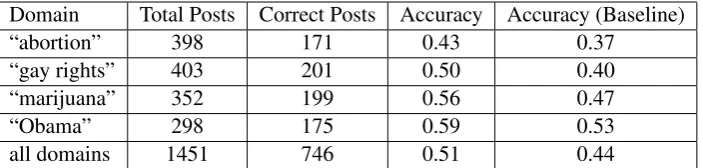
we have selected the two top-ranked sentences as the generated “summary”. In both experiments, each post is characterised as correct if the reason segment is contained in the extracted “summary”; otherwise the post is characterised as an error. The evaluation results are shown in Table 4 for experi-mentE1and Table 5 for experimentE2.
As can be seen from Tables 4 and 5, TextRank has achieved better performance (as measured by accuracy) than our baseline in both experiments,
E1 andE2. For experiment E1, accuracy has
in-creased from 0.44 (of the baseline) to 0.51, while in experiment E2, accuracy has increased from
Domain Total Posts Correct Posts Accuracy Accuracy (Baseline)
“abortion” 398 171 0.43 0.37
“gay rights” 403 201 0.50 0.40
“marijuana” 352 199 0.56 0.47
“Obama” 298 175 0.59 0.53
[image:7.595.125.477.62.146.2]all domains 1451 746 0.51 0.44
Table 4: Evaluation Results (for experimentE1) – first evaluation corpus (Hasan and Ng, 2014).
Domain Total Posts Correct Posts Accuracy Accuracy (Baseline)
“abortion” 398 267 0.67 0.57
“gay rights” 403 269 0.67 0.58
“marijuana” 352 273 0.78 0.68
“Obama” 298 223 0.75 0.70
all domains 1451 1032 0.71 0.63
Table 5: Evaluation Results (for experimentE2) – first evaluation corpus (Hasan and Ng, 2014).
Experiment Total Essays Correct Essays Accuracy Accuracy (Baseline)
E1 90 14 0.16 0.03
E2 90 26 0.29 0.11
E1(all claims) 90 47 0.52 0.33
[image:7.595.111.488.309.382.2]E2(all claims) 90 67 0.74 0.53
Table 6: Evaluation Results – second evaluation corpus (Stab and Gurevych, 2014).
posts, such as “abortion”. Of course, as the size of documents increases the task of selecting one or two sentences becomes more difficult, and this is evident by the drop in performance (for both Tex-tRank and the baseline) for domains “abortion” and “gay rights” when compared to the rest of the domains.
Results are similar for the second evaluation corpus of persuasive essays, as is shown in Ta-ble 6. Again TextRank has achieved better per-formance than the baseline for both experiments,
E1 andE2. The overall performance of both
Tex-tRank and the baseline is lower than the first cor-pus, mainly due to the increased size of persua-sive essays compared to posts (having an average size of 18.61 and 8.25 sentences respectively). For the second corpus an additional experiment has been performed, which expands the set of claims that have to be identified, from only the jor” claim, to all the claims (including the “ma-jor” one) in an essay. This experiment (labelled as “E1 (all claims)” and “E2 (all claims)” in
Ta-ble 6) examines whether the top-ranked sentence (experiment “E1 (all claims)”) by TextRank is a
claim, or whether the first two sentences as ranked
by TextRank contain a claim (experiment “E2 (all
claims)”). As expected, the performance of both TextRank and the baseline has been increased, as this is an easier task. The mean number of all claims (including the “major” claim) is 5.64 per persuasive essay.
5 Conclusions
In this paper we have applied an unsupervised al-gorithm for extractive summarisation, TextRank, on a task that relates to argument mining, the iden-tification of sentences that contain an argumenta-tion component. Motivated by the need to better address relations and interactions that are not lo-cal within a document, we have applied a graph-based algorithm, which models a whole document having sentences as its basic text unit. Evaluation has been performed on two English corpora. The first corpus contains user posts from an on-line de-bating forum, which has been manually annotated with the reasons each post author uses to declare its stance, in favour or against, towards a specific topic. The second corpus contains 90 persuasive essays, which has been manually annotated with claims and premises, along with a “major” claim for each essay. Evaluation results suggest that graph-based approaches and approaches targeting extractive summarisation can have a positive effect on tasks of argument mining.
Regarding directions for further research, there are several axes that can be explored. Our evalu-ation results suggest that TextRank achieved bet-ter performance than the baseline for documents between 6 and 11 sentences, and it would be in-teresting to evaluate further its performance on longer documents. At the same time, the perfor-mance of TextRank depends on how “similarity” between its text units is defined; alternative “sim-ilarity” measures can be considered, even super-vised ones that measure distance according to in-formation obtained from a domain, or informa-tion obtained for a specific task. Even an exter-nal knowledge base can be explored, providing distances closer to semantic similarity. Finally, a third dimension is to examine alternative extrac-tive summarisation algorithms, in order to clarify further whether other summarisation algorithms can have a positive impact for argument mining, similar to the results achieved by TextRank.
References
Ehud Aharoni, Anatoly Polnarov, Tamar Lavee, Daniel Hershcovich, Ran Levy, Ruty Rinott, Dan Gutfre-und, and Noam Slonim. 2014. A benchmark dataset for automatic detection of claims and evidence in the
context of controversial topics. In Proceedings of
the First Workshop on Argumentation Mining, pages
64–68, Baltimore, Maryland, June. Association for Computational Linguistics.
Philippe Besnard and Anthony Hunter. 2008.
El-ements of argumentation, volume 47. MIT press Cambridge.
Josh Bohde. 2012. Document Summarization
using TextRank. http://joshbohde.com/
blog/document-summarization. [Online;
accessed 12-May-2016].
Filip Boltuˇzi´c and Jan ˇSnajder. 2014. Back up your stance: Recognizing arguments in online
dis-cussions. In Proceedings of the First Workshop
on Argumentation Mining, pages 49–58, Baltimore, Maryland, June. Association for Computational Lin-guistics.
Sergey Brin and Lawrence Page. 1998. The anatomy of a large-scale hypertextual web search engine.
Comput. Netw. ISDN Syst., 30(1-7):107–117, April.
Lucas Carstens and Francesca Toni. 2015. Towards
relation based argumentation mining. In
Proceed-ings of the 2nd Workshop on Argumentation Min-ing, pages 29–34, Denver, CO, June. Association for Computational Linguistics.
R.A. Fisher and F. Yates. 1963. Statistical tables
for biological, agricultural, and medical research. Hafner Pub. Co.
Debanjan Ghosh, Smaranda Muresan, Nina Wacholder, Mark Aakhus, and Matthew Mitsui. 2014. Ana-lyzing argumentative discourse units in online
in-teractions. In Proceedings of the First Workshop
on Argumentation Mining, pages 39–48, Baltimore, Maryland, June. Association for Computational Lin-guistics.
George Giannakopoulos, Jeff Kubina, Ft Meade, John M Conroy, MD Bowie, Josef Steinberger, Benoit Favre, Mijail Kabadjov, Udo Kruschwitz,
and Massimo Poesio. 2015. Multiling 2015:
Multilingual summarization of single and multi-documents, on-line fora, and call-center
conversa-tions. 16th Annual Meeting of the Special Interest
Group on Discourse and Dialogue, page 270.
Theodosis Goudas, Christos Louizos, Georgios Petasis, and Vangelis Karkaletsis. 2014. Argument extrac-tion from news, blogs, and social media. In Aristidis Likas, Konstantinos Blekas, and Dimitris Kalles, ed-itors, Artificial Intelligence: Methods and Applica-tions, volume 8445 of Lecture Notes in Computer Science, pages 287–299. Springer.
Theodosis Goudas, Christos Louizos, Georgios Peta-sis, and Vangelis Karkaletsis. 2015. Argument
ex-traction from news, blogs, and the social web.
Heather Graves, Roger Graves, Robert Mercer, and Mahzereen Akter. 2014. Titles that announce ar-gumentative claims in biomedical research articles. In Proceedings of the First Workshop on Argumen-tation Mining, pages 98–99, Baltimore, Maryland, June. Association for Computational Linguistics. Nancy Green. 2014. Towards creation of a corpus for
argumentation mining the biomedical genetics re-search literature. InProceedings of the First Work-shop on Argumentation Mining, pages 11–18, Bal-timore, Maryland, June. Association for Computa-tional Linguistics.
Kazi Saidul Hasan and Vincent Ng. 2014. Why are you taking this stance? identifying and classifying
reasons in ideological debates. In Proceedings of
the 2014 Conference on Empirical Methods in Natu-ral Language Processing (EMNLP), pages 751–762, Doha, Qatar, October. Association for Computa-tional Linguistics.
Hospice Houngbo and Robert Mercer. 2014. An au-tomated method to build a corpus of rhetorically-classified sentences in biomedical texts. In Proceed-ings of the First Workshop on Argumentation Min-ing, pages 19–23, Baltimore, Maryland, June. Asso-ciation for Computational Linguistics.
Christian Kirschner, Judith Eckle-Kohler, and Iryna Gurevych. 2015. Linking the thoughts: Analysis of argumentation structures in scientific publications. In Proceedings of the 2nd Workshop on Argumen-tation Mining, pages 1–11, Denver, CO, June. Asso-ciation for Computational Linguistics.
John Lawrence and Chris Reed. 2015. Combining
argument mining techniques. In Proceedings of
the 2nd Workshop on Argumentation Mining, pages 127–136, Denver, CO, June. Association for Com-putational Linguistics.
John Lawrence, Chris Reed, Colin Allen, Simon McAl-ister, and Andrew Ravenscroft. 2014. Mining argu-ments from 19th century philosophical texts using
topic based modelling. In Proceedings of the First
Workshop on Argumentation Mining, pages 79–87, Baltimore, Maryland, June. Association for Compu-tational Linguistics.
Ran Levy, Yonatan Bilu, Daniel Hershcovich, Ehud Aharoni, and Noam Slonim. 2014. Context
de-pendent claim detection. In Proceedings of
COL-ING 2014, the 25th International Conference on Computational Linguistics: Technical Papers, pages 1489–1500. Dublin City University and Association for Computational Linguistics.
Christopher D. Manning, Prabhakar Raghavan, and Hinrich Sch¨utze. 2008. Introduction to Information Retrieval. Cambridge University Press, New York, NY, USA.
Rada Mihalcea and Paul Tarau. 2004. Textrank: Bringing order into texts. In Dekang Lin and Dekai
Wu, editors, Proceedings of EMNLP 2004, pages
404–411, Barcelona, Spain, July. Association for Computational Linguistics.
Niall Rooney, Hui Wang, and Fiona Browne. 2012. Applying kernel methods to argumentation mining. In G. Michael Youngblood and Philip M. McCarthy,
editors, Proceedings of the Twenty-Fifth
Interna-tional Florida Artificial Intelligence Research Soci-ety Conference, Marco Island, Florida. May 23-25,
2012. AAAI Press.
Christian Stab and Iryna Gurevych. 2014. Annotat-ing argument components and relations in persua-sive essays. In Junichi Tsujii and Jan Hajic, edi-tors, Proceedings of the 25th International Confer-ence on Computational Linguistics (COLING 2014), pages 1501–1510, Dublin, Ireland, August. Dublin City University and Association for Computational Linguistics.
Bianka Trevisan, Eva Dickmeis, Eva-Maria Jakobs, and Thomas Niehr. 2014. Indicators of argument-conclusion relationships. an approach for
argumen-tation mining in german discourses. In