The Aldrich Sure/SealTM packaging system
Air-sensitive reagents from Aldrich are packaged in spe-cial bottles, normally 800ml in the 32-oz Sure/Seal bottle and 100ml in the 4-oz Sure/Seal bottle. Our exclusive packag-ing system (Fig. 1) provides a convenient method for storing and dispensing research quantities of air-sensitive reagents. With this bottle, reactive materials can be handled and stored without exposure to atmospheric moisture or oxygen. The reagent comes in contact only with glass and Teflon®, yet it can be readily transferred using standard syringe techniques.
The Bakelite cap on a Sure/Seal bottle can be safely removed because the crown cap, with its Teflon/elas-tomer liner, is already crimped in place. The reagent can then be dispensed using a syringe or double-tipped needle inserted through the hole in the metal cap. We recommend only small-gauge needles (no larger than 16-gauge) be used and that the Bakelite cap be replaced after each use. After the needle has been withdrawn from the bottle, a small hole will remain in the Teflon/elastomer liner. Under normal circumstances, the hole in the liner will self-seal and the reagent will not deteriorate. How-ever, the possibility exists that once an elastomer liner is punctured, it may leak on long-term storage. This possibility is virtually eliminated with the Sure/Seal sys-tem because when the Bakelite cap is replaced, the Teflon/elastomer liner in the cap forms a seal against the top of the metal crown. Thus, the contents are protected from moisture and oxygen in the atmosphere.
A more convenient solution is to use our Sure/Seal septum cap (Fig. 1B). After removing the solid Bakelite cap, a septum cap (a Bakelite cap with a Pin. hole equipped with an elastomer liner) is placed securely on the bottle. The liner is made from white natural rubber, the same material as in our sleeve stoppers. With the septum cap in place, the needle is inserted into the hole in the Bakelite cap and through the septum-cap liner and the crown-cap liner. The Sure/Seal septum cap protects the reagent and works nicely if the reagent is to be used repeatedly over a relatively short period of time (no more than 2 or 3 days).
If an unused portion is to be stored for an extended length of time, the solid Bakelite cap should be replaced on the bottle. For added security, transfer the reagent to a suitable storage vessel or equip the bottle with the Oxford Sure/Seal Valve Cap (Fig. 1C).3
A. Bakelite cap
Teflon-faced liner Natural-rubber liner
B. Septum cap
C. Oxford Sure/Seal valve-cap
A variety of air-sensitive reagents is available from Aldrich. Specific examples include solutions of borane complexes, organoboranes, borohydrides, Grignard reagents, and organo-aluminums, -lithiums, and -zincs. Since all of these reagents react with water, oxygen, or both, they must never be exposed to the atmosphere.
Most synthetic chemists are familiar with these ver-satile organometallic reagents. However, because the compounds are air-sensitive or pyrophoric, some workers hesitate to make use of the remarkable chemistry of these reagents. Some chemists still believe that very specialized equipment and complicated techniques are required for handling air-sensitive reagents. This is often not the case.
Air-sensitive materials can be separated into two cat-egories: those which react catalytically with air and/or water, and those which react stoichiometrically. In the latter case- which fortunately includes most of the syntheti-cally useful reagents- the reagents can be handled easily on a laboratory scale using syringe techniques. The cata-lytically sensitive materials often require the use of more sophisticated apparatus such as vacuum lines, Schlenk apparatus, or inert-atmosphere glove boxes.
Brown and co-workers have described simple, conve-nient benchtop methods for handling stoichiometrically sensitive compounds on a laboratory scale.1 Shriver and Drezdzon have presented an excellent description of the more sophisticated techniques used to manipulate cata-lytically sensitive materials.2 This data sheet is limited to those techniques necessary for handling air-sensitive reagents on a preparative laboratory scale.
Contents
The Aldrich Sure/SealTM packaging system Equipment
Reagent transfer with syringes
Reagent transfer with double-tipped needles Storage vessels
Cold storage Equipment clean-up Aldrich equipment
References and trademarks Metal crown
cap with I-in. hole
Special neck with glass crown and threads Fig.1.
The Sure/Seal Bottle System
Handling air-sensitive reagents
revised 3/97 8 pages
Technical
Bulletin
AL-134
Equipment
Reactions involving our air-sensitive reagents can be carried out in common ground-glass apparatus. Other equipment required are a source of inert gas, a septum inlet, a bubbler, and syringes fitted with suitable needles.
Laboratory glassware contains a thin film of adsorbed moisture which can be easily removed by heating in an oven (125°/overnight or 140°/4 hrs). The hot glassware should be cooled in an inert atmosphere by assembling the glassware while hot and flushing with a stream of dry nitrogen or argon. A thin film of silicone or hydrocarbon grease must be used on all standard-taper joints to prevent seizure upon cooling. Alternatively, the apparatus may be assembled cold and then warmed with a heat gun while flushing with dry nitrogen.
The oven-drying procedure is more efficient than using a heat gun because it removes moisture from inner surfaces of condensers and from other intricate parts. Spring clips or rubber bands are required to secure joints during flushing since the nitrogen pressure may open the seals of unsecured standard-taper joints.
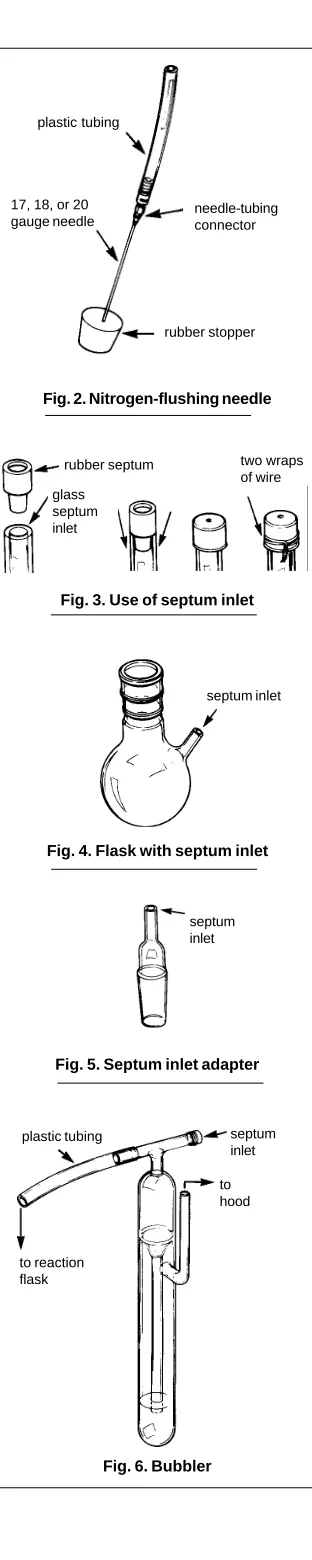
Only high-purity, dry nitrogen from a cylinder with a pressure regulator (adjusted to 3-5 psi) should be used for flushing. Plastic tubing can be used to connect the nitrogen line to a tube connector adapter (equipped with a stopcock) on the reaction apparatus. Nitrogen may also be introduced through a rubber septum via a hypodermic needle connected to the end of the flexible tubing on the nitrogen line. The needle-tubing connector provides a simple method for attaching the needle to the tubing. When not in use, this nitrogen-flushing needle should be closed by inserting the needle into a solid rubber stopper to prevent diffusion of air into the needle when the nitrogen is turned off (Fig. 2).
Large rubber septa may be used to cap female joints. However, the use of 6-mm septa and 9-mm o.d./6-mm i.d. medium-wall glass septum inlets is preferred. The small rubber septum provides a more positive reseal after puncture and allows less rubber to be in contact with organic vapors in the reaction vessel. With the recommended medium-wall tubing, the 6-mm septum not only fits the inside diameter of the glass tube but also fits snugly over the outside when the top is folded over (Fig. 3). The glass septum inlet can be built into the reaction flask (Fig. 4) or placed on an adapter (Fig. 5) for use with unmodified glassware.
The rubber septum may be wired in place as shown in Fig. 3. However, if the 6-mm septum is properly fitted to 9-mm medium-wall tubing, the wiring step may be omitted unless high pressures (>10 psi) are expected.
To maintain an air-tight system the reaction vessel must be vented through a mercury or mineral oil bubbler. Drying tubes will not prevent oxygen from entering the system. At all times during the reaction, the system should be under a slight positive pressure of nitrogen as visually indicated by the bubbler. Fig. 6 illustrates a suitable bubbler.
A pressure reversal may cause the liquid in the bubbler to be drawn into the reaction vessel. The enlarged head space in the bubbler will minimize this danger. However, if a large pressure reversal occurs, air will be admitted into the reaction vessel. The T-tube bubbler shown can be used to prevent this problem because nitrogen pressure can be introduced intermittently through the septum inlet. The problem can be completely eliminated by a slow and continuous nitrogen flow.
Small quantities (up to 50ml) of air-sensitive reagents and dry solvents may be transferred with a syringe equipped with a 1-2ft long needle. These needles are used to avoid having to tip reagent bottles and storage flasks. Tipping often causes the liquid to come in contact with the septum causing swelling and deterioration of the septa, and should therefore be avoided.
A rubber septum provides a positive seal for only a limited number of
punctures-plastic tubing
needle-tubing connector 17, 18, or 20
gauge needle
rubber stopper
septum inlet plastic tubing
to reaction flask
to hood
Fig. 5. Septum inlet adapter
septum inlet
Fig. 4. Flask with septum inlet
septum inlet
Fig. 3. Use of septum inlet
two wraps of wire rubber septum
[image:2.612.417.573.12.792.2]glass septum inlet
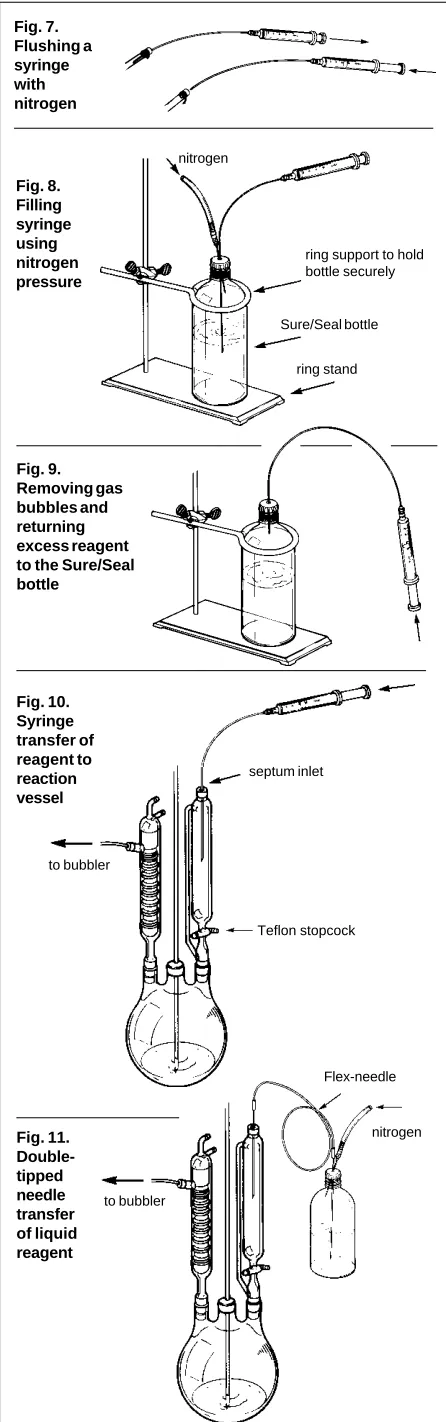
grease on a rubber septum to facilitate passage of the needle through the rubber and to minimize the size of the hole in the septum. Ideally, the syringe and needle should be dried in an oven prior to use. Naturally, the syringe body and plunger should not be assembled before being placed in the oven. The syringe should be flushed with nitrogen during the cooling. A syringe may also be flushed 10 or more times with dry nitrogen (illustrated in Fig. 7) to remove the air and most of the water adsorbed on the glass. A dry syringe may be closed to the atmosphere by inserting the tip of the needle into a rubber stopper (Fig 2).
The syringe-needle assembly should be tested for leaks prior to use. The syringe is half-filled with nitrogen and the needle tip is inserted in a rubber stopper. It should be possible to compress the gas to half its original volume without any evidence of a leak. A small amount of stopcock grease or a drop of silicon oil placed on the Luer lock tip will help ensure tightness.
Reagent transfer with syringe
The syringe transfer of liquid reagents (up to 100ml) is readily accomplished by first pressurizing the Sure/Seal reagent bottle with dry, high-purity nitrogen followed by filling the syringe as illustrated in Fig. 8. The nitrogen pressure is used to slowly fill the syringe with the desired volume plus a slight excess (to compensate for gas bubbles) of the reagent. Note that the nitrogen pressure pushes the plunger back as the reagent enters the syringe. The plunger should not be pulled back since this tends to cause leaks and create gas bubbles. The excess reagent along with any gas bubbles is forced back into the reagent bottle as illustrated in Fig. 9. The accurately measured volume of reagent in the syringe is quickly transferred to the reaction apparatus by puncturing a rubber septum on the reaction flask or addition funnel as shown in Fig. 10. Note: larger syringes are available but are awkward to handle when completely full.
Reagent transfer with a double-tipped needle
To conveniently transfer 50ml or more of reagent, the double-tipped needle technique is recommended. Fig. 11 illustrates liquid-reagent transfer under nitrogen pressure using this technique.To accomplish the double-tipped needle transfer, the needle is first flushed with nitrogen. The Sure/Seal bottle is pressur-ized with nitrogen using the nitrogen flushing needle. The double tipped needle is then inserted through the septum on the reagent bottle into the head space above the reagent. Nitrogen immediately passes through the needle. Finally, the other end of the double-tipped needle is inserted through the septum on the reaction apparatus, and the end of the needle in the reagent bottle is pushed down into the liquid. The volume of liquid reagent transferred is measured by using a calibrated flask or addition funnel. When the desired volume has been transferred, the needle is immediately withdrawn to the head space above the liquid, flushed slightly with nitrogen, and removed. The needle is first removed from the reaction apparatus and then from the reagent bottle.
to bubbler
nitrogen septum inlet
to bubbler
Teflon stopcock
Flex-needle
[image:3.612.335.558.35.746.2]Fig. 10. Syringe transfer of reagent to reaction vessel Fig. 7. Flushing a syringe with nitrogen
ring stand Sure/Seal bottle nitrogen
Fig. 8. Filling syringe using nitrogen pressure
ring support to hold bottle securely
Fig. 9. Removing gas bubbles and returning excess reagent to the Sure/Seal bottle
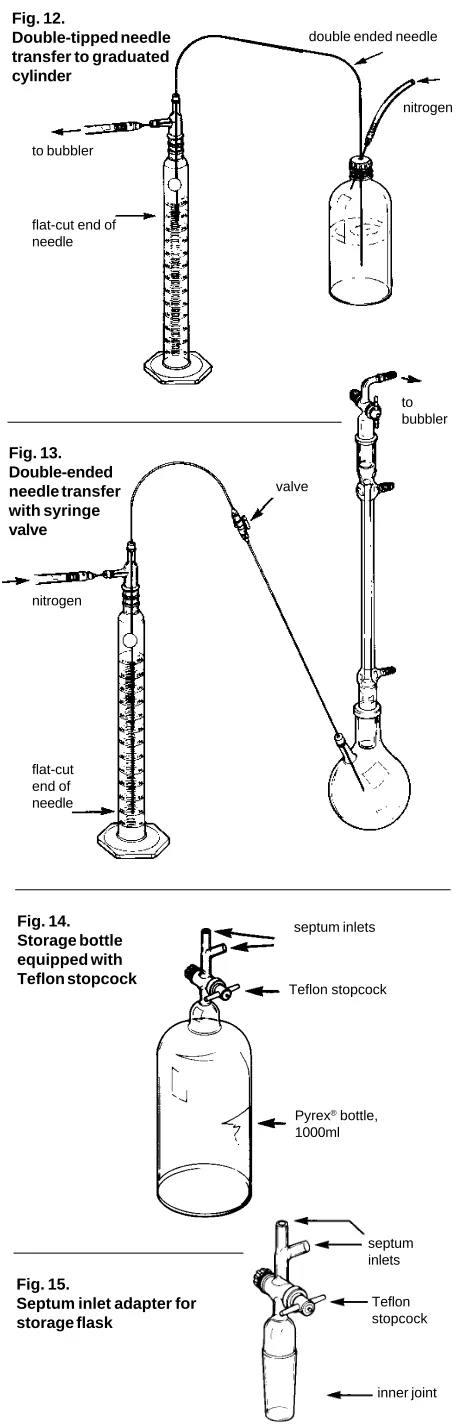
An alternative method for transferring measured amounts of reagents is shown in Fig. 12. The reagent is first transferred via a double-ended needle from the Sure/Seal bottle to a dry, nitrogen-flushed graduated cylinder (see Fig. 13) equipped with female B joint and a double inlet adapter. Only the desired amount of reagent is transferred to the cylinder. The needle is then removed from the Sure/Seal bottle and inserted through the septum on the reaction apparatus. By applying nitrogen pres-sure as before, the reagent is added to the reaction apparatus. If it is necessary to add the reagent slowly, a modified transfer needle is constructed from two long standard needles and a male Luer lock to male Luer lock syringe valve. The valve may be opened slightly allowing only a very slow flow of reagent. Thus, the addition funnel is not needed and many reactions can be carried out in single-necked flasks as shown in Fig. 13.
Storage vessels
The 12-gauge stainless steel needles on the Flex-needle provide a rapid means of transferring air-sensitive reagents under nitrogen pressure. However, the needles are so large that once the crown cap liner on the Sure/Seal bottle is punctured, the liner will not self-seal. If only a portion of the contents is to be used, a needle no larger than 16-gauge should be utilized. By using small needles and by always tightly replacing the Bakelite cap, the reagent in a Sure/Seal bottle will not deteriorate even after numerous septum punctures.
However, if the reagent is to be used repeatedly for small-scale reactions or if an unused portion is to be stored for an extended length of time, the material should be transferred from the Sure/Seal bottle to a suitable storage bottle. One type of container for air-sensitive reagents is shown in Fig. 14. Alterna-tively, an appropriate adapter can be used to convert a round-bottomed flask into a storage vessel (Fig. 15).
The Teflon stopcock on the storage bottle keeps solvent vapors away from the septum, thereby minimizing swelling and deterioration of the septum. Furthermore, the stopcock allows for replacement of the septa. A change of septa is sometimes necessary because they tend to deteriorate on prolonged stand-ing in a laboratory atmosphere.
Cold storage
A problem arises with cold storage in vessels equipped with Teflon stopcocks. Since the thermal expansion coefficient of Teflon is significantly different from that of glass, we have found that special techniques are required when Teflon-plug/glass-barrel stopcocks are used or stored in a coldroom. The Teflon plug contracts more than the glass barrel on cooling, thus, the stopcock can give a good seal at room temperature but leak when moved to a coldroom. Conversely, the stopcock can be tightened in the coldroom giving a good seal, but upon warming to room temperature the Teflon expands, freezing or breaking the stopcock. The simplest solution to this problem is to retighten the stopcock after the apparatus has cooled for about 15 minutes in the coldroom. Thereafter, open and close the stopcock only in the coldroom- do not attempt to turn the stopcock after it has warmed to room temperature.
Teflon will cold flow (creep) with time. Therefore, unattended long-term storage of a tightened Teflon stopcock is not
recom-Fig. 15.
Septum inlet adapter for storage flask
septum inlets
Teflon stopcock
Pyrex® bottle,
1000ml
Fig. 14. Storage bottle equipped with Teflon stopcock Fig. 13.
[image:4.612.38.267.41.753.2]Double-ended needle transfer with syringe valve
Fig. 12.
Double-tipped needle transfer to graduated cylinder
to bubbler
flat-cut end of needle
nitrogen
nitrogen double ended needle
valve
to bubbler
flat-cut end of needle
septum inlets
once a month) to check for tight-ness of its seal, regardless of where it is stored.
Storage or use of Teflon-stop-cock-equipped apparatus in a freezer (-20°C or below) pre-sents special problems. If a Teflon stopcock is tightened in a freezer and then allowed to warm to room temperature unattended, the expanding Teflon can break the glass barrel of the stopcock. To prevent this loosen the Teflon
plug while turning it as the apparatus warms. This process can be accelerated by warming the glass barrel with the hand. All of the above problems can be avoided by using only all-glass stopcocks whenever an appara-tus is to be stored in a coldroom.
A lubricant, such as a silicone or hydrocarbon grease, is required for glass stopcocks. Obviously, the solvents used for our reagents will slowly dissolve most stopcock greases. In cases where this can become a problem, it is advisable to substitute Teflon-clad stopcocks which combine the best of both systems. However, these special Teflon-coated glass plugs are expensive, and once the Teflon is worn, the plug must be discarded.
A better solution to the lubricant problem is to wrap the glass plug with a Teflon tape. The tape must not be overlapped, but wrapped around in one layer and in one continuous spiral with no gaps. The plug should be turned only in one direction to further tighten the tape (e.g., if the tape is wrapped counterclockwise, turn the plug clockwise only). If the Teflon-wrapped plug is held securely in place with a rubber band, a storage vessel can be stored for months in a coldroom or at room temperature without any leakage or freezing of the stopcock.
Equipment cleanup
Clean-up of equipment that has been used to transfer air-sensitive reagents must not be taken lightly. Since many of these reagents react violently with water, fires are a potential hazard. The crown cap and liner of an empty Sure/Seal bottle should be carefully removed and the open bottle left in the hood to allow the last traces of reactive reagent to be slowly air-hydrolyzed and oxidized. After at least a day, the inorganic residue can be rinsed out with water. Empty storage bottles and storage flasks should be treated similarly. Air-hydroly-sis in a hood is appropriate only for the last traces of material that remain after a Sure/Seal bottle has been emptied as completely as possible via syringe or double-ended needle transfer. The Aldrich Catalog/Handbook or material safety data sheets should be consulted for the recommended disposal procedures for larger amounts of reactive chemicals.
Immediately clean all syringes and needles that have been used to transfer air-sensitive materials. Also, in
general, a syringe should only be used for a single transfer. Failure to follow this practice can result in plugged needles and frozen syringes due to hydrolysis or oxidation of the reagents. The double-tipped needles are flushed free of reagent with nitrogen in the transfer system, and then immediately removed and placed in a clean sink. With water running in the sink and in the complete absence of flammable sol-vents and vapors, the double-tipped needles or Flex-needle can be rinsed with water. When no activity in the rinse water is observed, acetone from a squeeze bottle can be flushed through the needle. Depending on the reagent trans-ferred, it may be necessary to use dilute acid or base from a squeeze bottle to remove inorganic residue that is not water-soluble.
Following its use, a syringe contains a larger amount of residual reagent. It is advisable to rinse out the reactive reagent by first placing a few millimeters of the same solvent that was used for the reagent in a small Erlenm-eyer flask in the hood. Keeping the needle tip under the solvent at all times, no more than half the solvent is then drawn into the syringe. The solvent plus dissolved residual reagent is ejected from the syringe back into the same Erlenmeyer flask. Repeat this rinse treatment at least three times. The wash solution can be safely combined with other waste solvents and the syringe may be further cleaned with water and acetone in the sink. Again, treatment with dilute aqueous acid or base may be necessary.
Once the syringe needles and double-tipped needles have been rinsed in a sink, they can be further cleaned and dried using a device similar to that shown in Fig. 16. Needles are cleaned by inserting them through the sep-tum. Vacuum from a water aspirator is used to pull solvents from squeeze bottles through the needles. After pulling air through the system for a few minutes, the syringe plus needle or the double-tipped needle will be dry. The syringe plunger should be replaced in the barrel for storage. If a syringe plunger and barrel are not assembled for storage, dust can settle on the plunger and in the barrel. Upon reassembly, these fine particles will occasionally scratch the barrel or cause seizure of the plunger on the barrel. However, the plunger and barrel must be disassembled before oven drying.
Most of the above techniques were developed for handling various organoborane reagents. However, these methods are applicable to other air-sensitive materials. When handling air-sensitive materials, be prepared for the unexpected. For example, at least one extra set of clean, dry syringes and needles or double-tipped needles should always be available in case the first set of equipment becomes plugged. When working with these air-sensitive reagents keep in mind that these solutions should never be allowed to come in contact with the atmosphere.
septum inlet
to water aspirator
to stopcock for vacuum releasing heavy-walled
vacuum filtration flask
Aldrich hopes that by supplying the Sure/Seal packaging system and all the equipment required for syringe-transfer of liquids, chemists will no longer hesitate to use air-sensitive reagents. Our aim at Aldrich is the customers' complete satisfaction. Suggestions for improvement are always welcome.
SURE/SEAL BOTTLE SYSTEM
Natural-rubber liner Bakelite cap
Special neck equipped with glass crown and
threads
Oxford Sure/Seal valve-cap
metal crown cap with
I-in. hole
Teflon-faced liner
Sure/Seal bottles
Glass 125ml Z11,612-2
927ml Z11,613-0
Plastic-coated glass bottles are also available.
Oxford Sure/Seal valve-cap
Screws over Sure/Seal crown cap to permit repeated dispensing of product via syringe while ensuring positive valved closure. Technical Information Bulletin AL-195, with instructions for use of the valve, is
included. Z22,283-6
Bakelite caps
33-430. Solid tops with liner. Z10,216-4
33-430. With P-in. hole. Z10,807-3
Natural Rubber liner
White, 30-mm diameter, 60mil. Z10,808-1
Steel crown cap
With I-in. hole. Z10,214-8
Teflon-faced liner
For crown cap, 25-mm diam. Z10,215-6
Crown-cap crimpers
17I-in. high, 4-in. diam. base,
2in. from crown to pole. (left)
Z11,296-8
Replacement rubber washers.
Z15,154-8
Heavy duty. 21F-in. high,
12-in. diam. base, 3F-in. from
crown to pole. (right)
Z11,297-6
Storage bottles without joints. Clear glass, with stopcock-equipped septum inlet requiring septum Z10,072-2 or Z12,435-4.
Capacity (ml) Stopcock size (mm) Cat. No.
Teflon stopcock
125 2 Z10,328-4
250 2 Z10,329-2
500 4 Z10,199-0
1000 4 Z10,248-2
2000 4 Z10,330-6
Glass stopcock
125 2 Z10,733-6
250 2 Z10,734-4
500 4 Z10,735-2
Developed by Aldrich for the safe transfer of ag-gressive solvents, air-sensitive liquids and gases. Chemflex is constructed of a thin inner-tube of PTFE sheathed in clear PVC. CHEM-FLEX 106 tubing is designed specifically for use with 12 gauge transfer needles and is suitable for small volume transfers of products packed in Aldrich Sure/Seal bottles.
Features
• chemically inert • extra strong yet flexible • resists crushing and kinking • cut marks at 6 inch intervals • available in 25ft & 50ft lengths • color-coded for high visibility
Name/Color-code I.d. (in.) O.d.(in.) Cat. No.
CHEM-FLEX 106/Red 0.106 0.380 Z22,251-8
CHEM-FLEX 125/Blue 0.125 (K) 0.400 Z22,252-6
CHEM-FLEX 187/Green 0.187 (P) 0.470 Z22,253-4
CHEM-FLEX 250/Black 0.250 (I) 0.525 Z22,254-2
Tubing clamps
Nylon clamps secure CHEM-FLEX tubing to transfer needles and fittings.
Tubing size Diameter range (in.) Cat. No.
CHEM-FLEX 106, 125 23/64 to 25/64 Z22,417-0
CHEM-FLEX 187 25/64 to 15/32 Z22,418-9
CHEM-FLEX 250 15/32 to 17/32 Z22,419-7
Standard
Mineral oil or mercury, 5-7ml. For monitoring gas evolution or rate of flow, or closing off a reaction ves-sel from the atmosphere. Model (b) has a B24/40 joint.
A Z10,121-4 B Z10,432-9
Check-valve bubblers
Permits gas flow under positive pressure. Check-valve ball seats on ground surface under negative pressure preventing oil from be-ing drawn into the purged system. Single inlet tube, top outlet
C Z22,501-0
T inlet tube, side outlet
Z22,502-9
Safety bubbler
The built-in flash arrester bulbs prevents the backflow of mercury and mineral oil to pumps and pre-vents reactions due to overflow or violent bubbling. 15ml maximum fill mark prevents over-filling.
D Z22,372-7
Mini gas bubbler
For bubble counting. Maximum volume is 4ml.
E Z22,371-9
In-line oil bubblers
For precise N2 pressure control during inert atmosphere reactions. Connect reaction vessel to in-line
B joint or use with a ballast bulb to
keep pressure constant.
C14/20 joint F Z22,322-0 C19/38 joint Z22,334-4 C24/40 joint Z22,335-2 F
E D
C B
A
TUBING BUBBLERS
A B
Cap. (ml) C Joint Cat. No. Cat. No. Stopcock type
25 14/20 Z10,217-2 — —
50 14/20 Z10,218-0 Z10,725-5 Glass
50 14/20 — Z10,334-9 Teflon
100 14/20 Z10,331-4 Z10,726-3 Glass
100 14/20 — Z10,335-7 Teflon
250 14/20 Z10,332-2 Z10,336-5 Teflon
100 19/22 Z10,123-0 Z10,337-3 Teflon
250 19/22 Z10,124-9 Z10,338-1 Teflon
100 24/40 Z10,125-7 — —
250 24/40 Z10,126-5 Z10,729-8 Glass
250 24/40 — Z10,138-9 Teflon
A. Round bottom flask with
ground-glass joint and septum inlet.
B. As above but with 2-mm stopcock on
septum inlet.
B A
FLASKS
A mixed set of septa with carrying case is also available. Please see the Aldrich Catalog/Handbook for details!
NATURAL RUBBER SEPTA
White Red Cat. No. Cat. No.
8-mm o.d. wall or 9-mm o.d. wall glass tubing
Z10,072-2 Z12,435-4
9- and 10-mm o.d. standard-wall glass tubing
Z10,073-0 Z12,436-2
B14/20 joints Z10,074-9 Z12,437-0 B19/22 joints* Z10,076-5 Z11,830-3 B24/40 joints Z10,145-1 Z12,439-7
*Also fits 125- and 927-ml Sure/Seal bottles. Cat. No. Z10,072-2 shown
NEEDLES
CHEMFLEX Transfer needle
Two 12-gauge SS needles (6- and 18-in.) con-nected to 30-in. of CHEM-FLEX 106 tubing with nylon clamps, ready for use. Liquid comes in contact with Teflon and SS only during transfer. Z23,102-9
Transfer needles
12 gauge SS, double-ended with one noncoring tip and one flat-cut end. For fabrication of transfer lines with CHEM-FLEX 106 tubing. 16-in. length Z11,639-4
18-in. length Z11,640-8
Teflon syringe needles
With KEL-F Luer hub. 12 in. length 24 in. length Gauge Cat. No. Cat. No.
20* Z11,731-5 Z11,737-4
18* Z11,732-3 Z11,738-2
16* Z11,733-1 Z11,739-0
14 Z11,735-8 Z11,740-4
12 Z11,736-6 Z11,741-2
ALDRICH
®Organics and Inorganics for
© 1997 Sigma-Aldrich Co. Printed in the USA. Aldrich is a member of the Sigma-Aldrich Family. Aldrich warrants that its products conform to the information contained in this and other Aldrich publications. Purchaser must determine the suitability of the product for its particular use. See 1001 West Saint Paul Ave., Milwaukee, WI 53233
Telephone 414-273-3850 • 800-231-8327 Fax 414-273-4979 • 800-962-9591 Internet http://www.sial.com/aldrich
F M
Aldrich Schlenk-type Glassware
- Request Technical Bulletin AL-166Aldrich Schlenk-type glassware features threaded B ground glass joints. They require no grease, thus eliminating it as
a potential contaminant, and need no cumbersome clamps. The joints consist of a ground glass male joint (M) and a ground glass interior female joint (F) with exterior threads that allow the male portion to be secured by a septum-type plastic cap using an "O"-ring compression seal. (Cap and "O"-ring are included with all threaded male joints.) Most pieces have stopcock side arms which permit the evacuation of air and the introduction of an inert gas. A high vacuum is not necessary since the purge cycle is repeated a number of times. The versatility of Aldrich Schlenk-type glassware makes the manipulation of air- and moisture-sensitive reagents easier and safer.
Designed for small-scale manipulation of air- and moisture-sensitive reagents
ATMOSBAG — A CONTROLLED - ATMOSPHERE CHAMBER
The Aldrich AtmosBag is a 0.003-in. gauge PE bag that can be sealed, purged, and inflated with an appropriate inert gas, creating a portable, convenient, and inexpensive two handed “glove box” for handling air- and moisture-sensitive as well as toxic materials. Other applications include dust-free operations, controlled-atmosphere habitat, and, for the ethylene-oxide-treated AtmosBag, immunological and microbiological studies. Small AtmosBags have one inlet per side. Includes instructions.
CAUTION: When handling toxic materials use only in a hood or other
controlled system to prevent and protect against exposure in case of leakage. All products made of PE may tear, break, or puncture. To assure that air-sensitive materials do not become exposed to air, follow instructions on package; also test and monitor AtmosBag for leaks before and during use.
Uninflated dimensions (in.) Inflated Ethylene oxide treated Size Opening Width Length volume (in.3) Cat. No. Cat. No.
S 12 27 30 3,000 (50L) Z11,283-6 Z11,837-0
M 24 39 48 17,000 (280L) Z11,282-8 Z11,836-2
L 36 51 58 32,000 (520L) Z10,608-9 Z11,835-4
Teflon sealing tape
In 520-in. roll.
Width (in.) Cat. No.
I Z14,881-4 F Z10,438-8
1 Z22,188-0
Addition of Liquids • Chemical Reaction Distillation • Drying • Extraction
Filtration • Recrystallization Degassing • Transfer of Solids
Trademarks & registered trademarks
Aldrich Chemical Company, Inc. ... Aldrich® ... ATMOSBAG® ... CHEMFLEXTM ... Flex-needle® ... Sure/SealTM E.I. du Pont de Nemours & Co., Inc. ... Teflon® Union Carbide ... BakeliteTM
References
1) Kramer, G.W.; Levy, A.B.; Midland, M.M. in Brown, H.C. "Organic Synthesis via Boranes"; John Wiley and Sons, Inc.: New York, N.Y., 1975 (Aldrich Cat. No. Z10,144-3).
2) Shriver, D.F.; Drezdzon, M.A. "The Manipulation of Air-sensitive Com-pounds"; John Wiley & Sons: New York, N.Y., 1986 (Aldrich Cat. No. Z16,005-9).