Combining Active Learning and Partial Annotation
for Domain Adaptation of a Japanese Dependency Parser
Daniel Flannery∗ Vitei Inc.
Kankoboko-cho 79 Shimogyo-ku, Kyoto, Japan
Shinsuke Mori
ACCMS, Kyoto University Yoshida Honmachi, Sakyo-ku,
Kyoto, Japan [email protected]
Abstract
The machine learning-based approaches that dominate natural language processing research require massive amounts of la-beled training data. Active learning has the potential to substantially reduce the human effort needed to prepare this data by allowing annotators to focus on only the most informative training examples. This paper shows that active learning can be used for domain adaptation of depen-dency parsers, not just in single-domain settings. We also show that entropy-based query selection strategies can be combined with partial annotation to annotate infor-mative examples in the new domain with-out annotating full sentences. Simulations are common in work on active learning, but we measured the actual time needed for manual annotation of data to better frame the results obtained in our simula-tions. We evaluate query strategies based on both full and partial annotation in sev-eral domains, and find that they reduce the amount of in-domain training data needed for domain adaptation by up to 75% com-pared to random selection. We found that partial annotation delivers better in-domain performance for the same amount of human effort than full annotation.
1 Introduction
Active learning is a promising approach for do-main adaptation because it offers a way to reduce the amount of data needed to train classifiers, min-imizing the amount of difficult in-domain annota-tion. This type of annotation requires annotators to have both domain knowledge plus familiarity with
*This work was done when the first author was at Kyoto
University.
annotation standards. There has been much recent work on active learning for a variety of natural lan-guage processing tasks (Olsson, 2009), but most of it is concerned only with the single-domain case. Additionally, work on active learning commonly reports results for simulations only because of the high cost of annotation work.
We use active learning to perform domain adap-tation for a Japanese dependency parsing task, and measure the actual time required for manual anno-tation of training data to better frame the results of our experiments. This kind of evaluation is crucial for assessing the effectiveness of active learning in practice.
Previous work on active learning for structured prediction tasks like parsing (Hwa, 2004) often assumes that the training data must be fully an-notated. But recent work on dependency parsing (Spreyer et al., 2010; Flannery et al., 2011) has shown that models trained from partially anno-tated data (where only part of the tree structure is annotated) can achieve competitive performance. However, deciding which portion of the tree struc-ture to annotate remains a difficult problem.
2 Related Work
Most previous work on active learning for parsing (Hwa, 2004; Sassano and Kurohashi, 2010) stud-ies the single-domain case, where the initial la-beled data set and the pool of unlala-beled data share the same domain. An important difference from previous work is that we focus on domain adapta-tion, so we assume that the initial labeled data and annotation pool come from different domains.
Previous work on active learning for parsing (Tang et al., 2002; Hwa, 2004) has focused on se-lecting sentences to be fully annotated. Sassano and Kurohashi (2010) showed that smaller units like phrases (bunsetsu) could also be used in an ac-tive learning scenario for a Japanese dependency parser. Their work included results for partially
i 1 2 3 4 5 6 7 8 9
annotation
wi 政府 は 投資 に つなが る と 歓迎 し
Eng. Gov. subj. investment to leads ending that welcomes do
ti noun part. noun part. verb infl. part. noun verb
difull 2 8 4 5 6 7 8 9 NULL
dipart. 8
features
F1 6
F2 は 歓迎
F3 part. noun
F4 NULL, NULL,政府 つなが,る,と
F5 投資,に,つなが し, NULL, NULL
F6 NULL, NULL, noun verb, infl., part.
F7 noun, part., verb verb, NULL, NULL
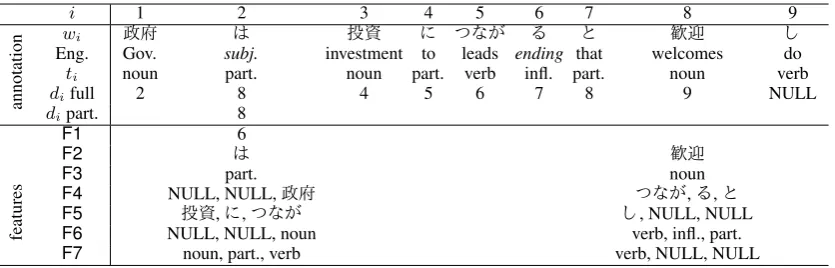
The second word, the case markerは(subj.), has two grammatically possible heads: the verbsつなが
[image:2.595.92.510.61.195.2](leads) and歓迎(welcomes). In the partial annotation framework, only this word needs to be annotated.
Table 1: An example of full annotation (difull) and partial annotation (di part.) for a sentence. Features
for the dependency between the case markerは(subj.) and the verb歓迎(welcomes) are also shown.
annotated sentences, but did not use entropy-based query strategies (Tang et al., 2002; Hwa, 2004) de-signed for selecting whole sentences because of the difficulty of applying them. We use an even smaller unit, words, and show how entropy-based measures can be successfully applied to their se-lection.
Mirroshandel and Nasr (2011) also investigated selection of units smaller than sentences for a graph-based parser in the single-domain setting. Their query strategy used an entropy-based mea-sure calculated from n-best lists, which are com-putationally expensive and require modification of the parser’s edge scoring function to produce. In contrast, our query strategy is a simpler one that does not require n-best lists.
All of the work discussed here reports results for simulations only. This is common practice in ac-tive learning research because large-scale annota-tion is prohibitively expensive. Some recent work on active learning has started to include more re-alistic measures of the actual costs of annotation (Settles et al., 2008). In this paper, we measure the time needed to manually annotate sentences with dependencies to better understand the costs of ac-tive learning for dependency parsing.
3 MST Parsing
Currently, the two major types of data-driven de-pendency parsers are shift-reduce parsers (Nivre et al., 2006) and graph-based parsers (McDon-ald et al., 2005). Shift-reduce parsers perform parsing deterministically (so their time complex-ity can be as fast as linear in the size of the input). Graph-based dependency parsers treat parsing as
the search for a directed maximum spanning tree (MST). We adopt the latter type in this paper be-cause its accuracy is slightly higher especially for long sentences (McDonald and Nivre, 2011). 3.1 Partial Annotation
Our goal is to reduce the total cost of preparing data for domain adaptation. We do this by combin-ing partial annotation with active learncombin-ing.Partial annotationrefers to an annotation method where only some dependencies in a sentence are anno-tated with their heads. The standard method in which all words must be annotated with heads is calledfull annotation. Table 1 shows an example of both types of annotation for a sentence.
Full sentences are the default unit of annotation in full annotation, even though the parser is trained from and operates on smaller units such as words or chunks. The motivation for partial annotation is to match the unit of annotation with the small-est unit that the parser uses for training. In the extreme case this is as small as a single depen-dency between two words. This fine-grained anno-tation unit is a natural fit for active learning, where we seek to find training examples with the great-est training value. However, fine-grained units are cognitively more difficult for a human annotator because less context is available. Thus, we must balance the granularity of annotations against the difficulty of processing them.
3.2 Pointwise MST Parsing
on surface forms and part-of-speech (POS) tags of words, and first-order features between pairs of head and dependent words. Higher-order features that refer to chains of two or more dependencies, like the ones used in the second-order MST intro-duced by McDonald and Pereira (2006), are not used. These restrictions make it easier to train on partially annotated sentences without sacrificing accuracy. Flannery et al. (2011) reported that both this parser and McDonald and Pereira (2006)’s second-order MST parser achieved just under 97% accuracy on a Japanese dependency parsing task. The assumption that written Japanese is head-final and that dependencies only go from left to right may be one reason why there is less of a perfor-mance gap between these two approaches than in other languages. They also reported that the train-ing time of their parser is fifteen times faster than the second-order MST parser, making it easier to use with active learning.
The following features, both individually and as combination features, are used in the pointwise parser that we adopt.
F1: The distancej−ibetween a dependent word
wi and its candidate headwj.
F2: The surface formswi andwj.
F3: The parts-of-speech ofwiandwj.
F4: The surface forms of up to three words to the
left ofwiandwj.
F5: The surface forms of up to three words to the right ofwiandwj.
F6: The parts-of-speech of the words selected for F4.
F7: The parts-of-speech of the words selected for F5.
Table 1 shows the values of these features for a partially annotated example sentence where one word, the case markerは(subj.), has been
anno-tated with its head, the verb歓迎(welcomes).
Par-tial annotation allows annotators to ignore trivial dependencies that are assumed to have little train-ing value.
4 Partial Annotation as a Query Strategy
In this section we give some background on active learning and outline the query strategies that we use to identify informative training examples.
oracle (human annotator)
pool of unlabeled
data machine
learning model
labeled training data
train model
[image:3.595.314.520.61.184.2]make query
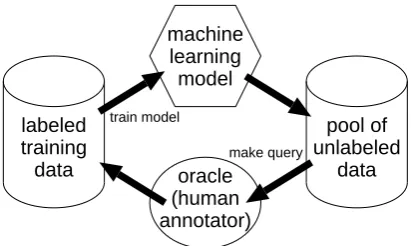
Figure 1: The pool-based active learning cycle.
4.1 Pool-Based Active Learning
We use the pool-based approach to active learn-ing (Lewis and Gale, 1994), because it is a natural fit for domain adaptation. In this framework, we have both initial training dataDL(corresponding
to labeled source domain corpora) and a large pool of unlabeled dataDU(corresponding to unlabeled
target domain text) from which to choose training examples. While labeling domain-specific text is difficult, it is usually relatively easy to acquire (for example, from the web).
In each iteration the entire pool is evaluated se-quentially and its members are ranked by their es-timated training value as determined by some cri-terion, called the query strategy. The top instances are typically selected greedily. The basic flow of pool-based active learning is Figure 1 and de-scribed below.
1. Use a base learnerB to train a classifierC
from the labeled training setDL.
2. Apply C to the unlabeled data set DU and
selectI, the nmost informative training ex-amples.
3. Make a query to the oracle for the correct la-bels of training instances inI.
4. Move training instances inIfromDUtoDL.
5. Train a new classifier C0 by applying B to
DL.
6. Repeat steps 2 to 5 until some stopping con-dition is fulfilled.
of data has been labeled. In a realistic domain adaptation scenario we are usually concerned with achieving a reasonable level of in-domain perfor-mance while keeping down annotation costs, so these kinds of simple termination criteria are suf-ficient.
4.2 Tree Entropy
Hwa (2004) proposed an active learning query strategy called tree entropy for selecting sentences to be fully annotated. Choosing a parse treevfor a sentence from the set of possible parse treesVis treated as assigning a value to the random variable
V. The entropy ofV,
H(V) =−∑ v∈V
p(v) log2(p(v)), (1)
is equivalent to the expected number of bits needed to encode the distribution of possible parse trees. Here,p(v)is the probability of assigning a single parse tree V = v using a given parsing model. Distributions close to uniform have higher en-tropy, corresponding to higher uncertainty of the model. Longer sentences will have more parse trees in V and thus a larger value of H(V). To compare sentences of varying lengths we normal-izeH(V)by the log of the number of parse trees inV.
Hn(V) = logH(V)
2(|V|) (2)
4.3 1-Stage Selection
To use tree entropy as a strategy for partial anno-tation, we propose to change the unit of selection to words as follows. Consider a wordwiin an
in-put sentencew = hw1, w2, . . . , wni, tagged with
POS tags t = ht1, t2, . . . , tni by a tagger. We
will model the distribution of its possible heads, or head entropy. Letwj be a single head word forwi,
wherej > iandwj 6=wi1. Then we can redefine vas a choice of positionjandVas the set of legal values for j. Thus p(v) becomes the probability of choosing the word at positionj as the head of the one at positioni. The parser we use (Flannery et al., 2011) calculatesp(v) = p(j|i) as follows. The feature vectorφ=hφ1, φ2, . . . , φmiconsists
of real values calculated from features on pairs
1We assume that Japanese is a head-final language, and
that each headwjis located to the right of its dependentwi in the sentence.
(i, j)along with their contextswandt, with cor-responding weights given by the parameter vector
θ=hθ1, θ2, . . . , θmi.
p(j|w,t, i,θ) = ∑ exp (θ·φ(i, j))
j0∈J exp (θ·φ(i, j0)) (3)
The simplest way to combine this query strategy with partial annotation is to calculate the head en-tropy for each word appearing in a sentence in the annotation pool, and then choose individual words with the highest head entropy for annotation. We call this query strategy1-stage.
4.4 2-Stage Selection
We expect 1-stage to perform well at identifying words with high training value. However, in re-ality it is difficult to annotate heads for individ-ual words without considering the overall sentence structure, so annotators must consider other de-pendencies. 1-stage does not realistically model annotation costs.
To address this problem, we propose a novel strategy called 2-stage which more accurately re-flects the annotation process. It balances the ability to select fine-grained units for annotation against the difficultly of annotating them.
Words to annotate with heads are chosen in two steps. First, the entropy of each sentence in the pool is calculated by summing the head entropy of its words, and sentences are ranked from highest to lowest summed head entropy. Next, the sen-tence with the highest head entropy is chosen and the words it contains are ranked in decreasing or-der by their head entropy. A fixed proportion r
of the highest-entropy words are then annotated. This value balances annotation granularity against annotation difficulty. A value of r = 1.0 is the standard full annotation case where all words are annotated with heads, which we refer to as2-stage full. A value ofr = 0.33means that the top 33% of the highest-entropy words in the sentence will be annotated, so we call this strategy2-stage par-tial2. In Section 5, we report results for these two
values, though several were tried.
5 Evaluation
To evaluate the query strategies, we measured the reduction in target domain annotations needed to
2We chose this value because it had good results in
ID source sentences words avg. length dependencies EHJ-train Dictionary examples 11,700 147,964 12.6 136,264
pool
NKN-train Newspaper articles 9,023 263,425 29.2 254,402 JNL-train Journal abstracts 322 12,263 38.1 11,941 NPT-train NTCIR patents 450 18,378 40.8 17,928
test
NKN-test Newspaper articles 1,002 29,037 29.0 28,035 JNL-test Journal abstracts 32 1,116 34.9 1,084
[image:5.595.89.509.62.178.2]NPT-test NTCIR patents 50 2,275 45.5 2,225
Table 2: Sizes of corpora.
reach a certain level of in-domain accuracy. For the 2-stage strategy, we also measured how many dependencies a real annotator could annotate in a given time using partial and full annotation. Mea-suring the actual annotation time is important be-cause our goal of active learning is to reduce the amount of human effort needed to prepare labeled training data for domain adaptation.
We used a corpus of example Japanese sen-tences from a dictionary as source domain train-ing data (Mori et al., 2014). This data was used as to train the initial model in each experiment. We also collected Japanese text from three target do-mains: newspapers3, journal article abstracts, and
patents (Goto et al., 2011). For each domain, there is a large annotation pool of potential training ex-amples and a smaller test set. See Table 2 for the details. Domain adaptation is needed in each case, because sentence length and vocabulary differs for each. Words in each sentence were manually seg-mented and assigned POS automatically with the tagger KyTea. This step can be done automatically because KyTea’s F-measure score for word seg-mentation and POS tagging is about 98% (Neubig et al., 2011). Words were then manually annotated with their heads.
5.1 Number of Annotations
We first investigate how much strategies reduce thenumberof in-domain dependencies needed for domain adaptation. Because real annotation is costly and not strictly necessary to measure this reduction, we simulate active learning by selecting the gold standard dependency labels from the an-notation pool. In practice, we are also concerned with the time needed for a human to annotate dependencies, which we examine in Section 5.3. Thus, good performance in this first experiment is
3The newspaper is similar to the Wall Street Journal and
focuses on economics.
0.86 0.87 0.88 0.89 0.90 0.91 0.92
0 5 10 15 20 25 30 Iterations (x100 Annotations)
Target Domain Dependency Accuracy
1-stage 2-stage, partial 2-stage, full random length
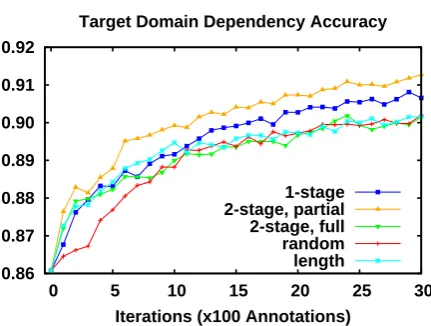
Figure 2: Newspaper (NKN) domain learning curves.
a necessary but not sufficient condition for an ef-fective strategy. Because we assume that Japanese is a head-final language and heads always occur to the right of their dependents, for all strategies the last word in each sentence skipped. For 1-stage and 2-1-stage, we also skipped the second-to-last word in each sentence.
In addition to the 1-stage and 2-stage meth-ods, we also tested two simple baselines. The strategyrandom simply selects words randomly from the pool. The length strategy simply chooses words with the longest possible depen-dency length4. This strategy reflects our intuition
that long-distance dependencies are more difficult and thus more informative.
We use the dictionary example sentences (see Table 2) as the initial training set and performed thirty iterations of active learning. In each itera-tion, we select a batch of one hundred target do-main dependency annotations, retrain the model, and then measure its in-domain accuracy.
4This is the same as selecting dependencies with the
[image:5.595.309.525.218.381.2]Figure 2 shows the results for the newspaper domain. The accuracy of the random strategy in-creases slowly and peaks at just over 90.5%. For the first ten iterations the length strategy delivers an improvement over random, but performs essen-tially the same after that. This is probably be-cause newspaper sentences are on average longer than dictionary examples (see Table 2), so at first words with the potential for longer dependencies are slightly more informative. However, this strat-egy is focused only on the training data and does not reflect the continuous updates of the model, and it soon begins to falter.
The 2-stage partial strategy dominates all other methods, though 1-stage reaches the same level after thirty-five iterations. Its peak accuracy is slightly higher than 91%, and it outperforms the best accuracy achieved by random after just sev-enteen iterations. In contrast, 2-stage full performs consistently worse than the partial annotation ver-sion, with behavior similar to length. While the 1-stage strategy always outperforms the random one, it lags behind 2-stage partial.
5.2 Annotation Pool Size
From Table 2, we can see that the size of the an-notation pool for the newspaper domain is ten to twenty times as large as the ones for the other do-mains. The total number of dependencies selected is 3k, which is only 1.2% of the newspaper pool. Because the 2-stage strategy chooses some depen-dencies with lower entropy over competing ones with higher entropy from other sentences in the pool, we expect its accuracy to suffer when a much larger fraction of the pool is selected.
To investigate this effect, we created a smaller pool from NKN-train that is closer in size to the ones from the other domains. We used the first 12,165 dependencies for this smaller pool. The re-sults are shown in Figure 3. It can be seen that 2-stage partial’s lead over the 1-stage strategy has been eliminated. After seventeen rounds of an-notation the 1-stage strategy begins to outperform the 2-stage strategy. The 2-stage partial strategy still dominates the 2-stage full strategy. This con-firms our intuition that the relative performance of strategies is influenced by the size of the annota-tion pool. In general we expect the number of in-formative dependencies to increase as the pool size increases. Comparing these results with the results for the newspaper domain in Figure 2, we see that
0.86 0.87 0.88 0.89 0.90 0.91 0.92
0 5 10 15 20 25 30 Iterations (x100 Annotations)
Target Domain Dependency Accuracy
1-stage 2-stage, partial 2-stage, full
Figure 3: Newspaper (NKN) domain accuracy with a small annotation pool.
the 1-stage strategy is robust to changes in the pool size, but the 2-stage partial can outperform it for a very large pool.
5.3 Time Required for Annotation
Simulation experiments are still common when using active learning because the cost of annota-tion is very high. However, recently there is in-creased interest in measuring the true costs of an-notation work when doing active learning (Settles et al., 2008). For a more realistic evaluation of active learning for parsing, we also measured an-notation time for the 2-stage strategy. We trained a model on EHJ-train plus NKN-train and used this model and the 2-stage strategy to select de-pendencies to be annotated by a human annota-tor. The pool is 747 blog sentences5from the
Bal-anced Corpus of Contemporary Written Japanese (Maekawa, 2008). We selected 2k dependencies in a single iteration so the annotator did not need to wait while the model was retrained after each batch of annotations. While real annotation times are not constant, this simplification is justified be-cause we expect the annotation strategy (partial or full) to have a larger effect on the overall annota-tion speed than the dependencies that are selected. A single annotator performed annotations for one hour each using the 2-stage strategy with both partial annotation and full annotation, alternating strategies every fifteen minutes. Sentences with more than forty words were not presented to the annotator. Table 3 shows the total number of de-pendencies annotated after each time period. After
5This data was taken from the Yahoo! Blog (OY)
0.86 0.87 0.88 0.89 0.90 0.91 0.92
0 0.5 1 1.5 2 2.5 3 Estimated Annotation Time (Hours) Target Domain Dependency Accuracy
[image:7.595.74.290.69.228.2]2-stage, partial 2-stage, full
Figure 4: Estimated annotation time for the news-paper (NKN) domain.
method 0.25 [h] 0.5 [h] 0.75 [h] 1.0 [h]
partial 226 458 710 1056
full 141 402 756 1018
Table 3: Annotation times for 2-stage methods.
the first fifteen minutes, the annotator completed 226 annotations compared with 141 for full anno-tation, an increase of about 60%. However, as time progresses the difference becomes smaller, and af-ter one hour the number of annotations was almost identical for both strategies.
From Table 3, we can see that the annotation speed reaches a maximum of about 350 anno-tations per fifteen minutes in the full annotation case, or 1.4k dependencies per hour. We expected more annotations to be completed when full anno-tation was used, because sentences have many triv-ial dependencies. However, the annotator reported that it was frustrating to check the annotation stan-dard and how it handled subtle linguistic phenom-ena. Most of this work can be skipped when using partial annotation because the annotator was al-lowed to delete the estimated heads, so the annota-tion speeds ended up being almost identical. This result shows the importance of accurately model-ing the annotation costs in active learnmodel-ing.
For both methods, the average speed is around 1k dependencies per hour. We used these speeds to estimate the rate of annotation for the experi-ments from Section 5.1. While this is not entirely realistic because speeds are likely to vary across domains, it is sufficient for comparing the relative performance of strategies in the same domain. The results are shown in Figure 4. We can see that
ac-0.88 0.89 0.90 0.91 0.92 0.93
0 5 10 15 20 25 30 Iterations (x100 Annotations)
Target Domain Dep. Accuracy
[image:7.595.305.526.71.228.2]1-stage 2-stage, partial 2-stage, full random length
Figure 5: Journal (JNL) domain learning curves.
0.83 0.84 0.85 0.86 0.87 0.88 0.89 0.90 0.91 0.92 0.93
0 5 10 15 20 25 30 Iterations (x100 Annotations)
Target Domain Dep. Accuracy
1-stage 2-stage, partial 2-stage, full random length
Figure 6: Patent (NPT) domain learning curves.
curacy improves faster for partial than it does for full, and the difference becomes pronounced after about half an hour of annotation work. In sum-mary, partial annotation is more efficient and thus delivers a greater return on investment than full an-notation for the proposed query strategy.
5.4 Results for Additional Domains
[image:7.595.309.524.273.433.2]0.88 0.89 0.90 0.91 0.92 0.93
0 0.5 1 1.5 2 2.5 3 Estimated Annotation Time (Hours) Target Domain Dependency Accuracy
[image:8.595.76.300.69.229.2]2-stage, partial 2-stage, full
Figure 7: Estimated annotation time for the jour-nal (JNL) domain.
domain random full partial
NKN 3,000 – 1,300
JNL 3,000 1,800 900
[image:8.595.205.510.72.230.2]NPT 2,700 – 1,500
Table 4: Reduction in in-domain data.
newspaper domain, in the patent domain the per-formance of 2-stage with full annotation is better than random for the first few iterations but soon becomes similar. This is not true in the journal do-main, where this strategy consistently beats ran-dom. The length strategy edges out random for a few iterations in both domains, but ultimately their performance is similar.
Table 4 shows the number of annotations needed for the highest accuracy by the random baseline in the second column, while the next two show the number of annotations needed for the full and partial versions of 2-stage to outperform it. Thus, smaller numbers are better. Compared to the random strategy, 2-stage full had mixed re-sults. In the journal abstract domain (JNL), it out-performed the random baseline while using only 60% of the amount of labeled data. However, it failed to outperform random selection in the other two domains. In contrast, 2-stage partial consis-tently outperforms random with only 45% to 55% of the labeled data. In terms of target domain data that must be prepared, it is clear that 2-stage par-tial offers large savings compared to random. It also does so more consistently and with less data than 2-stage full.
We also plotted the results for these domains in terms of estimated annotation time as we did
0.83 0.84 0.85 0.86 0.87 0.88 0.89 0.90 0.91 0.92
0 0.5 1 1.5 2 2.5 3 Estimated Annotation Time (Hours) Target Domain Dependency Accuracy
2-stage, partial 2-stage, full
Figure 8: Estimated annotation time for the patent (NPT) domain.
in Section 5.3. Figure 7 shows the results for the journal domain and Figure 8 shows the results for the patent domain. As before, 2-stage full is more efficient than 2-stage partial. In these domains, partial dominates full after about one hour of an-notation work. The gap between them is largest for the patent domain and smallest for the journal domain.
6 Conclusions
We combined partial annotation with active learn-ing to adapt a Japanese dependency parser to new domains, and showed that active learning is not limited to single-domain settings. We showed that an entropy-based query strategy can successfully identify units smaller than sentences, and that par-tial annotation can be successfully applied to ac-tive learning of structured prediction tasks like parsing. This strategy reduced the amount of in-domain training data needed for in-domain adapta-tion by up to 75%. We also investigated how the overall size of the annotation pool affects the per-formance of the query strategy, and found that the proposed method performs best for large annota-tion pools.
[image:8.595.96.267.284.342.2]Acknowledgments
This work was supported by JSPS Grants-in-Aid for Scientific Research Grant Numbers 26280084 and 26540190, NTT agreement dated 06/19/2015, and Basic Research on Corpus Annotation project of The National Institute for Japanese Language and Linguistics. We are also grateful to the an-notators for their contribution to the design of the annotation guidelines and their efforts in following them.
References
Daniel Flannery, Yusuke Miayo, Graham Neubig, and Shinsuke Mori. 2011. Training dependency parsers
from partially annotated corpora. InProceedings of
the Fifth International Joint Conference on Natural Language Processing, Chiang Mai, Thailand.
Isao Goto, Bin Lu, Ka Po Chow, Eiichiro Sumita, and Benjamin K. Tsou. 2011. Overview of the patent machine translation task at the NTCIR-9
work-shop. InProceedings of NTCIR-9 Workshop
Meet-ing, pages 559–578.
R. Hwa. 2004. Sample selection for statistical parsing.
Computational Linguistics, 30(3).
D. Lewis and W. Gale. 1994. A sequential algorithm
for training text classifiers. In Proceedings of the
17th annual ACM SIGIR conference on research and development in information retrieval.
Kikuo Maekawa. 2008. Balanced corpus of
contem-porary written Japanese. InProceedings of the 6th
Workshop on Asian Language Resources.
Ryan McDonald and Joakim Nivre. 2011. Analyzing
and integrating dependency parsers. Computational
Linguistics, 37(4):197–230.
Ryan McDonald and Fernando Pereira. 2006. Online Learning of Approximate Dependency Parsing
Al-gorithms. InProceedings of the Eleventh European
Chapter of the Association for Computational Lin-guistics, volume 6.
Ryan McDonald, Fernando Pereira, Kiril Ribarov, and Jan Hajiˇc. 2005. Non-projective dependency
pars-ing uspars-ing spannpars-ing tree algorithms. In
Proceed-ings of Human Language Technology Conference and Conference on Empirical Methods in Natural Language Processing, pages 523–530.
Seyed Abolghasem Mirroshandel and Alexis Nasr. 2011. Active learning for dependency parsing
us-ing partially annotated sentences. InProceedings of
the 12th International Conference on Parsing Tech-nologies, Dublin, Ireland.
Shinsuke Mori, Hideki Ogura, and Tetsuro Sasada. 2014. A Japanese word dependency corpus. In
Proceedings of the Nineth International Conference on Language Resources and Evaluation, pages 753– 758.
Graham Neubig, Yosuke Nakata, and Shinsuke Mori. 2011. Pointwise prediction for robust, adaptable
Japanese morphological analysis. InProceedings of
the 49th Annual Meeting of the Association for Com-putational Linguistics.
Joakim Nivre, Johan Hall, and Jens Nilsson. 2006. Maltparser: A data-driven parser-generator for
de-pendency parsing. In Proceedings of the Fifth
In-ternational Conference on Language Resources and Evaluation.
F. Olsson. 2009. A literature survey of active machine learning in the context of natural language process-ing. Technical Report T2009:06, Swedish Institute of Computer Science.
Manabu Sassano and Sadao Kurohashi. 2010. Using smaller constituents rather than sentences in active
learning for Japanese dependency parsing. In
Pro-ceedings of the 48th Annual Meeting of the Associa-tion for ComputaAssocia-tional Linguistics.
B. Settles, M. Craven, and L. Friedland. 2008. Active
learning with real annotation costs. InProceedings
of the NIPS Workshop on Cost-Sensitive Learning. Kathrin Spreyer, Lilja Øvrelid, and Jonas Kuhn. 2010.
Training parsers on partial trees: a cross-language
comparison. InProceedings of the Seventh
Interna-tional Conference on Language Resources and Eval-uation.
Min Tang, Xiaoqiang Luo, and Salim Roukos. 2002. Active learning for statistical natural language
pars-ing. InProceedings of the 40th Annual Meeting of