An extended dependency graph for relation extraction in biomedical texts
Yifan Peng1 Samir Gupta1 Cathy H. Wu1,2 K. Vijay-Shanker1
1Department of Computer Information & Sciences
2Center for Bioinformatics and Computational Biology
University of Delaware Newark, DE 19716
{yfpeng,sgupta,wuc,vijay}@udel.edu
Abstract
Kernel-based methods are widely used for relation extraction task and obtain good results by leveraging lexical and syntac-tic information. However, in biomedi-cal domain these methods are limited by the size of dataset and have difficulty in coping with variations in text. To ad-dress this problem, we propose Extended Dependency Graph (EDG) by incorporat-ing a few simple lincorporat-inguistic ideas and in-clude information beyond syntax. We be-lieve the use of EDG will enable machine learning methods to generalize more eas-ily. Experiments confirm that EDG pro-vides up to 10% f-value improvement over dependency graph using mainstream ker-nel methods over five corpora. We con-ducted additional experiments to provide a more detailed analysis of the contribu-tions of individual modules in EDG con-struction.
1 Introduction
With growing amount of biomedical information available in textual form, there has been consid-erable interest in applying NLP techniques and machine-learning (ML) methods to biomedical literature. Some of these projects involve ex-tracting relations such as protein-protein interac-tion (Krallinger et al., 2008).
In biomedical domain, most relation extraction work is currently applied on the abstracts of arti-cles. These abstracts by nature are dense with in-formation and often use constructions such as ap-positives and relative clauses. The abundance of textual variations can thus be problematic for ML systems, especially with small training corpora.
One solution to this issue is to find a suitable level of abstraction in the text representation so
that ML methods become easier to generalize. Use of syntax and parse information provides one such abstraction. Using syntactic dependency informa-tion has become prevalent in biomedical relainforma-tion extraction. It has been suggested dependency links are close to the semantic relationship needed for the next stage of interpretation (Covington, 2001).
There have been significant advances in the de-velopment of advanced machine learning and ker-nel methods and the use of sophisticated parame-ter tuning in the biomedical domain. In this work, we focus on the representation of the text used in learning rather than the machine learning tech-nique, with the hope that advances in both direc-tions will be improve the performance of the re-lation extraction systems. In this paper we pro-pose Extended Dependency Graph (EDG), which includes information about text that goes beyond syntax. We will define EDG and discuss how we construct it from a given sentence by using some simple linguistic notions.
The hypothesis we test here is that EDG allows ML techniques to generalize more easily. To de-termine the effect of EDG, we conducted experi-ments on protein-protein interaction (PPI) extrac-tion. For this purpose, we used two kernels: a simple kernel based on edit distance (Erkan et al., 2007) and a more elaborate kernel that is one of the top performing kernels on the PPI task (Airola et al., 2008). We compared the performance of both kernels using dependency graph and EDG on 5 corpora. Our results suggest EDG provides up to 10% f-value improvement over dependency graph. On 3 out of 5 corpora the results are better than the overall best system in the study of (Tikk et al., 2010), as well as an ensemble method that builds on them (Miwa et al., 2009a). We also evaluate the contributions of the individual components in-cluded in EDG.
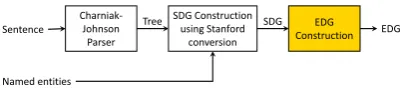
Charniak-Johnson Parser
SDG Construction using Stanford
conversion
EDG Construction Sentence
Named entities
EDG
[image:2.595.80.282.65.109.2]Tree SDG
Figure 1: Framework.
2 Related work
Many kernel-based relation extraction systems have employed lexical and syntactic informa-tion (Bunescu and Mooney, 2005; Zhou et al., 2007; Ning and Qi, 2011). There has been a growth in the use of more complex kernels and so-phisticated parameter tuning methods to improve the results (Zhang et al., 2006; Choi and Myaeng, 2010). In PPI task, machine learning methods using rich feature vectors (Miwa et al., 2009b), edit distance kernel (Erkan et al., 2007), depen-dency tree kernel (Chowdhury et al., 2011), all-path graph kernel (Airola et al., 2008), or their combination and variations (Miwa et al., 2009a; Zhang et al., 2012) have been proposed.
Our focus is on improving the representation of information in natural texts, rather than on devel-oping new kernels. There have been several at-tempts to leverage syntax and shallow semantic argument structure (Miwa et al., 2010; Van Lan-deghem et al., 2010; Van LanLan-deghem et al., 2012; Liu et al., 2013; Oepen et al., 2014; Peng et al., 2014; Nguyen et al., 2015). Though the focus of these works was not to utilize the information with machine learning methods, they offer insight on utility of information beyond syntax. We develop the EDG approach for relation extraction based on these ideas.
3 Method
Figure 1 illustrates the overall architecture with the core component highlighted: EDG construc-tion. The input is a sentence with named enti-ties marked. We use Charniak-Johnson parser and Stanford conversion tool to get the basic syntactic dependency graph (SDG). Our approach focuses on how to leverage simple linguistic principles and information beyond syntax to construct EDG from SDG.
3.1 Extended dependency graph (EDG)
In this paper, we use EDG to represent the struc-ture of the sentence. Like in the case of many dependency graph representations used in relation
extraction, the vertices in a EDG are labelled with information such as the text, part-of-speech, and the word lemma. If an entity mention spans mul-tiple tokens in a sentence, we merge their corre-sponding vertices (called contracting vertices) into one vertex.
EDG has two types of dependencies. The syn-tactic dependencies that are obtained from col-lapsed dependencies output by applying Stan-ford dependencies converter on a syntactic pars-ing tree (De Marneffe and Mannpars-ing, 2008). The other type of dependencies are the numbered argu-ments based on the guidelines of PropBank (Bo-nial et al., 2012). Because we are currently fo-cusing on binary relation extraction, we use only
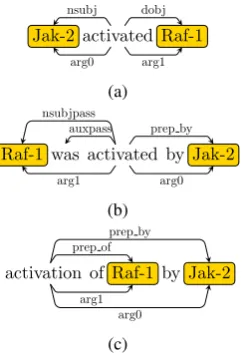
arg0andarg1(probably better stated as not-arg0) in EDG. Figure 2 shows EDGs of three text frag-ments with syntactic edges appearing above the words and numbered argument edges appearing below. From a relation extraction perspective, the syntactic dependencies in Figure 2 are less rele-vant but their numbered arguments between two entity mentions are same.
There are two motivations for using numbered arguments. One is to “provide consistent argument labels across different syntactic realizations of the same verb” (Bonial et al., 2012) with the intention of making generalizations easier downstream. The other is to add/propagate newarg0andarg1using reasoning that goes beyond syntax.
Following these two motivations, we will first discuss how to capture arg0 and arg1 using dif-ferent syntactic dependencies obtained from Stan-ford dependencies. Then we will describe rela-tions such as is-a, member-collection, and part-wholeand how to propagatearg0andarg1using them.
3.2 Syntax basedarg0andarg1
We follow approaches of SemRep (Rinaldi et al., 2006) and PASMED (Nguyen et al., 2015) to ob-tain the basic edgesarg0andarg1from the syntac-tic dependencies. For example, EDG will include anarg0from a verb to the noun if the syntactic de-pendency isnsubjoragentand include anarg1if the dependency isnsubjpassordobj.
Jak-2 activated Raf-1
nsubj dobj
arg0 arg1 (a)
Raf-1 was activated by Jak-2
auxpass prep by nsubjpass
arg1 arg0 (b)
activation of Raf-1 by Jak-2
prep of prep by
[image:3.595.122.244.62.239.2]arg1 arg0 (c)
Figure 2: Sample EDGs with an active (a), passive (b), or normalized (c) verb.
the retinoblastoma binding protein , RBP1
nn
nn appos
arg0 arg1
[image:3.595.309.519.63.156.2]arg1 (propagation)
Figure 3: A sample compound noun phrase.
“retinoblastoma binds to protein, RBP1”. There-fore, we addarg1from “binding” to “protein” in Figure 3. This operation will introduce cyclicity because the gerund is included in the noun phrase headed by “protein”. We posit that these edges are useful when found in combination with other construction, such as appositive. We will discuss how to propagatearg1from the gerund “binding” to “RBP1” later.
Next we consider two cases of argument elision.
Elided argument relation Here we con-sider cases when the argument of a predicate is not explicit but implicit. Figure 4 shows a sen-tence where arg0(interaction, Presenilin 1) can be inferred. The SDG includes a prep via from the first verb “suppresses” to the nominalized verb “interaction”, to indicate the PP attachment to the verb. In this case, we add an edge arg0 from the nominalized verb to thearg0-argument of the first verb. In constructing EDG, we also consider
prep through as well as prep by when a gerund verb, rather than a nominalized verb, follows it.
Reduced relative clauses Relative clause is a clause that modifies a noun phrase. There are two types of relative clauses that frequently ap-pear in biomedical text. Full relative clauses are introduced by relative pronouns, such as “which”
serine/threonine kinase that is phosphorylated by Pto nsubjpass
auxpass agent
arg1 arg0
(a) A sample full relative clause.
a Ca(2+)-binding protein phosphorylated by protein kinase A
vmod prep by
arg1 arg0
(b) A sample reduced relative clause.
Figure 5: Sample relative clauses.
and “that”. Reduced relative clauses start with a gerund or past participle and have no overt sub-ject.
The PropBank annotation guidelines (Bonial et al., 2012) posit a numbered argument link from the relative clause verb to the trace in the parse tree which also indicates the referent noun phrase. For full relative clauses, we follow the normal pro-cedure for verbs (Figure 5a). For reduced rela-tive clauses, since we use the dependency struc-ture that includes no traces, we use the edgevmod
in the SDG from the head of the noun phrase to the reduced relative clause’s verb (Figure 5b). The direction of this edge indicates that the relative clause is syntactically included in the larger noun phrase. For the arg edge, we reverse the direc-tion ofvmodand create an edge from the relative clause’s verb, as shown in Figure 5b. When com-pared to Figure 5a, theargconstruction unifies the treatment for full relative clauses.
Notice that although in both cases, the arg1is not an incident on named entities, it might still lead to the named entity through the propagation of edges as discussed in the next subsection.
3.3 Going Beyond Syntax
Here we consider the propagation ofargusing in-formation that goes beyond syntax.
Co-reference If an edge arg from a vertex
vreaches a pronominal node, we add a new edge
arg from v to any named entity the pronoun co-refers to. To detect the coreference we use the implementation of the technique described in (Qiu et al., 2004). For the acronyms with long-form and short-form, we treat them in the same way as coreference. We add extra edge arg when there is an arg incident on the long-form. We use the acronym detector of (Schwartz and Hearst, 2003) to add acronyms missed in SDG. Interestingly, SDG usesapposfor both acronym and appositive.
[image:3.595.86.281.294.347.2]Presenilin 1 suppresses the function of c-Jun homodimers via interaction with QM/Jif-1
nsubj
dobj
det nn
prep of prep via
prep with
arg0
arg0 (elided)
arg1 arg1
Figure 4: A sample elided argument relation.
HOX11 is a cellular oncogene that targets· · ·
amod det cop nsubj
nsubj rcmod
is-a arg0
arg0 (propagation)
Figure 6: A sampleis-arelation.
retinoblastoma binding protein, RBP1” in Fig-ure 3. Using the construction discussed thus far, thearg1will reach “protein”. Further, SDG uses an edgeappos from “protein” to “RBP1” for ap-positional modifier. We integratearg1 andappos
to construct another edgearg1from “binding” to the actual named entity “RBP1”.
Is-A In addition to appositive, we consider other forms of is-a relation mentioned textually, but cannot be directly found from the syntactic dependences. For example, in Figure 6, there is no edge in SDG to explicitly capture theis-a re-lation. It is worth noting that the edge nsubj it-self does not indicate theis-arelation, but together with two other edgescopanddet, we can figure it out. Hence we add a new edge from “oncogene” to “HOX11” to reflect this relation in EDG (dotted edge). Afterwards, we propagatearg0 from “tar-gets” to “HOX11”.
Besides the pattern shown in Figure 6, we also identify “known as”, “designated as”, “considered as”, “identified as” and “act as” as patterns that signal is-a relations. These patterns contain and extend rules in (Snow et al., 2005; Hearst, 1992).
Member-collection links a generic reference (called collection) to a group of entity mentions (called members). Like in Figure 7, typical key words that can identify member-collection rela-tions are “including” and “such as”. We consider the cases where mention group follows the key-words and the generic reference precedes these words. After the detection, we propagateargfrom the collection to its members.
Part-whole links an entity part to its mention, typically denoting construction of larger entities out of smaller ones. Just like “breaking the glass
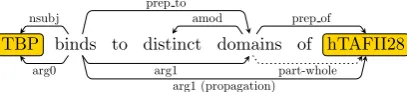
TBP binds to distinct domains of hTAFII28
nsubj
prep to
amod prep of
[image:4.595.312.516.167.213.2]arg0 arg1 part-whole arg1 (propagation)
Figure 8: A samplepart-wholerelation.
of the window” can be stated as “breaking the win-dow”, in biomedical tasks an action on a larger unit can often be inferred from a mention of the action applied on its part. That is, in Figure 8, af-ter we detect a part-wholerelation, an edgearg1
incident on the part is propagated to the object that contains it.
In this paper, we focus on three types of pat-terns to recognizepart-whole relations. The first is the preposition phrase such as “domain of e”. Here “domain” indicates the part ande indicates the larger entity mention the “domain” belongs to. Other keywords indicating parts include “frag-ment”, “portion”, and “region”. The second struc-tural elements is a compound nominal like “e do-main”. The third group exploits keywords such as “contain”, “consist”, and “compose”. For each
part-wholerelation, we propagate edges from the part to its entity mention.
4 Experiments
We evaluated our method on proteprotein in-teraction (PPI) extraction task, where the system identifies whether a given protein pair in a sen-tence has PPI relationship or not. We used SDG or EDG as input representation of the sentences, which includes the named protein entities.
4.1 Kernels
We tested the effect of using EDG on two kernels that have been employed for PPI extraction.
Cdi1 interacts with cyclin-dependent kinases , including human Cdc2 , Cdk2 , and Cdk3
nsubj amod
prep with prep including prep including
prep including
amod conj and conj and
arg0 arg1 member-collection member-collection
member-collection arg1 (propagation)
[image:5.595.96.502.65.166.2]arg1 (propagation) arg1 (propagation)
Figure 7: A samplemember-collectionrelation.
2007), this number is normalized by the length of the longer path and converted into a similarity measure.
sime(p1, p2) =e−γeditdist(p1,p2) (1)
When comparing two shortest paths, we consid-ered the word lemma and the edge labels . We also renamed the candidate pair in the sentence as “E1” and “E2” and the remaining proteins provided in the annotation as “EX”. For example, the follow-ing are the shortest paths of Figure 2a, 3, and 8.
(a) E1←arg0←activate→arg1→E2 (b) E1←arg0←bind→arg1→E2 (c) E1←arg0←bind→arg1→E2
Therefore, the edit distance between (a) and (b) is 1 because the predicate verbs are different. The distance between (b) and (c) is 0. It shows the generalizability of using EDG.
All-paths graph kernel is a practical instanti-ation of a graph kernel framework (G¨artner et al., 2003). It counts weighted shared paths of all pos-sible lengths in a graph (Airola et al., 2008). All-paths graph kernel uses two graph representations: (1) a dependency graph where all edges on the shortest paths between the candidate pair receive a weight of 0.9 and other edges receive a weight of 0.3; and (2) a linear graph where each word node is connected by an edge to its succeeding word node with weight 0.9.
We used word (not lemma) and edge labels to compute the all-paths graph kernel. Sim-ilar to the case with the edit distance ker-nel, we replaced the protein names in a sen-tence with “E1”, “E2” and “EX”. We use the APG software (http://mars.cs.utu.fi/
PPICorpora/GraphKernel.html) to train
and test the kernel. The software uses sparse reg-ularized least squares method instead of SVM.
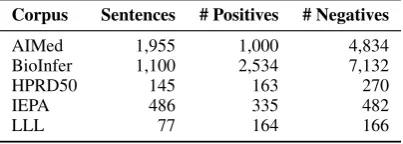
Table 1: Basic statistics of the corpora.
Corpus Sentences # Positives # Negatives
AIMed 1,955 1,000 4,834
BioInfer 1,100 2,534 7,132
HPRD50 145 163 270
IEPA 486 335 482
LLL 77 164 166
4.2 Experimental setup
We evaluated our method on five PPI cor-pora that have been used in the community: AIMed (Bunescu et al., 2005), BioInfer (Pyysalo et al., 2007), HPRD50 (Fundel et al., 2007), IEPA (Ding et al., 2002), and LLL (N´edellec, 2005). These corpora have different sizes (Ta-ble 1) and vary slightly in their definition of PPI (Pyysalo et al., 2008).
(Tikk et al., 2010) conducted a compari-son of a variety of PPI extraction systems on these corpora (http://mars.cs.utu.fi/
PPICorpora). We used the same
experimen-tal setup to evaluate our methods: self-interactions were excluded from the corpora and 10-fold document-level cross-validation is used for eval-uation.
For our experiments, we used the Charniak-Johnson parser (Charniak and Charniak-Johnson, 2005) and the Stanford conversion tool with “Collapsed” set-ting to obtain SDG (De Marneffe and Manning, 2008). The edit distance kernel was trained with LIBSVM (Chang and Lin, 2011). The APG ker-nel was trained with APG software.
Both these kernels have several parameters, whose settings can influence the performance. In this paper, we did not perform exhaustive system-atic parameter search and optimization. We be-lieve such parameter tuning techniques might lead to further improvements.
[image:5.595.316.518.238.310.2]the value used in the original application of edit kernel on these corpora (Erkan et al., 2007). We set c in SVM to 10, which was the average best value used in (Tikk et al., 2010). For the APG ker-nel, we used the default settings of implementation of (Airola et al., 2008) which uses a grid parame-ter search for each iparame-teration of the 10-fold cross validation. The parameter search selects the best setting based on a random set of 1,000 samples from the training sets (9 folds). If there are less than 1,000 samples, the software used the whole training set. Note that the test sets (the remaining fold) were not used for the parameter tuning.
4.3 Results
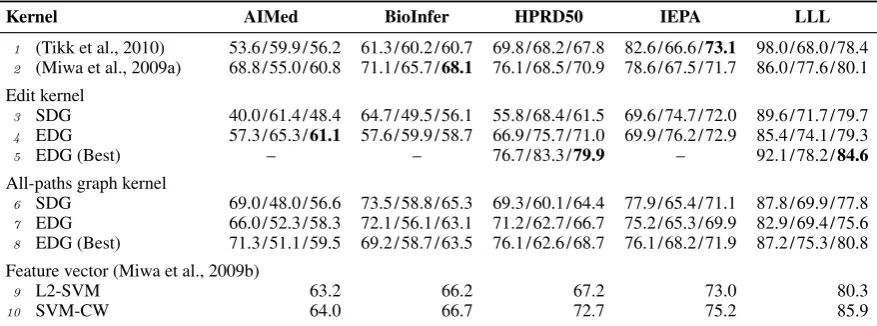
Performance, as measured by precision, recall, and F-value, is shown in Table 2. To provide con-text, we also include the results published in (Tikk et al., 2010) and (Miwa et al., 2009a). The first reports the results of the APG kernel (Airola et al., 2008) that was found to be a leading performer on these 5 corpora in the study reported in (Tikk et al., 2010). The second set of results is those of an ensemble method that combines different systems. Although we are using the same corpora in the study of (Tikk et al., 2010), and the same imple-mentation of the APG kernel, the results in Row 1 and Row 6 in the table are not the same. The dif-ferences are possibly due to the fact that different parsers were used and how parameters were cho-sen. However, we want to emphasize that all our own measurements (e.g., in Rows 3-5 or Rows 6-8) are directly comparable to each other because the same parameter settings were used for each corpus.
The first part of Table 2 shows results us-ing the edit distance kernel with original depen-dency graph (Row 3), and with the complete EDG (Row 4). We also experimented with different configurations of EDG by dropping one of the extra edge types added in EDG. The results ob-tained by the best configuration are reported in Row 5. On three of the corpora, the best results are obtained by using the full EDG. However, bet-ter results were obtained on HPRD50, when the
member-collectionrelations were not included and on LLL, when theis-arelations were not included. In the next subsection we will address why these relations were not included.
Overall, comparing Rows 3 and 4, we obtain F-value improvements using EDG over using SDG
on 4 corpora (except LLL), with around 10% gains on AIMed and HPRD50 and noticeable gain in re-call. For 3 of the corpora (AIMed, HPRD50 and IEPA), there is an increase in both precision and recall. For BioInfer, the gain in precision slightly exceeds the loss in recall whereas in LLL the gain in precision is slightly lower than the loss in re-call. When Row 5 is used for comparison, we ob-tain an improvement in F-value for all 5 corpora with improvement in recision and recall in 4 cor-pora (BioInfer being the exception). We now see over 18% F-value improvement on HPRD50.
Despite weak performance of the edit kernel us-ing the baseline SDG, the performance of this ker-nel with full EDG is close to or exceeds the results of the leading PPI systems using kernel methods (Rows 1 and 2) on 4 corpora and exceeds them on these 4 corpora when results of Row 5 is consid-ered.
The second part of Table 2 (Rows 6–8) shows results using the APG kernel. The EDG (Best) in Row 8 is achieved on AIMed, BioInfer and LLL by dropping theis-arelation and on HPRD50 by not including themember-collectionrelations. We see F-value gains on 4 corpora through the use of EDG.
Comparing the results on the edit distance and APG kernels, we find that the more complex APG kernel (the best one overall in (Tikk et al., 2010) study) gets generally better results than Edit kernel using the baseline SDG. However, the use of EDG not only closes the gap between the kernels but in fact, edit kernel with EDG obtains higher F-value than APG with SDG or EDG in 4 of the 5 corpora. To provide the comparision with non-kernel methods, we also include the results published in (Miwa et al., 2009b), which is the state-of-the-art system on the five corpora. This paper develops several systems that use a rich feature vector, com-bining analysis from different parsers and the val-ues obtained from multiple kernels including the APG’s score. L2-SVM and SVM-CW are among the leading SVM-based systems proposed in this paper.
Table 2: Evaluation results. Performance is reported in terms of Recall/Precision/F-value.
Kernel AIMed BioInfer HPRD50 IEPA LLL
1 (Tikk et al., 2010) 53.6/59.9/56.2 61.3/60.2/60.7 69.8/68.2/67.8 82.6/66.6/73.1 98.0/68.0/78.4 2 (Miwa et al., 2009a) 68.8/55.0/60.8 71.1/65.7/68.1 76.1/68.5/70.9 78.6/67.5/71.7 86.0/77.6/80.1
Edit kernel
3 SDG 40.0/61.4/48.4 64.7/49.5/56.1 55.8/68.4/61.5 69.6/74.7/72.0 89.6/71.7/79.7 4 EDG 57.3/65.3/61.1 57.6/59.9/58.7 66.9/75.7/71.0 69.9/76.2/72.9 85.4/74.1/79.3
5 EDG (Best) – – 76.7/83.3/79.9 – 92.1/78.2/84.6
All-paths graph kernel
6 SDG 69.0/48.0/56.6 73.5/58.8/65.3 69.3/60.1/64.4 77.9/65.4/71.1 87.8/69.9/77.8 7 EDG 66.0/52.3/58.3 72.1/56.1/63.1 71.2/62.7/66.7 75.2/65.3/69.9 82.9/69.4/75.6 8 EDG (Best) 71.3/51.1/59.5 69.2/58.7/63.5 76.1/62.6/68.7 76.1/68.2/71.9 87.2/75.3/80.8
Feature vector (Miwa et al., 2009b)
9 L2-SVM 63.2 66.2 67.2 73.0 80.3
10 SVM-CW 64.0 66.7 72.7 75.2 85.9
the source corpora) with “goodness” for training on the target corpus, adjusting the effect of their compatibility and incompatibility (Miwa et al., 2009b). Thus, their results are not directly com-parable with our results. However we obtain im-provements using edit kernel with EDG (Best) on HPRD50.
4.4 Contribution of individual relation
Table 3 compares the effects of different tech-niques in EDG on five corpora using the edit dis-tance kernel. We first evaluated SDG obtained from the Stanford conversion tool with “CCPro-cessed” setting (Row 2) for processing conjunc-tions, and next added only syntax basedarg0and
arg1 (Row 3). After that, we added in succes-sion referential links (including coreference, ap-positive, and is-a), member-collection, and part-whole detection in the EDG construction step by step (Row 4–6). Overall, using “CCProcessed” increases the F-values on all five corpora. EDG constructed using syntax basedargachieves addi-tional increases on 4 out of 5 corpora (exception was IEPA). Every subsequent step generally pro-vides more improvements on F-values. However, we observed that on HPRD50,member-collection
decreased F-value. Therefore we tried to switch off this part in the EDG construction but included the rest of the relations and achieved a higher F-value of 79.9% on this corpus (Row 7). This cor-responds to the same result we displayed in Row 5 (EDG Best) in Table 2. On the LLL corpus, as components were successively added, we no-ticed a drop in F-value when referential linking was added. So similarly by turning offis-a detec-tion and including all other EDG edges enabled us
to obtain the EDG best F-value of 84.6% on LLL. We also identified that is-adecreased F-values on IEPA, however no further improvement could be made by switching it off. We plan to further analyze this result in the future.
Additionally, due to the gap in the performance between our system and (Miwa et al., 2009a) on BioInfer, we analyzed the error cases and noticed several cases similar to the following example. The candidate pair of named enitites are marked in bold.
• This process involves other actin-binding proteins, such ascofilinand coronin.
Using techniques as shown in Figure 3, we can create arg0 (binding, actin) and arg1 (bind-ing, proteins) in EDG and also detect member-collection relation between “actin-binding pro-teins” and “cofilin”. With propogation, an inter-action between “actin” and “cofilin” can be pre-dicted. However, this relation is annotated as a negative, but instead the annotation in BioInfer in-cludes a positive relation between “actin-binding proteins” and “cofilin”. Because of similar exam-ples in BioInfer, the member-collection and is-a
and propagation failed to improve the results in BioInfer.
5 Conclusion
Table 3: Contributions of different part in SDG and EDG using edit kernel. Performance is reported in terms of Recall/Precision/F-value.
Kernel AIMed BioInfer HPRD50 IEPA LLL
1 SDG (Collapsed) 40.0/61.4/48.4 64.7/49.5/56.1 55.8/68.4/61.5 69.6/74.7/72.0 89.6/71.7/79.7 2 SDG (CCProcessed) 46.4/58.9/51.9 56.2/57.1/56.6 58.9/67.6/63.0 70.2/74.8/72.4 89.6/73.5/80.8 3 EDG (syntax basedarg) 48.1/61.2/53.9 56.3/58.5/57.4 66.9/73.2/69.9 69.3/74.4/71.7 89.0/74.1/80.9 4 EDG (above, coref, app, isa) 52.2/58.6/55.2 56.7/58.3/57.5 65.6/77.0/70.9 69.0/74.0/71.4 87.2/72.2/79.0 5 EDG (above, mem-coll) 53.2/59.2/56.0 57.1/58.6/57.8 64.4/77.8/70.5 69.6/76.4/72.8 85.4/74.5/79.6 6 EDG (above, part-whole) 57.3/65.3/61.1 57.6/59.9/58.7 66.9/75.7/71.0 69.9/76.2/72.9 85.4/74.1/79.3 7 EDG (Best) 57.3/65.3/61.1 57.6/59.9/58.7 76.7/83.3/79.9 69.9/76.2/72.9 92.1/78.2/84.6
with the edit distance and APG kernels and ap-plied them on 5 different PPI-related datasets. We obtained improvements in F-value by using EDG. We find that despite the simplicity of the edit ker-nel and its weak performance with the baseline graph, results comparable to state-of-the-art sys-tems using kernel methods are obtained on differ-ent corpora with the inclusion of EDG.
While the use of EDG has led to gain in recall as well as precision mostly, the recall drops with BioInfer dataset. We would like to analyze this re-sult further in the future. One of our main motiva-tions for developing EDG is to develop methods to learn with small datasets and whether the abstrac-tion captured in EDG allows for easier generaliza-tion. The testing of learning with small datasets and use in context of active learning will be inves-tigated in the future.
We plan to test the use of EDG on other rela-tion extracrela-tion tasks in the biomedical domain. We also plan to investigate richer features and their combinations in conjunction with the use of EDG.
Acknowledgments
Research reported in this manuscript is supported by the National Science Foundation under Grant No. DBI-1062520.
References
Antti Airola, Sampo Pyysalo, Jari Bj¨orne, Tapio Pahikkala, Filip Ginter, and Tapio Salakoski. 2008. All-paths graph kernel for protein-protein interac-tion extracinterac-tion with evaluainterac-tion of cross-corpus learn-ing. BMC bioinformatics, 9(Suppl 11):S2.
Claire Bonial, Jena Hwang, Julia Bonn, Kathryn Con-ger, Olga Babko-Malaya, and Martha Palmer, 2012.
English PropBank Annotation Guidelines. Cen-ter for Computational Language and Education Re-search Institute of Cognitive Science University of Colorado at Boulder.
Razvan C. Bunescu and Raymond J. Mooney. 2005. A shortest path dependency kernel for relation extrac-tion. InHLT-EMNLP, pages 724–731, Stroudsburg, PA, USA.
Razvan C. Bunescu, Ruifang Ge, Rohit J. Kate, Ed-ward M. Marcotte, Raymond J. Mooney, Arun K. Ramani, and Yuk Wah Wong. 2005. Comparative experiments on learning information extractors for proteins and their interactions. Artificial Intelligence in Medicine, 33(2):139–155.
Chih-Chung Chang and Chih-Jen Lin. 2011. LIB-SVM: A library for support vector machines. ACM Transactions on Intelligent Systems and Technology, 2(27):1–27.
Eugene Charniak and Mark Johnson. 2005. Coarse-to-fine n-best parsing and maxent discriminative reranking. InProceedings of the 43rdAnnual Meet-ing on Association for Computational LMeet-inguistics, pages 173–180. Association for Computational Lin-guistics.
Sung-Pil Choi and Sung-Hyon Myaeng. 2010. Sim-plicity is better: revisiting single kernel ppi extrac-tion. InProceedings of the 23rdInternational Con-ference on Computational Linguistics, pages 206– 214. Association for Computational Linguistics. Faisal Md. Chowdhury, Alberto Lavelli, and
Alessan-dro Moschitti. 2011. A study on dependency tree kernels for automatic extraction of protein-protein interaction. InProceedings of BioNLP 2011 Work-shop, pages 124–133, Portland, Oregon, USA, June. Association for Computational Linguistics.
Michael A. Covington. 2001. A fundamental algo-rithm for dependency parsing. InProceedings of the 39thAnnual ACM Southeast Conference, pages 95–
102.
Marie-Catherine De Marneffe and Christopher D Man-ning. 2008. The stanford typed dependencies rep-resentation. In Coling 2008: Proceedings of the workshop on Cross-Framework and Cross-Domain Parser Evaluation, pages 1–8. Association for Com-putational Linguistics.
sentences, or phrases. InProceedings of the Pacific Symposium on Biocomputing, volume 7, pages 326– 337.
G¨unes Erkan, Arzucan ¨Ozg¨ur, and Dragomir R Radev. 2007. Semi-supervised classification for extract-ing protein interaction sentences usextract-ing dependency parsing. InEMNLP-CoNLL, volume 7, pages 228– 237.
Katrin Fundel, Robert K¨uffner, and Ralf Zimmer. 2007. Relex - relation extraction using dependency parse trees. Bioinformatics, 23(3):365–371.
Thomas G¨artner, Peter Flach, and Stefan Wrobel. 2003. On graph kernels: Hardness results and ef-ficient alternatives. InConference on Learning The-ory, pages 129–143.
Marti A. Hearst. 1992. Automatic acquisition of hy-ponyms from large text corpora. InCOLING, pages 539–545, Stroudsburg, PA, USA. Association for Computational Linguistics.
Martin Krallinger, Florian Leitner, Carlos Rodriguez-Penagos, Alfonso Valencia, et al. 2008. Overview of the protein-protein interaction annotation extrac-tion task of biocreative ii.Genome biology, 9(Suppl 2):S4.
Haibin Liu, Karin Verspoor, Donald C Comeau, An-drew MacKinlay, and W John Wilbur. 2013. Gen-eralizing an approximate subgraph matching-based system to extract events in molecular biology and cancer genetics. In Proceedings of the BioNLP Shared Task 2013 Workshop, pages 76–85.
Makoto Miwa, Rune Sætre, Yusuke Miyao, and Jun’ichi Tsujii. 2009a. Protein-protein interac-tion extracinterac-tion by leveraging multiple kernels and parsers. International Journal of Medical Informat-ics, 78(12):e39–46.
Makoto Miwa, Rune Sætre, Yusuke Miyao, and Jun’ichi Tsujii. 2009b. A rich feature vector for protein-protein interaction extraction from multiple corpora. InProceedings of the 2009 Conference on Empirical Methods in Natural Language Process-ing: Volume 1-Volume 1, pages 121–130. Associa-tion for ComputaAssocia-tional Linguistics.
Makoto Miwa, Rune Sætre, Yusuke Miyao, and Jun’ichi Tsujii. 2010. Entity-focused sentence sim-plification for relation extraction. InProceedings of the 23rdInternational Conference on Computational Linguistics, COLING ’10, pages 788–796, Strouds-burg, PA, USA. Association for Computational Lin-guistics.
Claire N´edellec. 2005. Learning language in logic -genic interaction extraction challenge. In Proceed-ings of the 4th Learning Language in Logic Work-shop, volume 7, pages 31–37.
Nhung TH Nguyen, Makoto Miwa, Yoshimasa Tsu-ruoka, Takashi Chikayama, and Satoshi Tojo. 2015. Wide-coverage relation extraction from medline us-ing deep syntax.BMC bioinformatics, 16(1):107. Xia Ning and Yanjun Qi. 2011. Semi-supervised
con-volution graph kernels for relation extraction. In
SDM, pages 510–521. SIAM.
Stephan Oepen, Marco Kuhlmann, Yusuke Miyao, Daniel Zeman, Dan Flickinger, Jan Hajic, Angelina Ivanova, and Yi Zhang. 2014. Semeval 2014 Task 8: Broad-coverage semantic dependency parsing. In
Proceedings of the 8th International Workshop on Semantic Evaluation (SemEval 2014), pages 63–72. Yifan Peng, Manabu Torii, Cathy H. Wu, and K. Vijay-Shanker. 2014. An NLP framework for fast devel-opment of pattern-based biomedical relation extrac-tion systems. BMC bioinformatics, 15:285.
Sampo Pyysalo, Filip Ginter, Juho Heimonen, Jari Bj¨orne, Jorma Boberg, Jouni J¨arvinen, and Tapio Salakoski. 2007. BioInfer: A corpus for infor-mation extraction in the biomedical domain. BMC bioinformatics, 8(1):50.
Sampo Pyysalo, Antti Airola, Juho Heimonen, Jari Bj¨orne, Filip Ginter, and Tapio Salakoski. 2008. Comparative analysis of five protein-protein interac-tion corpora. BMC bioinformatics, 9(Suppl 3):S6. Long Qiu, Min yen Kan, and Tat seng Chua. 2004. A
public reference implementation of the rap anaphora resolution algorithm. InProceedings of the Fourth International Conference on Language Resources and Evaluation (LREC 2004), pages 291–294. Fabio Rinaldi, Gerold Schneider, Kaarel Kaljurand,
Michael Hess, and Martin Romacker. 2006. An en-vironment for relation mining over richly annotated corpora: the case of genia. BMC bioinformatics, 7(Suppl 3):S3.
A.S. Schwartz and M.A. Hearst. 2003. A simple al-gorithm for identifying abbreviation definitions in biomedical text. InProceedings of the Pacific Sym-posium on Biocomputing, volume 8, pages 451–462. Rion Snow, Daniel Jurafsky, and Andrew Y. Ng. 2005. Learning syntactic patterns for automatic hypernym discovery. InAdvances in Neural Information Pro-cessing Systems 17, pages 1297–1304, Cambridge, MA. MIT Press.
Domonkos Tikk, Philippe Thomas, Peter Palaga, J¨org Hakenberg, and Ulf Leser. 2010. A comprehen-sive benchmark of kernel methods to extract protein-protein interactions from literature. PLoS computa-tional biology, 6(7):e1000837.
Sofie Van Landeghem, Sampo Pyysalo, Tomoko Ohta, and Yves Van de Peer. 2010. Integration of static relations to enhance event extraction from text. In
144–152, Stroudsburg, PA, USA. Association for Computational Linguistics.
Sofie Van Landeghem, Jari Bj¨orne, Thomas Abeel, Bernard De Baets, Tapio Salakoski, and Yves Van de Peer. 2012. Semantically linking molecular enti-ties in literature through entity relationships. BMC bioinformatics, 13(Suppl 11):S6.
Min Zhang, Jie Zhang, Jian Su, and Guodong Zhou. 2006. A composite kernel to extract relations be-tween entities with both flat and structured features. InProceedings of the 21stInternational Conference on Computational Linguistics and the 44th annual meeting of the Association for Computational Lin-guistics, pages 825–832, Stroudsburg, PA, USA. Yijia Zhang, Hongfei Lin, Zhihao Yang, Jian Wang,
and Yanpeng Li. 2012. Hash subgraph pair-wise kernel for protein-protein interaction extrac-tion. IEEE/ACM Transactions on Computational Biology and Bioinformatics (TCBB), 9(4):1190– 1202.