Extending effect annotation with lexical decomposition
Josef Ruppenhofer and Jasper Brandes
Department of Information Science and Natural Language Processing Hildesheim University
D-31141 Hildesheim
{ruppenho|brandesj}@uni-hildesheim.de
Abstract
In this contribution, we report on an ef-fort to annotate German data with infor-mation relevant to opinion inference. Such information has previously been referred to aseffect or couched in terms of event-evaluation functors. We extend the the-ory and present an extensive scheme that combines both approaches and thus ex-tends the set of inference-relevant pred-icates. Using these guidelines to anno-tate 726 German synsets, we achieve good inter-annotator agreement.
1 Introduction
In recent years, there has been increasing interest in inferring implicit opinions in addition to cap-turing explicit expressions of opinion. A series of papers by Reschke and Anand as well as Wiebe and her collaborators (Anand and Reschke, 2010; Reschke and Anand, 2011; Deng et al., 2013; Wiebe and Deng, 2014) has shown the great po-tential of opinion inference: speakers and authors leave many implicit opinions for hearers to infer. While these additional inferred opinions involve sentences or clauses that bear no explicit sentiment at all, they very often interact with sentences or clauses that do bear explicit sentiment, as in ex-ample (1).
(1) She is disappointed that Peter is happy
because the ColtsLOST.
In (1), we can infer, for instance, that Peter, the (nested) source of the explicit sentiment (in bold-face) towards the event as a whole, is also nega-tive towards the Colts football team given that the event affected them negatively (in small caps). As laid out in great detail by Wiebe and Deng (2014), given partial knowledge about explicit subjective expressions, sources’ attitudes about participants and knowledge about the effects of events on their
participants, people can generate contextually de-feasible inferences about the missing pieces. And inferences can build on prior inferences: in the above example, we can further defeasibly infer that ‘she’ potentially holds the opposite opinion towards the Colts from Peter, given that she is dis-appointed at his attitude.
Although opinion inference is a pragmatic pro-cess, it relies on rich lexical knowledge of sub-jective expressions and of predicates, which entail some kind of effect.1 While a great deal of effort has been devoted to the acquisition of explicit sen-timent expressions, the acquisition of information that is relevant for opinion inference is in its in-fancy, by comparison.
In this paper, we report on an effort to manually annotate effect-relevant predicates in GermaNet (Hamp and Feldweg, 1997), a WordNet-like (Fell-baum, 1998) electronic lexical resource for Ger-man. The purpose of annotating the word senses of lemmas that have at least some effect-entailing senses is to construct a gold standard for evalu-ating automatic systems that provide a complete automatic annotation of the senses in the resource via label propagation along the lines of Choi and Wiebe (2014). Here we focus on the following contributions of our work:
• We extend the range of predicates covered, relative to Choi and Wiebe (2014).
• We provide a typology of effect-relevant predicates in terms of lexical decomposition.
• We explicitly take account of the syntax-semantics interface and mark the argument that is affected.
• We report inter-annotator agreement results for labeling lexical entries with argument-1Work on connotation detection by Feng et al. (2011) can be seen as addressing the issue of determining sources’ atti-tudes in those cases when they are aligned with their stereo-typical attitudes within particular (discourse) communities or cultures.
specific effect information, whereas so far only agreement on annotations of corpus in-stances has been studied.
This paper proceeds as follows. In §2, we present related work. In§3, we describe the way we chose the lexical entries we annotated.§4 lays out our own annotation scheme and its differences to prior work. We report on the inter-annotator agreement that we were able to achieve applying our scheme in§5. We offer our conclusions in§6.
2 Related work
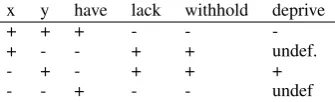
The relevance of predicates to the inference of at-titudes towards the events they are used to refer to was explored by Reschke and Anand (2011) who treat predicates and their arguments as functors that map tuples of argument and verb properties to evaluations. An example is given in Table 1. The first line of the table applies to the situation where there is a possessor (x) who is valued posi-tively by some nested source and a possession (y) that is also valued positively. If the relation be-tween them ishave(third column), that relation is valued positively from the external point-of-view. If the relation islack, that relation is valued nega-tively. The table shows that the reasoning forlack also applies to events of withholding and depriv-ing which result in lack.2
x y have lack withhold deprive
+ + + - -
-+ - - + + undef.
- + - + + +
[image:2.595.98.266.466.517.2]- - + - - undef
Table 1: Functors for verbs embedding a state of possession
It is important to keep in mind that the goal of the inference procedure is to assess the attitude of an external observer on the event. Thus, while an external viewer may feel positively towards a sit-uation where a person he or she dislikes,x, lacks something desirable, y, the relevant possessor, x, will most likely feel negatively about this lack. Reschke and Anand’s functor are intended only to capture the former attitude, of the observer, but not the latter, of the participant.3
2The possessor x ofwithholdanddepriveis the grammat-ical object of these verbs in active-form sentences rather than the subject as in the case ofhaveand lack. However, this difference is unimportant to the logic that applies.
3In cases where the participant and the reporter/observer
Reschke and Anand (2011) focus on classes of verbs assuming that verb classes such as verbs of creation behave consistently due to lexical entail-ments about their arguentail-ments. They focus on three prominent kinds of entailments: ones related to possession, existence and affectedness. Reschke and Anand (2011) test the correctness of the pre-dictions generated by their theory by annotating actual corpus instances. They do not evaluate the agreement on the presence of the lexical entail-ments for predicates themselves. Instead, they simply identified the verbs having particular lex-ical entailments by inspecting FrameNet’s frames (Baker et al., 1998; Ruppenhofer et al., 2010) and its hierarchy.
While acquisition or validation of a large lex-icon was not the aim of Reschke and Anand (2011), it is the focus of later work by Choi and Wiebe (2014) who seek to generate EffectWord-Net, a large lexical resource based on WordEffectWord-Net, in which information relevant for opinion inferences is recorded. The notion to which the annotation of the WordNet word senses appeals is that of ef-fect rather than the more specific entailments used by Reschke and Anand (2011). The idea is that in order to determine a nested source’s view on an event, one first needs to look at the positive or negative effect that the event has on its object.4 In combination with the attitude towards the ob-ject this yields the evaluation of the state that re-sults from the event. That evaluation can then be transferred onto the agent or cause responsible for bringing about the effect, and onto the overall ac-tion brought about by the agent or cause. Consider this example taken from Choi and Wiebe (2014): (2) The bill would curb skyrocketing health
care costs.
The reasoning applied to this example is that since skyrocketing conveys negative sentiment towards curb’s objecthealth care costs, which is negativey affected by the event of curbing, we understand that the writer feels positively towards the curbing event and thebillthat brings it about.
The idea of looking specifically at the posi-tive or negaposi-tive effect on a particular affected en-tity (=object) features only in Choi and Wiebe’s
coincide, as when somebodys says “I don’t have any money”, the two judgements also coincide. But this is just contin-gently and not necessarily the case.
(2014) theory. In the work of Reschke and Anand (2011), it is left implicit. Consider again Table 1: the plus and minus signs encode attitudes of an external viewer towards participants and events but they do not capture the nature of how (some) participants are affected. Further, as indicated by the variable names for the participants (x,y), no af-fected entity is identified.
In the work of Choi and Wiebe (2014), all WordNet word senses of 1143 lemmas were man-ually annotated as +/-effect. This data was then used as seed and test data for a label propa-gation algorithm that spread effect information throughout WordNet. In a prior study by Deng et al. (2013), textual instances of effect-predicates were annotated as triples consisting of <agent, +/-effect event,object>.5 In addition, the writer’s attitude toward the agents and objects of those events was captured.
3 Data
As noted in the introduction, our ultimate goal is to create a WordNet-like resource for German with information relevant to opinion inference that is similar to the English EffectWordNet. Following the approach of Choi and Wiebe (2014), we want to annotate word senses in GermaNet V9.0 (Hamp and Feldweg, 1997), the sister resource to Word-Net for German, that can serve both as training / seed data for automatic methods for graph-based label propagation, and also as a gold standard for evaluating automatic methods.
In picking German synsets to annotate, we made use of the work done by the EffectWordNet group. We extracted all 745 synsets from the Ef-fectWordNet gold standard that were annotated as either +effect or -effect. We omitted all synsets annotated as Null in the source synsets. We then retrieved 273 corresponding German synsets from BabelNet (Navigli and Ponzetto, 2010) on the ba-sis of the WordNet synset IDs. Using the German lemma information and the POS information in BabelNet, we next extracted 998 unique synsets from GermaNet that contained any word senses for the lemmas found in the 273 BabelNet synsets. After expanding the set again based on lemmas found in GermaNet but not in BabelNet, we ob-tained 1492 GermaNet synsets.
As we will show in§4.2, our annotation scheme 5We follow Choi and Wiebe (2014) and apply the more recent term+/-effectinstead of the earliergoodFor/badFor.
does not only focus on the effect on an entity caused by an agent but also allows for the anno-tation of uncaused states an entity may find itself in. We therefore must include inchoative and re-sultative verbs as well as rere-sultative adjectives in our data set. Thus, we manually culled inchoat-ive verbs such asaufbl¨uhen‘blossom’, resultative verbs likeverbl¨uhen ‘wither’ and adjectives (e.g. hoch, ‘high’) from various German lexicons. We extracted all corresponding GermaNet synsets by their lemma and POS information, resulting in 163 verbal and 52 adjectival synsets. After removing duplicate synsets that were found a second time as part of the search for uncaused states, our final data set consists of 1667 GermaNet synsets.
Figure 1 displays an instance of a GermaNet synset, along with its annotations. The key parts for our purposes are
a the initial pair of square brackets containing our effect annotations (bold-face);
b the orth forms set, which lists the lemmas of the synset (underlined);
c the paraphrases, which help us understand the intended senses of the lemmas (italics);
d and the example sentences (lines beginning with “# GermaNet”).
Unlike in (Effect)WordNet, each example sen-tence is accompanied by a syntactic subcategoriza-tion frame which lists the set of arguments and ad-juncts occurring with the lemma being exempli-fied. Thus, in the first sentence, gefallenis real-ized with a noun phrase in nominative case (NN) and another in dative case (DN). We refer to these morphosyntactic phrase labels in our effect anno-tations, as illustrated by the arrows in Figure 1. For instance, the initial block in the example says that for the verbm¨ogen‘like’ the participant coded as an accusative noun phrase (AN) is positively affected, whereas for the verb gefallen ‘please’ the participant coded as a nominative case noun phrase (NN) is positively affected.
35:[+Effect:AN:m¨ogen;+Effect:NN:gefallen] id: 52110, orth forms: [gefallen, m¨ogen], paraphrases: jemand findet etwas gut; jemandem angenehm sein; jemanden
oder etwas gern haben, lieben (etwas schw¨achere Form)
verben Allgemein [annotation-uncertain|meaning-uncertain] # GermaNet: Ihm gef¨allt Klassische Musik. NN.DN
# GermaNet: Er mag diese Musik. NN.AN
Figure 1: Annotation of a synset
to use GermaNet which is large, structured on the sense-level and has example sentences with asso-ciated subcategorization patterns that allow us to access at least syntactic, if not semantic valence.6 We supply our annotation labels with the under-standing that they cover only the syntactic frames exemplified by GermaNet. While these may not include all possible frames, they seem to cover the major syntactic frames for the predicates.
4 Scheme
Our overall approach is a mixture of the func-tor approach to event evaluation of Reschke and Anand (2011) and of the object-focused approach of Choi and Wiebe (2014). Like Choi and Wiebe (2014) we annotate synsets in a WordNet-like re-source but inspired by Reschke and Anand (2011) we annotate a wider variety of predicates and also cover cases where the focus on an affected object alone is not enough to allow a judgment about how the event as a whole should be evaluated.
For practical reasons, our annotations are done with reference to syntactic subcategorization frames that come with example sentences for the GermaNet synsets. Conceptually, we find it useful to reason about the annotation task in terms of lex-ical decompositions and semantic roles along the lines of e.g. Rappaport Hovav and Levin (1998) and Tenny (1994),inter alia.
We present our basic approach in§4.1 and dis-cuss extensions to it and further considerations in the following subsections§4.2-§4.4.
4.1 Underlying linguistic model of effects
Let us consider the prototypical case of predicates relevant for opinion inference, namely ones that involve a causal event (Cause) that brings about a resulting event, the (Effect). A clear example of such a predicate isproducein (3).
6Further example sentences are available through the WebCage corpus (Henrich et al., 2012) which, however, lack explicit syntactic frame information. We only use these addi-tional sentences to ascertain the relevant meaning.
(3) [The explosion Cause] PRODUCED [a
loud “bang”Effect].
Example (3) would be a simple +effect-verb in terms of Choi and Wiebe (2014). So it is for us: we mark its German counterpart produzieren as
+Effect:ANto capture the positive effect on its
ac-cusative object.
However, in many cases, the effect does not appear directly as a single argument of the pred-icate but is expressed in two semantically inter-connected phrases, one expressing an affected par-ticipant and another expressing the relevant situa-tion that affects that participant. ThePatientis typ-ically realized as an object for verbal predicates. The situation-referring constituent, which we call Eventuality, can be of various forms: it can be a verb phrase (4), an adjectival phrase (5), a prepo-sitional phrase, or some other type of unit that can function as a predicate. Semantically, the Patient is the ‘subject’ of the Eventuality predicate: e.g. (5) could be paraphrased as ‘My mortal fear and faintness brings it about that I am deadly pale.’ (4) [The explosion Cause] MADE [me
Patient] [fear for my lifeEventuality].
(5) [My mortal fear and faintness Cause]
must have MADE [me Patient] [deadly
paleEventuality].
In our annotation scheme, rather than leave these cases out of consideration, we explicitly record that, in order to assess the effect on the Pa-tient in object position, we need to consider the Eventuality expressed in the secondary predicate. We mark this dependence between the two phrases with the symbol ∼. For instance, for the Ger-man equivalent ofmakein (5),machen, we would
markEffect:AN∼BMnot specifying + or -, where
life’ is a positive or negative event, for which we can use information in our resource about the verb fear. Second, we input the result of that first com-putation to the basic cause-event reasoning used for the simple case in (3).
While verbs like cause and make are very generic and require the nature of the Eventuality to be specified explicitly, other verbs can be thought of as incorporating the Eventuality. For instance, we can think of the event structure of carve as “Agent causes Patient to exist by carving it” (cf. example (6)). In the syntax, the Eventuality “to exist” is not expressed because it is already con-tained in the meaning ofcarve.
(6) As well as painting, [heAgent] CARVED
[imagesPatient] from sandalwood.
For the verbcarve, we record that its active-form object is its Patient, which we take to be posi-tively affected by coming into existence, in line with Reschke and Anand (2011)’s Existence en-tailment or the guidance of Deng & Wiebe’s an-notation manual that “To Exist is Good”. The annotation for German schnitzen would be
+Ef-fect:AN. In a parallel way, verbs of destruction
can be thought of as including a negation of the existence-eventuality: destroy is “Agent causes Patient to no longer exist”. Accordingly, we would mark the Patients ofdestroyandkillas negatively affected; the German counterparts zerst¨oren and t¨otenwould receive the annotation-Effect:AN for their accusative objects.
If we allow that the Eventuality can be implicit in the verb’s meaning, we can also analyze verbs related to transfer in a similar way. The meaning ofgiveis “Agent causes Recipient to have Theme” but in the syntax there is no separate expression of the notion of having: it is incorporated bygive. As in the case ofmakein (4–5) the positive or negative quality of the Effect cannot be assessed based on either the Recipient or the Theme alone.
(7) [BillAgent]GAVE[my momRecipient]
[a valuable paintingTheme].
It is clear that we first need to figure out the Ef-fect’s polarity on the basis of “Recipient have Theme”, for which we reason along the lines of Reschke and Anand’s functor in Table 1. From there, we can proceed to the general level of “Cause causes Effect”. Accordingly, the annota-tion for Germangebenwould beEffect:DN∼AN, which captures the dependence between the dative Recipient phrase (DN) and the accusative Theme
phrase (AN). Note that the order matters: the (an-imate) Recipient’s state changes more saliently by coming into possession of the (inanimate) Theme than the other way around. For (7), we reason with Reschke and Anand (2011) that it’s good if a person we like has something good. Assuming we like our mothers, the possession of the valu-able painting is good. Since agents and causes get credit and blame for the good and bad things they bring about, Bill is evaluated positively.
The idea of decomposing verb meanings can be applied to yet more verb groups. For instance, verbs that refer to an item attaining a lower or higher position on a scale can be decomposed as “Cause causes Item to be higher/lower (on some scale)”, with the Eventuality “to be higher/lower” being implicit.
(8) [Water privatization Cause] RAISED
[pricesItem].
While Deng & Wiebe treat increases as a metaphorical case of existence, the evaluative logic behind these cases could also be couched as a functor in the style of Reschke and Anand (2011). Basically, “Increase is good, decrease is bad”. For the German equivalent ofraise,erh¨ohenwe would annotate+Effect:AN to capture the positive effect on its accusative object. For the antonymsenken, we would annotate-Effect:AN.
4.2 Evaluation of pure states / post-states
The last examples of the previous section suggest that there is no particular reason to focus solely on verbs that contain causation as part of their meaning. Just as we treat bothgoodandimprove (or: bad anddeteriorate) as equally relevant ex-plicit sentiment predicates, so we can treat the non-subjective adjectivehigh(or:low), the intran-sitive verb rise(or: decline, fall) and the transi-tive verbraise(or:decrease, lower) as relevant to opinion inference.
As argued by Reschke and Anand (2011), “The evaluation of a change of state is equivalent to the evaluation of the end state.”. This can be readily seen by taking into account sets of lexical decom-positions such as those for the verbsraiseandrise and the adjectivehighin (9–11), which alert us to series of related predicates and make explicit what the relevant (end) states are.
(9) causative raise.v: [xCAUSE [BECOME[y <high>]]]
(11) stativehigh.a: [y<high>]
Regarding the scalar predicates high and low, we reason “more is good, less is bad”. Analo-gously to the object of the transitive raise or the subject of the intransitive rise, we thus mark the head noun that is modified by the adjectivehigh as being in a positive state. Similarly, we anno-tate the head of lowas being in a negative state. Recall that “in a positive state” forhighis meant to metaphorically take the perspective of the entity referred to by the head, for examplerentsin (12). The overall evaluation of the situation described by (12) also depends on the evaluation of the ex-ternal viewer’s attitude towards high rents: if he or she is a landlord, it will tend to be positive; if he or she is a renter, it is most likely negative. (12) She said [rentsItem] areHIGHin Paris.
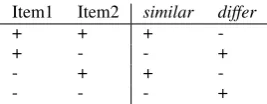
The states that are relevant to opinion inference are not necessarily ones with a single participant. There are also cases of relational states that we need to take into account. The verbs of possession covered by the functor in Table 1 are one impor-tant subclass. But we can also consider predicates like similar, like, and resemble, which talk about states of similarity ([y<similar>z]).
(13) Charles Krauthammer said . . . “[Putin
Item1] is LIKE [Hitler Item2] but he’s
more subtle and he’s also weaker, . . . ” Basically, if there is sentiment towards Item2, then it is imputed to Item1 as well by dint of the comparison (cf. Table 2). By paying at-tention to lexical decompositions, we know that we can reason in a parallel way about inchoative verbs and causative verbs that denote events with an end state of (dis)similarity. Accordingly, for the causative predicate like angleichen‘make sth equal to sth else’, we would markEffect:AN∼DN
to capture the fact that the Effect on the changed accusative object depends on the nature of the da-tive object. Note that in this case, unlike with geben in (7) the accusative phrase refers to the affected participant. The ordering of the argu-ments around the “∼”-symbol thus captures infor-mation that is lost in Anand and Reschke’s nota-tion, where affected participants are not identified. A second prominent class of relational states are, interestingly enough, inherent sentiment pred-icates.
(14) My best friend Martha just told me that [she Experiencer] LOVES [Sarah Palin Stimulus].
Item1 Item2 similar differ
+ + +
-+ - - +
- + +
[image:6.595.349.483.61.113.2]-- - - +
Table 2: Functor for predicates of similarity
While the Experiencer’s inherent positive senti-ment specified bylovetoward the Stimulus-object is clear, the state itself is also open to support opinion inferences. The basic reasoning could be couched as “positive/negative sentiment is use-ful/harmful for the Stimulus”. Accordingly, for the verblieben ‘love’, we mark the object as be-ing in a positive effect state (+Effect:AN).
Example (14) is underspecified. Assuming that the speaker approves of Sarah Palin herself, she will feel positive that her friend shares the sen-timent. Assuming that the speaker has so far not liked Sarah Palin, he or she may now have a conflicted attitude towards her friend Martha. Martha’s positive sentiment benefits Sarah Palin, and since the speaker does not like Palin, he or she should therefore also disapprove of the source of that (emotional) support for Palin.
A third large class of relational states concerns locative prepositions and causative predicates such asput, throw, removeetc. If the (post-)state is val-ued in some way, then so is the event (and poten-tially its author). For concrete physical locations, it is, however, often not obvious what value to at-tach to the Figure and Ground arguments a priori. Even Grounds that come heavily connotated with one polarity, can carry a different polarity, when we take into account the specifics of Figure and Ground (cf. (15) vs. (16)). For metaphorical loca-tions, it seems that the ‘Ground’ expressions that metaphorically evoke a state are often readily in-terpretable as to polarity, as in (17). The opera-tive logic for these cases is that “good/bad entities should be in good/bad states” (cf. Table 3). (15) [The laundry Figure] LAY [in the mud
Ground].
(16) [The rhinocerosFigure]LAY[in the mud Ground].
(17) . . . they DROVE [the company Figure]
[into the ditchGround].
The German verbliegen‘lie’ would be marked
asEffect:NN∼BL to capture the fact that the
Figure Ground in out of
+ + +
-+ - - +
- + - +
- - +
-Table 3: Functor for predicates of location
phrase (NN), depends on the nature of the Ground, coded as a kind of locative adverbial phrase (BL). With some locative verbs, we face a certain dif-ficulty because they incorporate their Theme ar-gument. E.g. asphaltieren ‘to asphalt, tarmac’ refers to a transfer of some material onto a sur-face. The evaluation of tarmacking depends on whether we think the ‘Theme’ (=asphalt) is appro-priately put on the location in question. We can mark the location as affected but the polarity de-pends on the theme. Since it is not realized explic-itly as a phrase, we hint at its relevance by anno-tatingEffect:AN∼Context.
4.3 Logical operators
While we can often identify states (and specifi-cally, post-states) as the most relevant concept for opinion-inference, it is clear that we need to deal with certain logical operators that can occur inside complex semantic decompositions. Consider en-ableandpossible.
(18) This workshop ENABLED delegates to
learn more about practical intervention strategies.
(19) This workshop made itPOSSIBLEfor
del-egates to learn more about practical inter-vention strategies.
(20) It isPOSSIBLEfor delegates to learn more
about practical intervention strategies. The causative verb enable allows for para-phrases as in (19). If we focus solely on the effect of (19), we get sentence (20). Although possibil-ity is certainly different from existence, the logic is the same: to be possible is good, to be impossi-ble is bad. Accordingly, if we approve of the dele-gates’ learning about practical intervention strate-gies, we will approve of the workshop. Since per-mission and requirement can be couched in terms of possibility, the aforementioned logic also ap-plies to predicates such asobligatory,permitetc.
(21) It wasOBLIGATORYto eat fish on certain
fast days laid down by the church.
In (21), we can paraphraseobligatoryas “not pos-sible not to do X”. Assuming eating fish is viewed negatively, not eating it is positive. The possibility of not eating it is positive, too, but once that pos-sibility is negated, we are left with a negatively evaluated situation. Similarly, if in (18) we re-placedenablebyprevent(and adjusted other syn-tax accordingly), we would come to the opposite conclusion becausepreventcan be decomposed as “cause it not to be possible for X to do Y”.
4.4 Pragmatic inference vs. lexical sentiment
It is desirable to keep the positive/negative state characterization of a predicate separate from any additional sentiment that the predicate may carry. To modify an example of Reschke and Anand (2011), consider the following pair of sentences: (22) Tom injured the burglar.
(23) Tom abused the burglar.
Both sentences imply a negative effect on the bur-glar. Given that the burglar is likely evaluated neg-atively, we could infer that the injuring event and its agent are evaluated positively or at least neu-trally in (22). In (23), this is not possible since abuselexically specifies negative evaluation on the abusing event and its author, however deserving of injury the abusee may be. In our annotation, the negative effect on the victim of abuse is preserved. We prefer to let the lexical sentiment information conflict with, and override, the effect-based infer-ence. This makes sense as the negative evaluation of the victim may (at least for some people) con-stitute an attenuating circumstance. If we ignored the effect altogether, this nuance would be lost.
For some words, the choice between a treat-ment in terms of lexically inherent sentitreat-ment and a treatment as pragmatic inference is difficult to make. As an example, consider the verb fawn. On the lexical analysis, the negative characteri-zation of another person’s speech as fawning is inherent in the meaning of fawn. On the infer-ence account, it just happens that speakers often describe other people’s behavior as fawning when they themselves dislike the person that the other people have positive sentiment for. The inference that the speaker disapproves of the fawning and of the fawners would then simply follow from the logic applied to sentiment states (cf.§4.2). (24) The critics at Cannes FAWNED all over
5 Inter-annotator agreement
We assess the inter-annotator agreement for the annotation task by two measures: percent agree-ment and κ (Cohen, 1960). Percent agreement is the ratio of all identically annotated synsets against all annotated synsets. For each annotated synset, we compare the annotations from both an-notators. If they are identical, the synset receives a credit of 1, while the synset receives no credit in case they are different. Finally, for all annotated synsets we add up the credit and divide the sum by the number of annotated synsets. Note that for synsets with multiple annotations, we do not con-sider the order of the individual annotations.
For κ, we proceed as follows. For each GermaNet synset, we extract the phrase labels from the valence frames that come with the ex-ample sentences. In order not to artificially inflate or deflate the inter-annotator agreement, we dis-card any duplicate valence frames that may arise from syntactically identical examples. From the extracted phrase labels, we construct three types of units: (i) phrase labels-only (PHL), (ii) phrase label relations (REL) and (iii) context-dependent phrase labels (CON).PHLrelates to annotations like +Effect:AN where there is positive/negative effect on one phrase label. Units of type REL
correspond to all pairwise combinations of phrase labels of a given valence frame. An annotation ex-ample isEffect:NN∼AN where the effect on NN is dependent on the evaluation of AN. Context-dependent effect on an entity, annotated as e.g. Effect:AN∼Context, corresponds toCON. For this unit, we construct a combination between a given phrase label and the term “Context”, connected by the ∼ symbol. Finally, for each annotation of a synset, we project the annotation onto these units. For cases, where there is no match, we ascribe “Default” for no annotation. We then compute Co-hen’sκseparately for each of the three units.
In total, two annotators, both authors of this paper, independently annotated 726 GermaNet synsets over two annotation phases. In the ex-ploratory phase I, we annotated 226 GermaNet synsets following the annotation guidelines for Ef-fectWordNet by Choi and Wiebe (2014). In phase II, we annotated 500 synsets using the scheme pre-sented in§4. In both phases, for each annotation round, we randomly selected the synsets to be an-notated and discussed differences after the annota-tion and accordingly adjusted the guidelines.
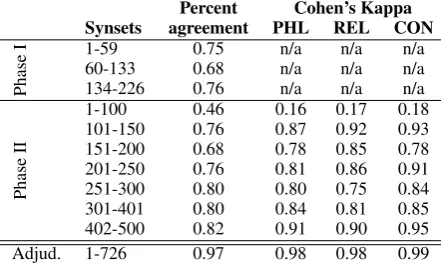
The agreement results are presented in Table 4. Due to different annotation formats, we only re-portκvalues for the annotations from phase II. For phase II, the agreement after the first 100 instances is very good with percent agreement values around 0.8 and κ values between 0.75 and 0.94. The first round (1-100) had low results because it was the first attempt to apply our own more extensive scheme. After each annotation round, we adjudi-cated the annotations, resolving almost all differ-ences between the annotators. The bottom row in Table 4 shows the agreement results for all annota-tionsafteradjudication. Note that we manually re-annotated the adjudicated synsets from phase I ac-cording to the final guidelines, in order to be able to include them in the overall computation of the inter-annotator agreement and for use as additional seed data in future work on label propagation.
It is not possible to directly compare our results to the annotation for EffectWordNet. Though that annotation effort was bigger in that all 1030 Word-Net senses of 1143 lemmas were covered, the an-notation was only done by a single annotator (Choi and Wiebe, 2014). Thus, no agreement informa-tion is available for those annotainforma-tions. However, the relevant annotator had taken part in a prior an-notation study (Choi et al., 2014), where two anno-tators achieved aκof 0.75 on 151 senses that were to be labeled as either +effect; -effect; or neutral.
By contrast, we performed double annotation on 726 GermaNet synsets. However, our anno-tation scheme is more extensive in several re-spects. It allows for the annotation of more opin-ion inference-relevant predicates and it takes into account syntactic valence information about the entity affected. Despite this added complexity, we have achieved good agreement results for all of the GermaNet senses that we have annotated so far.
Percent Cohen’s Kappa Synsets agreement PHL REL CON
Phase
I 1-59 0.75 n/a n/a n/a
60-133 0.68 n/a n/a n/a
134-226 0.76 n/a n/a n/a
Phase
II
1-100 0.46 0.16 0.17 0.18
[image:9.595.72.293.63.195.2]101-150 0.76 0.87 0.92 0.93 151-200 0.68 0.78 0.85 0.78 201-250 0.76 0.81 0.86 0.91 251-300 0.80 0.80 0.75 0.84 301-401 0.80 0.84 0.81 0.85 402-500 0.82 0.91 0.90 0.95 Adjud. 1-726 0.97 0.98 0.98 0.99
Table 4: Inter-annotator agreement for phase I (Ef-fectWordNet scheme) and phase II (our scheme). Bottom row: agreement after adjudication.
sth’ sense7 but negative effect on its object in the sense of ‘to expel so’. This indicates that effect ambiguity is also prevalent in German and con-firms the need for a sense-level lexical resource.
6 Conclusion and Future Work
We have presented an annotation scheme for effect-related information in a lexical resource that significantly extends prior work. We have broad-ened the coverage, and made more systematic the understanding of effect-related predicates by framing them in terms of lexical decomposition. First, in addition to effects resulting from causing events, we also take into account resulting states of events that need not involve a specific cause (e.g. fall) and even simple states and properties (e.g. high). Second, the states or relations that occur in effect-related predicates are not limited to ones referring to existence, possession or affectedness. Verbs of location, similarity, and sentiment are rel-evant, too. Third, our annotation scheme deals ex-plicitly with predicates where the evaluation of an event requires considering a relation between two semantic roles (e.g. give [me] [a cookie], make [Kim] [happy]).
We have achieved good levels of agreement given the complexity of the task. In successfully working on German data, we have provided fur-ther evidence that opinion inference and the rele-vance of lexical knowledge to support it are inde-pendent of specific languages.
A significant benefit of relating our annotations to example sentences and their syntactic valence descriptions is that we thereby generated sense-disambiguated data that can be used in evaluat-7For instance, emitting smoke causes the smoke to exist.
ing an opinion-inference system for German. The GermaNet data that we have annotated so far will be made available to the research community.8 In ongoing work, we are finishing the double anno-tation of the second half of our data set, which we will then also publish. In addition, we are beginning to experiment with ways to propagate the effect information on our seed data throughout GermaNet’s verbal and adjectival synsets.
With regard to the annotation scheme, one issue that we have not dealt with so far is that for a given predicate multiple end states could be relevant, de-pending on the context. As an example consider the synset containing verbs of resource extraction such asgewinnenandf¨ordern, which can co-occur with arguments realizing the agent, the theme and the source location. On the one hand, the agent’s possession that results from oil/gas/mineral ex-traction may be relevant in some contexts such as thinking about the wealth of nations. On the other hand, the theme’s (dis)location can be relevant, for instance, when arguing about whether to extract fossil fuels or leave them in the ground to mitigate climate change. Predicates with multiple relevant post-states may account for some of our annota-tion differences. Studying this issue more calls for performing annotation of actual corpus instances along the lines of Deng et al. (2013).
Another issue that we are pursuing is the inven-tory of different functors that are needed to reason about the post-states. Compare the functors for possession in Table 1, for similarity in Table 2, and for location in Table 3. All of them involve two ar-guments. Ignoring the role names, we see that the functors for possession and location are isomor-phic, while that for similarity is different. Given a small number of arguments for a (post-)state and the possible assignments of +/- values to these ar-guments and to the state, only a relatively small number of functor types is at all possible. The question is which of the possible functors actually occur, and with what frequency.
Acknowledgments
The authors were partially supported by the Ger-man Research Foundation (DFG) under grant RU 1873/2-1.
8http://www.uni-hildesheim.de/
References
Pranav Anand and Kevin Reschke. 2010. Verb classes as evaluativity functor classes. Proceedings of Verb 2010, pages 98–103.
Collin F. Baker, Charles J. Fillmore, and John B. Lowe. 1998. The berkeley framenet project. In Proceed-ings of the 36th Annual Meeting of the Associa-tion for ComputaAssocia-tional Linguistics and 17th International Conference on Computational Linguistics -Volume 1, ACL ’98, pages 86–90, Stroudsburg, PA, USA. Association for Computational Linguistics. Aljoscha Burchardt, Katrin Erk, Anette Frank,
An-drea Kowalski, Sebastian Pad´o, and Manfred Pinkal. 2006. The salsa corpus: a german corpus resource for lexical semantics. InProceedings of the 5th In-ternational Conference on Language Resources and Evaluation (LREC-2006), pages 969–974.
Yoonjung Choi and Janyce Wiebe. 2014. +/-effectwordnet: Sense-level lexicon acquisition for opinion inference. In Alessandro Moschitti, Bo Pang, and Walter Daelemans, editors, Proceed-ings of the 2014 Conference on Empirical Methods in Natural Language Processing, EMNLP 2014, Oc-tober 25-29, 2014, Doha, Qatar, A meeting of SIG-DAT, a Special Interest Group of the ACL, pages 1181–1191. ACL.
Yoonjung Choi, Lingjia Deng, and Janyce Wiebe. 2014. Lexical acquisition for opinion inference: A sense-level lexicon of benefactive and malefac-tive events. In Proceedings of the 5th Workshop on Computational Approaches to Subjectivity, Sen-timent and Social Media Analysis, pages 107–112, Baltimore, Maryland, June. Association for Compu-tational Linguistics.
Jacob Cohen. 1960. A coefficient of agreement for nominal scales. Educational and psychological measurement, 20(1):37–46.
Lingjia Deng, Yoonjung Choi, and Janyce Wiebe. 2013. Benefactive/malefactive event and writer at-titude annotation. InProceedings of the 51st Annual Meeting of the Association for Computational Lin-guistics (Volume 2: Short Papers), pages 120–125, Sofia, Bulgaria, August. Association for Computa-tional Linguistics.
Christiane Fellbaum. 1998. WordNet. Wiley Online Library.
Song Feng, Ritwik Bose, and Yejin Choi. 2011. Learn-ing general connotation of words usLearn-ing graph-based algorithms. In Proceedings of the Conference on Empirical Methods in Natural Language Process-ing, pages 1092–1103. Association for Computa-tional Linguistics.
Birgit Hamp and Helmut Feldweg. 1997. GermaNet -a Lexic-al-Sem-antic Net for Germ-an. InProceedings of ACL workshop Automatic Information Extraction and Building of Lexical Semantic Resources for NLP Applications, pages 9–15, Madrid, Spain.
Verena Henrich, Erhard Hinrichs, and Tatiana Vodola-zova. 2012. Webcage: a web-harvested corpus an-notated with germanet senses. InProceedings of the 13th Conference of the European Chapter of the As-sociation for Computational Linguistics, pages 387– 396. Association for Computational Linguistics. Roberto Navigli and Simone Paolo Ponzetto. 2010.
Babelnet: Building a very large multilingual seman-tic network. InProceedings of the 48th annual meet-ing of the association for computational lmeet-inguistics, pages 216–225. Association for Computational Lin-guistics.
Malka Rappaport Hovav and Beth Levin. 1998. Build-ing verb meanBuild-ings. The projection of arguments: Lexical and compositional factors, pages 97–134. Kevin Reschke and Pranav Anand. 2011. Extracting
contextual evaluativity. InProceedings of the Ninth International Conference on Computational Seman-tics, pages 370–374, Oxford, UK.
Josef Ruppenhofer, Michael Ellsworth, Miriam R.L. Petruck, Christopher R. Johnson, and Jan Schef-fczyk. 2010. FrameNet II: Extended Theory and Practice. International Computer Science Institute, Berkeley, California. Distributed with the FrameNet data.
Carol L Tenny. 1994. Aspectual roles and the syntax-semantics interface. Springer.