A repository of semantic types in the MIMIC II database clinical notes
Richard M. Osborne Computational Bioscience
University of Colorado School of Medicine [email protected]
Alan R. Aronson National Library of Medicine
Bethesda, MD [email protected]
K. Bretonnel Cohen Computational Bioscience
University of Colorado School of Medicine [email protected]
Abstract
The MIMIC II database contains 1,237,686 clinical documents of vari-ous kinds. A common task for researchers working with this database is to run MetaMap, which uses the UMLS Metathesaurus, on those documents to identify specific semantic types of entities mentioned in them. However, this task is computationally expensive and time-consuming. Research in many groups could be accelerated if there were a community-accessible set of outputs from running MetaMap on this document collection, cached and available on the MIMIC-II website. This paper describes a repository of all MetaMap output from the MIMIC II database, publicly available, assuming compliance with usage agree-ments required by UMLS and MIMIC-II. Additionally, software for manipulating MetaMap output, available on Source-Forge with a liberal Open Source license, is described.
1 Introduction
1.1 The MIMIC II database and its textual contents
The Multiparameter Intelligent Monitoring in In-tensive Care II (MIMIC-II) database is a public-access intensive care unit database that contains a broad array of information for over 33,000 pa-tients. The data were collected over a 7 year pe-riod, beginning in 2001 from Boston’s Beth Is-rael Deaconess Medical Center (Saeed et al, 2011; Goldberger et al., 2000).
Of particular interest are the 1,237,686 clini-cal documents, which are broadly classified into the following four groups: MD notes, discharge summaries, radiology reports and nursing/other.
Each free-text note contains information describ-ing such thdescrib-ings as a given patient’s health, ill-nesses, treatments and medications, among others.
1.2 Motivation for the resource: MetaMap runtimes
Part of the motivation for making this resource publicly available is that considerable resources must be expended to process it; if multiple groups can share the output of one processing run, the sav-ings across the community as a whole could be quite large. To illustrate why this would be valu-able from a resources perspective, we provide here some statistics on the performance of MetaMap.
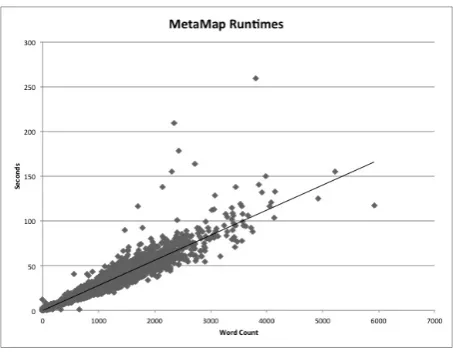
Random samples of each category (10% each) were chosen and Monte Carlo simulation was per-formed (1,000 iterations per note) to obtain the running times presented below. The clinical notes ranged from a minimum of 0 words to a maximum of 6,684 (some of the notes were 0 bytes because the note for a particular patient and day contained no text). The mean, median and mode per doc-ument processed by MetaMap were 17, 5 and 2 seconds, respectively, with a minimum of 1 and a maximum of 216 seconds.
Figure 1 below plots the number of words against processing times in seconds for each of the of notes, sampled as mentioned above.
The majority of the processing was done on a Sun Fire X4600M2 server with 16 (4 x Quad-Core AMD Opteron(tm) Processor 8356 cores, 2.3GHz), 128GB memory and 12 TB of disk stor-age, currently running Fedora Core 17 Linux. (An Apple MacBook Pro and a Windows desktop server were also used to speed processing. The analysis of the random sample of notes was per-formed in its entirety on the Sun machine, thereby providing consistent results for the data in Figure 1.)
Figure 1: MetaMap Runtimes
1.3 Motivation for the resource: reproducibility
Any large-scale run of MetaMap over a huge doc-ument collection will have occasional failures, etc. The odds of any two runs having the same out-put are therefore slim. Moreover, there is po-tential variability in how documents are prepro-cessed for use with MetaMap. Using this reposi-tory of MetaMap outputs will ensure reproducibil-ity of experiments and also preclude the neces-sity of performing the same preparatory work and MetaMap processing on the same data.
1.4 Motivation for the resource: semantic types
The creation of the MIMIC-II repository is an in-termediate step in our research. We are extracting the semantic types found in each clinical note in an attempt to determine if there exists evidence of subdomains across the categories used by MIMIC-II to group the notes.
2 Materials and Methods
2.1 Materials
MetaMap is a program developed at the National Library of Medicine (NLM) that maps biomedical concepts to the UMLS Metathesaurus and reports on the corresponding semantic types.1 The pro-gram is used extensively by researchers in the field of biomedical text mining. See Aronson, 2001; Aronson and Lang, 2010.
1Users of MetaMap must comply with the UMLS Metathesaurus license agreement (https://uts.nlm. nih.gov/license.html).
Although our focus is on the clinical notes con-tained in a single table,noteevents, MIMIC-II is both a relational database (PostgreSQL 9.1.9) con-taining 39 tables of clinical data and bedside mon-itor waveforms and the associated derived param-eters and events stored in flat binary files (with ASCII header descriptors). For each Intensive Care Unit (ICU) patient, Saeed et al. (2011) col-lected a wide range of data including inter alia
laboratory data, therapeutic intervention profiles, MD and nursing progress notes, discharge sum-maries, radiology reports, International Classifica-tion of Diseases, 9th Revision codes, and, for a subset of patients, high-resolution vital sign trends and waveforms. All data were scrubbed for per-sonal information to ensure compliance with the Health Insurance Portability and Accountability Act (HIPAA). These data were then uploaded to a relational database thereby allowing for easy ac-cess to extensive information for each patient’s stay in the ICU (Saeed et al.). A more detailed description of the use of the MIMIC-II database may be found in(Clifford et al. , 2012).
The abbreviated schema in Table 1 below shows that each ID uniquely identifies a note along with a SubjectID, a Category and Text.2We added the ID attribute tonoteevents as a primary key because SubjectID, Category and Text are not keys. Thus, a particular patient might have many notes and many categories but each note is uniquely iden-tified.
Attribute Type Cardinality Sample Values
ID integer unique 1, 2, 3, 4... SubjectID integer many to one ID 95, 100, 100, 99,
Category character varying(26) many to one ID radiology Text text many to one ID interval placement of ICD
Table 1: Schema MIMIC-II noteevents table.
As mentioned above, the notes in the MIMIC-II database are categorized as MD reports, radiology reports, discharge summaries and nursing/other reports. The contents of these notes varied greatly. The MD and nursing notes tended to be short and unstructured with a number of abbreviations and misspellings, whereas the radiology reports were longer, more structured and showed fewer errors.
The MIMIC-II version used for this research is 2.6 (April 2011; 32,536 subjects).
The distribution of reports with summary statis-tics is below in Table 2.
MD Discharge Radiology Nursing Totals
min words 0 0 0 0 0
max words 632 6684 2760 632 6684
median words 108 963.5 174 108 135 average words 131.6 1009.2 265.5 131.6 194.7
total notes 23,270 31,877 383,701 798,838 1,237,686
Table 2: MIMIC-II Clinical Note Summary Stats.
2.2 Methods
We used MetaMap to process the clinical notes in order to find semantic concepts, the latter of which are being used in our current research. For the work in this paper, we used MetaMap 2013 with the 2013AB database.
Before processing the notes with MetaMap, a number of preparatory steps were taken. As mentioned above, a primary key was added to the noteevents table to provide a unique id for each note. A Python script then queried the database extracting each note and storing it in a file named according to the following convention: uniqueID subjectID category.txt where uniqueID is the primary key value from thenoteevents ta-ble, subjectID is the unique number assigned to each patient and category is one of the four cate-gories mentioned above.
Each of the notes was then processed by a Bash shell script to remove blank lines and control char-acters. (This important step was added after a sig-nificant amount of processing had already taken place. If this is not done, a number of prob-lems arise when running MetaMap). Finally, all files with 0 bytes were removed. These files were present because many tuples in thenoteevents ta-ble contained clinical note entries with no data.
The number of options available when running MetaMap is considerable so we chose those that would provide a full and robust result set which would be useful to a wide range of researchers. In our first run, we limited the threshold for the Can-didate Score to 1,000. However, for the repository, no threshold was set so that a full range of output is provided.3
The output is in XML in order to structure the data systematically and provide an easier and con-sistent way to parse the data. Although we chose XML initially, we intend to provide the same data in plain text and Prolog formats, again to provide utility to a broad range of researchers.
In order to process all files, a Bash shell script
3The exact MetaMap command we used was metamap13 –XMLf –silent –blanklines 3 filename.txt
was created that called MetaMap on each note and created a corresponding XML file, named accord-ing to the same convention as that for notes but with the txt extension replaced by xml.
3 Results
3.1 The repository of MetaMap output The repository for the MetaMap output contains an XML file for each note that originally contained text in the MIMIC-II database. Each XML file contains a wealth of information about each note and a discussion of this is beyond the scope of this paper (seehttp://metamap.nlm.nih.
gov/Docs/MM12_XML_Info.shtml).
For our research, we are interested in the se-mantic types associated with phrases identified by MetaMap. Below is a section from output file 768591 19458 discharge.xml. This is a discharge summary for subject 19458 with a unique note id of 768591. The note contained the phrase “Admis-sion Date” which MetaMap matched with a candi-date score of 1000 and indicated that it is a tempo-ral concept (tmco).
Ultimately, the MetaMap output files will be up-loaded to the PhysioNet website and made avail-able to the public.4 The files will be organized in a fashion similar to the original data files on the site. Namely, data are grouped by subject ids and compressed in archives with approximately 1000 files each.
<Candidate>
<CandidateScore>-1000</CandidateScore> <CandidateCUI>C1302393</CandidateCUI> <CandidateMatched>Admission date
</CandidateMatched>
<CandidatePreferred>Date of admission </CandidatePreferred>
<MatchedWords Count="2">
<MatchedWord>admission</MatchedWord> <MatchedWord>date</MatchedWord> </MatchedWords>
<SemTypes Count="1"> <SemType>tmco</SemType> </SemTypes>
The original note contained 975 lines, whereas the MetaMap xml file contained 248,198. Thus it is obvious that there is a very large amount of MetaMap output that we don’t consider but which may be of interest to other researchers.
3.2 A Python module for manipulating MetaMap output
In order to make information in the XML files ac-cessible to others, we developed a Python module (parseMM xml.py) containing a number of meth-ods or functions that allow one to parse the XML tree and extract relevant information.
Although we will add more functionality as needed and requested, at this point the following methods are implemented:
• parseXMLtree(filename) – parses the con-tents of filename and returns a node repre-senting the top of the document tree.
• getXMLsummary(XMLtree) – summarizes the data contained in the parsed XML tree. The summary contains top-level elements and their corresponding text. The output is much like that contained in typical MetaMap text output.
• getCUIs(XMLtree) – returns the MetaMap CUIs found in the XML tree along with the matching concepts.
• getNegatedConcepts(XMLtree) – returns negated concepts and their corresponding CUIs.
• getSemanticTypes(XMLtree) – returns matched concepts, their CUIs, the candidate scores and the semantic types associated with the concept.
• findAttribute(attribute) – searches the docu-ment tree for an attribute of the user’s choos-ing. Returns the attributes with their corre-sponding text values.
We chose Python to create our module be-cause of its ease of use and its multi-platform capabilities. Once Python is installed and the parseMM xml.py is placed in a directory along with the MetaMap xml file which is to be ana-lyzed, retrieving relevant information is relatively straightforward.5
5Under most circumstances, Python is already installed on the Mac OS X and Linux operating systems.
A stylized version of our code is presented be-low.
# Parse XML tree and return semantic types.
import parseMM_xml xml_tree = \
parseXMLtree("noteid_subid_category.xml") semTypes = getSemanticTypes(xml_tree)
print(semTypes)
A truncated listing of the output:
CandidateCUI – C0011008 CandidateMatched – Date
1 – SemType – Temporal Concept CandidateCUI – C2348077 CandidateMatched – Date 2 – SemType – Food
In order to fully test the robustness of our mod-ule, we will do further unit and regression testing, in addition to providing more exception handling. Ultimately, the code will be available on Source-Forge, an Open Source web source code repository available atwww.sourceforge.net.
Acknowledgments
We would like to thank George Moody of MIT for his help with questions concerning the MIMIC-II database.
References
Alan R. Aronson 2001. Effective mapping of biomed-ical text to the UMLS Metathesaurus: the MetaMap program, Proc AMIA Symp. 2001; 17:21.
Alan R. Aronson, Franois-Michel Lang 2010. An overview of MetaMap: historical perspective and recent advances, J Am Med Inform Assoc 2010; 17:3 229-236
Gari D. Clifford, Daniel J. Scott, Mauricio Vil-larroel 2012. User Guide and Documen-tation for the MIMIC II Database, http: //mimic.physionet.org/UserGuide/ UserGuide.pdf
Mohammed Saeed, Mauricio Villarroel, Andrew T. Reisner, Gari Clifford, Li-Wei Lehman, George Moody, Thomas Heldt, Tin H. Kyaw, Benjamin Moody, Roger G. Mark. 2011 The Multiparameter intelligent monitoring in intensive care II (MIMIC-II): A public-access ICU database, Critical Care Medicine; 39(5):952-960
MetaMap Release Notes Website 2013. MetaMap 2013 Release Notes http://metamap.nlm. nih.gov/Docs/MM12_XML_Info.shtml
MetaMap 2012 Output Website 2014.
MetaMap 2012 XML Output Explained
http://metamap.nlm.nih.gov/Docs/ MM12_XML_Info.shtml
PhysioNet Website 2014. PhysioNet MIMIC-II