A Self Learning Vocal Interface for Speech-impaired Users
Bart Ons
1, Netsanet Tessema
1, Janneke van de Loo
2, Jort F. Gemmeke
1,
Guy De Pauw
2, Walter Daelemans
2, Hugo Van hamme
11
ESAT, KU Leuven, Leuven, Belgium
2
CLiPS - Computational Linguistics Group, University of Antwerp, Antwerp, Belgium
Abstract
In this work we describe research aimed at developing an assis-tive vocal interface for users with a speech impairment. In con-trast to existing approaches, the vocal interface is self-learning, which means it is maximally adapted to the end-user and can be used with any language, dialect, vocabulary and grammar. The paper describes the overall learning framework and the vocabulary acquisition technique, and proposes a novel gram-mar induction technique based on weakly supervised hidden Markov model learning. We evaluate early implementations of these vocabulary and grammar learning components on two datasets: recorded sessions of a vocally guided card game by non-impaired speakers and speech-impaired users engaging in a home automation task.
Index Terms: vocal user interface, self-taught learning, dysarthric speech, non negative matrix factorization, hidden Markov models
1. Introduction
These days, vocal user interfaces (VUIs) allow us to control computers, smart phones, car navigation systems and domestic devices by voice. While still generally perceived as a luxury, assistive technology employing a VUI can make a prominent difference in the lives of individuals with a physical disability for whom operating and controlling devices would require ex-haustive physical effort [1].
Unfortunately, even state-of-the-art speech recognition sys-tems offer little, if any, robustness to dialectic or dysarthric speech (often encountered with disabled users), and are often restricted in their vocabulary and grammar. In practice, it is not feasible to design speech interfaces featuring custom acoustic and language models that cater to the dialectic and/or patho-logical speech of individual users, and adaptation of existing acoustic models is limited to only very mild speech pathologies [2, 3, 4, 5, 6]. Moreover, the user’s voice may change over time due to progressive speech impairments.
Our aim is to build a VUI that is trained by the end-user himself, which means that it is maximally adapted to the — possibly dysarthric — speech of the user, and can be used with any vocabulary and grammar. The challenge is to learn both acoustics and grammar from a small number of examples, with as only supervisory information coarse annotation in the form of associated actions. For example, the annotation of the command “Turn on the television please”, accompanied by a button press, would only be annotated at the utterance level with a device label (television) and an action label (turn on).
Our learning approach consists of two components that in-teract. Vocabulary acquisition first builds recurrent acoustic
pat-terns representing words or parts of spoken commands, while grammar induction attempts to model the relationships between these patterns. For vocabulary acquisition, we build on existing work on child language learning modeling with non-negative matrix factorisation (NMF) [7]. For grammar induction, we propose the use of a weakly supervised Hidden Markov Model (HMM).
In short, we first use NMF to find recurrent acoustic pat-terns by mining utterance-level acoustic representations, suvised with relevant information about the action that was per-formed, such as a ‘television’ device and a ’turn on’ action. Building on these, we then use the temporal occurrence of these patterns in the training data as observation features to train a multi-label version of a discrete HMM [8, 9]. In the HMM, the hidden states represent the collection of possible values in the data structures (devices and actions in the example). By mining the temporal occurrence of the NMF-based observations and the commonalities and differences across commands, the HMM is able to discover temporal structure in the commands, related to the data structures representing the actions.
The goals of our work are similar to those of [10, 11] in that we aim to discover acoustic patterns that recur in utterances and ground these by linking them to other modalities. However, to accommodate pathological voices, our work does not rely on pre-trained models, but they are learned from the speaker-specific acoustic data. In that sense, it shows similarities to the work in [12], but we learn form continuous speech and do not model low-level acoustics with an HMM. In terms of grammar learning, our task approaches unsupervised grammar induction [13, 14], but on a restricted domain with a small vocabulary.
We evaluate our learning framework on two databases:PAT
-COR, recorded sessions of a vocally guided card game by
non-impaired speakers, and DOMOTICA-2, speech-impaired users engaging in a home automation task. The users were free to choose their own words and grammatical constructs to address the systems during the recording sessions.
The remainder of the paper is organised as follows. In sec-tion 2, we present an overview of the learning framework, de-scribe the acoustic representations and introduce the NMF and HMM learning approaches. In section 3, the experimental setup is explained and in sections 4 and 5 the experimental results are presented and discussed. We conclude with our conclusions and thoughts for future work in section 6.
2. Architecture
2.1. Semantic frame representation of an utterance
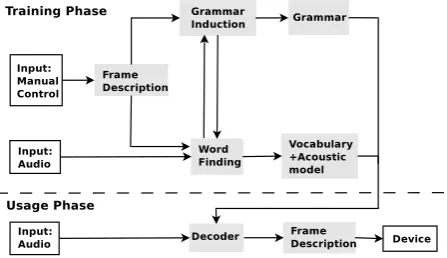
ac-Figure 1: Overview of the vocal interface framework. The white boxes indicate events or systems outside the learning framework. The top panel shows the training phase and the bottom panel indicates the usage phase.
tion that is expressed in the spoken command. Semantic frames have been used in many spoken language processing applica-tions [15]. Aframecontains at least oneslotrepresenting a spe-cific aspect of theaction. Eachslotin a frame can only be filled with a singlevalue. Aframe descriptionof anactionon the other hand, identifies a single frame out of the possibleframes where theactionis specified by the actualslot values.
2.2. The learning framework
The framework (Figure 1) is designed so it can learn from user interaction examples, i.e. a spoken command accompanied by an action on the device’s user interface. For instance, users might say “ Turn on the light” while pressing the button to switch on the light themselves or through the help of a care taker. The action performed on the device is translated into a frame description, which constitutes an abstraction layer making the learning algorithms application independent.
During the training phase, the word finding module looks for word-sized recurring acoustic patterns in the audio input that correlate well with the frame description. The frame descriptionacts as a weak form of supervision in finding the recurring acoustic patterns. Here the term weak supervision is used because the supervision does not provide explicit information about the sequence of words within the spoken utterance.
Thegrammar inductionmodule learns the relation between the different parts of a command. Given the frame description and the output of the word finding module, the grammar induction module learns the structure within commands, as well as the relation with the frame description during the training phase. During the usage phase, when only audio input is available, the grammar constrains the decoding process [16] and allows to propose a frame description of the spoken command. This frame description is then mapped onto an actual action on the device.
2.3. Audio representation
The word finding module in the training phase as well as the decoder in the usage phase need a suitable representation for the input speech. Both learning and recognition are based on
NMF (section 2.4.1), which requires that the audio representa-tion of an utterance be the sum of the representarepresenta-tions of individ-ual words. Therefore, and unlike main-stream ASR systems, an utterance is mapped to a vector of fixed size in three steps which are described below.
2.3.1. Spectral Representation
The first step of the audio processing chain extracts a 12-dimensional Mel Frequency Cepstral Coefficient (MFCC) rep-resentation of the short-term spectrum from speech segments of 25 ms with 10 ms overlap. The 12-dimensional MFCC is augmented with the log energy and the∆and∆∆features are appended, forming a 39 dimensionalspectral featurestream. 2.3.2. Intermediate representations
The obtained MFCC spectral representations are further processed to form posteriorgrams from which the final rep-resentations described in section 2.3.3, are obtained. Two different forms of posteriorgrams are considered here: a spectral feature vector is either transformed into a vector of posterior probabilities of Gaussians forming a code book (soft VQ), or it is transformed to the posterior probability of phone classes.
In Soft Vector Quantisation, eachspectral featurevector is softly assigned to all clusters in a code book. Each cluster is characterized by a Gaussian with full covariance. The degree of assignment is measured by the posterior probability of a Gaussian given thespectral featurevector.
The code book training starts off from a single cluster de-scribing all training data. It is then split along the dominant eigenvector of its covariance matrix into two subclusters. The centres are refined with k-means iterations after which each subcluster is characterised by a full covariance Gaussian. This process is repeated, each time splitting the cluster with the largest volume as measured by the determinant of the covari-ance matrix. This process is either stopped when the desired number of clusters are obtained [17], which we will refer to by Soft VQ, or when the number of spectral feature vectors assigned to a cluster falls below a threshold,minimum-number of frames, which is referred to asAdaptive Soft VQ, because the number of clusters will depend on the amount of training data.
Phone posteriorgramsare constructed from 50 monophone HMMs (including a model for silence), each modeled by three states with GMM emission densities, connected in a strict left-to-right topology. The utterance is first transcribed into a phone lattice without using a phone-level language model. The acous-tic likelihoods associated with the arcs are subsequently renor-malised to posterior probabilities, which allows us to compute a posterior probability for each phone at any time.
A major difference with Soft VQis that phone posterior-grams exploit prior knowledge about the phone inventory that the user can produce.
2.3.3. Utterance-level HAC representation
[image:2.595.60.284.74.203.2]of the acoustic patterns it contains [18, 19]. A mapping that exhibits this property is the so-called histogram of acoustic co-occurrences (HAC) [19]. The HAC of a speech segment is the posterior joint probability of twoacoustic eventshappening at a predefined time lagτ, accumulated over the entire segment. An acoustic event is the observation of a spectral feature vector from a particular cluster in the case of soft VQ, or the observa-tion of a phone in the case of phone posteriorgrams. Since the HAC representation considers event pairs, its dimensionality is the square of the number of acoustic event classes. In this paper, we stack HAC vectors computed for multiple values of the time lagτ = 20,50,90and200ms into a singleaugmented HAC
vectorto characterise an utterance. When multiple (training) utterances are available, their augmented HAC representations are arranged as columns of a matrixVa.
2.4. Non-negative matrix factorisation
NMF uses non-negativity constraints for decomposing a matrix into its components [20, 21, 22, 23], i.e given a non-negative matrixVof size [MxN], NMF approximately decomposes it into its non-negative componentsWof size [MxR] andHof size [RxN]. Under the right conditions, NMF is able to find parts in data. In ASR, NMF is used to discover recurring acous-tic patterns (word units) through some grounding information [24, 25, 26].
In this paper, we use the Kullback-Leibler divergence to quantify the approximation quality of the NMF as expressed in Eq 1.
(H,W) = arg min
(H,W)DKL( V ||[WH]) (1) Finding theW andH that minimize this approximation metric for a given data matrixVis achieved using multiplica-tive update rules[20].
2.4.1. Supervised NMF word learning
To employ NMF for word learning, we use a weak form of supervision represented by Vg, which is used together with
the augmented HAC acoustic representation of all the training utterances stacked into a matrixVa. The supervision
informa-tion links the discovered acoustic patterns to slot valuesand also helps NMF to avoid local optima of the Kullback-Leibler divergence. The supervisionVg is a label matrix where each
column represents an utterance and each row represents aslot value. The presence of aslot value in an utterance is rep-resented in the label matrix with a ‘1’ and its absence with a ‘0’.
Through the factorization of the composite matrix con-structed by vertical concatenation ofVgandVa, NMF
discov-ers latentslot valuerepresentations in each column ofWa. The
columns ofWglink the learned acoustic patterns in columns of
Wato theslot valuesrepresented by the rows ofVg.
Further-more, some extra columns ofWaandWgare used to represent
filler words(words which are present in the utterance but are not related to anyslot value). The columns ofHmatrix indicate which columns ofWaand Wg are combined to reconstruct
VaandVgrespectively. The learned acoustic patterns inWa
and labeling information inWgas given in Eq. 2 will be used
in the testing phase to detect the learned acoustic units within unseen test utterances.
» Vg
Va
–
≈
» Wg
Wa
–
H (2)
2.4.2. NMF in the usage phase
The learned NMF model is applied in two different approaches to decoding. Both decoders apply the learned NMF model to word-sized segments of speech in asliding windowanalysis. A sliding window of a width of 300 ms and a shift of 100 ms is used to produce anaugmented HAC vectorat 100 ms inter-vals across an utterance. As a result, an utterance is represented by a matrixVs, containing one column per window position.
By employing the NMF factorization Eq. 3, which is called the localNMF, the correspondingslot value activationsare calcu-lated.
Hs= arg min
Hs
DKL(Vs||WaHs) (3)
This is followed by the calculation of the activation matrix As. Each column of the activation matrix contains labeling
in-formation of allslot valuesfor a particular window position.
As=WgHs (4)
In the simplest form of decoding, calledNMF decoding, the slot values are inferred directly from the local (sliding window) NMF. The activations for all slot values are accumulated over all window positions, i.e. over the complete utterance. Since each slot can have at most one value assigned, only the value hypothesis with the largest accumulated activation is kept per slot. The slot value is considered to be detected, only if the accumulated activation exceeds a threshold. The order in which the acoustic patterns related to the slot values occur in the utterance is therefore ignored. Since this procedure may result in multiple possible frames, we select the frame with the highest average probability mass.
In a refinement, called HMM decoding, the local NMF model generates a data stream which is modeled by an HMM. The HMM captures the relation between word usage – includ-ing word order – and frame descriptions of actions. Since the HMM models the sequential aspects of the utterance (such as word order), we consider the learning of this HMM a form of grammar induction. The details of this approach are explained in the next section.
2.5. Grammar induction
Identical or similar words (e.g. numbers) may refer to different slots, so slot-value pairs can only be assigned correctly from spoken input if grammar is taken into account. HMM decod-ingfixes the major shortcoming ofNMF decoding, i.e. that the order in which slot values occur, is ignored. The local NMF stream is then modeled by an HMM, which is learned from the user interaction examples.
2.5.1. HMM learning
The activation sequence is modeled by a multi-labeling HMM [9]. Like in discrete-density HMMs, each state q is characterized by probabilitiesbj(q)over observationsj. In this
the inner product of this distribution with the state distribution.
Applied to this problem, eachsemantic frameis modeled by an HMM in which eachslot valueis assigned an HMM state referred to asslot value state. States are fully connected, with two exceptions. First, within slot transitions are prohibited, since each slot needs to be assigned only one value. Second, states can only transition to slot-value states within the same semantic frame, since each spoken command can only correspond to a single semantic frame. To limit the number of transition probabilities to be estimated, all transitions from states associated with a particular slot, to all states associated with another slot, share the same transition probability. The HMM will hence learn the sequence of slots in the user’s utterances, but not the sequence of individual words. All the states can be initial or final states.
HMM training is done using the Baum-Welch algorithm [27]. Supervision information provided by the labeling matrix Vg, is used to only assign non-zero state posteriors toslot
val-uesthat are present in theframe descriptionof an utterance. All non-zero entries of the state-transition matrix are initialised to (properly normalised) random values. The emission matrix is initialised byWg.
2.5.2. HMM decoding
During decoding, the maximum likelihood state sequence is ob-tained using the Viterbi algorithm for the given observation se-quenceHs. Visiting a state in an HMM corresponding to a
se-mantic frame implies the correspondingslot valueis detected. Since states representing slot values can only transition to states within the same semantic frame, the Viterbi search implicitly selects the most likely frame.
3. Experimental Setup
In this section, we give a description of the databases used for evaluation, the evaluation procedure and metrics.
3.1. Databases
3.1.1. PATCOR
The databasePATCORcontains recordings of subjects playing
a card game called “Patience” using spoken commands. The database contains 8 speakers with in total more than two thou-sand commands. The data was collected from unimpaired sub-jects with non-pathological speech, speaking Belgian Dutch. The users were free to choose their vocabulary and grammar, although in practice the vocabulary was limited indirectly by the number of cards, card positions and functionality.
A typical utterance inPATCORis“Put the four of clubs on
the five of hearts”. In this type of utterance, the order of the
Table 1: parameters of the speech databases
Database PATCOR DOMOTICA
number of speakers 8 20
number offrames 2 4
number ofslots 9 7
number ofslot values 58 27
number of blocks 8 6
41 32 33 42 30 37 35 28 47 29 31 46 34 45 40 48 17 44 43 11 0
10 20 30 40 50 60 70 80 90 100
Speakers id
[image:4.595.313.540.69.244.2]Intelligiblity score
Figure 2: Speech intelligibility measurements of the speak-ers inDOMOTICA-2. The speakers are order by intelligibility score. Generally speaking, a score higher than 85% is non-pathological (see the dashed line).
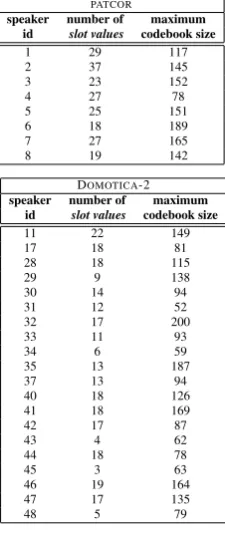
words plays a key role in discovering the utterance’s meaning. The gold-standard frame descriptions of the utterances were created manually. In Table 1 an overview of the total number of frames, slots and slot values used is given. Since not all pos-sible slot values occur for all speakers, Table 7 gives the actual number of slot values for each speaker. For a more detailed de-scription of the frame dede-scriptions that were used, as well as the slot values used for each speaker, we refer the reader to the technical report [28].
3.1.2. DOMOTICA-2
The DOMOTICA-2 database contains recordings of impaired, dysarthric speakers controlling a home automation system. A typicalDOMOTICA-2 utterance would look like “Turn on the kitchen light”.
Since collecting a large number of realistic, spontaneous spoken commands is difficult due to the targeted users getting tired quickly, a two-phase data collection method was used. In the first phase, 9 users were asked to control 31 different appli-ances in a 3D environment [28], guided by a visualised scenario in order to ensure an unbiased choice of words and grammar. In the second phase, these command lists were read back repeat-edly by 21 test users. Of these 21, 8 speakers were selected based on their increased risk for degenerate voice rather than currently having a pathological voice.
For all speakers, speech intelligibility scores were obtained by analysing their recorded speech using an automated tool [29]. These scores are shown in Fig. 2. Table 1 gives an overview of the total number of frames, slots and slot values. For some speakers some slot values were not used, since some commands were not spoken enough times to allow a meaning-ful evaluation; Table 7 gives the actual number of slot values for each speaker. For a more detailed description of the slot values used for each speaker we refer the reader to the technical report [28].
3.2. Methodology
this means the amount of training data can be very small, a form of cross validation is needed to obtain statistically meaningful scores.
First, we divide the spoken commands (utterances) of each speaker into equal or nearly equal parts called blocks. Thek blocks are created by minimising the Jensen-Shannon diver-gence (JSD) between the slot value distributions of all blocks. This optimisation is performed in an iterative process starting by dividing all utterances randomly intokblocks and then swap-ping at each iteration those two utterances that minimise the JSD the most from one block to the other one. The process stops when the JSD is minimised, i.e. when there are no swaps left that can lower the JSD. The slot values are then approximately evenly distributed throughout the blocks. Under the constraint that each slot value should occur at least once in each block, some slot values are excluded from the frame structure, mean-ing that the spoken words correspondmean-ing to these slot values, become filler words: they are not supervised and they are not scored anymore. Such adaptation to the supervision is speaker dependent and the number of slot values used for each speaker can be found in [28]. Utterances without any slot values were removed from the training and test sets.
To evaluate the learning speed of our framework, we cre-ated ak×klatin square in which each block occurs exactly once in each row and in each column. We selected five rows of the latin square to create a five-fold cross-validation experiment in which the train and test sets respectively increase and de-crease in size. In each fold, we start with an experiment where only one block is used for training while the remainingk−1 blocks are used for testing. We incrementally increase the num-ber of blocksnused for training in the subsequent experiments and the last experiment will be performed withn=k−1 train-ing blocks and one test block. Throughout the folds, the train and test sets are always composed of different blocks allowing for a more reliable scoring.
3.3. Parameters
The number of frames needed to have a reliable estimation of the cluster centres, depends on the dimensionality of the fea-ture vectors. The minimum number of frames used for adaptive codebook training is chosen to be78, two times the dimension-ality of the MFCC feature vectors. ForPATCOR, the resulting VQ codebook sizes typically ranged from40for the smallest training set to145for the largest training set. ForDOMOTICA
-2, the resulting codebook sizes typically ranged from36for the smallest training set to118for the largest training set.
For both databases, phone posteriorgrams were obtained us-ing a free phone recognizer usus-ing a unigram language model. The phone recognizer was trained on a dataset containing recordings of selected radio and television news broadcasts in the same language as the collected databases. Phones are mod-eled with 3-state HMMs and in total48845tied Gaussians are used in the acoustic model. The phonetic alphabet includes one noise unit and one silence unit in addition to48phones.
For the utterance-based HAC representations, from both VQ and phone posteriorgrams, only the top-three largest indices at each time frame were retained.
3.4. Evaluation
For each utterance in the databases, we have a manually con-structed gold standard frame description, which is used as a reference for system evaluation. In this reference frame de-scription, the slot values that are expressed in the utterance, are
filled in. The system was evaluated by comparing the automati-cally induced frame descriptions to the gold standard reference frames. The used metric is theslot Fβ=1-score, which is the
harmonic mean of the slot precision and the slot recall. These metrics are commonly used for the evaluation of frame-based systems for spoken language understanding [15]. The follow-ing formulas were used for calculation:
slot precision = # correctly filled slots
# total filled slots in induced frame (5) slot recall = # correctly filled slots
# total filled slots in reference frame (6) slot Fβ=1-score = 2· slot precision·slot recall
slot precision+slot recall (7)
This means that only slots that are filled with acorrectvalue are rewarded, and both slots that are falsely filled and slots that are falsely left empty are penalised. When an induced frame is of another type than the corresponding reference frame, the filled slots in the induced frame and in the reference frame are consequently different, which automatically results in a rela-tively large drop in the slot F-score. It should be noted that the reported F-scores aggregate slot counts over all five folds.
4. Results
In Fig. 3, F-scores for eight speakers per database are depicted as a function of the average number of utterances in the train-ing set. The F-scores against increastrain-ing train set sizes provides some insight into the self-learning aspect of the framework. For each database, there are two graphs, one graph depicting NMF learning of slot value representations and one graph depicting HMM-based grammar induction.
For visibility, Fig. 3 does not contain all speakers from
DOMOTICA-2. For this dataset, all F-scores for the NMF-based word finding module are presented in Table 2 and all scores for the HMM-based grammar induction module are presented in Table 3. There is one column for each speaker and the rows indicate the number of blocks in the training sets.
4.1. PATCOR
When we compare the respective F-scores for each speaker and for each training set size, we find a significant difference be-tween the scores of the word finding module and the grammar induction module using a paired student’s t-test,t(55) = 5,11, p < 0.001. On average, the grammar induction module im-proves the F-score with 5%, but the improvement varies be-tween speakers. For some speakers, the induced grammar pro-vides a considerable improvement, for instance for speaker3, The improvement is 16% on average, t(6) = 33,16, p <
0 50 100 150 200 250 0.2 0.3 0.4 0.5 0.6 0.7 0.8 1 1
1 1 1 1
1
Size of training set (#utterances)
F−score 2 2 2 2 2 2 2 3 3 3 3 3 3 3 4 4 4 4 4 4 4 5 5 5 5 5 5 5 6 6 6 6 6 6 6 7 7
7 7 7
7 7 8 8 8 8 8 8 8 (a)
0 50 100 150 200 250
0.2 0.3 0.4 0.5 0.6 0.7 0.8 1 1 1 1 1 1 1
Size of training set (#utterances)
F−score 2 2 2 2 2 2 2 3 3 3
3 3 3 3
4 4
4 4 4
4 4 5 5 5 5 5 5 5 6 6 6 6 6 6 6 7 7 7
7 7 7 7
8 8 8 8 8 8 8 (b)
0 50 100 150
0.1 0.2 0.3 0.4 0.5 0.6 0.7 0.8 0.9 11 11 11 11 11
Size of training set (#utterances)
F−score 17 17 17 17 17 29 29 29 29 29 31 31
31 31 31
34 34
34 34
34
35 35 35
35 35 41 41 41 41 41 45 45454545
(c)
0 50 100 150
0.1 0.2 0.3 0.4 0.5 0.6 0.7 0.8 0.9 11 11
11 11 11
Size of training set (#utterances)
[image:6.595.96.505.128.463.2]F−score 17 17 17 17 17 29 29 29 29 29 31 31 31 31 31 34 34 34 34 34 35 35 35 35 35 41 41 41 41 41 454545 45 45 (d)
Figure 3:The F-scores per speaker against the averaged number of utterances in the respective training sets. In Panel (a), the NMF-based results of the word finding module for the PATCOR database are depicted. In Panel (b), the results of the word finding module augmented with the HMM-based grammar induction tool are displayed. Panel (c) and Panel (d) display the same results as Panel (a) and Panel (b), respectively, for eight selected speakers in theDOMOTICA-2 database.
Table 2:F-scores for NMF word learning for all speakers ofDOMOTICA-2and all training set sizes
speaker 11 17 28 29 30 31 32 33 34 35 37 40 41 42 43 44 45 46 47 48 1 block 0.56 0.55 0.30 0.32 0.27 0.22 0.22 0.27 0.46 0.25 0.24 0.36 0.35 0.28 0.34 0.31 0.38 0.16 0.17 0.36 2 blocks 0.67 0.65 0.36 0.37 0.32 0.31 0.26 0.31 0.64 0.27 0.30 0.44 0.51 0.29 0.37 0.46 0.48 0.16 0.17 0.29 3 blocks 0.72 0.68 0.41 0.44 0.40 0.37 0.33 0.32 0.71 0.28 0.36 0.50 0.60 0.32 0.39 0.53 0.48 0.20 0.15 0.33 4 blocks 0.79 0.70 0.50 0.41 0.41 0.36 0.32 0.32 0.81 0.29 0.36 0.48 0.61 0.41 0.38 0.61 0.51 0.17 0.14 0.29 5 blocks 0.79 0.74 0.48 0.45 0.43 0.38 0.38 0.40 0.88 0.31 0.44 0.53 0.64 0.45 0.44 0.63 0.46 0.22 0.13 0.26
Table 3:F-scores for HMM grammar induction for all speakers ofDOMOTICA-2and all training set sizes
[image:6.595.51.547.628.683.2]Results are in the same range as the reported word finding results in [25], however, there are some speaker dependent dif-ferences in performance due to different experimental settings. The major discrepancies in settings are scoring and grammar discovery. While we report F-scores and investigate automat-ically induced grammar structures in this study, slot value re-call scores are reported in [25] and frame decoding is guided by a handcrafted grammar. Additionally, the feature represen-tations are also different between the two studies. While we combine phone posteriorgrams and adaptive softVQ for build-ing the acoustic feature representations, the feature representa-tion is based on softVQ using more larger codebooks in [25].
4.2. Domotica-2
ForDOMOTICA-2, we find a small but significant improvement using a paired student’s t-test when comparing the F-scores between the word finding module and the grammar induction module for each speaker and training set size (see Fig. 3c and Fig. 3d), t(99) = 3,24, p < 0.01. On average the gram-mar induction module cause an increase in F-scores of about 3%. For some speakers, the F-score improvements were more pronounced than for others. For instance, F-scores for speaker 31improved on average with a decimal of0.14,t(4) = 7,6, p <0.05while the F-scores for speaker17decreased with 8%,
t(4) =−3.77,p <0.05.
The differences between speakers is related to the intelligi-bility scores. We found a significant Kandall’s tau rank correla-tion equal to0.41, p <0.05for the average F-score per speaker and their respective intelligibility score. There are trend lines in Fig. 3c and Fig. 3d that are rather short because the amount of data was limited, such as the graphs for speaker35, resulting from early fatigue for some speakers in the recording phase of the DOMOTICA-2 corpus.
5. Discussion
In the word finding module, we aim to find the acoustic repre-sentation of the words corresponding to slot values in a semantic frame. In the grammar induction tool, the temporal structure in the commands is discovered and related to the semantic frame structure of the spoken commands. Positive scores necessitate a positive evaluation on both aspects, that is the correct recogni-tion of the spoken words and the correct allocarecogni-tion of the recog-nised words to the slots in the semantic frame structure. The second aspect is not a trivial issue for the utterances used in the
PATCORdatabase. For instance, in the utterance “Put the four
of clubs on the five of hearts”, words like “four” and “clubs” are related to the moving card while the same words are sometimes used to define the destination of the move. Some speakers spec-ify the moving card first while others may specspec-ify the destina-tion card first. Although spoken words are sometimes identical, different slot value labels specify different meanings. It can be seen in Fig 3b that the VUI gradually succeeds to distinguish these slots corresponding to the moved card and the destina-tion card for at least some speakers, such as speaker2,5and8. Scores above0.5are only possible when the correct slots are recognized, such as the slots related to the moving card versus the slots related to the destination card inPATCOR.
The NMF-based word finding module is able to learn more than words, as some context information of the words is incor-porated in the slot value representations. The features used in NMF learning consist of the co-occurrence of acoustic events over multiple delays, up toτ = 200ms, allowing for learning
context over spoken word boundaries. Moreover, the learned context of a word also involves the co-occurrence of acous-tic events with the frame slot events of the demonstrated com-mands. The learned context is helpful in identifying the words but also the frame slots for some speakers as can be seen in Fig 3a and Fig 3c. However, context learning in NMF over word boundaries is only possible in a local time context because co-occurrence of acoustic events over longer time delays are more divergent. Useful time delays might be extended by using prob-abilistic time delays instead of fixed ones used here. The use of longer time delays in learning the co-occurrence of events poses a challenge for future research.
Although the frame structure is acquired for some speakers without using the grammar induction module, not all speakers display good scores without grammar induction, such as speak-ers3,6and 7inPATCOR. The HMM-based grammar induc-tion tool improves the learning of the frame structure, espe-cially for those speakers for which the NMF word finding mod-ule demonstrates insufficiencies. The results demonstrated in Fig. 3 and Table 3 are encouraging in the sense that the graphs of all speakers in Fig. 3 tend to rise by increasing training set sizes, demonstrating the self-learning ability of the investigated framework. Further directions of research includes the accel-eration of the learning plots for normal and dysarthric speech. Accelerating the speed of learning is especially important for speech-impaired users, because they have to make more effort to utter commands and train the system. Besides accelerating the speed of learning, it remains an open issue at which level the scores tend to level off. Obviously, all scores presented in the graphs of Fig. 3b and Fig. 3d are not at levelling off for the largest training set, as the training data is too scarce for the self learning VUI to reach maximal performance. More data is needed to find out the maximal performance of the system and the relation between maximal scores and intelligibility of the users. We could help this issue by gathering more data or by sharing the emission probabilities for particular slot values sharing identical words similar to the sharing of the transition probabilities explained in Section 2.5.1.
There are some differences in performance between databases. Our framework performs best for intelligible speech. The speakers with higher F-scores for theDOMOTICA
-2 database are the speakers with the higher intelligibility scores close to85%. The performance of our framework for differ-ent speakers inDOMOTICA-2 demonstrates a larger variability and more spurious trajectories in Fig.3d than for normal speak-ers inPATCOR. Low scores are corresponding to a low number
of slot values which in turn is corresponding to a limited num-ber of recorded utterances due to early fatigue. However, the scores between the two databases are difficult to compare since the complexities of the categorical decisions are different from each other. For instance, there are more frame slot values per slot inPATCORthan inDOMOTICA-2 and there is more hier-archical structure in the PATCOR-commands compared to the
DOMOTICA-2-commands, making the recognition ofPATCOR
-commands much more difficult. In future research, we will evaluate our framework on more databases allowing us to com-pare the strengths and weaknesses of our system with other small-vocabulary, speaker-dependent systems, such as those de-scribed in [2, 6].
6. Conclusion
In contrast to existing approaches, the vocal interface is self-learning which means it is maximally adapted to the end-user and can be used with any language, dialect, vocabulary and grammar. We proposed a novel grammar induction technique, based on weakly supervised HMM learning, and we evaluated early implementations of these vocabulary and grammar learn-ing components on two datasets: recorded sessions of a vo-cally guided card game by non-impaired speakers, and speech-impaired users engaging in a home automation task.
While the performance varied widely between speakers, both for impaired and non-impaired speakers, performance did improve even with relatively small amounts of additional train-ing data. This demonstrates the potential of the self-learntrain-ing vocal interface. Additionally, the proposed HMM approach to weakly supervised grammar induction did improve the results for all but a few speakers, indicating that a limited form of gram-mar induction is not only feasible, but also beneficial to distin-guish between commands. Future work will focus not only on a detailed analysis of the obtained results, such as the grammars that were inferred and the relation between speech pathology and performance, but also on improvements such as more ad-vanced acoustic modelling techniques, hierarchical approaches of HMM learning, and integrating grammar induction and vo-cabulary acquisition in a single probabilistic framework.
[image:8.595.114.227.412.682.2]7. Appendix
Table 4:number of slot valuesand maximum codebook size PATCOR
speaker number of maximum id slot values codebook size
1 29 117
2 37 145
3 23 152
4 27 78
5 25 151
6 18 189
7 27 165
8 19 142
DOMOTICA-2
speaker number of maximum id slot values codebook size
11 22 149
17 18 81
28 18 115
29 9 138
30 14 94
31 12 52
32 17 200
33 11 93
34 6 59
35 13 187
37 13 94
40 18 126
41 18 169
42 17 87
43 4 62
44 18 78
45 3 63
46 19 164
47 17 135
48 5 79
8. Acknowledgements
The research in this work is funded by IWT-SBO grant 100049.
9. References
[1] J. Noyes and C. Frankish, “Speech recognition technology for in-dividuals with disabilities,”Augmentative and Alternative Com-munication, vol. 8, no. 4, pp. 297–303, 1992.
[2] H. Christensen, S. Cunningham, C. Fox, P. Green, and T. Hain, “A comparative study of adaptive, automatic recognition of disor-dered speech,” inProc Interspeech 2012, Portland, Oregon, US, Sep 2012.
[3] K. T. Mengistu and F. Rudzicz, “Comparing humans and au-tomatic speech recognition systems in recognizing dysarthric speech,” inProceedings of the Canadian Conference on Artificial Intelligence, 2011.
[4] H. V. Sharma and M. Hasegawa-Johnson, “State transition in-terpolation and map adaptation for hmm-based dysarthric speech recognition,” inHLT/NAACL Workshop on Speech and Language Processing for Assistive Technology (SLPAT), 2010, pp. 72–79. [5] F. Rudzicz, “Acoustic transformations to improve the
intelligibil-ity of dysarthric speech,” inProceedings of the Second Workshop on Speech and Language Processing for Assistive Technologies (SLPAT2011), 2011.
[6] M. S. Hawley, P. Enderby, P. Green, S. Cunningham, S. Brownsell, J. Carmichael, M. Parker, A. Hatzis, P. O’Neill, and R. Palmer, “A speech-controlled environmental control system for people with severe dysarthria,”Medical Engineering & Physics, vol. 5, no. 29, pp. 586 – 593, 2007.
[7] J. Driesen, J. Gemmeke, and H. Van hamme, “Weakly super-vised keyword learning using sparse representations of speech,” inProceedings of the 36th International Conference on Acoustics, Speech and Signal Processing, Kyoto, Japan, 2012.
[8] M. Nishimura and K. Toshioka, “Hmm-based speech recog-nition using multi-dimensional multi-labeling,” in Acoustics, Speech, and Signal Processing, IEEE International Conference on ICASSP ’87., vol. 12, 1987, pp. 1163–1166.
[9] J. Hernando, l.B. Maririo, A. Moreno, and C. Nadeu, “Multiple multilabeling applied to hmm-based noisy speech recognition,” in
Proc. ICSP ’93, 1993.
[10] R. Taguchi, N. Iwahashi, K. Funakoshi, M. Nakano, T. Nose, and T. Nitta,Human Machine Interaction - Getting Closer. InTech, 2012, ch. Learning Physically Grounded Lexicons from Spoken Utterances.
[11] D. Roy, “Grounded spoken language acquisition: Experiments in word learning,”IEEE Transactions on Multimedia, vol. 5(2), pp. 197–209, 2003.
[12] I. Ayllon Clemente, M. Heckmann, and B. Wrede, “Incremen-tal word learning: Efficient hmm initialization and large margin discriminative adaptation,” Speech Communication, vol. 54, pp. 1029–1048, Nov. 2012.
[13] R. Collobert, J. Weston, L. Bottou, M. Karlen, K. Kavukcuoglu, and P. Kuksa, “Natural language pro-cessing (almost) from scratch,” Journal of Machine Learning Research, vol. 12, pp. 2493–2537, Aug 2011. [Online]. Available: http://leon.bottou.org/papers/collobert-2011
[14] D. Klein, “The unsupervised learning of natural language struc-ture,” Ph.D. dissertation, Stanford University, 2005.
[15] Y. Wang, L. Deng, and A. Acero, “Semantic frame-based spo-ken language understanding,” inSpoken Language Understand-ing: Systems for Extracting Semantic Information from Speech, G. Tur and R. D. Mori, Eds. West-Sussex, UK: Wiley, 2011, ch. 3, pp. 41–91.
[16] J. van de Loo, G. De Pauw, J. Gemmeke, P. Karsmakers, B. Van Den Broeck, W. Daelemans, and H. Van hamme, “Towards shal-low grammar induction for an adaptive assistive vocal interface: a concept tagging approach,” inProceedings NLP4ITA, 2012, pp. 27–34.
[18] J. Driesen and H. Van hamme, “Fast word acquisition in an NMF-based learning framework,” inProceedings of the 36th Interna-tional Conference on Acoustics, Speech and Signal Processing, Kyoto, Japan, 2012.
[19] H. Van hamme, “Hac-models: a novel approach to continuous speech recognition,” inProceedings INTERSPEECH, 2008, pp. 2554–2557.
[20] D. Lee and H. Seung, “Learning the parts of objects by nonnega-tive matrix factorization,”Nature, vol. 401, pp. 788–791, 1999. [21] J. Eggert and E. Korner, “Sparse coding and nmf,” inNeural
Net-works, 2004. Proceedings. 2004 IEEE International Joint Confer-ence on, vol. 4, 2004, pp. 2529–2533 vol.4.
[22] Y.-X. Wang and Y.-J. Zhang, “Nonnegative matrix factorization: A comprehensive review,” Knowledge and Data Engineering, IEEE Transactions on, vol. 25, no. 6, pp. 1336–1353, 2013. [23] H. Lee, J. Yoo, and S. Choi, “Semi-supervised nonnegative matrix
factorization,”Signal Processing Letters, IEEE, vol. 17, no. 1, pp. 4–7, 2010.
[24] L. Boves, L. ten Bosch, and R. Moore, “Acorns-towards compu-tational modeling of communication and recognition skills,” in
Proc. IEEE int. Conf. On Cognitive informatics, California, USA, 2007, pp. 349–355.
[25] J. F. Gemmeke, J. van de Loo, G. De Pauw, J. Driesen, H. Van hamme, and W. Daelemans, “A self-learning assistive vocal in-terface based on vocabulary learning and grammar induction,” in
Proc. INTERSPEECH, 2012, pp. 1–4.
[26] B. Ons, J. F. Gemmeke, and H. Van hamme, “Label noise robust-ness and learning speed in a self-learning vocal user interface,” inProc. of the International Workshop on Spoken Dialog Systems (IWSDS), Ermenonville, France, 2012.
[27] L. Rabiner, “A tutorial on hidden markov models and selected applications in speech recognition,” Proceedings of the IEEE, vol. 77, no. 2, pp. 257–286, 1989.
[28] N. Tessema, B. Ons, J. Gemmeke, and H. Van hamme, “Technical report (aladin-tr01),” KULeuven ESAT-PSI, Tech. Rep., 2013. [29] C. Middag, “Automatic analysis of pathological speech,” Ph.D.