Comparison pattern matching and creative simile recognition
Vlad Niculae
Universit´e de Franche-Comt´e, Besanc¸on
Center for Computational Linguistics, University of Bucharest [email protected]
Abstract
Comparisons are phrases that express the likeness of two entities. They are usu-ally marked by linguistic patterns, among which the most discussed are X is like Y and as X as Y. We propose a simple slot-based dependency-driven description of such patterns that refines the phrase structure approach of Niculae and Yaneva (2013). We introduce a simple similarity-based approach that proves useful for mea-suring the degree of figurativeness of a comparison and therefore in simile (figu-rative comparison) identification. We pro-pose an evaluation method for this task on the VUAMC metaphor corpus.
1 Introduction
The comparison structure is a common linguistic pattern used to express similitude or distinction of two entities with respect to a property. When the comparison is not intended to be taken liter-ally, it is called asimile. Identifying comparison structures is important for information extraction, as it is a way of asserting properties of entities. The simile, on the other hand, is interesting for the striking creative images it often produces:
“Mrs. Cratchit entered: flushed, but smiling proudly: with the pudding, like a speckled cannon-ball, so hard and firm, (...)” (In “A Christmas Carol” by Charles Dickens)
The simile, as a figure of speech, is receiv-ing an increasreceiv-ing amount of interest, after bereceiv-ing historically discarded as a less interesting form of metaphor. To clarify that the expressive span of the metaphor and the simile overlap but are different, Israel et al. (2004) gives examples of metaphors that cannot be perfectly transformed
into similes, and vice versa. Further supporting this point, Hanks (2012) identifies many cases where the simile is used creatively as a way of describing things by constructing images that sur-pass the realm of the possible and the experienced.
2 Corpora
The VU Amsterdam Metaphor Corpus (Steen et al., 2010), henceforth VUAMC, is a subset of British National Corpus (BNC) Baby (Burnard, 1995) annotated for phenomena related to lin-guistic metaphor. It consists of16 202 sentences and 236 423 tokens. About half (50.7%) of the
sentences have at least anmrw(metaphor-related word) annotated. Of more interest for our study is the mFlag (metaphor flag) annotation, which surrounds trigger phrases for figurativeness. Ta-ble 1 shows the most frequent mFlag tags. We investigate the use of this annotation for automat-ically evaluating simile identification. Given the underrepresentation of similes in the VUAMC, we chose to only present experiments using the com-parison patterns involvinglike. The methods used are not pattern specific. Up to a degree of variation given by subtle language behaviour, they should apply to any comparison, as they only involve the contents of the comparison constituents that will be described in section 3.
In addition to the VUAMC, we used the collec-tion of examples from (Hanks, 2012) and a sub-set of extracted matches from the BNC (Burnard, 1995). All text was tagged and parsed using Tur-boParser (Martins et al., 2010) using the basic projective model and lemmatized using Treex1
(Popel and ˇZabokrtsk`y, 2010).
3 Syntactic aspects
3.1 Characterisation of comparisons
flag count freq. per sentence
like 57 0.35%
as 28 0.17%
as if 7 0.04%
of 6 0.04%
other 45 0.28%
[image:2.595.335.502.62.380.2]total 143 0.88%
Table 1: Metaphor flags in VUAMC
dict(slot=’E’,
pos=lambda x: x.startswith(’VB’), kids=[
dict(slot=’C’, form=’like’, pos=’IN’,
kids=[dict(slot=’V’, deprel=’PMOD’)]), dict(slot=’T’,
deprel=’SUB’, optional=True), dict(slot=’P’,
optional=True, deprel=’PRD’), ])
Listing 1: Python code representing the simple pattern for comparisons usinglikedefined by Fig-ure 1b.
Hanks (2012) identifies the following con-stituents of a comparison: the topic (T), the even-tuality (E), the shared property (P), the
compara-tor (C) and the vehicle (V). An example (adapted
from the BNC) of a simile involving all of the above would be:
[He T] [looked E] [like C] [a broiled
frogV], [hunchedP] over his desk,
grin-ning and satisfied.
Niculae and Yaneva (2013) used constituent parsing with GLARF (Meyers et al., 2001)
trans-formations in order to match several hand-written comparison patterns. While the normalizations performed by GLARFallow for more general
pat-terns (constructions using auxiliary verbs such as
have been are handled transparently), the tool is only available in English, and it proves error-prone in practice for complex sentences.
Dependency parsing, based on the formalism of Tesni`ere and Fourquet (1959), has been more
VG
E=VB
HEAD
T
SBJ
PP
IN
C ∈ {like, as}
HEAD
V
OBJ COMP/AD
V
(a) GLARF-style pattern.
E: */VB
C:
like/IN
V
PMOD P
PRD
T
SUB
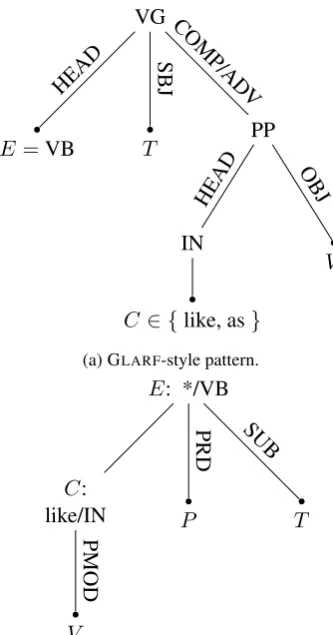
(b) DEP-style pattern. Its Python representation can be found in Listing 1.
Figure 1: Visualisation of the two types of ap-proaches for encoding theX is like Ypattern.
actively developed recently. Compared to con-stituent parsing (phrase-structure grammars), de-pendency trees are easier to annotate, hence the availability of dependency treebanks and trained models for more languages. The space of possible dependency trees of a sentence is much smaller than the space of possible constituent trees, al-lowing for better models. Recent work in struc-tured prediction includes the TurboParser (Martins et al., 2010), which we use in this work.
Figure 1 shows the GLARF-style pattern for
comparisons usinglike, along with a correspond-ing dependency pattern.
3.2 Encoding and matching dependency patterns
In the case of phrase-structure treebanks, the pow-erful toolsTgrepandTgrep22 permit fast
extrac-tion of trees sharing common patterns. Unfortu-nately, their formalism is inappropriate for
[image:2.595.71.291.107.403.2]ing dependency trees. Additionally, while expres-sive, their syntax is arguably opaque and unwel-coming. We propose a simpler pattern matcher written in Python with patterns represented as Python code. The resulting patterns look similar to their graphical representation. This representa-tion is a step closer to automatic construcrepresenta-tion of patterns, compared to hand-written pattern match-ing usmatch-ing conditionals. The implementation is cur-rently available in the comparison-pattern pack-age3under the permissive 3-clause BSD license. LikeTgrepworks on parenthesised trees, common for representing constituent parses, our matcher takes CoNLL-style input.
For brevity, we henceforth refer to our depen-dency pattern matching system as DEP.
Listing 1 shows the code needed to represent the pattern. For certain underspecified patterns with symmetries, it’s possible that several matches with the same root occur. Our matcher returns all of them and choosing the appropriate one is left as a separate problem that we do not treat in this work.
3.3 Comparison identification results
On the examples from (Hanks, 2012), DEP im-proves recall by identifying 6 additional matches, while losing only 2, one due to a POS tagging er-ror and the other due to a parsing erer-ror. In cases when both systems match a sentence, it is some-times the case that DEP provides more complete information, especially in the case of convoluted sentence structures.
On the subset from the BNC used by Nic-ulae and Yaneva (2013), we examine only the points of disagreement between systems (sen-tences matched by one but dismissed by the other). Even though this analysis ignores the possibility of making qualitatively different matches for the same sentence, we opted for it for convenience, as evaluation needs to be manual. Contrary to Nicu-lae and Yaneva (2013), we disregard matches that don’t identify the vehicle of the comparison, as we are interested in finding common vehicles, for mining different comparators.
At first sight, DEP identifies 199 sentences that GLARF misses, while GLARF matches 36 instances missed by DEP. Upon going through the examples, we find that 43 matches out of the 199are spurious because of preventable tag-ging or parsing errors, many of them in
tran-3http://github.com/vene/comparison-pattern
System P R F1 count
[image:3.595.311.521.61.132.2]LEXBL 0.166 1.00 0.284 320 GLARF 0.303 0.434 0.357 96 DEP 0.241 0.717 0.360 158 DEPSEM 0.252 0.717 0.373 151
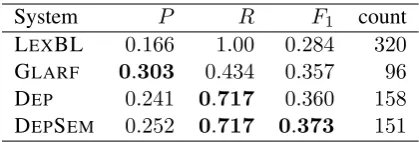
Table 2: Simile identification performance, with respect to the53instances ofmFlag=like annota-tion in VUAMC. LEXBL is the baseline that re-trieves all sentences that contain the preposition like. The last column measures the number of re-trieved instances.
scribed speech, where the word like functions as a filler word. However, 11 out of the GLARF-only matches were also spurious. Using depen-dency parsing is therefore a net gain for compari-son identification.
3.4 Automatically evaluating simile retrieval On VUAMC, we can use the mFlag annotation as ground truth for evaluating pattern matching. However, as the focus of the corpus is figurative language, literal comparison are not marked. Be-cause pattern matching finds comparisons, without any semantic processing, the retrieval precision will be low (all literal comparisons would be seen as spurious simile matches). However, it passes the sanity check against the LEXBL baseline that simply returns all sentences containing the prepo-sition like (after part-of-speech tagging). To our knowledge this is the first attempt at an automatic evaluation of simile retrieval performance. The re-sults are presented in table 2. Even though raw extraction F1 score is very close, DEP has much
better recall and therefore leaves more way for improvement with semantic methods, as promised by our DEPSEMheuristic described in section 4.1. This heuristic manages to improve precision at no cost in recall.
4 Semantic approximations of figurativeness and creativeness 4.1 Approach
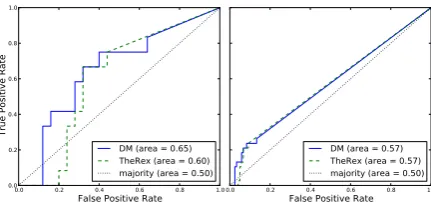
Figure 2: ROC curves for similarity as a predictor of comparison figurativeness measured on com-parisons found in the semantic resources (left) and on all comparisons, assuming missing values are zero (right).
figurativeness. We approximate conventionality as similarity between the tagged lemmas of the head
words of T and V. To this end, we make use
of two precomputed, freely accessible resources.
The DEPSEM heuristic filters out matched
com-parisons with similarity scores above a manually-set threshold, under the assumption that compar-isons against highly similar things are unlikely to be figurative.
4.2 Resources
Distributional Memory (Baroni and Lenci,
2010), henceforthDM, is a general-purpose model
of corpus-driven semantics. While it comes in a
tensor form ofword-link-word, we use the
distri-butional word representations induced by random
indexing, available online4. Shutova et al. (2010)
used distributional verb-noun clusters in metaphor identification, suggesting that such methods can be adopted for measuring figurativeness. We mea-sure similarity as the cosine between word vectors.
Thesaurus Rex (Veale and Li, 2013),
hence-forth THEREX5is a knowledge base of categories
and stereotypes mined from the web using the
pat-ternsas X as YandX such as Y. While less
com-plete than a knowledge-cheaper distributional
re-source such as DM, THEREX contains structures
that can be explored for simile simplification, by
inferring the missing P as discussed in (Niculae
and Yaneva, 2013). We measure similarity be-tween noun pairs as a sum of the weights of all shared categories of the two words and categories
of each of the word, derived from the other6.
4http://clic.cimec.unitn.it/dm/ 5http://ngrams.ucd.ie/therex2/
6This strategy proved better than measuring just the shared categories, or than simply counting instead of adding
[image:4.595.76.292.61.162.2]4.3 Evaluation
Figure 2 shows the ROC curves for the two meth-ods, where the similarity scores are seen as predic-tors of the target variable that indicates whether
mFlag=like is annotated within the sentence. It can be seen that these measures perform better than the baseline of always choosing the majority class.
For a qualitative evaluation and proof of con-cept, we point out several comparisons with low and high similarities, identified in the BNC.
The piano ripples like patent leather. [DM(piano, leather) = 0.076]
This is a vivid and funny produc-tion and their expertise makes the intricate puppetry go like a dream. [DM(puppetry, dream) = 0.076]
Ink, like paint, uses subtractive colour mixing while the video monitor uses the additive colours; red, green and blue, to produce the same effect. [DM(ink, paint) = 0.502]
5 Conclusions and future work
We improve upon previous work in comparison pattern matching by using dependency parsing, and at the same time provide a more general in-terpretation of pattern matching. Our approach is much easier to adapt to other languages, as it needs a POS tagger and a dependency parser.
We show that there exists some negative corre-lation between lexical semantic similarity and fig-urativeness, that we exploit in a simple heuristic for simile identification. Such measures can be used as features for simile classifiers.
Obvious improvements include measuring simi-larity between children nodes and not just the head node of each argument, or measuring other
argu-ments (E andV, for example). The shared
cate-gories of pairs of nouns and poetic catecate-gories of
single nouns available in THEREXshow promise
for simile simplification. Measures of compo-sitionality in distributional semantics as used by Vecchi et al. (2011) for identifying impossible constructions are expected to be better suited for our task than the representation based on simple co-occurrences.
References
Marco Baroni and Alessandro Lenci. 2010. Dis-tributional memory: A general framework for
corpus-based semantics. Computational
Linguis-tics, 36(4):673–721.
Lou Burnard. 1995. British National Corpus: Users
Reference Guide British National Corpus Version
1.0. Oxford Univ. Computing Service.
Patrick Hanks. 2012. The Roles and Structure of Com-parisons, Similes, and Metaphors in Natural
Lan-guage (An Analogical System). InPresented at the
Stockholm Metaphor Festival, September 6-8.
Patrick Hanks. 2013. Lexical Analysis: Norms and
Exploitations. Mit Press.
Michael Israel, Jennifer Riddle Harding, and Vera
To-bin. 2004. On simile. Language, Culture, and
Mind. CSLI Publications.
Andr´e FT Martins, Noah A Smith, Eric P Xing, Pe-dro MQ Aguiar, and M´ario AT Figueiredo. 2010. Turbo parsers: Dependency parsing by
approxi-mate variational inference. In Proceedings of the
2010 Conference on Empirical Methods in Natural Language Processing, pages 34–44. Association for Computational Linguistics.
Adam Meyers, Ralph Grishman, Michiko Kosaka, and Shubin Zhao. 2001. Covering treebanks with glarf. InProceedings of the ACL 2001 Workshop on Shar-ing Tools and Resources - Volume 15, STAR ’01, pages 51–58, Stroudsburg, PA, USA. Association for Computational Linguistics.
Vlad Niculae and Victoria Yaneva. 2013. Computa-tional considerations of comparisons and similes. In
51st Annual Meeting of the Association for Compu-tational Linguistics Proceedings of the Student Re-search Workshop, pages 89–95, Sofia, Bulgaria, Au-gust. Association for Computational Linguistics.
Martin Popel and Zdenˇek ˇZabokrtsk`y. 2010. Tectomt:
modular nlp framework. In Advances in Natural
Language Processing, pages 293–304. Springer.
Ekaterina Shutova, Lin Sun, and Anna Korhonen. 2010. Metaphor identification using verb and noun clustering. InProceedings of the 23rd International Conference on Computational Linguistics, pages 1002–1010. Association for Computational Linguis-tics.
G.J. Steen, A.G. Dorst, and J.B. Herrmann. 2010.
A Method for Linguistic Metaphor Identification: From Mip to Mipvu. Converging evidence in lan-guage and communication research. Benjamins.
Lucien Tesni`ere and Jean Fourquet. 1959. El´ements
de syntaxe structurale, volume 1965. Klincksieck Paris.
Tony Veale and Guofu Li. 2013. Creating similarity: Lateral thinking for vertical similarity judgments. In
Proceedings of the 51st Annual Meeting of the As-sociation for Computational Linguistics (Volume 1: Long Papers), pages 660–670, Sofia, Bulgaria, Au-gust. Association for Computational Linguistics.
Eva Maria Vecchi, Marco Baroni, and Roberto Zam-parelli. 2011. (linear) maps of the impossible: cap-turing semantic anomalies in distributional space. In