Medical text simplification using synonym replacement:
Adapting assessment of word difficulty to a compounding language
Emil Abrahamsson1Timothy Forni1 Maria Skeppstedt1 Maria Kvist1,21Department of Computer and Systems Sciences (DSV)
Stockholm University, Sweden
{emab6827, tifo6794, mariask}@dsv.su.se
2Department of Learning, Informatics, Management and Ethics (LIME)
Karolinska Institutet, Sweden
Abstract
Medical texts can be difficult to under-stand for laymen, due to a frequent occur-rence of specialised medical terms. Re-placing these difficult terms with eas-ier synonyms can, however, lead to im-proved readability. In this study, we have adapted a method for assessing difficulty of words to make it more suitable to med-ical Swedish. The difficulty of a word was assessed not only by measuring the frequency of the word in a general cor-pus, but also by measuring the frequency of substrings of words, thereby adapt-ing the method to the compoundadapt-ing na-ture of Swedish. All words having a MeSH synonym that was assessed as eas-ier, were replaced in a corpus of medical text. According to the readability measure LIX, the replacement resulted in a slightly more difficult text, while the readability increased according to the OVIX measure and to a preliminary reader study.
1 Introduction
Our health, and the health of our family and friends, is something that concerns us all. To be able to understand texts from the medical domain, e.g. our own health record or texts discussing sci-entific findings related to our own medical prob-lems, is therefore highly relevant for all of us.
Specialised terms, often derived from latin or greek, as well as specialised abbreviations, are, however, often used in medical texts (Kokkinakis and Toporowska Gronostaj, 2006). This has the effect that medical texts can be difficult to compre-hend (Keselman and Smith, 2012). Comprecompre-hend- Comprehend-ing medical text might be particularly challengComprehend-ing for those laymen readers who are not used to look-ing up unknown terms while readlook-ing. A survey of
Swedish Internet users showed, for instance, that users with a long education consult medical infor-mation available on the Internet to a much larger extent than users with a shorter education (Find-ahl, 2010, pp. 28–35). This discrepancy between different user groups is one indication that meth-ods for simplifying medical texts are needed, to make the medical information accessible to every-one.
Previous studies have shown that replacing dif-ficult words with easier synonyms can reduce the level of difficulty in a text. The level of diffi-culty of a word was, in these studies, determined by measuring its frequency in a general corpus of the language; a measure based on the idea that frequent words are easier than less frequent, as they are more familiar to the reader. This syn-onym replacement method has been evaluated on medical English text (Leroy et al., 2012) as well as on Swedish non-medical text (Keskis¨arkk¨a and J¨onsson, 2012). To the best of our knowledge, this method has, however, not previously been evalu-ated on medical text written in Swedish. In ad-dition, as Swedish is a compounding language, laymen versions of specialised medical terms are often constructed by compounds of every-day Swedish words. Whether a word consists of easily understandable constituents, is a factor that also ought to be taken into account when assessing the difficulty of a word.
The aim of our study was, therefore, to in-vestigate if synonym replacement based on term frequency could be successfully applied also on Swedish medical text, as well as if this method could be further developed by adapting it to the compounding nature of Swedish.
2 Background
The level of difficulty varies between different types of medical texts (Leroy et al., 2006), but studies have shown that even brochures intended
for patients, or websites about health issues, can be difficult to comprehend (Kokkinakis et al., 2012; Leroy et al., 2012). Bio-medical texts, such as medical journals, are characterised by sentences that have high informational and structural com-plexity, thus containing a lot of technical terms (Friedman et al., 2002). An abundance of med-ical terminology and a frequent use of abbrevia-tions form, as previously mentioned, a strong bar-rier for comprehension when laymen read medical text. Health literacy is a much larger issue than only the frequent occurrence of specialised terms; an issue that includes many socio-economic fac-tors. The core of the issue is, however, the read-ability of the text, and adapting word choice to the reader group (Zeng et al., 2005; Leroy et al., 2012) is a possible method to at least partly improve the readability of medical texts.
Semi-automatic adaption of word choice has been evaluated on English medical text (Leroy et al., 2012) and automatic adaption on Swedish non-medical text (Keskis¨arkk¨a and J¨onsson, 2012). Both studies used synonym lexicons and replaced words that were difficult to understand with more easily understandable synonyms. The level of dif-ficulty of a word was determined by measuring its frequency in a general corpus. The English study based its figures for word frequency on the number of occurrences of a word in Google’s index of En-glish language websites, while the Swedish study used the frequency of a word in the Swedish Pa-role corpus (Gellerstam et al., 2000), which is a corpus compiled from several sources, e.g. news-paper texts and fiction.
The English study used English WordNet as the synonym resource, and difficult text was trans-formed by a medical librarian, who chose eas-ier replacements for difficult words among candi-dates that were presented by the text simplifica-tion system. Also hypernyms from semantic cat-egories in WordNet, UMLS and Wiktionary were used, but as clarifications for difficult words (e.g. in the form: ’difficult word, a kind ofsemantic cat-egory’). A frequency cut-off in the Google Web Corpus was used for distinguishing between easy and difficult words. The study was evaluated by letting readers 1) assess perceived difficulty in 12 sentences extracted from medical texts aimed at patients, and 2) answer multiple choice questions related to paragraphs of texts from the same re-source, in order to measure actual difficulty. The
evaluations showed that perceived difficulty was significantly higher before the transformation, and that actual difficulty was significantly higher for one combination of medical topic and test setting.
The Swedish study used the freely available SynLex as the resource for synonyms, and one of the studied methods was synonym replacement based on word frequency. The synonym replace-ment was totally automatic and no cut-off was used for distinguishing between familiar and rare words. The replacement algorithm instead re-placed all words which had a synonym with a higher frequency in the Parole corpus than the fre-quency of the original word. The effect of the frequency-based synonym replacement was auto-matically evaluated by applying the two Swedish readability measures LIX and OVIX on the orig-inal and on the modified text. Synonym replace-ment improved readability according to these two measures for all of the four studied Swedish text genres: newspaper texts, informative texts from the Swedish Social Insurance Agency, articles from a popular science magazine and academic texts.
For synonym replacement to be a meaningful method for text simplification, there must exist synonyms that are near enough not to change the content of what is written. Perfect synonyms are rare, as there is typically at least one aspect in which two separate words within a language dif-fer; if it is not a small difference in meaning, it might be in the context in which they are typi-cally used (Saeed, 1997). For describing med-ical concepts, there is, however, often one set of terms that are used by health professionals, whereas another set of laymen’s terms are used by patients (Leroy and Chen, 2001; Kokkinakis and Toporowska Gronostaj, 2006). This means that synonym replacement could have a large poten-tial for simplifying medical text, as there are many synonyms within this domain, for which the dif-ference mainly lies in the context in which they are typically used.
termi-Original Med r¨ontgen kan man se en ¨okad trabekulering,osteoporos samt pseudofrakturer.
Transformed Med r¨ontgen kan man se en ¨okad trabekulering,bensk¨orhet samt pseudofrakturer.
Translated original With X-ray, one can see an increased trabeculation,osteoporosis and pseudo-fractures.
Translated transformed With X-ray, one can see an increased trabeculation,bone-brittleness and pseudo-fractures.
Table 1: An example of how the synonym replacement changes a word in a sentence.
nologies containing synonymic expressions, e.g. MeSH1and SNOMED CT2. Swedish, with fewer speakers, also has fewer lexical resources than En-glish, and although SNOMED CT was recently translated to Swedish, the Swedish version does not contain any synonyms. MeSH on the other hand, which is a controlled vocabulary for index-ing biomedical literature, is available in Swedish (among several other languages), and contains synonyms and abbreviations for medical concepts (Karolinska Institutet, 2012).
Swedish is, as previously mentioned, a com-pounding language, with the potential to create words expressing most of all imaginable concepts. Laymen’s terms for medical concepts are typi-cally descriptive and often consist of compounds of words used in every-day language. The word humerusfraktur (humerus fracture), for instance, can also be expressed as ¨overarmsbenbrott, for which a literal translation would be upper-arm-bone-break. That a compound word with many constituents occurring in standard language could be easier to understand than the technical terms of medical terminology, forms the basis for our adaption of word difficulty assessment to medical Swedish.
3 Method
We studied simplification of one medical text genre; medical journal text. The replacement method, as well as the main evaluation method, was based on the previous study by Keskis¨arkk¨a and J¨onsson (2012). The method for assessing word difficulty was, however, further developed compared to this previous study.
As medical journal text, a subset of the journal L¨akartidningen, the Journal of the Swedish Med-ical Association (Kokkinakis, 2012), was used.
1www.nlm.nih.gov/mesh/ 2www.ihtsdo.org
The subset consisted of 10 000 randomly selected sentences from issues published in 1996. As syn-onym lexicon, the Swedish version of MeSH was used. This resource contains 10 771 synonyms, near synonyms, multi-word phrases with a very similar meaning and abbreviation/expansion pairs (all denoted assynonymshere), belonging to 8 176 concepts.
Similar to the study by Keskis¨arkk¨a and J¨onsson (2012), the Parole corpus was used for frequency statistics. For each word in the L¨akartidningen subset, it was checked whether the word had a syn-onym in MeSH. If that was the case, and if the synonym was more frequently occurring in Parole than the original word, then the original word was replaced with the synonym. An example of a sen-tence changed by synonym replacement is shown in Table 1.
There are many medical words that only rarely occur in general Swedish, and therefore are not present as independent words in a corpus of stan-dard Swedish, even if constituents of the words frequently occur in the corpus. The method used by Keskis¨arkk¨a and J¨onsson was further developed to handle these cases. This development was built on the previously mentioned idea that a compound word with many constituents occurring in standard language is easier to understand than a rare word for which this is not the case. When neither the original word, nor the synonym, occurred in Pa-role, a search in Parole was therefore instead car-ried out for substrings of the words. The original word was replaced by the synonym, in cases when the synonym consisted of a larger number of sub-strings present in Parole than the original word. To insure that the substrings were relevant words, they had to consist of a least four characters.
al-gorithm first detects thathemangiomhas the syn-onym blodk¨arlstum¨or (blood-vessel-tumour) in MeSH. It thereafter establishes that neither he-mangiom nor blodk¨arlstum¨or is included in the Parole corpus, and therefore instead tries to find substrings of the two words in Parole. For he-mangiom, no substrings are found, while four substrings are found for blodk¨arlstum¨or (Table 2), and therefore hemangiom is replaced by blodk¨arlstum¨or.
Word 1 2 3 4
[image:4.595.325.509.61.157.2]hemangiom - - - -blodk¨arlstum¨or blod k¨arl blodk¨arl tum¨or
Table 2: Example of found substrings
As the main evaluation of the effect of the syn-onym replacement, the two readability measures used by Keskis¨arkk¨a and J¨onsson were applied, on the original as well as on the modified text. LIX (l¨asbarhetsindex, readability measure) is the standard metric used for measuring readability of Swedish texts, while OVIX (ordvariationsindex, word variation index) measures lexical variance, thereby reflecting the size of vocabulary in the text (Falkenjack et al., 2013).
The two metrics are defined as follows (M¨uhlenbock and Johansson Kokkinakis, 2009):
LIX= MO +L·O100 Where:
• O= number of words in the text
• M= number of sentences in the text
• L= number of long words in the text (more than 6 characters)
OVIX= log(O) log(2−loglog((UO))) Where:
• O= number of words in the text
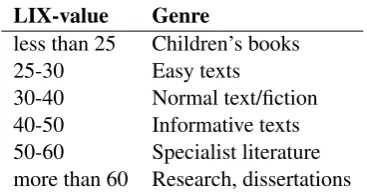
• U = number of unique words in the text The interpretation of the LIX value is shown in Table 3, while OVIX scores ranging from 60 to 69 indicate easy-to-read texts (M¨uhlenbock and Jo-hansson Kokkinakis, 2009).
LIX-value Genre
less than 25 Children’s books 25-30 Easy texts
30-40 Normal text/fiction 40-50 Informative texts 50-60 Specialist literature more than 60 Research, dissertations Table 3: The LIX-scale, from M¨uhlenbock and Jo-hansson Kokkinakis (2009)
To obtain preliminary results from non-automatic methods, a very small manual evalua-tion of correctness and perceived readability was also carried out. A randomly selected subset of the sentences in which at least one term had been replaced were classified into three classes by a physician: 1) The original meaning was retained after the synonym replacement, 2) The original meaning was only slightly altered after the syn-onym replacement, and 3) The original meaning was altered more than slightly after the synonym replacement. Sentences classified into the first cat-egory by the physician were further categorised for perceived readability by two other evaluators; both with university degrees in non-life science disciplines. The original and the transformed sen-tence were presented in random order, and the evaluators were only informed that the simplifica-tion was built on word replacement. The follow-ing categories were used for the evaluation of per-ceived readability: 1) The two presented sentences are equally easy/difficult to understand, 2) One of the sentences is easier to understand than the other. In the second case, the evaluator indicated which sentence was easier.
4 Results
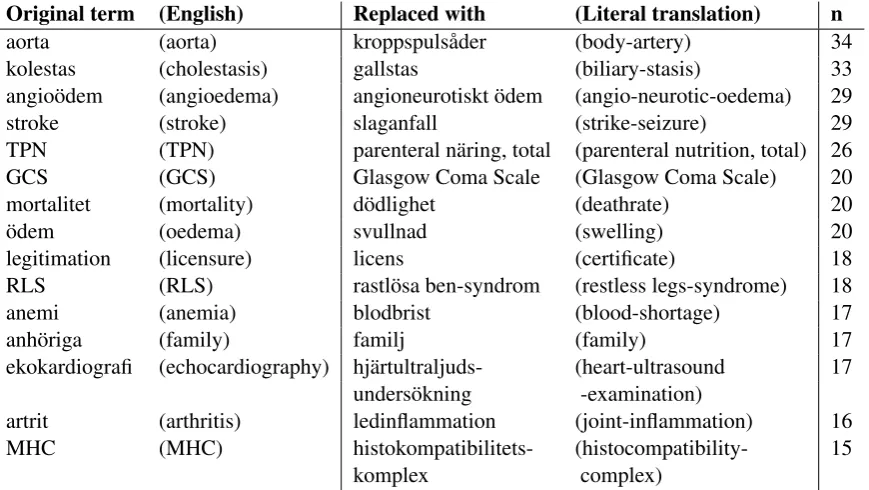
In the used corpus subset, which contained 150 384 tokens (26 251 unique), 4 909 MeSH terms for which there exist a MeSH synonym were found. Among these found terms, 1 154 were replaced with their synonym. The 15 most fre-quently replaced terms are shown in Table 4, many of them being words typical for a professional lan-guage that have been replaced with compounds of every-day Swedish words, or abbreviations that have been replaced by an expanded form.
[image:4.595.74.295.209.249.2]replace-Original term (English) Replaced with (Literal translation) n
aorta (aorta) kroppspuls˚ader (body-artery) 34 kolestas (cholestasis) gallstas (biliary-stasis) 33 angio¨odem (angioedema) angioneurotiskt ¨odem (angio-neurotic-oedema) 29 stroke (stroke) slaganfall (strike-seizure) 29 TPN (TPN) parenteral n¨aring, total (parenteral nutrition, total) 26 GCS (GCS) Glasgow Coma Scale (Glasgow Coma Scale) 20 mortalitet (mortality) d¨odlighet (deathrate) 20
¨odem (oedema) svullnad (swelling) 20
legitimation (licensure) licens (certificate) 18 RLS (RLS) rastl¨osa ben-syndrom (restless legs-syndrome) 18 anemi (anemia) blodbrist (blood-shortage) 17
anh¨origa (family) familj (family) 17
ekokardiografi (echocardiography) hj¨artultraljuds- (heart-ultrasound 17 unders¨okning -examination)
artrit (arthritis) ledinflammation (joint-inflammation) 16 MHC (MHC) histokompatibilitets- (histocompatibility- 15
[image:5.595.75.508.60.309.2]komplex complex)
Table 4: The 15 most frequently replaced terms. As the most frequent synonym (or synonym with most known substrings) is always chosen for replacement, the same choice among a number of synonyms, or a number of abbreviation expansions, will always be made. The columnncontains the number of times the original term was replaced with this synonym.
ment. Also the number of long words (more than six characters) increased from 51 530 to 51 851. This resulted in an increased LIX value, as can be seen in Table 5. Both before and after the transfor-mation, the LIX-value lies on the border between the difficulty levels of informative texts and non-fictional texts. The replacement also had the effect that the number of unique words decreased with 138 words, which resulted in a lower OVIX, also to be seen in Table 5.
For the manual evaluation, 195 sentences, in which at least one term had been replaced, were randomly selected. For 17% of these sentences, the original meaning was slightly altered, and for 10%, the original meaning was more than slightly altered. The rest of the sentences, which re-tained their original meaning, were used for mea-suring perceived readability, resulting in the fig-ures shown in Table 6. Many replaced terms oc-curred more than once among the evaluated sen-tences. Therefore, perceived difficulty was also measured for a subset of the evaluation data, in which it was ensured that each replaced term oc-curred exactly once, by only including the sen-tence in which it first appeared. These subset fig-ures (denoted Unique in Table 6) did, however, only differ marginally from the figures for the
en-tire set. Although there was a large difference be-tween the two evaluators in how they assessed the effect of the synonym replacement, they both clas-sified a substantially larger proportion of the sen-tences as easier to understand after the synonym replacement.
LIX OVIX
Original text 50 87.2 After synonym replacement 51 86.9
Table 5: LIX and OVIX before and after synonym replacement
5 Discussion
[image:5.595.75.510.62.307.2]Perceived effect Evaluator 1 Evaluator 2 of replacement All (Unique) All (Unique) No difference 51% (52%) 29% (28%) Easier 42% (42%) 54% (52%) More difficult 7% (7%) 17% (21%)
Table 6: Results for the manual classification of perceived difficulty. Evaluator 1 classified 143 sentences and Evaluator 2 classified 140 sen-tences. The (Unique) column contains results when only the first a occurrence of a replacement of a particular term is included. A binomial sign test (Newbold et al., 2003, p. 532) was performed on the effect of the replacement, with the null hy-pothesis that the probability of creating a more dif-ficult sentence was equal to that of creating an eas-ier one. This hypothesis could be rejected for both evaluators; when including all sentences and also when only including the (Unique) subset, show-ing that the differences were statistically signifi-cant (p0.01).
of every-day words. Replacing an abbreviation or an acronym with its expanded long form has the same effect. Expanding acronyms also increases the number of words per sentence, which also re-sults in a higher LIX value.
Studies on English medical text indicate, how-ever, that simple surface measures do not accu-rately reflect the readability (Zeng-Treitler et al., 2007; Wu et al., 2013), and user studies have been performed to construct readability measures bet-ter adapted to the domain of medical texts (Kim et al., 2007; Leroy and Endicott, 2012). Therefore, although the manual evaluation was very limited in scope, the results from this evaluation might give a better indication of the effects of the sys-tem. This evaluation showed that the perceived readability often improved with synonym replace-ment, although there were also replacements that resulted in a decrease of perceived readability. Further studies are required to determine whether these results are generalisable to a larger group of readers. Such studies should also include an eval-uation of actual readability, using methods similar to those of Leroy et al. (2012). The cases, in which the synonym replacement resulted in a perceived decrease in readability should also be further stud-ied. It might, for instance, be better to use a fre-quency cut-off for distinguishing between rare and frequent words, as applied by Leroy et al. (2012),
rather than always replacing a word with a more frequent synonym.
The manual evaluation also showed that the original semantic meaning had been at least slightly altered in almost a third of the sentences, which shows that the set of synonyms in Swedish MeSH might need to be adapted to make the syn-onyms suitable to use in a text simplification sys-tem. The replacements in Table 4 show three types of potential problems. First, there are also distant synonyms, as exemplified byoedema and swelling, whereoedemameans a specific type of swelling in the form of increased amount of liq-uid in the tissues, as opposed to e.g. increased amount of fat. Second, the MeSH terms are not always written in a form that is appropriate to use in running text, such as the term parenteral nu-trition, total. Such terms need to be transformed to another format before they can be used for au-tomatic synonym replacement. Third, although the abbreviations included in the manual evalua-tion were all expanded to the correct form, ab-breviations within the medical domain are often overloaded with a number of different meanings (Liu et al., 2002). For instance, apart from be-ing an acronym for restless legs syndrome, RLS can also mean reaction level scale (Cederblom, 2005). Therefore, in order to include abbrevia-tions and acronyms in the synonym replacement method studied here, an abbreviation disambigua-tion needs to be carried out first (Gaudan et al., 2005; Savova et al., 2008). An alternative could be to automatically detect which abbreviations and acronyms that are defined in the text when they first are mentioned (Dann´ells, 2006), and restrict the replacement method to those.
of standard language such as Parole, could be a method for finding candidates for expanding the terminological resources. Semi-automatic meth-ods could be applied for finding synonyms to these new candidate terms, as well as to existing terms within the terminology for which no synonyms are provided (Henriksson et al., 2013).
Table 1 also exemplifies a further issue not ad-dressed here, namely the frequent occurrence of inflected words in Swedish text. No morphologic normalisation, e.g. lemmatisation, was performed of the text that was to be simplified or of the terms in MeSH (e.g. normalisingpseudo-fractures topseudo-fracture). Such a normalisation would have the potential of matching, and thereby replac-ing, a larger number of words, but it would also re-quire that the replaced word is inflected to match the grammatical form of the original word.
An alternative to using frequency in the Parole corpus, or occurrence of substrings in a word in Parole, for determining when a synonym is to be replaced, is to use the frequency in a medical cor-pus. That corpus then has to be targeted towards laymen, as word frequency in texts targeted to-wards health professionals would favour word re-placements with words typical to the professional language. Examples of such patient corpora could be health related web portals for patients (Kokki-nakis, 2011). However, as also texts targeted to-wards patients have been shown to be difficult to understand, the method of searching for familiar words in substrings of medical terms might be relevant for assessing word difficulty also if easy medical corpora would be used.
6 Future work
A number of points for future work have al-ready been mentioned, among which evaluating the method on a large set of target readers has the highest priority. Adapting the method to han-dle inflected words, studying how near synonyms and ambiguity of abbreviations affect the content of the transformed sentences, as well as studying methods for semi-automatic expansion of termi-nologies, are other topics that have already been mentioned.
It might also be the case that what synonym re-placements are suitable are dependent on the con-text in which a word occurs. Methods for adapting assessment of word difficulty to context have been studied within the Semeval-2012 shared task on
English lexical simplification (Specia et al., 2012), although it was shown that infrequent words are generally perceived as more difficult, regardless of context.
In addition to these points, it should be noted that we in this study have focused on one type medical text, i.e. medical journal text. As men-tioned in the introduction, there is, however, another medical text type on which applying text simplification would also be highly relevant, namely health record text (Kvist and Velupillai, 2013; Kandula et al., 2010). The electronic health record is nowadays made available to patients via e-services in a number of countries, and there is also an on-going project constructing such a ser-vice in Sweden. Apart from health record text also containing many words derived from greek and latin, there are additional challenges associ-ated with this type of text. As health record text is written under time pressure, it is often written in a telegraphic style with incomplete sentences and many abbreviations (Friedman et al., 2002; Aan-taa, 2012). As was exemplified among the top 15 most frequently replaced words, abbreviations is one of the large problems when using the synonym replacement method for text simplification, as they are often overloaded with a number of meanings.
Future work, therefore, also includes the eval-uation of synonym replacement on health record text. It also includes the study of writing tools for encouraging health professionals to produce text that is easier to understand for the patient, or at least easier to transform into more patient-friendly texts with methods similar to the method studied here (Ahltorp et al., 2013).
7 Conclusion
con-clusions on the general effect of the method for as-sessment of word difficult. The preliminary results are, however, encouraging, showing that a method that replaces specialised words derived from latin and greek by compounds of every-day Swedish words can result in a increase of the perceived readability.
Acknowledgements
We would like to thank the three reviewers for many useful comments. This work was partly sup-ported by a grant from the V˚ardal Foundation
References
Kirsi Aantaa. 2012. Mot patientv¨anligare epikriser, en kontrastiv unders¨okning [towards more patient friendly discharge letters, a contrastive study]. Mas-ter’s thesis, Department of Nordic Languages, Uni-versity of Turku.
Magnus Ahltorp, Maria Skeppstedt, Hercules Dalianis, and Maria Kvist. 2013. Using text prediction for fa-cilitating input and improving readability of clinical text. Stud Health Technol Inform, 192:1149.
Staffan Cederblom. 2005. Medicinska f¨orkortningar
och akronymer (In Swedish). Studentlitteratur, Lund.
Dana Dann´ells. 2006. Automatic acronym
recogni-tion. InProceedings of the 11th conference on
Eu-ropean chapter of the Association for Computational Linguistics (EACL).
Johan Falkenjack, Katarina Heimann M¨uhlenbock, and Arne J¨onsson. 2013. Features indicating readability
in Swedish text. InProceedings of the 19th Nordic
Conference of Computational Linguistics (NODAL-IDA 2013), pages 27–40.
Olle Findahl. 2010.Svenskarna och Internet. .se. Carol Friedman, Pauline Kra, and Andrey Rzhetsky.
2002. Two biomedical sublanguages: a description based on the theories of zellig harris. J Biomed In-form, 35(4):222–35, Aug.
S. Gaudan, H. Kirsch, and D. Rebholz-Schuhmann.
2005. Resolving abbreviations to their senses
in medline. Bioinformatics, 21(18):3658–3664,
September.
M Gellerstam, Y Cederholm, and T Rasmark. 2000.
The bank of Swedish. InLREC 2000. The 2nd
In-ternational Conference on Language Resources and Evaluation, pages 329–333, Athens, Greece. Aron Henriksson, Mike Conway, Martin Duneld, and
Wendy W. Chapman. 2013. Identifying
syn-onymy between SNOMED clinical terms of vary-ing length usvary-ing distributional analysis of electronic
health records. InProceedings of the Annual
Sym-posium of the American Medical Informatics Asso-ciation (AMIA 2013), Washington DC, USA.
Sasikiran Kandula, Dorothy Curtis, and Qing Zeng-Treitler. 2010. A semantic and syntactic text sim-plification tool for health content. AMIA Annu Symp Proc, 2010:366–70.
Karolinska Institutet. 2012. Hur man anv¨ander
den svenska MeSHen (In Swedish,
trans-lated as: How to use the Swedish MeSH).
http://mesh.kib.ki.se/swemesh/manual se.html. Accessed 2012-03-10.
Alla Keselman and Catherine Arnott Smith. 2012. A classification of errors in lay comprehension of med-ical documents. Journal of Biomedical Informatics, 45(6):1151–1163.
Alla Keselman, Robert Logan, Catherine Arnott Smith, Gondy Leroy, and Qing Zeng-Treitler. 2008. Devel-oping informatics tools and strategies for
consumer-centered health communication. In J Am Med
In-form Assoc, volume 15:4, pages 473–483.
Robin Keskis¨arkk¨a and Arne J¨onsson. 2012. Auto-matic text simplification via synonym replacement. In Proceedings of Swedish Language Technology Conference 2012.
Hyeoneui Kim, Sergey Goryachev, Graciela Rosem-blat, Allen Browne, Alla Keselman, and Qing Zeng-Treitler. 2007. Beyond surface characteristics: a new health text-specific readability measurement.
AMIA Annu Symp Proc, pages 418–422.
Dimitrios Kokkinakis and Maria Toporowska Gronos-taj. 2006. Lay language versus professional lan-guage within the cardiovascular subdomain - a
con-trastive study. InProceedings of the 2006 WSEAS
Int. Conf. on Cellular & Molecular Biology, Bio-physics & Bioengineering.
Dimitrios Kokkinakis, Markus Forsberg, Sofie Johans-son Kokkinakis, Frida Smith, and Joakim ¨Ohl´en. 2012. Literacy demands and information to cancer
patients. In Proceedings of the 15th International
Conference on Text, Speech and Dialogue, pages 64–71.
Dimitrios Kokkinakis. 2011. Evaluating the coverage of three controlled health vocabularies with focus on findings, signs and symptoms. In NEALT
Proceed-ings Series, editor, NODALIDA, volume 12, pages
27–31.
Dimitrios Kokkinakis. 2012. The journal of the Swedish medical association - a corpus resource for
biomedical text mining in Swedish. In The Third
Maria Kvist and Sumithra Velupillai. 2013. Profes-sional language in swedish radiology reports – char-acterization for patient-adapted text simplification. InScandinavian Conference on Health Informatics, Copenhagen, Denmark, August.
Gondy Leroy and Hsinchun Chen. 2001. Meeting medical terminology needs-the ontology-enhanced
medical concept mapper. IEEE Transactions on
Information Technology in Biomedicine, 5(4):261– 270.
Gondy Leroy and James E. Endicott. 2012. Com-bining nlp with evidence-based methods to find text metrics related to perceived and actual text difficulty. InIHI, pages 749–754.
Gondy Leroy, Evren Eryilmaz, and Benjamin T. Laroya. 2006. Health information text
character-istics. InAMIA Annu Symp Proc, pages 479–483.
Gondy Leroy, James E Endicott, Obay Mouradi, David Kauchak, and Melissa L Just. 2012. Improving perceived and actual text difficulty for health infor-mation consumers using semi-automated methods.
AMIA Annu Symp Proc, 2012:522–31.
Hongfang Liu, Alan R Aronson, and Carol Friedman. 2002. A study of abbreviations in medline abstracts.
Proc AMIA Symp, pages 464–8.
Katarina M¨uhlenbock and Sofie Johansson Kokkinakis. 2009. Lix 68 revisited - an extended
readabil-ity measure. InProceedings of Corpus Linguistics
2009.
Paul Newbold, William L. Carlson, and Betty Thorne.
2003. Statistics for business and economics.
Prentice-Hall, Upper Saddle River, N. J., 5. ed. edi-tion.
John I. Saeed. 1997. Semantics. Blackwell Publishers, Oxford.
Guergana K. Savova, Anni Coden, Igor L. Sominsky, Rie Johnson, Philip V. Ogren, Piet C. de Groen, and Christopher G. Chute. 2008. Word sense disam-biguation across two domains: Biomedical literature and clinical notes. Journal of Biomedical Informat-ics, 41(6):1088–1100.
Lucia Specia, Sujay Kumar Jauhar, and Rada Mihal-cea. 2012. Semeval-2012 task 1: English lexical
simplification. In*SEM, First Joint Conference on
Lexical and Computational Semantics, pages 347– 355, Montr´eal, Canada.
Danny T Y Wu, David A Hanauer, Qiaozhu Mei, Pa-tricia M Clark, Lawrence C An, Jianbo Lei, Joshua Proulx, Qing Zeng-Treitler, and Kai Zheng. 2013. Applying multiple methods to assess the readability of a large corpus of medical documents. Stud Health Technol Inform, 192:647–51.
Qing T. Zeng, Tony Tse, Jon Crowell, Guy Divita, Laura Roth, and Allen C. Browne. 2005. Identify-ing consumer-friendly display (cfd) names for health
concepts. In Proceedings of AMIA Annual
Sympo-sium, pages 859–863.