Combining Formal and Distributional Models of Temporal and
Intensional Semantics
Mike Lewis School of Informatics University of Edinburgh Edinburgh, EH8 9AB, UK
Mark Steedman School of Informatics University of Edinburgh Edinburgh, EH8 9AB, UK
Abstract
We outline a vision for computational se-mantics in which formal compositional semantics is combined with a powerful, structured lexical semantics derived from distributional statistics. We consider how existing work (Lewis and Steedman, 2013) could be extended with a much richer lexical semantics using recent techniques for modelling processes (Scaria et al., 2013)—for example, learning that visit-ingevents start witharrivingand end with
leaving. We show how to closely inte-grate this information with theories of for-mal semantics, allowing complex compo-sitional inferences such asis visiting→has arrived in but will leave, which requires interpreting both the function and content words. This will allow machine reading systems to understand not just what has happened, butwhen.
1 Combined Distributional and Logical Semantics
Distributional semantics aims to induce the mean-ing of language from unlabelled text. Traditional approaches to distributional semantics have repre-sented semantics in vector spaces (Baroni et al., 2013). Words are assigned vectors based on col-locations in large corpora, and then these vectors a composed into vectors representing longer utter-ances. However, so far there is relatively limited empirical evidence that composed vectors provide useful representations for whole sentences, and it is unclear how to represent logical operators (such as universal quantifiers) in a vector space. While future breakthroughs may overcome these limita-tions, there are already well developed solutions in the formal semantics literature using logical rep-resentations. On the other hand, standard for-mal semantic approaches such as Bos (2008) have
found that hand-built ontologies such as Word-Net (Miller, 1995) provide an insufficient model of lexical semantics, leading to low recall on appli-cations. The complementary strengths and weak-nesses of formal and distributional semantics mo-tivate combining them into a single model.
In Lewis and Steedman (2013), we proposed a solution to these problems which uses CCG (Steedman, 2012) as a model of formal semantics, making it straightforward to build wide-coverage logical forms. Hand built representations are added for a small number of function words such as negatives and quantifiers—but the lexical se-mantics is represented by first clustering predi-cates (based on their usage in large corpora), and then using the cluster-identifiers as symbols in the logical form. For example, the induced CCG lexi-con might lexi-contain entries such as the following1:
write `(S\NP)/NP
: λyλxλe.rel43(x, y, e) author `N/PPof
: λyλxλe.rel43(x, y, e)
Equivalent sentences like Shakespeare wrote Macbeth and Shakespeare is the author of
Macbeth can then both be mapped to a
rel43(shakespeare, macbeth) logical form, us-ing derivations such as:
Shakespeare wrote Macbeth
NP (S\NP)/NP NP
shakespeare λyλxλe.rel43(x, y, e) macbeth
>
S\NP
λxλe.rel43(x, macbeth, e)
<
S
λe.rel43(shakespeare, macbeth, e)
This approach interacts seamlessly with stan-dard formal semantics—for example modelling negation by mapping Francis Bacon didn’t write Macbeth to ¬rel43(francis bacon, macbeth). Their method has shown good performance on a dataset of multi-sentence textual inference prob-lems involving quantifiers, by using first-order
the-1Theevariables are Davidsonian event variables.
orem proving. Ambiguity is handled by a proba-bilistic model, based on the types of the nouns.
Beltagy et al. (2013) use an alternative approach with similar goals, in which every word instance expresses a unique semantic primitive, but is con-nected to the meanings of other word instances us-ing distributionally-derived probabilistic inference rules. This approach risks requiring very large number of inference rules, which may make infer-ence inefficient. Our approach avoid this problem by attempting to fully represent lexical semantics in the lexicon.
2 Proposal
We propose how our previous model could be ex-tended to make more sophisticated inferences. We will demonstrate how many interesting problems in semantics could be solved with a system based on three components:
• A CCG syntactic parse for modelling com-position. Using CCG allows us to handle in-teresting forms of composition, such as co-ordination, extraction, questions, right node raising, etc. CCG also has both a developed theory of operator semantics and a transpent interface to the underlying predicate ar-gument structure.
• A small hand built lexicon for words with complex semantics—such as negatives, quantifiers, modals, and implicative verbs. • A rich model of lexical semantics
de-rived from distributionally-induced entail-ment graphs (Berant et al., 2011), extended with subcategories of entailment relations in a similar way to Scaria et al. (2013). We show how such graphs can be converted into a CCG lexicon.
2.1 Directional Inference
A major limitation of our previous model is that it uses a flat clustering to model the meaning of content words. This method en-ables them to model synonymy relations be-tween words, but not relations where the en-tailment only holds in one direction—for ex-ample, conquers→invades, but not vice-versa. This problem can be addressed using the en-tailment graph framework introduced by Berant et al. (2011), which learns globally consistent graphs over predicates in which directed edges
indicate entailment relations. Exactly the same methods can be used to build entailment graphs over the predicates derived from a CCG parse:
1
attackarg0,arg12
invadearg0,arg1
invasionposs,of
3
conquerannexargarg0,arg0,arg1 14
bombarg0,arg1
The graph can then be converted to a CCG lexi-con by making the semantics of a word be the lexi- con-junction of all the relation identifiers it implies in the graph. For example, the above graph is equiv-alent to the following lexicon:
attack `(S\NP)/NP
: λxλyλe.rel1(x, y, e) bomb `(S\NP)/NP
: λxλyλe.rel1(x, y, e)∧rel4(x, y, e) invade `(S\NP)/NP
: λxλyλe.rel1(x, y, e)∧rel2(x, y, e) conquer`(S\NP)/NP
: λxλyλe.rel1(x, y, e)∧ rel2(x, y, e)∧rel3(x, y, e)
This lexicon supports the correct infer-ences, such as conquers→attacks and didn’t invade→didn’t conquer.
2.2 Temporal Semantics
One case where combining formal and distribu-tional semantics may be particularly helpful is in giving a detailed model of temporal semantics. A rich understanding of time would allow us to un-derstand when events took place, or when states were true. Most existing work ignores tense, and would treat the expressions used to be president
andis presidenteither as equivalent or completely unrelated. Failing to model tense would lead to in-correct inferences when answering questions such asWho is the president of the USA?
events using date-stamped text and simple tense heuristics (Zhang and Weld, 2013). Such meth-ods escape common problems with traditional ap-proaches to distributional similarity, such as con-flating causes with effects, and may prove very useful for building entailment graphs.
Temporal information is conveyed by both by auxiliary verbs such as will or used to, and in the semantics of content words. For example, the statement John is visiting Baltimore licences en-tailments such as John has arrived in Baltimore
andJohn will leave Baltimore, which can only be understood through both knowledge of tense and lexical semantic relations.
The requisite information about lexical seman-tics could be represented by labelling edges in the entailment graphs, along the lines of Scaria et al. (2013). Instead of edges simply representing en-tailment, they should represent different kinds of lexical relations, such as precondition or conse-quence. Building such graphs requires training classifiers that predict fine-grained semantic rela-tions between predicates, and defining transitivity properties of the relations (e.g. a precondition of a precondition is a precondition). For example, the system might learn the following graph:
1
visitarg0,arg13
leavearg0,arg1
exitarg0,arg1
departarg0,from
2
arrivearg0,in
reacharg0,arg1
initiated by terminated by
By defining a simple mapping between edge la-bels and logical forms, this graph can be converted to CCG lexical entries such as:
visit `(S\NP)/NP
: λyλxλe.rel1(x, y, e)∧
∃e0[rel2(x, y, e0)∧before(e, e0)]∧
∃e00[rel3(x, y, e00)∧after(e, e00)] arrive `(S\NP)/PPin
: λyλxλe.rel2(x, y, e) leave `(S\NP)/NP
: λyλxλe.rel3(x, y, e)
These lexical entries could be complemented with hand-built interpretations for a small set of common auxiliary verbs:
has `(S\NP)/(Sb\NP)
: λpλxλe.before(r, e)∧p(x, e) will `(S\NP)/(Sb\NP)
: λpλxλe.after(r, e)∧p(x, e) is `(S\NP)/(Sng\NP)
: λpλxλe.during(r, e)∧p(x, e) used `(S\NP)/(Sto\NP)
: λpλxλe.before(r, e)∧p(x, e)∧ ¬∃e0[during(r)∧p(x, e0)]
Here,ris the reference time (e.g. the time that the news article was written). It is easy to verify that such a lexicon supports inferences such asis visiting→will leave, has visited→has arrived in, orused to be president→is not president.
The model described here only discusses tense, not aspect—so does not distinguish betweenJohn arrived in BaltimoreandJohn has arrived in Bal-timore(the latter says that the consequences of his arrival still hold—i.e. that he is still in Baltimore). Going further, we could implement the much more detailed proposal of Moens and Steedman (1988). Building this model would require distinguishing
statesfromevents—for example, the semantics of
arrive, visit and leave could all be expressed in terms of the times that anis instate holds.
2.3 Intensional Semantics
Similar work could be done by subcatego-rizing edges in the graph with other lexi-cal relations. For example, we could ex-tend the graph with goal relations between words, such as between set out for and ar-rive in, search and find, or invade and conquer:
1
set outarg0,for
headarg0,to
2
arrivearg0,in
reacharg0,arg1
goal
The corresponding lexicon contains entries such as:
set out `(S\NP)/PPfor
: λyλxλe.rel1(x, y, e)∧
∃e0[goal(e, e0)∧rel2(x, y, e0)]
The modal logicoperator is used to mark that the goal event is a hypothetical proposition, that is not asserted to be true in the real world—so
Columbus set out for India6→Columbus reached India. The same mechanism allows us to handle Montague (1973)’s example thatJohn seeks a uni-corndoes not imply the existence of a unicorn.
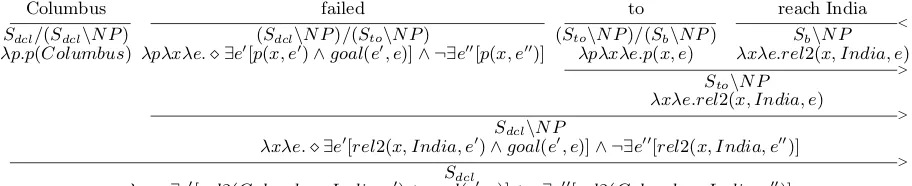
Columbus failed to reach India
<
Sdcl/(Sdcl\NP) (Sdcl\NP)/(Sto\NP) (Sto\NP)/(Sb\NP) Sb\NP
λp.p(Columbus) λpλxλe. ∃e0[p(x, e0)∧goal(e0, e)]∧ ¬∃e00[p(x, e00)] λpλxλe.p(x, e) λxλe.rel2(x, India, e)
>
Sto\NP
λxλe.rel2(x, India, e)
>
Sdcl\NP
λxλe. ∃e0[rel2(x, India, e0)∧goal(e0, e)]∧ ¬∃e00[rel2(x, India, e00)]
>
Sdcl
[image:4.595.72.528.62.155.2]λe. ∃e0[rel2(Columbus, India, e0)∧goal(e0, e)]∧ ¬∃e00[rel2(Columbus, India, e00)]
Figure 1: Output from our system for the sentenceColumbus failed to reach India
be expressed using implicative verbs like try or
fail. As the semantics of implicative verbs is of-ten complex (Karttunen, 1971), we propose hand-coding their lexical entries:
try `(S\NP)/(Sto\NP)
: λpλxλe.∃e0[goal(e, e0)∧p(x, e0)] fail `(S\NP)/(Sto\NP)
: λpλxλe.∃e0[goal(e, e0)∧p(x, e0)]∧
¬∃e00[goal(e, e00)∧p(x, e00)]
Theoperator is used to assert that the comple-ment oftryis a hypothetical proposition (sotry to reach6→reach). Our semantics forfailis the same as that for try, except that it asserts that the goal event did not occur in the real world.
These lexical entries allow us to make complex compositional inferences, for exampleColumbus failed to reach India now entails Columbus set out for India, Columbus tried to reach Indiaand
Columbus didn’t arrive in India.
Again, we expect that the improved model of formal semantics should increase the quality of the entailment graphs, by allowing us to only clus-ter predicates based on their real-world arguments (ignoring hypothetical events).
3 Conclusion
We have argued that several promising recent threads of research in semantics can be combined into a single model. The model we have described would enable wide-coverage mapping of open-domain text onto rich logical forms that model complex aspects of semantics such as negation, quantification, modality and tense—whilst also using a robust distributional model of lexical se-mantics that captures the structure of events. Con-sidering these interwined issues would allow com-plex compositional inferences which are far be-yond the current state of the art, and would give a more powerful model for natural language un-derstanding.
Acknowledgements
We thank Omri Abend, Michael Roth and the anonymous reviewers for their helpful comments. This work was funded by ERC Advanced Fellow-ship 249520 GRAMPLUS and IP EC-FP7-270273 Xperience.
References
M. Baroni, R. Bernardi, and R. Zamparelli. 2013. Frege in space: A program for compositional dis-tributional semantics. Linguistic Issues in Language Technologies.
Islam Beltagy, Cuong Chau, Gemma Boleda, Dan Gar-rette, Katrin Erk, and Raymond Mooney. 2013. Montague meets markov: Deep semantics with probabilistic logical form. pages 11–21, June.
Jonathan Berant, Ido Dagan, and Jacob Goldberger. 2011. Global learning of typed entailment rules. In Proceedings of the 49th Annual Meeting of the Association for Computational Linguistics: Human Language Technologies - Volume 1, HLT ’11, pages 610–619. Association for Computational Linguis-tics.
Johan Bos. 2008. Wide-coverage semantic analy-sis with boxer. In Johan Bos and Rodolfo
Del-monte, editors,Semantics in Text Processing. STEP
2008 Conference Proceedings, Research in Compu-tational Semantics, pages 277–286. College Publi-cations.
L. Karttunen. 1971. The Logic of English
Predi-cate Complement Constructions. Linguistics Club Bloomington, Ind: IU Linguistics Club. Indiana University Linguistics Club.
Mike Lewis and Mark Steedman. 2013. Combined
Distributional and Logical Semantics. Transactions
of the Association for Computational Linguistics, 1:179–192.
G.A. Miller. 1995. Wordnet: a lexical database for
english. Communications of the ACM, 38(11):39–
Marc Moens and Mark Steedman. 1988. Temporal
on-tology and temporal reference. Computational
lin-guistics, 14(2):15–28.
Richard Montague. 1973. The proper treatment of quantification in ordinary english. InApproaches to natural language, pages 221–242. Springer. Aju Thalappillil Scaria, Jonathan Berant, Mengqiu
Wang, Peter Clark, Justin Lewis, Brittany Harding, and Christopher D. Manning. 2013. Learning bi-ological processes with global constraints. In Pro-ceedings of EMNLP.
Mark Steedman. 2012. Taking Scope: The Natural
Semantics of Quantifiers. MIT Press.