Learning the hyperparameters to learn morphology
Stella Frank
ILCC, School of Informatics University of Edinburgh Edinburgh, EH8 9AB, UK
Abstract
We perform hyperparameter inference within a model of morphology learn-ing (Goldwater et al., 2011) and find that it affects model behaviour drastically. Changing the model structure successfully avoids the unsegmented solution, but re-sults in oversegmentation instead.
1 Introduction
Bayesian models provide a sound statistical framework in which to explore aspects of language acquisition. Explicitly specifying the causal and computational structure of a model enables the in-vestigation of hypotheses such as the feasibility of learning linguistic structure from the available in-put (Perfors et al., 2011), or the interaction of dif-ferent linguistic levels (Johnson, 2008a). However, these models can be sensitive to small changes in (hyper-)parameters settings. Robustness in this re-spect is important, since positing specific parame-ter values is cognitively implausible.
In this paper we revisit a model of morphol-ogy learning presented by Goldwater and col-leagues in Goldwater et al. (2006) and Goldwa-ter et al. (2011) (henceforth GGJ). This model demonstrated the effectiveness of non-parametric stochastic processes, specifically the Pitman-Yor Process, for interpolating between types and to-kens. Language learners are exposed to tokens, but many aspects of linguistic structure are lexical; identifying which tokens belong to the same lexi-cal type is crucial. Surface form is not always suf-ficient, as in the case of ambiguous words. More-over, morphology in particular is influenced by vocabulary-level type statistics (Bybee, 1995), so it is important for a model to operate on both lev-els: token statistics from realistic (child-directed) input, and type-level statistics based on the token analyses.
The GGJ model learns successfully given fixed hyperparameter values in the Pitman-Yor Process. However, we show that when these hyperparam-eters are inferred, it collapses to a token-based model with a trivial morphology. In this paper we discuss the reasons for this problematic be-haviour, which are relevant for other models based on Pitman-Yor Processes with discrete base dis-tributions, common in natural language tasks. We investigate some potential solutions, by chang-ing the way morphemes are generated within the model. Our results are mixed; we avoid the hyper-parameter problem, but learn overly compact mor-pheme lexicons.
2 The Pitman-Yor Process
The Pitman-Yor ProcessG∼PYP(a, b, H0)
(Pit-man and Yor, 1997; Teh, 2006) generates distribu-tions over the space of the base distribution H0,
with the hyperparameters a and b governing the extent of the shift fromH0. Draws fromG have
values from H0, but with probabilities given by
the PYP. For example, in a unigram PYP language model with observed words, H0 may be a
uni-form distribution over the vocabulary,U(T1). The PYP shifts this distribution to the power-law dis-tribution over tokens found in natural language, allowing words to have much higher (and lower) than uniform probability. We will continue using the language model example in this section, since the subsequent morphology model is effectively a complex unigram language model in which word types correspond to morphological analyses. In our presentation, we pay particular attention to the role of the hyperparametera, since this value gov-erns the power-law behaviour of the PYP (Buntine and Hutter, 2010).
When G is marginalised out, the result is the PYP Chinese Restaurant Process, which is a use-ful representation of the distribution of observa-tions (word tokens) to values fromH0 (types). In
this restaurant, customers (tokens) arrive and are seated at one of a potentially infinite number of tables. Each table receives a dish (type) from the base distribution when the first customer is seated there; thereafter all subsequent customers adopt the same dish. The probability of customerzi be-ing seated at a tablekdepends on the number of customers already seated at that table nk. Popu-lar tables will attract more customers, generating a Zipfian distribution over customers at tables.
This Zipfian/power-law behaviour can be simi-lar to that of the natural language data, and is the principal motivation behind using the PYP. How-ever, it is only valid for the distribution of cus-tomers to tables. When the base distribution is dis-crete — as in our language model example and the morphology model — the same dish may be served at multiple tables. In most cases, the dis-tribution of interest is generally that of customers (tokens) to dishes (types), rather than to tables, suggesting a preference for a setting in which each dish appears at few tables. This is dependent ona (constrained to be0 ≤a <1), and to a lesser ex-tent onb: Ifais small, each dish will be served at a single table, resulting in the type-token and the table-customer power-laws matching. Ifais near 1, however, the probability of more than a single customer being seated at a table is small, and the distribution of dishes being eaten by the customers will match the base distribution, rather than being adapted by the caching mechanism of the PYP.
The expected number of tables K grows as O(Na)(see Buntine and Hutter (2010) for an ex-act formulation). The number of word types in the data gives us a minimum number of tables, K ≥T. Whenais small (less than 0.5), the num-ber of expected tables is significantly less than the number of types in a non-trivial dataset, suggest-ing a lower bound for values ofa.
In our language model, the posterior probability of assigning a wordwito a tablekwith dish`kand nkprevious customers is:
p(wi(=k|w1. . . wi−1, a, b)∝ (1)
(nk−a)I(wi =`k) if1≤k≤K
(Ka+b)H0(wi) ifk=K+ 1
where I(wi = `k) returns 1 if the token and the dish match, and 0 otherwise. We see that in order to prefer assigning customers to already occupied tables, we needH0(w)(Ka+b)< nk−a. Given
K ≥ T, and setting H0 = T1, we can
approxi-mate this with 1
T(T a+b) < nk −a. From this we obtaina < 1
2(nk−Tb), which indicates that in order for tables with a single customer (nk= 1) to attract further customers, amust be smaller than 0.5. Thus, there is a tension between the number of tables required by the data and our desire to reuse tables. One solution is to fix a to an arbi-trary, sufficiently small value, as GGJ do in their experiments. In contrast, in this paper we infer a andbalong with the other parameters, and change the other free variable, the base distributionH0.
3 Morphology
The morphology model introduced by GGJ has a base distribution that generates not simply word types, as in the language model example, but mor-phological analyses. These are relatively simple, consisting of stem+suffix segmentation and a clus-ter membership. The probability of a word is the sum of the probability of all clusterc, stems, suf-fixf tuples:
H0(w) =
X
(c,s,f)
p(c)p(s|c)p(f|c)I(w=s.f)
(2) with the stems and the suffixes being gener-ated from cluster-specific distributions. In the GGJ model, all three distributions (cluster, stem, suffix) are finite conjugate symmetric Dirichlet-Multinomial (DirMult) distributions. We retain the DirMult over clusters, but change the morpheme-generating distributions.
The DirMult is equivalent to a Dirichlet Process prior (DP) with a finite base distribution; we use this representation because it allows us to replace the base distributions flexibly. A DP(α, H0)is also
equivalent to a PYP witha= 0, and thus also can be represented with a Chinese Restaurant Process, but in this case we sum over all tables to obtain the predictive probability of a (say) stem:
p(s|αs, HS) = Pms+αsHS
s0ms0 +αs (3) Note that the countsms refer to stems generated within the base distribution, not to token counts within the PYP.
The original GGJ model,ORIG, is equivalent to settingHSfor stems toU(S1), and likewiseHF = U(1
There are two difficulties with this model. Firstly, it assumes a closed vocabulary and re-quires settingS andF in advance, by looking at the data. As a cognitive model, this is awkward, since it assumes a fixed, relatively small number of possible morphemes.
Secondly, when the PYP hyperparameters are inferred,ais set to be nearly 1, resulting in a model with as many tokens as tables. This behaviour is due to the interaction between vocabulary size and base distribution probabilities outlined in the pre-vious section: this base distribution assigns rel-atively high probability to words, so new tables have high probability; as the number of tables in-creases (from its fairly large minimum), the op-timalafor this table configuration also increases, resulting in convergence at the token-based model. We investigate two alternate base distribution over stems and suffixes, both of which extend the space of possible morphemes, thereby lowering the overall probability of the observed words.
DP-CHAR generates morphemes by first
gener-ating a length l ∼ Poisson(λ). Characters are then drawn from a uniform distribution, c0...l ∼ U(1/|Chars|). A morpheme’s prob-ability decreases exponentially by length, re-sulting in a strong preference for shorter mor-phemes.
DP-UNI simply extends the original uniform
dis-tribution to sand f ∼ U(1/1e6), in effect moving probability mass to a large number of unseen morphemes. It is thus similar to DP-CHARwithout the length preference.
4 Inference
We follow the same inference procedure as GGJ, using Gibbs sampling. The sampler iterates be-tween inferring each token’s table assignment and resampling the table labels (see GGJ for details).
Within the morphology base distribution, the prior for the DirMult over clusters is set toαk =
0.5. To replicate the original DirMult model1, we
setαs = 0.001S andαf = 0.001F. In the other models,αs = αf = 1. WithinDP-CHAR,λ = 6 for stems, 0.5 for suffixes.
1In this model, the predictive posterior is defined as
p(s|α, S) = ms+α
m.+Sα, using an alternate definition ofα.
Eve (Orth.) Ornat (Orth.) a Tables/Type a Tables/Type ORIG 0.96 21.2 0.97 10.64 DP-CHAR 0.46 1.4 0.56 1.17 DP-UNI 0.81 7.3 0.70 2.33
Table 1: Final values foraon the orthographic En-glish and Spanish datasets, as well as the average number of tables for each word type. The 95% confidence interval across three runs is ≤ 0.01. (Phonological Eve is similar to Orthographic Eve.)
4.1 Sampling Hyperparameters
We sample PYP a and b hyperparameters using a slice sampler2. Previous work with this model
has always fixed these values, generally finding small a to be optimal and b to have little effect. In experiments with fixed hyperparameters, we set a=b= 0.1.
To sample the hyperparameters, we place vague priors over them: a ∼ Beta(1,1) and b ∼
Gamma(10,0.1). The slice sampler samples a new value foraandbafter every 10 iterations of Gibbs sampling.
5 Experiments
5.1 Datasets
Our datasets consist of the adult utterances from two morphologically annotated corpora from CHILDES, an English corpus, Eve (Brown, 1973), and a Spanish corpus, Ornat (Ornat, 1994). Mor-phology is marked by a grammatical suffix on the stem, e.g.doggy-PL. Words marked with irregular morphology are unsegmented.
The two languages, while related, have differ-ing degrees of affixation: the English Eve corpus consists of 63 315 tokens (5% suffixed) and 1 988 types (28% suffixed); the Ornat corpus has 43 796 tokens (23% suffixed) and 3 157 types (50% suf-fixed). The English corpus has 17 gold suffix types, while Spanish has 72.
We also use the phonologically encoded Eve dataset used by GGJ. This dataset does not ex-actly correspond to the orthographic version, due to discrepancies in tokenisation, so we are unable to evaluate this dataset quantitatively.
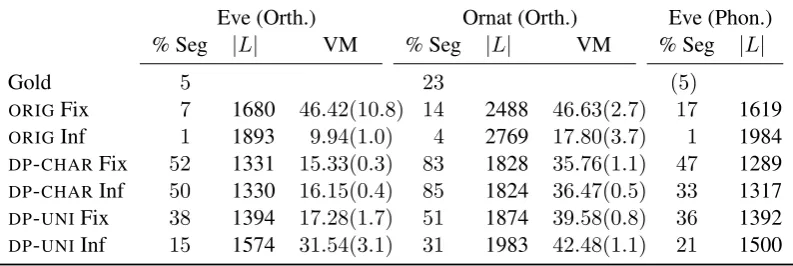
Eve (Orth.) Ornat (Orth.) Eve (Phon.) % Seg |L| VM % Seg |L| VM % Seg |L|
Gold 5 23 (5)
ORIGFix 7 1680 46.42(10.8) 14 2488 46.63(2.7) 17 1619
[image:4.595.101.498.64.197.2]ORIGInf 1 1893 9.94(1.0) 4 2769 17.80(3.7) 1 1984 DP-CHARFix 52 1331 15.33(0.3) 83 1828 35.76(1.1) 47 1289 DP-CHARInf 50 1330 16.15(0.4) 85 1824 36.47(0.5) 33 1317 DP-UNIFix 38 1394 17.28(1.7) 51 1874 39.58(0.8) 36 1392 DP-UNIInf 15 1574 31.54(3.1) 31 1983 42.48(1.1) 21 1500
Table 2: Final morphology results. ‘Fix’ refers to models with fixed PYP hyperparameters (a=b= 0.1), while ‘Inf’ models have inferred hyperparameters. % Seg shows the percentage of tokens that have a non-null suffix, while|L|is the size of the morpheme lexicon. VM is shown with 95% confidence intervals.
5.2 Results
For each setting, we report the average over three runs of 1000 iterations of Gibbs sampling without annealing, using the last iteration for evaluation.
Table 1 shows what happens when hyperpa-rameters are inferred: ORIG finds a token-based solution, with as many tables as tokens, while DP-CHARis the opposite, with a smallaallowing for just over one table for each word type.DP-UNI is between these two extremes. b is consistently between 1 and 3, confirming it has little effect.
The effect of the hyperparameters can be seen in the morphology results, shown in Table 2. DP-CHAR is robust across hyperparameter val-ues, finding the same type-based solution with fixed and inferred hyperparameters, while the other models have very different results depending on the hyperparameter settings. ORIG with fixed hyperparameters performs best, with the highest VM score (a clustering measure, Rosenberg and Hirschberg (2007)) and a level of segmentation close to the correct one. However, with inferred hyperparameters, this model severely underseg-ments: it finds the unsegmented maximum likeli-hood solution, where all tokens are generated from the stem distribution (Goldwater, 2007).
The models with alternate base distributions go to the other extreme, oversegmenting the corpus. As generating new morphemes becomes less prob-able, the pressure to find the most compact mor-pheme lexicon grows. This leads to oversegmen-tation due to many spurious suffixes. The length penalty inDP-CHARexacerbates this problem, but it can be seen in the DP-UNI solutions as well, particularly when hyperparameters are fixed to en-courage a type-based solution.
6 Conclusion
The base distribution in the original GGJ model assigned a relatively high probability to unseen morphemes, allowing the model to generate new analyses for seen words instead of reusing old analyses and leading to undersegented token-based solutions. The alternative base distributions proposed here were effective in finding type-based solutions. However, these over-segmented solu-tions clearly do not match the true morphology, indicating that the model structure is inadequate.
One reason may be that the model structure is overly simple. The model is faced with an ar-guably more difficult task than a human learner, who has access to semantic, syntactic, and phono-logical cues. Adding these types of information has been shown to help morphology learning in similar models (Johnson, 2008b; Sirts and Gold-water, 2013; Frank et al., 2013).
References
Roger Brown. A first language: The early
stages. Harvard University Press, Cambridge,
MA, 1973.
Wray Buntine and Marcus Hutter. A Bayesian view of the Poisson-Dirichlet process. 2010. URLarXiv:1007.0296.
Joan Bybee. Regular morphology and the
lexi-con. Language and Cognitive Processes, 10:
425–455, 1995.
Stella Frank, Frank Keller, and Sharon Goldwater. Exploring the utility of joint morphological and syntactic learning from child-directed speech.
InProceedings of the 18th Conference on
Em-pirical Methods in Natural Language
Process-ing (EMNLP), 2013.
Sharon Goldwater.Nonparametric Bayesian
Mod-els of Lexical Acquisition. PhD thesis, Brown
University, 2007.
Sharon Goldwater, Thomas L. Griffiths, and Mark Johnson. Interpolating between types and to-kens by estimating power-law generators. In
Advances in Neural Information Processing
Systems 18, 2006.
Sharon Goldwater, Thomas L. Griffiths, and Mark Johnson. Producing power-law distributions and damping word frequencies with two-stage language models. Journal of Machine Learning
Research, 12:2335–2382, 2011.
Mark Johnson. Using Adaptor Grammars to iden-tify synergies in the unsupervised acquisition of linguistic structure. InProceedings of the 46th Annual Meeting of the Association for
Compu-tational Linguistics (ACL), 2008a.
Mark Johnson. Unsupervised word segmentation for Sesotho using Adaptor Grammars. In Pro-ceedings of the Tenth Meeting of ACL Special Interest Group on Computational Morphology
and Phonology, pages 20–27, June 2008b.
Yoong Keok Lee, Aria Haghighi, and Regina Barzilay. Modeling syntactic context improves morphological segmentation. InProceedings of Fifteenth Conference on Computational Natural
Language Learning (CONLL), 2011.
S. Lopez Ornat. La adquisicion de la lengua
es-pagnola. Siglo XXI, Madrid, 1994.
Amy Perfors, Joshua B. Tenenbaum, and Terry
Regier. The learnability of abstract syntactic principles. Cognition, 118(3):306 – 338, 2011. Jim Pitman and Marc Yor. The two-parameter
Poisson-Dirichlet distribution derived from a stable subordinator. Annals of Probability, 25 (2):855–900, 1997.
Hoifung Poon, Colin Cherry, and Kristina Toutanova. Unsupervised morphological segmentation with log-linear models. In
Proceedings of the Conference of the North American Chapter of the Association for
Computational Linguistics (NAACL), 2009.
Andrew Rosenberg and Julia Hirschberg. V-measure: A conditional entropy-based external cluster evaluation measure. In Proceedings of the 12th Conference on Empirical Methods in
Natural Language Processing (EMNLP), 2007.
Kairit Sirts and Tanel Alum¨ae. A hierarchical Dirichlet process model for joint part-of-speech and morphology induction. In Proceedings of the Conference of the North American Chapter of the Association for Computational
Linguis-tics (NAACL), 2012.
Kairit Sirts and Sharon Goldwater. Minimally-supervised morphological segmentation using adaptor grammars.Transactions of the
Associa-tion for ComputaAssocia-tional Linguistics, 1:231–242,
2013.
Yee Whye Teh. A hierarchical Bayesian language model based on Pitman-Yor processes. In Pro-ceedings of the 44th Annual Meeting of the
As-sociation for Computational Linguistics (ACL),