1
FOREWORD 3
BIOGRAPHIES OF THE INTERNATIONAL STEERING COMMITTEE 5
PART 1 9
Report of the International Steering Committee 9
PART 2 21
Reports of International Site Visitors 21
Contribution from the Business Sector 45
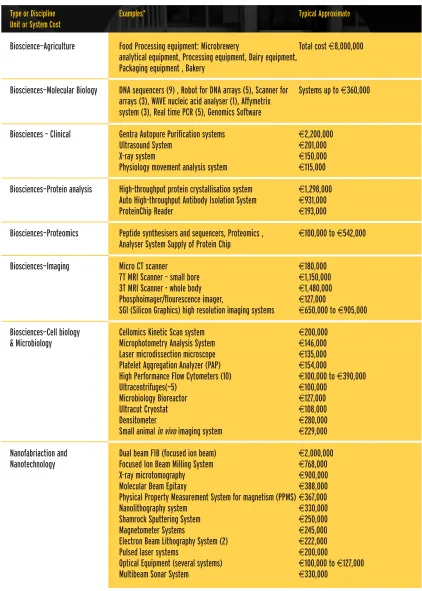
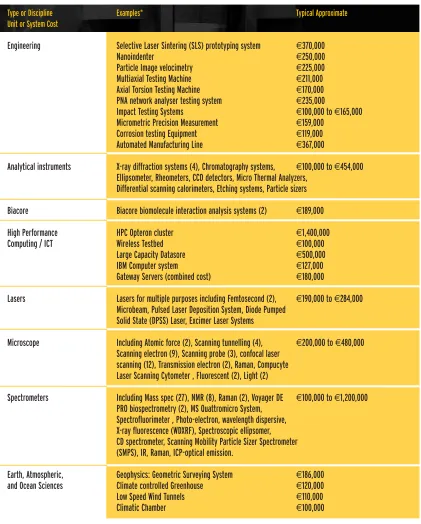
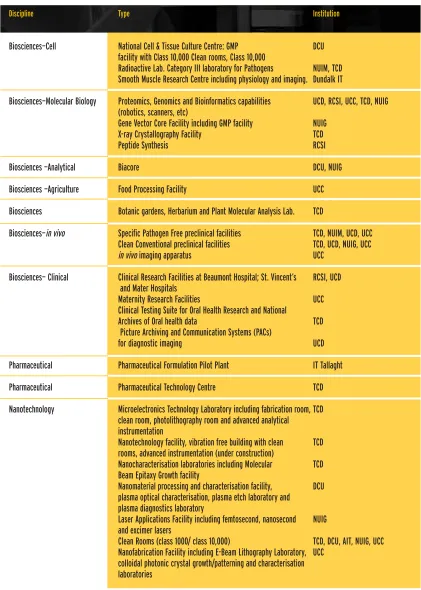
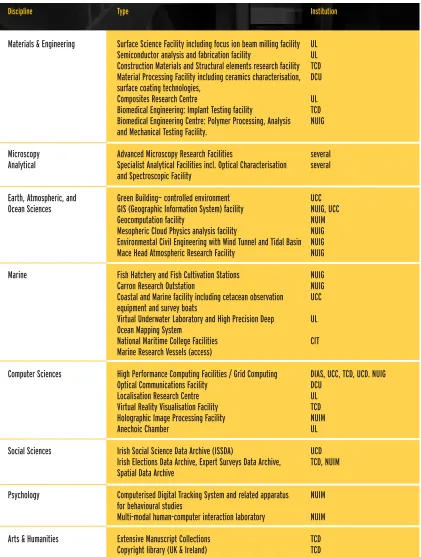
Data and Information on Existing Research Infrastructure 51
APPENDICES 57
Appendix 1 Outline and Overview of the Process 58
Appendix 2 List of International Site Visitors 60
Appendix 3 List of Contributors to the Review 62
Appendix 4 Acronyms & Abbreviations 64
Appendix 5 Higher Education Authority Members 67
3
In early summer 2006, the Higher EducationAuthority (HEA) and Forfás agreed to conduct a review of the research infrastructure in Ireland. The purpose of the review was to internationally benchmark the research infrastructure in the higher-education sector in particular and to identify gaps in the national platform of research infrastructure, which could be addressed in the short to medium term. The review was conducted mindful of the goals, objectives and enhanced investment proposed in the Government’s Strategy for Science, Technology and Innovation, 2006–2013 (SSTI) published in June, and of the new National Development Plan 2007–2013 (NDP).
Review Process
A key feature of the process was the appointment of an independent international Steering Committee, which had oversight of the comprehensive process review of research infrastructures in ten broad disciplinary areas covering the spectrum of research activity in Ireland. The review included the preparation of a database of the existing infrastructure in the higher education sector, which built upon earlier work of the Capital Review and Prioritisation Group (‘Kelly Review’—September 2004). A consultation questionnaire was prepared and submissions were sought from a range of stakeholders. An advertisement was also placed in the national press welcoming submissions from all those who wished to engage with the review.
Through this process inputs were received across the spectrum of national research activity and across a wide range of stakeholders (see Appendix 3). The HEA and Forfás are grateful for the many submissions received from stakeholders, a significant effort having been made by researchers, higher-education institutions, funders, policy bodies, government agencies and departments to provide detailed submissions in support of this exercise in a short time-frame.
In addition, thirty-four international experts conducted visits across a sample of research infrastructures in the higher education sector. In the region of 50 per cent of all research infrastructure was visited. These visits provided the independent international benchmark for our research infrastructure and were invaluable to the process. We sincerely thank those international experts who gave of their time and expertise to assist us with this important national exercise.
A special workshop was organised to obtain inputs from the business and enterprise sector with knowledge of the existing research infrastructure base. There was a high level of congruence between the views of the enterprise sector on key gaps and needs, and that of the international reviewers.
The outcomes from the site visits and the emerging findings from the process were presented and discussed at a specially convened Forum at Croke Park in late October. This event provided an opportunity for the international Steering Committee to get feedback and engage with the Irish research community in advance of the conclusion of the process.
Findings and Conclusions
In short, the Steering Group’s key finding is that notwithstanding the significant investment of funds in research infrastructure since 1998, and the remarkable transformation of the Irish research landscape since that time, weaknesses exist and gaps remain in the higher-education and national research infrastructure. This finding, in the context of the lack of investment prior to 1998, means in effect that we are still in ‘catch up’ mode whilst at the same time trying to compete with our international competitors. The gaps and weaknesses identified in the review require to be addressed in the context of the enhanced investment in R&D announced by the Government in June 2006 under the SSTI if Ireland is to achieve its potential.
4
Encouragingly the Steering Group’s report has demonstrated that there is sufficient strength in many areas to be used as a foundation on which to build critical mass but importantly raises concerns in a number of instances where there has been a lack of investment in spite of the strategic importance of the area nationally. The biosciences area has received significant investment in recent years, but is still in need of investment in basic infrastructure requirements. This is also the case in the relation to chemistry. There are significant renewal requirements in the areas of physical sciences and mathematics, earth sciences and engineering. In the creative arts, humanities and social sciences, space provision and data management and archiving facilities need to be developed in way that promotes collaboration in research and excellence in scholarship. Similarly, there is urgent need for expansion and upgrade of the HEANet research support infrastructure to continue to support the ever more complex needs of researchers.There are of course also areas where the need was not as clear from the range of stakeholders and where further work will be required to validate needs. HEA and Forfás are committed to facilitating further examinations of gaps and needs at the micro level, and further stakeholder consultation will be necessary. This review is the start of an on-going process and subsequent revisions will be vital to better define priorities for sectors or cross-cutting themes identified for further investigation. Decisions will be made early
in 2007 on a number of areas due for further examination.
This broad review of Ireland’s research infrastructure needs, and any future review, will also have to be cognisant of developments and opportunities at the European level, whilst also building a strong national infrastructure which will attract and retain quality researchers.
Finally on behalf of the HEA and Forfás, we would like to express our gratitude to the members of the Steering Committee, Professor Ken Pounds, Professor Roger Jowell, Dr. Anneli Pauli and Ms Eeva Ikonen, and in particular to the Chairman of the Group, Dr. Hans Chang. They have completed a difficult task in a limited period of time. Thanks also to Dr. Tom Higgins, who was the Secretary to the Committee, and to Dr. Eucharia Meehan (HEA) and Mr. Declan Hughes (Forfás), and their respective teams, who supported the process.
In conclusion this report will now become a key guiding document for forthcoming cycles of the PRTLI and will be presented to Government through the implementation structures for the SSTI. We look forward to working with all stakeholders in moving forward to establish a strong research infrastructure for Ireland.
Michael Kelly / Martin Cronin
RE
SEARCH INFR
A
S
TRUC
TURE IN IRELAND
BUILD
ING F
OR T
OMORRO
W
>
>
BIOGRAPHIES OF THE
INTERNATIONAL
STEERING COMMITTEE
6
DR. HANS CHANG CHAIRMAN
Dr. Hans Chang is Director of the Foundation for Fundamental Research on Matter (FOM). FOM is the national coordinating research organization in the field of physics, mainly financed by the Dutch national research council, NWO. The organisation runs four national laboratories and also acts as a funding agency for physics projects executed in the science departments of Dutch universities. Hans Chang holds a Ph.D. in physics (condensed matter, 1972) from the University of Amsterdam. Subsequent to the completion of this he published a number of studies dealing with scientific issues. Thereafter he moved into affairs of national science policy at the Dutch Ministry of Education and Science. Since 1985 he has occupied the position of Director of FOM. In this capacity he is also Director of the Physics Division of NWO. He publishes regularly on science policy matters.
He was the inaugural Chairman of the European Union of Physics Research Organisations (EURPRO)—a union of the physics divisions of European national research councils; the first Chairman of the COST technical committee on physics, a Vice-Chairman of the OECD Global Science Forum, and the inaugural Chairman of the European Strategy Forum on Research Infrastructures (ESFRI). Within these bodies he continues to serve as the Dutch delegate. He has been a member of international panels evaluating research agencies and he is the Dutch delegate in several other international scientific bodies.
PROFESSOR KENNETH POUNDS, CBE
Professor Kenneth Alwyne Pounds, CBE, FRS is Emeritus Professor of Physics at the University of Leicester.
He was born in Bradford, Yorkshire, and gained his B.Sc. and Ph.D. from University College London. He then moved to the University of Leicester as an Assistant Lecturer in 1960. He became Deputy Director of Space Research in 1967, and was one of the pioneers of using rockets and satellites for research in the U.K.. He subsequently became the inaugural Director of the X-ray Astronomy group in 1974. His research is in the area of active galaxies, and one of his many discoveries is that black holes are common in the universe.
Ken Pounds became Professor of Space Physics at the University of Leicester in 1973. He was appointed Head of the Department of Physics in 1986, and the following year he took the decision to merge the Physics and the Astronomy Departments to create the present Department of Physics and Astronomy.
He has been a member of the Science and Engineering Research Council, 1980–1984, and President of the Royal Astronomical Society, 1990–2002, and he was seconded as the first Chief Executive of the newly-formed Particle Physics and Astronomy Research Council, 1994–1998, following the restructuring of the Research Councils. He then returned to the University of Leicester as Head of Department until his retirement in 2002. He remains active in the Department as a Research Fellow.
7
PROFESSOR ROGER JOWELL, CBEProfessor Roger Jowell is a British academic social scientist. He is a Research Professor at City University London from where he heads the Centre for Comparative Social Surveys. The Centre houses the 30-nation European Social Survey, a multi-funded European time series, which he initiated and still coordinates. Prior to joining City University he was the founder-Director of the National Centre for Social Research, now Britain’s largest non-profit research institute which he headed for over 30 years.
An elected member of the International Statistical Institute and a founding Academician of the U.K. Academy of Social Sciences, he was awarded a CBE in 2001 for services to social science. He is also a recent Vice-President of the U.K.’s Royal Statistical Society and a Descartes Prize Laureate in 2005 “for excellence in collaborative scientific research”.
His primary research interests are in social and political attitudes and survey methodology. His writing has focused primarily on Britain’s and Europe’s changing social condition, and his publications include a text-book on survey methods, eighteen edited books on changes in British social attitudes, and four co-authored books on British electoral behaviour.
DR. ANNELI PAULI
Since 2001, Dr. Anneli Pauli has been Vice-President of the Academy of Finland, responsible for matters concerning science policy and funding as well as for international cooperation. Before that she worked as Secretary General of the Research Council for Environment and Natural Resources, and also had responsibility for the implementation and development of the Finnish Centre of Excellence Programmes. Dr. Pauli completed her doctoral thesis in 1994 at the University of Helsinki. Her field of research is aquatic microbiological ecology.
8
MS. EEVA IKONEN
ASSOCIATE STEERING COMMITTEE MEMBER
Ms. Eeva Ikonen is a Senior Science Adviser at the Academy of Finland and a Member of the ESFRI Executive Board since 2005. She has lengthy and wide experience in Finnish research and higher-education policy, both at the ministerial level and in the funding agency (Academy of Finland) for basic research, as well as in university administration. Her expertise in management and administration has been put to good use in the Research Council for Environment, the Research Council for Natural Sciences and Engineering, and in the International Relations Unit of the Academy of Finland. She had an active role when Finland joined EMBL, ESRF, CERN and ESA. When Japan joined the EISCAT Scientific Association, and when the new EISCAT Svalbard radar was planned and constructed, she acted as Chair of the Finance Committee of the Association.
RE
SEARCH INFR
A
S
TRUC
TURE IN IRELAND
BUILD
ING F
OR T
OMORRO
W
>
PART 1
REPORT OF THE
INTERNATIONAL
STEERING COMMITTEE
10
Our task has been to review the status of research infrastructure in the higher-education sector in Ireland and make recommendations for future support. We have received reports from site visits and had oral and written evidence from across the sector.
We have found a research system in impressive transition as a result of the major injection in funds over the past few years. This investment is beginning to transform the research base in Ireland, supporting a growing influence and recognition in the now-global research enterprise.
However given the historical deficits in infrastructure funding, Ireland is still some way behind other developed nations competing and collaborating in international research programmes. Recent investments have had a strong positive impact, but these investments must be properly supported and maintained. It is also important to recognize that the research base remains narrow at the highest international level.
Building on the progress to date will require the Irish authorities to balance several competing and critical demands on new investment funds. These cover:
• Consolidation of the investments recently made so as to ensure their full and effective exploitation
• Broadening the base of research in the Irish higher-education sector
• Investing for rapid development in specific, high-priority areas
Accordingly we recommend for consideration by the relevant authorities:
• A restructured PRTLI that will accommodate support for new proposals and for existing investments, as well as for pre-determined infrastructures, disciplines or areas, on an open competitive basis
• Re-instatement of the mechanism formerly operated by the HEA for replacement, updating and renewal of research equipment
• Discussion within research groups, and with the HEA and Forfás, of both the general and specific issues (identified in Section 3 below) pertaining to the development of proposals for future rounds of infrastructure investment
11
1. INTRODUCTIONWe were invited by the Higher Education Authority (the higher-education policy and funding body) and Forfás (the science and technology policy body) of Ireland to assist in a review of research infrastructures in the Irish higher-education sector. Our review is based on findings from site visits, carried out by international experts, to a cross-section of higher-education institutions; on survey results, and on inputs from funders, policy bodies and other stakeholders in the research domain in Ireland.
We particularly appreciate the reports of the site visit teams and the contributions from representatives of a wide range of research and research-related bodies in attendance at a specially-organised Consultation Forum at Croke Park on Monday 23rd October 2006.
Our task was to provide an overview of the quality of facilities currently available to third-level researchers and to identify gaps in the existing infrastructures that are most in need of attention in forthcoming rounds of national infrastructure funding under the SSTI (Strategy for Science, Technology and Innovation).1
The process adopted by the Committee for this purpose is outlined in Appendix 1.
We are pleased to acknowledge the assistance provided by the joint HEA/Forfás project team in facilitating our work and the highly professional manner in which this assistance was provided.
The Committee comprised:
Dr. Hans Chang, Director of the Dutch physics research organisation, FOM, and first Chairman of the European Strategy Forum on Research Infrastructures (ESFRI).
Professor Ken Pounds, Emeritus Professor of Physics, University of Leicester and former Chief Executive of the U.K. Particle Physics and Astronomy Research Council.
Professor Roger Jowell, Head of the Centre for Comparative Social Surveys, City University, London.
Dr. Anneli Pauli, Vice President (Research), Academy of Finland, Finnish ESFRI delegate.
Ms. Eeva Ikonen(Associate member), Senior Science Advisor, Academy of Finland, ESFRI Board member and Finnish delegate.
In order to meet the schedule established by the Irish authorities, our examination had to be undertaken within an unusually constrained time frame. Thus while we have been able to address our set agenda and make specific recommendations, we feel that there are other issues that would benefit from consultation within the various research groups and stakeholder communities in Ireland. These are identified in our report and we commend them for further discussion and analysis.
We have adopted the broadly based ESFRI definition of infrastructure.2 This covers both physical facilities and equipment, including the associated human resources, as well as the soft infrastructure (collections, databases, archives, networks, processes etc) and includes the support personnel and services required for exploitation of infrastructure.
We have been apprised of government ambitions for Irish research, as expressed in recent public policy documents, and we applaud these. The challenges are formidable, but not beyond achievement. We hope that the outcome of this initial and broadly-based review will be of help. However we believe that a more detailed examination and evaluation of requirements will be necessary, sector by sector, to ensure that the essential further investments are soundly based. We recommend the establishment of systematic and periodic review processes for research infrastructure in the future.
Finally we wish to express our strongly-held view that, in any discussion about infrastructure metrics and deficits, it is critical that the focus is on quality rather than quantity. Academic research is now a highly competitive global enterprise and requires high-quality performance. Only the best research is good enough and, of course, the best research and education require a first-rate research infrastructure.
>
Main Report
1Strategy for Science, Technology and Innovation 2006–2013 (Government of Ireland, 2006)
12
2. THE STORY SO FAR
The Committee is aware that it is examining a work in progress.
In recent years the Irish authorities have made a major commitment to strengthening the research base in the higher-education sector and a substantial capacity building process is now underway. The commitment was first given expression with the launch of the Programme for Research in Third-Level Institutions (PRTLI) in 1998, which was a landmark event. Subsequent funding through this mechanism alone has provided in excess of €600 million, largely for support of new research infrastructure. We find evidence that this injection, together with new funding following the establishment of Science Foundation Ireland (SFI) and the two new Research Councils, is dramatically changing the research landscape in Ireland.
Higher-education research infrastructure in Ireland in 1998 and prior to the PRTLI, was characterised by chronic public under-investment and a consequent heavy reliance on support from the rest of Europe. We were told that researchers had to chase funding wherever they could find it, usually outside the country, and fiercely compete with one another for the meagre domestic funding that was available. It was apparently not unknown for researchers to have to shift fields and
specialties more than once in order to qualify for funding. As a result, the direction of research in Ireland in this period was inchoate and set more by international agendas than by domestic priorities. Of necessity, Irish academic research was opportunistic rather than strategic in its direction. In effect, much depended on the ‘lone scholar’ model of research. There was inadequate opportunity for planning or priority setting or for strategy formulation and little necessity for a planned approach anyway, given the paucity of national funding available. As their counterpart institutions in Europe and beyond moved progressively towards a more professional and strategic basis for research investment, the Irish institutions were falling well behind. The institutions themselves had too little influence on the content or overall direction of the research undertaken within them.3
In the PRTLI Impact Assessment (2004) Banda and his team reported significant improvements in both the volume and quality of research output, in institutional capacity, and in international competitiveness.4
13
function, especially in the way they planned andmanaged their research. Thus whilst, pre-1998, only one institution had a published research strategy, twelve such strategies were found by Banda in 2004. Similarly whilst, pre-1998, only two institutions had a senior designated Vice-President or Dean for Research, seven such posts had been established by 2004. We have the impression now that virtually all third-level institutions provide strategic plans for research and have a high-level dedicated research administrator. Banda noted evidence of stronger interdisciplinary and inter-institutional collaboration, concluding that the PRTLI was transforming the higher-education research landscape in Ireland.
Based on the findings presented to us, we are persuaded that the improvements noted by Banda and his team in 2004 are continuing and becoming embedded in Ireland’s research system. Today, as a result of the infrastructure injection beginning in 1998, the situation has been substantially transformed. Research institutions in Ireland are now able to set their research agendas and prioritise their strengths, while individual researchers and institutions can collaborate on shared programmes for the benefit of scholarship across Ireland. A collaborative culture is establishing itself. As a result, institutions and researchers have significantly more discretion in the choice of research topics, and are thereby more able to
compete internationally in many fields. In addition Irish research groups are more attractive international partners and are more pro-active in putting together teams for international competition.
In summary, progress over a relatively short period has been extraordinary. It is however vital that the present momentum is maintained as there is still much to do.
3Comparative International Assessment of the Organisation, Management and Funding of University Research in Ireland and
Europe (The Higher Education Authority, 1996).
14
3. WHERE IS IRELAND NOW—A REALITY CHECK
Based on the information received during our Review, we have formulated a number of general and specific conclusions as to the current state of research infrastructure in Ireland. In developing these conclusions we have had access to the views and concerns of a wide cross-section of senior researchers at the institutions. We have been provided with the judgments of the institutions themselves on their existing infrastructures. Our calibration of these views and opinions has been greatly assisted by the reports from the international site visitors. We also had available many written inputs from a wide range of stakeholders and the outcome of a debate at the specially convened Enterprise Forum. Finally, we had the benefit of a day of dialogue with senior representatives of the research system at the aforementioned meeting at Croke Park.
Reports on the site visits by international experts are provided in Part 2.
Based largely, but not exclusively, on these inputs, we have formed the following general conclusions:
Facilities and Space
• There remains a patchy landscape of research facilities, with new state-of-the-art facilities co-existing in some locations with buildings/facilities which are in poor condition and not fit-for-purpose. Site layout and usage of both new and old buildings needs to be addressed in many discipline areas.
• Space limitations, even in some of the newer facilities, mean that many are already at their maximum capacity. Overcrowding was particularly identified in the physical sciences and engineering, and is seen as a barrier to the attraction of international researchers, even at a number of high-profile, successful centres. The space problem is also causing the fragmentation of existing research groups.
• The current space allocation model is believed by many researchers to be out-dated and should be reviewed.
15
Foundation Infrastructure• IT systems, computing services, and e-infrastructure, and the maintenance thereof, are generally deficient. The lack of common IT networks and platforms and of wireless access were high-lighted. High-end computing capability is generally weak, affecting many research areas, especially in the medical sciences, humanities, physical sciences and mathematics. Site visitors frequently commented that computation and data-analysis facilities were not adequate for first-class research.
• Deficiencies in data-management infrastructure were noted in the life sciences, medical sciences, physical sciences, engineering, earth, atmospheric and ocean sciences, and in the social sciences.
• Data archives and repositories remain at an early developmental stage—data access (to existing national and international sources) and data acquisition (storage and updating across the spectrum of disciplines/areas) is weak. These issues emerged strongly in the medical and social sciences areas.
• The absence of adequate library provision in general was identified, but in particular in the arts and humanities.
• On the positive side, HEANet, Ireland’s National Education and Research Network, was cited consistently as a strength of the national research infrastructure. It provides a high-speed national network with direct connectivity for its community (the educational research sectors) to other networks world-wide.
Support infrastructure
• The technical and administrative support systems needed to underpin effective research performance were found to be inadequate in a majority of the sites visited.
• High-end technical support, frequently at Ph.D. level, for servicing, maintenance and operation of complex facilities and operations is needed. The case for permanent technical staff for this purpose was made during many site visits, especially in the areas of the physical sciences, earth, atmospheric and ocean sciences, and biological sciences.
16
Equipment
• Whilst there is an expanding equipment portfolio in the higher-education institutions, much remains in urgent need of replacement. This issue was high-lighted particularly in the areas of earth, atmospheric and ocean sciences and in chemistry, but is an issue across many areas.
• While very large equipment can be obtained under the PRTLI, and some small equipment from other funders, there has been no dedicated equipment fund for new acquisitions and updating—especially of small and middle-sized items—since the closure of the earlier HEA fund (the Large Equipment Grant). As most national funding agencies nowadays have such a fund, the Committee suggests new arrangements to cover these needs on an on-going basis.
• The flow of funds for the maintenance of research equipment was also found to be a major issue in many discipline areas. It was particularly critical in biological and medical sciences and in physical sciences.
We also wish to draw the attention of local management to the fact that in some of the site visit reports occupational health and safety issues were raised which will need to be addressed urgently.
In addition to these general findings, we wish to draw attention to a number of issues that are associated with specific disciplines, and have formulated the following discipline-specific conclusions:5
Arts, Humanities and Social Sciences
• Although data archives and repositories need attention, existing national research collections and data repositories in the humanities were identified as a strong base upon which to be built. There are, for example, unique collections, such as the TCD Library, which in addition to its status as a legal deposit library for Ireland, has also had U.K. legal deposit privilege since 1801. • Instances where humanities’ researchers are
engaged in innovative collaborative links with physical scientists in the use of technology were noted by visiting experts. However it was also found that interaction between researchers in the arts and humanities, education, and creative arts and media, and other disciplines is held back by the lack of designated, high-quality, fit-for-purpose research space.
• Notwithstanding severe under-investment in research infrastructure and research capabilities, recent successes by institutions specialising in media and creative arts were noted. It was considered, however, that there remains a compelling need for an underpinning infrastructure to enable researchers to compete in this area. Space and obsolete equipment were problems across these disciplines.
• Key strengths in social sciences identified during the site visits were some new interdisciplinary research centres. The Irish Social Science Data Archive (managed by one Dublin-based institution) has, in the view of the expert visitors, the potential to be a key infrastructure resource, despite being under-resourced. Access to specific data was identified as a serious problem, with deficits in access to both national and international data sets. The absence of data storage and archive facilities and their ability to be updated with fresh datasets is a serious and continuing impediment to high-quality social science research in Ireland.
5The disciplinary areas were: Arts and Humanities; Biological and Agricultural Sciences; Computer Sciences; Creative Arts and
17
Biological and Medical Sciences• The strength and future potential of Irish hospitals as part of the national research infrastructure, and the recent award by the Wellcome Trust and the HRB for a new Clinical Research Facility, were noted. However it was the view of the experts that there remains a significant gap in the interaction between the academic community and the medical community.
Physical Sciences, Mathematics and Environmental Sciences
• The strength of the existing network of facilities in the West of Ireland in marine and environmental sciences was noted by visiting experts. However investment in equipment and technical support is a barrier to progress in this area.
• In the environmental sciences, researchers have access to the Mace Head Atmospheric Research Station in Connemara. It is an internationally recognised coastal site and part of the global air chemistry monitoring network. However experts noted the lack of adequate investment in atmospheric science facilities to exploit this potential. Fragmentation of effort was also high-lighted.
• Geology was identified as an area in which there are very severe short-comings both in buildings and equipment.
• The success of one institution in integrating materials and engineering research within one location was noted by the visiting experts. The level of interdisciplinarity observed in the physical sciences, in particular in two Dublin institutions, was also deemed impressive.
• In addition to evident strengths in nanoscience found in two national centres, it was observed that a wide range of space-intensive ‘Nano’ projects were also
underway at a number of other institutions. Overall these projects are rather small-scale and the achievement of the critical mass required for their success may be a significant challenge. It was felt that Ireland will need to consider the value of this work and avoid duplication across the sector, perhaps through the encouragement of a collaborative approach.
We recommend further discussion of all these issues, general and specific, within the relevant research groups, and with the HEA and Forfás, in the development of proposals for future rounds of infrastructure funding.
18
4. SUGGESTIONS FOR THE FUTURE The landmark event of the commencement of the PRTLI dramatically changed the research landscape in Ireland. However momentum has to be maintained as there is still much to do. Whilst formulating research policies, the authorities should address ‘balance questions’ dealing with:
• Consolidation of the investments recently made, so as to ensure full exploitation of those investments.
• Further broadening of the base of academic research in Ireland.
• Investing for rapid development in specific priority areas.
The Committee realizes that the question of how much extra funding is needed is a matter of political debate. Since 1998 Ireland has been closing the gap with OECD/EU but is still short of their average investment levels. In 2004 the Irish HERD (Higher-Education Expenditure on R&D) was 0.40% of GNP compared with an average OECD/EU figure of 0.43%, ranking Ireland in 14th position out of 30 countries.6
At the upper end, Sweden, with a higher-education system somewhat comparable to that in Ireland, allocates 0.83% of GDP, more than twice the Irish level. Other relevant comparators are Finland 0.67%, Denmark 0.60% and Austria 0.57%. We suggest these, rather than the EU average figures, provide the appropriate targets for Ireland.
Clearly the investment gap is still too large. Higher levels of funding will be required if Ireland is to achieve the stated government policy objective of matching the top institutions in the OECD. Indeed the HEA’s own stated strategy is to match the top decile of OECD countries, an achievement which would represent a substantial shift from Ireland’s current position.7
Given the historical deficits in infrastructure funding that accumulated over many years, we find a research system in transition, still at a relatively immature stage, and lacking the scale and critical mass of its realistic international competitors. There is no deficit of intellectual capacity in the Irish research system, only a deficit of opportunities. We consider the case for increased and sustained investment is very strong.
An appropriate mix of top-down and bottom-up funding decisions could address the issues of balance mentioned above. Thus a top-down decision might be made to selectively add broad areas or disciplines in which important deficiencies exist. Perhaps a ring-fenced sum might be set aside for supporting or enhancing existing investments. Within both these pools, however, institutions and researchers should presumably still have to compete for funds. Previous recipients of funds ought not, in our view, to be privileged, but equally they should not be penalized. Thus previous recipients of funding might be subject to a performance appraisal, based on the use they have made of that funding.
In sum, we suggest that the mechanism for funding infrastructures on the next occasion might have two elements:
• An open element, which would call for proposals for both new and existing infrastructures, including upgrades of existing facilities, and would be allocated on a competitive basis.
• A selective element, which would be reserved for certain HEA/Forfás-nominated infrastructures or disciplines, such as access to and replenishment of databases, IT systems, computing, etc also to be allocated on a competitive basis. The consolidated reports at the Forum, questionnaire results and the site visit findings would provide valuable evidence for the selection of appropriate subject areas.
Overall we believe that this will provide a mechanism that will help to broaden the Irish research base. Its open and competitive basis allows all researchers to apply for support, under the open element, and be selected on the basis of excellence. Its selective element allows the authorities to specify important aspects of the base that need support and invite suitable competitive proposals from all interested researchers and institutions. This funding structure will, we believe, help the Irish authorities to address the balance issues that we described above.
19
Both elements of the model should, in our view,favour collaborative proposals, as the PRTLI currently does, and proposals which demonstrate the fullest exploitation of existing and proposed new facilities. This includes considerations about access. New facilities should offer access for all interested and competent researchers, irrespective of their institutional location, and not just for the benefit of particular institutions.
Irish researchers have a long tradition of international (particularly EU) collaboration.8We understand that it was precisely these links that sustained the research system during earlier decades of under-investment. Such international collaboration will continue to be extremely important for Ireland in an age of increasing globalisation. So the existence of international links should also be a factor in awarding new infrastructures. Whereas Irish researchers have in the past looked abroad for opportunities, a scaled-up and higher quality research infrastructure at home will provide new opportunities for attracting researchers from abroad who seek access to state-of-the-art facilities for high-calibre research. Irish researchers will also be able to play an increasingly prominent role in EU research frameworks.
In this context, it is opportune that after two years of intensive work, ESFRI has recently presented the first European ‘road-map’ for new, large-scale research infrastructures, based on international peer-review. The road-map includes a short description of each of the projects together with an estimate for construction costs. Some are evolving projects while others need firm financial commitments very soon. Also, Irish ministers responsible for research have been invited by ESFRI to embark on national discussions
about which projects Ireland could join. Discussions and decisions at a national level will therefore also be critical in influencing the focus of future European research infrastructures. We anticipate that these discussions might also encourage the development of national road-maps and the ear-marking of dedicated national budgets for the construction of research infrastructures with a European/international dimension.
There are important opportunities here for Ireland. Research communities that are currently less well structured than those appearing in the first ESFRI road-map will be stimulated to participate more effectively in the process from now on. National representatives will be able to participate in discussions about the realisation of these Europe-wide infrastructures. These opportunities will enable Irish policy-makers and researchers not only to engage with nominated ESFRI projects, but also to begin formulating projects of Irish origin in which prominent Irish researchers could play the lead role in future infrastructures.
Selected investments in research infrastructures should be viewed as investments for capacity building in strategic areas of research and career development of young people. International collaboration and researchers’ mobility between institutions and participation in international research infrastructure projects provide wider opportunities for researcher training and career development of Irish researchers. High-quality research infrastructures are a necessary prerequisite in attracting foreign researchers and
7Don Thornhill, Chairman, Higher Education Authority, 8th September 2004 in Review and Prioritisation of Capital Projects in
the Higher Education Sector: Report of the Review Group (The Higher Education Authority, 2004).
8A recent example of the universities’ commitment to international collaboration is their proposal for a new digital repository of
20
good collaborations in Ireland. Quality infrastructure is also essential in retaining the best Irish research talent in Irish institutions.
Investments in infrastructures must be viewed in a national, as well as an institutional context. Thus, issues of access, sharing and transparency, nationally and internationally, will have to be more formally addressed than in the past, including access to existing national databases.
Although particular institutions or groups of institutions are given the privilege of hosting particular infrastructures and national databases, they should not be given exclusive or proprietary rights to the infrastructures themselves or to their products. Indeed proposals for infrastructures should be judged on the basis of their quality, their inclusiveness and their envisaged utilization.
RE
SEARCH INFR
A
S
TRUC
TURE IN IRELAND
BUILD
ING F
OR T
OMORRO
W
>
PART 2
REPORTS OF THE
INTERNATIONAL
SITE VISITORS
22
1. INTRODUCTION
A key component of the Review was the infrastructure site visits. A total of 34 international experts were invited to visit a sample of sites in Irish higher-education institutions (see Appendix 2). Owing to time constraints of this Review, not all facilities could be visited. As a result, a selection was made on the basis of the relative amount of research space in a given discipline area. In addition, facilities in both good and poor condition were selected to represent the national picture in a particular research field, this selection being informed by information submitted by individual institutions on the condition of facilities. It is anticipated that future national reviews will focus in more detail on individual research areas. A total of 14 different institutions were visited, with just under half of the research space in Irish higher-education institutions captured by the visits. During the Review, in the region of 95 facilities were visited. In addition, two visits to national libraries were carried out as part of the arts and humanities’ site visits. Visits took approximately one half-day per institution per discipline area. A breakdown of the scope of the site visits is given in Table 1 below.
Individual reports from different discipline areas were submitted to the Steering Committee for the Review and summaries of these reports are published here. The reports have been grouped as follows:
• Arts & Humanities, Education, and Creative Arts & Media.
• Psychology and Social Sciences • Biological and Medical Science
(including Agricultural Sciences and Chemistry*)
Clinical Research Facilities • Computer Sciences
• Earth, Atmospheric, and Ocean Sciences • Engineering
• Physical Sciences and Mathematics
* Chemistry facilities were also visited under the category of ‘Physical Sciences’
*Two of these site visitors also carried out a site visit in the thematic area of physical sciences and mathematics
Table 1. Breakdown of the scope of the site visits conducted as part of the Research Infrastructure Review.
Discipline Clusters Sub-disciplines Number of Number of % Total Research Number of International Institutions Visited Facilities Visited Visited (approximate) Site Visitors
Biological and Biological Sciences 5 16 Bio/Agri 43% 10
Medical Sciences (including Agricultural 15 Preclin/Clin Sciences and Chemistry),
Preclinical in vivo facilities, Clinical Research Facilities
Arts, Humanities & Humanities, Social 7 19 30% 10
Social Sciences Sciences & Psychology, Education, Creative Media & Arts
Physical Sciences Physical Sciences & 6 11 Phys Sci/Maths 48% 8 Mathematics, Engineering 12 Engineering
Earth, Atmospheric, Earth, Atmospheric, 3 9 42% 4
and Ocean Sciences and Ocean Sciences
23
2. ARTS & HUMANITIES, EDUCATION,AND CREATIVE ARTS & MEDIA Overall Observations
• The space allocation model used is out-dated; it may be time to reassess needs across institutions. Good quality, fit-for-purpose research space is needed. The lack of space provision is problematic in that it precludes a sense of belonging or ownership which is important when trying to encourage commitment and contribution from Ph.D. candidates. Supervisory arrangements are also challenging, as it can often be difficult to locate candidates who are mostly situated off-campus as a result of lack of provision. It is suspected this also has a detrimental effect on completion rates.
• Research centres appear to work in isolation. Physical grouping of centres in cognate areas could facilitate a different arrangement of space more conducive to the sharing and stimulation of ideas, exploration of solutions to common problems, and the creation of an integrated support network (of people not systems. Bringing together of centres would also allow a more integrated provision of administrative support— particularly in the case of secretarial assistance—and also provide a more co-ordinated approach to IT.
• In the field of education in particular, the lack of postgraduate seminar rooms was noted and, in the rare cases where these facilities do exist, there was an absence of AVC equipment. Generally the infrastructure for research in the areas of education and adult/continuing education is non-existent. Neither site visited in this area, because of space restrictions, facilitates the interaction of researchers. In general researchers in the areas of creative arts & media, arts & humanities, and education were not located in proximity to each other
• There is a clear lack of any acknowledgement of the creative arts and design fields as an important element of the national strategy for research and innovation. Facilities are totally unfit for purpose, dangerous and certainly unsuitable for use as a premier creative arts postgraduate research facility. The
equipment provided in film and video studios is woefully out of date. Digitisation is urgently required if those researches produced in this field are to serve a purpose in industry. Those institutes successful under the National Digital Research Centre (NDRC) programme have highlighted the need to progress this project. Opportunity for the provision of a springboard for the creative arts is being wasted by long delays in NDRC start-up. In addition, The National College of Art and Design is limited by the outdated provisions of the 1971 legislation under which it functions.
• In addition to its status as a legal deposit library for Ireland, the Library of Trinity College Dublin was given U.K. legal deposit privilege in 1801. It continues to receive copies of all material published in the British Isles. The storage space for early printed books/manuscripts is full and extensive use is already being made of off-campus storage. A strategic decision, at national level, is required to decide on the future expansion of this major national research resource. • The lack of major data repositories and
national depository for qualitative data and repository for research papers is a significant gap.
• Absence of an adequate library provision needs to be addressed. Where this resource exists, there is a need for dedicated research space. Library provision as a whole is as an undergraduate resource and is generally unsuitable for postgraduate use. • The increasing availability of electronic
books and journals means the IReL electronic library initiative should be rapidly extended to the humanities and indeed the Institute of Technology sector.
24
Summary of Findings
Building Condition and Space
The institutions visited presented something of a dichotomy. In some cases the quality of space was generally good and fit-for-purpose, but insufficient in quantity and not of world-class calibre. In other cases it was very poor, bordering on the dangerous, and certainly no longer adequate.
There is a clear need for good quality, fit-for-purpose, dynamic and community-enhancing space to serve the needs of a vibrant and successful research community. Ireland is uniquely positioned to engage in this type of research at world-class level if the facilities were available.
In many cases research space currently needs to be carved out of the undergraduate provision, as the specific funding models do not support provision of research space.
Equipment
Equipment where available was adequate and reasonably up-to-date, in other places it was non-existent and centres had to strive to keep up-to-date with very limited budgets. In the context of the humanities capital intensive equipment is not a necessity in most areas. However in other areas the data access issue identified earlier is clearly of major concern.
Foundation Infrastructure
Foundation Infrastructure deficits include lack of access to high-end computing facilities to handle the large data-sets of information from surveys, focus groups and interviews. However this access to high-performance computing is a constraint across the research landscape in Ireland. Access to specific data was identified as a serious problem. Large data sets are collected by such government agencies as Forfás and the Central Statistics Office (CSO), and by independent entities such as ESFRI, and could be of tremendous use to researches in this field. The data collated is very current and could be invaluable even at macro level. Lack of ‘in progress’ access to this data has been cited as restrictive as availability is common in other EU states. Restricted access precludes Irish
academics from participation in international research programmes. Specific access problems appear to be a result of lack of support staff in these agencies or specific rules and policies. Provision for the storage and dissemination of research data (in particular from funded programmes such as the PRTLI) has not been made. As many projects will run for a specific term and have significant outputs provision for data hosting, mining, updating and access should be made at a national level.
Technical Support
Information technology support was an issue. There appears to be little IT support and the specialised staff in place are ‘overwhelmed’ and primarily employed to support teaching. While support is available, this is mostly located in centralised system support offices and geographic distance can result in slow response rates. The support system is extended to postgraduates more through personal support of the tasks being carried out rather than as a specific support role. Software provision and support was also problematic in certain areas.
Management
Little formal administrative support on the scale necessary to support the activity required. Most existing efforts are dependent on the time and efforts of the individual. In other cases support is ‘borrowed’ through good will and is taken from the undergraduate provision. A dedicated resource (secretarial and administrative support) at local level to facilitate research is absent.
25
Access to large scale or multi-user facilitiesA library lending exchange provision is required across all higher-education institution libraries.
Site layout and accessibility
The dispersion of academic staff and researchers over a number of buildings is not conducive to good interaction. Of the sites visited, those designed and built with grant monies and a specific mission are good. However other re-allocated spaces, which are generally located in undergraduate and teaching and resource centres, are less suitable to the provision of a positive atmosphere.
There appeared to be a fragmentation of communication across sites and no means of exchanging information. As mentioned above, building layout does not facilitate collegiality. In spite of this general observation, reviewers commended the innovative collaborative links that have been established between physical scientists and humanities’ researchers.
Space is required for visiting researchers, including in libraries. Some ‘hot desks’ are available in certain institutions but on a first-come first-served basis. In certain cases there is no central administrative support in relation to the provision of library and computer access. Each centre has to address its own requirements.
3. PSYCHOLOGY AND SOCIAL SCIENCES Overall Observations
• There are striking contrasts between facilities for psychology and other social sciences. Whilst research in psychology and sociology is being conducted in buildings that are simply not suitable for modern research methods, research in other social sciences is being conducted in new buildings. • The absence of an adequate national data archive is a serious impediment to social science research in Ireland, as well as to research undertaken in other countries that is inclusive of data pertaining to Ireland. UCD has established the basis for developing a national archive but lacks the resources to proceed.
• Absence of adequate library provision needs to be addressed.
• All of the sites visited are planning to expand their research activity, aiming to double Ph.D. output by 2013 in line with the national research strategy. Space constraints alone make this aim unrealistic. Each university should identify its research priorities and focus on those.
26
Summary of Findings
Building Condition and Space
The condition of buildings varies from excellent to adequate or no longer fit-for-purpose. Even newer facilities are now approaching capacity as the ambitious increases in postgraduate students envisaged in the new National S&T strategy were not anticipated when the buildings were designed. Most psychology research facilities were not fit-for-purpose. Such research necessitates access to specialised research laboratories which are not currently available and which, it seems, cannot be accommodated in existing buildings.
Equipment
No particular equipment problems were noted. However the absence of a clear mechanism for equipment maintenance and renewal is a concern.
Foundation Infrastructure
The major issue here is the availability of data archives for social science research. There is, on the one hand, the need to establish a national archive, exemplified by the fact that the ESRI has a mine of useful data, both current and from the pre-electronic age, that is not covered by the UCD archive. On the other hand, there is the need (now lacking) to access international data archives such as the ICPSR in Ann Arbour, the Data Documentation Initiative (DDI), the Luxembourg Income Survey (LIS) and the Cross National Equivalent File (CNEF at Cornell University). The Social Science Data Archive in UCD should be a key infrastructural resource for the Irish social sciences community as well as for international researchers. Only if data pertaining to Ireland is available through a data archive can researchers from other countries include Ireland in their studies. Archives in general need much greater resources and better research capacity (in order to know what researchers really want), which must result in wider promotion and ease of access to the academic community in all fields of social and behavioural sciences.
On some sites, the inadequacies of the library provision, particularly for research, were observed. Access is a problem, in addition to the fact that the range of books available for scholarship and research is narrow and
out-of-date—issues which the reviewers did not address in detail on these visits.
Technical Support
With the exception of research in psychology, there are no serious issues with technical support for research. However this probably reflects the absence of an adequate data archive; should this lack be rectified then technical support will need to be expanded also.
Management
Management of space is critical. Space shortages are evident in a number of areas. There could be potential for more effective management of space across the campuses but this issue was not really fully addressed. Likewise there is neither room nor resources for expansion across all disciplines, and research prioritisation is necessary.
Site layout and accessibility
The newer buildings and social science research centres are designed to encourage interaction between researchers and good interdisciplinary work was observed at most sites. However the older buildings are completely unsuited for this; some buildings house a multitude of departments and activities, making access by visiting scholars difficult.
Other Comments
27
4. BIOLOGICAL AND MEDICAL SCIENCESOverall Observations
• The reviewers considered that world-class research is being conducted in particular areas. It appears that this has been achieved through the development of a clear institutional strategy to attain international standards of excellence. However there remains a great need to invest in people. Without the provision of more long-term contracts, high-quality staff will not be attracted. Critically important is the absence of both administrative and technical support for researchers in the biosciences.
• The demand for monitoring and reporting from research funding agencies has been passed directly to the research performers, diverting them from research into routine administration. Technical officers, usually at Ph.D. level, are needed to operate and maintain complex and expensive equipment. • Good equipment quickly becomes obsolete
and the absence of resources for on-going maintenance, upgrades and renewal exacerbates the situation and prevents laboratories remaining at the cutting-edge of experimental science. The absence of a mechanism for replacing equipment on a regular basis is a barrier to progress. • There are serious health and safety issues in
a significant number of the laboratories visited.
• The biosciences, in general, need to be closely aligned with the medical arena to exploit the synergies from closely related areas of fundamental science
Summary of Findings
Building Condition and Space
There is a huge variation in the quality of buildings in the life sciences. New buildings are in excellent condition, and would have no difficulty attracting international students and researchers. Although staff are making valiant efforts in the very old facilities, these are, in the main, not fit-for-purpose. In general, it is preferable to re-build rather than refurbish existing buildings.
In some cases there appeared to be a gross imbalance between the usage of space in the various parts of the buildings, some areas of which are facing serious over-crowding. Even some new buildings failed to anticipate the increased demand for space for both staff and students which has resulted from dramatic rises in research income and performance.
Basic requirements such as temperature control, air conditioning, suitable ceilings and benches are needed in some facilities.
The food processing hall visited is unique, most similar facilities having been dismantled but its potential is not exploited. For example, with greater collaboration between the various parties some of the research equipment could also be used for training in food process engineering.
28
Equipment
The majority of equipment in newer facilities was considered as adequate. Within that there was a range from good to excellent. In older facilities there was a lot of antiquated equipment, which needs to be replaced.
Some specific requirements include high resolution TEM, rheometers, calorimeters, solid state NMR (Nuclear Magnetic Resonance) or low resolution NMR.
Priority must be given to generating a policy for upgrading equipment.
In chemistry, there appears to be a great need for some basic analytical equipment and even relevant modern equipment is not being properly maintained because of the absence of an adequate maintenance contract budget and the lack of suitable technicians.
It would appear that the discontinuation of the HEA’s Large Equipment Fund removed a mechanism which was found very useful for replacing obsolete equipment. The reviewers felt that this or a similar mechanism for funding needs to be reinstated.
Foundation Infrastructure
Generally the foundation infrastructure was considered adequate even in the most inadequate of buildings. Access to electronic journals has improved enormously in recent years; however many journals are still unavailable and this is an issue for some researchers.
There is a lack of access to high-performance computing capacity for such areas as bioinformatics.
Technical Support
The absence of a suitable career structure for highly qualified research technicians and for research administrators is a serous weakness in the Irish biosciences system.
There is an insufficient number of highly qualified technicians. As a result, many sophisticated and expensive pieces of equipment are under-utilised or not operating at maximum efficiency and this impacts on the quality and efficiency of the research effort. There is a need for sustainable long-term funding to support technical expertise.
Management
There is a critical need for administrative support. Administrative tasks, both reporting on research inputs and outputs as well as preparing new research proposals, is a very arduous task in a research environment. The absence of administrative support staff is a severe hindrance to the development of a research environment which is both attractive to leading researchers and conducive to the efficient and effective performance of the research itself.
29
Access to large scale or multi-user facilitiesResearch groups should have access to European facilities as required. Establishing lines of collaboration with centres of excellence around the world would allow for instant access to facilities that are currently wanting within the higher-education system. Programmes for exchange of students, postdoctoral fellows and faculty could enhance the research potential. Ireland needs a generic national transgenic facility for the research community. Furthermore, access to large animal facilities is needed. Improved imaging facilities were also identified as being a specific need.
Site layout and accessibility
The newer facilities have been set up to be interdisciplinary and they seem to be working well in this regard. To encourage inter-institutional work the use of two-way video conferencing facilities might be of benefit. Linking with other institutions and hospitals would certainly facilitate such interactions. An initiative such as this would be welcomed by many researchers.
The layout of older buildings does not facilitate and encourage interaction of researchers.
Other Comments
The classification of food science as part of agriculture reflects the old view of the subject as being producer-led, whereas the modern view, such as that proposed in EU funding, is towards consumer-led work; it may be that this change needs to be reflected within the structure of Irish science. Nevertheless the food groups could benefit from better links with agriculture.
5. PRECLINICAL IN VIVO FACILITIES Overall Observations
• There is a great need to establish either a high-capacity national central preclinical facility or some regional medium-capacity facilities.
• There is a great need to increase the number and capacity of small animal facilities and of GLP surgical space in dedicated institutes.
• More specialised capabilities are needed, in particular robust transgenic production at a local and/or national level, including schooling Irish junior staff for future central and regional facilities.
• Absolute need to move toward the closure of substandard facilities.
• Absolute need for transparency regarding aims and perspectives of the on-going and planned experimental research, in order to avoid anti-lobbyism.
Summary of Findings
Building Condition and Space
The condition of preclinical in vivo facilities in the sample of sites visited was mixed. Recently commissioned facilities were in very good condition, up-to-date and adequate for the research being conducted. A total of eleven units were visited. Seven of these were in good condition, one needed some remediation, and three were inadequate and were not considered fit-for-purpose. For the latter the reviewers considered that while refurbishment might be possible, this was unlikely to be a cost-effective approach and that replacement facilities were required.
Overall where facilities were of a high standard, lack of sufficient capacity and room for growth was highlighted as a key issue. Specifically, some specialised facilities (SPF or clean conventional) were being compromised to house animals that did not require these conditions. In addition, more non-holding space was required, in particular for advanced surgical procedures that were being conducted to a high standard but in modified animal housing rooms, owing to an overall lack of space.
30
against epidemic contaminations with specific pathogens than a single central high-capacity animal facility within a university.
Moreover it was highlighted that there is a need for holding space for experimental purposes within committed institutions in addition to central medium- to high-capacity facilities shared by all institutions. The key recommendation on building condition and space was that there needs to be a move toward the closure of substandard facilities and a significant increase in the capacity of small animal units.
All of the institutions visited were aware of the space issues and have individually explored the needs of researchers for the future and appeared to be at an advanced stage of thinking with regard to the design of proposed new facilities.
Equipment
Equipment in the main was considered to be adequate. Apart from the need for microinjector equipment, it was felt that specialised clinical research equipment for large animal studies including imaging equipment needed some investment. Where specialised facilities do exist, it is imperative that appropriate structures are put in place to facilitate effective access to other researchers nationally. Reviewers suggested that some form of access funding might assist this facilitation.
Technical Support
Technical support services and availability of service personnel was not adequate in all cases. In general the team felt that skills and expertise were present but that in some cases this expertise was not being invested in core institutional staff but rather in transient contract
researchers. As more specialised facilities are developed in the future it is imperative that these are run and maintained by core technical staff to ensure continuity of in house expertise. Hiring of suitably trained staff from abroad may be required as necessary expansion takes place. This approach had been taken in some cases and has been effectively demonstrated. Long-term aim, however, was felt to be that schooling by technical staff should help ensuring availability of suitable trained Irish junior staff in the future.
Research Capabilities
31
Access to large scale or multi-user facilitiesThe reviewers considered that a major hurdle to the research activities in this area was the issue of animal importation. With the current set up all small animals are sourced from abroad. This is expensive and has serious timing issues, forcing researchers to house animals ahead of time in holding areas that could be more effectively employed. As a result researchers are paying more than their European counterparts. The reviewers recommended that this issue be explored further, potentially with the involvement of a commercial partner. As Irish researchers increase the demand, a centralised national source would perhaps be a viable approach. Whilst it was stressed that certain specialised experiments be conducted at a local level, it was felt that certain services could be effectively run centrally. This might for example include routine breeding, backcrossing, cryopreservation (as an effective means to retaining genetically modified lines) and long-term housing.
Other Comments
Clinical Research
An issue highlighted by reviewers and researchers was the future trend in the advancement of translational research in Ireland. As the move toward clinical trials and clinical testing is encouraged and advanced, so too will the need for high-standard GLP animal facilities as the step prior to clinical research. This is in keeping with the move toward the commercialisation of research and the ability of researchers in Ireland to effectively translate research.
Regulatory Issues
Although somewhat removed from the remit of this visit, the reviewers noted that the regulatory system in Ireland needs to be addressed. Project and personal licences were reported to take up to twelve months in cases and this was considered excessive. It was admitted that this process was also now adapting to changes in the research system.
6. CLINICAL RESEARCH FACILITIES Overall Observations
• Different clinical research facilities across Ireland need to adopt standard operating procedures and have similar effective management structures in order to maximise the co-ordination of research activities. Although steps have been taken towards the development of significant clinical research infrastructure, the reviewers felt that these steps had not yet been co-ordinated to a consistently high standard. The reviewers could not overstate the need for oversight in the development of this infrastructure in order to avoid the creation of under-used and over-specified facilities. A co-ordinated strategic approach with national equity is vital. Surveillance procedures should be put in place to ensure close adherence to this recommendation. • Technical support does not currently meet
requirements. There is a great need to increase core personnel to run the clinical research facilities (CRFs). Fostering of “institutional memory” is critical to success. Key functions include core management, research nursing, statistical and study design support.
• The establishment of a network of nurse managers will play an important part in the setting-up of new clinical research facilities. They should develop and sustain close links with the nurse manager network already established in the U.K..
• There is a need for dedicated resources for data acquisition, visualisation and analysis. National data archives (paper, electronic and biological) need to be stored in safe and secure environments.
• Appropriate national networks and core facilities need to establish a common information technology platform capable of providing comparable data sets across all facilities (which will also enable multi-centre trials), common regulatory and trial support, and a common GMP facility to support clinical research activities.