Atmospheric and Climate Sciences, 2013, 3, 55-60
http://dx.doi.org/10.4236/acs.2013.31008 Published Online January 2013 (http://www.scirp.org/journal/acs)
MODIS-Derived Arctic Land-Surface Temperature Trends
Reginald R. Muskett
Geophysical Institute, University of Alaska Fairbanks, Fairbanks, USA Email: [email protected]
Received September 19, 2012; revised October 21, 2012; accepted October 30,2012
ABSTRACT
Across the Arctic changes in active layer, melting of glaciers and ground ice, thawing of permafrost and sequestration changes of carbon storage are driven in part by variations of land surface heat absorption, conduction and re-radiation relative to solar irradiance. We investigate Arctic land-surface temperature changes and regional variations derived by the MODIS sensors on NASA Aqua and Terra from March 2000 through July 2012. Over this decadal period we detect increase in the number of days with daytime land-surface temperature above 0˚C. There are indications of increasing trends of land-surface temperature change. Regional variations of the changes in land-surface temperature likely arise due to surface material types and topography relative to the daytime variation of solar irradiance.
Keywords: MODIS; Aqua; Terra; Land-Surface; Temperature; Trends; Arctic
1. Introduction
The ongoing NASA Earth Observation System (EOS) is conceived by the successes of NASA and international Earth observing satellite missions up to the early 1990’s [1,2]. EOS consists of science segments, data processing and archiving systems and space segments, growing and evolving since fiscal year 1991 within the NASA Earth- Sun Exploration Division. A fundamental guiding ques- tion for EOS is, “How is the Earth changing and what are the consequences for life on Earth?”
Land-surface temperature is a key parameter of land- surface physics and processes at local and up to global scales [2]. It is the consequence of direct and indirect energy fluxes of the sun and atmosphere with the ground. Hence it is a vital parameter for the changes in biogeo- chemical cycles, ecosystems, energy-heat-mass budgets and cycles, meteorology and climate across the spectrum of temporal scales from the diurnal to multidecadal and longer.
Across the Arctic a unique variety of land-surfaces are present [3]. These include the snow fields and glacier ice of the Greenland Icesheet and ice caps of the Canadian high north, tundra landscapes, summertime wetlands— peatlands, thaw lake districts, the northern continuous permafrost zone and its summertime thaw-layer (the ac- tive layer), lowland-upland ecosystems and river basins feeding freshwater to the Arctic Ocean.
Recent investigations have turned to address the vul- nerability of carbon and associated biological sequestra- tion and release of old-carbon from carbon-ice rich per- mafrost [4,5]. The change of land-surface temperature is
a key physics constraint and parameter in the changes of land-carbon storage [6].
In this research we investigate land-surface tempera- ture and its changes across the Arctic derived by the Moderate Resolution Imaging Spectroradiometer (MODIS) on the NASA Terra and Aqua satellites from year 2000 through 2012 (Figure 1). This being the first complete
decade of MODIS operations we explore the changes and trends of Arctic land-surface temperature.
2. MODIS Terra and Aqua Data
The NASA Terra satellite was launched in December 1999 [7]. It is a satellite of the NASA EOS program [8]. NASA EOS satellites Terra and Aqua carry the MODIS Proto-Flight Model (PFM) and Flight Model 1 (FM1), respectively. Terra orbits in a near polar 98˚ sun-synchro- nous “morning phase” orbit with a local equator crossing, 705 km altitude, at 10:30 hours local time in the de- scending mode [7]. In May 2002 NASA launched the EOS Aqua satellite. The Aqua orbit mirrors Terra in near polar sun-synchronous “afternoon phase” with a local equator crossing at 13:30 hours local time in the ascend- ing mode [7]. Both Aqua and Terra orbits are with re- spect to the Worldwide Reference System 2 grid [8].
Figure 1. MODIS land-surface temperature and regions of interest: (A) MODIS-Terra 22 July 2004 with 65˚N region and (B) 65˚N ACE2 DEM. Regions of interest for land-surface temperature change are represented by the 65˚N red circle A and the 120˚ sector regions B.
are performed monthly [10].
The MODIS land-surface temperature (Kelvin) retrieval algorithm uses clear-sky day/night thermal emission and emissivity in the 10.78 to 11.28 μm and 11.77 to 12.27
μm bands [11]. L1B Level 2 swath product using cloud- cover detection routines with corrections for atmosphere column water vapor and boundary level temperatures and off-zenith-angle pointing are the input data source.
MOD11A1 (Terra) and MYD11AI (Aqua) Level-3 Version 5 datasets are in HDF-EOS format and data structure. The kelvin data layer is a 5-by-5 degree gran- ule at 1-km posting sinusoidal grid [12]. We extract day- time (AM and PM) temperatures with the highest quality flag (most reliable) beginning on 5 March 2000 (Terra) and 8 July 2002 (Aqua). Accuracy of the retrieval land- surface temperature is at 1-kelvin level [13,14]. Diur- nal-average trends of MODIS land-surface temperatures with near-ground air temperatures and shallow sub-sur- face soil temperatures show consistent and high correla- tion [15].
We process the northern hemisphere 5-by-5 degree granule grids at 1-km posting into daily AM daytime morning and PM daytime afternoon mosaics. We re- project the daily mosaics using the World Geodetic Sys- tem reference ellipsoid WGS-84 to be consistent with the International Terrestrial Reference Frame.
3. Results
To explore trends from the MODIS land-surface temper- ature we use areas of interest covering the 65˚N and high latitudes (Arctic), and three 120˚ azimuth sectors for Eur- asia, Western North American-Eastern Russia and East- ern North America-Northwestern Europe (Figure 1). In
these regions we extract the daily daytime morning and afternoon temperatures at 1-km spacing and compose time series at daily and monthly intervals through March 2010 (Terra) and July 2012 (Aqua). The results are illus- trated in Figure 2 through 5 and summarized in Tables 1
and 2.
3.1. Decadal Period Daily Comparisons
Figure2 and Table 1 show decadal comparisons of daily
morning land-surface temperatures from March 2000 through March 2010 from MODIS-Terra. The Arctic region Figure 2(A) shows 2010 land-surface tempera-
tures are increase relative to 2000 land-surface tempera- tures by 2.1˚C ± 0.2˚C on average with uncertainty. The P-Value (ANOVA) of the increase is 0.01 indicating high significance. The correlation has an R-Square value of 0.97.
On a sector basis regional Arctic morning land-surface temperature show spatial variation. Arctic Eurasia shows an increase of 1.7˚C ± 0.3˚C on average with uncertainty, P-Value of 0.01 and R-Square value of 0.93, Figure 2(B).
Arctic western North America shows an increase of 1.9˚C ± 0.2˚C on average with uncertainty, P-Value of 0.01 and R-Square value of 0.95, Figure 2(C). Arctic eastern North
America-Western Europe shows an increase of 2.5˚C ± 0.3˚C on average with uncertainty, P-Value of 0.01 and R-Square value of 0.85, Figure 2(D).
Figure 3 and Table 2 show decadal comparisons of
daily afternoon land-surface temperatures from July 2002 through July 2012 from MODIS-Aqua. The Arctic region
Figure 3(A) shows 2012 land-surface temperatures are
R. R. MUSKETT 57
[image:3.595.308.537.81.293.2]Figure 2. Comparison plots of MODIS-Terra land-surface temperatures in the regions of interest, year 2000 through 2010: (A) 65˚N; (B) Eurasia; (C) Western North America and (D) Eastern North America and Western Europe.
Table 1. Arctic MODIS-derived decadal land-surface tem- perature change trends.
Regions MODIS-Terra MODIS-Aqua 10:30 13:30 2000-2010 2002-2012
D˚C PV R2 D˚C PV R2
Arctic +2.1 ± 0.20.01 0.95 +0.1 ± 0.2 0.01 0.95 *Eurasia +1.7 ± 0.30.01 0.93 +2.8 ± 0.3 0.01 0.93
*Western NA +1.9 ± 0.2 0.01 0.95 −1.5 ± 0.2 0.01 0.95 *Eastern NA-WE +2.5 ± 0.3 0.01 0.85 −1.5 ± 0.3 0.01 0.87
[image:3.595.57.288.377.479.2]*120˚ azimuth sectors of the Arctic. PV = P-Value (ANOVA).
Table 2. Arctic MODIS-derived decadal change of days above 0˚C.
Regions MODIS-Terra MODIS-Aqua
10:30 13:30
2000-2010 2002-2012
D Days Above 0˚C D Days Above 0˚C Arctic +14 +14
*Eurasia +0 +20
*Western NA +13 +8
*Eastern NA-WE +31 +23
*120˚ azimuth sectors of the Arctic. PV = P-Value (ANOVA).
(ANOVA) of the increase is 0.01 indicating high signifi- cance. The correlation has an R-Square value of 0.97.
Using the same sector basis regional Arctic afternoon land-surface temperatures show spatial variation that is difference than morning land-surface temperatures. Arc- tic Eurasia shows an increase of 2.8˚C ± 0.3˚C on aver- age with uncertainty, P-Value of 0.01 and R-Square
Figure 3. Comparison plots of MODIS-Aqua land-surface temperatures in the regions of interest, year 2002 through 2012: (A) 65˚N; (B) Eurasia; (C) Western North America and (D) Eastern North America and Western Europe.
value of 0.93, Figure 3(B). Arctic western North Amer-
ica shows a decrease of 1.5˚C ± 0.2˚C on average with uncertainty, P-Value of 0.01 and R-Square value of 0.95,
Figure 3(C). Arctic eastern North America-Western Eur-
ope shows a decrease of 1.5˚C ± 0.3˚C on average with uncertainty, P-Value of 0.01 and R-Square value of 0.87,
Figure 3(D).
Figure 4 shows the Arctic daily morning (A) and af-
ternoon (B) land-surface temperature change over the
decadal periods of MODIS-Terra and MODIS-Aqua, re- spectively. Non-stationarity of the daily morning and af- ternoon land-surface temperature changes is evident. More land-surface temperature decreases occur during after- noon than during morning.
On a daily basis we take account of the number of days with land-surface temperature above 0˚C. Within the Arctic over the decadal periods of MODIS-Terra and MODIS-Aqua the number of days with morning and af- ternoon land-surface temperature above 0˚C is increase by 14.
[image:3.595.56.288.528.629.2]Figure 4. Change of land-surface temperature above 65˚N: (A) MODIS-Terra relative 10:30 and (B) MODIS-Aqua relative 13:30 local equator crossing times. Note: (A) that the beginning series March is from 2000 through 2010 and the ending series March is from 2001 through 2011 and (B) that the beginning series July is from year 2002 through year 2011 and the ending series July is from year 2003 through 2012.
land-surface temperature decade from MODIS-Terra.
3.2. Decadal Period Monthly Changes
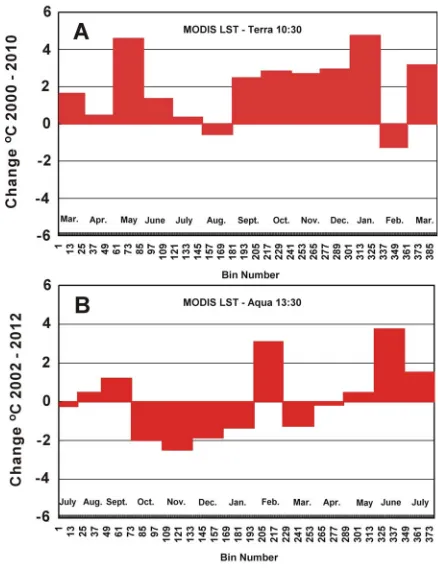
From the Arctic daily morning and afternoon land-sur- face temperatures we compose monthly changes over the decadal periods of MODIS-Terra and MODIS-Aqua, Fig- ure 5. Morning monthly mean land-surface temperature
change (Figure 5(A)) shows increase is largest during
January and May decrease in largest during February and August. The magnitude of the land-surface temperature increase is larger than decrease by up to a factor of four. Moreover, March monthly mean land-surface tempera- ture shows a decadal increase, i.e. a trend.
Afternoon monthly mean land-surface temperature ch- ange (Figure 5(B)) shows decrease is largest during No-
vember and increase is largest during June. Seven mon- ths show decrease and six months show increase. The magnitude of the November decrease is less than the mag- nitude of the June increase. July afternoon monthly mean land-surface temperature shows a decadal increase, i.e. a trend consistent with morning mean changes (Figure 5(A)).
Figure 5. Change of land-surface monthly temperatures above 65˚N: (A) MODIS-Terra relative 10:30 and (B) MODIS- Aqua relative 13:30 local equator crossing times. Note the decadal context of the months is the same as in Figure 4.
4. Discussion and Conclusion
Solar irradiance at the surface of the Earth is a funda- mental driving parameter of climate, ecosystems, energy- water cycles and meteorology [16,17]. Solar irradiance and activity varies diurnally, by latitude and seasonally (the solar zenith angle) [16]. Solar irradiance varies by solar physics operative on decadal (Schwabe Cycle), multi-decadal (Hale-Gleissberg Cycles) and century and longer periods (Suess/deVries-Hallstatt Cycles) [18-21].
At the surface of the Earth irradiance is direct (solar) and indirect (re-radiance) [19,20]. Re-radiance depends on surface properties, terrain elevation and geometry, and on atmosphere absorption, scattering and transmission by aerosols, chemical species such as those of carbon, hy- drogen, nitrogen, and oxygen and their compounds such as carbon monoxide and dioxide, methane, water vapor and ice and ozone [16,22].
At local, regional hemisphere and global scales clouds play important roles in indirect irradiance at infrared wavelengths [16,19,20,23]. This is secondary in power- magnitude relative to direct solar irradiance at the ultra- violet through blue wavelengths.
5. Conclusions
[image:4.595.314.533.83.368.2]R. R. MUSKETT 59
acquisitions at local times of 10:30 NASA-Terra and 13:30 NASA-Aqua. For both satellite missions the op- erational periods are now extending beyond one decade. On this short period there are indications of trends of land-surface temperature, where we focus on the Arctic region. The Arctic is noteworthy for the historical obser- vations of its cloud cover. Many important energy pro- cess feedbacks rely on albedo of atmosphere (clear sky), clouds and surface with respect to long-term changes referred to as global dimming and brightening that plays an important role in the surface energy budget.
During the first decade of MODIS land-surface tem- perature retrievals we detect increase of the number of days with land-surface temperature above 0˚C. This is an important constraint on physical processes affecting snow- ice-permafrost vulnerability, ecosystems and hydrology of the Arctic region. We detect significant trends of land- surface temperature changes during the first decade of daytime sun-synchronous 10:30 and 13:30 local equato- rial crossing acquisitions from MODIS on Terra and Aqua satellites, respectively.
Furthermore we detect regional variations intrends of Arctic Eurasia, North America and Western Europe. These are dependent on surface material types and resident heat capacities. The Arctic regions are noteworthy for the high spatial density of tundra thaw lakes. Likely the va- riations in land-surface temperatures across Arctic West- ern North America and Arctic Eastern Eurasia are in part due to a summertime lake signal given the large heat capacity of water.
6. Acknowledgements
We thank the National Aeronautics and Space Admini- stration Goddard Space Flight Center and the US Geo- logical Survey Land Processes Distributed Active Ar- chive Center for providing the MODIS datasets. R. R. Muskett thanks the University of Alaska Fairbanks Arc- tic Region Supercomputing Center for computational facilities assistance. R. R. Muskett thanks Prof. Vladimir E. Romanovsky, Geophysical Institute and the Scenar- ios Network for Alaska including the Arctic and Western Alaska Landscape Conservation Cooperatives and the USGS Alaska Climate Science Center for support. Ge- neric Mapping Tools, ENVI/IDL and MATLAB were used. R. Muskett thanks Dr. Devin White (Oak Ridge National Laboratory Depart of Energy for the MODIS Conversion Tool (Exelis Visual Information Solutions), which was modified for this research.
REFERENCES
[1] H. Mannstein, “Surface Energy Budget, Surface Temper- ature and Thermal Inertia,” In: R. A. Vaughan and D. Reidel, Eds., Remote Sensing Applications in Meteorol- ogy and Climatology, NATO Science Series Catalog: Ma-
thematical and Physical Sciences, Sci. Reidel Publishing Co., Dordrecht, 1987, pp. 391-410.
[2] Z. Wan, “MODIS Land-Surface Temperature Algorithm Theoretical Basis Document (LST ATBD),” National Ae- ronautics and Space US Department of Commerce, Wash- ington, 1999.
[3] J. C. Rowland, C. E. Jones, G. Altmann, R. Bryan, B. T. Crosby, G. L. Geernaert, L. D. Hinzman, D. L. Kane, D. M. Lawrence, A. Mancino, P. Marsh, J. P. McNamara, V. E. Romanovsky, H. Toniolo, B. J. Travis, E. Trochim and C. J. Wilson, “Arctic Landscapes in Transition: Responses to Thawing Permafrost,” EOS Transactions of the Ameri- can Geophysical Union, Vol. 91, No. 26, 2010, p. 229. doi:10.1029/2010EO260001
[4] M. T. Jorgenson, V. E. Romanovsky, J. Harden, Y. L. Shur, J. O’Donnell, T. Schuur and M. Kanevskiy, “2010: Resilience and Vulnerability of Permafrost to Climate Change,” Canadian Journal of Forest Research, Vol. 40, No. 4, 2010, pp. 1219-1236. doi:10.1139/X10-060 [5] G. Grosse, S. Marchenko, V. Romanovsky, K. P. Wick-
land, N. French, M. Waldrop, L. Bourgeau-Chavez, R. Striegl, J. Harden, M. Turetsky, A. D. McGuire, P. Camill, C. Tarnocai, S. Frolking, E. Schuur and T. Jorgenson, “Vulnerability of High Latitude Soil Organic Carbon in North America to Disturbance,” Journal Geophysical Re- search, Vol. 116, 2011, Article ID: G00K06.
doi:10.1029/2010JG001507
[6] R. A. Houghton, E. A. Davidson and G. M. Woodwell, “Missing Sinks, Feedbacks, and Understanding the Role of Terrestrial Ecosystems in the Global Carbon Balance,” Global Biogeochemical Cycles, Vol. 12, No. 1, 1998, pp. 25-34. doi:10.1029/97GB02729
[7] X. X. Xiong, K. F. Chiang, A. S. Wu, W. L. Barnes, B. Guenther and V. V. Salomonson, “Multiyear On-Orbit Calibration and Performance of Terra MODIS Thermal Emissive Bands,” IEEE Transaction on Geoscience and Remote Sensing, Vol. 46, No. 6, 2008, pp. 1790-1803. doi:10.1109/TGRS.2008.916217
[8] C. L. Parkinson, A. Ward and M. D. King, “Earth Science Reference Handbook: A Guide to NASA’s Earth Science Program and Earth Observing Satellite Missions,” In: C. L. Parkinson, A. Ward and M. D. King, Eds., Earth Sci- ence Reference Handbook, National Aeronautics and Space Administration, US Department of Commerce, Washing- ton, 2006, pp. 1-6, 73-88 and 225-227.
[9] T. S. L’Ecuyer and J. H. Jiang, “Touring the Atmosphere aboard the A-Train,” Physics Today, Vol. 63, No. 7, 2010, pp. 36-41.
[10] X. X. Xiong, J. Q. Sun and W. Barnes, “Intercomparison of On-Orbit Calibration Consistency between Terra and Aqua MODIS Reflective Solar Bands Using the Moon,” IEEE Geoscience and Remote Sensing Letters, Vol. 5, No. 4, 2008, pp. 778-782. doi:10.1109/LGRS.2008.2005591 [11] Z. Wan, “New Refinements and Validation of MODIS
Land-Surface Temperature/Emissivity Products,” Remote Sensing Environment, Vol. 112, No. 1, 2008, pp. 59-74. doi:10.1016/j.rse.2006.06.026
Surface Temperature Product,” Journal Geophysical Re- search, Vol. 114, 2009, Article ID: D20102.
[13] W. Wang, S. Liang and T. Meyers, “Validating MODIS Land Surface Temperature Products Using Long-Term Nighttime Ground Measurements,” Remote Sensing En- vironment, Vol. 112, No. 3, 2008, pp. 623-635.
[14] D. K. Hall, J. E. Box, K. A. Casey, S. J. Hook, C. A. Shuman and K. Steffen, “Comparison of Satellite-Derived and In-Situ Observations of Ice and Snow Surface Tem- peratures over Greenland,” Remote Sensing Environment, Vol. 112, No. 10, 2008, pp. 3739-3749.
doi:10.1016/j.rse.2008.05.007
[15] S. Hachem, C. R. Duguay and M. Allard, “Comparison of MODIS-Derived Land Surface Temperatures with Near- Surface Soil and Air Temperature Measurements in the Continuous Permafrost Terrain,” The Cryosphere Discus- sion, Vol. 5, No. 3, 2011, pp. 1583-1625.
doi:10.5194/tcd-5-1583-2011
[16] B. Weatherhead, A. Tanskanen and A. Stevermer, “Fac- tors Affecting Surface Ultraviolet Radiation Levels in the Arctic,” In: C. J. Cleveland, Ed., Encyclopedia of Earth, International Arctic Science Committee, Environmental Information Coalition, National Council for Science and the Environment, Washington, 2010, pp. 1-17.
[17] I. G. Usoskin, “A History of Solar Activity over Millen- nia,” Living Reviews in Solar Physics, Vol. 5, No. 3, 2008, pp. 1-88. http://www.livingreviews.org/lrsp-2008-3 [18] F. R. Stephenson and A. W. Wolfendale, “Secular Solar
and Geomagnetic Variations in the Last 10,000 Years,” In: F. R. Stephenson and A. W. Wolfendale, Eds., NATO ASI
Series C, Mathematical and Physical Sciences, Kluwer Academic Publishers—Springer, New York, 1988. [19] W.W.-H. Soon, “Solar Arctic-Mediated Climate Variation
on Multidecadal to Centennial Timescales: Empirical Evi- dence, Mechanistic Explanations, and Testable Consequ- ences,” Physical Geography, Vol. 30, No. 2, 2009, pp. 144-184. doi:10.2747/0272-3646.30.2.144
[20] W. W.-H. Soon, “Variable Solar Irradiance as a Plausible Agent for Multidecadal Variations in the Arctic-Wide Surface Air Temperature Record of the Past 130 Years,” Geophysical Research Letters, Vol. 32, No. 16, 2005, p. L16712. doi:10.1029/2005GL023429
[21] I. G. Usoskin, S. K. Solanki and G. A. Kovaltsov, “Grand Minima and Maxima of Solar Activity: New Observatio- nal Constraints,” Astronomy and Astrophysics, Vol. 471, No. 1, 2007, pp. 301-309.
doi:10.1051/0004-6361:20077704
[22] N. Scafetta and B. J. West, “Phenomenological Solar Sig- nature in 400 Years of Reconstructed Northern Hemi- sphere Temperature Record,” Geophysical Research Let- ters, Vol. 33, No. 17, 2006, p. L17718.
doi:10.1029/2006GL027142