Extracting Gene Regulation Networks Using
Linear-Chain Conditional Random Fields and Rules
Slavko ˇZitnik†‡ Marinka ˇZitnik† Blaˇz Zupan† Marko Bajec†
†
Faculty of Computer and Information Science University of Ljubljana
Trˇzaˇska cesta 25 SI-1000 Ljubljana
{name.surname}@fri.uni-lj.si
‡
Optilab d.o.o. Dunajska cesta 152
SI-1000 Ljubljana
Abstract
Published literature in molecular genetics may collectively provide much informa-tion on gene regulainforma-tion networks. Ded-icated computational approaches are re-quired to sip through large volumes of text and infer gene interactions. We propose a novel sieve-based relation extraction sys-tem that uses linear-chain conditional ran-dom fields and rules. Also, we intro-duce a new skip-mention data represen-tation to enable distant relation extraction using first-order models. To account for a variety of relation types, multiple models are inferred. The system was applied to the BioNLP 2013 Gene Regulation Network Shared Task. Our approach was ranked first of five, with a slot error rate of 0.73. 1 Introduction
In recent years we have witnessed an increas-ing number of studies that use comprehensive PubMed literature as an additional source of in-formation. Millions of biomedical abstracts and thousands of phenotype and gene descriptions re-side in online article databases. These represent an enormous amount of knowledge that can be mined with dedicated natural language process-ing techniques. However, extensive biological insight is often required to develop text mining techniques that can be readily used by biomedi-cal experts. Profiling biomedibiomedi-cal research litera-ture was among the first approaches in disease-gene prediction and is now becoming invaluable to researchers (Piro and Di Cunto, 2012; Moreau and Tranchevent, 2012). Information from pub-lication repositories was often merged with other databases. Successful examples of such integra-tion include an OMIM database on human genes and genetic phenotypes (Amberger et al., 2011),
GeneRIF function annotation database (Osborne et al., 2006), Gene Ontology (Ashburner et al., 2000) and clinical information about drugs in the DailyMed database (Polen et al., 2008). Biomed-ical literature mining is a powerful way to iden-tify promising candidate genes for which abundant knowledge might already be available.
Relation extraction (Sarawagi, 2008) can iden-tify semantic relationships between entities from text and is one of the key information extrac-tion tasks. Because of the abundance of publica-tions in molecular biology computational methods are required to convert text into structured data. Early relation extraction systems typically used hand-crafted rules to extract a small set of rela-tion types (Brin, 1999). Later, machine learning methods were adapted to support the task and were trained over a set of predefined relation types. In cases where no tagged data is available, some un-supervised techniques offer the extraction of rela-tion descriptors based on syntactic text properties (Bach and Badaskar, 2007). Current state-of-the-art systems achieve best results by combining both machine learning and rule-based approaches (Xu et al., 2012).
Information on gene interactions are scattered in data resources such as PubMed. The reconstruc-tion of gene regulatory networks is a longstanding but fundamental challenge that can improve our understanding of cellular processes and molecular interactions (Sauka-Spengler and Bronner-Fraser, 2008). In this study we aimed at extracting a gene regulatory network of the popular model organism theBacillus subtilis. Specifically, we focused on the sporulation function, a type of cellular differ-entiation and a well-studied cellular function inB. subtilis.
We describe the method that we used for our participation in the BioNLP 2013 Gene Regula-tion Network (GRN) Shared Task (Bossy et al., 2013). The goal of the task was to retrieve the
genic interactions. The participants were provided with manually annotated sentences from research literature that contain entities, events and genic interactions. Entities are sequences of text that identify objects, such as genes, proteins and reg-ulons. Events and relations are described by type, two associated entities and direction between the two entities. The participants were asked to pre-dict relations of interaction type in the test data set. The submitted network of interactions was compared to the reference network and evaluated with Slot Error Rate (SER) (Makhoul et al., 1999)
SER = (S+I+D)/N that measures the frac-tion of incorrect predicfrac-tions as the sum of relafrac-tion substitutions (S), insertions (I) and deletions (D) relative to the number of reference relations (N).
We begin with a description of related work and the background of relation extraction. We then present our extension of linear-chain conditional random fields (CRF) with skip-mentions (Sec. 3). Then we explain our sieve-based system archi-tecture (Sec. 4), which is the complete pipeline of data processing that includes data preparation, linear-chain CRF and rule based relation detection and data cleaning. Finally, we describe the results at BioNLP 2013 GRN Shared Task (Sec. 6).
2 Related Work
The majority of work on relation extraction fo-cuses on binary relations between two entities. Most often, the proposed systems are evaluated against social relations in ACE benchmark data sets (Bunescu and Mooney, 2005; Wang et al., 2006). There the task is to identify pairs of enti-ties and assign them a relation type. A number of machine learning techniques have been used for relation extraction, such as sequence classifiers, including HMM (Freitag and McCallum, 2000), CRF (Lafferty et al., 2001) and MEMM (Kamb-hatla, 2004), and binary classifiers. The latter most oftem employ SVM (Van Landeghem et al., 2012). The ACE 2004 data set (Mitchell et al., 2005) contains two-tier hierarchical relation types. Thus, a relation can have another relation as an attribute and second level relation must have only atomic attributes. Therefore, two-tier relation hierarchies have the maximum height of two. Wang et al. (2006) employed a one-against-one SVM classi-fier to predict relations in ACE 2004 data set using semantic features from WordNet (Miller, 1995). The BioNLP 2013 GRN Shared Task aims to
de-tect three-tier hierarchical relations. These rela-tions describe interacrela-tions that can have events or other interactions as attributes. In contrast to pair-wise approach of Wang et al. (2006), we extract relations with sequence classifiers and rules.
The same relation in text can be expressed in many forms. Machine-learning approaches can resolve this heterogeneity by training mod-els on large data sets using a large number of feature functions. Text-based features can be constructed through application of feature func-tions. An approach to overcome low cover-age of different relation forms was proposed by Garcia and Gamallo (2011). They introduced a lexico-syntactic pattern-based feature functions that identify dependency heads and extracts rela-tions. Their approach was evaluated over two re-lation types in two languages and achieved good results. In our study we use rules to account for the heterogeneity of relation representation.
super-vised relation extraction method.
Methods for biomedical relation extraction have been tested within several large evaluation initia-tives. The Learning language in logic (LLL) chal-lenge on genic interaction extraction (N´edellec, 2005) is similar to the BioNLP 2013 GRN Shared Task, which contains a subset of the LLL data set enriched with additional annotations. Giu-liano et al. (2006) solved the task using an SVM classifier with a specialized local and global con-text kernel. The local kernel uses only mention-related features such as word, lemma and part-of-speech tag, while the global context kernel com-pares words that appear on the left, between and on the right of two candidate mentions. To de-tect relations, they select only documents contain-ing at least two mentions and generate nk
train-ing examples, wherenis the number of all men-tions in a document andkis number of mentions that form a relation (i.e. two). They then predict three class values according to direction (subject-object, object-subject, no relation). Our approach also uses context features and syntactic features of neighbouring tokens. The direction of relations predicted in our model is arbitrary and it is further determined using rules.
The BioNLP 2011 REL Supporting Shared Task addressed the extraction of entity relations. The winning TESS system (Van Landeghem et al., 2012) used SVMs in a pipeline to detect entity nodes, predict relations and perform some post-processing steps. They predict relations among ev-ery two mention pairs in a sentence. Their study concluded that the term detection module has a strong impact on the relation extraction module. In our case, protein and entity mentions (i.e. men-tions representing genes) had already been identi-fied, and we therefore focused mainly on extrac-tion of events, relaextrac-tions and event modificaextrac-tion mentions.
3 Conditional Random Fields with Skip-Mentions
Conditional random fields (CRF) (Lafferty et al., 2001) is a discriminative model that estimates joint distributionp(y|x) over the target sequence
y, conditioned on the observed sequencex. The following example shows an observed sequencex
where mentions are printed in bold:
“Transcription ofcheV initiates from a sigma D-dependent promoter element
both in vivo and in vitro, and expression of acheV-lacZ fusion is completely de-pendent onsigD.”1
Corresponding sequences xP OS, xP ARSE,
xLEM M A contain part-of-speech tags, parse tree
tokens and lemmas for each word, respectively. Different feature functionsfj (Fig. 2), employed
by CRF, use these sequences in order to model the target sequence y, which also corresponds to tokens in x. Feature function modelling is an essential part when training CRF. Selection of feature functions contributes the most to an in-crease of precision and recall when training CRF classifiers. Usually these are given as templates and the final features are generated by scanning the entire training data set. The feature functions used in our model are described in Sec. 3.1.
CRF training finds a weight vector wthat pre-dicts the best possible (i.e. the most probable) se-quenceyˆgivenx. Hence,
ˆ
y= arg max
y p(y|x, w), (1)
where the conditional distribution equals
p(y|x, w) = exp( Pm
j=1wjPni=1fj(y, x, i))
C(x, w) . (2) Here,nis the length of the observed sequencex,
mis the number of feature functions andC(x, w) is a normalization constant computed over all pos-sibley. We do not consider the normalization con-stant because we are not interested in exact target sequence probabilities. We select only the target sequence that is ranked first.
y1
x1
yn
xn
y2
x2
y3
[image:3.595.354.479.554.615.2]x3
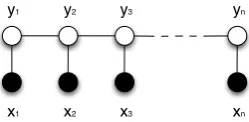
Figure 1: The structure of a linear-chain CRF model. It shows an observable sequencexand tar-get sequenceycontainingntokens.
function f(y, x, i): if (yi−1 == O and
yi == GENE and
xi−1 == transcribes) then return 1
else
[image:4.595.75.282.61.158.2]return 0
Figure 2: An example of a feature function. It checks if the previous label wasOther, the current isGeneand the previous word was “transcribes”, returns 1, otherwise 0.
structure of the LCRF. Note that the i-th factor can depend only on the current and the previous sequence labels yi and yi−1. LCRF can be
effi-ciently trained, whereas exact inference of weights in CRF with arbitrary structure is intractable due to an exponential number of partial sequences. Thus, approximate approaches must be adopted. 3.1 Data Representation
The goal of our task is to identify relations be-tween two selected mentions. If we process the input sequences as is, we cannot model the de-pendencies between two consecutive mentions be-cause there can be many other tokens in between. From an excerpt of the example in the previous section, “cheV initiates from asigmaD”, we can observe the limitation of modelling just two con-secutive tokens. With this type of labelling it is hard to extract the relationships using a first-order model. Also, we are not interested in identify-ing relation descriptors (i.e. segments of text that best describe a pre-defined relation); therefore, we generate new sequences containing only mentions. Mentions are also the only tokens that can be an attribute of a relation. In Fig. 3 we show the trans-formation of our example into a mention sequence. The observable sequence x contains sorted en-tity mentions that are annotated. These annota-tions were part of the training corpus. The target sequence y is tagged with the none symbol (i.e.
O) or the name of the relationship (e.g. Interac-tion.Requirement). Each relationship target token represents a relationship between the current and the previous observable mention.
The mention sequence as demonstrated in Fig. 3 does not model the relationships that exist be-tween distant mentions. For example, the men-tionscheVandpromoterare related by aPromoter
O
cheV
Interaction. Transcription
sigma D
Master of promoter
promoter
O
cheV
Interaction. Requirement
sigD
[image:4.595.317.533.67.172.2]Promoter of
Figure 3: A mention sequence with zero skip-mentions. This continues our example from Sec. 3.
ofrelation, which cannot be identified using only LCRF. Linear model can only detect dependen-cies between two consecutive mentions. To model such relationships on different distances we gen-erate appropriate skip-mention sequences. The notion of skip-mention stands for the number of other mentions between two consecutive mentions which are not included in a specific skip-mention sequence. Thus, to model relationships between every second mention, we generate two one mention sequences for each sentence. A one skip-mention sequence identifies thePromoter of rela-tion, shown in Fig. 4.
O
cheV
Promoter of
promoter
O
[image:4.595.356.481.440.521.2]sigD
Figure 4: A mention sequence with one skip-mention. This is one out of two generated men-tion sequences with one skip-menmen-tion. The other consists of tokenssigmaDandcheV.
For every s skip-mention number, we gen-erate s + 1 mention sequences of length dn
se.
After these sequences are generated, we train one LCRF model per each skip-mention number. Model training and inference of predictions can be done in parallel due to the sequence indepen-dence. Analogously, we generate model-specific skip-mention sequences for inference and get tar-get labellings as a result. We extract the identified relations between the two mentions and represent them as an undirected graph.
be-0 1 2 3 4 5 6 7 8 9 11 13 15 17 19
BioNLP 2013 GRN dataset relation Mention distance distribution
Mention distance between relation arguments
Number of relationships
0
20
40
60
80
46
28 69
73
45
31
14 14
7
4 3 6 2 2
[image:5.595.48.293.68.243.2]1 2 1 2 1 1
Figure 5: Distribution of distances between two mentions connected with a relation.
tween the relation mention attributes (i.e. agents and targets) in the BioNLP 2013 GRN training and development data set. The attribute mention data consists of all entity mentions and events. We ob-serve that most of relations connect attributes on distances of two and three mentions.
To get our final predictions we train CRF mod-els on zero to ten skip-mention sequences. We use the same unigram and bigram feature function set for all models. These include the following:
• target label distribution,
• mention type (e.g. Gene, Protein) and ob-servable values (e.g., sigma D) of mention distance 4 around current mention,
• context features using bag-of-words match-ing on the left, between and on the right side of mentions,
• hearst concurrence features (Bansal and Klein, 2012),
• token distance between mentions,
• parse tree depth and path between mentions, • previous and next lemmas and part-of-speech
tags.
4 Data Analysis Pipeline
We propose a pipeline system combining multi-ple processing sieves. Each sieve is an indepen-dent data processing component. The system con-sists of eight sieves, where the first two sieves
prepare data for relation extraction, main sieves consist of linear-chain CRF and rule-based rela-tion detecrela-tion, and the last sieve cleans the out-put data. Full implementation is publicly available (https://bitbucket.org/szitnik/iobie). We use CRF-Suite (http://www.chokkan.org/software/crfsuite) for faster CRF training and inference.
First, we transform the input data into a format appropriate for our processing and enrich the data with lemmas, parse trees and part-of-speech tags. We then identify additional action mentions which act as event attributes (see Sec. 4.3). Next, we em-ploy the CRF models to detect events. We treat events as a relation type. The main relation pro-cessing sieves detect relations. We designed sev-eral processing sieves, which support different re-lation attribute types and hierarchies. We also em-ploy rules at each step to properly set the agent and target attributes. In the last relation processing sieve, we perform rule-based relation extraction to detect high precision relations and boost the recall. In the last step we clean the extracted results and export the data.
The proposed system sieves are executed in the following order:
i Preprocessing Sieve ii Mention Processing Sieve iii Event Processing Sieve
iv Mention Relations Processing Sieve v Event Relations Processing Sieve vi Gene Relations Processing Sieve vii Rule-Based Relations Processing Sieve viii Data Cleaning Sieve
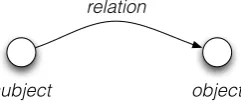
In the description of the sieves in the follow-ing sections, we use general relation terms, nam-ing the relation attributes as subject and object, as shown in Fig. 6.
subject object relation
[image:5.595.358.479.670.722.2]4.1 Preprocessing Sieve
The preprocessing sieve includes data import, sen-tence detection and text tokenization. Addition-ally, we enrich the data using part-of-speech tags, parse trees (http://opennlp.apache.org) and lem-mas (Jurˇsic et al., 2010).
4.2 Mention Processing Sieve
The entity mentions consist of Protein, Gene-Family, ProteinGene-Family, ProteinComplex, Poly-meraseComplex, Gene, Operon, mRNA, Site, Reg-ulon and Promoter types. Action mentions (e.g.
inhibits, co-transcribes) are automatically de-tected as they are needed as event attributes for the event extraction. We therefore select all lem-mas of the action mentions from the training data and detect new mentions from the test data set by comparing lemma values.
4.3 Event Processing Sieve
The general definition of an event is described as a change on the state of a molecule or bio-molecules (e.g. “expressionof a cheV-lacZ fusion is completely dependent onsigD”). We represent events as a special case of relationship and name them “EVENT”. In the training data, the event sub-ject types areProtein, GeneFamily, PolymeraseC-omplex, Gene, Operon, mRNA, Site, Regulonand
Promoter types, while the objects are always of the action type (e.g. “expression”), which we dis-cover in the previous sieve. After identifying event relations using the linear-chain CRF approach, we apply a rule that sets the action mention as an ob-ject and the gene as a subob-ject attribute for every extracted event.
4.4 Relations Processing Sieves
According to the task relation properties (i.e. dif-ferent subject and object types), we extract rela-tions in three phases (iv, v, vi). This enables us to extract hierarchical relations (i.e. relation contains another relation as subject or object) and achieve higher precision. All sieves use the proposed linear-chain CRF-based extraction. The process-ing sieves use specific relation properties and are executed as follows:
(iv) First, we extract relations that contain only entity mentions as attributes (e.g. “Transcrip-tion of cheV initiates from a sigmaD” re-solves into the relation sigmaD → Interac-tion.Transcription→cheV).
(v) In the second stage, we extract relations that contain at least one event as their attribute. Prior to execution we transform events into their mention form. Mentions generated from events consist of two tokens. They are taken from the event attributes and the new event mention is included into the list of existing mentions. Its order within the list is deter-mined by the index of the lowest mention to-ken. Next, relations are identified following the same principle as in the first step.
(vi) According to an evaluation peculiarity of the challenge, the goal is to extract possible inter-actions between genes. Thus, when a relation between a gene G1 and an event E should be extracted, the GRN network is the same as if the method identifies a relation between a geneG1 and geneG2, ifG2 is the object of event E. We exploit this notion by gen-erating training data to learn relation extrac-tion only betweenB. subtilisgenes. During this step we use an external resource of all known genes of the bacteria retrieved from the NCBI2.
The training and development data sets include seven relation instances that have a relation as an attribute. We omitted this type of hierarchy extrac-tion due to the small number of data instances and execution of relation extraction between genes.
There are also four negative relation instances. The BioNLP task focuses on positive relations, so there would be no increase in performance if neg-ative relations were extracted. Therefore, we ex-tract only positive relations. According to the data set, we could simply add a separate sieve which would extract negations by using manually defined rules. Words that explicitly define these negations arenot,whereas,neitherandnor.
4.5 Rule-Based Relations Processing Sieve
The last step of relation processing uses rules that extract relations with high precision. General rules consist of the following four methods:
• The method that checks all consequent men-tion triplets that contain exactly one acmen-tion mention. As input we set the index of the ac-tion menac-tion within the triplet, its matching regular expression and target relation.
2http://www.ncbi.nlm.nih.gov/nuccore/
• The method that processes every two con-sequentB. subtilis entity mentions. It takes a regular expression, which must match the text between the mentions, and a target rela-tion.
• The third method is a modification of the pre-vious method that supports having a list of entity mentions on the left or the right side. For example, this method extracts two rela-tions in the following example: “rsfAis under the control of bothsigma(F)andsigma(G)”. • The last method is a variation of the
sec-ond method, which removes subsentences between the two mentions prior to relation extraction. For example, the method is able to extract distant relation from the following example: “sigma(F)factor turns on about 48 genes, including the gene for RsfA, and the gene forsigma(G)”. This issigma(F)→ In-teraction.Activation→sigma(G).
We extract the Interaction relations using regu-lar expression and specific keywords for the tran-scription types (e.g. keywords transcrib, directs transcription, under control of), inhibition (key-wordsrepress,inactivate,inhibits,negatively reg-ulated by), activation (e.g. keywords governed by,activated by,essential to activation,turns on), requirement (e.g. keyword require) and binding (e.g. keywordsbinds to,-binding). Notice that in biomedical literature, a multitude of expressions are often used to describe the same type of genetic interaction. For instance, researchers might prefer using the expressionto repressoverto inactivate
orto inhibit. Thus, we exploit these synsets to im-prove the predictive accuracy of the model. 4.6 Data Cleaning Sieve
The last sieve involves data cleaning. This consists of removing relation loops and eliminating redun-dancy.
A relation is considered a loop if its attribute mentions represent the same entity (i.e. men-tions corefer). For instance, sentence “... sigma Delement, while cheV-lacZ depends onsigD...” contains mentionssigma DandsigD, which can-not form a relationship because they represent the same gene. By removing loops we reduce the number of insertions. Removal of redundant re-lations does not affect the final score.
5 Data in BioNLP 2013 GRN Challenge
Table 1 shows statistics of data sets used in our study. For the test data set we do not have tagged data and therefore cannot show the detailed eval-uation analysis for each sieve. Each data set consists of sentences extracted from PubMed ab-stracts on the topic of the gene regulation network of the sporulation ofB. subtilis. The sentences in both the training and the development data sets are manually annotated with entity mentions, events and relations. Real mentions in Table 1 are the mentions that refer to genes or other structures, while action mentions refer to event attributes (e.g. transcription). Our task is to extract Interaction
relations of the types regulation, inhibition, acti-vation,requirement,bindingandtranscriptionfor which the extraction algorithm is also evaluated.
The extraction task in GRN Challenge is two-fold: given annotated mentions, a participant needs to identify a relation and then determine the role of relation attributes (i.e. subject or object) within the previously identified relation. Only pre-dictions that match the reference relations by both relation type and its attributes are considered as a match.
6 Results and Discussion
We tested our system on the data from BioNLP 2013 GRN Shared Task using the leave one out cross validation on the training data and achieved a SER of 0.756, with 4 substitutions, 81 dele-tions, 14 insertions and 46 matches, given 131 ref-erence relations. The relatively high number of deletions in these results might be due to ambigu-ities in the data. We identified the following num-ber of extracted relations in the relation extraction sieves (Sec. 4): (iii) 91 events, (iv) 130 relations between mentions only, (v) 27 relations between an event and a mention, (vi) 39 relations between entity mentions, and (vii) 44 relations using only rules. Our approach consists of multiple submod-ules, each designed for a specific relation attribute type (e.g. either both attributes are mentions, or an event and a mention, or both are genes). Also, the total sum of extracted relations exceeds the num-ber of final predicted relations, which is a conse-quence of their extraction in multiple sieves. Du-plicates and loops were removed in the data clean-ing sieve.
Data set Documents Tokens Real mentions
Action mentions
Events Relations Interaction relations
dev 48 1321 205 55 72 105 71
train 86 2380 422 102 157 254 159
test 67 1874 290 86 / / /
Table 1: BioNLP 2013 GRN Shared Task development (dev), training (train) and test data set properties.
in the test data, we trained our models on the joint development and training data. At the time of submission we did not use the gene relations processing sieve (see Sec. 4) because it had not yet been implemented. The results of the par-ticipants in the challenge are shown in Table 2. According to the official SER measure, our sys-tem (U. of Ljubljana) was ranked first. The other four competing systems were K. U. Leuven (Provoost and Moens, 2013), TEES-2.1 (Bj¨orne and Salakoski, 2013), IRISA-TexMex (Claveau, 2013) and EVEX (Hakala et al., 2013).
Partici-Participant S D I M SER
U. of Ljubljana 8 50 6 30 0.73
K. U. Leuven 15 53 5 20 0.83
TEES-2.1 9 59 8 20 0.86
IRISA-TexMex 27 25 28 36 0.91
EVEX 10 67 4 11 0.92
Table 2: BioNLP 2013 GRN Shared Task results. The table shows the number of substitutions (S), deletions (D), insertions (I), matches (M) and slot error rate (SER) metric.
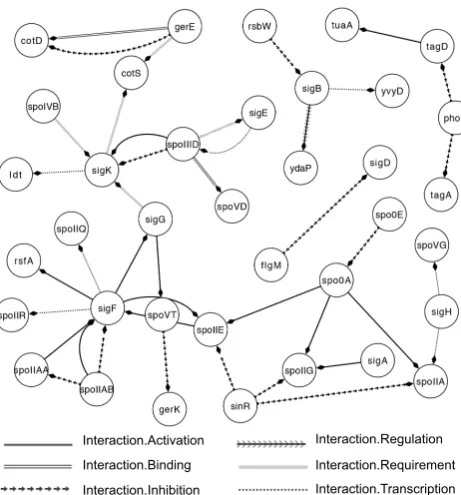
pants aimed at a low number of substitutions, dele-tions and inserdele-tions, while increasing the number of matches. We got the least number of substi-tutions and fairly good results in the other three indicators, which gave the best final score. Fig. 7 shows the predicted gene regulation network with the relations that our system extracted from test data. This network does not exactly match our submission due to minor algorithm modifications after the submission deadline.
7 Conclusion
We have proposed a sieve-based system for re-lation extraction from text. The system is based on linear-chain conditional random fields (LCRF) and domain-specific rules. In order to support the extraction of relations between distant mentions, we propose an approach calledskip-mention lin-ear chain CRF, which extends LCRF by varying
Interaction.Activation Interaction.Binding Interaction.Inhibition
[image:8.595.302.533.309.557.2]Interaction.Regulation Interaction.Requirement Interaction.Transcription
the number of skipped mentions to form mention sequences. In contrast to common relation extrac-tion approaches, we inferred a separate model for each relation type.
We applied the proposed system to the BioNLP 2013 Gene Regulation Network Shared Task. The task was to reconstruct the gene regulation net-work of sporulation in the model organismB. sub-tilis. Our approach scored best among this year’s submissions.
Acknowledgments
The work has been supported by the Slovene Re-search Agency ARRS within the reRe-search program P2-0359 and in part financed by the European Union, European Social Fund.
References
Joanna Amberger, Carol Bocchini, and Ada Hamosh. 2011. A new face and new challenges for online Mendelian inheritance in man (OMIM). Human Mutation, 32(5):564–567.
Michael Ashburner, Catherine A. Ball, Judith A. Blake, David Botstein, Heather Butler, Michael J. Cherry, Allan P. Davis, Kara Dolinski, Selina S. Dwight, Janan T. Eppig, Midori A. Harris, David P. Hill, Lau-rie Issel-Tarver, Andrew Kasarskis, Suzanna Lewis, John C. Matese, Joel E. Richardson, Martin Ring-wald, Gerald M. Rubin, and Gavin Sherlock. 2000. Gene Ontology: Tool for the unification of biology. Nature Genetics, 25(1):25–29.
Nguyen Bach and Sameer Badaskar. 2007. A review of relation extraction. Literature Review for Lan-guage and Statistics II, pages 1–15.
Michele Banko and Oren Etzioni. 2008. The trade-offs between open and traditional relation extraction. Proceedings of ACL-08: HLT, page 28–36.
Mohit Bansal and Dan Klein. 2012. Coreference se-mantics from web features. In Proceedings of the 50th Annual Meeting of the Association for Com-putational Linguistics: Long Papers-Volume 1, page 389–398.
Jari Bj¨orne and Tapio Salakoski. 2013. TEES 2.1: Au-tomated annotation scheme learning in the bioNLP 2013 shared task. InProceedings of BioNLP Shared Task 2013 Workshop, Sofia, Bulgaria, August. Asso-ciation for Computational Linguistics.
Robert Bossy, Philippe Bessi`res, and Claire N´edellec. 2013. BioNLP shared task 2013 - an overview of the genic regulation network task. InProceedings of BioNLP Shared Task 2013 Workshop, Sofia, Bul-garia, August. Association for Computational Lin-guistics.
Sergey Brin. 1999. Extracting patterns and relations from the world wide web. InThe World Wide Web and Databases, page 172–183. Springer.
Razvan C. Bunescu and Raymond J. Mooney. 2005. A shortest path dependency kernel for relation ex-traction. In Proceedings of the conference on Hu-man Language Technology and Empirical Methods in Natural Language Processing, page 724–731.
Vincent Claveau. 2013. IRISA participation to bioNLP-ST13: lazy-learning and information re-trieval for information extraction tasks. In Pro-ceedings of BioNLP Shared Task 2013 Workshop, Sofia, Bulgaria, August. Association for Computa-tional Linguistics.
Dayne Freitag and Andrew McCallum. 2000. In-formation extraction with HMM structures learned by stochastic optimization. In Proceedings of the National Conference on Artificial Intelligence, page 584–589.
Marcos Garcia and Pablo Gamallo. 2011. Dependency-based text compression for semantic relation extraction. Information Extraction and Knowledge Acquisition, page 21.
Claudio Giuliano, Alberto Lavelli, and Lorenza Ro-mano. 2006. Exploiting shallow linguistic infor-mation for relation extraction from biomedical liter-ature. InProceedings of the Eleventh Conference of the European Chapter of the Association for Com-putational Linguistics (EACL-2006), page 401–408.
Kai Hakala, Sofie Van Landeghem, Tapio Salakoski, Yves Van de Peer, and Filip Ginter. 2013. EVEX in ST’13: Application of a large-scale text mining resource to event extraction and network construc-tion. InProceedings of BioNLP Shared Task 2013 Workshop, Sofia, Bulgaria, August. Association for Computational Linguistics.
Matjaˇz Jurˇsic, Igor Mozetiˇc, Tomaˇz Erjavec, and Nada Lavraˇc. 2010. LemmaGen: multilingual lemmati-sation with induced ripple-down rules. Journal of Universal Computer Science, 16(9):1190–1214.
Nanda Kambhatla. 2004. Combining lexical, syntac-tic, and semantic features with maximum entropy models for extracting relations. InProceedings of the ACL 2004 on Interactive poster and demonstra-tion sessions, page 22.
John D. Lafferty, Andrew McCallum, and Fernando C. N. Pereira. 2001. Conditional random fields: Probabilistic models for segmenting and labeling se-quence data. InProceedings of the Eighteenth In-ternational Conference on Machine Learning, pages 282–289.
John Makhoul, Francis Kubala, Richard Schwartz, and Ralph Weischedel. 1999. Performance measures for information extraction. In Proceedings of DARPA Broadcast News Workshop, page 249–252.
George A. Miller. 1995. WordNet: a lexical database for English.Commun. ACM, 38(11):39–41.
Alexis Mitchell, Stephanie Strassel, Shudong Huang, and Ramez Zakhary. 2005. ACE 2004 multilin-gual training corpus. Linguistic Data Consortium, Philadelphia.
Yves Moreau and L´eon-Charles Tranchevent. 2012. Computational tools for prioritizing candidate genes: boosting disease gene discovery. Nature Re-views Genetics, 13(8):523–536.
Claire N´edellec. 2005. Learning language in logic-genic interaction extraction challenge. In Proceed-ings of the 4th Learning Language in Logic Work-shop (LLL05), volume 7, pages 1–7.
John D. Osborne, Simon Lin, Warren A. Kibbe, Li-hua J. Zhu, Maria I. Danila, and Rex L. Chisholm. 2006. GeneRIF is a more comprehensive, cur-rent and computationally tractable source of gene-disease relationships than OMIM. Technical report, Northwestern University.
Rosario M Piro and Ferdinando Di Cunto. 2012. Computational approaches to disease-gene predic-tion: rationale, classification and successes. The FEBS Journal, 279(5):678–96.
Hyla Polen, Antonia Zapantis, Kevin Clauson, Jennifer Jebrock, and Mark Paris. 2008. Ability of online drug databases to assist in clinical decision-making with infectious disease therapies. BMC Infectious Diseases, 8(1):153.
Thomas Provoost and Marie-Francine Moens. 2013. Detecting relations in the gene regulation network. InProceedings of BioNLP Shared Task 2013 Work-shop, Sofia, Bulgaria, August. Association for Com-putational Linguistics.
Lance A. Ramshaw and Mitchell P. Marcus. 1995. Text chunking using transformation-based learning. InProceedings of the Third ACL Workshop on Very Large Corpora, page 82–94.
Sunita Sarawagi. 2008. Information extraction. Foun-dations and Trends in Databases, 1(3):261–377.
Tatjana Sauka-Spengler and Marianne Bronner-Fraser. 2008. A gene regulatory network orchestrates neu-ral crest formation. Nature reviews Molecular cell biology, 9(7):557–568.
Sofie Van Landeghem, Jari Bj¨orne, Thomas Abeel, Bernard De Baets, Tapio Salakoski, and Yves Van de Peer. 2012. Semantically linking molecular enti-ties in literature through entity relationships. BMC Bioinformatics, 13(Suppl 11):S6.
Ting Wang, Yaoyong Li, Kalina Bontcheva, Hamish Cunningham, and Ji Wang. 2006. Automatic ex-traction of hierarchical relations from text. The Semantic Web: Research and Applications, page 215–229.
Yan Xu, Kai Hong, Junichi Tsujii, I Eric, and Chao Chang. 2012. Feature engineering combined with machine learning and rule-based methods for struc-tured information extraction from narrative clinical discharge summaries. Journal of the American Med-ical Informatics Association, 19(5):824–832.