Extracting Biomedical Events and Modifications Using Subgraph
Matching with Noisy Training Data
Andrew MacKinlay♦, David Martinez♦, Antonio Jimeno Yepes♦, Haibin Liu♠, W. John Wilbur♠and Karin Verspoor♦
♦NICTA Victoria Research Laboratory, University of Melbourne, Australia
{andrew.mackinlay,david.martinez}@nicta.com.au
{antonio.jimeno,karin.verspoor}@nicta.com.au
♠National Center for Biotechnology Information, Bethesda, MD, USA
[email protected],[email protected]
Abstract
The Genia Event (GE) extraction task of the BioNLP Shared Task addresses the ex-traction of biomedical events from the nat-ural language text of the published litera-ture. In our submission, we modified an existing system for learning of event pat-terns via dependency parse subgraphs to utilise a more accurate parser and signifi-cantly more, but noisier, training data. We explore the impact of these two aspects of the system and conclude that the change in parser limits recall to an extent that cannot be offset by the large quantities of training data. However, our extensions of the sys-tem to extract modification events shows promise.
1 Introduction
In this paper, we describe our submission to the Genia Event (GE) information extraction subtask of the BioNLP Shared Task. This task requires the development of systems that are capable of iden-tifying bio-molecular events as those events are expressed in full-text publications. The task rep-resents an important contribution to the broader problem of converting unstructured information captured in the biomedical literature into struc-tured information that can be used to index and analyse bio-molecular relationships.
This year’s task builds on previous instantia-tions of this task (Kim et al., 2009; Kim et al., 2012), with only minor changes in the task defini-tion introduced for 2011. The task organisers pro-vided full text publications annotated with men-tions of biological entities including proteins and genes, and asked participants to provide annota-tions of simple events including gene expression, binding, localization, and protein modification, as well as higher-order regulation events (e.g.,
pos-itive regulation of gene expression). In our sub-mission, we built on a system originally developed for the BioNLP-ST 2011 (Liu et al., 2011) and ex-tended in more recent work (Liu et al., 2013a; Liu et al., 2013b). This system learns to recognise sub-graphs of syntactic dependency parse sub-graphs that express a given bio-molecular event, and matches those subgraphs to new text using an algorithm called Approximate Subgraph Matching.
Due to the method’s fundamental dependency on the syntactic dependency parse of the text, in this work we set out to explore the impact of substituting the previously employed dependency parsers with a different parser which has been demonstrated to achieve higher performance than other commonly used parsers for full-text biomed-ical literature (Verspoor et al., 2012).
In addition, we aimed to address the relatively lower recall of the method through incorporation of large quantities of external training data, ac-quired through integration of previously automat-ically extracted bio-molecular events available in a web repository of such extracted events, EVEX (Van Landeghem et al., 2011; Van Landeghem et al., 2012), and additional bio-molecular events generated from a large sample of full text pub-lications using one of the state-of-the-art event extraction systems, TEES (Bj¨orne and Salakoski, 2011). Since the performance of the subgraph matching method, as an instance-based learning strategy (Alpaydin, 2004), is dependent on having good training examples that express the events in a range of syntactic structures, the motivation under-lying this was to increase the amount of training data available to the system, even if that data was derived from a less-than-perfect source. The aug-mentation of training corpora with external unla-belled data that is automatically processed to gen-erate additional labels has been explored for re-training the same system, in an approach known as self-training. This approach has been shown to be
very effective for improving parsing performance (McClosky et al., 2006; McClosky and Charniak, 2008). Self-training of the TEES system has been previously explored (Bjorne et al., 2012), with somewhat mixed results, but with evidence sug-gesting it could be useful with an appropriate strat-egy for selecting training examples. Here, rather than training our system with its own output over external data, we explore a semi-supervised learn-ing approach in which we train our system with the outputs of a different system (TEES) over external data.
2 Methodology
2.1 Base Event Extraction System
The event extraction algorithm is essentially the same as the one used in Liu et al. (2013b). A fuller description can be found there, but we summarise the most important aspects of it here.
2.1.1 Event Extraction with ASM
The principal method used in event extraction is Approximate Subgraph Matching, or ASM (Liu et al., 2013a). Broadly, we learn subgraph patterns from the event structures in the training data, and then apply them by looking for matches with the patterns of the learned rules, using ASM to allow for non-exact matches of the patterns.
The first stage in this is learning the rules which link subgraphs to associated patterns. The input is a set of dependency-parsed articles (the setup is described in§2.1.2), and a set of gold-standard annotations of proteins and events in the shared task format. Using the standoff annotations in the training data, every protein and trigger is mapped to one or more nodes in the corresponding depen-dency graphs. In addition, the textual content of every protein is replaced with a generic string en-abling abstraction over individual protein names. Then, for each event annotation in the training data, we retrieve the nodes from the graph corre-sponding to the associated trigger and protein en-tities. We determine the shortest path (or paths, in case of a tie) connecting the graph trigger to each of the event argument nodes. For arguments which are themselves events (e.g., for regulatory events), the node corresponding to the trigger of the event argument is used instead of a protein node. Where there are multiple arguments, we take the union of the shortest paths to each individual argument.
This path is then used as the pattern
compo-nent of an event rule. The rule also consists of an event type, and a mapping from event arguments to nodes from the pattern graph, or to an event type/node pair for nested event arguments. Af-ter processing all training documents, we get on the order of a few thousand rules; this can be de-creased slightly by removing rules with subgraphs that are isomorphic to those of other rules.
In principle, this set of rules could then be di-rectly applied to the test documents, by searching for any matching subgraphs. However, in practice doing so leads to very low recall, since the pat-terns are not general enough to get a broad range of matches on new data. We can alleviate this by re-laxing the strictness of the subgraph matching pro-cess. Most basically, we relax node matching. In-stead of requiring an exact match between both the token and the part-of-speech of the nodes of the sentence graph and those from the rule subgraph, we also allow a match on the basis of the lemma (according to BioLemmatizer (Liu et al., 2012)), and a coarse-grained POS-tag (where there is only one POS-tag for nouns, verbs and adjectives).
More importantly, we also relax the require-ments on how closely the graphs must match, by using ASM. ASM defines distances measures be-tween subgraphs, based on structure, edge labels and edge directions, and uses a set of specified weights to combine them into an overall subgraph distance. We have a pre-configured set of distance thresholds for each event type, and for each sen-tence/rule pairing, we extract events for any rules with subgraphs under the given threshold.
The problem with this approximate matching is that some rules now match too broadly, and pre-cision is reduced. This is mitigated by adding an iterative optimisation phase. In each iteration, we run the event extraction using the current rule set over some dataset – usually the training set, or a subset of it. We check the contribution of each rule in terms of postulated events and actual events which match the gold standard. If the ra-tio of matched to postulated events is too low (for the work reported here, the threshold is 0.25), the rule is discarded. This process is repeated until no more rules are discarded. This can take multiple iterations since the rules are interdependent due to the presence of nested event arguments.
We were able to improve optimisation times some-what by parallelising the event extraction, and temporarily removing documents with long ex-traction times from the optimisation process un-til as late as possible, but it remained the primary bottleneck in our experimentation.
2.1.2 Parsing Pipeline
In our parsing pipeline, we first split sentences using the JULIE Sentence Boundary Detector, or JSBD (Tomanek et al., 2007). We then parse using a version of clearnlp1 (Choi and McCal-lum, 2013), a successor to ClearParser (Choi and Palmer, 2011), which was shown to have state-of-the-art performance over the CRAFT corpus of full-text biomedical articles (Verspoor et al., 2012). We use dependency and POS-tagging mod-els trained on the CRAFT corpus (except where noted); these pre-trained models are provided with
clearnlp. Our fork of clearnlp integrates to-ken span marking into the parsing process, so the dependency nodes can easily be matched to the standoff annotations provided with the shared task data. This pipeline is not dependent on any pre-annotated data, so can thus be trivially applied to extra data not provided as part of the shared task. In addition the parsing is fast, requiring roughly 46 wall-clock seconds (processing serially) to parse the 5059 sentences from the training and develop-ment sets of the 2013 GE task – an average of 9 ms per sentence. The ability to apply the same pars-ing configuration to new text was useful for addpars-ing extra training data, as discussed in§2.2.
The usage of clearnlpas the parser is the pri-mary point of difference between our system and that of Liu et al. (2013b), who use the Charniak-Johnson parser with the McClosky biomedical model (CJM; McClosky and Charniak (2008)), al-though there are other minor differences in tokeni-sation and sentence splitting. We expected that the higher accuracy ofclearnlpover biomedical text would translate into increased accuracy of event detection in the shared task; we consider this ques-tion in some detail below.
2.2 Adding Noisy Training Data
One of the limitations of the ASM approach is that the high precision comes at the cost of lower re-call. Our hypothesis is that adding extra training instances, even if some are errors, will raise re-call and improve overall performance. We utilised
1https://code.google.com/p/clearnlp/
two sources of automatically-annotated data: the EVEX database, and running an automatic event annotator over documents from PubMed Central (PMC) and MEDLINE.
To test our hypothesis, we utilise one of the best performing automatic event extractors in pre-vious BioNLP tasks: TEES (Turku Event Extrac-tion System)2(Bj¨orne et al., 2011). We expand our pool of training examples by adding the highest-confidence events TEES identifies in unlabelled text. We explored different approaches to ranking events based on classifier confidence empirically.
TEES relies on multi-class SVMs both for trig-ger and event classification, and produces confi-dence scores for each prediction. We explored ranking events according to: (i) score of the trig-ger prediction, (ii) score of the event-type tion, and (iii) sum of trigger and event type predic-tions. We also compared the performance when selecting the top-k events overall, versus choos-ing the top-k events for each event type. We also tested adding as many instances per event-type as there were in the manually-annotated dataset, with different multiplying factors. Finally, we evalu-ated the effect of using different splits of the data for the evaluation and optimisation steps of ASM. This is the full list of parameters that we tested over held-out data:
• Original confidence scores: we ranked events according to the three SVM scores mentioned above: trigger prediction, event-type predic-tion, and combined.
• Overall top-k: we selected the top 1,000, 5,000, 10,000, 20,000, 30,000, 40,000, and 50,000 for the different experimental runs.
• Top-k per type: for each event type, we se-lected the top 400, 1,000, and 2,000.
• Training bias per type: we add as many in-stances from EVEX per type as there are in the manually annotated data. We experiment with adding up to 6 times as many as in man-ually annotated data.
• Training/optimisation split: we combine manually and automatically annotated data for training. For optimisation we tested different options: manually annotated only, manual + automatic, manual + top-100 events, and manual + top-1000 events.
We did not explore all these settings exhaus-tively due to time constraints, and we report here the most promising settings. It is worth mention-ing that most of the configurations contributed to improve the baseline performance. We only ob-served drops when using automatically-annotated data in the optimisation step.
2.2.1 Data from EVEX
Conveniently, the developers of TEES have re-leased the output of their tool over the full 2009 collection of MEDLINE, consisting of abstracts of biomedical articles, in a collection known as the EVEX dataset. We used the full EVEX dataset as provided by the University of Turku, and explored different ways of ranking the full list of events as described above.
2.2.2 Data from TEES
To augment the training data, we annotated two data sets with TEES based on MEDLINE and PubMed Central (PMC). The developers of TEES released a trained model for the GE 2013 training data that we utilised.
Due to the long pre-processing time of TEES, which includes gene named entity recognition, part-of-speech tagging and parsing, we used the EVEX pre-processed MEDLINE, which required some adaptation of the EVEX XML to the XML format accepted by TEES. Once this adaptation was finished, the files were processed by TEES.
Then, we have selected articles from PMC us-ing a query containus-ing specific MeSH headus-ings related to the GE task and limiting the result to only the Open Access part of PMC. From the al-most 600k articles from the PMC Open Access set, we reduced the total number of articles to around 155k. The PMC query is the following:
(Genetic Phenomena[MH] OR Metabolic Phenomena[MH] OR Cell Physiological Phenomena[MH] OR Biochemical Processes[MH]) AND open access[filter]
Furthermore, the articles were split into sections and specific sections from the full text like Intro-duction,Background andMethods were removed to reduce the quantity of text to be annotated by TEES. The PMC files produced by this filtering were processed by TEES on the NICTA cluster.
2.3 Modification Detection
To evaluate the utility of ASM for a diverse range of tasks, we also applied it to the task of detect-ing modification (SPECULATION or NEGATION)
NEGATIONcues
• Basic: not, no, never,nor, only, neither,fail, cease, stop,terminate,end,lacking,missing,absent,absence, failure,negative,unlikely,without,lack,unable • Data-derived: any,prevention,prevent, disrupt,
dis-ruption SPECULATIONcues:
• Basic:analysis,whether,may,should,can,could, un-certain,questionable,possible,likely,probable, prob-ably,possibly,conceivable,conceivably,perhaps, ad-dress,analyze,analyse,assess,ask,compare,consider, enquire,evaluate,examine,experiment,explore, inves-tigate,test,research,study,speculate
• Data-derived: measure, measurement, suggest, sug-gestion,value,quantify,quantification,determine, de-termination,detect,detection,calculate,calculation
Table 1: Modification cues
of events. In event detection, triggers are explic-itly annotated, so the linguistic cue which indi-cates that an event is occurring is easy to identify. As described in Section 3.2, these triggers are im-portant for learning event patterns.
The event extraction method is based on paths between dependency graph nodes, so it is neces-sary to have at least two relevant graph nodes be-fore we can determine a path between them. For learning modification rules, one graph node is the trigger of the event which is subjec to modifica-tion. However here we needed a method to deter-mine another node in the sentence which provided evidence that NEGATION or SPECULATION was occurring, and could thus form an endpoint for a semantically relevant graph pattern. To achieve this, we specified a setcue lemmasfor NEGATION
and SPECULATION. The basic set of cue lemmas came from a variety of sources. Some were man-ually specified and some were derived from previ-ous work on modification detection (Cohen et al., 2011; MacKinlay et al., 2012). We manually ex-panded this cue list to include obvious derivational variants. This gave us a basic set of 34 SPECULA
-TIONand 21 NEGATIONcues.
We also used a data-driven strategy to find ad-ditional lemmas indicative of modification. We adapted the method of Rayson and Garside (2000) which uses log-likelihood for finding words that characterise differences between corpora. Here, the “corpora” are sentences attached to all events in the training set, and sentences attached to events which are subject to NEGATIONor SPECULATION
us-ing the observed frequency from the modification events and the expected frequency over all events. Sorting by decreasing log-likelihood, we get a list of lemmas which are most strongly associated with NEGATIONor SPECULATION. We manually examined the highest-ranked lemmas from these two lists and noted lemmas which may occur, according to human judgment, in phrases which would denote the relevant modification type. We found seven extra SPECULATION cues and three
extra NEGATIONcues. Expanding with morpho-logical variants as described above yielded 47 SPECULATION cues and 26 NEGATION cues
to-tal. These cues are shown, divided into basic and data-derived, in Table 1.
For every node N with a lemma in the appro-priate set of cue lemmas, we create a rule based on the shortest path between the cue lemma node
N and the event trigger node. The trigger lem-mas are replaced with generic lemlem-mas which only reflect the POS-tag of the trigger, to broaden the range of possible matches. Each rule thus consists of the POS-tag of an event trigger, and a subgraph pattern including the abstracted event trigger node. At modification detection time, the rules are ap-plied in a similar way to the event rules. After detecting events, we look for matches of each ex-tracted event with every modification rule. A rule
Ris considered to match if the event trigger node POS tag matches the POS tag of the rule, and the subgraph pattern of the rule matches the graph of the sentence, including a node corresponding to the event trigger node. If R is found to match for a given event and sentence, any events which have the trigger defined in the rule are marked as SPECULATION or NEGATIONas appropriate. As in event extraction, we use ASM to allow a looser match between graphs, but initial experimentation showed that increasing the match thresholds be-yond a relatively small distance was detrimental. We have not yet added an optimisation phase for modification, which might allow larger ASM dis-tance threshold to have more benefit.
3 Results
We present our results over development data, and the official test. We report the Approximate Span/Approximate Recursive metric in all our ta-bles, for easy comparison of scores. We describe the data split used for development, explain our event extraction results, and finally describe our
performance in modification detection.
3.1 Data division for development
In the data provided by the task organisers, the split of data between training and development sets, with 249 and 222 article sections respec-tively, was fairly even. If we had used such a split, we would have had an unfeasibly small amount of data to train from during development, and possible unexpected effects when we sharply in-creased the amount of training data for running over the held-out test set. We instead used our own data set split during development, pooling the provided training and development sets, and randomly selecting six PMC articles (PMC IDs 2626671, 2674207, 3062687, 3148254, 3333881 and 3359311) for the development set, with the remainder available for training. We respected ar-ticle boundaries in the new split to avoid training and testing on sentences taken from different sec-tions of the same article. Results over the devel-opment set reported in this section are over this data split. We will refer to our training subset as GE13tr, and to the testing subset as GE13dev.
For our runs over the official test of this chal-lenge, we merged all the manually annotated data from 2013 to be used as training. We also per-formed some experiments with adding the exam-ples from the 2011 GE task to our training data.
3.2 Event Extraction
For our first experiment, we evaluated the contri-bution of the automatically annotated data over us-ing GE13tr data only. We performed a set of ex-periments to explore the parameters described in Section 2.2 over two sources of extra examples: EVEX and TEES.
Using EVEX data in training resulted in clear improvements in performance when only manu-ally annotated data was consulted for optimisa-tion. The increase was mainly due to the better recall, with small variations in precision over the baseline for the majority of experiments. Our best run over the GE13dev data followed this setting: rank events according to trigger scores, include all top-30000 events (without considering the types of the events), and use only manually annotated data for the optimisation step. Other settings also per-formed well, as we will see below.
System Prec. Rec. F-sc.
GE13tr 60.40 27.02 37.34
+TEES 59.27 29.89 39.74
+TEES +EVEX (top5k) 46.93 30.78 37.18 +TEES +EVEX (top20k) 56.32 31.90 40.73 +TEES +EVEX (top30k) 55.34 32.48 40.93
+TEES +EVEX (pt1k) 58.54 30.96 40.50 +TEES +EVEX (trx4) 57.83 31.23 40.56
Table 2: Impact of adding extra training data to the ASM method. top5k,20k,30k: using the top 5,000, 20,000, and 30,000 events. pt1k: using the top 1,000 events per event-type. trx4: following the training bias of events, with a multiplying factor of four. For TEES we always use the top 10,000 events. Evaluated over GE13dev.
training data. Initial results showed that when us-ing only MEDLINE annotated data in the train-ing step, the performance decreased compared to not using any additional data. This might have been due to differences between the EVEX pre-processed data that we used and what TEES was expecting, so the MEDLINE set was not consid-ered for further experimentation. Using PMC ar-ticles annotated with TEES in the training step se-lected by the evidence score of TEES shows an in-crease of recall while slightly decreasing the pre-cision, which was expected. We selected the top 10000 events from the PMC set based on the evi-dence score as additional training data.
Table 2 summarises the results of combin-ing different settcombin-ings of EVEX with TEES. We achieve a considerable boost in recall, at the cost of precision for most configurations. The only set-ting where there is a slight drop in F-score is the experiment with only 5000 events from EVEX; in the remaining runs we are able to alleviate the drop in precision, and improve the F-score. Consider-ing the addition of top-events accordConsider-ing to their type, the increment in recall is slightly lower, but these runs are able to reach similar F-score to the best ones, using less training data. Results with TEES might be slightly overoptimistic since the PMC annotation is based on a TEES model trained on the 2013 GE data and our configurations are evaluated on a subset of this data.
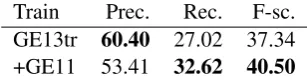
For our next experiment, we tested the contribu-tion of adding the dataset from the 2011 GE task to the training dataset. We use this data both in the training and optimisation steps. The results are
[image:6.595.70.297.62.174.2]Train Prec. Rec. F-sc. GE13tr 60.40 27.02 37.34 +GE11 53.41 32.62 40.50
Table 3: Adding GE11 data to the training and op-timisation steps. Evaluated over GE13dev.
Parser Train Prec. Rec. F-sc.
clearnlp GE13 60.40 27.02 37.34
+GE11 53.41 32.62 40.50
CJM GE13 60.96 33.11 42.91 +GE11 64.11 38.93 48.44
Table 4: Performance depending on the applied parsing pipeline (clearnlp for this work against the CJM pipeline of Liu et al. (2013b)) over GE13dev. For each run, the available data was used both in training and optimisation.
given in Table 3, where we can observe a boost in recall at the cost of precision. Overall, the im-proved F-score suggests that this dataset would make a useful contribution to the system.
[image:6.595.339.493.63.103.2]We also compared our system to that of Liu et al. (2013b), where the primary difference (although not the only difference, as noted in §2.1.2) is the use ofclearnlpinstead of the CJM (Charniak-Johnson/McClosky) pipeline. It is thus somewhat surprising to see in Table 4 that the CJM pipeline outperforms our clearnlp pipeline by 5.5–8% in F-score, depending on the train-ing data. For the smaller GE13-only traintrain-ing set, the gap is smaller, and the precision figures are in fact comparable. However, the recall is uni-formly lower, suggesting that the rules learned fromclearnlpparses are for some reason less gen-erally applicable. Another interesting difference is that ourclearnlppipeline gets a smaller benefit from the addition of the GE11 training data. We consider possible reasons for this in§4.1.
Train Prec. Rec. F-sc. GE11, GE13 65.71 32.57 43.55 +TEES+EVEX 63.67 33.50 43.91
[image:7.595.74.271.63.116.2]+TEES+EVEX * 50.68 36.99 42.77
Table 5: Test set results, always optimised over gold data only. * denotes the official submission.
performance compared to the other results.
3.3 Modification Detection
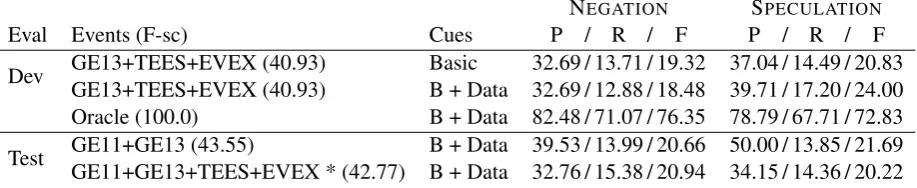
We show results for selected modification detec-tion experiments in Table 6. In all cases we used all of the available gold training data from the GE11 and GE13 datasets. To assess the impact of modification cues, we show results using the basic set as well as with the addition of the data-derived cues. It has often been noted (MacKinlay et al., 2012; Cohen et al., 2011) that modification detec-tion accuracy is strongly dependent on the quality of the upstream event annotation, so we provide an oracle evaluation, using gold-standard event anno-tations rather than automatic output.
The performance over the automatically-annotated runs is respectable, given that the recall is fundamentally limited by the recall of the input event annotations, which is only around 30% for the configurations shown. With the oracle event annotations, the results improve substantially, with considerable gains in precision, and recall increasing by a factor of 4–6. This boost in recall in particular is more than we would naively expect from the roughly threefold increase in recall over the events. It seems that many of the modification rules we learned were even more effective over events which our pipeline was unable to detect. The modification rules were learned from oracle event data, but this does not fully explain the discrepancy. Regardless, our algorithm for mod-ification detection showed excellent performance over the oracle annotations. Over the 2009 version of the BioNLP shared task data, MacKinlay et al. (2012) report F-scores of 54.6% for NEGATION
and 51.7% for SPECULATION. These are not directly comparable with those in Table 6, but running our newer algorithm over the same 2009 data gives F-scores of 84.2% for NEGATIONand 69.1% for SPECULATION.
For the official run, which conflates event extraction and modification detection accuracy, our system was ranked third for NEGATION and
SPECULATION out of the three competing teams, although the other teams had event extraction F-scores of roughly 8% higher than our system. For SPECULATION, our system had the highest preci-sion of 34.15%, while the F-score of 20.22% was close to the best result of 23.92%. Our NEGA
-TION detection was less competitive, with an
F-score of 20.94% – roughly 6% lower than the other teams. We cannot extrapolate directly from the or-acle evaluation in Table 6, but it seems to indicate that an increase in event extraction accuracy would have flow-on benefits in modification detection.
4 Discussion
4.1 Detrimental Effects of Parser Choice
The biggest surprise here was that clearnlp, a more accurate dependency parser for the biomed-ical domain, as evaluated on the CRAFT tree-bank, gave a substantially lower event extrac-tion F-score than the CJM parser. To determine whether preprocessing caused the differences, we replaced the existing modules (sentence-splitting from JSBD and tokenisation/POS-tagging from
clearnlp) with the BioC-derived versions from the CJM pipeline, but this yielded only an insignifi-cant decrease in accuracy.
Over the same training data, the optimised rules from CJM have an average of 2.6 nodes per sub-graph path, compared to 3.9 nodes per path using
clearnlp. A longer path is less likely to match than a shorter path, so this may help to explain the lower generalisability of theclearnlp-derived rules. While it is possible for a longer subgraph to match just as generally, if the test sentences are parsed consistently, in general there are more nodes and edges which can fail to match due to mi-nor surface variations. One way to mitigate this is to raise the ASM distance thresholds to compen-sate for this; preliminary experiments suggest it would provide a small (∼1%) boost in F-score but this would not close the gap between the parsers.
Both parsers produce outputs with Stanford Dependency labels (de Marneffe and Manning, 2008), so we might naively expect similar graph topology and subgraph pattern lengths. However, the CJM pipeline produces graphs in the “CCpro-cessed” SD format, which are simpler and denser. If a nodeN has a link to a nodeOwith a conjunc-tion link to another nodeP(from e.g.and), an ex-tra link with the same label is added directly from
NEGATION SPECULATION
Eval Events (F-sc) Cues P / R / F P / R / F
Dev GE13+TEES+EVEX (40.93) Basic 32.69 / 13.71 / 19.32 37.04 / 14.49 / 20.83 GE13+TEES+EVEX (40.93) B + Data 32.69 / 12.88 / 18.48 39.71 / 17.20 / 24.00 Oracle (100.0) B + Data 82.48 / 71.07 / 76.35 78.79 / 67.71 / 72.83
[image:8.595.74.533.66.160.2]Test GE11+GE13 (43.55) B + Data 39.53 / 13.99 / 20.66 50.00 / 13.85 / 21.69 GE11+GE13+TEES+EVEX * (42.77) B + Data 32.76 / 15.38 / 20.94 34.15 / 14.36 / 20.22
Table 6: Results for SPECULATIONand NEGATIONusing automatically-annotated events (showing the F-score of the configuration), as well as using oracle event annotations from the gold standard, over our development set and the official test set. Rules are learned from GE13+GE11 gold data (excluding any test data). Cues for learning rules are either the basic manually-specified set (34 SPEC/21 NEG) or the augmented set with data-driven additions (47 SPEC/26 NEG). * denotes the official submission.
there are more direct links in the graph, match-ing the semantics more closely. The shortest path fromN toPis now direct, instead of viaO, which could enable the CJM pipeline to produce more general rules.
To evaluate how much this detrimentally af-fects the clearnlp pipeline, as a post hoc in-vestigation, we implemented a conversion mod-ule. Using Stanford Dependency parser code, we replicated the CCprocessed conversion on the
clearnlp graphs, reducing the average subgraph pattern length to 2.8, and slightly improving ac-curacy. Over our development set, compared to the results in Table 3 it gave a 0.7% absolute F-score boost over using GE13 training-data only, and 1.1% over using GE11 and GE13 training data (in both cases improving recall). Over the test set, the improvement was greater, with a P/R/F of 35.66/64.99/46.05, a 2.5% increase in F-score compared to the results in Table 5 and only 2.9% less than the official Liu et al. (2012) submission.
Clearly some of the inter-parser discrepancies are due to surface features and post-processing, and as noted above, we can also achieve small im-provements by relaxing ASM thresholds, so some problems may be caused by the default parameters being suboptimal for the parser. However, the ac-curacy is still lower where we would expect it to be higher, and this remaining discrepancy is diffi-cult to explain without performing a detailed error analysis, which we leave for future work.
4.2 Effect of additional data
Our initial intuition that using additional noisy training data during the training of the system would improve the performance is supported by the results in Table 2. Table 3 shows that
us-ing a larger set of manually annotated data based on 2011 GE task data also improves performance. However, these tables also indicate that adding manually annotated data produces an increase in performance comparable to adding the noisy data, despite its smaller size, and when using this man-ually annotated set together with the noisy data, the improvement resulting from the noisy data is smaller (Table 5). Noisy data was only used dur-ing traindur-ing, which limits its effectiveness—any rule extracted from automatically acquired anno-tations that are not seen during optimisation of the rule set will have a lower weight. On the other hand, we found that using noisy data for optimi-sation seemed to decrease performance. Together, these results suggest that studying strategies, pos-sibly self-training, for selection of events from the noisy data to be used during rule set optimisation in the ASM method are warranted.
5 Conclusion
Acknowledgments
NICTA is funded by the Australian Government as represented by the Department of Broadband, Communications and the Digital Economy and the Australian Research Council through the ICT Centre of Excellence program. This research was supported in part by the Intramural Research Pro-gram of the NIH, NLM.
References
Ethem Alpaydin. 2004. Introduction to Machine Learning. MIT Press.
Jari Bj¨orne and T. Salakoski. 2011. Generalizing biomedical event extraction. In Proceedings of BioNLP Shared Task 2011 Workshop, pages 183– 191.
Jari Bj¨orne, Juho Heimonen, Filip Ginter, Antti Airola, Tapio Pahikkala, and Tapio Salakoski. 2011. Ex-tracting contextualized complex biological events with rich graph-based features sets. Computational Intelligence, 27(4):541–557.
Jari Bjorne, Filip Ginter, and Tapio Salakoski. 2012. University of turku in the bionlp’11 shared task.
BMC Bioinformatics, 13(Suppl 11):S4.
Jinho D. Choi and Andrew McCallum. 2013. Transition-based dependency parsing with selec-tional branching. InProceedings of the 51st Annual Meeting of the Association for Computational Lin-guistics, Sofia, Bulgaria.
Jinho D. Choi and Martha Palmer. 2011. Getting the most out of transition-based dependency parsing. In
Proceedings of the 49th Annual Meeting of the Asso-ciation for Computational Linguistics: Human Lan-guage Technologies, pages 687–692, Portland, Ore-gon, USA, June. Association for Computational Lin-guistics.
K.B. Cohen, K. Verspoor, H.L. Johnson, C. Roeder, P.V. Ogren, W.A. Baumgartner, E. White, H. Tip-ney, and L. Hunter. 2011. High-precision biological event extraction: Effects of system and data. Com-putational Intelligence, 27(4):681701, November.
Marie-Catherine de Marneffe and Christopher D. Man-ning. 2008. The Stanford typed dependencies rep-resentation. InCrossParser ’08: Coling 2008: Pro-ceedings of the workshop on Cross-Framework and Cross-Domain Parser Evaluation, pages 1–8, Mor-ristown, NJ, USA. Association for Computational Linguistics.
J.D. Kim, T. Ohta, S. Pyysalo, Y. Kano, and J. Tsu-jii. 2009. Overview of bionlp’09 shared task on event extraction. Proceedings of Natural Language Processing in Biomedicine (BioNLP) NAACL 2009 Workshop, pages 1–9.
Jin-Dong Kim, Ngan Nguyen, Yue Wang, Jun’ichi Tsu-jii, Toshihisa Takagi, and Akinori Yonezawa. 2012. The genia event and protein coreference tasks of the bionlp shared task 2011. BMC Bioinformatics, 13(Suppl 11):S1.
H. Liu, R. Komandur, and K. Verspoor. 2011. From graphs to events: A subgraph matching approach for information eextraction from biomedical text. ACL HLT 2011, page 164.
Haibin Liu, Tom Christiansen, William Baumgartner, and Karin Verspoor. 2012. Biolemmatizer: a lemmatization tool for morphological processing of biomedical text. Journal of Biomedical Semantics, 3(1):3.
Haibin Liu, Lawrence Hunter, Vlado Keselj, and Karin Verspoor. 2013a. Approximate subgraph matching-based literature mining for biomedical events and re-lations.PLoS ONE, 8(4):e60954, 04.
Haibin Liu, Karin Verspoor, Don Comeau, Andrew MacKinlay, and W. John Wilbur. 2013b. General-izing an approximate subgraph matching-based sys-tem to extract events in molecular biology and can-cer genetics. In Proceedings of the 2013 BioNLP Workshop Companion Volume for the Shared Task.
Andrew MacKinlay, David Martinez, and Timo-thy Baldwin. 2012. Detecting modification of biomedical events using a deep parsing approach.
BMC Medical Informatics and Decision Making, 12(Suppl 1):S4.
David McClosky and Eugene Charniak. 2008. Self-training for biomedical parsing. In Proceedings of the Association for Computational Linguistics (ACL 2008, short papers).
David McClosky, Eugene Charniak, and Mark John-son. 2006. Effective self-training for parsing. In
Proceedings of the Human Language Technology conference of the North American chapter of the ACL, pages 152–159.
Paul Rayson and Roger Garside. 2000. Comparing corpora using frequency profiling. InThe Workshop on Comparing Corpora, pages 1–6, Hong Kong, China, October. Association for Computational Lin-guistics.
Katrin Tomanek, Joachim Wermter, and Udo Hahn. 2007. Sentence and token splitting based on con-ditional random fields. InProceedings of the 10th Conference of the Pacific Association for Compu-tational Linguistics, pages 49–57, Melbourne, Aus-tralia.
S. Van Landeghem, K. Hakala, S. R¨onnqvist, T. Salakoski, Y. Van de Peer, and F. Ginter. 2012. Exploring biomolecular literature with EVEX: Con-necting genes through events, homology and indirect associations. Advances in Bioinformatics, Special issue Literature-Mining Solutions for Life Science Research:ID 582765.