A Pilot Experiment in Knowledge Authoring as Dialogue
∗Artemis Parvizi† Caroline Jay‡ Christopher Mellish† Jeff Z. Pan† Yuan Ren† Robert Stevens‡ Kees van Deemter†
Abstract
This project aims to build an ontology authoring interface in which the user is engaged in a dialogue with the system in controlled natural language. To investigate what such a dialogue might be like, a layered annotation scheme is being developed for interactions between ontology authors and the Prot´eg´e ontology authoring environment. A pilot experiment has been conducted with ontology authors, which reveals the complexity of mapping between user-interface actions and acts that appear in natural language dialogues; it also suggests the addition of some unanticipated types of dialogue acts and points the way to some possible enhancements of the authoring interface.
1
Introduction
Ontology authoring – the process of creating and modifying an ontology in order to capture the knowl-edge about a domain – is hard. Studies such as (Rector et al., 2004) and (Dzbor et al., 2006), for example, have shown that ontology authors frequently misunderstand axioms in the ontology. These studies also suggest that current ontology authoring tools fail to support some of the actions that authors would like to perform, and that users would like to be warned against potential mis-uses of axioms and unforeseen consequences of those axioms.
This paper reports on work in progress, in which we study the interaction of human users with an ontology authoring interface, with the ultimate aim of developing a tool that will permit a much richer knowledge authoring experience, thereby addressing the above-mentioned problems associated with ex-isting knowledge authoring. We envisage developing a plugin to the knowledge authoring interface Prot´eg´e1that will allow authors to interact with the ontology via a controlled natural language (CNL) di-alogue that offers users some of the freedom of natural language without causing insurmountable natural language understanding problems to the system. Specifically, we report on a pilot experiment in which we observed human editors who were invited to use Prot´eg´e while talking to an experimenter, and on a layered annotation scheme that we are developing for annotating the resulting interactions. Once a stable annotation scheme has been reached, we shall use the scheme to obtain annotations involving a larger number of users and a larger number of knowledge authoring tasks, the results of which will inform the design of the new knowledge authoring interface. In this paper, we focus on the following questions:
• If knowledge authoring is viewed as a dialogue, what would be the main moves that one would expect to see in these dialogues?
• How are these dialogue moves grounded in lower-level actions like “Finding subsumers for a given concept”, or “Looking at a concept”?
• How does the annotation of a knowledge authoring dialogue compare to the annotation of real spoken dialogue?
∗
This work was supported by EPSRC grants EP/J014354/1 and EP/J014176/1. †
University of Aberdeen, UK ‡
University of Manchester, UK 1
Ontology authoring aided by CNL has been addressed from various points. ACE (Fuchs et al., 1999) and PENG (Schwitter, 2002) allow users to express specifications that can be translated into an unam-biguous logical language, understandable to machines. CLCE (Sowa, 2004) resembles ACE but, being closer to English, its output is more readable. SWAT (Power, 2009) uses natural language generation to enable users to produce description logic statements. Similar to CLCE, (Bernardi et al., 2012)’s work is another example of a novel controlled language capable of assisting ontology authoring.
Whereas this previous work has addressed the problem of producing isolated utterances relevant to knowledge authoring using CNL, this project attempts to further develop knowledge authoring by adopting new interactive methods inspired by human dialogue. For example, we hypothesise that by allowing an author to posewhat-if questions prior to authoring an axiom in an ontology, the authoring process will run in a more informed manner. The following dialogue is an example of the type of communication that this project is attempting to make possible during knowledge authoring:
U1 I want a Moral Right to be able to have a date.
S1 Moral Rights currently have no date property.
U2 What if I import timeframe.owl?
S2 That is consistent. There is now a date property.
U3 What if a Moral Right must have exactly one date?
S3 That implies that Attribution Rights and Integrity Rights must have exactly one date.
2
A new dialogue annotation scheme for Knowledge Authoring
We decided to use a layered model of human-computer interaction to analyse the interactions between knowledge editors and Prot´eg´e. This general idea has a long pedigree. Moran (1981) proposed a com-mand language grammar, Foley et al. (1982) suggested a 4-layer design model, Buxton (1983) expanded Foley et al.’s model into a 5-layer design model, and Nielsen (1986) presented a virtual communication protocol. Generally, the aim is to have a better understanding of various aspects of human machine inter-action, recognising that a high-level action may be “implemented” in various ways. In this section, we sketch our intial three-level scheme for analysing the interaction between users and Prot´eg´e, which was then modified in light of our experiment.
KLM level.The lowest level of analysis is akin to the Keystroke Level Model (KLM) (Card et al., 1986).
This level records the physical interactions of the user with the system. KLM level includes acts such as clicks, mouse hovers, and eye movements.
Authoring level. At a higher level of analysis, we wanted to record what it is that users attempt to
do and the high-level actions that they perform to accommodate these goals. Some existing analyses (Goncalves et al., 2011; Abgaz et al., 2012) have attempted to understand and categorise changes to the knowledge base during its development. The intention of the present work is not only to categorise such change, but also to understand users’ thinking and, ultimately, to work towards a greater knowledge authoring functionality. We decided to group authoring-level acts into general acts and interface acts.
General actsare grouped into (1) various types of observations (for example, looking whether a class
of a given name exists in the ontology; looking to see what instances of a class exist), (2) addition, updating, and deletion of axioms, (3) noticing and resolving inconsistencies. Interface actsinclude (1) common interface features such as undoing or redoing a previous action, and (2) seeking explanations of inconsistencies.
Dialogue level.Annotation at this level involves a creative step where actions are analysedas ifthey were
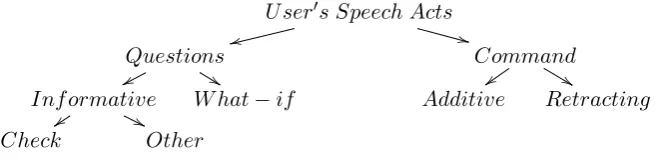
instances of acts in a natural language dialogue. These dialogue acts will provide basis for the design of an interface for knowledge authoring that is similar to natural dialogue. Annotation of dialogue acts is standard in the analysis of Natural Language dialogues (Bunt, 1994; Ginzburg, 1994), but this is not yet used in ontology authoring. Figures 1 and 2 show our initial intuition of dialogue acts, which are categorised into user and system’s dialogue acts.
• Informative QuestionsThe aim of this type of question is to acquire some information, for
U ser0s Speech Acts
+
+
s
s
Questions
%
%
w
w Commandzz %%
Inf ormative
'
'
z
z W hat−if Additive Retracting
[image:3.595.136.469.73.154.2]Check Other
Figure 1: User’s Dialogue Acts
through the inferred hierarchy for a response.
• What-if QuestionsBased on the current context, this type of question informs the user about a
possible future state of the system. The system needs to perform an action and report its conse-quences. However, the decision to apply the change is made by the user later.
• Check QuestionsSimilar in nature to informative questions, check questions provide answers to
user’s inquiries, but where the user has a strong expectation about the answer.
• Additive CommandInforming the system of a certain statement that has to be added or made true
in the ontology. The consistency of the ontology needs to be checked and reported to the user. The decision how and when to address the inconsistency has to be made by the user later.
• Retracting CommandIn certain circumstances when the ontology has become inconsistent, the
user can either ask an informative question, or a check question and based on the answer decide to retract a change; or, the user can simply retract one or more of the uttered statements.
System0s Speech Acts
*
*
r
r
Questions
x
x ((
Statements
t
t ++
P roposal Clarif ication Expressive Conf irmation
t
t ++
Disconf irmation
Response to Question Response to Statement
Figure 2: System’s Dialogue Acts
• Expressive StatementsA response to an information seeking or awhat-if question. Based on the
type of question to be addressed, the system may or may not be involved in an authoring process.
• Confirmation Statements in Response to QuestionsInforming the user that an authoring act had
the desired effect.
• Disconfirmation Statements in Response to QuestionInforming the user of the consequences to
an authoring act, which may not be desired.
• Confirmation Statements in Response to StatementsConfirmation of a successful authoring act.
• Proposal QuestionsA suggestion by the system to undertake an action.
• Clarification QuestionsA question posed to the user to clarify a command.
3
A Pilot Experiment
The 5 participants in the pilot study were computer scientists who were experienced users of OWL and Prot´eg´e. They were asked to set up the Prot´eg´e interface as they normally operated it. They were asked to explore the People and Pet ontology acquired from the Tones repository2, and manipulate it as they saw fit. They were asked to follow the think aloud protocol, and describe their moves. In addition, their interactions and eye movements were video-recorded. Where the experimenters were unclear about a description of what was happening, they asked the subject for clarification. Occasionally, when the
2
[image:3.595.89.511.368.451.2]subject felt unsure how to proceed, the experimenter suggested an action (for example, Why don’t you look at the axioms now appearing in red?”)
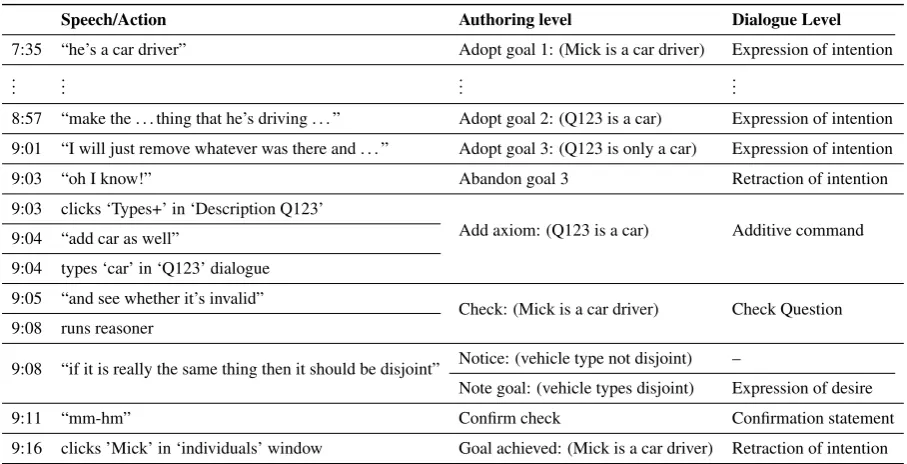
Table 1: A pilot experiment and various levels of annotation
Speech/Action Authoring level Dialogue Level
7:35 “he’s a car driver” Adopt goal 1: (Mick is a car driver) Expression of intention ..
. ... ... ...
8:57 “make the . . . thing that he’s driving . . . ” Adopt goal 2: (Q123 is a car) Expression of intention
9:01 “I will just remove whatever was there and . . . ” Adopt goal 3: (Q123 is only a car) Expression of intention
9:03 “oh I know!” Abandon goal 3 Retraction of intention
9:03 clicks ‘Types+’ in ‘Description Q123’
Add axiom: (Q123 is a car) Additive command 9:04 “add car as well”
9:04 types ‘car’ in ‘Q123’ dialogue
9:05 “and see whether it’s invalid”
Check: (Mick is a car driver) Check Question 9:08 runs reasoner
9:08 “if it is really the same thing then it should be disjoint” Notice: (vehicle type not disjoint) –
Note goal: (vehicle types disjoint) Expression of desire
9:11 “mm-hm” Confirm check Confirmation statement
9:16 clicks ’Mick’ in ‘individuals’ window Goal achieved: (Mick is a car driver) Retraction of intention
Knowledge authoring sessions were annotated with reference to the scheme outlined above but, cru-cially, annotators wrote annotations in a free style: the interface did not limit them to a fixed set of labels implied by our initial annotation scheme. A small annotated segment of one session is presented in Table 1. In the speech/action column, speech refers to the user’s comments and is displayed within quotations, and actions refers to the physical interactions between the user and the Prot´eg´e interface.
Our initial intuitions about dialogue acts were shown to be far from perfect. Perhaps unsurprisingly, it became clear that the mapping between KLM, Prot´eg´e and dialogue levels can be very complex. An annotation in one layer can correspond to more than one in another layer. For example, a subject may observe the definition or the location in the hierarchy of a concept for various conceptual reasons, for instance to check consistency (aCheck Questionin our scheme) or to prepare for adding a new concept
(an Additive Command). Difficulties of a similar kind are well known from the annotation of natural
language dialogue, for instance whether a given spoken utterance (for example, “You are 29 years old”) has declarative or interrogative meaning (Beun, 1989). It also became clear that a separate category is required where a command is both Additive and Retracting at the same time, such as aModifying Com-mand. Furthermore, as displayed in Table 1 at 9:08, an action at one layer may not correspond to an action in another layer at all. Most interestingly, we discovered that knowledge authoring is full of what we call Hidden Acts, which do not correspond with actual Prot´eg´e actions, but which turn out to play an important role in the interaction, as evidenced by subjects’ spoken utterances. These include, most prominently, various types of goal handling, such as the adoption, revision, satisfaction, and abandon-ment of goals. At the dialogue level, these correspond to the expression of desires (when a goal is set aside for later) and intentions (when a goal is starting to be pursued).
Expressive Statements(given that the addition of an axiom has been modelled as aCommand).Proposals
(as opposed toCommands) are only open to the system. Perhaps the most interesting differences between the two schemes relate to the expression of goals, which appears to be absent from the ISO standard. A few other natural-language related annotation schemes (e.g, (Leech and Weisser, 2003)) do allow the expression of “desires”, though the distinction between desires and intentions – reminiscent of Bratman-style “Beliefs, Desires and Intentions” (Bratman, 1999) – is not made.
4
Where do we go from here?
Our annotation scheme has been updated to reflect the observations reported in the previous section, adding categories likeExpression of IntentionandExpression of Desire. Having offered tentative answers to the three questions mentioned at the end of the introduction to this paper, how do we plan to proceed? First, we aim to further improve our understanding of knowledge authoring. Our experiment has given us some relevant insights, as incorporated in our modified annotation scheme, but the validity of these insights has yet to be proven. To do this we shall write an explicit annotation manual, and ask annotators to use these in a full-scale experiment. As before, the study proper will have as participants ontologists working on an ontology they either own or collaborate on in authoring and will not necessarily be computer scientists. Thus the study proper will observe participants in their everyday work, rather than a task that was merely an artefact of the study. In such a setting, there is the potential for athink
aloud protocol to distort ‘normal working practices’, which was not an issue in the pilot study. After
the experiment they will be asked to clarify their actions (retrospective think-aloud), and to elaborate on what they were trying to do (Olmsted-Hawala et al., 2010). Next, we shall ask annotators to use the annotation manual (and an annotation tool based on the categories defined in the manual) to annotate a number of episodes from the full-scale experiment. Inter-annotator agreement will then be measured using standard methods (for example, the κtest), which should tell us whether our annotation scheme, and the annotations that are based on it, are clear. Where necessary the scheme will be adapted in light of the experiment and the editors’ clarifications.
As explained in the Introduction, we aim to exploit our improved understanding of knowledge au-thoring by designing an improved knowledge auau-thoring interface. This will be a difficult step, which will start with an in-depth study of the outcomes of the full-scale experiment, trying to understand what ontology authors were attempting to do, and how their actions may be better supported by an improved knowledge authoring interface. It is too early to say with certainty what these improvements will be but, in light of our pilot studies, it seems plausible that the new interface will allow ontology authors to manipulate goals at different levels (“I’d like this concept to be subsumed by concept X”, “I’d like this concept to have an infinite extension”, “This goal has now been fulfilled and can therefore be deleted”), ask competency questions (such as questions that knowledge authors are often asked to write down before starting the authoring process proper) and ask what-if questions that allow users to explore the conse-quences of potential actions without as yet committing to them. Ultimately, we envisage implementing the new dialogue moves as a plug-in to Prot´eg´e-style knowledge authoring software.
References
Abgaz, Y., M. Javed, and C. Pahl (2012). Analyzing impacts of change operations in evolving ontologies.
InISWC Workshops: Joint Workshop on Knowledge Evolution and Ontology Dynamics.
Bernardi, R., D. Calvanese, and C. Thorne (2012). Designing efficient controlled languages for ontolo-gies. InComputating Meaning(Vol 4 ed.). Springer.
Beun, R. (1989). The recognition of declarative questions in information dialogues. Ph. D. thesis, University of Tilburg.
Bunt, H. (1994). Context and dialogue control. Think Quarterly 3(1), 19–31.
Bunt, H., J. Alexandersson, J. Carletta, J.-W. Choe, A. C. Fang, K. Hasida, K. Lee, V. Petukhova, A. Popescu-Belis, L. Romary, C. Soria, and D. Traum (2010). Towards an iso standard for dia-logue act annotation. InProceedings of the 7th International Conference on Language Resources and
Evaluation, Valletta, Malta. European Language Resources Association.
Buxton, W. (1983). Lexical and pragmatic considerations of input structures. Computer Graphics 17(1), 31–37.
Card, S., T. Moran, and A. Newell (1986). The psychology of human-computer interaction. L. Erlbaum Associates Inc.
Dzbor, M., E. Motta, J. M. Gomez, C. Buil, K. Dellschaft, O. G¨orlitz, and H. Lewen (2006). D4.1.1 anal-ysis of user needs, behaviours & requirements wrt user interfaces for ontology engineering. Technical report, NeOn Project.
Foley, J. and A. Van Dam (1982). Fundamentals of interactive computer graphics, Volume 1. Addison Wesley Longman Publishing Co.
Fuchs, N., U. Schwertel, and R. Schwitter (1999). Attempto controlled english not just another logic specification language. InLogic-Based Program Synthesis and Transformation, Volume 1559, pp. 1–20. Springer.
Ginzburg, J. (1994). An update semantics for dialogue. InProceedings of the 1st International Workshop
on Computational Semantics.
Goncalves, R. S., B. Parsia, and U. Sattler (2011). Categorising logical differences between owl on-tologies. InProceedings of the 20th ACM international conference on Information and knowledge
management, pp. 1541–1546. ACM.
Leech, G. and M. Weisser (2003). Generic speech act annotation for task-oriented dialogues, pp. 441– 446. Centre for Computer Corpus Research on Language Technical Papers, Lancaster University.
Moran, T. (1981). The command language grammar: A representation for the user interface of interactive computer systems.International Journal of Man-Machine Studies 15(1), 3–50.
Nielsen, J. (1986). A virtual protocol model for computer-human interaction. International Journal of
Man-Machine Studies 24(3), 301–312.
Olmsted-Hawala, E., E. Murphy, S. Hawala, and K. Ashenfelter (2010). Think-aloud protocols: a com-parison of three think-aloud protocols for use in testing data-dissemination web sites for usability. In
the 28th international conference on Human factors in computing systems, pp. 2381–2390.
Power, R. (2009). Towards a generation-based semantic web authoring tool. InProceedings of the 12th
European Workshop on Natural Language Generation, Stroudsburg, PA, USA, pp. 9–15. Association
for Computational Linguistics.
Rector, A., N. Drummond, M. Horridge, J. Rogers, H. Knublauch, R. Stevens, H. Wang, and C. Wroe (2004). Owl pizzas: Practical experience of teaching owl-dl: Common errors & common patterns. In
Engineering Knowledge in the Age of the Semantic Web, Volume 3257, pp. 63–81. Springer.
Schwitter, R. (2002). English as a formal specification language. In Database and Expert Systems
Applications, 2002. Proceedings. 13th International Workshop on, pp. 228 – 232.