Evaluation of Crowdsourced User Input Data for Spoken Dialog Systems
Maria Schmidt, Markus M¨uller,Martin Wagner, Sebastian St¨uker and Alex Waibel
Karlsruhe Institute of Technology Karlsruhe, Germany [email protected]
Hansj¨org Hofmann and Steffen Werner Daimler AG
Sindelfingen, Germany
[email protected] [email protected]
Abstract
Using the Internet for the collection of data is quite common these days. This process is called crowdsourcing and en-ables the collection of large amounts of data at reasonable costs. While being an inexpensive method, this data typically is of lower quality. Filtering data sets is therefore required. The occurring er-rors can be classified into different groups. There are technical issues and human er-rors. For speech recording, technical is-sues could be a noisy background. Human errors arise when the task is misunder-stood. We employ several techniques for recognizing errors and eliminating faulty data sets in user input data for a Spo-ken Dialog System (SDS). Furthermore, we compare three different kinds of ques-tionnaires (QNRs) for a given set of seven tasks. We analyze the characteristics of the resulting data sets and give a recommenda-tion which type of QNR might be the most suitable one for a given purpose.
1 Introduction
Similar to research in other areas, Automatic Speech Recognition (ASR) systems and SDSs are facing the challenge how to get new training data, e. g., if there is the urge to cover new domains. Un-til several years ago, a common procedure was to record the required audio samples in an anechoic chamber and let experts (e. g., linguistics students) create the transcriptions. Although the data col-lected via this method is of high quality and can be used as a gold standard, researchers found that this approach is very time-consuming and results in quite little data related to the effort.
A few years ago, companies like Amazon Me-chanical Turk started to offer so-called
crowd-sourcing approaches, which means that Human In-telligence Tasks (HITs) are performed by a group of non-experts. Furthermore, these tasks are open calls and are assigned to the different crowdsource workers. Especially in industrial contexts, crowd-sourcing seems to be the means to choose because development cycles are short and much data for ASR or SDS development can be generated right as it is needed, although the data collected needs to be checked for quality (Snow et al., 2008).
Our work analyzes crowdsourced data collected by the company Clickworker (Eskenazi et al., 2013, ch. 9.3.4). The data consists of user input to an in-car SDS, where the crowdworkers had to input one German utterance for each of the seven tasks, after which they had to transcribe the utter-ance themselves. This procedure was conducted for three different types of QNRs: pictures, se-mantics, and text. We show the differences among these QNRs as well as an overall quality evalua-tion of the collected data. For this, we make use of Natural Language Processing (NLP) tools.
2 Related Work
2.1 Collection of Speech Data via Crowdsourcing
Crowdsourcing is a common part for collecting speech data nowadays. Esk´enazi defines it as “a crowd as a group of non-experts who have an-swered an open call to perform a given task” (Es-kenazi et al., 2013). Such a call will be adver-tised using special platforms on the Internet. Even though the participants are called “non-experts”, they are skilled enough to perform these tasks. For collecting speech data, recording audio from a variety of different speakers helps to build better systems. Different speakers have different back-grounds. This is reflected in their speaking style and choice of words (Hofmann et al., 2012). These aspects are key for training a speaker-independent
system. The choice of participants should reflect the target audience of the system. Using untrained workers is also cheaper than to hire experts.
2.2 Using ASR to Improve the Quality Using an ASR system is an integral part of the col-lection of annotated speech data. Such systems are being used to optimize the collection meth-ods. (Williams et al., 2011) have shown how to process HITs for difficult speech data efficiently. One approach is to first create a transcription and let crowdworkers correct it. Since humans are op-timistic about correcting errors (Audhkhasi et al., 2012), a two step approach was proposed in (Par-ent and Eskenazi, 2010): let the workers first rate the quality/correctness of transcriptions and per-form the corrections in a separate step.
Another approach (van Dalen et al., 2015) deals with the combination of automatic and manual transcriptions. The errors produced are orthogo-nal: while humans tend to introduce spelling er-rors or skip words, automatic transcriptions fea-ture wrong words, additional or even missing words. The usual approach for combining mul-tiple transcriptions is ROVER (Fiscus, 1997) re-quiring an odd (typically three) amount of differ-ent transcriptions to be merged to break the tie. By the use of an ASR system, van Dalen et. al have shown that two manual transcriptions are suf-ficient to produce high quality.
3 Analysis of Crowdsourced User Input Data for Spoken Dialog Systems
In this section, we describe our approach to an-alyze the given corpus containing crowdsourced user input data for a goal-oriented in-car SDS.
3.1 The Corpus
The underlying German utterances for our analy-sis were collected by the German company Click-worker (http://www.clickClick-worker.com/en). The participants were asked to invoke seven specific actions of an imaginary SDS deployed in a car. First, they got a task description, then they should record an audio of their input via a browser-based application on their own PC incl. microphone at home. After that the subjects were asked to tran-scribe their own utterance without hearing or see-ing it again. In the followsee-ing we describe the tasks 1, 4 and 5 exemplarily: In task 1, the imaginary user tells the system that he/she wants to listen to
a certain radio station. Task 4 comprises the navi-gation to the address “Stieglitzweg 23, Berlin”. In task 5, the user should call Barack Obama on his cell phone. There were three different QNRs, each one asking for all seven tasks named above. The QNRs differed in the way how the tasks were pre-sented to the subject: by means of pictures, text, or semantics (see Figure 1). In the pictures QNR, the participants were shown one or more pictures de-picting the task they should perform. Without any written text, this type of task description does not imply the use of specific terms. For type text, the participants were presented a few lines describ-ing the situation they are in and the actions they should perform. This form of textual representa-tion of the objects is more influencing towards the use of specific terms. In the semantics QNR, the participants are influenced the most, as they get presented a few keywords. This does not favor the use of different words. Each participant answered all seven tasks, but was presented only one type of task description across them. Each type of QNR was assigned to approximately 1,080 users result-ing in 22,680 utterances (34.7 hours) in total, i. e., roughly 7,560 per QNR. Most subjects were be-tween 18 and 35 years old, a smaller number of subjects was up to 55 years old. 90% of the sub-jects were between 18 and 35 years old, 8% be-tween 36 and 55. The smallest group was aged over 55 which resulted in 2% of the data. Our par-ticipants were 60% men and 40% women.
Figure 1: Instructions for task 4 in form of pictures, text and semantic entities
words on our “synonymously used words” list by using the Levenshtein distance. Third, after decid-ing which spelldecid-ing is the most appropriate one for each word, we store the corrected utterances and use them for further analysis. The latter included Part-of-Speech (POS) Tagging with the TreeTag-ger (Schmid, 1994) to investigate, which and how many different POS patterns, i.e. types of sen-tence patterns, occur in the corpus and how the QNRs differ from each other on this level. Fur-ther, we investigated the most frequent words used in each task, and how many words in total are used in a specific task and in a specific QNR. With our analysis, we provide answers to the following questions: (a) How large is the linguistic varia-tion in the data set (on sentence and word level)? (b) Which pros and cons do the presented QNRs have? (c) Which QNR is the right one for a certain purpose? We present the results in Section 4.2.
3.3 Evaluation of Self-Recorded Audio Data To determine the usability of the recordings, we compared the length of the recordings and ana-lyzed them using an ASR system. Generally, we assume that most recordings are done appropri-ately and that their quality resembles a normal dis-tribution. We conducted our analysis using the Janus Recognition Toolkit (JRTk) (Woszczyna et al., 1994) which features the IBIS decoder (Soltau et al., 2001). For each task, a certain answer length is expected. This length may vary, but a signif-icantly shorter or longer audio file indicates an error. Whether due to a technically false record-ing setup or a misunderstandrecord-ing of the task de-scription, in both cases the recording needs to be discarded. Even if the length is within a suit-able range, the transcription of the audio might be wrong. To see if the transcription matches the spo-ken words, we use JRTk to perform a forced align-ment. We use a GMM/HMM-based recognizer for German with 6,000 context-dependent quintphone
states for aligning a phoneme sequence to the au-dio using forced Viterbi alignment. If there is a mismatch between audio and transcriptions, there will be phonemes covering unusual long or short parts of the audio.
4 Results & Discussion
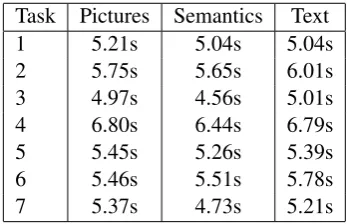
4.1 Results of the Audio Data Analysis We divided the recordings into 21 different sets as there are 3 different QNRs and 7 tasks each. Ta-ble 1 shows a detailed overview of the recording lengths for different tasks. While task 4 produces the longest recordings, the semantics QNR pro-duces the shortest recordings.
Task Pictures Semantics Text
1 5.21s 5.04s 5.04s
2 5.75s 5.65s 6.01s
3 4.97s 4.56s 5.01s
4 6.80s 6.44s 6.79s
5 5.45s 5.26s 5.39s
6 5.46s 5.51s 5.78s
[image:3.595.329.503.407.519.2]7 5.37s 4.73s 5.21s
Table 1: Average length of recordings.
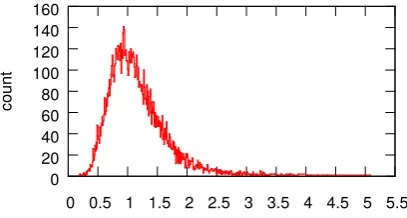
We also performed a forced Viterbi alignment: Figure 2 shows a histogram of the length of the longest phoneme per utterance used to indicate whether recording and transcription fit together. Since we do not have multiple transcriptions per utterance, we could not determine an optimal pa-rameter set for identifying mismatched cases. But our preliminary results indicate that the longer the longest phoneme, the more likely a mismatch. 4.2 Results of the Transcript Analysis
0 20 40 60 80 100 120 140 160
0 0.5 1 1.5 2 2.5 3 3.5 4 4.5 5 5.5
count
Length in seconds of the longest phoneme
Figure 2:Longest phoneme length per utterance.
ond line of each table displays how many oblig-atory semantic entities were named, i.e. whether the two main content words (nouns in many tasks) were named, like ”Sender, SWR3”. The third line displays the number of insufficient utterances ac-cording to this criterion. Similarly, line four and five tell how many entities, which were actually asked for, i.e. all three (or four) items, were named and how many utterances were dismissed accord-ingly. As shown, the pictures QNR has to dismiss the most entities, while the semantics QNR dis-misses the least. The values of the text QNR are in between the latter two QNRs. In total over all QNRs, we have dismissal rates of 17% and 37%.
Table 4 displays the variance of words used for all three QNRs and across tasks 1-7. It is valid for all tasks that the semantics QNR has the low-est number of different words. This is probably caused by displaying three exact semantic items, inevitably being the corresponding words. For tasks 1-3 and 7, the text QNR has the highest num-ber of different words, while the pictures QNR leads the number of different words in tasks 4-6.
The analysis of the most frequent POS se-quences per QNR showed that in the semantics QNR, most people used a polite modal construc-tion ”Ich m¨ochte den Sender SWR h¨oren” (PPER VMFIN ART NN NN VVINF). In the other QNRs ”Radio SWR3” (NN NN) is the most common one among finite and infinite constructions.
Table 5 displays the most common sentence for each task. As you can see, there is a wide variety of linguistic patterns in each task.
5 Conclusion
We have presented various methods for evaluat-ing the collected data set and that different types of QNRs lead to different styles in performing the tasks. With respect to the actual application
[image:4.595.79.283.69.178.2]sce-total number of utterances 7,546 number of obligatory entities 5,420 72% number of insufficient utterances 2,126 28% number of asked for entities 3,033 40% number of insufficient utterances 4,513 60% Table 2: Picture QNR with its dismissal rate.
total number of utterances 7,581 number of obligatory entities 6,947 92% number of insufficient utterances 634 8% number of asked for entities 6,126 81% number of insufficient utterances 1,455 19% Table 3: Semantics QNR with its dismissal rate.
# words used pictures semantics text avg.
Task 1 199 176 237 204
Task 2 216 206 256 226
Task 3 279 225 326 277
Task 4 327 260 309 299
Task 5 266 179 253 233
Task 6 297 188 264 250
Task 7 340 229 377 315
Average 275 209 289 258
Table 4: Variance of used words across all QNRs.
Task Most frequent sentences
1 Ich m¨ochte den Sender SWR3 h¨oren
4 Navigiere [mich] zu[m] Stieglitzweg 23 in Berlin 5 Barack Obama [auf [dem]] Handy anrufen Table 5: Most common sentences for tasks 1, 4, 5.
nario, the way in presenting the task to the partici-pants has to be chosen in the correct manner.
The semantics QNR is precise by using three semantic items and is the best choice for generat-ing exact phrases; it generates very few utterance dismissals. But at the same time it displays the words themselves. To avoid the mere usage of these, one approach for future studies would be to display the semantic items in English. Simulta-neously, the QNR would be easily reusable for the generation of data from other languages.
ThepicturesQNR is optimal to generate a very high linguistic variance in the data. The downside of this approach is the high dismissal rate, if one aims at generating specific utterances.
References
Kartik Audhkhasi, Panayiotis G Georgiou, and Shrikanth S Narayanan. 2012. Analyzing quality of crowd-sourced speech transcriptions of noisy audio
for acoustic model adaptation. InAcoustics, Speech
and Signal Processing (ICASSP), 2012 IEEE Inter-national Conference on, pages 4137–4140. IEEE. Maxine Eskenazi, Gina-Anne Levow, Helen Meng,
Gabriel Parent, and David Suendermann. 2013. Crowdsourcing for Speech Processing: Applications to Data Collection, Transcription and Assessment. John Wiley & Sons.
Jonathan G Fiscus. 1997. A post-processing system to yield reduced word error rates: Recognizer
out-put voting error reduction (rover). In Automatic
Speech Recognition and Understanding, 1997. Pro-ceedings., 1997 IEEE Workshop on, pages 347–354. IEEE.
Hansj¨org Hofmann, Ute Ehrlich, Andr´e Berton, and Wolfgang Minker. 2012. Speech interaction with
the internet–a user study. In Intelligent
Environ-ments (IE), 2012 8th International Conference on, pages 323–326. IEEE.
Gabriel Parent and Maxine Eskenazi. 2010. Toward better crowdsourced transcription: Transcription of a year of the let’s go bus information system data. In Spoken Language Technology Workshop (SLT), 2010 IEEE, pages 312–317. IEEE.
Helmut Schmid. 1994. Probabilistic part-of-speech
tagging using decision trees. InProceedings of the
international conference on new methods in lan-guage processing, volume 12, pages 44–49. Cite-seer.
Rion Snow, Brendan O’Connor, Daniel Jurafsky, and Andrew Y Ng. 2008. Cheap and fast—but is it good?: evaluating non-expert annotations for
natu-ral language tasks. InProceedings of the conference
on empirical methods in natural language
process-ing, pages 254–263. Association for Computational
Linguistics.
Hagen Soltau, Florian Metze, Christian Fugen, and Alex Waibel. 2001. A one-pass decoder based on polymorphic linguistic context assignment. In Automatic Speech Recognition and Understanding, 2001. ASRU’01. IEEE Workshop on, pages 214–217. IEEE.
R van Dalen, K Knill, P Tsiakoulis, and M Gales. 2015. Improving multiple-crowd-sourced
transcrip-tions using a speech recogniser. In Proceedings of
the International Conference on Acoustics, Speech and Signal Processing (ICASSP). Institute of Elec-trical and Electronics Engineers.
Jason D Williams, I Dan Melamed, Tirso Alonso, Bar-bara Hollister, and Jay Wilpon. 2011. Crowd-sourcing for difficult transcription of speech. In Automatic Speech Recognition and Understanding
(ASRU), 2011 IEEE Workshop on, pages 535–540. IEEE.
Monika Woszczyna, N. Aoki-Waibel, Finn Dag Buø, Noah Coccaro, Keiko Horiguchi, Thomas Kemp, Alon Lavie, Arthur McNair, Thomas Polzin, Ivica Rogina, Carolyn Rose, Tanja Schultz, Bernhard Suhm, M. Tomita, and Alex Waibel. 1994. Janus
93: Towards spontaneous speech translation. In