A Linked Data Model for Multimodal Sentiment and Emotion Analysis
J. Fernando S´anchez-Rada Grupo de Sistemas
Inteligentes Universidad Polit´ecnica
de Madrid
Carlos A. Iglesias Grupo de Sistemas
Inteligentes Universidad Polit´ecnica
de Madrid [email protected]
Ronald Gil
Massachusetts Institute of Technology
Abstract
The number of tools and services for senti-ment analysis is increasing rapidly. Unfor-tunately, the lack of standard formats hin-ders interoperability. To tackle this prob-lem, previous works propose the use of the NLP Interchange Format (NIF) as both a common semantic format and an API for textual sentiment analysis. However, that approach creates a gap between tex-tual and sentiment analysis that hampers multimodality. This paper presents a mul-timedia extension of NIF that can be lever-aged for multimodal applications. The ap-plication of this extended model is illus-trated with a service that annotates online videos with their sentiment and the use of SPARQL to retrieve results for different modes.
1 Introduction
With the rise of social media and crowdsourc-ing, the interest in automatic means of extraction and aggregation of user opinions (Opinion Min-ing) and emotions (Emotion MinMin-ing) is growing. This tendency is mainly focused on text analysis, the cause and consequence of this being that the tools for text analysis are getting better and more accurate. As is often the case, these tools are het-erogeneous and implement different formats and APIs. This problem is hardly new or limited to sentiment analysis, it is also present in the Natu-ral Language Processing (NLP) field. In fact, both fields are closely related: textual sentiment analy-sis can be considered a branch of NLP. Looking at how NLP deals with heterogeneity and interop-erability we find NIF, a format for NLP services
that solves these issues. Unfortunately, NLP In-terchange Format (NIF) (Hellmann et al., 2013) is not enough to annotate sentiment analysis ser-vices. Fortunately, it can be extended, by exploit-ing the extensibility of semantic formats. Usexploit-ing this extensibility and already existing ontologies for the sentiment and emotion domains, the R&D Eurosentiment project recently released a model that extends NIF for sentiment analysis (Buitelaar et al., 2013).
However, the Eurosentiment model is bound to textual sentiment analysis, as NIF focuses on annotation of text. The R&D MixedEmo-tions project aims at bridging this gap by provid-ing a Big Linked Data Platform for multimedia and multilingual sentiment and emotion analysis. Hence, different modes (e.g. images, video, au-dio) require different formats. Format heterogene-ity becomes problematic when different modes co-exist or when the text is part of other media. Some examples of this include working with text ex-tracted from a picture with OCR, or subtitles and transcripts of audio and video. This scenario is not uncommon, given the maturity of textual sen-timent analysis tools.
In particular, this paper focuses on video and audio sources that contain emotions and opinions, such as public speeches. We aim to represent that information in a linked data format, linking the original source with its transcription and any senti-ments or emotions found in any of its modes. Us-ing the new model it is possible to represent and process multimodal sentiment information using a common set of tools.
The rest of the paper is structured as follows: Section 2 covers the background for this work; Section 3 presents requirements for semantic an-notation of sentiment in multimedia; Section 4
introduces the bases for sentiment analysis using NIF and delves into the use of NIF for media other than text; Section 5 exemplifies the actual appli-cation of the new model with a prototype and se-mantic queries; Section 6 is dedicated to related work; lastly, Section 7 summarises the conclu-sions drawn from our work and presents possible lines of work.
2 Background
2.1 Annotation based on linked data
Annotating is the process of associating metadata with multimedia assets. Previous research has shown that annotations can benefit from compat-ibility with linked data technologies (Hausenblas, 2007).
The W3C Open Annotation Community Group has worked towards a common RDF-based specification for annotating digital resources. The group intends to reconcile two previous proposals: the Annotation Ontology (Ciccarese et al., 2011) and the Open Annotation Collab-oration (OAC) (Haslhofer et al., 2011). Both proposals incorporate elements from the earlier Annotea model (Kahan et al., 2002). The Open Annotation Ontology (Robert Sanderson and de Sompel, 2013) provides a general description mechanism for sharing annotation between systems based on an RDF model. An annota-tion is defined by two relaannota-tionships: body, the annotation itself, and target, the asset that is annotated. Both body and target can be of any media type. In addition, parts of the body or target can be identified by using Fragment Selectors (oa:FragmentSelector) entities. W3C Fragment URIs (Tennison, 2012) can be used instead, although the use of Fragment Selectors is encour-aged. The vocabulary defines fragment selectors for text (oa:Text), text segments plus passages before or after them (oa:TextQuoteSelector), byte streams (oa:DataPositionSelector), ar-eas (oa:AreaSelector), states (oa:State), time moments (oa:TimeState) and request headers (oa:RequestHeaderState). Finally, Open Annota-tion (OA) ontology defines how annotaAnnota-tions are published and transferred between systems. The recommended serialisation format is JSON-LD.
Another research topic has been the standard-isation of linguistic annotations in order to im-prove the interoperability of NLP tools and re-sources. The main proposals are Linguistic
An-notation Framework (LAF) and NIF 2.0. The ISO Specification LAF (Ide and Romary, 2004) and its extension Graph Annotation Format (GrAF) (Ide and Suderman, 2007) define XML serialisation of linguistic annotation as well as RDF mappings. NIF 2.0 (Hellmann et al., 2013) follows a prag-matic approach to linguistic annotations and is fo-cused on interoperability of NLP tools and ser-vices. It is directly based on RDF, Linked Data and ontologies, and it allows handling structural interoperability of linguistic annotations as well as semantic interoperability. NIF 2.0 Core ontol-ogy provides classes and properties to describe the relationships between substrings, text and docu-ments by assigning URIs to strings. These URIs can then be used as subjects in RDF easily an-notated. NIF builds on current best practices for counting strings and creating offsets such as LAF. NIF uses Ontologies for Linguistic Annotation (OLiA) (Chiarcos, 2012) to provide stable iden-tifiers for morpho-syntactical annotation tag sets. In addition to the core ontology, NIF defines Vo-cabulary modules as an extension mechanism to achieve interoperability between different annota-tion layers. Some of the defined vocabularies are Marl (Westerski et al., 2011) and Lexicon Model for Ontologies (lemon) (Buitelaar et al., 2011).
As discussed by Hellmann (Hellmann, 2013), the selection of the annotation scheme comes from the domain annotation requirements and the trade-off among granularity, expressiveness and simplic-ity. He defines different profiles with this purpose. The profile NIF simple can express the best es-timate of an NLP tool in a flat data model, with a low number of triples. An intermediate profile called NIF Stanbol allows the inclusion of alterna-tive annotations with different confidence as well as provenance information that can be attached to the additionally created URN for each annotation. This profile is integrated with the semantic content management system Stanbol (Westenhaler, 2014). Finally, the profile NIF OA provides the most ex-pressive model but requires more triples and cre-ates up to four new URNs per annotation, making it more difficult to query.
project is to define a new Enhancement Struc-ture for the semantic content management system Apache Stanbol (Bachmann-Gm¨ur, 2013). Fuse-pool researchers’ main design considerations with OA is for it to define a very expressive model ca-pable of very complex annotations. This technique comes with the disadvantage of needing a high amount of triples to represent lower level NLP pro-cessing, which in turn complicates the queries nec-essary to retrieve simple data.
2.2 Eurosentiment Model
The work presented here is partly based on an ear-lier work (Buitelaar et al., 2013) developed within the Eurosentiment project. The Eurosentiment model proposes a linked data approach for senti-ment and emotion analysis, and it is based on the following specifications:
• Marl (Westerski et al., 2011) is a vocabulary designed to annotate and describe subjective opinions expressed on the web or in informa-tion systems
• Onyx (Sanchez-Rada and Iglesias, 2013) is built on the same principles as Marl to an-notate and describe emotions, and provides interoperability with Emotion Markup Lan-guage (EmotionML) (Schr¨oder et al., 2011)
• lemon (Buitelaar et al., 2011) defines a lex-icon model based on linked data principles which has been extended with Marl and Onyx for sentiment and emotion annotation of lex-ical entries
• NIF 2.0 (Hellmann et al., 2013) which de-fines a semantic format and API for improv-ing interoperability among natural language processing services
The way these vocabularies have been integrated is illustrated in the example below, where we are going to analyse the sentiment of an opin-ion (“Like many Paris hotels, the rooms are too small”) posted in TripAdvisor. In the Eurosenti-ment model,lemonis used to define the lexicon for a domain and a language. In our example, we have to generate this lexicon for the hotel domain and the English language1. A reduced lexicon for
Ho-tels in English (le:hotel en) is shown in Listing 1
1The reader interested in how this domain specific lexicon
can be generated can consult (Vulcu et al., 2014).
for illustration purposes. The lexicon is composed of a set of lexical entries (prefix lee). Each lexical entry is semantically disambiguated and provides a reference to the syntactic variant (in the example the canonical form) and the senses. The example shows how the senses have been extended to in-clude sentiment features. In particular, the sense small 1 in the context of room 1 has associated a negative sentiment. That is, “small room” is neg-ative (while small phone could be positive, for ex-ample).
lee:sense/small_1 a lemon:Sense; lemon:reference "01391351";
lexinfo:partOfSpeech lexinfo:adjective; lemon:context lee:sense/room_1;
marl:polarityValue "-0.5"ˆˆxsd:double; marl:hasPolarity marl:negative.
le:hotel_en a lemon:Lexicon; lemon:language "en";
lemon:topic ed:hotel;
lemon:entry lee:room, lee:Paris, lee: small.
lee:room a lemon:LexicalEntry;
lemon:canonicalForm [ lemon:writtenRep
"room"@en ];
lemon:sense [ lemon:reference wn:synset -room-noun-1;
lemon:reference dbp:Room ]; lexinfo:partOfSpeech lexinfo:noun.
lee:Paris a lemon:LexicalEntry;
lemon:canonicalForm [ lemon:writtenRep
"Paris"@en ];
lemon:sense [ lemon:reference dbp: Paris;
lemon:reference wn:synset-room-noun -1 ];
lexinfo:partOfSpeech lexinfo:noun.
lee:small a lemon:LexicalEntry;
lemon:canonicalForm [ lemon:writtenRep
"small"@en ];
lemon:sense lee:sense/small_1;
lexinfo:partOfSpeech lexinfo:adjective. Listing 1: Sentiment analysis expressed with Eurosentiment model.
string, e.g. a scheme based on RFC5147 (Wilde and Duerst, 2008), and a custom scheme based on context. In addition to the format itself, NIF 2.0 defines a REST API for NLP services with stan-dardised parameters. An example of how these on-tologies are integrated is illustrated in Listings 2, 3 and 4.
<http://tripadvisor.com/myhotel#char =0,49>
rdf:type nif:RDF5147String , nif: Context;
nif:beginIndex "0"; nif:endIndex "49";
nif:sourceURL <http://tripadvisor.com/ myhotel.txt>;
nif:isString "Like many Paris hotels, the rooms are too small";
marl:hasOpinion <http://tripadvisor. com/myhotel/opinion/1>.
Listing 2: NIF + Marl output of a service call http://eurosentiment.eu?i=Like many Paris hotels, the rooms are too small
<http://tripadvisor.com/myhotel/opinion /1>
rdf:type marl:Opinion;
marl:describesObject dbp:Hotel; marl:describesObjectPart dbp:Room; marl:describesFeature "size"; marl:polarityValue "-0.5";
marl:hasPolarity: http://purl.org/marl /ns#Negative.
Listing 3: Sentiment analysis expressed with Eurosentiment model.
<http://eurosentiment.eu/analysis/1> rdf:type marl:SentimentAnalysis; marl:maxPolarityValue "1"; marl:minPolarityValue "-1";
marl:algorithm "dictionary-based"; prov:used le:hotel_en;
prov:wasAssociatedWith http://dbpedia. org/resource/UPM.
Listing 4: Sentiment analysis expressed with Eurosentiment model.
3 Requirements for semantic annotation of sentiment in multimedia resources The increasing need to deal with human fac-tors, including emotions, on the web has led to the development of the W3C specification EmotionML (Schr¨oder et al., 2011). EmotionML aims for a trade-off between practical applicability and scientific well-foundedness. Given the lack of agreement on a finite set of emotion descriptors,
EmotionML follows a plug-in model where emo-tion vocabularies can be defined depending on the application domain and the aspect of emotions to be focused.
EmotionML (Schr¨oder et al., 2011) uses Me-dia URIs to annotate multimeMe-dia assets. Tempo-ral clipping can be specified either as Normal Play Time (npt) (Schulzrinne et al., 1998), as SMPTE timecodes (Society of Motion Picture and Tele-vision Engineers, 2009), or as real-world clock time (Schulzrinne et al., 1998).
During the definition of the EmotionML speci-fication, the Emotion Incubator group defined 39 individual use cases (Schr¨oder et al., 2007) that could be grouped into three broad types: man-ual annotation of materials (e.g. annotation of videos, speech recordings, faces or texts), auto-matic recognition of emotions from sensors and generation of emotion-related system responses. Based on these uses cases as well as others identi-fied in the literature (Grassi et al., 2011), a number of requirements have been identified for the anno-tation of multimedia assets based on linked data technologies:
• Standards compliance. Emotion annota-tions should be based on linked data tech-nologies such as RDF or W3C Media Frag-ment URI. Unfortunately, EmotionML has been defined in XML. Nevertheless, as com-mented above, the vocabulary Onyx provides a linked data version of EmotionML that can be used instead. Regarding the annotation framework, OA covers the annotation of mul-timedia assets while NIF only supports the annotation of textual sources.
• Trace annotation of time-varying signals. The time curve of properties scales (e.g. arousal or valence) should be preserved. To this end, EmotionML defines two mecha-nisms. The element trace allows the repre-sentation of the time evolution of a dynamic scale value based on a periodic sampling of values (i.e. one value every 100ms at 10 Hz). In case of aperiodic sampling, separate emo-tion annotaemo-tions should be used. The current version of the ontologies we use does not sup-port trace annotations.
URIs to be able to annotate temporal interval or frames. As presented above, NIF provides a compact scheme for textual fragment anno-tation, but it does not cover multimedia frag-ments. In contrast, OA supports the annota-tion of multimedia fragments using a number of triples.
• Collaborative and multi-modal annota-tions. Emotion analysis of multimedia assets may be performed based on different com-bination of modalities (i.e. full body video, facial video, each with or without speech or textual transcription). Thus, interoperability of emotion annotations is essential. Semantic web technologies provide a solid base for dis-tributed, interoperable and shareable annota-tions, with proposals such as OA and NIF.
4 Linked Data Annotation for Multimedia Sentiment Analysis
One of the main goals of NIF is interoperability between NLP tools. For this, it uses a convention to assign URIs to parts of a text. Since URIs are unique, different tools can analyse the same text independently, and one may use the URIs later to combine the information from both.
These URIs are constructed with a combination of the URI of the source of the string (its con-text), and a unique identifier for that string within that particular context. A way to assign that iden-tifier is called a URI scheme. Strings belong to different classes, according to the scheme used to generate its URI. The currently available schemes are: ContextHashBasedString, OffsetBasedString, RFC5147String and ArbitraryString. The usual scheme isRFC5147String.
For instance, for a context
http://example.com, its content may
be “This is a test”, and the RFC5147String
http://example.com#char=5,7 would
refer to the “is” part within the context.
However, to annotate multimedia sources in-dexing by characters is obviously not possible. We need a different way to uniquely refer to a frag-ment.
Among the different possible approaches to identify media elements, we propose to follow the same path as the Ontology for Media Re-sources (Lee et al., 2012) and use the Media Frag-ments URI W3C recommendation (Troncy et al.,
2012). The recommendation specifies how to re-fer to a specific fragment or subpart of a media resource. URIs follow this scheme:
<scheme>:<part>[?<q>][#<frag.>]
Where <scheme> is the specific scheme or protocol (e.g. http), part is the hierarchical part (e.g. example.com), q is the query (e.g. user=Nobody), andfrag is the piece we are in-terested in: the multimedia fragment (e.g. t=10).
[image:5.595.308.527.254.378.2]Since the Media Fragments URI schema is very similar to those already used in NIF and follows the same philosophy, we have extended NIF to in-clude it. The result is Figure 1.
Figure 1: By extending the URI Schemes of NIF, we make it possible to use multimedia sources in NIF, and refer to their origin using the Media Frag-ments recommendation.
Using this URI Scheme and the NIF notation for sentiment analysis, the results from a service that analyses both the captions from a YouTube video and the video comments would look like the document in Listing 5. In this way, we fulfill the requirements previously identified in Sect. 3. This example is, in fact, the aggregation of three differ-ent kinds of analysis: textual sdiffer-entimdiffer-ent analysis on comments (CommentAnalysis) and captions
(CaptionAnalysis), and sentiment analysis
based on facial expressions (SmileAnalysis). Each analysis would individually return a docu-ment similar to that of the example, with only the fields corresponding to that particular analysis.
The results can be summarised as follows: a youtube video
(http://youtu.be/W07PoKUD-Yk) is
tagged as positive overall based on facial expressions (OpinionS01); the section of the video from second 108 to second 110
(http://youtu.be/W07PoKUD-Yk#t=108,
lastly, the video has a comment
(http://www.youtube.com/comment?lc=
<CommentID>) that reflects a positive opinion
(OpinionC01).
The JSON-LD context in Listing 6 provides ex-tra information the semantics of the document, and has been added for completeness.
{
"analysis": [{
"@id": "SmileAnalysis",
"@type": "marl:SentimentAnalysis", "marl:algorithm": "AverageSmiles"
}, {
"@id": "CaptionAnalysis",
"@type": "marl:SentimentAnalysis", "marl:algorithm": "NaiveBayes"
}, {
"@id": "CommentAnalysis",
"@type": "marl:SentimentAnalysis", "marl:algorithm": "NaiveBayes"
}],
"entries": [{
"@id": "http://youtu.be/W07PoKUD-Yk", "@type": [
"nifmedia:MediaFragmentsString", "nif:Context"],
"nif:isString": "<FULL Transcript>", "opinions": [{
"@id": "_:OpinionS01",
"marl:hasPolarity": "marl:Positive", "marl:polarityValue": 0.5,
"prov:generatedBy": "SmileAnalysis"
}],
"sioc:hasReply": "http://
,→ www.youtube.com/comment?lc=<
,→ CommentID>", "strings": [{
"@id": "http://youtu.be/W07PoKUD-Yk#t=
,→ 108,110", "@type": "nifmedia:
,→ MediaFragmentsString",
"nif:anchorOf": "Family budgets under
,→ pressure", "opinions": [{
"@id": "_:OpinionT01",
"marl:hasPolarity": "marl:Negative", "marl:polarityValue": -0.3058,
"prov:generatedBy": "CaptionAnalysis"
}] }] }, {
"@id": "http://www.youtube.com/comment?
,→ lc=<CommentID>", "@type": [
"nif:Context", "nif:RFC5147String" ], "nif:isString": "He is well spoken", "opinions": [{
"@id": "OpinionC01",
"marl:hasPolarity": "marl:Positive", "marl:polarityValue": 1,
"prov:generatedBy": "CommentAnalysis"
}] }] }
Listing 5: Service results are annotated on the fragment level with sentiment and any other
property in NIF such as POS tags or entities.
{
"marl": "http://www.gsi.dit.upm.es/
,→ ontologies/marl/ns#", "nif":
"http://persistence.uni-,→ leipzig.org/nlp2rdf/ontologies/
,→ nif-core#",
"onyx": "http://www.gsi.dit.upm.es/
,→ ontologies/onyx/ns#",
"nifmedia": "http://www.gsi.dit.upm.es/
,→ ontologies/nif/ns#", "analysis": {
"@id": "prov:wasInformedBy"
},
"opinions": {
"@container": "@list", "@id": "marl:hasOpinion", "@type": "marl:Opinion"
},
"entries": {
"@id": "prov:generated"
},
"strings": {
"@reverse": "nif:hasContext"
} }
Listing 6: JSON-LD context for the results necessary to give semantic meaning to the JSON in Listing 5.
5 Application
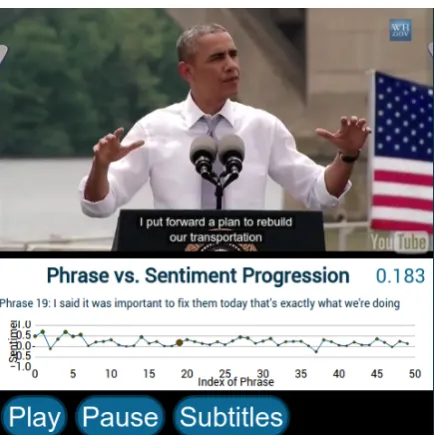
5.1 VESA: Online HTML5 Video Annotator The first application to use NIF annotation for sen-timent analysis of Multimedia sources is VESA, the Video Emotion and Sentiment Analysis tool. VESA is both a tool to run sentiment analy-sis of online videos, and a visualisation tool which shows the evolution of sentiment informa-tion and the transcript as the video is playing, us-ing HTML5 widgets. The visualisation tool can run the analysis in real time (live analysis) or use previously stored results.
The live analysis generates transcriptions using the built-in Web Speech API in Google Chrome2
while the video plays in the background. To im-prove the performance and accuracy of the tran-scription process, the audio is chunked in sen-tences (delimited by a silence). Then, each chunk is sent to a sentiment analysis service. As of this writing, users can choose sentiment analysis in Spanish or English, in a general or a financial do-main, using different dictionaries.
The evolution of sentiment within the video is shown as a graph below the video in Figure 2. The
2https://www.google.com/intl/en/
full transcript of the video allows users to check the accuracy of the transcription service.
The results from the service can be stored in a database, and can be later replayed. We also de-veloped a Widget version of the annotator that can be embedded in other websites, and integrated in widget frameworks like Sefarad3.
[image:7.595.73.291.197.415.2]The project is completely open source and can be downloaded from its Github repository4.
Figure 2: The graph shows the detected sentiment in the video over time, while the video keeps play-ing.
5.2 Semantic multimodal queries
This section demonstrates how it would be pos-sible to integrate sentiment analysis of different modes using SPARQL. In particular, it covers two scenarios: fusion of results from different modes, and detection of complex patterns using informa-tion from several modes.
As discussed in Section 6, SPARQL has some limitations when it comes to querying media frag-ments. There are extensions to SPARQL that over-come those limitations. However, for the sake of clarity, this section will avoid those extensions. In-stead, the examples assume that the original media is chunked equally for every mode. Every chunk represents a media fragment, which may contain an opinion.
3http://github.com/gsi-upm/Sefarad 4https://github.com/gsi-upm/
video-sentiment-analysis
When different modes yield different senti-ments or emotions, it is usually desirable to inte-grate all the results into a single one. The query in Listing 7 shows how to retrieve all the opinions for each chunk. These results can be fed to a fu-sion algorithm.
SELECT ?frag ?algo ?opinion ?pol WHERE { ?frag a nifmedia:MediaFragmentsString;
marl:hasOpinion ?opinion. ?opinion marl:hasPolarity ?pol. ?algo prov:generated ?opinion. }
Listing 7: Gathering all the opinions detected in a video.
Another possibility is that the discrepancies be-tween different modes reveal useful information. For instance, using a cheerful tone of voice for a negative text may indicate sarcasm or untruthful-ness. Listing 8 shows an example of how to detect such discrepancies. Note that it uses both opinions and emotions at the same time.
SELECT ?frag WHERE {
?frag a nifmedia:MediaFragmentsString; marl:hasOpinion ?opinion;
onyx:hasEmotion ?emo. ?opinion prov:wasGeneratedBy
_:TextAnalysis; marl:hasPolarity marl:
Negative. ?emo prov:wasGeneratedBy
_:AudioAnalysis; onyx:hasEmotionCategory wna:
Cheerfulness. }
Listing 8: Detecting negative text narrated with a cheerful tone of voice.
6 Related work
On the other hand, a better integration between multimedia and the linked data toolbox would be necessary. Working with multimedia fragments in plain SPARQL is not an easy task. More specifi-cally, it is the relationship between fragments that complicates it, e.g. finding overlaps or contiguous segments. An extension to SPARQL by Kurz et al. (Kurz et al., 2014), SPARQL-MM, introduces convenient methods that allow these operations in a concise way.
7 Conclusions and future work
We have introduced the conceptual tools to de-scribe sentiment and emotion analysis results in a semantic format, not only from textual sources but also multimedia.
Despite being primarily oriented towards anal-ysis of texts extracted from multimedia sources, this approach can be used to apply other kinds of analysis, in a way similar to how NIF integrates results from different tools. However, more effort needs to be put into exploring different use cases and how they can be integrated in our extension of NIF for sentiment analysis in multimedia. This work will be done in the project MixedEmotions, where several use cases (Brand Monitoring, Social TV or Call Center Management) have been identi-fied and involve multimedia analysis.
In addition, this discussion can be carried out in theLinked Data Models for Emotion and Sen-timent AnalysisW3C Community Group5, where
professionals and academics of the Semantic and sentiment analysis worlds meet and discuss the ap-plication of an interdisciplinary approach.
Regarding the video annotator, although the current version is fully functional, it could be im-proved in several ways. The main limitation is that its live analysis relies on the Web Speech API, and needs user interaction to set specific audio set-tings. We are studying other fully client-side ap-proaches.
Acknowledgements
This research has been partially funded and by the EC through the H2020 project MixedEmotions (Grant Agreement no: 141111) and by the Spanish Ministry of Industry, Tourism and Trade through the project Calista (TEC2012-32457).
5http://www.w3.org/community/
sentiment/
The authors also want to thank Berto Y´a˜nez for his support and inspiring demo “Popcorn.js Senti-ment Tracker”.
References
Reto Bachmann-Gm¨ur. 2013. Instant Apache Stanbol.
Packt Publisher.
Paul Buitelaar, Philipp Cimiano, John McCrae, Elena Montiel-Ponsoda, and Thierry Declerck. 2011. On-tology lexicalisation: The lemon perspective. In
Workshop at 9th International Conference on Termi-nology and Artificial Intelligence (TIA 2011), pages 33–36.
Paul Buitelaar, Mihael Arcan, Carlos A Iglesias, J Fer-nando S´anchez-Rada, and Carlo Strapparava. 2013. Linguistic linked data for sentiment analysis. In
2nd Workshop on Linked Data in Linguistics (LDL-2013): Representing and linking lexicons, termi-nologies and other language data, Pisa, Italy.
Christian Chiarcos. 2012. Ontologies of linguistic
an-notation: Survey and perspectives. InLREC, pages
303–310.
Paolo Ciccarese, Marco Ocana, Leyla Jael Garcia-Castro, Sudeshna Das, and Tim Clark. 2011. An open annotation ontology for science on web 3.0. J. Biomedical Semantics, 2(S-2):S4.
Marco Grassi, Christian Morbidoni, and Francesco
Piazza. 2011. Towards semantic multimodal
video annotation. InToward Autonomous, Adaptive,
and Context-Aware Multimodal Interfaces. Theo-retical and Practical Issues, volume 6456 of Lec-ture Notes in Computer Science, pages 305–316. Springer Berlin Heidelberg.
Bernhard Haslhofer, Rainer Simon, Robert Sanderson, and Herbert Van de Sompel. 2011. The open
anno-tation collaboration (oac) model. InMultimedia on
the Web (MMWeb), 2011 Workshop on, pages 5–9. IEEE.
Michael Hausenblas. 2007. Multimedia vocabularies on the semantic web. Technical report, World Wide Web (W3C).
Sebastian Hellmann, Jens Lehmann, S¨oren Auer, and Martin Br¨ummer. 2013. Integrating nlp using linked
data. InThe Semantic Web–ISWC 2013, pages 98–
113. Springer.
Sebastian Hellmann. 2013. Integrating Natural
Language Processing (NLP) and Language Re-sources using Linked Data. Ph.D. thesis, Universit¨at Leipzig.
Nancy Ide and Keith Suderman. 2007. Graf: A graph-based format for linguistic annotations. In Proceed-ings of the Linguistic Annotation Workshop, LAW ’07, pages 1–8, Stroudsburg, PA, USA. Association for Computational Linguistics.
J. Kahan, M.-R. Koivunen, E. Prud’Hommeaux, and
R.R. Swick. 2002. Annotea: an open{RDF}
in-frastructure for shared web annotations. Computer
Networks, 39(5):589 – 608.
Thomas Kurz, Sebastian Schaffert, Kai Schlegel, Flo-rian Stegmaier, and Harald Kosch. 2014.
Sparql-mm-extending sparql to media fragments. In The
Semantic Web: ESWC 2014 Satellite Events, pages 236–240. Springer.
WonSuk Lee, Werner Bailer, Tobias B¨urger, Pierre-Antoine Champin, Jean-Pierre Evain, V´eronique Malais´e, Thierry Michel, Felix Sasaki, Joakim S¨oderberg, Florian Stegmaier, and John Strassner. 2012. Ontology for Media Resources 1.0. Technical report, World Wide Web Consortium (W3C), Febru-ary. Available at http://www.w3.org/TR/mediaont-10/.
C. Morbidoni, M. Grassi, M. Nucci, S. Fonda, and G. Ledda. 2011. Introducing semlib project: se-mantic web tools for digital libraries. International Workshop on Semantic Digital Archives-Sustainable Long-term Curation Perspectives of Cultural Her-itage Held as Part of the 15th International Con-ference on Theory and Practice of Digital Libraries (TPDL), Berlin.
Jonathan Marsh Paul Grosso, Eve Mater and Normal Walsh. 2003. W3C XPointer Framework. Tech-nical report, World Wide Web Consortium (W3C), March. Available at http://www.w3.org/TR/xptr-framework/.
Pablo Ciccarese Robert Sanderson and Herbert Van
de Sompel. 2013. W3C Open Annotation
Data Model. Technical report, World Wide
Web Consortium (W3C), February. Available at http://www.openannotation.org/spec/core/.
J Fernando Sanchez-Rada and Carlos Angel Iglesias. 2013. Onyx: Describing emotions on the web of
data. InESSEM@ AI* IA, pages 71–82. Citeseer.
Marc Schr¨oder, Enrico Zovato, Hannes Pirker,
Christian Peter, and Felix Burkhardt. 2007.
W3C Emotion Incubator Group Report 10 July 2007. Technical report, W3C, July. Available at http://www.w3.org/2005/Incubator/emotion/XGR-emotion/.
Marc Schr¨oder, Paolo Baggia, Felix Burkhardt, Cather-ine Pelachaud, Christian Peter, and Enrico Zovato.
2011. Emotionml – an upcoming standard for
representing emotions and related states. In Sid-ney D’Mello, Arthur Graesser, Bj¨orn Schuller, and
Jean-Claude Martin, editors, Affective Computing
and Intelligent Interaction, volume 6974 of Lec-ture Notes in Computer Science, pages 316–325. Springer Berlin Heidelberg.
H. Schulzrinne, A. Rao, and R. Lanphier. 1998.
Real Time Streaming Protocol (RTP).
Tech-nical Report RFC2326, IETF. Available at
http://www.ietf.org/rfc/rfc2326.txt.
Society of Motion Picture and Television Engineers. 2009. SMPTE - RP 136. time and control codes for 24, 25 or 30 frame-per-second motion-picture sys-tems - stabilized 2009. Technical report, SMPTE. Jeni Tennison. 2012. Best practices for fragment
iden-tifiers and media type definitions. Technical report, World Wide Web (W3C).
Rapha¨el Troncy, Erik Mannens, Silvia Pfeiffer, and
Davy Van Deursen. 2012. W3C
Recommen-dation Media Fragments URI 1.0. Technical re-port, World Wide Web Consortium (W3C), Septem-ber. Available at http://www.w3.org/TR/2012/REC-media-frags-20120925/.
Gabriela Vulcu, Paul Buitelaar, Sapna Negi, Bianca Pereira, Mihael Arcan, Barry Coughlan, J. Fernando S´anchez-Rada, and Carlos A. Iglesias. 2014. Gen-erating Linked-Data based Domain-Specific Senti-ment Lexicons from Legacy Language and
Seman-tic Resources. In th International Workshop on
Emotion, Social Signals, Sentiment & Linked Open Data, co-located with LREC 2014, Reykjavik, Ice-land, May. LREC2014.
Rupert Westenhaler. 2014. Open Annotation and NIF 2.0 based Annotation Model for Apache Stanbol. In
Proceedings of ISWC 2014.
Adam Westerski, Carlos A. Iglesias, and Fernando Tapia. 2011. Linked opinions: Describing senti-ments on the structured web of data.
E. Wilde and M. Duerst. 2008. URI
Frag-ment Identifiers for the text/plain Media Type. Technical Report RDF5147, Internet
Engineer-ing Task Force (IETF), April. Available at