Generating Image Descriptions with Gold Standard Visual Inputs:
Motivation, Evaluation and Baselines
Josiah Wang
Department of Computer Science University of Sheffield
United Kingdom
Robert Gaizauskas Department of Computer Science
University of Sheffield United Kingdom
Abstract
In this paper, we present the task of gen-erating image descriptions with gold stan-dard visual detections as input, rather than directly from an image. This allows the Natural Language Generation community to focus on the text generation process, rather than dealing with the noise and complications arising from the visual de-tection process. We propose a fine-grained evaluation metric specifically for evaluat-ing the content selection capabilities of image description generation systems. To demonstrate the evaluation metric on the task, several baselines are presented us-ing boundus-ing box information and textual information as priors for content selec-tion. The baselines are evaluated using the proposed metric, showing that the fine-grained metric is useful for evaluating the content selection phase of an image de-scription generation system.
1 Introduction
There has been increased interest in the task of automatically generating full-sentence natural lan-guage image descriptions in recent years. Com-pared to earlier work that annotates images with isolated concept labels (Duygulu et al., 2002), such detailed annotations are much more informa-tive and discriminating, and are important for im-proved text and image retrieval. They also pose an interesting and difficult challenge for natural lan-guage generation.
Previous work on generating image descriptions concentrates on solving the problem ‘end-to-end’, that is to generate a description given an image as input (Yao et al., 2010; Kulkarni et al., 2011; Yang et al., 2011). Recent advances in large scale vi-sual object recognition, especially in deep learning
techniques, have reached a reasonably high level of accuracy in the last few years. For the task of classifying an image into one of 1,000 object cat-egories (i.e. does the image contain an object of category X, yes or no?) on the ImageNet Large Scale Visual Recognition Challenge (ILSVRC’14) dataset (Russakovsky et al., 2014), the state-of-the-art currently performs at a 4.82% top-5 error rate (Ioffe and Szegedy, 2015) comparable to the 5.1% error rate of a human annotator who trained himself to recognise the object categories (Rus-sakovsky et al., 2014). For the more challenging object category detection task (i.e. draw a bound-ing box around each instance of objects of the given categories), the state-of-the-art achieved a mean average precision of 43.9%. However, even at this level of performance, the errors from the visual output are still problematic when used as input to an image description generation system, especially when considering a large pool of candi-date object categories to be mentioned in the de-scription.
What if we were to assume that visual object recognisers have already achieved close to perfect detection rates, and that the object instances have already been identified and localised in an image? This then raises many interesting questions with regards to generating a description for an image, including: (i) how do we decide which objects are to be mentioned? (ii) how should these objects be ordered in the description? (iii) how do we infer and describe activities or actions? (iv) how to we describe spatial relations between objects? (v) how and when do we describe the object at-tributes? Many of these questions could be ex-plored if we had a ‘perfect’ visual input to our im-age description generator.
bench-[5] painting.n.01
[6] curtain.n.01
[1] cabinet.n.01
[2] bed.n.01
[4] male child.n.01
[0] cabinet.n.01
[3] blanket.n.01
[image:2.595.72.291.62.212.2][7] book.n.01
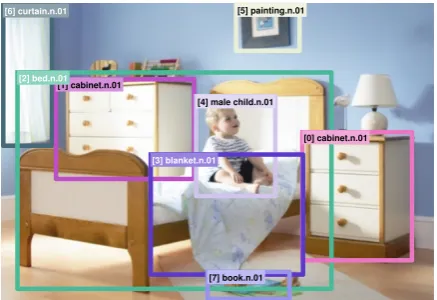
Figure 1: We present the task of generating textual descriptions given gold standard labelled bound-ing boxes as input. This allows researchers to focus on the text generation aspects of the im-age description generation task, rather than deal-ing with the noise arisdeal-ing from visual detection. This task also allows us to evaluate specific phases of the conventional generation pipeline, providing insights into which specific phases of the genera-tion pipeline contribute to the performance of an image description generation system.
marking challenge (Villegas et al., 2015; Gilbert et al., 2015). More specifically, we assume that perfectly labelled object instances and their local-isations are available to image description genera-tion systems, as done in Elliott and Keller (2013) and Yatskar et al. (2014). Given this knowledge, we would like to evaluate how well image descrip-tion generadescrip-tion systems perform through the vari-ous stages of Natural Language Generation (Reiter and Dale, 2000): content determination (what ob-jects to describe), microplanning (how to describe objects) and realisation (generating the complete sentence). This pilot task is an attempt at en-couraging fine-grained evaluation specifically for image descriptions, compared to general-purpose metrics like METEOR (Denkowski and Lavie, 2014) that evaluates text at a global, coarse-grained level. For our pilot, we concentrated on just one fine-grained metric: a content selection measure to evaluate how well a text generation system selects the correct object instances to be mentioned in the resulting image description.
A dataset has been introduced for this partic-ular challenge. This paper will not discuss in great detail how the dataset has been collected and annotated; we instead refer readers to Gilbert et al. (2015) for more details about the challenge.
The main purpose of this paper, instead, is to: (i) present and discuss the task of generating image descriptions with agold standard visual input; (ii) propose a fine-grained metric specifically for eval-uating thecontent selectioncapabilities of image description generation systems; (iii) introduce sev-eralbaselinesfor this task and evaluate the base-lines using the proposed fine-grained metric.
Overview. In section 2, we discuss the
motiva-tions for introducing the pilot task and the fine-grained metric in the ImageCLEF 2015 challenge, positioning them in relation to existing work. In section 3, we describe the task of generating im-age descriptions given gold standard visual inputs, along with a discussion on evaluating image de-scription generation systems with regards to their content selection abilities. Section 4 presents sev-eral baselines for this task, while section 5 eval-uates these baselines using the proposed content selection metric. Finally, we discuss further chal-lenges with the proposed task, and introduce pos-sible fine-grained metrics to be considered in the future.
2 Motivation and Related Work
There are currently three main groups of ap-proaches to generating image descriptions. The most common and intuitive paradigm is the knowledge-based, generative approach that takes an image as input, detects instances of pre-defined object categories in the image using a visual recog-niser, and then reasons about the detected objects to generate a novel textual description (Yao et al., 2010; Kulkarni et al., 2011; Yang et al., 2011; Li et al., 2011; Mitchell et al., 2012). However, these approaches are constrained to a limited num-ber of categories, for example 20 in Kulkarni et al. (2011). We found that these approaches are gener-ally sensitive to errors from visual input detection, as such errors tend to propagate and accumulate through the generation pipeline. The problem is accentuated when scaling up to a larger number of categories (e.g. 1000), where it becomes diffi-cult to reason about what to describe amongst the candidate instances produced by the noisy visual detectors. Thus, generating image descriptions with gold standard visual input allows researchers to concentrate on the sentence generation aspects without being bogged down by the complications of the vision aspects of the task.
de-[4] hair.n.01 [2] woman.n.01
[0] dress.n.01 [3] car.n.01
[6] signboard.n.01
[1] wheel.n.01 [5] boot.n.01
A[woman]2in a white[dress]0and gold[boots]5leaning on a[car]3.
[image:3.595.78.199.62.244.2]A[woman]2poses along a[car]3.
[woman]2dressed in white with gold [boots]5poses next to a police[car]3.
A[woman]2dressed in white leans against a white[car]3.
A[woman]2is leaning against a[car]3.
A[woman]2with gold[boots]5leans against an Indy pace[car]3.
A blonde[woman]2wearing gold shiny[boots]5, a white[top]0and short
white skirt is leaning on a[car]3.
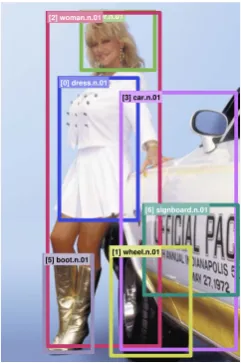
Figure 2: An example image and its seven corresponding textual descriptions from the development dataset, with bounding box annotations labelled with WordNet concepts, and the correspondence of bounding boxes to entity mentions in the descriptions. For example, [woman]2 in the first sentence
refers to bounding box ID [2] in the image, and[dress]0corresponds to bounding box ID [0].
Correspon-dence is annotated at word level rather than at phrase level to avoid possible complications with multiple correspondences within the same phrase (woman in a white dress).
scription generation by retrieving existing textual descriptions from similar images. A common ap-proach would be to map text and images to a com-mon meaning space (Farhadi et al., 2010; Ho-dosh et al., 2013; Socher et al., 2014) or by using some similarity measure (Ordonez et al., 2011). Although such methods produce descriptions that are more expressive, they rely on a large amount of training data, and are unable to produce novel sentences. There have been attempts at retrieving only text fragments and combining them to gen-erate novel descriptions (Kuznetsova et al., 2012; Kuznetsova et al., 2014) or by pruning irrelevant fragments for better generalisation (Kuznetsova et al., 2013). However, the resulting descriptions may still be pure ‘guesswork’ and may reference text fragments that are irrelevant to image content.
Most recently, work using deep learning approaches has produced state-of-the-art re-sults (Karpathy and Fei-Fei, 2015; Donahue et al., 2015; Vinyals et al., 2015), by utilising Convo-lutional Neural Networks (CNN) (Krizhevsky et al., 2012; Razavian et al., 2014) as image features, and a Recurrent Neural Network (RNN) (Mikolov et al., 2010) for language modelling, and learning to generate descriptions jointly from images and their descriptions. The advantages of such models are that they cope better with noisy visual detec-tions, and that the RNN language models are
ca-pable of modelling long range dependencies. The main disadvantages are (i) it is difficult to inspect what has been learnt by the model and hence to gain insight into what is working or not working in the system; (ii) these methods are dependent on image datasets aligned with sentences as learning is performed in a joint manner. The latter limita-tion means new datasets need to be produced even for small changes in the task, such as generating descriptions that are more or less detailed, or in more or less simplified language (e.g. for chil-dren) or have a specific information focus (say, fo-cussing on buildings versus people in an image for a particular application). Thus, knowledge-based, generative approaches may have an advantage in this respect, as there is no need for aligned image-text datasets, since visual detection and sentence generation are independent, allowing the language model to be tuned at surface realisation stages.
Image description generation with gold
stan-dard input. As discussed, knowledge-based,
anno-tations, as well as fine-grained region properties such as attributes, parts, and activities. Zitnick and Parikh (2013) take a unique approach of generat-ing scenes from clipart as an abstraction to real world images to address the issue of noisy input. Our work takes a similar direction as Elliott and Keller (2013) and Yatskar et al. (2014), but with bounding boxes as gold standard input, and with an emphasis on fine-grained evaluation of image description generation systems.
Evaluation of image description generation
systems. Existing image description generation
systems are most commonly evaluated using au-tomatic evaluation metrics such as BLEU (Pap-ineni et al., 2002), ROUGE (Lin, 2004), ME-TEOR (Denkowski and Lavie, 2014) and most recently CIDEr (Vedantam et al., 2015). How-ever, such global measures only allow evalua-tion of image descripevalua-tion generaevalua-tion systems as a whole, without being able to ascertain which parts of the generation process, or components of the generation system, are responsible for perfor-mance gains or losses. Although evaluations based on human judgments could provide a more fine-grained metric (Yang et al., 2011; Mitchell et al., 2012; Kuznetsova et al., 2012), they are expensive and difficult to scale. We propose instead to ex-ploit the pipeline of knowledge-based, generative approaches to generation, allowing us to inspect specific capabilities of image generation systems by means of evaluation with fine-grained metrics. Rather than just evaluating image description gen-eration extrinsically with a global evaluation mea-sure, we isolate evaluation of different phases of description generation, and treat each phase as a first-class citizen.
3 Task and Evaluation Measure
As mentioned above, we introduced as a bench-marking challenge the task of generating image descriptions for 450 test images given gold stan-dard, labelled bounding box annotations as input (Figure 1). The category labels were restricted to 251 WordNet synsets selected specifically for the challenge. To enable evaluation with our proposed fine-grained metric, participants were also asked to annotate, within their generated descriptions, the bounding box ID to which a term in the de-scription corresponds. A development dataset of 500 images was provided with labelled bounding box annotations and correspondence annotations
between textual terms and bounding boxes. Fig-ure 2 shows an example annotation of bounding boxes and the correspondences between bound-ing box instances and terms in the image descrip-tions. Note that correspondence was annotated at word level (unigram) rather than at phrase level (higher-ordern-grams) to avoid possible
compli-cations with multiple correspondences within the same phrase (woman in a white dress).
3.1 Fine-grained Evaluation Metric
As a pilot, we propose a fine-grained metric to evaluate the content selection capabilities of an image description system. Thiscontent selection
metric is theF1 score averaged across all 450 test
images, where eachF1score is computed from the
precision and recall averaged over all gold stan-dard descriptions for the image.
Formally, let I = {I1, I2, ...IN} be the set of test images. Let GIi = {GIi
1, GI2i, ..., GIMi} be
the set of gold standard descriptions for imageIi,
where eachGIi
m is the set of unique bounding box instances referenced in gold standard description
mof imageIi. LetSIibe the set of unique
bound-ing box instances referenced by the participant’s generated sentence for image Ii. The precision PIi for test imageI
iis computed as:
PIi = 1
M
M
X
m
|GIi
m∩SIi|
|SIi| (1)
where |GIi
m ∩ SIi| is the number of unique bounding box instances referenced in both the gold standard description and the generated sen-tence, andM is the number of gold standard
de-scriptions for imageIi.
Similarly, the recallRIifor test imageI
iis com-puted as:
RIi = 1
M
M
X
m
|GIi
m∩SIi|
|GIi
m|
(2)
The content selection score for imageIi,FIi, is
computed as the harmonic mean ofPIiandRIi:
FIi = 2×P
Ii×RIi
PIi+RIi (3)
The finalP,RandFscores are computed as the
meanP,RandF scores across all test images.
instances based on how frequently they occur across the gold standard descriptions. For exam-ple, in Figure 2, both woman and car are ref-erenced in all seven gold standard descriptions,
while boot is mentioned four times and dress
twice. Thus, a generated description that refer-ences woman and car will naturally result in a higher score than one that references onlywoman
anddress.
Note that for this metric, we are only concerned with evaluating the generation system’s content selectioncapabilities, rather than its referring ex-pression generation. As such, systems are free to generate any referring expression for each se-lected bounding box instance. We consider the evaluation of referring expressions as a potentially separate fine-grained evaluation task to be intro-duced in the future. In addition, we do not evalu-ate terms outside those that refer to bounding box instances, and as for the pilot task of the challenge use the global METEOR metric to cover evalua-tion of other aspects of image descripevalua-tion genera-tion.
4 Generating Descriptions: Baselines We propose a set of baselines for the image de-scription generation task, or more specifically the content selection task. These allow us to test the proposed fine-grained content selection met-ric (Section 3.1) and to gain some insights into what features might inform content selection. The baselines use visual and textual cues to select the bounding box instances to be described in the text to be generated.
4.1 Generation based on Visual Cues
Stratos et al. (2012) found that the size and posi-tion of visual entities in an image, to a certain ex-tent, plays a part in determining what is mentioned in the corresponding description. As such, we con-sider two baselines based on different visual cues: (i) bounding box size (bigger objects have higher likelihood of being mentioned); (ii) distance of the centroid of the bounding box to the centre of the image (central objects have higher likelihood of being mentioned). For each test image, bounding boxes instances are sorted based on these visual cues, and a fixed threshold used to limit the num-ber of instances to be selected for sentence gener-ation. We will explore different thresholds in our experiments in Section 5.
1 2 3 4 5 6 7 8 9 10 11 12 13 14 15
k (maximum number of instances) 0.0
0.1 0.2 0.3 0.4 0.5 0.6
F
[image:5.595.312.521.65.220.2]Bigram Unigram Bounding Box Size Bounding Box Position Random
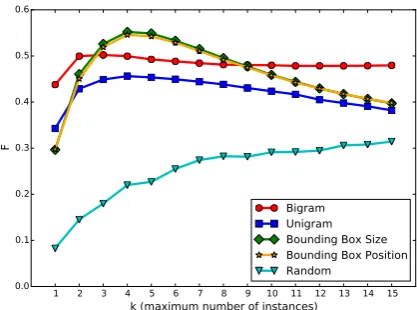
Figure 3: The content selection score, F, evalu-ated on the proposed baselines at varying levels of
k (maximum number of instances per sentence).
Standard deviations are omitted for clarity, but are included in Table 1.
4.2 Generation based on Textual Priors We also consider baselines based on textual pri-ors, as Stratos et al. (2012) also showed that the category of the object play a role in determining whether it will be mentioned in the corresponding textual description.
For the first baseline, we consider as a prior uni-gram counts of concepts that have been referenced to a bounding box in the gold standard descrip-tions from the development set. For each test im-age, bounding boxes are sorted by the frequency of their concept labels in the development set, i.e. frequently mentioned concepts have higher prece-dence.
We also consider a more sophisticated baseline based on bigram sequences, where a concept is se-lected based on how likely it is to be referenced
immediately after another concept, i.e. there are no other terms referencing a bounding box in be-tween. For instance, for the first sentence in Fig-ure 2, we considerwomanto be followed bydress,
dressfollowed byboot, andbootfollowed bycar,
but not woman followed by car or boot.
1 2 3 4 5 6 7 8 9 10 11 12 13 14 15 k (maximum number of instances)
0.0 0.1 0.2 0.3 0.4 0.5 0.6 0.7 0.8 0.9 1.0
P (solid line) and R (dashed line) Bigram
Unigram Random
(a) Baselines based on textual priors
1 2 3 4 5 6 7 8 9 10 11 12 13 14 15
k (maximum number of instances) 0.0
0.1 0.2 0.3 0.4 0.5 0.6 0.7 0.8 0.9 1.0
P (solid line) and R (dashed line) Bounding Box Size
Bounding Box Position Random
[image:6.595.84.523.63.225.2](b) Baselines based on visual cues
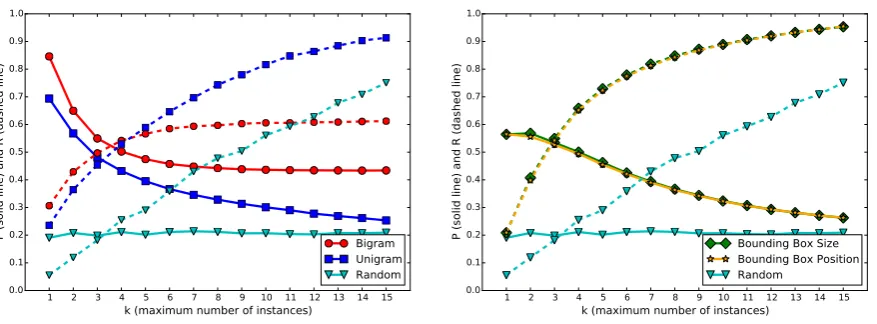
Figure 4: The precisionP(solid lines) and recallR(dashed lines), as evaluated on the proposed baselines
at varying levels ofk. Again, error bars are omitted for clarity, but are included in Table 1.
For all baselines, we select the first term among the synonyms of the WordNet synset to generate the referring expression for each concept.
4.3 Function Words
Our metric only evaluates the content selection process and ignores everything else. However, for completeness and in the spirit of generating complete descriptions, we attempt to connect se-lected concept terms with randomly sese-lected func-tion words or phrases. The phrases are selected to be a random word from a predefined list of prepo-sitions and conjunctions, followed by an optional articlethe.
5 Experimental Results
The generation systems described in Section 4 were evaluated using the proposed content selec-tion metric (Secselec-tion 3.1). We also compared the proposed systems to a baseline that selects bound-ing boxes at random, up to a pre-defined thresh-oldkof the maximum allowed number of
bound-ing boxes per image. We explore different values of this threshold by varying k from 1 to 15. We
take min(k, Nbox) for images with fewer thank bounding boxes, where Nbox is the total number of bounding boxes for the image.
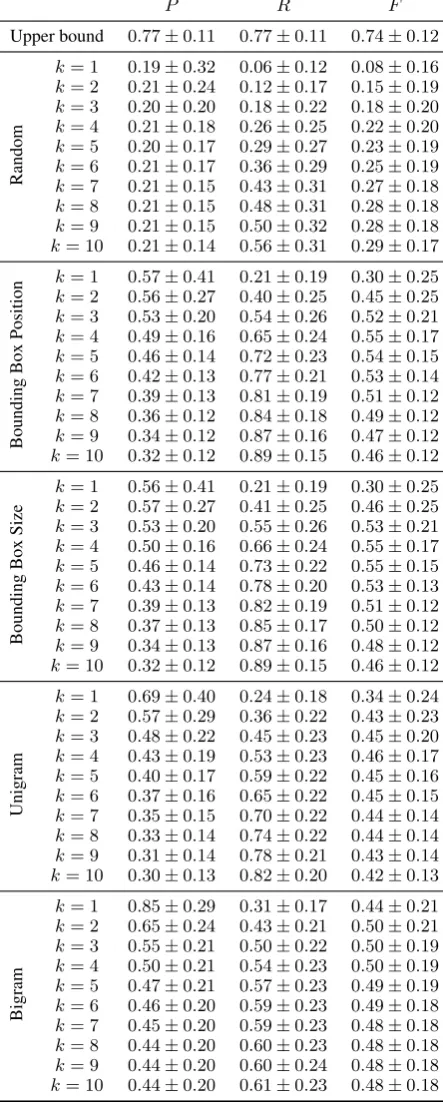
As an upper bound to how well humans perform content selection, we evaluated the gold standard descriptions by evaluating one description against the other descriptions of the image and repeating the process for all descriptions. The upper bound is computed to be F = 0.74±0.12, with P = 0.77±0.11andR= 0.77±0.11.
Figure 3 shows the F-scores of our proposed
generation systems. Firstly, we examine the ef-fects of varying the thresholdkon the number of
instances to be selected. TheF-score peaks atk
between 3 and 4 across all systems except the ran-dom baseline, and then drops or remains stagnant beyond that. Figure 4 gives an insight about this observation when the precisionPand recallRare
examined separately. As expected, P decreases
while R increases whenk is increased. The two
graphs intersect at about k between 3 to 4,
sug-gesting that these values are an optimal tradeoff between precision and recall (the mean number of unique instances per description is 2.89 in the de-velopment dataset).
Comparing the baselines based on visual and textual cues, theF-score in Figure 3 suggests that
baselines using textual cues perform better when
k is small, and visual cues perform better with
largerk’s. However, Figure 4 gives a clearer
pic-ture, where the bigram-based system obtained the best precision regardless of k (Figure 4a), while
the systems based on bounding box cues relied on the increased recall when increasingkto obtain a
high F-score (Figure 4b). Note that the
bigram-based generation system is less sensitive to larger
k’s as the model itself contains an internal
stop-ping criterion when no suitable concept is likely to follow a selected concept, resulting in a lower but stable recall rate compared to other systems, whenkis increased. Figure 5 shows some
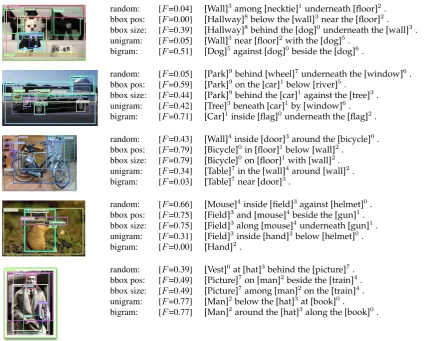
exam-ple sentences generated by our baseline systems, fork=3.
knowledge on the ordering of concepts (i.e. bi-grams) is helpful for concept selection; (ii) fre-quency of concepts (i.e. unigrams) are helpful when there are only one or two instances to be described, possibly because the remaining objects are not mentioned as frequently as the main actors; (iii) visual cues are helpful for concept selection, although the precision is reduced askincreases.
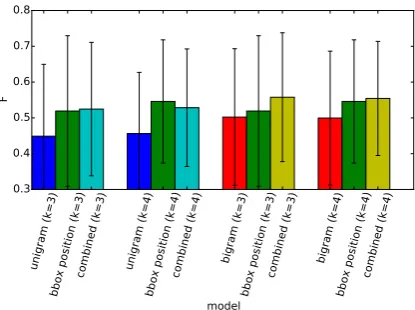
5.1 Combining Textual and Visual Priors We also explored combining textual priors and visual cues, which could potentially produce a stronger baseline. This is done by re-ranking the bounding boxes, for each image, by the average rank from both systems. In the case of the bigram-based system, bounding boxes that are not selected are all assigned an equal rank: 0.5 ×((Nbox +
1)−Ns) +Ns, whereNbox is the number of all bounding boxes for the image andNsthe number of bounding boxes selected by the bigram-based system. For example, if only 3 out of 9 bound-ing boxes are selected (and assigned ranks 1, 2 and 3 respectively), then the remaining 6 bound-ing boxes are all assigned equal rank 6.5. Fig-ure 6 compares the F-scores of systems
combin-ing textual priors (unigram or bigram) and visual cues (bounding box position) atk=3 andk=4; we
omitted bounding box size as the results are simi-lar to bounding box position. Combining unigram and bounding box position did not significantly improve the F-score compared to using
bound-ing box position alone, atk=3 andk=4. As seen
earlier, the performance of the unigram-based sys-tem at thesek’s is much lower than systems based
on visual cues. The combination of bigram and bounding box position, however, seems to yield slightly improved performance at these k’s. This
is likely due to the bigram-based system providing higher precision and the system based on visual cues providing better recall. This shows that com-bining textual and visual priors may be beneficial when they complement each other.
6 Discussion and Future Work
We presented the task of generating image de-scriptions from gold standard labelled bounding boxes as input to a text generation system. We also proposed a fine-grained evaluation metric specifi-cally to evaluate the content selection capabilities of the image description generation system, which measures how well the system selects the concepts
unigram (k=3) bbox position (k=3)combined (k=3)
unigram (k=4) bbox position (k=4)combined (k=4)
bigram (k=3)
bbox position (k=3)combined (k=3) bigram (k=4)
bbox position (k=4)combined (k=4)
model 0.3
0.4 0.5 0.6 0.7 0.8
[image:7.595.313.521.65.220.2]F
Figure 6: The content selection score, F, when combining textual priors and visual cues. For text priors, we compare both unigram and bigram pri-ors. For visual cues, we show only the results for bounding box position as using bounding box size yields similar results. We compare the combined baselines atk=3 andk=4.
to be described compared against a set of human-authored reference descriptions. Several baselines were proposed to demonstrate the proposed metric on the task. We found that selecting a maximum of 3 to 4 instances is optimal for this dataset, and that both text and visual cues play a part in the content selection process.
Further challenges can be observed for the pro-posed generation task based solely on gold stan-dard visual inputs:
Bounding boxes. Bounding boxes labelled with
concepts may be a good starting point for a ‘clean’ input task, but may be somewhat uninformative as important visual information is discarded in the process that might prove useful for the genera-tion process. A possible solugenera-tion would be to en-rich the bounding box inputs with more informa-tion, either as attributes (adjectives, verbs etc.) or directly using visual features. However, manu-ally annotating such fine-grained information is an onerous task.
Suitability of metrics. Another possible issue
evalu-[8] hallway.n.01
[7] dog.n.01 [5] dog.n.01 [6] dog.n.01
[4] vest.n.01
[3] wall.n.01
[2] floor.n.01 [1] necktie.n.01
[0] dog.n.01
random: [F=0.04] [Wall]3among [necktie]1underneath [floor]2. bbox pos: [F=0.00] [Hallway]8below the [wall]3near the [floor]2. bbox size: [F=0.39] [Hallway]8behind the [dog]0underneath the [wall]3. unigram: [F=0.05] [Wall]3near [floor]2with the [dog]5.
bigram: [F=0.51] [Dog]5against [dog]0beside the [dog]6.
[11] lighter.n.02
[10] window.n.01
[9] park.n.01
[8] temple.n.01
[7] wheel.n.01 [6] window.n.01
[5] river.n.01 [4] wheel.n.01 [3] tree.n.01
[2] flag.n.01
[1] car.n.01 [0] flag.n.01
random: [F=0.05] [Park]9behind [wheel]7underneath the [window]6.
bbox pos: [F=0.59] [Park]9on the [car]1below [river]5.
bbox size: [F=0.44] [Park]9behind the [car]1against the [tree]3.
unigram: [F=0.42] [Tree]3beneath [car]1by [window]6.
bigram: [F=0.71] [Car]1inside [flag]0underneath the [flag]2.
[8] door.n.01 [7] table.n.02
[6] bottle.n.01
[5] bottle.n.01 [2] wall.n.01 [3] door.n.01 [4] wall.n.01
[1] floor.n.01
[0] bicycle.n.01 random: [F=0.43] [Wall]
4inside [door]3around the [bicycle]0.
bbox pos: [F=0.79] [Bicycle]0in [floor]1below [wall]2.
bbox size: [F=0.79] [Bicycle]0on [floor]1with [wall]2.
unigram: [F=0.34] [Table]7in the [wall]4around [wall]2.
bigram: [F=0.03] [Table]7near [door]3.
[4] mouse.n.01
[3] field.n.01
[2] hand.n.01
[1] gun.n.01
[0] helmet.n.01
random: [F=0.66] [Mouse]4inside [field]3against [helmet]0.
bbox pos: [F=0.75] [Field]3and [mouse]4beside the [gun]1.
bbox size: [F=0.75] [Field]3along [mouse]4underneath [gun]1.
unigram: [F=0.31] [Field]3inside [hand]2below [helmet]0.
bigram: [F=0.00] [Hand]2.
[7] picture.n.01
[6] vest.n.01[5] scarf.n.01
[4] train.n.01
[3] hat.n.01
[2] man.n.01 [1] face.n.01
[0] book.n.01
random: [F=0.39] [Vest]6at [hat]3behind the [picture]7.
bbox pos: [F=0.49] [Picture]7on [man]2beside the [train]4. bbox size: [F=0.49] [Picture]7among [man]2on the [train]4. unigram: [F=0.77] [Man]2below the [hat]3at [book]0.
[image:8.595.76.502.59.400.2]bigram: [F=0.77] [Man]2around the [hat]3along the [book]0.
Figure 5: Example image descriptions generated by our baselines (k= 3).
ate them with such fine-grained metrics.
Future work with fine-grained metrics.
Al-though we only consider one metric to evalua-tion the content selecevalua-tion capabilities of genera-tion systems, further fine-grained metrics can be introduced to evaluate different components of the generation pipeline. Some examples include content ordering, lexicalisation or referring ex-pression generation of concepts (and/or their at-tributes), evaluating the appropriateness of verbs, predicates and prepositions, and surface realisa-tion.
Future work on image description generation. In this paper, we presented several baselines based on different textual and visual priors, and also ex-plored combining cues from both text and vision. Future work on image description generation could involve stronger cues, for example from co-occurrences and spatial relationships between multiple objects.
We believe that the introduction of a fine-grained approach to evaluating image description
generation tasks can encourage further growth in this area, linking further research between com-puter vision and natural language generation.
Acknowledgments
This work has been supported by the EU CHIST-ERA D2K 2011 Visual Sense project, EPSRC grant reference: EP/K019082/1.
References
Michael Denkowski and Alon Lavie. 2014. Meteor universal: Language specific translation evaluation for any target language. InProceedings of the EACL 2014 Workshop on Statistical Machine Translation.
Jeffrey Donahue, Lisa Anne Hendricks, Sergio Guadar-rama, Marcus Rohrbach, Subhashini Venugopalan, Kate Saenko, and Trevor Darrell. 2015. Long-term recurrent convolutional networks for visual recogni-tion and descriprecogni-tion. In Proceedings of the IEEE Conference on Computer Vision & Pattern Recogni-tion.
im-P R F Upper bound 0.77±0.11 0.77±0.11 0.74±0.12
Random
k= 1 0.19±0.32 0.06±0.12 0.08±0.16 k= 2 0.21±0.24 0.12±0.17 0.15±0.19 k= 3 0.20±0.20 0.18±0.22 0.18±0.20 k= 4 0.21±0.18 0.26±0.25 0.22±0.20 k= 5 0.20±0.17 0.29±0.27 0.23±0.19 k= 6 0.21±0.17 0.36±0.29 0.25±0.19 k= 7 0.21±0.15 0.43±0.31 0.27±0.18 k= 8 0.21±0.15 0.48±0.31 0.28±0.18 k= 9 0.21±0.15 0.50±0.32 0.28±0.18 k= 10 0.21±0.14 0.56±0.31 0.29±0.17
Bounding
Box
Position
k= 1 0.57±0.41 0.21±0.19 0.30±0.25 k= 2 0.56±0.27 0.40±0.25 0.45±0.25 k= 3 0.53±0.20 0.54±0.26 0.52±0.21 k= 4 0.49±0.16 0.65±0.24 0.55±0.17 k= 5 0.46±0.14 0.72±0.23 0.54±0.15 k= 6 0.42±0.13 0.77±0.21 0.53±0.14 k= 7 0.39±0.13 0.81±0.19 0.51±0.12 k= 8 0.36±0.12 0.84±0.18 0.49±0.12 k= 9 0.34±0.12 0.87±0.16 0.47±0.12 k= 10 0.32±0.12 0.89±0.15 0.46±0.12
Bounding
Box
Size
k= 1 0.56±0.41 0.21±0.19 0.30±0.25 k= 2 0.57±0.27 0.41±0.25 0.46±0.25 k= 3 0.53±0.20 0.55±0.26 0.53±0.21 k= 4 0.50±0.16 0.66±0.24 0.55±0.17 k= 5 0.46±0.14 0.73±0.22 0.55±0.15 k= 6 0.43±0.14 0.78±0.20 0.53±0.13 k= 7 0.39±0.13 0.82±0.19 0.51±0.12 k= 8 0.37±0.13 0.85±0.17 0.50±0.12 k= 9 0.34±0.13 0.87±0.16 0.48±0.12 k= 10 0.32±0.12 0.89±0.15 0.46±0.12
Unigram
k= 1 0.69±0.40 0.24±0.18 0.34±0.24 k= 2 0.57±0.29 0.36±0.22 0.43±0.23 k= 3 0.48±0.22 0.45±0.23 0.45±0.20 k= 4 0.43±0.19 0.53±0.23 0.46±0.17 k= 5 0.40±0.17 0.59±0.22 0.45±0.16 k= 6 0.37±0.16 0.65±0.22 0.45±0.15 k= 7 0.35±0.15 0.70±0.22 0.44±0.14 k= 8 0.33±0.14 0.74±0.22 0.44±0.14 k= 9 0.31±0.14 0.78±0.21 0.43±0.14 k= 10 0.30±0.13 0.82±0.20 0.42±0.13
Bigram
[image:9.595.73.295.107.659.2]k= 1 0.85±0.29 0.31±0.17 0.44±0.21 k= 2 0.65±0.24 0.43±0.21 0.50±0.21 k= 3 0.55±0.21 0.50±0.22 0.50±0.19 k= 4 0.50±0.21 0.54±0.23 0.50±0.19 k= 5 0.47±0.21 0.57±0.23 0.49±0.19 k= 6 0.46±0.20 0.59±0.23 0.49±0.18 k= 7 0.45±0.20 0.59±0.23 0.48±0.18 k= 8 0.44±0.20 0.60±0.23 0.48±0.18 k= 9 0.44±0.20 0.60±0.24 0.48±0.18 k= 10 0.44±0.20 0.61±0.23 0.48±0.18
Table 1: P,RandF scores (with standard
devia-tions) of the content selection metric, as evaluated on different baselines at varying levels of k(1 to
10).
age vocabulary. In Proceedings of the European Conference on Computer Vision, pages 97–112. Desmond Elliott and Frank Keller. 2013.
Im-age description using visual dependency represen-tations. InProceedings of the Conference on Em-pirical Methods in Natural Language Processing (EMNLP).
Ali Farhadi, Mohsen Hejrati, Amin Sadeghi, Peter Young, Cyrus Rashtchian, Julia Hockenmaier, and David Forsyth. 2010. Every picture tells a story: Generating sentences for images. InProceedings of the European Conference on Computer Vision. Andrew Gilbert, Luca Piras, Josiah Wang, Fei Yan,
Emmanuel Dellandrea, Robert Gaizauskas, Mauri-cio Villegas, and Krystian Mikolajczyk. 2015. Overview of the ImageCLEF 2015 Scalable Image Annotation, Localization and Sentence Generation task. In CLEF2015 Working Notes, CEUR Work-shop Proceedings, Toulouse, France, September 8-11. CEUR-WS.org.
Micah Hodosh, Peter Young, and Julia Hockenmaier. 2013. Framing image description as a ranking task: Data, models and evaluation metrics. Journal of Ar-tificial Intelligence Research (JAIR), 47(1):853–899, May.
Sergey Ioffe and Christian Szegedy. 2015. Batch normalization: Accelerating deep network train-ing by reductrain-ing internal covariate shift. CoRR, abs/1502.03167.
Andrej Karpathy and Li Fei-Fei. 2015. Deep visual-semantic alignments for generating image descrip-tions. In Proceedings of the IEEE Conference on Computer Vision & Pattern Recognition.
Alex Krizhevsky, Ilya Sutskever, and Geoffrey E. Hin-ton. 2012. Imagenet classification with deep con-volutional neural networks. In F. Pereira, C.J.C. Burges, L. Bottou, and K.Q. Weinberger, editors,
Advances in Neural Information Processing Systems 25, pages 1097–1105. Curran Associates, Inc. Girish Kulkarni, Visruth Premraj, Sagnik Dhar, Siming
Li, Yejin Choi, Alexander C. Berg, and Tamara L. Berg. 2011. Baby talk: Understanding and generat-ing image descriptions. InProceedings of the IEEE Conference on Computer Vision & Pattern Recogni-tion.
Polina Kuznetsova, Vicente Ordonez, Alexander Berg, Tamara Berg, and Yejin Choi. 2012. Collective gen-eration of natural image descriptions. In Proceed-ings of the 50th Annual Meeting of the Association for Computational Linguistics (Volume 1: Long Pa-pers), pages 359–368, Jeju Island, Korea, July. As-sociation for Computational Linguistics.
Sofia, Bulgaria, August. Association for Computa-tional Linguistics.
Polina Kuznetsova, Vicente Ordonez, Tamara L. Berg, and Yejin Choi. 2014. Treetalk: Composition and compression of trees for image descriptions. In Pro-ceedings of the Conference on Empirical Methods in Natural Language Processing (EMNLP).
Siming Li, Girish Kulkarni, Tamara L. Berg, Alexan-der C. Berg, and Yejin Choi. 2011. Compos-ing simple image descriptions usCompos-ing web-scale n-grams. InComputational Natural Language Learn-ing (CoNLL).
Chin-Yew Lin. 2004. Rouge: A package for automatic evaluation of summaries. InProc. ACL workshop on Text Summarization Branches Out, page 10.
Tomas Mikolov, Martin Karafit, Luks Burget, Jan Cer-nock, and Sanjeev Khudanpur. 2010. Recurrent neural network based language model. In Takao Kobayashi, Keikichi Hirose, and Satoshi Nakamura, editors,INTERSPEECH, pages 1045–1048. ISCA.
Margaret Mitchell, Jesse Dodge, Amit Goyal, Kota Ya-maguchi, Karl Stratos, Xufeng Han, Alyssa Mensch, Alex Berg, Tamara Berg, and Hal Daume III. 2012. Midge: Generating image descriptions from com-puter vision detections. InProceedings of the 13th Conference of the European Chapter of the Associa-tion for ComputaAssocia-tional Linguistics, pages 747–756, Avignon, France, April. Association for Computa-tional Linguistics.
Vicente Ordonez, Girish Kulkarni, and Tamara L. Berg. 2011. Im2text: Describing images using 1 million captioned photographs. InAdvances in Neural In-formation Processing Systems.
Kishore Papineni, Salim Roukos, Todd Ward, and Wei-Jing Zhu. 2002. Bleu: a method for automatic evaluation of machine translation. In Proceedings of 40th Annual Meeting of the Association for Com-putational Linguistics, pages 311–318, Philadelphia, Pennsylvania, USA, July. Association for Computa-tional Linguistics.
Ali Sharif Razavian, Hossein Azizpour, Josephine Sul-livan, and Stefan Carlsson. 2014. CNN features off-the-shelf: An astounding baseline for recognition. In IEEE Conference on Computer Vision and Pat-tern Recognition, CVPR Workshops 2014, Colum-bus, OH, USA, June 23-28, 2014, pages 512–519.
Ehud Reiter and Robert Dale. 2000. Building Natural Language Generation Systems. Cambridge Univer-sity Press, New York, NY, USA.
Olga Russakovsky, Jia Deng, Hao Su, Jonathan Krause, Sanjeev Satheesh, Sean Ma, Zhiheng Huang, An-drej Karpathy, Aditya Khosla, Michael S. Bernstein, Alexander C. Berg, and Fei-Fei Li. 2014. Imagenet large scale visual recognition challenge. CoRR, abs/1409.0575.
Richard Socher, Andrej Karpathy, Quoc Le, Christo-pher Manning, and Andrew Ng. 2014. Grounded compositional semantics for finding and describing images with sentences. Transactions of the Associa-tion for ComputaAssocia-tional Linguistics, 2:207–218. Karl Stratos, Aneesh Sood, Alyssa Mensch, Xufeng
Han, Margaret Mitchell, Kota Yamaguchi, Jesse Dodge, Amit Goyal, Hal Daum´e III, Alexander C. Berg, and Tamara L. Berg. 2012. Understanding and predicting importance in images. In Proceed-ings of the IEEE Conference on Computer Vision & Pattern Recognition.
Ramakrishna Vedantam, C. Lawrence Zitnick, and Devi Parikh. 2015. Cider: Consensus-based image description evaluation. InThe IEEE Conference on Computer Vision and Pattern Recognition (CVPR), June.
Mauricio Villegas, Henning M¨uller, Andrew Gilbert, Luca Piras, Josiah Wang, Krystian Mikolajczyk, Alba Garc´ıa Seco de Herrera, Stefano Bromuri, M. Ashraful Amin, Mahmood Kazi Mohammed, Burak Acar, Suzan Uskudarli, Neda B. Marvasti, Jos´e F. Aldana, and Mar´ıa del Mar Rold´an Garc´ıa. 2015. General Overview of ImageCLEF at the CLEF2015 Labs. Lecture Notes in Computer Sci-ence. Springer International Publishing.
Oriol Vinyals, Alexander Toshev, Samy Bengio, and Dumitru Erhan. 2015. Show and tell: A neural im-age caption generator. InProceedings of the IEEE Conference on Computer Vision & Pattern Recogni-tion.
Yezhou Yang, Ching Teo, Hal Daum´e III, and Yiannis Aloimonos. 2011. Corpus-guided sentence genera-tion of natural images. InProceedings of the Con-ference on Empirical Methods in Natural Language Processing (EMNLP), pages 444–454. Association for Computational Linguistics.
Benjamin Z. Yao, Xiong Yang, Liang Lin, Mun Wai Lee, and Song Chun Zhu. 2010. I2t: Image pars-ing to text description. Proceedings of the IEEE, 98(8):1485–1508.
Mark Yatskar, Michel Galley, Lucy Vanderwende, and Luke Zettlemoyer. 2014. See no evil, say no evil: Description generation from densely labeled images. In Proceedings of the Third Joint Conference on Lexical and Computational Semantics (*SEM 2014), pages 110–120, Dublin, Ireland, August. Associa-tion for ComputaAssocia-tional Linguistics and Dublin City University.
C. Lawrence Zitnick and Devi Parikh. 2013. Bring-ing semantics into focus usBring-ing visual abstraction. In