Linear Inversion Transduction Grammar Alignments
as a Second Translation Path
Markus SAERS and Joakim NIVRE Computational Linguistics Group Dept. of Linguistics and Philology
Uppsala University Sweden
Dekai WU
Human Language Technology Center Dept. of Computer Science and Engineering
HKUST Hong Kong
Abstract
We explore the possibility of using Stochastic Bracketing Linear Inversion Transduction Grammars for a full-scale German–English translation task, both on their own and in conjunction with align-ments induced with GIZA++. The ratio-nale for transduction grammars, the details of the system and some results are pre-sented.
1 Introduction
Lately, there has been some interest in using In-version Transduction Grammars (ITGs) for align-ment purposes. The main problem withITGs is the time complexity,O(Gn6)doesn’t scale well. By limiting the grammar to a bracketingITG (BITG), the grammar constant (G) can be eliminated, but O(n6)is still prohibitive for large data sets.
There has been some work on approximate in-ference of ITGs. Zhang et al. (2008) present a method for evaluating spans in the sentence pair to determine whether they should be excluded or not. The algorithm has a best case time com-plexity of O(n3). Saers, Nivre & Wu (2009) in-troduce a beam pruning scheme, which reduces time complexity to O(bn3). They also show that severe pruning is possible without significant deterioration in alignment quality (as measured by downstream translation quality). Haghighi et al. (2009) use a simpler aligner as guidance for pruning, which reduces the time complexity by two orders of magnitude. Their work also par-tially implements the phrasalITGs for translation-driven segmentation introduced in Wu (1997), al-though they only allow for one-to-many align-ments, rather than many-to-many alignments. A more extreme approach is taken in Saers, Nivre & Wu (2010). Not only is the search severely pruned, but the grammar itself is limited to a
lin-earized form, getting rid of branching within a sin-gle parse. Although a small deterioration in down-stream translation quality is noted (compared to harshly pruned SBITGs), the grammar can be in-duced in linear time.
In this paper we apply SBLITGs to a full size German–English WMT’10 translation task. We also use differentiated translation paths to com-bine SBLITG translation models with a standard GIZA++ translation model.
2 Background
A transduction grammar is a grammar that gener-ates a pair of languages. In a transduction gram-mar, the terminal symbols consist of pairs of to-kens where the first is taken from the vocabulary of one of the languages, and the second from the vocabulary of the other. Transduction grammars have to our knowledge been restricted to trans-duce between languages no more complex than context-free languages (CFLs). Transduction be-tweenCFLs was first described in Lewis & Stearns (1968), and then further explored in Aho & Ull-man (1972). The main motivation for explor-ing this was to build programmexplor-ing language com-pilers, which essentially translate between source code and machine code. There are two types of transduction grammars betweenCFLs described in the computer science literature: simple transduc-tion grammars (STGs) and syntax-directed trans-duction grammars (SDTGs). The difference be-tween them is that STGs are monotone, whereas SDTGs allow unlimited reordering in rule produc-tions. Both allow the use of singletons to insert and delete tokens from either language. A sin-gleton is a biterminal where one of the tokens is the empty string (). Neither STGs nor SDTGs are intuitively useful in translating natural lan-guages, sinceSTGs have no way to model reorder-ing, andSDTGs require exponential time to be in-duced from examples (parallel corpora). Since
compilers in general work on well defined, manu-ally specified programming languages, there is no need to induce them from examples, so the expo-nential complexity is not a problem in this setting –SDTGs can transduce inO(n3)time, so once the grammar is known they can be used to translate efficiently.
In natural language translation, the grammar is generally not known, in fact, state-of-the art trans-lation systems rely heavily on machine learning. For transduction grammars, this means that they have to be induced from parallel corpora.
An inversion transduction grammar (ITG) strikes a good balance between STGs and SDTGs, as it allows some reordering, while requiring only polynomial time to be induced from parallel cor-pora. The allowed reordering is either the iden-tity permutation of the production, or the inver-sion permutation. Restricting the permutations in this way ensures that an ITG can be expressed in two-normal form, which is the key property for avoiding exponential time complexity in biparsing (parsing of a sentence pair).
An ITG in two-normal form (representing the transduction between L1 andL2) is written with identity productions in square brackets, and in-verted productions in angle brackets. Each such rule can be construed to represent two (oneL1and oneL2) synchronizedCFGrules:
ITGL1,L2 CFGL1 CFGL2
A→[B C ] A→B C A→B C A→ hB C i A→B C A→C B A→e/f A→e A→f
Inducing anITGfrom a parallel corpus is still slow, as the time complexity isO(Gn6). Several ways to get around this has been proposed (Zhang et al., 2008; Haghighi et al., 2009; Saers et al., 2009; Saers et al., 2010).
Taking a closer look at the linearITGs (Saers et al., 2010), there are five rules in normal form. De-composing these five rule types into monolingual rule types reveals that the monolingual grammars are linear grammars (LGs):
LITGL1,L2 LGL1 LGL2
A→[e/f C ] A→e C A→f C A→[B e/f ] A→B e A→B f A→ he/f C i A→e C A→C f A→ hB e/f i A→B e A→f B A→/ A→ A→
This means thatLITGs are transduction grammars that transduce between linear languages.
There is also a nice parallel in search time com-plexities betweenCFGs andITGs on the one hand, and LGs and LITGs on the other. Searching for all possible parses given a sentence is O(n3) for CFGs, andO(n2)forLGs. Searching for all possi-ble biparses given a bisentence isO(n6)forITGs, and O(n4) for LITGs. This is consistent with thinking of biparsing as finding everyL2parse for everyL1 parse. Biparsing consists of assigning a joint structure to a sentence pair, rather than as-signing a structure to a sentence.
In this paper, only stochastic bracketing gram-mars (SBITGs andSBLITGs) were used. A brack-eting grammar has only one nonterminal symbol, denoted X. A stochastic grammar is one where each rule is associated with a probability, such that
∀X
X
φ
p(X →φ) = 1
While training a Stochastic Bracketing ITG (SBITG) or LITG(SBLITG) withEM, expectations of probabilities over the biparse-forest are calcu-lated. These expectations approach the true prob-abilities, and can be used as approximations. The probabilities over the biparse-forest can be used to select the one-best parse-tree, which in turn forces an alignment over the sentence pair. The alignments given bySBITGs andSBLITGs has been shown to give better translation quality than bidi-rectional IBM-models, when applied to short sen-tence corpora (Saers and Wu, 2009; Saers et al., 2009; Saers et al., 2010). In this paper we ex-plore whether this hold for SBLITGs on standard sentence corpora.
3 Setup
Corpus Type Size
[image:3.595.100.503.62.146.2]German–English Europarl out of domain 1,219,343 sentence pairs German–English news commentary in-domain 86,941 sentence pairs English news commentary in-domain 48,653,884 sentences German–English news commentary in-domain tuning data 2,051 sentence pairs German–English news commentary in-domain test data 2,489 sentence pairs
Table 1: Corpora available for the German–English translation task after baseline cleaning.
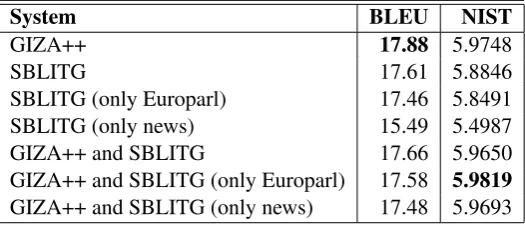
System BLEU NIST
GIZA++ 17.88 5.9748 SBLITG 17.61 5.8846 SBLITG (only Europarl) 17.46 5.8491 SBLITG (only news) 15.49 5.4987 GIZA++ and SBLITG 17.66 5.9650 GIZA++ and SBLITG (only Europarl) 17.58 5.9819
GIZA++ and SBLITG (only news) 17.48 5.9693
Table 2: Results for the German–English translation task.
We chose to focus on the German–English translation task. The corpora resources available for that task is summarized in Table 1. We used the entire news commentary monolingual data con-catenated with the English side of the Europarl bilingual data to train the language model. In ret-rospect, this was probably a bad choice, as others seem to prefer the use of two language models in-stead.
We contrasted the baseline system with pure SBLITG systems trained on different parts of the training data, as well as combined systems, where theSBLITGsystems were combined with the base-line system. The combination was done by adding theSBLITGtranslation model as a second transla-tion path to the base line system.
To train ourSBLITGsystems, we used the algo-rithm described in Saers et al. (2010). We set the beam size parameter to 50, and ran expectation-maximization for 10 iterations or until the log-probability of the training corpus started deterio-rating. After the grammar was induced we ob-tained the one-best parse for each sentence pair, which also dictates a word alignment over that sentence pair, which we used instead of the word alignments provided byGIZA++. From that point, training did not differ from the baseline procedure.
We trained a total of three pureSBLITGsystem, one with only the news commentary part of the corpus, one with only the Europarl part, and one
with both. We also combined all three SBLITG systems with the baseline system to see whether the additional translation paths would help.
The system we submitted corresponds to the “GIZA++ and SBLITG (only news)” system, but with RandLM (Talbot and Osborne, 2007) as lan-guage model rather thanSRILM. This was because we lacked the necessary RAM resources to calcu-late the fullSRILM model before the system sub-mission deadline.
4 Results
[image:3.595.168.431.187.300.2]5 Conclusions
We tried to use SBLITGs as word aligners on full size sentences, which has not been done to date, and noted that the formalism seems unable to ac-count for the full complexity of longer sentence pairs. We also tried combining the translation models acquired with SBLITG alignments to the baseline system, and noted very small differences, tending to a deterioration in quality. The fact that SBLITGs seem unable to capture the complex re-lationship between an English and a German sen-tence in one parse means that we need to find ei-ther some more complex model or some way to use the entire parse forest to arrive at the align-ment.
Acknowledgments
This work was funded by the Swedish Na-tional Graduate School of Language Technol-ogy (GSLT), the Defense Advanced Research Projects Agency (DARPA) under GALE Con-tract No. HR0011-06-C-0023, and the Hong Kong Research Grants Council (RGC) under research grants GRF621008, DAG03/04.EG09, RGC6256/00E, and RGC6083/99E. Any opinions, findings and conclusions or recommendations ex-pressed in this material are those of the authors and do not necessarily reflect the views of the Defense Advanced Research Projects Agency. The com-putations were performed on UPPMAX resources under project p2007020.
References
Jeffrey D. Aho, Alfred V. Ullman. 1972. The Theory of Parsing, Translation, and Compiling. Prentice-Halll, Englewood Cliffs, NJ.
Peter F Brown, Stephen A Della Pietra, Vincent J Della Pietra, and Robert L Mercer. 1993. The mathemat-ics of statistical machine translation: Parameter esti-mation. Computational Linguistics, 19(2):263–311. George Doddington. 2002. Automatic evaluation of machine translation quality using n-gram co-occurrence statistics. In Proceedings of Human Language Technology conference (HLT-2002), San Diego, California.
Aria Haghighi, John Blitzer, John DeNero, and Dan Klein. 2009. Better word alignments with super-vised ITG models. InProceedings of the Joint Con-ference of the 47th Annual Meeting of the ACL and the 4th International Joint Conference on Natural Language Processing of the AFNLP, pages 923– 931, Suntec, Singapore, August.
Philipp Koehn, Hieu Hoang, Alexandra Birch, Chris Callison-Burch, Marcello Federico, Nicola Bertoldi, Brooke Cowan, Wade Shen, Christine Moran, Richard Zens, Chris Dyer, Ondrej Bojar, Alexan-dra Constantin, and Evan Herbst. 2007. Moses: Open source toolkit for statistical machine transla-tion. InProceedings of the 45th Annual Meeting of the Association for Computational Linguistics Com-panion Volume Proceedings of the Demo and Poster Sessions, pages 177–180, Prague, Czech Republic, June.
Philip M. Lewis and Richard E. Stearns. 1968. Syntax-directed transduction. Journal of the Association for Computing Machinery, 15(3):465–488.
Franz Josef Och and Hermann Ney. 2003. A sys-tematic comparison of various statistical alignment models. Computational Linguistics, 29(1):19–51.
Franz Josef Och. 2003. Minimum error rate training in statistical machine translation. In 41st Annual Meeting of the Association for Computational Lin-guistics, pages 160–167, Sapporo, Japan, Jul.
Kishore Papineni, Salim Roukos, Todd Ward, and Wei-Jing Zhu. 2002. Bleu: a method for automatic evaluation of machine translation. In Proceedings of 40th Annual Meeting of the Association for Com-putational Linguistics, pages 311–318, Philadelphia, Pennsylvania, July.
Markus Saers and Dekai Wu. 2009. Improving phrase-based translation via word alignments from Stochas-tic Inversion Transduction Grammars. In Proceed-ings of the Third Workshop on Syntax and Structure in Statistical Translation (SSST-3) at NAACL HLT 2009, pages 28–36, Boulder, Colorado, June.
Markus Saers, Joakim Nivre, and Dekai Wu. 2009. Learning Stochastic Bracketing Inversion Transduc-tion Grammars with a cubic time biparsing algo-rithm. InProceedings of the 11th International Con-ference on Parsing Technologies (IWPT’09), pages 29–32, Paris, France, October.
Markus Saers, Joakim Nivre, and Dekai Wu. 2010. Word alignment with Stochastic Bracketing Linear Inversion Transduction Grammar. InProceedings of Human Language Technologies: The 11th Annual Conference of the North American Chapter of the Association for Computational Linguistics, Los An-geles, California, June.
Andreas Stolcke. 2002. SRILM – an extensible lan-guage modeling toolkit. In International Confer-ence on Spoken Language Processing, Denver, Col-orado, September.
Stephan Vogel, Hermann Ney, and Christoph Tillmann. 1996. Hmm-based word alignment in statistical translation. In Proceedings of the 16th conference on Computational linguistics, pages 836–841, Mor-ristown, New Jersey.
Dekai Wu. 1997. Stochastic inversion transduction grammars and bilingual parsing of parallel corpora.
Computational Linguistics, 23(3):377–403.