Two strong baselines for the BioNLP 2009 event extraction task
Andreas Vlachos
Computer Laboratory University of Cambridge
Abstract
This paper presents two strong baselines for the BioNLP 2009 shared task on event extraction. First we re-implement a rule-based approach which allows us to ex-plore the task and the effect of domain-adapted parsing on it. We then replace the rule-based component with support vec-tor machine classifiers and achieve perfor-mance near the state-of-the-art without us-ing any external resources. The good per-formances achieved and the relative sim-plicity of both approaches make them re-producible baselines. We conclude with suggestions for future work with respect to the task representation.
1 Introduction
The termbiomedical event extractionis used to re-fer to tasks whose aim is the extraction of informa-tion beyond the entity level. It commonly involves recognizing actions and relations between one or more entities. The recent BioNLP 2009 shared task on event extraction (Kim et al., 2009) focused on a number of relations of varying complexity in which an event consisted of a trigger and one or more arguments. It attracted 24 submissions and provided a basis for system development. The per-formances ranged from 16% to 52% in F-score.
In this paper we describe two strong baseline approaches for the main task (described in Sec. 2) with a focus on annotation costs and reproducibil-ity. Both approaches rely on a dictionary of lem-mas associated with event types (Sec. 3). First we re-implement the rule-based approach of Vlachos et al. (2009) using resources provided in the shared task. While it is unlikely to reach the perfor-mance of approaches combining supervised ma-chine learning, exploring its potential can high-light what annotated data is useful and its poten-tial contribution to performance. Also, given its
reliance on syntax, it allows us to assess the impor-tance of syntactic parsing. Nevertheless, the per-formance achieved (35.39% F-score) is competi-tive with systems that used more annotated data and/or other resources (Sec. 5).
Building on the error analysis of the rule-based approach, we replace the rule-based component with support vector machine (SVM) classifiers trained on partial event annotation in the form of trigger-argument associations (Sec. 6). The use of a trainable classifier highlights issues concern-ing the suitability of the annotated data as train-ing material. Ustrain-ing a simple feature representa-tion and no external resources, the performance rises to 47.89% in F-score, which would have been second best in the shared task (Sec. 7). The er-ror analysis suggests that future work on event ex-traction should look into different task representa-tions which will allow more advanced models to demonstrate their potential (Sec. 8). Both systems shall become publically available.
2 Definition, datasets and resources
The BioNLP 2009 shared task focused on extrac-tion of events involving proteins. Protein recogni-tion was considered a given in order to focus the research efforts on the novel aspects of the task. Nine event types were defined in the main task, which can be broadly classified in two classes. Simple events, namely Gene expression, Tran-scription, Protein catabolism, Phosphorylation, Localization and Binding, which have proteins as their Theme argument and Regulation events, namely Positive regulation, Negative regulation and (unspecified) Regulation which have an oblig-atory Theme argument and an optional Cause ar-gument which can be either a protein or another event. Every event has a trigger which is a con-tiguous textual string that can span over one or more tokens, as well as a part of a token. Triggers and arguments can be shared across events and
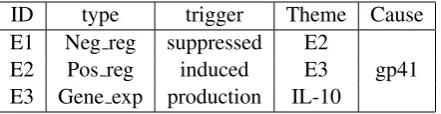
ID type trigger Theme Cause E1 Neg reg suppressed E2
[image:2.595.73.294.62.119.2]E2 Pos reg induced E3 gp41 E3 Gene exp production IL-10
Table 1: Shared task example annotation.
the same textual string can be a trigger for events of different types. In an example demonstrating the complexity of the task: “. . . SQ 22536 sup-pressedgp41-inducedIL-10production in mono-cytes.” Participating systems, given the two pro-teins (in bold), need to generate the three appro-priately nested events of Table 1.
While event components can reside in different sentences, we focus on events that are contained in a single sentence. Participants were not pro-vided with resources to develop anaphora resolu-tion components and the anaphoric phenomena in-volved were rather complex, as we observed in Vlachos et al. (2009). Extraction of events involv-ing anaphoric relations inside a sinvolv-ingle sentence is still possible but it is likely to require rather com-plex patterns to be extracted.
The shared task involved three datasets, train-ing, development and test, which consisted of 800, 150 and 260 abstracts respectively taken from the GENIA event corpus. Their annotation was tai-lored to the shared task definition. A resource made available and used by the majority of the sys-tems was the output of four syntactic parsers:
• Bikel’s (2004) re-implementation of Collins’ parsing model. This parser was trained on newswire data exclusively.
• The re-ranking parser of Charniak & Johnson adapted to the biomedical domain (McClosky and Charniak, 2008). The in-domain, part-of-speech (PoS) tagger was trained on the GENIA corpus (Kim et al., 2003) and the self-training of the re-ranking module used a part of the GE-NIA treebank as development data.
• The C&C Combinatory Categorial Grammar (CCG) parser adapted to the biomedical do-main (Rimell and Clark, 2009). The PoS tag-ger was trained on the GENIA corpus, while 1,000 sentences were annotated with lexical categories and added to the training data of the CCG supertagger and 600 sentences of the BioInfer corpus (Pyysalo et al., 2007) were used for parameter tuning.
• The GDep dependency parser trained for the biomedical domain in the experiments of Miyao et al. (2008). This parser was trained for the biomedical domain using the GENIA treebank.
The native Penn TreeBank output of Bikel’s and McClosky’s parser was converted to the Stanford Dependency (SD) collapsed dependency format (de Marneffe and Manning, 2008). The output of the CCG parser was also converted to the same de-pendency format, while the output of GDep was provided in a different dependency format used for the dependency parsing CoNLL 2007 shared task. From the description above, it is clear that the various parsers have different levels of adap-tation to the biomedical domain. While it is diffi-cult to assess quantitatively the actual annotation effort involved, it is possible to make some com-parisons. Bikel’s parser was not adapted to the domain, therefore it would be the cheapest one to deploy. McClosky and CCG used in-domain cor-pora annotated with PoS tags for training, while the latter using some additional annotation for lex-ical categories. Furthermore, they were tuned us-ing in-domain syntactic treebanks. Therefore, they represent a more expensive option in terms of an-notation cost. Finally, GDep was trained using an in-domain treebanked corpus, thus representing the alternative with the highest annotation cost.
3 Trigger extraction
We perform trigger identification using a dictio-nary of lemmas associated with the event type they indicate. The underlying assumption is that a par-ticular lemma has the same semantic content in ev-ery occurrence, which results in extracting all of its occurrences as triggers of the same event type. This is clearly an over-simplification, but the re-stricted domain and the task definition alleviates most of the problems caused. For each lemma in the dictionary, we extract all its occurrences in the text as triggers, therefore over-generating, since not all occurrences denote a biomedical event. This can be either because they are not connected with appropriate arguments or because they are used with a sense irrelevant to the task. Both is-sues are being resolved at the argument identifi-cation stage since superfluous triggers should not receive arguments and not form events.
term can denote events of different types. For ex-ample, “expression” is used as a trigger of four different event types in the training data, namely Gene expression, Transcription, Localization and Positive regulation. While it can be argued that in some cases this is due to annotation inconsisten-cies, it is generally accepted that context can alter the semantics of a token. In order to ameliorate this problem, we define the concept oflight trig-gersin analogy analogy tolight verbs. The latter are verbs whose semantics are lost when occur-ring in particular constructions, e.g. “make” as in “make mistakes”. In the shared task, some lem-mas commonly associated with a particular event type, when modified by a term associated with a different event type, denote events of the type of their modifier instead of their own. For ex-ample, “regulation” generally denotes Regulation events, unless it has a modifier of a different event type, e.g. “positive”. In these cases, “regulation” becomes part of a multi-token Positive regulation trigger (e.g. “positive regulation”). However, if the actual tokens are not adjacent, only “regula-tion” is annotated as a Positive regulation trigger, which is due to the requirement that triggers are contiguous textual strings. We refer to lemmas exhibiting this behaviour as light triggers. Addi-tionally, we observe that some lemmas triggered events only when modified by another lemma as-sociated with an event type. For example, “ac-tivity” when occurring without a modifier is not considered a trigger of any event, however, when modified by “binding” then it becomes a Binding event trigger. We refer to lemmas exhibiting this behaviour asultra-light triggers.1
In order to construct the dictionary of terms with their associated event types we use the trig-ger annotation from the training data, but we ar-gue that such information could be obtained from domain experts. First, we remove the triggers en-countered only once in the data in order to avoid processing non-indicative triggers. Then, we lem-matize them with morpha(Minnen et al., 2001). We remove prepositions and other stopwords from multi-token triggers such as “in response to” and “have a prominent increase” in order to keep only the terms denoting the event type. Then, using the single-token triggers only, we associate each lemma with its most common event type. In cases
1Kilicoglu and Bergler (2009) made similar observations
on the lemma “activity” without formalizing them.
where a lemma consistently generates more that one event trigger of different types (typically one of the Simple event class and one of the Reg-ulation class, we associate the lemma with all the relevant event types. For example, “overex-press” consistently denotes Gene expression and Positive regulation events. The last token of each multi-token trigger becomes a light trigger. Fi-nally, if a lemma is encountered as part of a multi-token trigger of a different event type more of-ten than with the event type associated with it as a single-token trigger, then it becomes an ultra-lighttrigger. We avoid stemming because suffixes distinguish lemmas in an important way with re-spect to the task. For example, “activation” de-notes Positive regulation events, while “activity” is anultra-lighttrigger. We only keep lemmas as-sociated at least four times with a particular event type, since below that threshold the annotation was rather inconsistent.
During testing, we attempt to match each token with one of the lemmas associated with an event type. We perform this by relaxing the matching successively, using the token lemma first and if no match is found allowing a partial match in order to deal with particles (e.g. so that “co-express” matches “express”). This process returns single-token triggers, some of which are processed fur-ther in case they are light or ultra-light using syn-tactic dependencies in the following stage.
4 Rule-based argument identification
class triggers we consider asarg-tokens not only tokens containing (parts of) protein names but also thetrigger-tokensfound in the same sentence. The rules defined are the following:
• If a trigger-token is the governor of an arg-tokenin subject relation (subj), then the latter is identified as the Theme argument of the for-mer, e.g. “Stat1expresses”. The only excep-tion to this rule is that when the trigger denotes Regulation class events and the nominal sub-ject relation (nsubj) is observed, thearg-token
is identified as a Cause argument, e.g. “gp41 induces”.
• If a trigger-token is the governor of an arg-tokenin a prepositional relation, then the lat-ter is identified as the Theme argument of the former, e.g. “expression ofStat1”.
• If a trigger-token is the governor of an arg-token in modifier relation then the latter is identified as the Theme argument of the for-mer, e.g. “Stat1 expression”. We restrict the definition of the modifier relation to sub-sume only the following relations: adjectival modifier (amod), infinitival modifier (infmod), participial modifier (partmod), adverbial mod-ifier (advmod), relative clause modifier ( rc-mod), quantifier modifier (quantmod), tempo-ral modifier (tmod) and noun compound mod-ifier (nn) relations. This restriction is placed in order to avoid matches irrelevant to the task. • If a trigger-token is the governor of an
arg-tokenin object relation (obj) then the latter is identified as the Theme argument, e.g. “SQ 22536 suppressedgp41”.
• If a Regulation event class trigger and a pro-tein name are found in the same token, then the protein name is identified as the Cause ar-gument, e.g. “gp41-induced”.
A pre-processing step taken was to propagate modifier and prepositional relations over tokens that were co-ordinated or in an appositive relation. This was necessary since the SD output provided by the organizers is in the collapsed format, which treats co-ordinated tokens asymmetrically without propagating their dependencies.2
For each Simple or Binding trigger-argument pair, we generate a single event with the
argu-2The organizers re-generated the dependencies in the
propagation format but we avoid using them in order to be able to compare against the shared task participants.
ment marked as Theme. This approach is expected to deal adequately with all event types except for Binding, which can have multiple themes. We generate Regulation events for trigger-argument pairs whose argument is a protein name or a trig-ger that has an already formed event. Since Reg-ulation events can have other RegReg-ulation events as Themes or Causes, we repeat this process until no more events can be formed. Finally, at this stage we generate the required Regulation class event for triggers that consistently denote two events.
5 Rule-based system results
We report our results using the approximate span matching/approximate recursive matching variant of the evaluation. This variant allows for an event to be considered extracted correctly if its trigger is extracted with span within an one-token exten-sion of the correct trigger span. Also in the case of nested events, events below the top-level need only their Theme argument to be correctly identified so that the top-level event is considered correct. This evaluation variant was used as the primary perfor-mance criterion in the shared task.
We first compared the performances obtained using the output of the different parsers pro-vided by the organizers on the development data. The best F-score was achieved using McClosky (39.66%), followed by CCG (38.73%) and Bikel (36.97%). As expected, the overall performance correlates roughly with the adaptation cost in-volved in the development of these parsers as de-scribed in Section 2. Bikel, which is essentially unadapted, has the worst performance overall, but it would have been the cheapest to deploy. While this can be viewed as a task-based parser compar-ison, similar to the experiments of Miyao et al. (2008), one should be careful with the interpreta-tion of the results. As pointed out by the authors, this type of evaluation cannot substitute a parsing evaluation against an appropriately annotated cor-pus since in the context of a given task only some aspects of parsing are likely to be relevant. Fur-thermore, in our experiments we are are not us-ing the native output of the parsers but its conver-sion to the SD format. Therefore unavoidably we evaluate the conversion as well as the parsing. For this reason we avoided using the output of GDep which was not provided in this format.
parser, we observe that the most common triggers of events not extracted correctly had lemmas that were included in the dictionary, such as “binding”, “expression”, “induction” and “activation”. This suggests that most event extraction errors are due to argument identification and that using a dictio-nary for trigger extraction is sufficient, despite the rather strong assumptions it is based upon. Dis-abling the processing of light and ultra-light trig-gers, the performance on the development data drops to 39.28%, the main reason being the de-creased recall in Binding events.
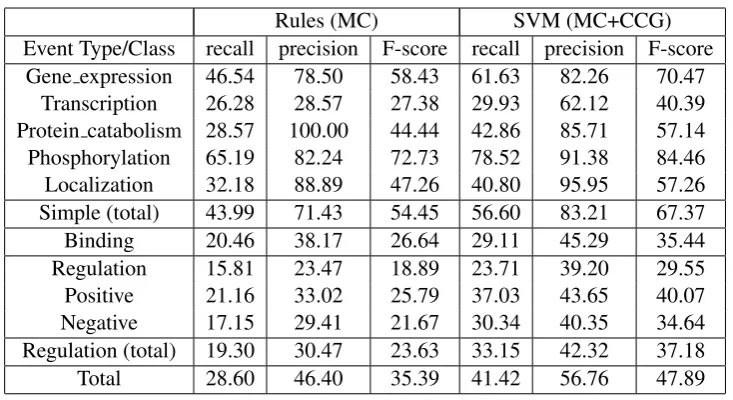
Based on the comparison performed on the de-velopment data, we run our system using the Mc-Closky parser on the test data (Table 2). The over-all performance achieved (35.39%) is relatively close to the one obtained on the development set (4% lower). This is important since rule-based systems are prone to overfitting their development data due to the way they are built. Compared to the performances achieved by the shared task partici-pants, the system presented would be ranked sev-enth in overall performance. We believe this is a strong result, since it surpasses systems that used supervised machine learning methods taking ad-vantage of the development and the training data. Restricting the comparison to rule-based systems, it would have the second best performance out of nine such systems, most of which used exter-nal knowledge sources in order to improve their performance. The best rule-based system (Kil-icoglu and Bergler, 2009) had overall performance of 44.62% in F-score, ranking third overall. The main difference is that it used a much larger set of lexicalized rules (27) which were extracted us-ing the trainus-ing data. Also, heuristics were em-ployed in order to correct syntactic parsing errors (Schuman and Bergler, 2006). While the benefits from these additional processing steps are indis-putable, they involved a lot of manual work, both for rule construction as well as for the annotation of the data used to extract the rules. We argue that these performance benefits could be obtained using machine learning methods aimed at ame-liorating the argument identification stage. Com-pared to the rule-based approach of Vlachos et al. (2009), the performance is improved substan-tially. The main difference between that system and the one presented here is that the former uses the domain-independent RASP parser (Briscoe et al., 2006). While its performance was reasonable
(it was ranked 10th overall, 30.80% F-score), these results lag behind those reported here. Note that a direct comparison using the output of RASP is not possible since the latter uses its own syntactic dependency scheme and there is no lossless con-version to the SD scheme.
Overall, the results of this section demonstrate that the use of domain-adapted parsing is bene-ficial to event extraction. This is not surprising since the system presented depends heavily on the parsing output. We argue that the annotation cost of this adaptation is a good investment because, unlike the task-specific training data, improved syntactic parsing is likely to be useful for other event extraction tasks, or even other IE tasks, e.g. anaphora resolution. Therefore, we suggest that domain-adaptation of syntactic parsing should be considered first, especially in tasks that are heavily dependent on it.
6 Improving argument identification with partial annotation and support vector machines
In this section, we present an approach to argu-ment identification which attempts to overcome the drawbacks of the rule-based approach. Fol-lowing the trigger extraction stage, for each trigger combined with each of its candidate arguments we create a classification instance. The classification task is to assign the correct argument type to the instance. Therefore, we construct a binary clas-sifier which determines whether a protein name is the Theme argument of a Simple or a Binding trigger (ThemePositive or ThemeNegative) and a ternary classifier which determines whether a pro-tein name or another trigger (and as consequence its associated events) is the Theme or the Cause argument of a Regulation trigger ( RegThemePosi-tive,RegCausePositive,RegNegative).
in-Rules (MC) SVM (MC+CCG) Event Type/Class recall precision F-score recall precision F-score
[image:6.595.116.483.59.259.2]Gene expression 46.54 78.50 58.43 61.63 82.26 70.47 Transcription 26.28 28.57 27.38 29.93 62.12 40.39 Protein catabolism 28.57 100.00 44.44 42.86 85.71 57.14 Phosphorylation 65.19 82.24 72.73 78.52 91.38 84.46 Localization 32.18 88.89 47.26 40.80 95.95 57.26 Simple (total) 43.99 71.43 54.45 56.60 83.21 67.37 Binding 20.46 38.17 26.64 29.11 45.29 35.44 Regulation 15.81 23.47 18.89 23.71 39.20 29.55 Positive 21.16 33.02 25.79 37.03 43.65 40.07 Negative 17.15 29.41 21.67 30.34 40.35 34.64 Regulation (total) 19.30 30.47 23.63 33.15 42.32 37.18 Total 28.60 46.40 35.39 41.42 56.76 47.89
Table 2: Performance of the rule-based and the SVM-based systems on the test data. Each horizontal corresponds to an event type or class. Binding events are not included in the Simple class aggregate performance because they can have multiple Themes.
cluded in the GS then it is labeled as ThemePos-itive, else it labeled asThemeNegative. If the in-stance being considered has a Regulation trigger that has been matched with a GS trigger, and if its argument is a protein name and their pair is in-cluded in the GS then it is labeled according to the latter (Reg{Theme/Cause}Positive), else, if not found in the GS it is labeled as RegThemeNega-tive. The same process is followed if the argument is an event trigger which has been matched with a GS trigger. We consider only Regulation trig-gers that are matched in the GS in order to avoid validRegCausePositiveinstances being labeled as
RegNegative. Recall that the Cause argument is optional, while the Theme is obligatory for Reg-ulation events. This means that if an appropriate Theme argument is not present, then it is possible that a Cause argument that is present is not anno-tated. Similarly, when considering event triggers as arguments, we acquire labels only for instances involving triggers that were annotated in the GS. Since triggers without an appropriate Theme are not annotated in the gold standard, it is possible that a valid RegThemePositive or RegCausePosi-tiveis labeled asRegNegativeinstance not because of the actual relation between the trigger and the argument but because the argument did not have an appropriate Theme present. In the example mentioned in Sec. 2, if “IL-10” was replaced by “protein” then none of the events would be an-notated. We argue that a human annotator would produce these annotations implicitly, and that this
partial (with respect to the task definition) annota-tion scheme allows the encoding of this informa-tion in a more flexible way. Also, this is likely to be a more efficient way to use the annotation time, since annotators would be requested to annotate pre-determined trigger-argument pairs instead of searching for events from scratch, given only the protein name annotation.
For training data generation we consider the triggers extracted using the dictionary instead of those in the GS. This process is certain to intro-duce some noise as some triggers might be omit-ted due to limiomit-ted dictionary coverage. If the event type determined by the dictionary is incorrect, this is unlikely to affect the argument identification process, since the latter is dependent on the lemma of the trigger rather than its type. For example, the Theme argument of the trigger “expression” is un-likely to depend on whether the event denoted is Gene expression or Transcription.
For feature extraction, we find the shortest de-pendency path connecting each trigger-argument pair using Dijkstra’s algorithm. We allow paths to follow either dependency direction by incor-porating the direction in the dependency labels. Apart from the dependency path, we extract as features the trigger-token, the trigger event type and the argument type (event type if the argument is a trigger or Entity in case of protein names). We filtered the training set considering only in-stances in which the trigger was at a maximum dis-tance of 4 dependencies away from the argument, since longer paths were too sparse to be useful in classifying unseen instances. At classification time, we consider as {Theme/Reg}Negative any instances in which the dependency path has not been encountered in the training data, as well as instances without a dependency path connecting trigger and argument. This is necessary in order to avoid instances being classified only on the basis of the trigger-token and the argument type. Af-ter the classifier has assigned labels to the trigger-argument pairs, we construct events as described in Sec. 4. In cases where it is unclear (to the classi-fier) which is the trigger and which is the argument in a given pair of Regulation event triggers the pro-cess can result in cyclic dependencies. We resolve them using the confidence of the classifier for each decision by removing the least confident RegThe-mePositiveorRegCausePositiveassignment.
7 SVM-based system results
In our experiments we used the LIBSVM toolkit (Chang and Lin, 2001) which provides an imple-mentation of Support Vector Machines with vari-ous kernels and uses the one-against-one scheme for multiclass problems. In all experiments, the Gaussian kernel was used in order to capture po-tential non-linear feature combinations, e.g. cases where the combination of dependency path and trigger-token would result in a different decision rather than each of them independently. Prelimi-nary experiments with the linear kernel confirmed this expectation.
We focused on using the output of the two domain-adapted parsers, namely CCG and Mc-Closky. The reason for this is that, as argued in Sec. 5, given the importance of syntactic parsing to event extraction one should consider domain adaptation of syntactic parsing before developing task-specific training resources. We first compared
the performances obtained using the output of the different parsers provided by the organizers us-ing the development data. The main observation is that, using either parser, the results are much improved compared to those reported in Sec. 5, by approximately eight percentage points in F-score in either case (46.49% and 47.40% F-F-score for CCG and McClosky respectively). Most of the improvement is due to higher recall, suggest-ing that the argument identification component is able to learn patterns that are relevant to the task. Overall, using the output of CCG results in higher precision, while McClosky results in higher re-call. These parsers have different theoretical foun-dations, therefore they are expected to make dif-ferent errors. In an effort to take advantage of both parsers simultaneously, we combined them by adding for each trigger-argument pair the de-pendency paths extracted by both parsers. This improved performance further to 49.35% F-score.
We then run the system combining the two parsers on the test data, obtaining the results pre-sented in Table 2. Overall, the system prepre-sented would have the second best performance in the shared task achieving 41.42%/56.76%/47.89% in Recall/Precision/F-score. The top system (Bjorne et al., 2009) achieved 46.73%/58.48%/51.95% (R/P/F). It followed a machine learning approach to trigger extraction which, while it is likely to be responsible for the performance difference ob-served when compared to the other participating systems, requires explicit trigger annotation, thus being more expensive. Furthermore, we argue that the data provided by the organizers are not suit-able to train a trigger extractor, since only triggers participating in events are annotated, and semanti-cally valid triggers without appropriate arguments present are ignored. We hypothesize that this is the reason the authors had to adjust the decisions of their SVM classifiers.
The second best system (Buyko et al., 2009) achieved 45.82%/47.52%/46.66% (R/P/F) using many external knowledge sources such as the Gene Ontology Annotation database, the Uni-versal Protein Resourceand the Medical Subject Headings thesaurus. While the use of these re-sources and their successful usage is commend-able, we believe it is important that the system presented achieves comparable performance using fewer resources.
Markov Logic Networks were applied to the BioNLP 2009 event extraction shared task by Riedel et al. (2009) and were ranked fourth. This result was improved upon recently by Poon and Vanderwende (2010) who achieved 50% F-score, 2.11 percentage points better than the re-sult achieved in this work. Such models have great potential for event extraction and we believe that they can benefit from the insights presented here. Finally, despite the fact that we used the same ex-perimental setup as the shared task participants, we do not consider our results are directly com-parable to theirs since we did not work under the same time constraints and we profited from their experiences.
8 Discussion
Our error analysis on the output of the best system on the development data discouraged us from pur-suing further improvements. Echoing the observa-tions of Buyko et al. (2009), we found that anno-tation inconsistency was affecting our results sig-nificantly. In many cases the event triggers anno-tated in the development data were rather mislead-ing, e.g. “negative” as a Gene expression event trigger (abstract 8622883), “increase the stabil-ity” as a Positive regulation event trigger (abstract 8626752), “disappearance” as a Binding event trigger (abstract 10455128). Finally, some events were ignored by the annotation, such as “regula-tion ofthymidine kinase” (abstract 8622883).
An additional complication is that events that are annotated due to anaphoric linking can have a disproportionate effect on the scores. In an ex-ample from abstract 9794375: “CD3, CD2, and CD28are functionally distinct receptors on T lym-phocytes. Engagement of any of these recep-tors induces the rapid tyrosine phosphorylation of a shared group of intracellular signaling pro-teins, includingVav,Cbl, p85 phosphoinositide 3-kinase, and theSrcfamily kinasesLckandFyn.” Failing to recognize the anaphoric Binding events involving proteins “CD2” and “CD28”, an other-wise perfect system would receive two false nega-tives for the Binding events, eight false neganega-tives for the missing Positive regulation events due to the missing Causes and four false positives for the incomplete Positive regulation events extracted.
Despite this criticism, we believe that the BioNLP 2009 shared task on event extraction was a big step forward for biomedical information
ex-traction and we are grateful to the organizers for the effort and resources provided, without which the research presented here would not have been possible. The performances achieved in the main Task1 ranged from 16% to 52% in F-score, sug-gesting improvements in task definition, data an-notation and participating systems compared to previous community-wide efforts. Indicatively, in the protein-protein interaction pair subtask of BioCreative II (Krallinger et al., 2008) the anno-tated datasets provided were produced by extract-ing curation information from relevant databases. This meant that there was no text-bound annota-tion, thus making the application and evaluation of existing NLP techniques difficult, resulting in rather low performances. The best performance achieved was 29% in F-score, while many of the teams scored below 10%.
However, we believe that future work should look at improving the annotation in order to be able to assess the progress in the systems devel-oped. In particular, we argue that we should move towards a dependency-based representation, simi-lar to the one introduced by Surdeanu et al. (2008) for joint syntactic parsing and semantic role label-ing. Such representation can express the nested nature of the events and evaluate the dependencies between them directly. Furthermore, given the im-portance of syntactic parsing via syntactic depen-dencies to event extraction, it would be interesting to see how performing these tasks jointly would help improve the performance. A dependency-based representation would also allow for non-contiguous event components, as well as more complex phenomena such as thelight triggers dis-cussed earlier.
9 Conclusions
Acknowledgements
The author would like to thank Ted Briscoe, Mark Craven and the three anonymous reviewers for their feedback.
References
Daniel M. Bikel. 2004. Intricacies of Collins’ parsing
model. Computational Linguistics, 30(4):479–511.
Jari Bjorne, Juho Heimonen, Filip Ginter, Antti Airola, Tapio Pahikkala, and Tapio Salakoski. 2009. Ex-tracting complex biological events with rich graph-based feature sets. InProceedings of the BioNLP’09 Shared Task on Event Extraction, pages 10–18.
Ted Briscoe, John Carroll, and Rebecca Watson. 2006.
The second release of the RASP system. In
Pro-ceedings of the COLING/ACL Interactive presenta-tion sessions, pages 77–80, Morristown, NJ, USA. Association for Computational Linguistics.
Ekaterina Buyko, Erik Faessler, Joachim Wermter, and Udo Hahn. 2009. Event extraction from trimmed
dependency graphs. InProceedings of the BioNLP
2009 Workshop Companion Volume for Shared Task, pages 19–27.
Chih-Chung Chang and Chih-Jen Lin,
2001. LIBSVM: a library for support
vector machines. Software available at
http://www.csie.ntu.edu.tw/˜cjlin/libsvm.
Marie-Catherine de Marneffe and Christopher D. Man-ning. 2008. The stanford typed dependencies
rep-resentation. InCrossParser ’08: Coling 2008:
Pro-ceedings of the Workshop on Cross-Framework and Cross-Domain Parser Evaluation, pages 1–8.
Halil Kilicoglu and Sabine Bergler. 2009. Syntactic dependency based heuristics for biological event
ex-traction. InProceedings of the BioNLP 2009
Work-shop Companion Volume for Shared Task, pages 119–127.
Jin-Dong Kim, Tomoko Ohta, Yuka Tateisi, and Jun’ichi Tsujii. 2003. GENIA corpus - a semanti-cally annotated corpus for bio-textmining. In Bioin-formatics, volume 19, Suppl. 1, pages 180–182.
Jin-Dong Kim, Tomoko Ohta, Sampo Pyysalo, Yoshi-nobu Kano, and Jun’ichi Tsujii. 2009. Overview of BioNLP’09 shared task on event extraction. In
BioNLP ’09: Proceedings of the Workshop on BioNLP, pages 1–9.
Martin Krallinger, Florian Leitner, Carlos Rodriguez-Penagos, and Alfonso Valencia. 2008. Overview of the protein-protein interaction annotation extraction
task of BioCreative II. Genome Biology, 9(Suppl
2):S4.
David McClosky and Eugene Charniak. 2008.
Self-training for biomedical parsing. In Proceedings of
the 46th Annual Meeting of the Association of Com-putational Linguistics: Human Language Technolo-gies, pages 101–104.
Guido Minnen, John Carroll, and Darren Pearce. 2001.
Applied morphological processing of English.
Nat-ural Language Engineering, 7(3):207–223.
Yusuke Miyao, Rune Sætre, Kenji Sagae, Takuya Mat-suzaki, and Jun’ichi Tsujii. 2008. Task-oriented evaluation of syntactic parsers and their representa-tions. InProceedings of the 46th Annual Meeting of the Association of Computational Linguistics: Hu-man Language Technologies, pages 46–54.
Hoifung Poon and Lucy Vanderwende. 2010. Joint in-ference for knowledge extraction from biomedical
literature. In Proceedings of the North American
Chapter of the Association for Computational Lin-guistics - Human Language Technologies 2010 con-ference.
Sampo Pyysalo, Filip Ginter, Juho Heimonen, Jari Bjorne, Jorma Boberg, Jouni Jarvinen, and Tapio Salakoski. 2007. BioInfer: a corpus for information
extraction in the biomedical domain. BMC
Bioin-formatics, 8(1):50+.
Sebastian Riedel, Hong-Woo Chun, Toshihisa Takagi, and Jun’ichi Tsujii. 2009. A Markov Logic
Ap-proach to Bio-Molecular Event Extraction. In
Pro-ceedings of the BioNLP 2009 Workshop Companion Volume for Shared Task, pages 41–49.
Laura Rimell and Stephen Clark. 2009.
Port-ing a lexicalized-grammar parser to the
biomedi-cal domain. Journal of Biomedical Informatics,
42(5):852–865.
Jonathan Schuman and Sabine Bergler. 2006. Post-nominal prepositional phrase attachment in
pro-teomics. InProceedings of the Workshop on Linking
Natural Language Processing and Biology, pages 82–89.
Mihai Surdeanu, Richard Johansson, Adam Meyers,
Llu´ıs M`arquez, and Joakim Nivre. 2008. The
CoNLL-2008 shared task on joint parsing of
syn-tactic and semantic dependencies. InCoNLL 2008:
Proceedings of the Twelfth Conference on Natural Language Learning, pages 159–177.
Andreas Vlachos, Paula Buttery, Diarmuid
´