Considerations on Automatic Mapping Large-Scale
Heterogene-ous Language Resources: Sejong Semantic Classes and KorLex
Heum Park
Center for U-Port IT
Research and Education
Pusan National University
[email protected]
Aesun Yoon
LI Lab. Dept. of French
Pusan National University
[email protected]
Woo Chul Park and
Hyuk-Chul Kwon*
AI Lab Dept. of Computer
Science
Pusan National University
[email protected]
Abstract
This paper presents an automatic map-ping method among large-scale hetero-geneous language resources: Sejong Semantic Classes (SJSC) and KorLex.
KorLex is a large-scale Korean Word-Net, but it lacks specific syntactic & semantic information. Sejong Electron-ic DElectron-ictionary (SJD), of which semantic
segmentation depends on SJSC, has much lower lexical coverage than KorLex, but shows refined syntactic & semantic information. The goal of this study is to build a rich language re-source for improving Korean semanti-co-syntactic parsing technology. There-fore, we consider integration of them and propose automatic mapping me-thod with three approaches: 1) Infor-mation of Monosemy/Polysemy of Word senses (IMPW), 2) Instances be-tween Nouns of SJD and Word senses of KorLex (INW), and 3) Semantically Related words between Nouns of SJD and Synsets of KorLex (SRNS). We obtain good performance using com-bined three approaches: recall 0.837, precision 0.717, and F1 0.773.
1
Introduction
While remarkable progress has been made in Korean language engineering on morphologi-cal level during last two decades, syntactic and semantic processing has progressed more slowly. The syntactic and semantic processing requires 1) linguistically and formally well
defined argument structures with the selection-al restrictions of each argument, 2) large and semantically well segmented lexica, 3) most importantly, interrelationship between the ar-gument structures and lexica. A couple of lan-guage resources have been developed or can be used for this end. Sejong Electronic Dictiona-ries (SJD) for nouns and predicates (verbs and
adjectives) along with semantic classes (Hong 2007) were developed for syntactic and seman-tic analysis, but the current versions do not contain enough entries for concrete applica-tions, and they show inconsistency problem. A Korean WordNet, named KorLex (Yoon & al,
2009), which was built on Princeton WordNet 2.0 (PWN) as its reference model, can provide means for shallow semantic processing but does not contain refined syntactic and semantic information specific to Korean language. Ko-rean Standard Dictionary (STD) provides a
large number of entries but it lacks systematic description and formal representation of word senses, like other traditional dictionaries for humans. Given these resources which were developed through long-term projects (5 – 10 years), integrating them should result in signif-icant benefits to Korean syntactic and semantic processing.
The primary goal of our recent work includ-ing the work reported in this paper is to build a language resource, which will improve Korean semantico-syntactic parsing technology. We proceed by integrating the argument structures as provided by SJD, and the lexical-semantic hierarchy as provided by KorLex. SJD is a language resource, of which all word senses are labeled according to Sejong semantic classes (SJSC), and in which selectional
strictions are represented in SJSC as for the argument structures of predicates. KorLex is a large scale language resource, of which the lexical-semantic hierarchies and other lan-guage–independent semantic relations between synsets (synonym sets) share with those of PWN, and of which Korean language specific information comes from STD. The secondary goal is the improvement of three resources as a result of comparing and integrating them.
In this paper, we report on one of the operat-ing steps toward to our goals. We linked each word sense of KorLex to that of STD by hand, when the former was built in our previous work (Yoon & al. 2009). All predicates in SJD were mapped to those of STD on word sense level by semi-automatic mapping (Yoon, 2010). Thus KorLexVerb and KorLexAdj have syntactico-semantic information on argument structures via this SJD - STD mapping. How-ever, the selectional restrictions provided by SJD are not useful, if SJSC which represents the selectional restrictions in SJD is not linked to KorLex. We thus conduct two mapping me-thods between SJSC and upper nodes of Kor-LexNoun: 1) manual mapping by a PH.D in computational semantics (Bae & al. 2010), and 2) automatic mapping. This paper reports the latter. Reliable automatic mapping methods among heterogeneous language resources should be considered, since the manual map-ping among large-scale resources is a very time and labor consuming job, and might lack consistency. Less clean resources are, much harder and more confusing manual mapping is. In this paper, we propose an automatic map-ping method of those two resources with three approaches to determine mapping candidate synsets of KorLex to a terminal node of SJSC: 1) using information of monosemy/polysemy of word senses, 2) using instances between nouns of SJD and word senses of KorLex, and 3) using semantically related words between nouns of SJD and word senses of KorLex. We compared the results of automatic mapping method with three approaches with those of manual mapping aforementioned.
In the following Section 2, we discuss re-lated studies concerning language resources and automatic mapping methods of heteroge-neous language resources. In Section 3, we introduce KorLex and SJD. In Section 4, we
propose an automatic mapping method with three approaches from semantic classes of SJD to synsets of KorLex. In Section 5, we com-pare the results of automatic mapping with those of manual mapping. In Section 6, we draw conclusions and future works.
2
Related Works
Most existing mappings of heterogeneous lan-guage resources were conducted manually by language experts. The Suggested Upper Merged Ontology (SUMO) had been fully linked to PWN. For manual mapping of be-tween PWN and SUMO, it was considered synonymy, hypernymy and instantiation be-tween synsets of PWN and concepts of SUMO, and found the nearest instances of SUMO for synsets of PWN. Because the concept items of SUMO are much larger than those of PWN, it could be mapped between high level concepts of PWN and synonymy concepts of SUMO easily. (Ian Niles et al 2003). Dennis Spohr (2008) presented a general methodology to mapping EuroWordNet to the SUMO for ex-traction of selectional preferences for French. Jan Scheffczyk et al. (2006) introduced the connection of FrameNet to SUMO. They pre-sented general-domain links between Frame-Net Semantic Types and SUMO classes in SUOKIF and developed a semi-automatic, domain-specific approach for linking Frame-Net Frame Elements to SUMO classes (Scheffczyk & al. 2006). Sara Tonelli et al. (2009) presented a supervised learning frame-work for the mapping of FrameNet lexical units onto PWN synsets to solve limited cover-age of semantic phenomena for NLP applica-tions. Their best results were recall 0.613, pre-cision 0.761 and F1 measure 0.679.
semantic similarity between concepts (Leacock 1998), the semantic similarity between con-cepts using IS-A relation (Resnik 1995), the measure of similarity between concepts (Lin 1998), Jiang and Conrath’s (1997) similarity computations to synthesize edge and node based techniques, etc.
Satanjeev et al. (2003) presented a new measure of semantic relatedness between con-cepts that was based on the number of shared words (overlaps) in their definitions (glosses) for word sense disambiguation. The perfor-mances of their extended gloss overlap meas-ure with 3-word window were recall 0.342, precision 0.351 and F1 0.346. Siddharth et al. (2003) presented the Adapted Lesk Algorithm to a method of word sense disambiguation based on semantic relatedness. In addition, Alexander et al (2006) introduced the 5 exist-ing evaluatexist-ing methods for PWN-based meas-ures of lexical semantic relatedness and com-pared the performance of typical five measures of semantic relatedness for NLP applications and information retrieval. Among them, Jiang-Conrath’s method showed the best perfor-mances: precision 0.247, recall 0.231 and F1 0.211 for Detection.
In many studies, it was presented a variety of the adapted evaluating algorithms. Among them, Jiang-Conrath’s method, Lin’s the measure of similarity and Resnik’s the seman-tic similarity show good performances (Alex-ander & al 2006, Daniele 2009).
3
Language resources to be mapped
3.1 KorLex 1.5
KorLex 1.5 was constructed from 2004 to 2007. Different from its previous version (KorLex 1.0) which preserves all semantic relations among synsets of PWN, KorLex 1.5 modifies them by deletion/correction of existing synsets, addition of new synsets and conversion of hierarchical structure. Currently, KorLex includes nouns, verbs, adjectives, adverbs and classifiers: KorLexNoun, KorLexVerb, KorLexAdj, KorLexAdv and KorLexClas, respectively. Table 1 shows the size of KorLex 1.5, in which ‘Trans’ means the number of synsets translated from PWN 2.0 and ‘Total’ is the number of manually added synsets including translated ones.
Word Forms
Synsets Word Senses Trans Total KorLexNoun 89,125 79,689 90,134 102,358 KorLexVerb 17,956 13,508 16,923 20,133 KorLexAdj 19,698 18,563 18,563 20,905
KorLexAdv 3,032 3,664 3,664 3,123
KorLexClas 1,181 - 1,377 1,377
[image:3.595.319.499.69.179.2]Total 130,992 115,424 130,661 147,896
Table 1. Product of KorLex 1.5
KorLexNoun includes 25 semantic domains with 11 unique beginners with maximum 17 levels in depth and KorLexVerb includes 15 semantic domains with 11 unique beginners with maximum 12 levels in depth. Basically, KorLex synsets inherit the semantic informa-tion of PWN synsets mapped to them. The synset information of PWN consists of synset ID, semantic domain, POS, word senses, se-mantic relations, frame information, and so on.
We linked each word sense of KorLex 1.5 to that of STD by hand, when the former was built in our previous work (Yoon & al. 2009). STD includes 509,076 word entries with about 590,000 word senses. It contains a wide cover-age for general words and a variety of example sentences for each meaning. More than 60% of word senses in KorLex 1.5 are linked to those of STD. KorLex 1.5, thus, inherits lexical rela-tions described in STD, but both resources lack refined semantic-syntactic information.
3.2 Sejong Electronic Dictionary
SJD was developed during 1998-2007 manual-ly by linguists for a variety of Korean NLP application as a general-purpose machine read-able dictionary. Based on Sejong semantic classes (SJSC), approximately 25,000 nouns
and 20,000 predicates (verbs and adjectives, SJPD) contain refined syntactic and semantic information.
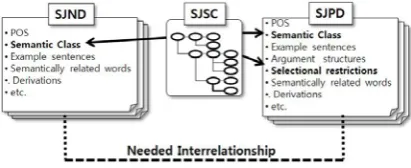
Figure 1. Correlation of lexical information among SJND, SJPD and SJSC
Figure 1 shows the correlation of lexical in-formation among SJND, SJPD and SJSC. Cer-tainly, that information of SJD should be ap-plied to a variety of NLP applications: infor-mation retrieval, text analysis/generation, ma-chine translations, and various studies and educations. However, SJD has much lower lexical coverage than KorLex. More serious problem is that SJND and SJPD are still noisy: internal consistency inside each dictionary and external interrelationship between SJND, SJPD, and SJSC need to be ameliorated, as indicated by dot line in Fig. 1.
4
Automatic Mapping from Semantic
Class of SJSC to Synsets of KorLex
KorLex and SJSC have different hierarchical structures, grain sizes, and lexical information as aforementioned. For example, the semantic classes of SJSC are much bigger concepts in grain size than the synsets of KorLex: 623 concepts in SJSC vs.130,000 synsets in Kor-Lex. Determining their semantic equivalence thus needs to be firmly based on linguistic clues.
Using following 3 linguistic clues that we found, we propose an automatic mapping me-thod from semantic classes of SJSC to synsets of KorLex with three approaches to determine mapping candidate synsets: 1) Information of Monosemy/Polysemy of Word senses (IMPW), 2) Instances between Nouns of SJD and Word senses of KorLex (INW), and 3) Semantically Related words between Nouns of SJD and Synsets of KorLex (SRNS).
For automatic mapping method, following processes were conducted. First, to find word senses of synsets that matched to nouns of SJND for each semantic class. Second, to se-lect mapping candidate synsets among them with three approaches aforementioned. Third, to determine the least upper bound (LUB)
syn-sets and mapping synsyn-sets among candidates. Finally, to link each semantic class of SJSC to all lower-level synsets of LUB synsets.
4.1 Finding matched word senses between synsets and nouns of SJND
[image:4.595.305.514.312.424.2]For a semantic class of SJSC, we first find word senses and synsets from KorLex that matched with nouns of SJND classified to that semantic class. Figure 2 shows the matched word senses and synsets between nouns of SJND, then synsets of KorLex for a semantic class. The left side of Figure 2 shows nodes of semantic classes with hierarchical structure and the center box shows the matched words (bold ones) among nouns of SJND with word senses of synsets in KorLex, and the right side shows matched word senses and synsets in KorLex’ hierarchical structure.
Figure 2. Matched word senses and synsets with nouns of SJND for a semantic class For example, a semantic class
‘Atmospheric Phenomena’ (rectangle in the left) has nouns of SJND (words in the center), the bold words are the matched words with word senses of synsets from KorLex, and the underlined synsets of the right side are the matched ones and synset IDs in KorLex. The notations for automatic mapping process be-tween semantic classes of SJSC and synsets of KorLex are as follows: noun of SJND is ns,
matched noun nsm, un-matched nsu , semantic class of SJSC is sc, synset is ss and word sense
of a synset is ws in KorLex, and monosemy
word is wmono and polysemy word is wpoly. A semantic class sc has nouns ns of SJND
having matched noun nsm and un-matched nsu by comparing with word senses ws of a synset ss in KorLex. Thus a synset has word senses as ss1={ws1, ws2, …, wsn}={ nsm1, nsm2, …, nsmk,
nsm2, …, nsmk, nsu k, nsu k+1, …}. Therefore, we can find the matched word senses nsm1 ~ nsmk for a semantic class sc from nouns of SJND
and word senses of a synset ss in KorLex.
4.2 Selecting Mapping Candidate Synsets
Using those matched synsets and word senses, we select mapping candidate synsets with three different approaches.
4.2.1 Using Information of Monosemy and Polysemy of KorLex
Using information of monosemy/polysemy of word senses of a synset, the first approach eva-luates mapping candidate synsets. The candi-date synsets are evaluated into three catego-ries: mc(A) is a most relevant candidate synset, mc(B) is a relevant candidate synset and mc(C)
is a reserved synset. Evaluation begins from lowest level synsets to top-level beginner. The process of first approach is as follows.
1) For a synset which contains a single word sense, ss={ws1}, if the word sense is a mo-nosemy, it is categorized as a a candidate synset mc(A). If it is a polysemy,
categori-zation is postponed for evaluating related-ness among siblings: candidate mc(C).
2) In the case of a synset having more than one word sense, ss={ws1, ws2, …}, if the matched words nsm among word senses of a synset are over 60%: Pss(ws)=(count(nsm)/ count(ws)) ≥ 0.6, we evaluate whether that
synset is mapping candidate in the next step. 3) If all matched words nsm of a synset are monosemic, we categorize it as a candidate synset mc(A). If monosemic words among
matched words are over 50%: Pss(wmono|
nsm) ≥ 0.5, it is evaluated as a mc(B). A synset containing polysemies over 50%:
Pss(wpoly|nsm) ≥ 0.5, categorization is post-poned for evaluating relatedness among siblings: candidate synset mc(C).
4) To repeat from step 1) to 3) for all of syn-sets, in order to evaluate mapping candidate synsets. And then, to construct hierarchical structure for all those synsets.
4.2.2 Using Instances between Nouns of SJND and Word senses of KorLex The second approach is to evaluate mapping candidate synsets using comparison of
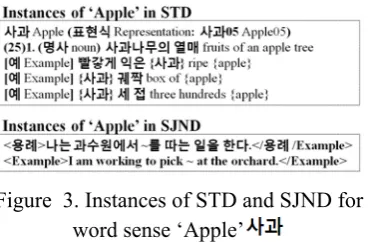
[image:5.595.319.504.138.259.2]in-stances between nouns of SJND and word senses of a synset. As for KorLex, we used the examples of STD linked to word senses of KorLex. Figure 3 shows instances of STD and SJND for a word sense ‘Apple’.
Figure 3. Instances of STD and SJND for word sense ‘Apple’
We reformulated the Lesk algorithm (Lesk 1987, Banerjee and Pedersen 2002) for com-paring instances and evaluating mapping can-didate synsets. The process of evaluating map-ping candidate synsets is as follows.
1) To compare instances of a noun ns of
SJND with examples of a word of STD linked to word sense ws of a synset ss, and
to compute the Relatedness-A(ns, ws) =
score(instance(ns), example(ws)).
2) To compare all nouns ns of SJND for a
semantic class with all nouns in instances of STD linked to word senses ws, and to
compute the Relatedness-B(ns, ws) =
score(∀ns, nouns(example(ws))).
3) If Relatedness-A(ns, ws) ≥λ1 and Related-ness-B(ns, ws) ≥λ2, a synset is evaluated as a candidate synset mc(A). If either
Related-ness-A(ns, ws) ≥ λ1 or Relatedness-B(ns,
ws) ≥ λ2, evaluated as a candidate synset
mc(B). When threshold λ1 and λ2 were 1~4, we had good performances.
4) To repeat from step 1) to 3) for all of syn-sets, in order to determine mapping candi-date synsets. And then, to construct hierar-chical structure for all those synsets.
4.2.3 Using Semantically Relatedness be-tween Nouns of SJND and Synsets of KorLex
computa-tional formula of relatedness based on the Lesk algorithm (Lesk 1987, Banerjee & al 2002). The process of evaluating mapping candidate synsets is as follows.
1) To compare semantically related words: between synonyms, hypernyms, hyponyms and antonyms of a noun of SJND and those of a synset of KorLex. To compute the Re-latedness-C(ns, ss) = score (relations(ns),
relations(ss)).
2) To compare all nouns ns of SJND for a
semantic class with synonyms, hypernyms and hyponyms of a synset of KorLex, and compute the Relatedness-D(ns, ss) = score
(∀ns, relations(ss)).
3) If Relatedness-C(ns, ss) ≥ λ3 and Related-ness-D(ns, ss) ≥λ4, a synset is evaluated as a candidate synset mc(A). If either
Related-ness-C(ns, ss) ≥λ3 or Relatedness-D(ns, ss)
≥λ4, evaluated as a candidate synset mc(B). When threshold λ3 and λ4 were 1~4, we have good performances.
4) To repeat from step 1) to 3) for all of syn-sets, in order to determine mapping synsets. And then, to construct hierarchical struc-ture for all those synsets.
4.3 Determining Least Upper Bound (LUB) Synsets and Mapping Synsets Next, we determine the LUB synsets using mapping candidate synsets and hierarchical structure having semantic relations: parent, child and sibling. In order to determine LUB and mapping synsets, we begin evaluation with bottom-up direction. Using relatedness among child-sibling candidate synsets, we evaluated whether their parent synset is a LUB synset or not. If the parent is a LUB synset, we evaluate its parent (grand-parent of the candidate) syn-set using relatedness among its sibling synsyn-sets. If the parent is not a LUB, the candidate syn-sets mc(A) or mc(B) are determined as
map-ping synsets (or LUB) and stop finding LUB. For all semantic classes, we determine LUB and mapping synsets. Finally, we link the LUB and mapping synsets to each semantic class of SJSC. The process of determining of LUB and mapping synsets is as follows.
1) Using candidate synsets and their sibling, for all candidate synsets mc(A), mc(B) or
mc(C) selected from the processes of “4.2
Select Mapping Candidate Synsets”, to de-termine whether it is a LUB or not and fi-nal mapping synsets.
2) Among sibling synsets, if the ratio of count(mc(A)) to count(mc(A)+mc(B)+ mc(C)) is over 60%, the parent synset of
siblings is evaluated as a candidate synset
mc(A) and as a LUB.
3) If the ratio of count(mc(A)+mc(B)) to
count(mc(A)+mc(B)+mc(C)) is over 70%,
the parent of siblings is evaluated as a can-didate synset mc(A) and as a LUB. If the
ratio of count(mc(A)+mc(B)) to count
(mc(A) +mc(B)+mc(C)) is between 50%
and 69%, the parent of siblings is evaluated as a candidate synset mc(B) and as a LUB.
4) And if the others, to stop finding LUB for that synset and to determine final mapping synsets with its own level of candidate. 5) To repeat from step 1) to 4) until finding
[image:6.595.311.507.360.473.2]LUB synsets and final mapping synsets.
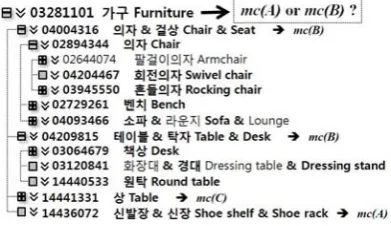
Figure 4. Hierarchical structure of mapping candidate synsets for a semantic class Figure 4 shows hierarchical structure of mapping candidate synsets for a semantic class ‘Furniture’ and when candidate synsets’ ID are ‘04004316’ (Chair & Seat): mc(B), ‘04209815’
(Table & Desk): mc(B), ‘14441331’ (Table): mc(C), and ‘14436072’ (Shoe shelf & Shoe
rack): mc(A), we determine whether their
par-ent synset ‘03281101’ (Furniture) is a LUB or not, and evaluate it as a candidate synset mc(A)
or mc(B). In this case, synset ‘03281101’
(Fur-niture) is a candidate mc(A) and a LUB synset.
5
Experiments and Results
We experimented automatic mapping between 623 semantic classes of SJSC and 90,134 noun synsets of KorLex using the proposed automat-ic mapping method with three approaches. To evaluate the performances, we used the results of manual mapping as correct answers, that was mapped 474 semantic classes (terminal nodes) of SJSC to 65,820 synsets (73%) (in-clude 6,487 LUB) among total 90,134 noun synsets of KorLex. We compared the results of automatic mapping with those of manual map-ping. For evaluation of performances, we em-ployed Recall, Precision and the F1 measure: F1 = (2*Recall*Precision)/(Recall+ Precision).
Approaches Recall Precision F1
1) 0.904 0.502 0.645
2) 0.774 0.732 0.752
3) 0.670 0.802 0.730
1)+2) 0.805 0.731 0.766
1)+3) 0.761 0.758 0.759
2)+3) 0.636 0.823 0.718
[image:7.595.305.516.140.247.2]1)+2)+3) 0.838 0.718 0.774
Table 2. Performances of automatic mapping with three approaches
Table 2 shows the performances of automat-ic mapping with three approaches: 1) IMPW, 2) INW, and 3) SRNS. The ‘1)’, ‘2)’ or ‘3) in the Table present the results using for each approach method and ‘1)+2)’, ‘1)+3)’ or ‘2)+3)’ present those of combining two ap-proaches. The ‘1)+2)+3)’ presents those of the combining three approaches and we can see the best performances using the last approach among results: recall 0.837, precision 0.717 and F1 0.773. The first approach ‘1)’ method shows high recall, but low precision and the third approach ‘3)’ method present low recall and high precision. ‘1)+3)’ and ‘2)+3)’ shows good performances overall. Thus, we could see good performances using the combined ap-proach methods.
Second, we compared the numbers of se-mantic classes, nouns entries of SJND, noun synsets and word senses of KorLex for each approach, after mapping processes.
As shown in Table 3, we can see the most numbers of mapping synsets using the ‘1)’ ap-proach. The ‘1)+2)+3)’ shows the results simi-lar to ‘1)’, but has the best performances (see Table 2). The percentages in the round bracket
present the ratio of the results of automatic mapping to original lexical data of Sejong and
KorLex: 474 semantic classes of SJSC, 25,245 nouns of SJND and 90,134 noun synsets and 147,896 word senses in KorLex.
SJD KorLex
Approaches SC (SJSC)
Nouns
(SJND) Synsets
Word Senses
1) 473 18,575 54,943 69,970
2) 445 18,402 52,109 66,936
3) 413 18,047 49,768 64,003
1)+2) 463 18,521 52,563 67,109
1)+3) 457 18,460 51,786 66,157
2)+3) 383 17,651 48,398 62,063
1)+2)+3) 466 (98.3%)
18,542 (72.8%)
54,083 (60%)
69,259 (46.8%)
Table 3. Numbers of semantic class, noun of SJD, synset and word sense of KorLex In manual mapping, we mapped 73% (65,820) synsets of KorLex for 474 semantic classes of SJSC. The 24,314 synsets was ex-cluded in manual mapping among 90,134 total nouns synsets. The reasons of excluded synsets in manual mapping were 1) inconsistency of inheritance for lexical relations of parent-child in SJSC or KorLex, 2) inconsistency between criteria for SJSC and candidate synsets, 3) candidate synsets belonging to more than two semantic classes, 4) specific proper nouns (chemical compound names), and 5) polysemic abstract synsets (Bae & al. 2010).
In automatic mapping, we could map 60% (54,083) synsets among total nouns synsets (90,134) of KorLex, and it is 82.2% of the re-sults of manual mapping. The 11,737 synsets was excluded in automatic mapping by com-paring with manual mapping. Most of them were 1) tiny-grained synsets found in the low-est levels, 2) synsets having no matched word senses with those of SJND, 3) synsets with polysemic word senses, 4) word senses having poor instances in KorLex and in SJND, 5) word senses in SJND having poor semantic relations.
Level LUB Ratio Level LUB Ratio
1 18 0.6% 9 230 7.3%
2 18 0.6% 10 98 3.1%
3 174 5.5% 11 32 1.0%
4 452 14.3% 12 20 0.6%
5 616 19.5% 13 4 0.1%
6 570 18.0% 14 4 0.1%
7 486 15.4% 15 2 0.1%
[image:7.595.96.279.273.355.2]8 442 14.0% 16-17 0 0%
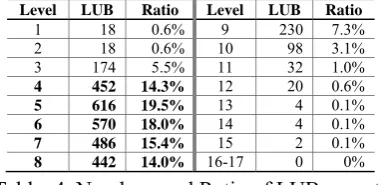
[image:7.595.313.504.616.708.2]Table 4 shows the numbers and ratio of the LUB synsets excluded in automatic mapping for each level in depth. Most synsets are 4-8 levels synsets among 17 levels in depth.
6
Conclusions
We proposed a novel automatic mapping me-thod with three approaches to link Sejong Se-mantic Classes and KorLex using 1) informa-tion of monosemy/polysemy of word senses, 2) instances of nouns of SJD and word senses of KorLex, 3) semantically related words of nouns of SJD and synsets of KorLex. To find common clues from lexical information among those language resources is important process in automatic mapping method. Our proposed automatic mapping method with three ap-proaches shows notable performances by com-paring with other studies on automatic map-ping among language resources: recall 0.837, precision 0.717 and F1 0.773. Therefore, from those studies, we can improve Korean seman-tico-syntactic parsing technology by integrat-ing the argument structures as provided by SJD, and the lexical-semantic hierarchy as provided by KorLex. In addition, we can enrich three resources: KorLex, SJD and STD as results of comparing and integrating them. We expect to improve automatic mapping technology among other Korean language resources through this study.
Acknowledgement
This work was supported by the National Re-search Foundation of Korea (NRF) grant funded by the Korea government(MEST) (No. 2007-0054887).
References
Jan Scheffczyk, Adam Pease, Michael Ellsworth. 2006. Linking FrameNet to the Suggested Upper Merged Ontology. Proc of the 2006 conference
on Formal Ontology in Information Systems (FOIS 2006): 289-300.
Ian Niles and Adam Pease. 2003. Linking lexicons and ontologies: Mapping wordnet to the sug-gested upper merged ontology. In Proceedings of
the 2003 International Conference on Informa-tion and Knowledge Engineering (IKE 03).
KorLex, 2007. Korean WordNet, Korean Language
processing Lab, Pusan National University. Available at http://korlex.cs.pusan.ac.kr
C. Hong. 2007. The Research Report of Develop-ment 21th century Sejong Dictionary, Ministry
of Culture, Sports and Tourism, The National In-stitute of the Korean Language.
Dennis Spohr. 2008. A General Methodology for Mapping EuroWordNets to the Suggested Up-per Merged Ontology, Proceedings of the 6th
LREC 2008:1-5.
Alexander Budanitsky and Graeme Hirst. 2006.
Evaluating WordNet-based Measures of Lexi-cal Semantic Relatedness, Computational
Lin-guistics,Vol 32: Issue 1:13- 47.
Siddharth Patwardhan, Satanjeev Banerjee and Ted Pedersen. 2003. Using Measures of Semantic Relatedness for Word Sense Disambiguation,
CICLing 2003, LNCS(vol 2588):241-257. Satanjeev Banerjee and Ted Pedersen. 2002. An
Adapted Lesk Algorithm for Word Sense Dis-ambiguation Using WordNet, Proceedings of
CICLing 2002, LNCS 2276:136-145
Sara Tonelli and Daniele Pighin. 2009. New Fea-tures for FrameNet -WordNet Mapping,
Pro-ceedings of the 13th Conference on Computa-tional Natural Language Learning: 219-227. Aesun Yoon, Soonhee Hwang, E. Lee, Hyuk-Chul
Kwon. 2009. Consruction of Korean WordNet ‘KorLex 1.5’, JourNal of KIISE: Sortware and
Applications, Vol 36: Issue 1:92-108.
Soonhee Hwang, A. Yoon, H. Kwon. 2010. KorLex 1.5: A Lexical Sematic Network for Korean Numeral Classifiers, JourNal of KIISE:
Sort-ware and Applications, Vol 37: Issue 1:60-73.
Sun-Mee Bae, Kyoungup Im, Aesun Yoon. 2010.
Mapping Heterogeneous Ontologies for the HLT Applications: Sejong Semantic Classes and KorLexNoun 1.5, Korean Journal of
Cog-nitive Science. Vol. 21: Issue 1: 95-126. Aesun Yoon. 2010. Mapping Word Senses of
Ko-rean Predicates Between STD(STandard Dic-tionary) and SJD(SeJong Electronic Dictio-nary) for the HLT Applications, Journal of the
Linguistic Society of Korea. No 56: 197-235.
Hyopil Shin. 2010. KOLON: Mapping Korean
Words onto the Microkosmos Ontology and Combining Lexical Resources. Journal of the