Proceedings of the Joint 5th Workshop on Statistical Machine Translation and MetricsMATR, pages 290–295, Uppsala, Sweden, 15-16 July 2010. c2010 Association for Computational Linguistics
An Augmented Three-Pass System Combination Framework:
DCU Combination System for WMT 2010
Jinhua Du, Pavel Pecina, Andy Way
CNGL, School of Computing Dublin City University
Dublin 9, Ireland
{jdu, ppecina, away}@computing.dcu.ie
Abstract
This paper describes the augmented three-pass system combination framework of the Dublin City University (DCU) MT group for the WMT 2010 system combi-nation task. The basic three-pass frame-work includes building individual confu-sion networks (CNs), a super network, and a modified Minimum Bayes-risk (mCon-MBR) decoder. The augmented parts for WMT2010 tasks include 1) a rescoring component which is used to re-rank the
N-best lists generated from the individual CNs and the super network, 2) a new hy-pothesis alignment metric – TERp – that is used to carry out English-targeted hy-pothesis alignment, and 3) more differ-ent backbone-based CNs which are em-ployed to increase the diversity of the mConMBR decoding phase. We took part in the combination tasks of English-to-Czech and French-to-English. Exper-imental results show that our proposed combination framework achieved 2.17 ab-solute points (13.36 relative points) and 1.52 absolute points (5.37 relative points) in terms of BLEU score on English-to-Czech and French-to-English tasks re-spectively than the best single system. We also achieved better performance on hu-man evaluation.
1 Introduction
In several recent years, system combination has become not only a research focus, but also a pop-ular evaluation task due to its help in improving machine translation quality. Generally, most com-bination approaches are based on a confusion net-work (CN) which can effectively re-shuffle the
translation hypotheses and generate a new target sentence. A CN is essentially a directed acyclic graph built from a set of translation hypotheses against a reference or “backbone”. Each arc be-tween two nodes in the CN denotes a word or to-ken, possibly anullitem, with an associated pos-terior probability.
Typically, the dominant CN is constructed at the word level by a state-of-the-art framework: firstly, a minimum Bayes-risk (MBR) decoder (Kumar and Byrne, 2004) is utilised to choose the back-bone from a merged set of hypotheses, and then the remaining hypotheses are aligned against the backbone by a specific alignment approach. Cur-rently, most research in system combination has focused on hypothesis alignment due to its signif-icant influence on combination quality.
A multiple CN or “super-network” framework was firstly proposed in Rosti et al. (2007) who used each of all individual system results as the backbone to build CNs based on the same align-ment metric, TER (Snover et al., 2006). A consen-sus network MBR (ConMBR) approach was pre-sented in (Sim et al., 2007), where MBR decod-ing is employed to select the best hypothesis with the minimum cost from the original single system outputs compared to the consensus output.
pass, all the 1-best hypotheses coming from sin-gle MT systems, individual networks, and the su-per network are combined to select the final result using the mConMBR decoder.
In the system combination task of WMT 2010, we adopted an augmented framework by extend-ing the strategy in (Du and Way, 2009). In addi-tion to the basic three-pass architecture, we aug-ment our combination system as follows:
• We add a rescoring component in Pass 1 and Pass 2.
• We introduce the TERp (Snover et al., 2009) alignment metric for the English-targeted combination.
• We employ different backbones and hypothe-sis alignment metrics to increase the diversity of candidates for our mConMBR decoding.
The remainder of this paper is organised as fol-lows. In Section 2, we introduce the three hy-pothesis alignment methods used in our frame-work. Section 3 details the steps for building our augmented three-pass combination framework. In Section 4, a rescoring model with rich features is described. Then, Sections 5 and 6 respec-tively report the experimental settings and exper-imental results on English-to-Czech and French-to-English combination tasks. Section 7 gives our conclusions.
2 Hypothesis Alignment Methods
Hypothesis alignment plays a vital role in the CN, as the backbone sentence determines the skeleton and the word order of the consensus output.
In the combination evaluation task, we inte-grated TER (Snover et al., 2006), HMM (Ma-tusov et al., 2006) and TERp (Snover et al., 2009) into our augmented three-pass combination framework. In this section, we briefly describe these three methods.
2.1 TER
The TER (Translation Edit Rate) metric measures the ratio of the number of edit operations between the hypothesisE0and the referenceE
bto the total
number of words inEb. Here the backboneEb is
assumed to be the reference. The allowable edits include insertions (Ins), deletions (Del), substitu-tions (Sub), and phrase shifts (Shft). The TER of
E0 compared toE
bis computed as in (1):
T ER(E0, Eb) =Ins+Del+Sub+Shft
Nb ×100% (1)
whereNbis the total number of words inEb. The
difference between TER and Levenshtein edit dis-tance (or WER) is the sequence shift operation al-lowing phrasal shifts in the output to be captured. The phrase shift edit is carried out by a greedy algorithm and restricted by three constraints: 1) The shifted words must exactly match the refer-ence words in the destination position. 2) The word sequence of the hypothesis in the original position and the corresponding reference words must not exactly match. 3) The word sequence of the reference that corresponds to the desti-nation position must be misaligned before the shift (Snover et al., 2006).
2.2 HMM
The hypothesis alignment model based on HMM (Hidden Markov Model) considers the align-ment between the backbone and the hypoth-esis as a hidden variable in the conditional probability Pr(E0|Eb). Given the backbone
Eb = {e1, . . . , eI} and the hypothesis E0 = {e0
1, . . . , e0J}, which are both in the same
lan-guage, the probability Pr(E0|Eb) is defined as in
(2):
Pr(E0|Eb) = X
A
Pr(E0, A|Eb) (2)
where the alignemnt A ⊆ {(j, i) : 1 ≤ j ≤ J; 1 ≤ i ≤ I}, iand j represent the word po-sition inEbandE0respectively. Hence, the
align-ment issue is to seek the optimum alignalign-ment Aˆ
such that:
ˆ
A= arg max
A P(A|e
I
1, e01J) (3)
For the HMM-based model, equation (2) can be represented as in (4):
Pr(E0|Eb) = X
aJ j
J Y
j=1
[p(aj|aj−1, I)·p(e0j|eaj)] (4)
where p(aj|aj−1, I) is the alignment probability
andp(e0
j|ei)is the translation probability.
2.3 TER-Plus
the constant edit cost for all operations such as shifts, insertion, deleting or substituting in TER, all edit costs in TERp are optimized to maximize correlation with human judgments.
TERp uses all the edit operations of TER – matches, insertions, deletions, substitutions, and shifts – as well as three new edit operations: stem matches, synonym matches, and phrase sub-stitutions (Snover et al., 2009). TERp employs the Porter stemming algorithm (Porter, 1980) and WordNet (Fellbaum, 1998) to perform the “stem match” and “synonym match” respectively. Se-quences of words in the reference are considered to be paraphrases of a sequence of words in the hypothesis if that phrase pair occurs in the TERp phrase table (Snover et al., 2009).
In our experiments, TERp was used for the French-English system combination task, and we used the default configuration of optimised edit costs.
3 Augmented Three-Pass Combination Framework
The construction of the augmented three-pass combination framework is shown in Figure 1.
Hypotheses Set
BLEU TER TERp MBR
BLEU TER TERp Top M Single
HMM TER TERp Alignment
Individual CNs
Nbest
Re-ranking Super CN Networks
mConMBR
Pass 1
Pass 2
Pass 3
[image:3.595.71.293.429.655.2]N Single MT Systems
Figure 1: Three-Pass Combination Framework
In Figure 1, the dashed boxes labeled “TERp” indicate that the TERp alignment is only appli-cable for English-targeted hypothesis alignment. The lines with arrows pointing to “mConMBR” represent adding outputs into the mConMBR de-coding component. “TopMSingle” indicates that the 1-best results from the bestM individual MT
systems are also used as backbones to build in-dividual CNs under different alignment metrics. The three dashed boxes represent Pass 1, Pass 2 and Pass 3 respectively. The steps can be sum-marised as follows:
Pass 1: Specific Metric-based Single Networks
1. Merge all the1-best hypotheses from single MT systems into a newN-best setNs.
2. Utilise the standard MBR decoder to se-lect one from theNs as the backbone given
some specific loss function such as TER, BLEU (Papineni et al., 2002) and TERp; Ad-ditionally, in order to increase the diversity of candidates used for Pass 2 and Pass 3, we also use the 1-best hypotheses from the top
M single MT systems as the backbone. Add the backbones generated by MBR intoNs.
3. Perform the word alignment between the dif-ferent backbones and the other hypotheses via the TER, HMM, TERp (only for English) metrics.
4. Carry out word reordering based on word alignment (TER and TERp have completed the reordering in the process of scoring) and build individual CNs (Rosti et al., 2007);
5. Decode the single networks and export the1 -best outputs and the N-best lists separately. Add these1-best outputs intoNs.
Pass 2: Super-Network
1. Connect the single networks using a start node and an end node to form a super-network based on multiple hypothesis align-ment and different backbones. In this evalu-ation, we set uniform weights for these dif-ferent individual networks when building the super network(Du and Way, 2009).
2. Decode the super network and generate a consensus output as well as the N-best list. Add the1-best result intoNs.
3. Rescore the N-best lists from all individual networks and super network and add the new
1-best results intoNs.
Pass 3: mConMBR
1. Rename the setNsas a new setNcon;
2. Use mConMBR decoding to search for the best final result from Ncon. In this step, we set a uniform distribution between the candi-dates inNcon.
4 Rescoring Model
We adapted our previous rescoring model (Du et al., 2009) to larger-scale data. The features we used are as follows:
• Direct and inverse IBM model;
• 4-gram and 5-gram target language model;
• 3, 4, and 5-gram Part-of-Speech (POS) lan-guage model (Schmid, 1994; Ratnaparkhi, 1996);
• Sentence-length posterior probability (Zens and Ney, 2006);
• N-gram posterior probabilities within theN -best list (Zens and Ney, 2006);
• Minimum Bayes Risk cost. This process is similar to the calculation of the MBR decod-ing in which we take the current hypothesis in theN-best list as the “backbone”, and then calculate and sum up all the Bayes risk cost between the backbone and each of the rest of theN-best list using BLEUmetric as the loss
function;
• Length ratio between source and target sen-tence.
The weights are optimized via the MERT algo-rithm (Och, 2003).
5 Experimental Settings
We participated in the English–Czech and French–English system combination tasks.
In our system combination framework, we use a large-scale monolingual data to train language models and carry out POS-tagging.
5.1 English-Czech Training Data
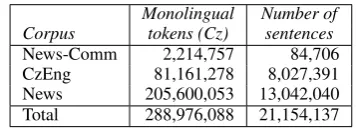
The statistics of the data used for language models training are shown in Table 1.
[image:4.595.321.506.396.461.2]Monolingual Number of Corpus tokens (Cz) sentences News-Comm 2,214,757 84,706 CzEng 81,161,278 8,027,391 News 205,600,053 13,042,040 Total 288,976,088 21,154,137
Table 1: Statistics of data in the En–Cz task
All the data are provided by the workshop organisers. 1 In Table 1, “News-Comm” indi-cates the data set of News-Commentary v1.0 and
1http://www.statmt.org/wmt10/translation-task.html
“CzEng” is the Czech–English corpus v0.9 (Bo-jar and ˇZabokrtsk´y, 2009). “News” is the Czech monolingual News corpus.
As to our CN and rescoring components, we use “News-Comm+CzEng” to train a 4-gram language model and use “News-Comm+CzEng+News” to train a 5-gram language model. Additionally, we per-form POS tagging (Hajiˇc, 2004) for ‘News-Comm+CzEng+News” data, and train 3-gram, 4-gram, and 5-gram POS-tag language models.
Devset and Testset
The devset includes 455 sentences and the testset contains 2,034 sentences. Both data sets are pro-vided by the workshop organizers. Each source sentence has only one reference. There are 11 MT systems in the En-Cz track and we use all of them in our combination experiments.
5.2 French-English Training Data
The statistics of the data used for language models training and POS tagging are shown in Table 2.
[image:4.595.90.269.638.703.2]Monolingual Number of Corpus tokens (En) sentences News-Comm 2,973,711 125,879 Europarl 50,738,215 1,843,035 News 1,131,527,255 48,648,160 Total 1,184,234,384 50,617,074
Table 2: Statistics of data in the Fr–En task
“News” is the English monolingual News corpus. We use “News-Comm+Europarl” to train a 4-gram language model and use “News-Comm+Europarl+News” to train a 5-gram lan-guage model. We also perform POS tagging (Rat-naparkhi, 1996) for all available data, and train 3-gram, 4-gram and, 5-gram POS-tag language models.
Devset and Testset
We also use all the 1-best results to carry out sys-tem combination. There are 14 MT syssys-tems in the Fr-En track and we use all of them in our combi-nation experiments.
6 Experimental Results
In this section, all the results are reported on de-vsets in terms of BLEU and NIST scores.
6.1 English–Czech
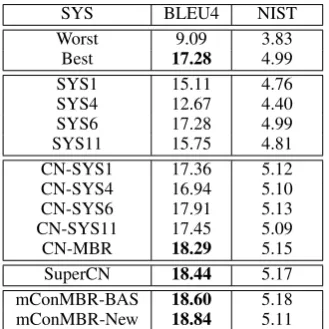
alignment. However, in order to increase diversity for our 3-pass framework, in addition to using the output from MBR decoding as the backbone, we also separately selected the top 4 individual tems (SYS1, SYS4, SYS6, and SYS11 in our sys-tem set) in terms of BLEU scores on the devset as the backbones so that we can build multiple indi-vidual CNs for the super network. All the results are shown in Table 3.
SYS BLEU4 NIST
Worst 9.09 3.83
Best 17.28 4.99
SYS1 15.11 4.76
SYS4 12.67 4.40
SYS6 17.28 4.99
SYS11 15.75 4.81
CN-SYS1 17.36 5.12
CN-SYS4 16.94 5.10
CN-SYS6 17.91 5.13
CN-SYS11 17.45 5.09
CN-MBR 18.29 5.15
SuperCN 18.44 5.17
mConMBR-BAS 18.60 5.18
[image:5.595.99.264.198.363.2]mConMBR-New 18.84 5.11
Table 3: Automatic evaluation of the combination results on the En-Cz devset.
“Worst” indicates the 1-best hypothesis from the worst single system, the “Best” is the 1-best hypothesis from the best single system (SYS11)). “CN-SYSX” denotes that we use SYSX (X = 1,4,6,11and MBR) as the backbone to build an individual CN. “mConMBR-BAS” stands for the original three-pass combination framework with-out rescoring component, while “mConMBR-New” indicates the proposed augmented combina-tion framework. It can be seen from Table 3 that 1) in all individual CNs, the CN-MBR achieved the best performance; 2) SuperCN and mConMBR-New improved by 1.16 (6.71% relative) and 1.56 (9.03% relative) absolute BLEU points compared to the best single MT system. 3) our new three-pass combination framework achieved the improvement of 0.24 absolute (1.29% relative) BLEU points than the original framework.
The final results on the test set are shown in Ta-ble 4.
SYS BLEU4 human eval.(%win)
Best 16.24 70.38
mConMBR-BAS 17.91
[image:5.595.324.503.359.496.2]-mConMBR-New 18.412 75.17
Table 4: Evaluation of the combination results on the En-Cz testset.
It can be seen that our “mConMBR-New” framework performs better than the best single system and our original framework “mConMBR-BAS” in terms of automatic BLEU scores and hu-man evaluation for the English-to-Czech task. In this task campaign, we achieved top 1 in terms of the human evaluation.
6.2 French–English
We used three hypothesis alignment methods – TER, TERp and HMM – to carry out word align-ment between the backbone and the rest of the hypotheses. Apart from the backbone generated from MBR, we separately select the top 5 individ-ual systems (SYS1, SYS10, SYS11, SYS12, and SYS13 in our system set) respectively as the back-bones using HMM, TER and TERp to carry out hypothesis alignment so that we can build more individual CNs for the super network to increase the diversity of candidates for mConMBR. The re-sults are shown in Table 5.3
SYS BLEU4(%) NIST
Worst 15.04 4.97
Best 28.88 6.71
CN-SYS1-TER 29.56 6.78
CN-SYS1-HMM 29.60 6.84
CN-SYS1-TERp 29.77 6.83
CN-MBR-TER 30.16 6.91
CN-MBR-HMM 30.19 6.92
CN-MBR-TERp 30.27 6.92
SuperCN 30.58 6.90
mConMBR-BAS 30.74 7.01
mConMBR-New 31.02 6.96
Table 5: Automatic evaluation of the combination results on the Fr-En devset.
“CN-MBR-X” represents the different possi-ble hypothesis alignment methods (X = {TER, HMM, TERp}) which are used to build indi-vidual CNs using the output from MBR de-coding as the backbone. We can see that the SuperCN and mConMBR-New respectively im-proved by 1.7 absolute (5.89% relative) and 2.88 absolute (9.97% relative) BLEU points compared to the best single system. Furthermore, our aug-mented framework “mConMBR-New” achieved the improvement of 0.28 absolute (0.91% relative) BLEU points than the original three-pass frame-work as well.
2This score was measured in-house on the
refer-ence provided by the organizer using metric mteval-v13 (ftp://jaguar.ncsl.nist.gov/mt/resources/mteval-v13.pl).
3In this Table, we take SYS1 as an example to show the
results using a single MT system as the backbone under the three alignment metrics.
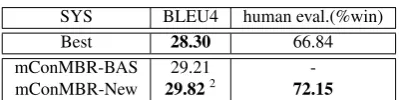
[image:5.595.81.280.706.755.2]The final results on the test set are shown in Ta-ble 6.
SYS BLEU4 human eval.(%win)
Best 28.30 66.84
mConMBR-BAS 29.21
[image:6.595.81.281.98.148.2]-mConMBR-New 29.822 72.15
Table 6: Evaluation of the combination results on Fr-En test set.
It can be seen that our “mConMBR-New” framework performs the best than the best single system and our original framework “mConMBR-BAS” in terms of automatic BLEU scores and hu-man evaluation for the French–English task.
7 Conclusions and Future Work
We proposed an augmented three-pass mul-tiple system combination framework for the WMT2010 system combination shared task. The augmented parts include 1) a rescoring model to select the potential 1-best result from the invidual CNs and super network to increase the di-versity for “mConMBR” decoding; 2) a new hy-pothesis alignment metric “TERp” for English-targeted alignment; 3) 1-best results from the top
M individual systems employed to build CNs to augment the “mConMBR” decoding. We took part in the English-to-Czech and French-to-English tasks. Experimental results reported on test set of these two tasks showed that our aug-mented framework performed better than the best single system in terms of BLEU scores and hu-man evaluation. Furthermore, the proposed aug-mented framework achieved better results than our basic three-pass combination framework (Du and Way, 2009) as well in terms of automatic evalua-tion scores. In the released preliminary results, we achieved top 1 and top 3 for the English-to-Czech and French-to-English tasks respectively in terms of human evaluation.
As for future work, firstly we plan to do further experiments using automatic weight-tuning algo-rithm to tune our framework. Secondly, we plan to examine how the differences between the hy-pothesis alignment metrics impact on the accuracy of the super network. We also intend to integrate more alignment metrics to the networks and verify on the other language pairs.
Acknowledgments
This research is supported by the Science Foundation Ireland (Grant 07/CE/I1142) as part of the Centre for Next Gener-ation LocalisGener-ation (www.cngl.ie) at Dublin City University
and has been partially funded by PANACEA, a 7th Frame-work Research Programme of the European Union (contract number: 7FP-ITC-248064) as well as partially supported by the projectGA405/09/0278of the Grant Agency of the Czech Republic. Thanks also to the reviewers for their insightful comments.
References
Bojar, O. and ˇZabokrtsk´y, Z. (2009). CzEng0.9: Large Par-allel Treebank with Rich Annotation. Prague Bulletin of Mathematical Linguistics, 92.
Du, J., He, Y., Penkale, S., and Way, A. (2009). MaTrEx: The DCU MT System for WMT2009. In Proceedings of the EACL-WMT 2009, pages 95–99, Athens, Greece. Du, J. and Way, A. (2009). A Three-pass System
Com-bination Framework by Combining Multiple Hypothesis Alignment Methods. InProceedings of the International Conference on Asian Language Processing (IALP), pages 172–176, Singapore.
Fellbaum, C., editor (1998). WordNet: an electronic lexical database. MIT Press.
Hajiˇc, J. (2004).Disambiguation of Rich Inflection (Compu-tational Morphology of Czech), volume 1. Charles Uni-versity Press, Prague.
Kumar, S. and Byrne, W. (2004). Minimum Bayes-Risk De-coding for Statistical Machine Translation. In Proceed-ings of the HLT-NAACL 2004, pages 169–176, Boston, MA.
Matusov, E., Ueffing, N., and Ney, H. (2006). Computing consensus translation from multiple machine translation systems using enhanced hypotheses alignment. In Pro-ceedings of EACL’06, pages 33–40.
Och, F. (2003). Minimum error rate training in statistical machine translation. InProceedings of the 41st Annual Meeting of the Association for Computational Linguistics (ACL), pages 160–167, Sapporo, Japan.
Papineni, K., Roukos, S., Ward, T., and Zhu, W.-J. (2002). BLEU: a Method for Automatic Evaluation of Machine Translation. InProceedings of the ACL-02, pages 311– 318, Philadelphia, PA.
Porter, M. F. (1980). An algorithm for suffix stripping, pro-gram.
Ratnaparkhi, A. (1996). A Maximum Entropy Model for Part-of-Speech Tagging. In Proceedings of the EMNLP’96, pages 133–142, Philadelphia, PA.
Rosti, A., Matsoukas, S., and Schwartz, R. (2007). Improved Word-Level System Combination for Machine Transla-tion. InProceedings of ACL’07, pages 312–319. Schmid, H. (1994). Probabilistic Part-of-Speech Tagging
Us-ing Decision Trees. InProceedings of International Con-ference on New Methods in Language Processing, pages 44–49, Manchester, UK.
Sim, K., Byrne, W., Gales, M., Sahbi, H., and Woodland, P. (2007). Consensus network decoding for statistical ma-chine translation system combination. InProceedings of the ICASSP’07, pages 105–108.
Snover, M., Dorr, B., Schwartz, R., Micciula, L., and Makhoul, J. (2006). A study of translation edit rate with targeted human annotation. InProceedings of the AMTA’06), pages 223–231, Cambridge, MA.
Snover, M., Madnani, N., J.Dorr, B., and Schwartz, R. (2009). Fluency, adequacy, or HTER? Exploring different human judgments with a tunable MT metric. In Proceed-ings of the WMT’09, pages 259–268, Athens, Greece. Zens, R. and Ney, H. (2006). N-gram Posterior Probabilities
for Statistical Machine Translation. InProceedings of the HLT-NAACL’06), pages 72–77, New York, USA.