NUTRITIONAL VALUE IN PROCESSED PRODUCTS OF ACAI
*
,1Inez
Helena
Vieira
3Wanderley
Rodrigues
1
Nutrition Course, Centro Universitario Sao Lucas. Porto Velho, Brazil
2Department of Chemistry, Universidade Federal de Rondonia. Porto Velho,
3
Laboratory of Environmental Biogeochemistry, Universidade Federal de Rondonia. Porto Velho, Brazil
4Embrapa Rondônia. P.O. Box 127. Porto Velho, Brazil
ARTICLE INFO ABSTRACT
Acai is a Brazilian palm tree which fruits are widely used by the Amazonian population and play an important socioeconomic and cultural role. Knowledge of food compositional, nutritional and functional properties is fundamental for defining the quality of trop
the abundance and bioavailability of essential nutrients. This study is aimed to evaluate the composition of water, proteins, lipids, carbohydrates, fiber, caloric content, and the minerals calcium, iron, magnesium, mang
jelly. The samples of these products were lyophilized until complete dehydration to estimate the humidity percentage. The protein content was estimated based on the total content of
samples
extraction in a Soxhlet with acid hydrolysis. subtracting the weights of water, proteins, li
the dietary fiber was based on digestion in an acid medium followed by digestion in an alkaline medium.
carbohydrates. In order to determine the content of minerals,
acidified in an open system and then quantified by flame atomic absorption spectrometry. The content of nutrients and caloric content found in the study were compared
(DRV) established by the Ministry of Health based on a daily diet of 2,000 kcal for healthy adults. Water, protein, lipids, and fiber were higher in pulp than in jam and jelly. Carbohydrates and caloric content was higher in ja
indicate that the processing, especially cooking, leads to loss of nutrients. An exception was observed for carbohydrates and energy content, because of the inherent addition of su
jam and jelly.
Copyright©2016, Inez Helena Vieira da Silva Santos
permits unrestricted use, distribution, and reproduction in any medium, provided the original work is properly cited.
INTRODUCTION
The Amazon Forest is a remarkable source of calories, proteins, vitamins and minerals, which has an excellent potential for health, nutrition and life quality for its population. Nevertheless, the social and economic reality, together with the precariousness of nutrition and health records
contrast with the richness in biologic resources (Aguiar, 2006). The region is characterized by the availability of fruits with high economic and nutritional potential. The interest in these fruits increases - nationally and internationally
*Corresponding author: Inez Helena Vieira da Silva Santos,
Nutrition Course, Centro Universitario Sao Lucas. Porto Velho, Brazil.
ISSN: 0975-833X
Article History:
Received 03rd September, 2016 Received in revised form 19th October, 2016
Accepted 05th November, 2016
Published online 30th December,2016
Key words:
Nutrients, Food composition, Processed products.
Citation: Inez Helena Vieira da Silva Santos, Mariangela Soares de Azevedo, Wanderley Rodrigues Bastos and Maurício Reginaldo Alves dos
Santos, 2016.“Nutritional value in processed products of acai
42809-42814.
RESEARCH ARTICLE
NUTRITIONAL VALUE IN PROCESSED PRODUCTS OF ACAI (
EUTERPE PRECATORIA
AN AMAZONIAN FRUIT
Vieira
da
Silva
Santos,
2Mariangela
Soares
de
Rodrigues
Bastos and
4Maurício Reginaldo Alves dos Santos
Nutrition Course, Centro Universitario Sao Lucas. Porto Velho, Brazil
Department of Chemistry, Universidade Federal de Rondonia. Porto Velho,
Laboratory of Environmental Biogeochemistry, Universidade Federal de Rondonia. Porto Velho, Brazil
Embrapa Rondônia. P.O. Box 127. Porto Velho, Brazil
ABSTRACT
is a Brazilian palm tree which fruits are widely used by the Amazonian population and play an important socioeconomic and cultural role. Knowledge of food compositional, nutritional and functional properties is fundamental for defining the quality of trop
the abundance and bioavailability of essential nutrients. This study is aimed to evaluate the composition of water, proteins, lipids, carbohydrates, fiber, caloric content, and the minerals calcium, iron, magnesium, manganese, potassium, sodium, zinc and copper in acai products
jelly. The samples of these products were lyophilized until complete dehydration to estimate the humidity percentage. The protein content was estimated based on the total content of
samples in natura by the Kjeldahl method. The determination of the lipid content was carried out by extraction in a Soxhlet with acid hydrolysis. The portion of carbohydrates was determined by subtracting the weights of water, proteins, lipids and ashes from the original sample.
the dietary fiber was based on digestion in an acid medium followed by digestion in an alkaline medium.The energy content of each product was estimated from the content of proteins, lipids and
hydrates. In order to determine the content of minerals,
acidified in an open system and then quantified by flame atomic absorption spectrometry. The content of nutrients and caloric content found in the study were compared
(DRV) established by the Ministry of Health based on a daily diet of 2,000 kcal for healthy adults. Water, protein, lipids, and fiber were higher in pulp than in jam and jelly. Carbohydrates and caloric content was higher in jam. Minerals were higher in pulp. The higher nutrient concentrations in pulp indicate that the processing, especially cooking, leads to loss of nutrients. An exception was observed for carbohydrates and energy content, because of the inherent addition of su
jam and jelly.
et al.This is an open access article distributed under the Creative Commons Att use, distribution, and reproduction in any medium, provided the original work is properly cited.
source of calories, proteins, vitamins and minerals, which has an excellent potential for health, nutrition and life quality for its population. Nevertheless, the social and economic reality, together with the precariousness of nutrition and health records in the region contrast with the richness in biologic resources (Aguiar, 2006). The region is characterized by the availability of fruits with high economic and nutritional potential. The interest in these nationally and internationally - mainly due to
Inez Helena Vieira da Silva Santos,
Nutrition Course, Centro Universitario Sao Lucas. Porto Velho, Brazil.
their exotic flavors and aromas (Leterme
et al., 2012). Acai (Euterpe precatoria
common to Western Amazon (Amazonas, Acre, Rondonia, and Roraima states). It propagates by seeds rather than by tillers unlike many palm trees. Its fruiting occurs mainly at the beginning of the year, during the Amazonian winter. The is round, purplish, almost black when ripe, with rich edible pulp (Galotta and Boaventura, 2005; Sanabria and Sangronis, 2007; Santana and Jesus, 2012). It is popularly appreciated by
the Amazonian population and plays an important
socioeconomic and cultural role (Santos and Salay, 2014). The fruits are widely used in local cuisine as juice
known as "acai wine" - in meals with cassava flour or tapioca flour in combination with meat, fried fish or shrimp and mixed
International Journal of Current Research
Vol. 8, Issue, 12, pp.42809-42814, December, 2016
INTERNATIONAL
Inez Helena Vieira da Silva Santos, Mariangela Soares de Azevedo, Wanderley Rodrigues Bastos and Maurício Reginaldo Alves dos Nutritional value in processed products of acai (Euterpe precatoria), An amazonian fruit”, International Journal of Current Research,
EUTERPE PRECATORIA
),
de
Azevedo,
Maurício Reginaldo Alves dos Santos
Nutrition Course, Centro Universitario Sao Lucas. Porto Velho, Brazil
Department of Chemistry, Universidade Federal de Rondonia. Porto Velho, Brazil
Laboratory of Environmental Biogeochemistry, Universidade Federal de Rondonia. Porto Velho, Brazil
is a Brazilian palm tree which fruits are widely used by the Amazonian population and play an important socioeconomic and cultural role. Knowledge of food compositional, nutritional and functional properties is fundamental for defining the quality of tropical fruits – characterized by both the abundance and bioavailability of essential nutrients. This study is aimed to evaluate the composition of water, proteins, lipids, carbohydrates, fiber, caloric content, and the minerals calcium, anese, potassium, sodium, zinc and copper in acai products – pulp, jam and jelly. The samples of these products were lyophilized until complete dehydration to estimate the humidity percentage. The protein content was estimated based on the total content of nitrogen of the The determination of the lipid content was carried out by The portion of carbohydrates was determined by pids and ashes from the original sample. The analysis of the dietary fiber was based on digestion in an acid medium followed by digestion in an alkaline The energy content of each product was estimated from the content of proteins, lipids and hydrates. In order to determine the content of minerals, the samples were calcinated and acidified in an open system and then quantified by flame atomic absorption spectrometry. The content of nutrients and caloric content found in the study were compared to the Daily Reference Value (DRV) established by the Ministry of Health based on a daily diet of 2,000 kcal for healthy adults. Water, protein, lipids, and fiber were higher in pulp than in jam and jelly. Carbohydrates and caloric m. Minerals were higher in pulp. The higher nutrient concentrations in pulp indicate that the processing, especially cooking, leads to loss of nutrients. An exception was observed for carbohydrates and energy content, because of the inherent addition of sugar in the production of
is an open access article distributed under the Creative Commons Attribution License, which
their exotic flavors and aromas (Leterme et al., 2012; Portinho
Euterpe precatoria) is a palm tree very
common to Western Amazon (Amazonas, Acre, Rondonia, and Roraima states). It propagates by seeds rather than by tillers – unlike many palm trees. Its fruiting occurs mainly at the beginning of the year, during the Amazonian winter. The fruit is round, purplish, almost black when ripe, with rich edible pulp (Galotta and Boaventura, 2005; Sanabria and Sangronis, 2007; Santana and Jesus, 2012). It is popularly appreciated by
the Amazonian population and plays an important
cultural role (Santos and Salay, 2014). The fruits are widely used in local cuisine as juice - traditionally in meals with cassava flour or tapioca flour in combination with meat, fried fish or shrimp and mixed
INTERNATIONAL JOURNAL OF CURRENT RESEARCH
Inez Helena Vieira da Silva Santos, Mariangela Soares de Azevedo, Wanderley Rodrigues Bastos and Maurício Reginaldo Alves dos
with fruit and granola. It makes excellent jams, jellies,
chocolates, creams, ice creams, and liqueurs (Schirmann et al.,
2009; Yuyama, et al., 2011). Acai has a high caloric content
and since it has a considerable level of iron, it is empirically used to treat cases of anemia throughout the Amazon region
(Yuyama et al., 2002; Toaiari et al., 2005). Nowadays,
demand for acai is growing in the international market. It is considered as an exotic fruit with high levels of lipids, anthocyanin and polyphenols - substances with high antioxidant capacity and proven beneficial health effects
(Sangronis et al.; 2006; Schirmann et al., 2009). Knowledge
of food compositional, nutritional and functional properties is fundamental for defining the quality of tropical fruits. In general, properties are characterized by both the abundance and bioavailability of essential nutrients (Naozuka and Oliveira, 2007). This study is aimed to evaluate the composition of water, proteins, lipids, carbohydrates, fiber, caloric content, and the minerals calcium, iron, magnesium, manganese, potassium, sodium, zinc and copper in acai
products. Pulps, jams and jellies processed from acai (Euterpe
precatoria) at the Joint Consortium for Economic
Reforestation (RECA), in the state of Rondonia, Western Amazonia, were evaluated.
MATERIALS AND METHODS
The acai products were collected at the Joint Consortium for Economic Reforestation (RECA), located at BR 364, km 355.5, District of Nova California, in Porto Velho, Rondonia. The frozen fruit pulps were transported in plastic bags and packed in ice in polystyrene boxes to the Environmental Biogeochemistry Laboratory Wolfgang C. Pfeiffer of the Federal University of Rondonia (LABIOGEOQ/UNIR). The jams and jellies were transported at room temperature, as they are marketed, in 500 mL glass bottles sealed with metal caps. All the collected samples had different dates of production. To make pulp of acai three parts water are added to one part fruit. To make jam, one part sugar is added to one part pulp and then the product is cooked until desired consistency. To make jelly, the pulp is blended and sieved, sugar and pectin are added to the pulp in the proportions 1 : 0.5 : 0.004 (pulp : sugar : pectin) and then the product is cooked until desired consistency. The preparations of jam and jelly of acai are processed in food grade stainless steel, heated by liquefied petroleum gas. The composition of water, proteins, lipids, carbohydrates, fiber, minerals and caloric content found in the study were compared to the Daily Reference Value (DRV) established by the Ministry of Health based on a daily diet of 2,000 kcal for healthy adults (Brasil, 2003). The proportions of these compounds were expressed per 100 grams of edible fresh matter of the products.
Determination procedures
Water content. The samples of pulp, jam and jelly were frozen
at -24°C for 6 days and then submmited to a lyophilizer (Terroni LH0500/41) for 120 hours, until complete water removal. To estimate the humidity percentage, the formula described by IAL (2008) was used.
Proteins. The protein content was estimated based on the total
content of nitrogen of the samples in natura by the Kjeldahl method, as preconized by AOAC (1997). The results of the titration were adjusted by the conversion factor of 6.25, according to Vicenzi (2008).
Lipids. The determination of the lipid content was carried out
by extraction in a Soxhlet with acid hydrolysis, as described by IAL (2008).
Minerals.The samples were calcinated in a muffle (EDG 3000
model) and the ashes were then acidified in an open digestion
system, adding 4.0 mL HNO3 in accordance with the methods
#393 and 394/IV described by IAL (IAL, 2008). After digestion, the minerals were quantified by flame atomic absorption spectrometry (Perkin Elmer model AAS400) calibrated with standard solutions of Fe, Zn, Mn, and Cu (IAL, 2008). The results were expressed in µg mineral / 100 g samples.
Carbohydrates. The portion of carbohydrates was determined
by subtracting the weights of water, proteins, lipids and ashes from the original sample. The obtained values include dietary fiber (LATINFOODS, 2002; NEPA, 2011).
Fiber. The analysis of the dietary fiber was carried out by the
Weende method (A.O.A.C., 1997), which is based on digestion
in an acid medium (sulfuric acid – H2SO4 at 1,25%), followed
by digestion in an alkaline medium (sodium hydroxide – NaOH at 1,25%).
Caloric content. The energy content of each product, in
kilocalories (kcal) and in kilojoules (kj), was estimated from the content in grams of proteins, lipids and carbohydrates. The Atwater system of conversion – based on the specific coefficients of the combustion heat generated from the nutrients (4.0, 4.0, and 9.0 kcal/g of proteins, carbohydrates and lipids, respectively) – was used (LATINFOODS, 2002; Brasil, 2003; NEPA, 2011).
Statistical procedures. A completely randomized design was
used with three replications of three samples. All data was subjected to analysis of variance. The standard deviations and coefficients of variance were calculated for each nutrient. Statistical analyses were performed with the BioEstat program,
5th edition, 2007.
RESULTS AND DISCUSSION
were observed by Pereira et al. (2002), who found in other
species of acai, Euterpe oleracea, 84.7% water in the pulp. The
humidity value disclosed by NEPA (2011) is 88.7% in frozen
pulp. In contrast, Aguiar et al. (1980) found 36.0% water in
acai fruit of the same species. This difference is due to the extraction process, in which addition of water is inherent. Melo
Neto et al. (2013) analyzed the water content of a jelly of acai
mixed with cacao honey and found similar values to those found in this study – from 35.6 to 39.8% water. According to
Viana et al. (2012), the water content in jams is directly related
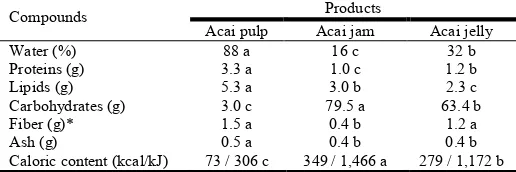
to the storage of the product. The amounts of protein were significantly different in the three acai products. It was observed 3.3, 1.00 and 1.2 g / 100 g of dry pulp, jam and jelly, respectively. The value found in this work for acai pulp is in accordance to the Ordinance n. 01 (Brasil, 2000), which recommends at least 6.0 g in 100 g dry matter of the product, corresponding to 0.72 g in 100 grams of wet weight and is close to the value determined by NEPA (2011) – 0.8 g / 100 g of frozen pulp. The highest concentration of protein in the pulp was due to the fact that the production of jam and jelly involves cooking, and the increase in temperature is responsible for the denaturation of proteins. The cooking time for making jelly is shorter than for making jam, which may explain the difference between the amounts of protein
observed in these products. According to Araújo et al. (2014),
the cooking process of fruits is fast, and they become softened and lose their shape, as a result of denaturation of proteins and consequent reduction of the permeability of cell membranes, allowing penetration of solutes such as sugar. It is possible to observe the significant difference in the content of lipids between the acai pulp and its products. 5.3 g/100 g was found in the acai pulp, while the values found in jam and jelly were 3.0 g/100 g and 2.3 g/100 g respectively. Similary, Menezes
and Guitini. (2008) found in E. oleraceae fruit pulp 5.5 g/100 g
of lipids. The value determined by NEPA (2011) is 3.9 g/100 g of fruit pulp. Sanabria and Sangronis (2007) obtained 4.0 g of lipids in 100 g of acai pulp. In a study on fatty acid
composition of acai, Nascimento et al. (2008) showed that acai
has a high content of unsaturated fatty acids 68-71%, placing this fruit in the classification of functional food, in preventing cardiovascular disease, besides being a high-caloric food
(Toaiari et al., 2005).
It is observed that the pulp has a much higher content of lipids than jam and jelly. This may occur because the processed products have large quantities of other components such as
sugar. Melo Neto et al. (2013) found close values in acai jelly,
ranging from 3.5 to 3.9 grams, prepared with different amounts of cocoa honey. Processes using thermal treatment accelerate the rate of chemical reaction in foods. The combination of heat, air, light, and moisture substantially alter the chemical properties of the food. During the cooking of jam and jelly the temperature is higher than 100°C (Araujo, 2008). The temperature elevation and cooking time may have been the reason for reducing the amount of lipids in these products. The carbohydrate content found in acai products in this study were 3.0, 79.5 and 63.4 g/100 g of pulp, jam and jelly, respectively. The values differ significantly, following an expected pattern – due to the addition of sugar in the proportions 1:1 for jam and 1:0.5 for jelly. Sugars do more than enhance sweetness – color, texture, capacity to retain water, viscosity and firmness of gelatin and pectin are some of the parameters influenced by the
presence of sugar (Araújo and Ramos, 2007). Fregonesi et al.
(2010) obtained 3.61g of carbohydrates in 100 grams of whole acai pulp. Sanabria and Sangronis (2007) observed 16.24
grams of carbohydrates in 100 grams of pure acai pulp. The amounts of fiber observed in acai products were 1.5, 0.4 and 1.2 grams in 100 grams of pulp, jam and jelly, respectively. In general, raw foods are significantly richer in fiber than cooked products because the heating leads to breaking down of the fiber (Pourchet-Campos, 1980; Ornellas, 2007). However, in the case of the jelly, the addition of pectin contributes to the content of fiber in the final product. The mentioned amounts of fiber are included in those values found for carbohydrate. The ash content found in 100 g of the acai pulp was 0.5 g, while the ash value found in jam and jelly was 0.40 g. NEPA (2011)
established in 100 g of frozen acai 0.30 g ash and Fragonesi et
al. (2010) found 0.4 g ash in 100 g of frozen pulp. These
values are similar to those found in the present study, but differ
from the amounts found by Aguiar (1996) and Pereira et al.
(2002), who found 1.00 g and 0.64 g of ash per 100 grams of pulp, respectively. In relation to the total energy value in 100 grams of acai products, the following results were found – 73 kcal or 306 kJ in pulp; 349 kcal or 1,466 kJ in jam; and 279
kcal or 1,172 kJ in jelly. Fregonesi et al. (2010) obtained 93.83
[image:3.595.304.562.467.553.2]kcal in 100 grams of whole acai pulp. Aguiar (1996) obtained 262 kcal per 100 grams of pure acai fruit. Considering the dilution of 3:1 in the manufacture of pulp, this value decreases to 63 kcal per 100 grams of pulp – a similar result to that found in this study. NEPA (2011) established 58 kcal for frozen acai pulp and 110 kcal for pulp of acai with guarana syrup and glucose. Considering a daily diet of 2,000 kcal for healthy adults, as recommended by the Ministry of Health (Brasil, 2003), the percentage of energy supplied per 100 grams of pulp, jam and jelly studied matches, respectively, 3.6%, 17.5% and 11.9% of total dietary energy (Daily Reference Values).
Table 1. Content of water, proteins, lipids, carbohydrates, fiber, ash, and caloric content per 100 grams of processed products of
acai
Compounds Products
Acai pulp Acai jam Acai jelly
Water (%) 88 a 16 c 32 b
Proteins (g) 3.3 a 1.0 c 1.2 b
Lipids (g) 5.3 a 3.0 b 2.3 c
Carbohydrates (g) 3.0 c 79.5 a 63.4 b
Fiber (g)* 1.5 a 0.4 b 1.2 a
Ash (g) 0.5 a 0.4 b 0.4 b
Caloric content (kcal/kJ) 73 / 306 c 349 / 1,466 a 279 / 1,172 b Averages with the same letter in the line indicate no significant difference between samples by Tukey test (p ≤ 0.05).
*Fiber values are included in carbohydrates values.
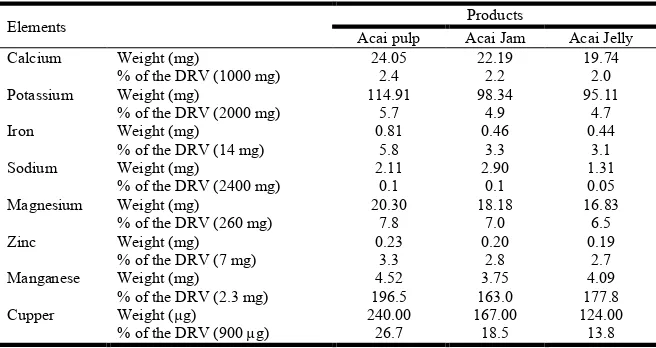
pulp and 2.2% of the DRV in acai jam and 2.0% in jelly. Thus, acai products studied in this research cannot be considered a source of calcium compared to foods rich in this mineral. Generally, the amounts of calcium in fruits and vegetables are minimal in comparison to milk, milk products, and oilseeds
(Yuyama et al., 1997). As for potassium, the acai pulp contains
5.7% of the DRV, and can be considered a food source of potassium, but the jam and jelly are not considered sources, for these products presented 4.9 and 4.8% of the DRV,
respectively. Melo Neto et al. (2013) found in different jellies
composed of acai and cacao honey values ranging from 1.51 to 1.54 g/100 g. Lehti (1993) found 74.9 mg/100 g in fruit of acai. NEPA (2011) determined for frozen acai pulp 124.0 mg of potassium per 100 grams. Sanabria and Sangronis (2007) found 362.0 mg of potassium per 100 grams of acai fruit.
Potassium is a mineral element widely distributed in in natura
food, since it is an essential constituent of the cells. However, its content is reduced about 60% during cooking (Yuyama
et al., 1997; Tramonte et al., 2016; Philippi et al., 2008). The
found iron concentrations were relatively low. The only product that had more than 5% of the DRV was acai pulp with 0.81 mg/100 g (5.8%). Sanabria and Sangronis (2007) found in the acai fruit 0.12 mg/100 grams. NEPA (2011) determined 0.4
mg of iron in the frozen pulp. Melo Neto et al. (2013) found
32.7 to 72.1 mg/100 g in different acai jelly formulations with cocoa honey. Iron is an important metal in the metabolism of all living organisms and exerts various physiological functions
(Cozzolino et al., 2008). Acai is popularly considered a
powerful source of iron, which is not really true. Researchers fed guinea pigs with acai and concluded that the high nutritional value of the fruit is energy and this is not related to
the iron content (Sangronis, 2006; Yuyama et al., 2002). It is
known that most of the iron present in acai is not bioavailable due to the presence of inhibitors of absorption such as tannins
and dietary fiber (Toaiari et al., 2005).
With regard to sodium, the values were extremely low. The highest value was observed in acai jam, 2.9 mg/100 g. In acai fruit, Lehti (1993) found 2.4 mg/100 g, Sanabria and Sangronis (2007) found 3.43 mg/100 g, and NEPA (2011) established 5.0 mg/100 g. The amounts described herein do not represent a problem because although there are minimum limits for sodium consumption, this mineral is usually consumed in excess, in the form of NaCl. This has become a health problem due to the role of sodium in high blood pressure, although it is
important in maintaining the cell osmotic pressure, the hydric
and acid-base balances of the body (Tramonte et al., 2016).
The concentrations of magnesium were 20.3, 18.2 and 16.8 mg/100 g of pulp, jam and jelly respectively. The three acai products studied are sources of magnesium with percentages from 6.5 to 7.8% of the DRV. In 100 g of acai fruit, Lehti (1993) found 18.2 mg of magnesium and Sanabria and Sangronis (2007) found 20.7 mg. NEPA (2011) determined the concentration of magnesium of 13.0 mg/100 g of frozen pulp.
Mg+2 is a cation of great importance in cellular biochemistry
because it is used as a cofactor or substrate in over 100 enzymatic reactions dependent of ATP (Mafra and Cozzolino, 2016). The zinc concentrations were low in the acai products. Fruit pulp had the highest concentration, 0.23 mg/100 g (3.2% of the DRV); jam and jelly contained 0.20 mg/100 g (2.8% of the DRV). Lehti (1993) found 0.30 mg/100 grams in acai fruit.
Melo Neto et al. (2013) found the value of 5.57 mg/100 g in
jam with cacao honey. Zinc is one of the essential trace
elements to human nutrition (Cozzolino et al., 2008). Among
the trace elements, zinc is the second most important to the human body, being a constituent of more than 300 metalloenzymes involved in the synthesis of carbohydrates, lipids, proteins and degradation of nucleic acids. It also participates as an enzyme cofactor, and plays a major role in regulating DNA transcription, cell division, and also stores and
releases insulin (Yuyama et al., 2007, Cozzolino et al., 2008).
The three acai products are excellent sources of manganese, with concentrations of 4.52, 3.75 and 4.09 mg/100 g in pulp, jam and jelly respectively (163.0 to 196.5% of the DRV). NEPA (2011) determined 6.2 mg/100 g for frozen pulp of acai and 3.3 mg/100 g for acai with guarana syrup and glucose. Manganese is important as a cofactor in enzymatic reactions and also in bone formation. It is a constituent of pyruvate carboxylase, important in carbohydrate metabolism and manganese superoxide dismutase, involved in antioxidant reactions. As well it participates in the metabolism of amino
acids, proteins and cholesterol (Silva et al., 2016; Cozzolino
et al., 2008). In relation to copper the concentrations were
240.0, 167.0 and 124.0 µg/100 g of pulp, jam and jelly respectively (26.7, 18.6 and 13.8% of the DRV). The pulp can be considered an excellent source of this mineral, while the other two preparations are good sources. Lehti (1993) observed 0.3 µg/100 g of acai fruit and NEPA (2011) determined 18 µg.
Melo Neto et al. (2013) found values ranging between 12.6
[image:4.595.132.460.86.260.2]and 17.6 µg of copper in jellies of acai with cacao honey.
Table 2. Amounts of Calcium, Potassium, Iron, Sodium, Magnesium, Zinc, Manganese, and Cupper per 100 grams of processed products of acai and percentages in relation to the Daily Reference Values (DRV)
Elements Products
Acai pulp Acai Jam Acai Jelly
Calcium Weight (mg) 24.05 22.19 19.74
% of the DRV (1000 mg) 2.4 2.2 2.0
Potassium Weight (mg) 114.91 98.34 95.11
% of the DRV (2000 mg) 5.7 4.9 4.7
Iron Weight (mg) 0.81 0.46 0.44
% of the DRV (14 mg) 5.8 3.3 3.1
Sodium Weight (mg) 2.11 2.90 1.31
% of the DRV (2400 mg) 0.1 0.1 0.05
Magnesium Weight (mg) 20.30 18.18 16.83
% of the DRV (260 mg) 7.8 7.0 6.5
Zinc Weight (mg) 0.23 0.20 0.19
% of the DRV (7 mg) 3.3 2.8 2.7
Manganese Weight (mg) 4.52 3.75 4.09
% of the DRV (2.3 mg) 196.5 163.0 177.8
Cupper Weight (µg) 240.00 167.00 124.00
According to Hashimoto et al. (2016), copper suffers loss in bioavailability during heat treatment due to the formation of compounds of the Maillard Reaction (amino sugars), which reduce the sites available to form bonds between metals and nitrogen, subsequently organometallic compounds of high bioavailability are decreased. In general, fruits are not considered good copper sources – this mineral is more
abundant in seafood, nuts, seeds and cocoa (Cozzolino, et al.,
2008). Copper has specific physiological functions because it is a constituent of enzymes with oxidizing and reducing activity, such as copper-zinc superoxide dismutase and cytochrome C oxidase, among others. Childhood is a critical period in terms of copper requirements, considering that the rapid growth increases the demands of this mineral (Hashimoto
et al, 2016; Cozzolino et al., 2008).
Conclusion
In general, the nutrient concentrations are higher in pulp than in jam and jelly of acai. This indicates that the processing, especially cooking, leads to loss of nutrients. An exception was observed for carbohydrates and energy content, because of the inherent addition of sugar in the production of jam and jelly.
Acknowledgement
This study was supported by CNPq (Conselho Nacional de Desenvolvimento Científico e Tecnológico – National Council for Scientific and Technological Development).
REFERENCES
Aguiar, G.F.S, 2006. Nutrição e adaptação humana em áreas de pesca na Amazônia: sugestões para políticas em saúde. Boletim Museu Paranaense Emílio Goeldi, 1(2): 129-138. Aguiar, J.P.L, 1996. Tabela de composição de alimentos da
Amazônia. Acta Amazonica. 26(1): 121-126.
Aguiar, J.P.L., H.A. Mainho, Y.S. Rabelo and R. Shrimpton, 1980. Aspectos nutritivos de alguns frutos da Amazônia, Acta Amazonica, 10(4): 755-758.
AOAC – Association Of Official Analytical Chemists. 1997. Official methods of analysis of the Associatios of Official Analytical Chemists. A.O.A.C. International. 16ª. ed. International Arlington: Gaithersburg, MD.
Araujo, L.M, 2007. Produção de Alimentos Funcionais
Formulados com Xilitol a Partir ae Cupuaçu (Theobroma
grandiflorum) e Maracujá (Passiflora edulis f. flavicarpa),
Ph. D. thesis, Univ. Federal Amazonas, Manaus, AM, Brazil.
Araujo, W.M.C., L.A Borgo, and H.M.C Araujo, 2014. Aspectos da química e da funcionalidade das substâncias químicas presentes nos alimentos, In: Alquimia dos alimentos, Eds., Araújo, W.M.C.; N.A. Montebello, R.B.A. Botelho, and L.A. Borgo, Brasília, DF: SENAC, pp. 89-178.
Brasil, 2000. Instrução Normativa N 01. Ministério da Agricultura e Abastecimento.
Brasil, 2015. Alimentos Regionais Brasileiros. Ministério da Saúde.
BRASIL. Ministério da Saúde. Agência Nacional de Vigilância Sanitária. Resolução de Diretoria Colegiada – RDC 360 de 22 de dezembro de 2003. Brasília-DF: Ministério da Saúde, 2003
Cozzolino, S.M.F., C. Cominetti and M.C. Bortoli, 2008. Grupo das Carnes e Ovos. In Pirâmide dos Alimentos –
Fundamentos Básicos da Nutrição, Ed., Phiplippi, S.T. Barueri, SP: Manole, pp: 167-210.
Fregonesi, B.M., C.E Yokosawa, I.A. Okada, G. Massafera, T M.B. Costa, and S.P. T Prado, 2010. Polpa de açaí congelada: características nutricionais, físico-químicas, microscópicas e avaliação da rotulagem. Revista do Instituto Adolfo Lutz, 69(3): 387-395.
Galotta, A.L.Q.A and Boaventura, M.A.D., 2005.
Constituintes Químicos da Raiz e do Talo da Folha do Açaí
(Euterpe precatória Mart., ARECACEAE). Revista
Química Nova, 28(4): 610-613.
Hashimoto, L.L., L.F.C. Pedrosa, C. Cominetti, S.M.F. Cozzolino and S.M. Franciscato, 2016. Cobre. In Biodisponibilidade de Nutrientes, Ed., Cozzolino, S.M.F. Barueri, SP: Manole, pp: 705-728.
IAL – Instituto Adolfo Lutz, 2008. In Métodos Físico-Químicos para Análise de Alimentos, Eds., Zenebon, O., N.S. Pascuet and P. Tiglea. São Paulo, SP: Instituto Adolfo Lutz, 1020 p.
LATINFOODS. 2002. Tabla de Composición de Alimentos de América Latina.
Leterme, P., A. Buldgen, F. Estrada and A.M. Londono, 2012. Mineral Content of Tropical Fruits an Unconventional Foods of the Andes and the Rain Forest of Colombia. Food Chemistry, 95: 644-652.
Lethi, K.K., 1993.Composição nutricional de alguns alimentos da Amazônia brasileira – resultados preliminares. Revista U.A. Série: Ciências da Saúde, 2(1-2): 139-147.
Mafra, D. and S.M.F. Cozzolino, Magnésio. 2016. In Magnesio: Biodisponibilidade de nutrients Ed., Cozzolino, S.M.F, Barueri, SP: Manole, pp.657-672.
Melo Neto, B.A., E.A. Carvalho, K.V. Pontes, W.S. Barretto and C.K. Sacramento, 2013. Chemical, physico-chemical
and sensory characterization of mixed açai (Euterpe
oleracea) and cocoa´s honey (Theobroma cacao) jellies.
Revista Brasileira de Fruticultura, 35(2): 587-593.
Menezes, E.W. and Guintini, E.B. 2008. In Fibras alimentares:
Pirâmide dos alimentos, fundamentos básicos da nutrição,
Ed., Phiplippi, S.T. Barueri-SP: Manole, 2008, pp.
341-362.
Naozuka, J. and Oliveira, P.V. 2007. Cu, Fe, Mn and Zn Distribution in Protein Fractions of Brazil-Nut, Cupuassu Seed and Coconut Pulp by Solid-Liquid Extraction and Electrothermal Atomic Absorption Spectrometry. Journal Brazilian Chemistry Society, 18(8):1547-1553.
NEPA – Núcleo de Estudos e Pesquisa em Alimentação, 2011. Tabela Brasileira de Composição Química dos Alimentos. Universidade Estadual de Campinas, SP, Brazil.
Pereira, E.A., A.J.M. Queiroz and R.M.F Figueiredo, 2002. Massa específica de polpa de açaí em função do teor de sólidos totais e da temperatura. Revista Brasileira de Engenharia Agrícola e Ambiental, 6(3): 526-530.
Philippi, S.T., 2008. Pirâmide dos Alimentos: Fundamentos Básicos da Nutrição, Ed., Philippi, S.T., Barueri, SP: Manole, pp: 03-29.
Portinho, J.A.; L.M. Zimmermann, and M.R. Bruck, 2012. Efeitos Benéficos do Açaí. International Journal of Nutrology, 5(1): 15-20.
Sanabria, N. and E. Sangronis, 2007. Caracterización del Açai
o Manaca (Euterpe olerácea Mart.): Un Fruto del
Amazonas. Venezuelano. Archivos Latinosamericanos de La Nutrición, 57(1): 94-99.
Venezuelano. Archivos Latinosamericanos de La Nutrición, 56(1): 77-82.
Santana, G.P. and J.A. Jesus, 2012. Estudo de Presentes na
Mauritia Flexuosa L. e Euterpe precatoria mart. da Região
do Polo Industrial de Manaus. Revista Scientia Amazonia, 1(1): 21-24.
Santos, G.F. and E. Salay, 2014. Afeto e percepção de riscos e benefícios à saúde de indivíduos em relação ao açaí, município de Coari, Amazonas. Acta Amazonica, 44(3): 329-334.
Schirmann, G.S., P.M. Rebollar, and P.R.M. Miller, 2009. Açaí na Dieta Brasileira: Tradições Regionais e Valor Nutricional. Embrapa, Brazil.
Silva, A.G.H., J.L.S. Donadio and S.M.F. Cozzolino, 2016. Magnesio. In Biodisponibilidade de Nutrientes, Ed., Cozzolino, S.M.F. Barueri, SP: Manole, pp: 851-872. Tirapegui, J. and R.R. Mendes, 2006. Introdução à Nutrição. In
Nutrição Fundamentos e Aspectos Atuais, Ed., Tirapegui, J. São Paulo: Atheneu, pp: 01-5.
Toaiari, S.D.A., L.K.O. Yuyama, J.P.L. Aguiar, and R.F.S.
Souza, 2005. Biodisponibilidade de Ferro do Açaí (Euterpe
oleraceae Mart.) e da Farinha de Mandioca Fortificada
Com Ferro em Ratos. Revista de Nutrição, 18(3): 291-299. Tramonte, V.L.C.G. K.R.A. Callou and S. M. F. Cozzolino,
2016. Sódio, Cloro, Potássio: Biodisponibilidade de Nutrientes. Ed., Cozzolino, S.M.F. Barueri, SP: Manole, p.p. 575-598.
Viana, E.S., R.C. Reis and C. K. Sacramento, 2012. Caracterização físico-química e sensorial de geleia de mamão com araçá-boi. Revista Brasileira de Fruticultura, 34(4): 1154-1164.
Vicenzi, R., 2008. Introdução a análise de alimentos.
Disponível em: <http://www.sinpro-rs.org.br/paginas
Pessoais/layout2/..%5Carquivos%5CProf_394%5CAPOST ILA%20DE%20AN%C3%81LISE%20DE%20ALIMENT OS.doc>. Acesso em 22 nov.2008
Yuyama, L.K.O., J.P.L. Aguiar, D.F. Silva Filho, K. Yuyama, M.J. Varejão, D.I.T. Fávaro, M.B.A. Vasconcelos, S.A. Pimentel and M.S.F. Caruso, 2011. Caracterização
Físico-Química do Suco de Açaí de Euterpe precatoria Mart.
Oriundo de Diferentes Ecossistemas Amazônicos. Acta Amazonica, 41(4): 545-552.
Yuyama, L.K.O., J.P.L. Aguiar, S.H.M. Macedo, T. Gioia, K. Yuyama, D.I.T. Favaro, C. Afonso, M.B.A. Vasconcelos and S.M.F. Cozzolino, 1997. Determinação dos Teores de Elementos Minerais em Alimentos Convencionais e Não Convencionais da Região Amazônica Pela Técnica de Análise por Ativação com Nêutrons Instrumental. Acta Amazonica, 27(3): 183-196.
Yuyama, L.K.O., R.D. Rosa, J.P.L. Aguiar, D. Nagahama, F.H. Alencar, K. Yuyama, G.W.O. Cordeiro, and H.O.
Marques, 2002. Açaí (Euterpe oleracea Mart.) e
Camu-camu (Myrciaia dubia (H.B.K.) McVaugh) Possuem Ação
Anti-anêmica?, 2002. Acta Amazonica, 32(4): 625-633.