CLOUD COMPUTING – ARCHITECTURE, FEATURES, SECURITY AND PRIVACY IN CLOUD
*,1
Shirisha B
1
Department of Computer Science and Engineering,
2Department of
ARTICLE INFO ABSTRACT
Cloud computing is the development of distributed computing, parallel
and virtualization technologies which define the shape of a new era. In this paper, we explore the concept of cloud architecture and compares cloud computing with grid computing
several challenges from the cloud com
interoperability issue that deserves substantial further research and development. Cloud computing is a completely internet dependent technology where client data is stored and maintain in the data ce a cloud provider. Limited control over the data may incur various security issues and threats. The challenges for adopting cloud computing such as well managed service level agreement, interoperability, privacy and reliability. This research paper
various cloud models and the main security risks and issues that are currently present within the cloud computing industry.
Copyright©2017, Shirisha Bethala and Pravallika Bethala
permits unrestricted use, distribution, and reproduction
INTRODUCTION
Cloud is a distributed as well as parallel computing system consisting of a collection of inter-connected and virtualised computers that are dynamically provisioned and presented as one or more unified computing resources based on service level agreements (SLA) established through negotiation between the service provider and consumers.”
of this technology, the cost of computation, hosting of an applications, content storage and delivery is reduced significantly (Grossman, 2009). Cloud comput
approach to experience direct cost benefits and it has the potential to transform a data center from a capital
up to a variable priced environment. The idea of cloud computing is based on a very fundamental principal of ‘reusability of IT capabilities' (A Platform Computing Whitepaper, 2010). Cloud computing is a model that enables convenient, on-demand network access to a shared pool of configurable computing resources such as networks, servers, storage, applications that can be rapidly provisioned and released with lesser management effort or service provider’s interaction.
*Corresponding author: Shirisha, B.
Department of Computer Science and Engineering, IARE, JNTUH
ISSN: 0975-833X
Vol.
Article History:
Received 02nd August, 2017
Received in revised form 16th September, 2017
Accepted 09th October, 2017 Published online 30th November, 2017
Citation: Shirisha Bethala and Pravallika Bethala,
of Current Research, 9, (11), 60387-60391.
Key words:
Cloud computing, Distributed computing, Grid Computing, Security Issues, Architecture, Challenges, Research issues.
RESEARCH ARTICLE
ARCHITECTURE, FEATURES, SECURITY AND PRIVACY IN CLOUD
Shirisha Bethala and
2Pravallika Bethala
Department of Computer Science and Engineering, CMRIT, JNTUH
Department of Information Technology, IARE, JNTUH
ABSTRACT
Cloud computing is the development of distributed computing, parallel
and virtualization technologies which define the shape of a new era. In this paper, we explore the concept of cloud architecture and compares cloud computing with grid computing
several challenges from the cloud computing adoption perspective and we also highlighted the interoperability issue that deserves substantial further research and development. Cloud computing is a completely internet dependent technology where client data is stored and maintain in the data ce a cloud provider. Limited control over the data may incur various security issues and threats. The challenges for adopting cloud computing such as well managed service level agreement, interoperability, privacy and reliability. This research paper outlines what cloud computing is, the various cloud models and the main security risks and issues that are currently present within the cloud computing industry.
Shirisha Bethala and Pravallika Bethala. This is an open access article distributed under the Creative in any medium, provided the original work is properly cited.
Cloud is a distributed as well as parallel computing system connected and virtualised computers that are dynamically provisioned and presented as one or more unified computing resources based on
service-(SLA) established through negotiation between the service provider and consumers.” With the advent of this technology, the cost of computation, hosting of an applications, content storage and delivery is reduced . Cloud computing is a practical approach to experience direct cost benefits and it has the potential to transform a data center from a capital-intensive set up to a variable priced environment. The idea of cloud computing is based on a very fundamental principal of A Platform Computing . Cloud computing is a model that enables demand network access to a shared pool of configurable computing resources such as networks, servers, an be rapidly provisioned and released with lesser management effort or service provider’s
Department of Computer Science and Engineering, IARE, JNTUH
Architectural components
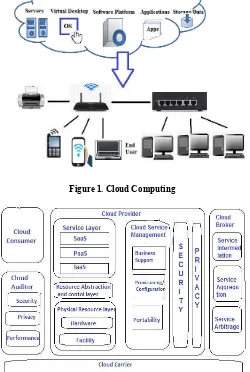
Cloud service models are classified into SaaS, PaaS, and IaaS that exhibited by a given cloud infrastructure. It’s helpful to add more structure to the service model stacks: Fig. 2 shows a cloud architecture (Torry Harris
important security-relevant cloud components explicit and provides an abstract overview of cloud computing for security issue analysis (Kandukuri et al.,
A.Cloud Computing entities
Cloud providers and consumers are the two main entities in the business market. But, service brokers and auditors are the two more emerging service level entities in the Cloud world. These are discussed as follows
1) Cloud Providers : A cloud provider
offers some component of
Infrastructure as a Service(IaaS), Software as a or Platform as aService (PaaS)
individuals. Cloud providers as cloud service providers (Buyya
2) Cloud Service Brokers: A cloud broker is a
individual or business that acts as an intermediary between the purchaser of a cloud computing
service. Service brokers concentrate on the negotiation of the International Journal of Current Research
Vol. 9, Issue, 11, pp.60387-60391, November, 2017
, 2017. “Cloud computing – Architecture, Features, Security and Privacy in cloud
ARCHITECTURE, FEATURES, SECURITY AND PRIVACY IN CLOUD
JNTUH
Cloud computing is the development of distributed computing, parallel computing, grid computing and virtualization technologies which define the shape of a new era. In this paper, we explore the concept of cloud architecture and compares cloud computing with grid computing. We identified puting adoption perspective and we also highlighted the interoperability issue that deserves substantial further research and development. Cloud computing is a completely internet dependent technology where client data is stored and maintain in the data center of a cloud provider. Limited control over the data may incur various security issues and threats. The challenges for adopting cloud computing such as well managed service level agreement, outlines what cloud computing is, the various cloud models and the main security risks and issues that are currently present within the cloud
Creative Commons Attribution License, which
Cloud service models are classified into SaaS, PaaS, and IaaS that exhibited by a given cloud infrastructure. It’s helpful to add more structure to the service model stacks: Fig. 2 shows a Torry Harris, 2009) that makes the relevant cloud components explicit and provides an abstract overview of cloud computing for security
., 2009).
Cloud providers and consumers are the two main entities in the But, service brokers and auditors are the two more emerging service level entities in the Cloud world. These
cloud provider is a company that offers some component of cloud computing – typically (IaaS), Software as a Service (SaaS) (PaaS) – to other businesses or are sometimes referred to Buyya et al., 2009).
A cloud broker is a third-party individual or business that acts as an intermediary between the cloud computing service and the sellers of that Service brokers concentrate on the negotiation of the
INTERNATIONAL JOURNAL OF CURRENT RESEARCH
relationships between consumers and providers without owning or managing the whole Cloud infrastructure.
3) Cloud Auditors: Auditors can become most significance
factor of the Cloud market when the Cloud providers will expand their business. Cloud providers (Mell and Grance, 2009) may choose local IT consultancy firms or auditors of their existing products to act as “auditors” for their Cloud-based products in a particular region.
Cloud Consumers: End users belong to the category of Cloud
[image:2.595.53.288.230.427.2]consumers. However, also Cloud service brokers and auditors can belong to this category as soon as they are customers of another Cloud provider, broker or reseller (Pring et al., 2009).
Figure 1. Cloud Computing
Fig. 2. Cloud Computing reference architecture
B.Service Models in Cloud
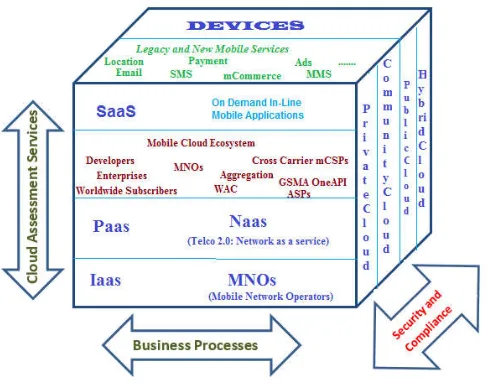
Software as a Service (SaaS): In SaaS model, a complete
application is offered to the customer, as a service on demand. A single instance of the service runs on the cloud & multiple end users are serviced (Pring et al., 2009). On the customer side, there is no need for upfront investment in servers and software licenses, while for the provider, the costs are lowered, since only a single application needs to be hosted, maintained. Today SaaS is offered by companies such as Google, Salesforce, Zoho, Microsoft etc.
Platform as a Service (Paas) : Here, a layer of software, or
development environment is encapsulated & offered as a service, upon which other higher levels of service can be built. The customer has the freedom to build his own applications, which run on the providers infrastructure. (Aman Bakshi and Yogesh B. Dujodwala, 2010) To meet manageability and scalability requirements of the applications, PaaS providers offer a predefined combination of OS and application servers, such as LAMP platform (Linux, Apache, MySql and PHP), restricted J2EE, Ruby etc. Google’s App Engine is one of the popular PaaS example.
1) Infrastructure as a Service (Iaas): IaaS provides basic
storage and computing capabilities as standardized services over the network. Servers, storage systems, data centre space, networking equipment etc. are combined and made available to handle workloads. The customer would typically deploy his own software on the infrastructure. Some common examples are GoGrid, 3 Tera, Amazon etc.
2) Network as a service (NaaS): NaaS provides the capability
to use the network services and inter-cloud network connectivity services. Improvement of possession allocation services include in view of network and computing resources. These type of services involved extensible, enhanced virtual private network (Feng-Tse Lin and Teng-San Shih, 2010).
Business-as-a-Service (BaaS): It's the service that will be
provided to the consumer in the form of an integrated set of transactional and collaborative activities to accomplish a specific organizational goal. Comprehensive business services (offered as SaaS) will be managed and monitored (as MaaS), run (as PaaS), orchestrated (as BPaaS) and hosted (as IaaS) – all in cloud. This concept of Business as a Service will allow end-users and partners to remotely run and monitor entire business verticals in the cloud (Hughes et al., 2010).
C. Deployment Models
Deploying cloud computing can differ depending on requirements, and the following four deployment models have been identified, each with specific characteristics that support the needs of the services and users of the clouds in particular ways.
1) Private Cloud — This infrastructure has been deployed,
maintained and operated for a specific organization. The operation may be in-house or with third party on the premises.
2) Community Cloud — This infrastructure shares a
number of organizations with similar interests and requirements. This help limit the capital expenditure costs for its establishment as the costs are shared among the organizations. The operation may be in-house or with third party on the premises.
3) Public Cloud — This infrastructure is available to public
on a commercial basis by a cloud service provider. This enables a consumer to develop and deploy a service in the cloud with little financial outlay compared to the capital expenditure requirements normally associated with other deployment options.
4) Hybrid Cloud — This infrastructure consists of a
number of clouds of any type, but the clouds have the ability through their interfaces to allow data and/or applications to be moved from one cloud to another.
[image:2.595.40.290.256.628.2](Adabala et al., 2005) This is a combination of private and public clouds that support the requirement to retain some data in an organization, and also the need to offer services in the cloud.
Fig. 3. Service and Deployment Models in Cloud
Roots of Cloud Computing
Cloud computing is development of parallel computing, distributed computing, grid computing, and is the combination and evolution of Utility computing.
Grid computing can be defined as the use of computer
resources from multiple administrative domains to reach a common goal. It is considered as a distributed system with non-interactive workloads involving a large number of files, yet more loosely coupled, heterogeneous, and geographically dispersed as compared to cluster computing. In its simplest form, grid computing may be represented as a “super virtual computer” composed of many networked loosely coupled computers acting together to perform humongous tasks (Broberg et al., 2008).
Utility computing involves the renting of computing resources
such as hardware, software and network bandwidth on an as-required, on-demand basis (Buyya and Venugopal, 2009). In other words, what were earlier considered products, are treated as services in utility computing.
Cloud Computing: Although both grid computing and utility
computing were precursors to cloud computing, nowadays they can be considered as implementations of the latter. Cloud computing does everything grid computing and utility computing do, and much more. For example, cloud computing is not restricted to specific network, but accessible through the biggest network of them all – the Internet. Also, virtualization of resources and its consequent advantages of scalability and reliability are much more pronounced in cloud computing. Note that utility computing can be implemented without cloud computing.
Features of a cloud
Some features of cloud are important to enable services that satisfy the expectations of customers, and satisfy the cloud offerings must be
1) Self-Service
Customers of cloud computing services expect on-demand, nearly instant access to resources. To support this expectation, clouds must allow self-service access so that customers can request, use and pay for the resources without intervention of human operators (Ambrust et al., 2009).
2) Per-Usage Metering and Billing
Cloud computing eliminates full commitment by users, allowing them to request and use only the necessary amount. Services must be priced on a short term basis (by the hour), allowing users to release (and not pay for) resources as soon as they are not needed (Ambrust et al., 2009). For this kind of reasons, cloud must implement features to allow efficient trading of service such as accounting, pricing and billing. Metering should be done consequently for different types of service (e.g., storage, processing, and bandwidth) and usage promptly reported, thus providing greater transparency (Squicciarini et al., 2010).
3) Elasticity
Cloud computing gives the belief of infinite computing resources available on demand (Hwang and Li, 2010). Therefore users expect clouds to rapidly provide resources in any quantity at any time. In particular, it is expected that the additional resources can be (a) provisioned, possibly automatically, when an application load increases and (b) released when load decreases (scale up and down).
4) Customization
In a multi-tenant cloud a great disparity between user needs is often the case. Thus, resources rented from the cloud can easily modify to suit for particular task. In the case of infrastructure services, customization means allowing users to deploy specialized virtual appliances and to be given restricted (root) access to the virtual servers. Other service classes (PaaS and SaaS) offer less flexibility and are not suitable for general-purpose computing (Hughes et al., 2010), but still are expected to provide a certain level of customization.
Security and Privacy
The top most concern that everybody agree as a challenge with cloud is security. The data security and privacy concerns ranks top on almost all of the surveys. Cloud computing introduces another level of threat because necessary services are often outsourced to a third party, making it harder to maintain data integrity and privacy, support data and service availability, and demonstrate compliance.
Real Benefits / Business Outcome – Though we have several
case studies showcasing the benefits arising out of implementing cloud technologies, some of the customers are still not convinced on the possible benefits. Their main concern is how to realize the investment to full potential and make cloud part of their mainstream IT Portfolio (Subashini and Kavitha, 2011).
Service Quality: Service quality is one of the biggest factors
Agreements (SLAs) provided by the cloud providers today are not sufficient to guarantee the requirements for running a production applications on cloud especially related to the availability, performance and scalability. In most cases, enterprises get refunded for the amount of time the service was down but most of the current SLAs down cover business loss. (Keahey et al., 2009)
1) Performance / Insufficient responsiveness over network:
Delivery of complex services through the network is clearly impossible if the network bandwidth is not adequate. Many of the organisations are waiting for improved bandwidth and lower costs before they consider moving into the cloud. Many cloud applications are still too bandwidth intensive.
Integration: Many applications have complex integration
needs to connect to other cloud applications as well as other on-premise applications. These include to integrate the cloud applications with existing enterprise applications and data structures. (Ronald L. Krutz and Russell Dean Vines, 2010) There is a need to connect the cloud application with the rest of the enterprise in a simple, quick and cost effective way.
Scope of Cloud computing
In Future, we are likely to see how low-power processors large quantity of workloads in the cloud, housed in highly automated datacenters and supporting massively federated, scalable software architecture.
Conclusion
In this paper we discussed the architecture and popular platforms of cloud computing. It also addressed challenges and issues of cloud computing in detail. In spite of the several confines and the need for better methodologies processes, cloud computing is becoming a hugely attractive paradigm, especially for large enterprises. Cloud Computing could affect the enterprises within two to three years as it has the potential to significantly change IT. Even though, cloud computing too has its pros and cons. While the technology can prove to be a great asset to any business / individuals, it could also cause harm if not understood and used properly. Virtual networks also target for some attacks particularly when communicating with remote virtual machines.
REFERENCES
A Platform Computing Whitepaper. 2010. “Enterprise Cloud Computing: Transforming IT.” Platform Computing, pp6. Adabala, S., V. Chadha, P. Chawla, R. Figueiredo, J. Fortes, I.
Krsul, A. Matsunaga, M. Tsugawa, J. Zhang, Mi. Zhao, L. Zhu, and X. Zhu. 2005. From virtualized resources to virtual computing Grids: the In-VIGO system. Future Generation Comp. Syst., 21(6):896–909.
Aman Bakshi, Yogesh B. Dujodwala, 2010. “Securing cloud from DDoS Attacks using Intrusion Detection System in Virtual Machine,” ICCSN ’10 Proceeding of the 2010 Second International Conference on Communication Software and networks, pp. 260-264, 2010, IEEE Computer Society, USA, ISBN: 978-0-7695-3961-4. Ambrust, M., A. Fox, R. Griffith, A. D. Joseph, R. Katz, A.
Konwinski, G. Lee, D.Patterson, A. Rabkin, I. Stoica, and M. Zaharia, 2009. Above the Clouds: A Berkeley View of Cloud Computing, UC Berkeley RAD Systems Labs.
Armbrust, M., A. Fox, R. Griffith, A. D. Joseph, and R. Katz, 2009. Above the Clouds: UC Berkeley Reliable Adaptive Distributed Systems Laboratory White Paper, A Berkeley View of Cloud Computing.
Armbrust, M., A. Fox, R. Griffith, A. Joseph, R. Katz, A. Konwinski, G. Lee, D.Patterson, A. Rabkin, I. Stoica, M. Zaharia. 2009. Above the Clouds: A Berkeley View of Cloud Computing. Technical Report No. UCB/EECS-2009-28, University of California at Berkley, USA.
Barham, P., B. Dragovic, K. Fraser, S. Hand, T. L. Harris, A. Ho, R. Neugebauer, I. Pratt and A. Warfield. 2003. Xen and the art of virtualization. In Proceedings of the 19th ACM.Symposium on OS Principles, pages 164–177, NewYork, U. S. A.
Bolchini, C., C. A. Curino, E. Quintarelli, F. A. 2007. Schreiber and L. Tanca, A dataoriented survey of context models, SIGMOD Record, 36(4):19_26.
Broberg, J., S. Venugopal, and R. Buyya, 2008. Market-oriented Grid and utility computing: The state-of-the-art and future directions, Journal of Grid Computing, 6:255-276.
Buyya R. and S. Venugopal, 2009. Market oriented computing and global Grids: An introduction, in Market Oriented Grid and Utility Computing, R. Buyya and K. Bubendorfer (eds.), John Wiley & Sons, Hoboken, NJ, pp. 2444.
Buyya, R., C. S. Yeo, S. Venugopal, I. Brandic and J. Broberg, 2009. Cloud computing and emerging IT platforms: Vision, hype, and reality for delivering computing as the 5th utility, Future Generation Computer Systems, 25:599616.
Feng-Tse Lin and Teng-San Shih, 2010. “Cloud Computing: The Emerging Computing Technology,” ICIC Express Letters Part B: Applications (ISSN: 2185-2766), v1, pp. 33-38.
Grossman, R. L. 2009. “The Case for Cloud Computing,” IT Professional, vol. 11(2), pp. 23-27, ISSN: 1520-9202. Hughes, G., D. Al-Jumeily and A. Hussain, 2010. “Supporting
Cloud Computing Management through an object Mapping Declarative Language”, Developments in E-systems engineering.
Hwang, K. and D. Li, 2010. “Trusted cloud computing with
secure resources and data coloring,” IEEE Internet
Computing, vol. 14, no. 5, pp. 14–22.
Kandukuri, B. R., R. Paturi V, A. Rakshit, 2009. “Cloud Security Issues”, In Proceedings of IEEE International Conference on Services Computing, pp. 517-520.
Keahey, K., I. Foster, T. Freeman, and X. Zhang, 2009. Virtual workspaces: Achieving Tim Mather, Subra Kumaraswamy, Shahed Latif, Cloud Security and Privacy: An Enterprise Perspective on Risks and Compliance, O’ Reilly Media, USA.
Mell P. and T. Grance, 2009. The NIST Definition of Cloud
Computing, National Institute of Standards and
Technology, Information Technology Laboratory,
Technical Report Version 15.
Pring et al. 2009. “Forecast: Sizing the cloud; understanding the opportunities in cloud services,” Gartner Inc., Tech. Rep. G00166525.
Ronald L. Krutz, Russell Dean Vines, 2010. “Cloud Security A Comprehensive Guide to Secure Cloud Computing”, Wiley Publishing, Inc., “Addressing cloud computing security issues” - Future Generation.
Squicciarini, A., S. Sundareswaran, and D. Lin, 2010. “Preventing information leakage fromindexing in the cloud,” in Proceedings of the 3rd IEEE International
Conference on Cloud Computing (CLOUD ’10), pp. 188– 195.
Subashini, S. and V. Kavitha, 2011. “Security
cloud computing”; Journal of Network and Computer
Applications, Vol. 34(1), pp 1–11, Academic united Press
Ltd., UK, ISSN: 1084-8045.
Torry Harris – “Cloud Computing – Overview”.