MODIFIED DYNAMIC SET POINT WEIGHTED CONTROLLER FOR VARIOUS
*
Florance
Department of Electronics and Instrumentation
ARTICLE INFO ABSTRACT
The property of
excessive oscillation and
and ZNPI exhibit equally poor load regulation. Dynamic set point weighted PI controller (DSPWPI) shows better response than FSPWPI and ZNPI but only for very low sampling period. Her online modified dynamic set
proposed modified dynamic set
processes shows a significant improvement and stable response for sampling period range.
Copyright © 2015 Florance Mary and Ananda Natarajan
permits unrestricted use, distribution, and reproduction in any medium, provided the original work is properly cited.
INTRODUCTION
Currently, more than half of the controllers used in industry are PID controllers. In the past, many of these controllers were analog. However, many of today's controllers use digital signals and computers. When a mathematical model of a system is available, the parameters of the controller can be explicitly determined. However, when a mathematical model is unavailable, the parameters must be determined experimentally. Controller tuning is the process of determining the controller parameters which produce the desired output. Controller tuning allows for optimization of a process and minimizes the error between the variable of the process and its set point. The Ziegler–Nichols tuning method
method of tuning a PID controller (Ziegler and Nichol
All books on process control have a chapter on tuning of PID controllers and a large number of papers have also appeared. However, performances of ZNPIs under both set
and load disturbance are not satisfactory for high processes due to excessive oscillation associated with a large overshoot and poor load regulation (Astrom and Haglund, 1995; Astrom and Hagglund, 2004; Astrom and Hagglund, 2001). The rules do, however, have severe drawbacks, since they use insufficient process information and the design criterion gives closed loop systems with poor robustness.
*Corresponding author: Florance Mary, M.
Department of Electronics and Instrumentation, Pondicherry Engineering College, Puducherry, India.
ISSN: 0975-833X
Article History:
Received 21st December, 2014
Received in revised form
04th January, 2015
Accepted 25th February, 2015
Published online 31st March,2015
Key words:
Modified DSPWPI, DSPWPI,
Sampling Period Selection
RESEARCH ARTICLE
MODIFIED DYNAMIC SET POINT WEIGHTED CONTROLLER FOR VARIOUS
SAMPLING PERIOD
Florance Mary, M. and Ananda Natarajan, R.
Instrumentation, Pondicherry Engineering College
ABSTRACT
The property of traditional Ziegler–Nichols tuned PI controllers (ZNPIs) are simple tuning rules with excessive oscillation and large overshoot. However, both the fixed set point weighted PI
and ZNPI exhibit equally poor load regulation. Dynamic set point weighted PI controller (DSPWPI) shows better response than FSPWPI and ZNPI but only for very low sampling period. Her online modified dynamic set-point weighting technique (MDSPWPI) is proposed. Performance of the proposed modified dynamic set-point weighting based PI controller (MDSPWPI) for various processes shows a significant improvement and stable response for
sampling period range.
Florance Mary and Ananda Natarajan. This is an open access article distributed under the Creative Commons Att use, distribution, and reproduction in any medium, provided the original work is properly cited.
Currently, more than half of the controllers used in industry are PID controllers. In the past, many of these controllers were analog. However, many of today's controllers use digital signals and computers. When a mathematical model of a e, the parameters of the controller can be explicitly determined. However, when a mathematical model is unavailable, the parameters must be determined experimentally. Controller tuning is the process of determining he desired output. Controller tuning allows for optimization of a process and minimizes the error between the variable of the process and its Nichols tuning method is a heuristic Ziegler and Nichols, 1942). All books on process control have a chapter on tuning of PID controllers and a large number of papers have also appeared. However, performances of ZNPIs under both set-point change and load disturbance are not satisfactory for high-order s due to excessive oscillation associated with a large Astrom and Haglund, 1995; Astrom and Hagglund, 2004; Astrom and Hagglund, The rules do, however, have severe drawbacks, since formation and the design criterion gives closed loop systems with poor robustness.
Pondicherry
Many studies in the literature also indicate that by approach for the fractional order proportional
derivative controller (FO-PID) design can be used for the unstable first order time delay system. The controller design is based on the system time delay
Akbar Jalali, 2011). The dynamic set (βd) for dynamic set point weighted PI
is heuristically derived from the instantaneous process trend. The Performance of the dynamic set
controller (DSPWPI) does not show good results for the sampling range specified by control theory
Levine, 1995). The Performance of the proposed modified dynamic set-point weighting based PI controller (MDSPW shows better results than PI and DSPWPI for allowable sampling period range. In this work, the performance of the PI controller with modified dynamic set
(MDSPWPI) is proposed and tested for various process and the value of the tuning parameter γ is also proposed. Performance comparison shows that our proposed technique is capable of providing satisfactory response for various process models at all allowable sampling period.
Rest of the paper is organized as follows
Section 2 describes the structure of the proposed Modified dynamic set point weighting based PI controller. Simulation study on various process models is given in Section 3. Conclusions are drawn in the final Section 4.
International Journal of Current Research
Vol. 7, Issue, 03, pp.13796-13803, March, 2015
MODIFIED DYNAMIC SET POINT WEIGHTED CONTROLLER FOR VARIOUS
College, Puducherry, India
Nichols tuned PI controllers (ZNPIs) are simple tuning rules with large overshoot. However, both the fixed set point weighted PI ( FSWPI) and ZNPI exhibit equally poor load regulation. Dynamic set point weighted PI controller (DSPWPI) shows better response than FSPWPI and ZNPI but only for very low sampling period. Here, an point weighting technique (MDSPWPI) is proposed. Performance of the point weighting based PI controller (MDSPWPI) for various processes shows a significant improvement and stable response for set point change at allowable
is an open access article distributed under the Creative Commons Attribution License, which
Many studies in the literature also indicate that by a numerical approach for the fractional order
proportional-integral-PID) design can be used for the unstable first order time delay system. The controller design is system time delay (Hamideh Hamidian and Ali The dynamic set-point weighting factor ) for dynamic set point weighted PI (Rajani and Mudi, 2011) is heuristically derived from the instantaneous process trend. namic set-point weighting based PI controller (DSPWPI) does not show good results for the sampling range specified by control theory (William and . The Performance of the proposed modified point weighting based PI controller (MDSPWPI) shows better results than PI and DSPWPI for allowable In this work, the performance of the PI controller with modified dynamic set-point weighting (MDSPWPI) is proposed and tested for various process and the arameter γ is also proposed. Performance comparison shows that our proposed technique is capable of providing satisfactory response for various process models at
e paper is organized as follows
Section 2 describes the structure of the proposed Modified dynamic set point weighting based PI controller. Simulation study on various process models is given in Section 3. Conclusions are drawn in the final Section 4.
Modified Dynamic Set-Point Weighting Method
The block diagram of the proposed MDSPWPI is shown in Fig. 1. The weighted set point for the proportional action is calculated online by the dynamic weighting factor βd based on
error change. When the output of the process is trying to move towards its set point, proportional action should be reduced to prevent possibly large overshoot, on the other hand, when the process is moving away from the set point, proportional action should be increased to restrict such deviations, for the process output to reach its desired value at the earliest. Hence the dynamic set point weighting factor βd is made proportional to
instantaneous change in error as shown in equation (1) and (3).
……… (1)
………. (2)
……… (3)
Where ( ) is the dynamic weighting factor, respectively at kth instant. is the proposed tuning parameter, is the normalized dead time of the process and fn stands for the function of. Here, we propose the tuning of γ, which is developed through an simulation study on a wide range of processes. Here, γ is a function of Kp, Ku and Tu where Ku and Tu are the ultimate gain and ultimate period and Kp is
process gain respectively. ∆ ( ) is the change of error at kth instant.
Simulation Studies
The proposed MDSPWPI is tested through simulation experiments on different types of process models for verification.
The model considered are higher order integrating process, Second-order marginally stable process, second-order linear process and first order process.
Higher order integrating process
We observed the performance of MDSPWPI for a unity feedback system of
( ) =
( ( )()) ………... (4)
The value for γ is 0.6118 for this process. The frequency response of this system shows a gain cross over frequency of
= 1.572 . As per the rule, given in (William, 1995),
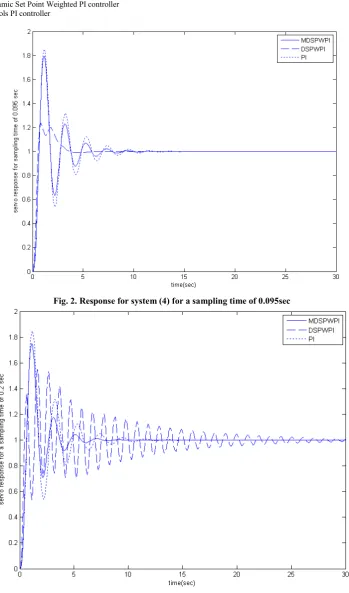
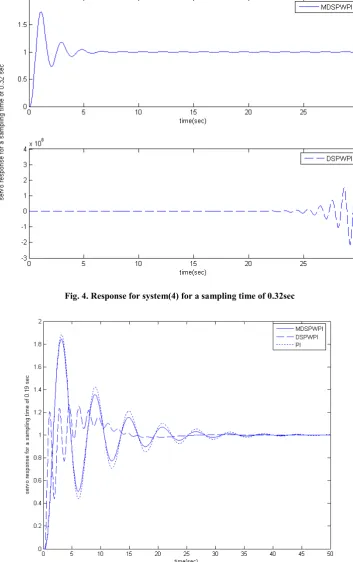
(Åström and Wittenmark, 1987) the sample period range is 0.095 to 0.32. The system is tested for different controllers in this range and was found that DSPWPI has an increased oscillation as the sampling period increases and becomes unstable. Performance of the system is shown in Fig. 2 to Fig. 4. Its performance analysis for different controllers is presented in Table 1. Here, it is found that DSPWPI is not suitable for the allowable sampling range.
When compares with conventional PI, proposed MDSPWPI has less overshoot. This comparison is also shown in Table 1.
Second-order marginally stable process
Transfer function of the second-order marginally stable process is
[image:2.595.107.464.219.432.2]Table 1. Performance Analysis for set point change of the process in (4)
SAMPLING TIME IN SEC ZNPI DSPWPI PROPOSED
MDSPWPI
% OVERSHOOT
IAE ISE IAE ISE IAE ISE PI MDSPWPI
0.095 0.2 0.32
1.892 1.892 1.892
0.9542 0.9542 0.9542
0.9321 11.44 1.48
1.127 11.42 8.77
1.568 1.397 1.43
0.8321 0.7988 0.8584
85.5 85.5 85.5
79.5 75.5 74.2 MDSPWPI – Modified Dynamic Set Point Weighted PI controller
[image:3.595.112.462.161.755.2]DSPWPI – Dynamic Set Point Weighted PI controller PI- Zeigler Nichols PI controller
Fig. 2. Response for system (4) for a sampling time of 0.095sec
The value for γ is 0.2696 for this process. The frequency response of this system shows a gain cross over frequency of
= 0.786 . As per the rule given in (William,
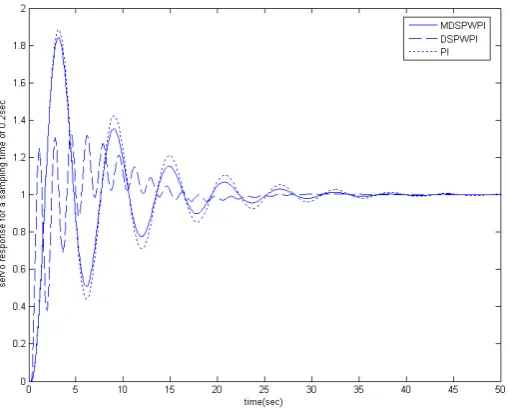
1995),(Åström and Wittenmark, 1987), the sample period range is 0.1908 to 0.6361. The system is tested for different controllers in this range and was found that DSPWPI has an increased oscillation as the sampling period increases and becomes unstable.
[image:4.595.104.463.54.340.2]Performance of the system is shown in Fig. 5 to Fig. 7. Its performance analysis for different controllers is presented in Table 2. Here, it is found that DSPWPI is not suitable for the allowable sampling range. When compared with conventional PI, proposed MDSPWPI has less overshoot. This comparison is also shown in Table 2.
Fig. 4. Response for system(4) for a sampling time of 0.32sec
[image:4.595.101.455.63.626.2] [image:4.595.125.438.369.629.2]Table 2. Performance Analysis for set point change of the process in (5)
SAMPLING TIME IN SEC ZNPI DSPWPI PROPOSED MDSPWPI % OVERSHOOT
IAE ISE IAE ISE IAE ISE PI MDSPWPI
0.1908 0.2 0.4 0.6361
6.58 6.58 6.58 6.58
3.141 3.141 3.141 3.141
14.04 19.72 1.389 9.32
42.5 57.77 9.86 5.066
5.676 5.637 5.027 4.663
2.775 2.759 2.56 2.499
88.5 88.5 88.5 88.5
84.4 84 81 78.7
MDSPWPI – Modified Dynamic Set Point Weighted PI controller DSPWPI – Dynamic Set Point Weighted PI controller
[image:5.595.171.426.187.392.2]PI- Zeigler Nichols PI controller
Fig. 6. Response for system(5) for a sampling time of 0.2sec
Fig. 7. Response for system(5) for a sampling time of 0.6361sec
Table 3. Performance Analysis for set point change of the process in (6)
SAMPLING TIME IN SEC ZNPI DSPWPI PROPOSED MDSPWPI % OVERSHOOT
IAE ISE IAE ISE IAE ISE PI MDSPWPI
0.1998 0.5 1 1.3320
1.256 1.256 1.256 1.256
0.4046 0.4046 0.4046 0.4046
2.631 55.15 22.4 17.62
8.539 192.1 58.51 24.9
1.204 1.175 1.279 1.384
0.5934 0.6082 0.6868 0.6826
26.1 26.1 26.1 26.1
24.5 22.7 23.5 25
MDSPWPI – Modified Dynamic Set Point Weighted PI controller DSPWPI – Dynamic Set Point Weighted PI controller
[image:5.595.166.425.424.632.2] [image:5.595.73.516.681.750.2]Table 4. Performance Analysis for set point change of the process in (7)
SAMPLING TIME IN SEC ZNPI DSPWPI PROPOSED MDSPWPI % OVERSHOOT
IAE ISE IAE ISE IAE ISE PI MDSPWPI
0.418 1 2.5
0.9518 0.9518 0.9518
[
0.524 0.524 0.524
3.917 6.536 9.155
6.425 7.502 9.617
0.9415 1.056 1.258
0.560 0.6217 0.6467
15.2 15.2 15.2
13.5 9.7 12.6
MDSPWPI – Modified Dynamic Set Point Weighted PI controller DSPWPI – Dynamic Set Point Weighted PI controller
[image:6.595.124.471.171.469.2]PI- Zeigler Nichols PI controller
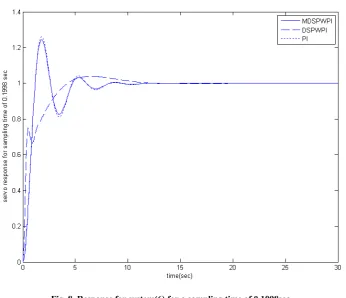
Fig. 8. Response for system(6) for a sampling time of 0.1998sec
[image:6.595.122.475.484.764.2]Second-order linear process
A second-order linear process is expressed by the following transfer function:
( ) =
.( . ) ……….. (6)
[image:7.595.127.465.65.337.2] [image:7.595.125.466.65.639.2]The value for γ is 0.2532 for this process. As per the rule specified in (William, 1995) based on the damping ratio and rise time, the sampling period range is 0.1998 to 1.332. Performance of the system is shown in Fig. 8 and Fig. 9. Its performance analysis for different controllers is presented in Table 3. Here, it is found that proposed MDSPWPI gives better response than ZNPI and MDSPWPI at all allowable sampling period.
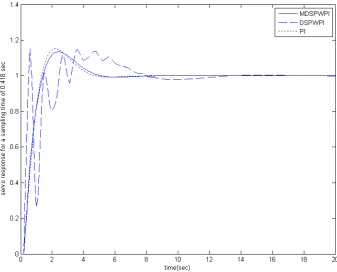
Fig.10. Response for system (7) for a sampling time of 0.418sec
[image:7.595.136.464.352.628.2]Here, as the sampling period is increased the oscillation increases for DSPWPI with high ISE and IAE values. The performance analysis shows that for the allowable range, proposed MDSPWPI shows comparatively less overshoot than conventional PI.
First order linear process
A second-order linear process is expressed by the following transfer function:
( ) =
( ) ………... (7)
The value for γ is 0.4264 for this process. As per the rule specified in (William, 1995) based on the time constant and rise time, the sampling period range is 0.4180 to 2.508. Performance of the system is shown in Fig. 10 to Fig 12. Its performance analysis for different controllers is presented in Table 4. Here, it is found that proposed MDSPWPI gives better response than ZNPI and MDSPWPI at all allowable sampling period. Here, as the sampling period is increased the oscillation increases for DSPWPI with high ISE and IAE values. The performance analysis shows that for the allowable range, proposed MDSPWPI shows comparatively less overshoot than conventional PI.
Conclusion
A new dimension to dynamic set point weighted PI controller is presented. The performance of the PI controller with proposed modified dynamic set-point weighting (DSPWPI) is tested for wide range of process and the value for the tuning parameter γ is also proposed.
The results demonstrate the better performance of the proposed modified dynamic set point weighted PI control scheme used in this paper compared with Ziegler Nichols PI controller and dynamic set point weighted controller for all allowable sampling period with less overshoot and less oscillation.
REFERENCES
Astrom, K.J. and Hagglund, T. 2001. The future of PID control, Control Engineering Practice 9 1163–1175. Astrom, K.J. and Hagglund, T. 2004. "Revisiting the Ziegler–
Nichols step response method for PID control", Journal of
Process Control, 14 635–650.
Astrom, K.J. and Haglund, T. 1995. “PID Controller: Theory, Design and Tuning”, 2nded.Research Tringle park, NC: Instrum.Soc.Amer.
Åström, K.J. and Wittenmark, B. 1987. Computer Controlled system, Prentice Hall,Englewood Chiffs, N.J.
Hamideh Hamidian and Ali Akbar Jalali, March-2011. Calculation of PID Controller Parameters for Unstable First Order Time Delay Systems, International Journal of
Scientific and Engineering Research, Volume 2, Issue 3.
Rajani, K., Mudi, Chanchal Dey, B. 2011. Performance improvement of PI controllers through dynamic set-point weighting, ISA Transactions 50 220–230.
William, S. Levine, 1995. The control handbook, CRC press and IEEE press, Pg 313-320.
Ziegler, J.G. and Nichols, N.B. 1942. Optimum settings for automatic controllers, Trans. ASME 64 759–768.
[image:8.595.127.464.57.330.2]