ISSN Print: 2327-5219
DOI: 10.4236/jcc.2018.611022 Nov. 27, 2018 227 Journal of Computer and Communications
Towards a Categorical Framework for
Verifying Design and Implementation of
Concurrent Systems
Ming Zhu, Jing Li
College of Computer Science and Technology, Shandong University of Technology, Zibo, China
Abstract
Process-oriented design and implementation of concurrent systems has im-portant benefits. However, the inherent complexity of concurrent processes’ communication imposes challenges such as verifying consistency between the process-oriented design and implementation of a concurrent system. To deal with such a challenge, we use Galois connections, Failures and Category Theory to construct a formal framework for designing, implementing, ana-lyzing and verifying consistency of concurrent systems. For the purpose of il-lustrating the framework, a running concurrent system is designed by Com-municating Sequential Processes, implemented by a process-oriented pro-gramming language Erasmus.
Keywords
Concurrent System, Verification, CSP, Process-Oriented Programming, Abstraction, Category Theory
1. Introduction
A concurrent system involves several executing components. Such a system usually allows carrying out multiple tasks at the same time, which can speed up the computational work of software substantially. As traditional means to con-currency conflict with assumptions of human intuition for sequential program-ming, process-oriented approach is a necessary concept for designing and im-plementing software systems [1]. This approach is founded on process algebra, which considers a concurrent system as a set of interacting processes with messag-es passing through channels [1] [2]. It has been considered that process-oriented design and implementation could provide systems with known safety properties
How to cite this paper: Zhu, M. and Li, J. (2018) Towards a Categorical Framework for Verifying Design and Implementation of Concurrent Systems. Journal of Com-puter and Communications, 6, 227-246. https://doi.org/10.4236/jcc.2018.611022
Received: October 26, 2018 Accepted: November 24, 2018 Published: November 27, 2018
Copyright © 2018 by authors and Scientific Research Publishing Inc. This work is licensed under the Creative Commons Attribution International License (CC BY 4.0).
DOI: 10.4236/jcc.2018.611022 228 Journal of Computer and Communications
to prevent deadlock, livelock, process starvation [1]. Concurrent systems devel-oped by process-oriented approach are able to be efficiently distributed across multiple processors and clusters of machines [2].
However, design and implementation are usually at different levels of abstrac-tion in Software development process. It is challenging to incorporate knowledge and experience to control the consistency between these phases in developing concurrent systems [3]. Especially, when many processes communicate simulta-neously, a concurrent system may exhibit a large number of different behaviors. Inconsistencies arising would bring errors to the production of concurrent sys-tems [4], which would be fatal to the systems in areas with non-tolerance of fail-ure. To deal with such a challenge, verification plays a crucial role in reducing, or even preventing, the introduction of errors in design and implementation of a concurrent system [5]. Research [6] [7] used category theory, dataflow and Traces in Communicating Sequential Processes (CSP) to explore approaches that may address the challenge. This paper is based on Category Theory, Galois con-nections and Failures in CSP. The aim of this paper is to provide a categorical framework for formally verifying consistency of communications between process-oriented design and implementation of concurrent systems.
The rest of the paper is organized as follows. Section 2 provides some back-ground and related work on the process algebra CSP, the process-oriented pro-gramming language Erasmus, Galois connections in abstract interpretation, and category theory. In this paper, CSP is used to design and analyze concurrent sys-tems; Erasmus is a CSP-based process-oriented programming language for im-plementing concurrent systems; Galois connections are used to build abstract semantics from concurrent systems, and category theory provides the founda-tion for verificafounda-tion. In Secfounda-tion 3, the categorical framework is proposed to for-mally design and implement concurrent systems, and verify consistency of communications between design and implementation. Specifically, the frame-work is illustrated on a running example from Section 4 to Section 10. Section 11 concludes the paper and suggests directions for future research work.
2. Background and Related Work
In this section, background and work related to our research are introduced.
2.1. Communicating Sequential Processes
Process algebra has been developed to model concurrent systems by describing algebras of communicating processes [8]. CSP is a process algebra that formally models concurrent systems by events [9] [10], which might alleviate the problem of state-space explosion caused by modeling states [11]. CSP has been widely used to specify, design and implement concurrent systems [12]. In CSP, a process is defined as (alphabet, failures, divergences) [9] [10]:
• alphabet: A set of all events a process may engage in,
DOI: 10.4236/jcc.2018.611022 229 Journal of Computer and Communications
event from the set of events X occurs, the process would stop,
• divergences: A divergence (s, D) denotes, after engaged in a trace of events s,
if any event from the set of events D occurs, the process would become chaos. Processes can be assembled together as a system, where they can interact with each other through channels. Such interactions are called communications, which are synchronized. If one process needs to communicate to another process, a channel is required between them to receive the input of messages and pass the output of messages. To describe the semantics of CSP, several rules are defined for calculating failures and divergences of a single process (P), a se-quences of processes (P; Q), determinism (P □ Q), nondeterminism (P ΠQ) and communications (P || Q) [9] [10], where P and Q are processes.
2.2. Erasmus
Process-oriented programming is predicted to be the next programming para-digm [1] [13] [14]. The basis of process-oriented programming is process alge-bra [2]. Erasmus is one of process-oriented programming languages, which is based on the idea of CSP but with some differences [13] [15] [16]. An Erasmus program consists of cells, processes, ports, protocols and channels. A cell, con-taining a collection of one or more processes or cells, provides the structuring mechanism for an Erasmus program. A process is a self-contained entity which performs computations, and communicates with other processes through its ports. A port, which is of a type of protocol, usually serves as an interface of a process for sending and receiving messages. A protocol specifies the type and the orderings of messages that can be sent and received by ports of the type of this protocol. A channel, which is of a type of protocol, must be built between two ports for two processes to communicate. Erasmus also offers operations for de-terministic choices and nondede-terministic choices by using keywords select and case respectively.
In Erasmus, communication is as important as method invocation in ob-ject-oriented languages. The requirements of communications between two processes p1 and p2 are:
• p1 must have a port, π1, which is of protocol t1, • p2 must have a port, π2, which is of protocol t2,
• Each protocol may contain several different types of requests, which specifies
the types of requests the port can send or receive,
• There exists a channel, x, which is defined with either protocol t1 or t2. A
channel has two ends, one is channel in for receiving incoming request and the other is channel out for sending outgoing request,
• Requests are sent by a process through its client port (declared with “−”), then received at channel in of a channel and sent out by channel out of the channel, and finally received by the other process at the server port (declared with “+”),
DOI: 10.4236/jcc.2018.611022 230 Journal of Computer and Communications
and π2 can communicate, t2 must satisfy t1. Here, t2 satisfies t1 is defined as
that the set of types of requests of t1 must be a subset of the set of types of
requests of t2.
Some research is proposed to study communications in Erasmus, which in-cludes constructing a fair protocol that allows arbitrary, nondeterministic com-munication between processes [17], describing an alternative construct that al-lows a process to nondeterministcally choose between possible communications on several channels [18], and building a static analyzer to detect communication errors between processes [19]. In this paper, we are exploring an approach to ve-rify consistency of communications between design and implementation of concurrent systems developed by Erasmus.
2.3. Galois Connection in Abstraction Interpretation
Abstraction interpretation is a method for gathering information about the be-havior of the program from abstract semantics of the program instead of con-crete semantics of the program [20]. It uses Galois connections to build rela-tionships between concrete and abstract semantics with providing sound an-swers to questions about the behaviors of the programs [21]. Specifically, Galois connection is a relation between two partially ordered sets in order theory [20]. Given 〈C, ⊑〉 and 〈A, ≼〉 are two partially ordered sets, and two monotone func-tions α: C → A and γ: A → C. Then (α; γ) is a Galois connection of C and A if and only if for all x ∊ A and y ∊ C, α(x) ⊑ y ≡ x ≼ γ(y).
As concurrent systems usually have a large number of different behaviors, di-rectly analyzing such systems might be difficult [22]. Using Galois connection in abstraction interpretation, the concurrent systems could be simplified as abstract models with retaining some of the properties of the systems [22]. For concurrent systems developed by Erasmus, Galois connection is exploited to build abstract semantics of systems in terms of event order vector [19] [22]. In our research, Galois connection is used to construct abstract implementation.
2.4. Category Theory
Due to its abstractness and generality, category theory has led to its use as a conceptual framework in many areas of computer science [23] and software en-gineering [24]. It is suggested that category theory can be helpful towards disco-vering and verifying connections in different areas, while preserving structures in those areas [25]. In software engineering, category theory is proposed as an approach to formalizing refinement from design to implementation that are at different level of abstraction [24] [26]. Specifically, for modeling concurrency, category theory is used to model, analyze, and compare Transition System, Trace Language, Event Structure, Petri nets, and other classical models of concurrency
speci-DOI: 10.4236/jcc.2018.611022 231 Journal of Computer and Communications
fication, design and implementation of Reactive Autonomic System (RAS) [31]. As there is no such kind of framework for process-oriented design and imple-mentation, we propose the categorical framework that is inspired from the con-cept of RASF. To understand this paper, some of the categorical constructs are listed below:
• A category consists of objects and morphisms. A morphism f: A → B has
ob-ject A as its domain and object B as its codomain, respectively. If there are morphisms f: A → B and g: B → C, then there is also a morphism g ◦ f: A → C
called their composition. Composition is associative: (h ◦ g) ◦ f = h ◦ (g ◦ f). Every object X has an identity morphism IdX. For every morphism f: A → B, IdB◦f = f = f◦IdA.
• A functor F: C → D maps each object of category C onto a corresponding
ob-ject of category D, and maps each morphism of category C onto a corres-ponding morphism of category D, with preserving structure and composi-tion.
3. The Categorical Framework
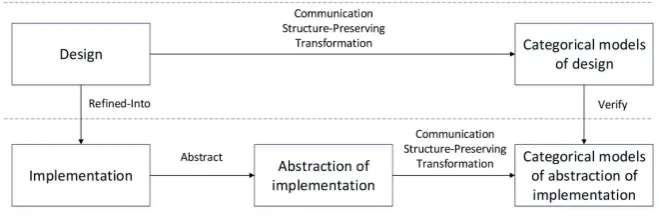
In this research, we propose the categorical framework to verify the consistency of communications between design and implementation (see Figure 1).
To build the framework, the necessary steps are listed below:
• Designing: design concurrent systems by CSP, and analyze processes and communications by failures in CSP.
• Implementing: implement concurrent systems by Erasmus with refining the
design,
• Abstracting: abstract processes and communications out of implementation
with Galois Connection, and analyze them by failures in Erasmus,
• Categorizing Design: construct categorical models of design with preserving
structures of communications,
• Categorizing Abstraction of Implementation: construct categorical models of
abstraction of implementation with preserving structures of communica-tions, and
• Verifying: construct functors to verify categorical models from design against
categorical models from implementation.
To present our research activities, a vending machine example is created to il-lustrate the framework.
4. Specification of a Vending Machine Example
DOI: 10.4236/jcc.2018.611022 232 Journal of Computer and Communications
Figure 1. The categorical framework.
Figure 2. The vending machine example.
In the following sections, we verify the design and implementation of this example according to the steps specified in the proposed framework.
5. Designing
This section introduces how to design and analyze processes and communica-tions from the specification of the example. Firstly, the approach to describing processes and communications in CSP is described. Secondly, details related to modeling and analyzing the example are presented.
5.1. Describing Processes and Communications
In CSP, a process can be represented as (alphabet, failures, divergences), along with several rules for calculating failures and divergences [9] [10]. In our re-search, processes are assumed not to become chaos, so neither divergences nor chaos is discussed. A process in design is described as (alphabet, failures). Processes can communicate with each other in parallel operation ||. To generate and analyze failures, the following rules are used for our research based on CSP.
1) Let P be a process, and let a be an event occurring before P. There is a → P
with the failures FLS(a → P) = {(〈〉, X)|a ∉X} ∪ {(〈a〉⌒s, Y)|(s, Y) ∊ FLS(P)}. It
means that if event a doesn’t occur first, any other event in the set of events X
would cause a → P stops; if event a occurs first, and then the failures FLS(a → P) depend on FLS(P) = {(s, Y)}. Function FLS() calculates the failures of a processes. This rule is as same as the corresponding rule in CSP [9]. FLS() represent the set of failures of a process.
2) Let P and Q be two processes, and let P execute before Q. There is P; Q with the failures FLS(P; Q) = {(s, X)|(s, X) ∊ FLS(P)} ∪ {(ss⌒t, Y)|ss
∊ STRCS(P) ⋀ (t,
DOI: 10.4236/jcc.2018.611022 233 Journal of Computer and Communications
execution with trace ss successfully, the failures FLS(P; Q) depend on FLS(Q). STRCS(P) represents a set of all the longest traces of events the process P en-gaged in when it finished execution successfully.
3) Let P be a process iterating n times in a loop, and let Pi represent P in the ith iteration. There is P1; …; Pnwith the failures FLS(P1; …; Pn) = {(s, X) | (s, X) ∊
FLS(P)}∪{(s1⌒s, X)|s1∊ STRCS(P) ⋀ (s, X) ∊ FLS(P)}∪… ∪{(s1⌒s2⌒…⌒sn−1⌒s, X)|si∊ STRCS(P) 〈〉 1 ≤ i ≤ n − 1 ⋀ (s, X) ∊ FLS(P)}. This rule is derived from
FLS(P; Q). It means that if P iterates once, the failures FLS(P1; …; Pn) become
FLS(P); if P iterates twice, P accomplishes its execution in the first iteration suc-cessfully with trace s1, and then the failures FLS(P1; …; Pn) depends on the
fail-ures FLS(P) in the second iteration; if P iterates n times, and P accomplishes its execution from 1st iteration to (n − 1)th iteration successfully with trace
s1⌒s2⌒…⌒sn−1, and then the failures FLS(P1; …; Pn) depend on the failures FLS(P)
in the nth iteration.
4) Let P and Q be two processes executing nondeterministically. There is P Π Q with the failures FLS(P ΠQ) = FLS(P)∪FLS(Q). Due to the nondeterminism, even though the event offered by environment satisfies P or Q, P or Q still may not execute. Thus, FLS(P ΠQ) depends on either FLS(P) or FLS(Q), which is as same as the corresponding rule in CSP [9].
5) Let P and Q be two processes executing deterministically. There is P □ Q
with the failures FLS(P □ Q) = {(s, X)|(s = 〈〉 ⋀ (s, X) ∊ FLS(P)∩FLS(Q)) ⋁ (s ≠
〈〉 ⋀ (s, X) ∊ FLS(P)∪FLS(Q))}. When both processes P and Q wait for the
oc-currence of the first event, FLS(P □ Q) would become the failures of both P and
Q, FLS(P) ∩FLS(Q), due to the determinism. When the trace s occurs, it indi-cates either P or Q executes, so FLS(P □ Q) would become FLS(P)∪ FLS(Q)). This rule differs from CSP, because we are not using divergences [9].
6) Let P and Q be two processes communicating with each other. There is P ||
Q with the failures FLS(P || Q) = {(s, X ∪Y)|((s, X) ∊ FLS(P) ⋁ (s, Y) ∊ FLS(Q))
⋀ (s ∊ TRCS(P) ⋀s ∊ TRCS(Q))}. In this research, two process can communicate only when the same event occurs simultaneously in both processes. If there is a failure of P || Q, the failure would be from either FLS(P) or FLS(Q) with the oc-currence of trace s in both processes P and Q. TRCS() is the set of all traces which a process may engage in.
5.2. Modeling and Analyzing the Example
For the example, vending machine and person can be modeled as processes ven-dingMachine and person respectively. Both processes communicate two mes-sages: one is coin, the other is coke or pepsi. From the perspective of person, the choice of person can be modeled as a nondeterministic choice, as it depends on person only. However, from the perspective of vendingMachine, offering the kind of drink can be modeled as a deterministic choice, since the kind of drink offered depends on both person and vendingMachine. Process vendingMachine
DOI: 10.4236/jcc.2018.611022 234 Journal of Computer and Communications
process person can order coke or pepsi only once.
In the design of the example, let APHB() represent the alphabet of a process, let ps and vm denote process person and process vendingMachine respectively, let X indicate the successful termination of a process, let svm describe process
vendingMachine executes only once, let svmi represent the process vendingMa-chine in the ith iteration of a loop, and let communications between processes
vendingMachine and person be modeled as pskvm. By applying rules in Section 5.1, processes and communications of the example in the design are modeled and analyzed as follows.
ps =coin→ (coke →Π pepsi →)
APHB(ps) ={coin,coke,pepsi}
FLS(ps) ={(〈〉,X) | X⊆ {coke,pepsi}},{(〈coin〉,X) | X⊆ {coin,coke,pepsi}}}
svm =coin→(coke→□ pepsi →) vm =svm1;svm2;...;svmn−1;svmn
APHB(vm) =APHB(svm) = {coin,coke,pepsi}
FLS(svm) ={{(〈〉,X) | X⊆ {coke,pepsi}},{(〈coin〉,X) | X⊆ {coin}}} STRCS(svm) ={〈coin,coke〉,〈coin,pepsi〉}
FLS(vm) =FLS(svm1;...;svmn)
={(s,X) | (s,X) ∊ FLS(svm)} ∪{ (s1⌒s,X) | s1∊ {〈coin,coke〉,〈coin,pepsi〉}
⋀ (s,X) ∊ FLS(svm)}
∪···∪ {(s1⌒...⌒sn−1⌒s,X) | si∊ {〈coin,coke〉,〈coin,pepsi〉}
⋀1 ≤i≤n − 1 ⋀ (s,X) ∊ FLS(svm)}
APHB(pskvm) = {coin,coke,pepsi}
FLS(pskvm) ={{(〈〉,X∪Y )|X⊆ {coke,pepsi} ⋁Y⊆ {coke,pepsi}},
{(〈coin〉,X∪Y )|X⊆ {coin,coke,pepsi} ⋁Y⊆ {coin}},
{(〈coin,coke〉,X∪Y )|X⊆ {} ⋁Y⊆ {coke,pepsi}},
{(〈coin,pepsi〉,X∪Y )|X⊆ {} ⋁Y⊆ {coke,pepsi}}}
6. Implementing
This section introduces how to implement and analyze processes and commu-nications by Erasmus based on the design. In the implementation, processes
vendingMachine and person are capable to do more than those of design. Spe-cifically, vendingMachine/person not only can offer/order coke or pepsi, but also can provide/get tea that is not included in the design. The Erasmus code of the implementation is as follows.
// define a protocol to accept events the order = protocol {coin|coke|pepsi|tea} // set-up a port to send an order
person = process makeOrder:-order { makeOrder.coin;
case
// make nondeterministic choices {
DOI: 10.4236/jcc.2018.611022 235 Journal of Computer and Communications
|| makeOrder.pepsi || makeOrder.tea }
}
// set-up a port to receive orders
vendingMachine = process getOrder: + order { loop // set-up indefinite recursion
{
scrln("Welcome to use the vending machine\n"); scrln("We serve coke, pepsi or tea at one dollar\n"); scrln("Please insert the one-dollar coin\n"); getOrder.coin;
scrln("The coin is accepted\n"); select
// make deterministic choices {
|| getOrder.coke; scrln("dispense_coke\n") || getOrder.pepsi; scrln("dispense_pepsi\n") || getOrder.tea; scrln("dispense_pepsi\n") }
scrln("Bye\n"); }
}
// encapsulate processes into a cell system = cell {
// construct a channel to connect ports chnl: order;
person(chnl);
vendingMachine(chnl) }
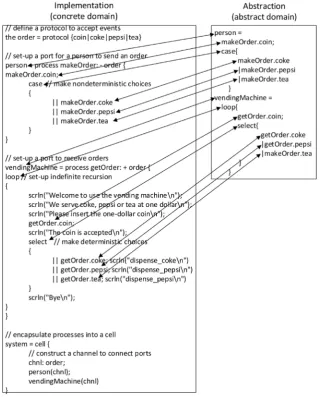
The structure of the implementation of the example is illustrated in Figure 3. In this implementation, there are two processes person and vendingMachine. Process person can send messages like coin, coke, pepsi or tea to port make Or-der, then the messages are passed through channel chnl, and process vending-Machine receives the messages from the port get Order. In these messages, tea is not specified in the design. To get the drink, process person sends out coin first, and then executes case statement to make a nondeterministic choice of drink,
DOI: 10.4236/jcc.2018.611022 236 Journal of Computer and Communications
Figure 3. The implemented vending machine.
7. Abstracting
This section introduces how to use Galois connection to abstract processes and communications from the implementation, and to analyze processes and com-munications by failures in Erasmus. Firstly, abstraction rules based on Galois connection are introduced. Secondly, abstracted implementation of the example is presented. Thirdly, rules for generating and analyzing failures in abstracted implementation are defined. Fourthly, we model and analyze failures in the ab-stracted implementation of the Example.
7.1. Abstraction Rules
As we are interested only in communications between processes, code not re-lated to the communications is necessarily to be ruled out, and code relevant to the communications needs to be retained. In this paper, Galois Connection is used for abstraction.
Implementation is considered as concrete domain, and abstraction of imple-mentation is deemed as abstract domain. There are partial-order relationships, “execute before or simultaneously”, between statements in concrete domain and between statements in abstract domain respectively. There are two partial-order sets 〈ConcreteStatements, ⊑〉 and 〈Ab-stractStatements, ≼〉, where ⊑ and ≼
represent the “execute before or simultaneously” relationship between state-ments in concrete domain and abstract domain respectively.
According to Galois Connection, after abstracting implementation, relation-ships between statements in abstract domain must be able to be mapped to cor-responding relationships between statements in concrete domain, and vice versa. Thus, there are two monotone mappings, namely α: ConcreteStatements → Ab-stractStatements, and γ: AbstractStatements → ConcreteStatements. α and γ
mappings involve communication-related statements only. There are 1). for any
x, y ∊ ConcreteStatements, if x ⊑ y, then α(x) ≼ α(y); 2). for any a, b ∊ Ab-stractStatements, if a ≼ b, then γ(a) ⊑ γ(b), and; 3). for all x ∊ ConcreteState-ments and b ∊ AbstractStatements, a(x) ≼ b ≡a ⊑ γ(b).
The details of mapping rules for α and γ are specified in Table 1 and Table 2
respectively.
In Table 1 and Table 2, C represents statements related to communications;
C1; C2 means C1 executes before C2; |ai| Ci(1 ≤ i ≤ n) in select indicates that if
condition aiis true, then Ciwill execute (sometimes, condition aiis not
necessar-ily provided. If Ciis satisfied in the choice, it will be executed); || is the delimiter
DOI: 10.4236/jcc.2018.611022 237 Journal of Computer and Communications
Table 1. Mapping rules for α.
Concrete Statements Abstract Statements
C C1;C2
select {| a1| C1··· | an| Cn }
case {|| C1··· || Cn }
loop {C}
C C1;C2
select {a1;C1| ··· | an;Cn}
case {C1| ··· | Cn}
loop {C}
Table 2. Mapping rules for α.
Abstract Statements Concrete Statements
C C1;C2
select {C1 |···|Cn }
case {C1| ··· | Cn}
loop {C}
C C1;C2
select {||C1||···||Cn}
case {|| C1··· || Cn }
loop {C}
7.2. Abstracting the Implementation of the Example
By following the mapping rules of abstraction, the implementation of the vend-ing machine example is abstracted as follows.
person =//process person makeOrder.coin;//insert a coin case{//nondeterministic choices makeOrder.coke
|makeOrder.pepsi |makeOrder.tea }
vendingMachine =//process vendingMachine loop{//run into a loop
getOrder.coin;//get a coin select{//deterministic choices getOrder.coke
|getOrder.pepsi |makeOrder.tea }
}
In this example, implementation is considered as concrete domain, and ab-straction is considered as abstract domain. The relationships “execute before or simultaneously” between statements in abstraction are maintained in imple-mentation, and vice versa. The details of mappings for the example are shown in
Figure 4.
7.3. Describing Processes and Communications
DOI: 10.4236/jcc.2018.611022 238 Journal of Computer and Communications
Figure 4. Mappings between implementation and abstraction.
more ports for communications, which differs from the process in CSP. A set of all messages a port can send or receive is considered as the alphabetport. A set of
messages of all ports of a process is deemed as the alphabetprocess= {alphabetport1 ∪∙∙∙∪ alphabetportn}. To model implementation, a process is represented as {( al-phabetport1, failuresport1), …, (alphabetportn, failuresportn)}, and a port can be
mod-eled as (alphabetport, failuresport). Semantics of failures in Erasmus are similar to
those of CSP, while the process in CSP is replaced by port in Erasmus. A failure (s, X) in Erasmus means, after engaged in a trace of events s, if any event from the set of events X occurs, the port would stop.
com-DOI: 10.4236/jcc.2018.611022 239 Journal of Computer and Communications
pound statement (see rules below). Based on the rules in section 5.1 and Eras-mus, the rules for generating and analyzing failures in abstraction of implemen-tation are defined as follows.
1) Let P be a process, let p be a port of P, and let m be the first message that will be sent/received through prot p. The message can be represented P.p.m.
P.p.m is a simple statement. If port p is unique in the system, P.p.m can be ab-breviated as p.m. The failures of port p of process P for sending/receiving mes-sage m are FLS(P.p.m) = {(〈〉, X)|X ⊆ (APHB(p) − m)}. It means any event oc-curs on port p other than message m, p stops working.
2) Let C1 and C2 be two statements, and let C1 execute before C2. There is C1; C2, which is a compound statement with the failures FLS(C1; C2) = {(s, X)|(s, X) ∊ FLS(C1)}∪ {(ss⌒t, Y)|ss ∊ STRCS(C1) ⋀ (t, Y) ∊ FLS(C2)}. It means that the
failures FLS(C1; C2) become FLS(C1) first, as C1 executes before C2. after C1
ac-complishing its execution with trace ss successfully, the failures FLS(C1; C2)
de-pend on FLS(C2).
3) Let C be a statement iterating n times in a loop, and let Ci represent the ith
iteration of a loop of C. There is loop{C} = {C1; C2; ∙∙∙; Cn−1; Cn}, which is a
com-pound statement with the failures FLS(loop{C}) = {(s, X)|(s, X) ∊ FLS(C)} ∪
{(s1⌒s, X)|s1 ∊ STRCS(C) ⋀ (s, X) ∊ FLS(C)} ∪ ∙∙∙ ∪ {(s1⌒s2⌒∙∙∙⌒sn−1⌒sn, X)|si ∊
STRCS(C) ⋀ 1 ≤ i ≤ n − 1 ⋀ (s, X) ∊ (FLS(C))}. It means that if C iterates once, the failures FLS(loop{C}) become FLS(C); if C iterates twice, and if the execution of the first iteration is accomplished successfully with trace s1, the failures
FLS(loop{C}) depends on the failures FLS(C) in the second iteration; if C iterates
n times, and if the execution from 1st iteration to (n − 1)th iteration successfully with trace s1⌒s2⌒∙∙∙⌒sn−1, the failures FLS(loop{C}) depend on the failures
FLS(C) in the nth iteration.
4) Let Ci be a statement where 1 ≤ i ≤ n, and let case represent
nondeterminis-tic choices. There is case {C1|…|Cn}, which is a compound statement with the
failures FLS(case{C1|…|Cn}) = {(s, X)|(s, X) ∊ FLS(C1) ∪… ∪FLS(Cn)}. This rule
is derived from the rule 4) in section 5.1 and Erasmus. It means that FLS(case{C1|…|Cn}) depends on one of FLS(Ci) where 1 ≤ i ≤ n.
5) Let Ci be a statement where 1≤ i ≤ n, and let select represent deterministic
choices. There is select{C1|…|Cn}, which is a compound statement with the
fail-ures FLS (select{C1|…|Cn}) = {(s, X)|(s = 〈〉 ⋀ (s, X) ∊ FLS(C1) ∩… ∩ FLS(Cn)) ⋁
(s ≠ 〈〉 ⋀ (s, X) ∊ FLS(C1) ∪… ∪ FLS(Cn))}. This rule is derived from the rule 5)
in section 5.1 and Erasmus. It means that if statements Ci wait for the occurrence
of the first message, FLS(select{C1|∙∙∙|Cn}) would become FLS(C1) ∩… ∩ FLS(Cn).
When the trace s occurs, it indicates one of Ci executes, so FLS(select{C1|∙∙∙|Cn})
would become FLS(C1) ∪… ∪ FLS(Cn).
6) Let C1 be a statement from a process, let C2 be a statement from another
process, and let C1 and C2 be able to communicate with each other. There is C1 || C2, which is a compound statement with the failures FLS(C1 || C2) = {(s, X ∪Y)|((s, X) ∊ FLS(C1) ⋁ (s, Y) ∊ FLS(C2)) ⋀ (s ∊ TRCS(C1) ⋀ s ∊ TRCS(C2))}.
DOI: 10.4236/jcc.2018.611022 240 Journal of Computer and Communications
port and received by anotherport simultaneously. If there is a failure of C1||C2,
the failure would be from either FLS(C1) or FLS(C2) with the occurrence of trace
s in both C1 and C2. TRCS() is the set of all traces that a process may engage in.
7.4. Maintaining the Integrity of the Specifications
In the implementation of the example, process person has only one port ma-keOrder, and process vendingMachine has only one port getOrder. Thus, person
can be represented as {(APHB(makeOrder), FLS(makeOrder))}, and vending-Machine can be represented as {(APHB(getOrder), FLS(getOrder))}. Let GetPort
describe port getPort executes only once, let GetPorti represent port getPort in
the ith iteration of a loop, and let communications between processes person
and vendingMachine be modeled as makeOrder||getOrder. By following the rules for generating and analyzing failures in Section 7.3, the abstraction of im-plementation of the example can be modeled and analyzed as follows.
makeOrder = makeOrder.coin;
case{makeOrder.coke | makeOrder.pepsi | makeOrder.tea} APHB(makeOrder) ={coin,coke,pepsi,tea}
FLS(makeOrder) ={(〈〉,X) | X⊆ {coke,pepsi,tea}}, {(〈coin〉,X) | X⊆ {coin,coke,pepsi,tea}}}
getOrder = loop{getOrder.coin;select{getOrder.coke | getOrder.pepsi | ge-tOrder.tea}}
GetOrder = getOrder.coin;select{getOrder.coke | getOrder.pepsi | getOrd-er.tea}}
APHB(getOrder) = APHB(GetOrder) = {coin,coke,pepsi,tea}
FLS(GetOrder) ={{(〈〉,X) | X⊆ {coke,pepsi,tea}},{(〈coin〉,X) | X⊆ {coin}}} STRCS(GetOrder) ={〈coin,coke〉,〈coin,pepsi〉,〈coin,tea〉}
FLS(getOrder) =FLS(loop{GetOrder}) =FLS(GetOrder1;...;GetOrdern)
={(s,X) | (s,X) ∊ FLS(GetOrder)}
∪{ (s1⌒s,X) | s1∊{〈coin,coke〉,〈coin,pepsi〉,〈coin,tea〉} ⋀(s,X) ∊ FLS(GetOrder}
∪…∪{ (s1⌒...⌒sn−1⌒s,X) | si∊ {〈coin,coke〉,〈coin,peps〉,〈coin,tea〉} ⋀1 ≤i≤n−1 ⋀ (s,X) ∊ FLS(GetOrder)}
APHB(makeOrderkgetOrder) = {coin,coke,pepsi,tea} FLS(makeOrderkgetOrder) =
{{(〈〉,X∪Y )|X⊆ {coke,pepsi,tea} ⋁Y⊆ {coke,pepsi,tea}},
{(〈coin〉,X∪Y )|X ⊆{coin,coke,pepsi,tea} ⋁Y⊆ {coin}},
{(〈coin,coke〉,X∪Y )|X ⊆ {} ⋁Y⊆ {coke,pepsi,tea}},
{(〈coin,pepsi〉,X∪Y )|X ⊆ {} ⋁Y⊆ {coke,pepsi,tea}},
{(〈coin,tea〉,X∪Y )|X ⊆ {} ⋁Y⊆ {coke,pepsi,tea}}}
8. Categorizing Design
DOI: 10.4236/jcc.2018.611022 241 Journal of Computer and Communications
communications in the design. The progress of communications can be indi-cated by failures [7]. Firstly, we propose the definition of category of failures. Secondly, we use the definition to categorize failures of communications of the example.
8.1. A Category of Failures
In the design, communications are modeled as processes using operator ||, and a process is modeled as (alphabet, failures). As failures contain traces that can in-dicate the progress of the process, in this paper, failures are modeled as catego-ries.
Definition 1. Category of Failures: Each object is a set that has subsets of fail-ures of a process as elements. A Morphism A →⊆ B represents A is a subset
of B, which indicates the progress of the process.
8.2. Categorizing Failures of Communications of the Example
By following the Definition 1, failures of processes in the example can be cate-gorized. As communications are of our interests and communication can be modeled as processes, in this paper, communications between both processes
person and vendingMachine are modeled as a category in terms of failures. Proposition 1. CCD is a category modeling design (see Figure 5). Each object is a set that has subsets of failures of communications between processes person
and vendingMachine as elements. The morphism between two objects is the ⊆
relationship, which represents the progress of communications. For example, {{(〈〉, X ∪Y )|X ⊆ {coke, pepsi} ⋁ Y ⊆ {coke, pepsi}}} is an object, {{(〈〉, X ∪Y )|X ⊆ {coke, pepsi} ⋁ Y ⊆ {coke, pepsi}}, {(〈coin〉, X ∪Y)|X ⊆ {coin, coke, pepsi} ⋁ Y ⊆ {coin}}} is another object, and there is morphism ⊆ between them to indicate the progress of communications from no event to event coin.
9. Categorizing Abstraction of Implementation
This section introduces how to construct categories of failures for communica-tions in the abstraction of implementation. In the implementation, process per-son communicates with vendingMachine through portmakeOrder and port get Order. Thus, the category of communications between both processes is con-structed based on makeOrder k get Order.
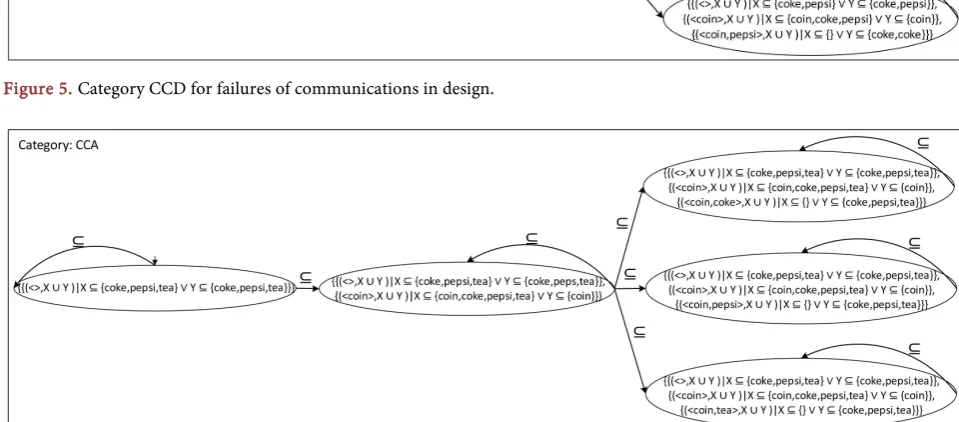
Proposition 2. CCA is a category modeling abstraction of implementation (see Figure 6). Each object is a set that has subsets of failures of communications between processes person and vendingMachine as elements. The morphism be-tween two objects is the ⊆ relationship, which represents the progress of com-munications. For example, {{(〈〉, X ∪Y)|X⊆ {coke, pepsi, tea} ⋁ Y⊆ {coke, pep-si, tea}}} is an object, {{(〈〉, X ∪ Y)|X ⊆ {coke, pepsi, tea} ⋁ Y ⊆ {coke, pepsi,
DOI: 10.4236/jcc.2018.611022 242 Journal of Computer and Communications
Figure 5. Category CCD for failures of communications in design.
Figure 6. Category CCA for failures of communications in abstraction.
10. Verifying Implementation against Design
This section introduces how to verify implementation against design by structing functors. In the example, communications in the implementation con-tain more information than communications in the design. That is because the implementation offers tea, while tea is not specified in the design. However, in-cluding tea in implementation should not affect the implementation of designed communications for person to obtain coke and pepsi from vendingMachine. Functor is used for the verification. By constructing a functor from the category of abstraction of implementation to the category of design, it is able to verify whether the designed communications are implemented. Successful construc-tion of such a functor could indicate communicaconstruc-tions in the design are captured in the implementation. Failing to construct such a functor could indicate an in-consistency between the implemented system and the designed system.
Proposition 3. FC:CCA → CCD is a functor (see Figure 7). This functor maps objects and 1) morphisms of CCA to the corresponding objects and mor-phisms of CCD as follows:
1) Let ocd be an object of CCD, and let oca be an object of CCA. When each element with the form {(〈td〉; Ed)|td is a trace ⋀Ed is a set of events} in ocd has a
corresponding element with the form {(〈ta〉; Ea)|ta is a trace ⋀Ea is a set of events}
where td = ta and Ed⊆ Ea, there exist a mapping from oca to ocd. For every object
[image:16.595.55.535.162.373.2]DOI: 10.4236/jcc.2018.611022 243 Journal of Computer and Communications
Figure 7. Functor FC from the Category CCA to the Category CCD.
communications between processes person and vendingMachine in design are captured in implementation. If ocd doesn’t have the mapping object in CCA, it means the designed communications are not implemented. In the example, tea is implemented in communications, but it is not designed. There still has a map-ping that maps the object, ocat, of CCA including tea in the trace to the object,
ocdnt, of CCD.
2) For every morphism mcd: ocd1 → ocd2 of CCD, there must be at least one
corresponding morphism mca: oca1 → oca2 of CCA, such that mca can be
mapped to mcd when oca1 and oca2 can be mapped to ocd1 and ocd2 respectively.
These mappings indicate that all the progresses of communications between process person and vendingMachine in design are captured in implementation. If mcd doesn’t have the corresponding morphism in CCA, it means the designed progress of communications is not implemented. For the morphism mcat: ocac
→ ocat of CCA indicating person orders tea, it can be mapped to the identity morphism of object ocdnt, which means that the implementation of offering tea
does not affect the design. A successful construction of the functor FC indicates that the designed communications are consistent with the implemented com-munications.
A successful construction of the functor FC indicates that the designed com-munications are consistent with the implemented comcom-munications.
11. Conclusions and Future Work
DOI: 10.4236/jcc.2018.611022 244 Journal of Computer and Communications
framework for formally verifying consistency of communications between de-sign and implementation of concurrent systems. To illustrate the framework, a concurrent system, the vending machine example, is created. In doing so, the design of the system is modeled and analyzed by failures in CSP; the implemen-tation of the system is developed by Erasmus; the abstraction of the implementa-tion is analyzed and constructed based on Galois connecimplementa-tion; failures of the im-plementation in Erasmus are analyzed based on abstraction; categories of fail-ures from the design and implementation are created; by constructing a functor, the consistency of communications between the design and the implementation is verified.
Though initiatives towards the categorical framework are presented in this paper, there are still some limitations that could be improved in future. First, di-vergences in CSP and Erasmus are not discussed in this paper. It would be inter-esting to explore divergences in modeling and analyzing design, implementation and verification. Secondly, the vending machine example consists of only two processes. More complex examples that can scale up to realistic concurrent sys-tems need to be analyzed with the framework. In addition, regarding categorical modeling, only functors and categories are studied. There are still several cate-gorical structures, such as product/coproduct, limit/colimit, and natural trans-formation, which might be useful for verification of communications.
Acknowledgements
We thank the Editor and the referee for their comments. Research of M. Zhu and J. Li is funded by the Shandong University of Technology grants 4041-416069 and 4041-417010. The support is greatly appreciated.
Conflicts of Interest
The authors declare no conflicts of interest regarding the publication of this pa-per.
References
[1] Welch, P. (2013) Life of Occam-Pi. In: Welch, P.H., et al., Eds., Communicating Process Architectures 2013, Open Channel Publishing Ltd., Medarbetare, 293-317. [2] Sampson, A.T. (2008) Process-Oriented Patterns for Concurrent Software
Engi-neering. PhD Thesis, University of Kent, Kent.
[3] Kiniry, J.R. and Fairmichael, F. (2009) Ensuring Consistency between Designs, Do-cumentation, Formal Specications, and Implementations. Proceedings of 12th In-ternational Symposium on Component-Based Software Engineering, East Strouds-burg, PA, 24-26 June 2009, 242-261. https://doi.org/10.1007/978-3-642-02414-6_15 [4] Clarke, E.M., Grumberg, O. and Peled, D. (2001) Model Checking. The MIT Press,
Cambridge. https://doi.org/10.1016/B978-044450813-3/50026-6
[5] Godefroid, P. (1996) Partial-Order Methods for the Verification of Concurrent Sys-tems: An Approach to the State-Explosion Problem. Springer, Secaucus.
DOI: 10.4236/jcc.2018.611022 245 Journal of Computer and Communications [6] Zhu, M., Grogono, P., Ormandjieva, O. and Kamthan, P. (2014) Using Category Theory and Data Flow Analysis for Modeling and Verifying Properties of Commu-nications in the Process-Oriented Language Erasmus. Proceedings of the Seventh C* Conference on Computer Science and Software Engineering, Montreal, 3-5 Au-gust 2014, 201424:1-24:4. https://doi.org/10.1145/2641483.2641529
[7] Zhu, M., Grogono, P. and Ormandjieva, O. (2017) Exploring Relationships between Syntax and Semantics of a Process-Oriented Language by Category Theory. The 8th International Conference on Ambient Systems, Networks and Technologies, Ma-deira, 16-19 May 2017, 241-248. https://doi.org/10.1016/j.procs.2017.05.342 [8] Hinchey, M.G. and Bowen, J.P. (1999) High-Integrity System Specification and
De-sign. Springer-Verlag, New York.
[9] Hoare, C.A.R. (1985) Communicating Sequential Processes. Prentice-Hall, Engle-wood Cliffs.
[10] Roscoe, A.W. (2010) Understanding Concurrent Systems. Springer, London. https://doi.org/10.1007/978-1-84882-258-0
[11] Mach, M., Plasil, F. and Kofron, J. (2005) Behavior Protocols Verification: Fighting State Explosion. International Journal of Computer and Information Science, 6, 22-30.
[12] Schneider, S. (1999) Concurrent and Real Time Systems: The CSP Approach. John Wiley & Sons, Inc., New York.
[13] Grogono, P. and Shearing, B. (2008) Concurrent Software Engineering: Preparing for Paradigm Shift. Proceedings of the First C* Conference on Computer Science and Software Engineering, Montreal, 12-13 May 2008, 99-108.
https://doi.org/10.1145/1370256.1370270
[14] Brown, N. (2006) Rain: A New Concurrent Process-Oriented Programming Lan-guage. Communicating Process Architectures 2006, Edinburgh, 17-20 September 2006, 237-251.
[15] Grogono, P. and Shearing, B. (2008) Modular Concurrency: A New Approach to Manageable Software. Proceedings of the Third International Conference on Soft-ware and Data Technologies, Porto, 5-8 July 2008, 47-54.
[16] Grogono, P. (2018) The Erasmus Project: Process Oriented Programming. http://users.encs.concordia.ca/~grogono/Erasmus/erasmus.html
[17] Grogono, P. and Jafroodi, N. (2010) A Fair Protocol for Non-Deterministic Message Passing. Proceedings of the Third C* Conference on Computer Science and Soft-ware Engineering, C3S2E '10, Montréal, 19-20 May 2010, 53-58.
https://doi.org/10.1145/1822327.1822334
[18] Jafroodi, N. and Grogono, P. (2013) Implementing Generalized Alternative Con-struct for Erasmus Language. Proceedings of the 16th International ACM Sigsoft Symposium on Component-Based Software Engineering, CBSE’13, Vancouver, 17-21 June 2013, 101-110. https://doi.org/10.1145/2465449.2465464
[19] Zakeryfar, M. and Grogono, P. (2013) Static Analysis of Concurrent Programs by Adapted Vector Clock. Proceedings of the Sixth International C* Conference on Computer Science and Software Engineering, Porto, 10-12 July 2013, 58-66. https://doi.org/10.1145/2494444.2494476
[20] Cousot, P. and Cousot, R. (1992) Abstract Interpretation Frameworks. Journal of Logic and Computation, 2, 511-547. https://doi.org/10.1093/logcom/2.4.511
Prin-DOI: 10.4236/jcc.2018.611022 246 Journal of Computer and Communications
ciples of Programming Languages, San Diego, 22-24 January 2014, 3-4. https://doi.org/10.1145/2535838.2537850
[22] Zakeryfar, M. (2014) Static Analysis of a Concurrent Programming Language by Abstract Interpretation. PhD Thesis, Concordia University, Montreal.
[23] Barr, M. and Wells, C. (2012) Category Theory for Computing Science. Pren-tice-Hall, Upper Saddle River.
[24] Fiadeiro, J.L. (2005) Categories for Software Engineering. Springer, Berlin.
[25] Awodey, S. (2006) Category Theory. The Clarendon Press Oxford University Press, New York. https://doi.org/10.1093/acprof:oso/9780198568612.001.0001
[26] Hoare, C.A.R. (1989) Notes on an Approach to Category Theory for Computer Scientists. Constructive Methods in Computing Science, 55, 245-305.
https://doi.org/10.1007/978-3-642-74884-4_9
[27] Winskel, G. and Nielsen, M. (1995) Models for Concurrency. Handbook of Logic in Computer Science, 4, 1-148.
[28] Sassone, V., Nielsen, M. and Winskel, G. (1996) Models for Concurrency: Towards a Classification. Theoretical Computer Science, 170, 297-348.
https://doi.org/10.1016/S0304-3975(96)80710-9
[29] Hildebrandt, T.T. (2000) Categorical Models for Concurrency: Independence, Fair-ness and Dataow. PhD Thesis, University of Aarhus, Aarhus.
[30] Goubault, E. and Mimram, S. (2010) Formal Relationships between Geometrical and Classical Models for Concurrency. Electronic Notes in Theoretical Computer Science, 283, 77-109. https://doi.org/10.1016/j.entcs.2012.05.007