doi:10.4236/jct.2011.25095 Published Online December 2011 (http://www.SciRP.org/journal/jct)
Comparison of 4-Weekly vs 3-Weekly
Gemcitabine as Adjuvant Chemotherapy
Following Curative Resection for Biliary Tract
Cancer: A Prospective Randomized Controlled
Trial
Shogo Kobayashi1, Atsushi Miyamoto2*, Junzo Shimizu3, Masaki Kashiwazaki4, Yutaka Takeda5, Shigeyuki Ueshima6, Yongkook Kim7, Toru Kitagawa1, Keizo Dono3, Masaki Mori1,
Yuichiro Doki1, Hiroaki Nagano1
1Department of Surgery, Graduate School of Medicine, Osaka University, Suita, Japan; 2Department of Surgery, National Hospital
Organization, Osaka National Hospital, Osaka, Japan; 3Department of Surgery, Toyonaka Municipal Hospital, Toyonaka, Japan; 4Department of Surgery, Hyogo Prefectural Nishinomiya Hospital, Nishinomiya, Japan; 5Department of Surgery, Kansai Rosai
Hos-pital, Amagasaki, Japan; 6Department of Surgery, Osaka Police Hospital, Osaka, Japan; 7Department of Surgery, Osaka Rosai
Hos-pital, Sakai, Japan.
E-mail: *[email protected]
Received August 28th, 2011; revised September 30th, 2011; accepted October 15th, 2011.
ABSTRACT
Background: Surgery for biliary tract cancer, including pancreatoduodenectomy and major hepatectomy, is too ag-gressive and does not allow postoperative gemcitabine to be administered by the usual dosage protocol. We hypothe-sized that the feasibility of 3-weekly protocol (days 1 and 8, every 3 weeks) of adjuvant gemcitabine therapy may be superior to the usual 4-weekly protocol (days 1, 8, and 15 every 4 weeks). Method: We compared the outcomes of 6 cycles of the 4-weekly protocol and 9 cycles of the 3-weekly protocol in a prospective randomized setting. The primary endpoint was the completion rate, and the secondary endpoints were the adverse events and the recurrence-free sur-vival rate. Results: Totally, 27 patients were enrolled. The protocol could be completed without any omittances and/or dose modifications in two patients (14%) of the 4-weekly protocol, and three patients (23%) of the 3-weekly protocol (p
= 0.8099); grade 3/4 neutropenia occurred in almost all the remaining (70%) patients. The relative dose intensity was
72% in the 4-weekly protocol and 78% in the 3-weekly protocol. There was no significant difference in the recur-rence-free survival rate. Conclusion: The 3-weekly protocol did not yield superior completion, adverse events or re-currence-free survival rates as compared to the 4-week protocol. Trial Registration: UMIN-CTR, UMIN000001020.
Keywords: Biliary Tract Cancer, Adjuvant Therapy, Gemcitabine
1. Introduction
The prognosis of biliary tract cancer (BTC) is still poor [1-6]. Although surgical treatment remains the only po-tentially curative treatment, the overall 5-year survival rate remains approximately 40% [6,7]. This uncommon cancer is not yet well-studied because of the complexity of its classification and surgical procedures, andthe high perioperative morbidity, including liver dysfunction and cholangitis. Therefore, no (neo-) adjuvant chemotherapy has been established for these patients [8]. On the other
hand, a pooled analysis [9] and multicenter retrospective analysis [10] revealed the potential efficacy of gemcitabine for unresectable and recurrent BTC, and a prospective randomized study revealed the survival benefit of gem-citabine-based chemotherapy in these patients [11,12]. Moreover, this drug has been shown to have a good safety profile, with a low incidence of grade 3/4 toxicities [13].
and 15 every 4 weeks) after BTC surgery. And, there have been several reports of gemcitabine-based adjuvant chemo therapy following major hepatic to mine for BTC or pancrea to duodenectomy for pancreatic cancer, which have suggested that dose modification is often necessary or that the usual 4-weekly protocol could not be, or was not applied [14-16]. Because of the morbidity, liver dys-function, and low performance status (PS) after BTC surgery (major hepatectomy/pancreatoduodenectomy), it would seem difficult to complete the usual 4-weekly pro- tocol, and frequent pauses during the adjuvant during therapy would be necessary.
For the above reasons, we hypothesized that postop-erative gemcitabine therapy by the3-weekly protocol (1000 mg/m2 on days 1 and 8 every 3 weeks) might be
more feasible and superior to the 4-weekly protocol, be-cause it would allow more treatment pauses. In this study, we compared the completion rate between patients as-signed to the 4-weekly and 3-weekly protocols, for the same planned total dosage (6 cycles for the 4-weekly protocol and 9 cycles for the 3-weekly protocol). Be- cause no feasibility studies of adjuvant gemcitabine the- rapy have been reported yet for BTC, we also compara-tively estimated the frequency and severity of adverse events and the treatment efficacy (recurrence-free sur-vival) between the two protocols. This study was regis-tered with the University Hospital Medical Information Network Clinical Trials Registry (UMIN-CTR, UMIN 000001020) in JAPAN.
2. Patients and Methods
2.1. Study Design and Endpoints
We designed this open, multicenter, randomized con-trolled trial to explore the feasibility and efficacy of ad-juvant gemcitabine therapy for BTC. The trial was initi-ated by the Osaka University Biliary Tract Cancer Treat- ment Group (OBCG, affiliated to the Multicenter Clinical Study Group of Osaka), Department of Surgery, Gradu-ate School of Medicine, Osaka University. The protocol was approved by the institutional review board a teach hospital, and written informed consent was obtained from each of the patients.
The primary end point was the completion rate of ad-juvant therapy. As control, we employed the 4-weekly protocol of gemcitabine treatment, which was studied in the CONKO-001 study after similar surgeries for pancre-atic cancer [15].
The secondary end points included the frequency and severity of adverse events, for the purpose of collecting data on adverse events associated with adjuvant therapy, and the recurrence-free survival.
We determined that alpha and beta errors were 10%
and 20%, respectively, to explore the feasibility and effi- cacy. After calculation of the sample seize, we determined that a total of 40 patients would be required. The study was started in August 2007 and completed in March 2010.
2.2. Patient Selection
Patients with histologically confirmed BTC (extrahepatic bile duct cancer, gall bladder cancer, or cancer of the papilla of Vater, UICC-stage II to IV [17]), who under-went macroscopic complete resection and no other ther-apy than surgery, were eligible for the study, and adju-vant therapy was to be started from 4 to 12 weeks after the surgery. Other eligibility criteria included age ≥20 years, Eastern Cooperative Oncology Group (ECOG) PS 0/1 [18], adequate hematological, liver and renal function (hemoglobin > 10 g/dl, leukocytes > 4000/µl, neutrophils > 2000/µl, platelets > 100,000/µl, serum transaminases < 4× the upper limit of normal (ULN), serum bilirubin < 2× ULN, andserum creatinine <ULN).
Patients were excluded if they had active interstitial pneumonia, severe edema, pregnancy, active infection, severe underlying disease (impaired cardiac function, active peptic ulcer, ileus, uncontrolled diabetes mellitus, etc.), severe allergy, severe mental disorders, or active a- nother cancer.
2.3. Treatment and Dose Modification
Standard surgical procedures were used depending on BTC involvement. Eligible patients were randomly assigned by a computer-generated central randomization with stratifi- cation for institution and surgical procedure (pancrea to duodenectomy vs. others).
Patients assigned to the 4-weekly protocol received 6 cycles, with each cycle consisting of three weekly ad-ministrations of intravenous gemcitabine at 1000 mg/m2,
followed by a1-week drug-free pause. Patients assigned to the 3-weekly protocol received 9 cycles, each cycle-consisting of two weekly administrations of gemcitabine, followed by a1-week drug-free pause.
The first administration in each cycle was started with adequate hematological, liver, and renal functions (leu-kocytes > 3000/µl or neutrophils > 1500/µl, platelets > 100,000/µl, serum transaminases < 5 × ULN, serum biliru- bin < 3 × ULN, and serum creatinine < ULN). When the first administration of any cycle could not be started wi- thin 28 days, the patient was withdrawn from the study.
Resection for Biliary Tract Cancer: A Prospective Randomized Controlled Trial
> 800 mg/m2 > 600 mg/m2 > withdrawal from the study.
Omitted doses of gemcitabine were not replaced. During the study, neither anti-cancer therapies were allowed. Pa- tients were withdrawn from the study for any of the fol- lowing reason: disease recurrence, patient’s desire to dis- continue, or unacceptable treatment toxicity
2.4. Assessments
Prior to enrollment in the study, all patient sunder went routine examinations and laboratory studies. Tumor as-sessments were performed on the chest X-ray and ab-dominal computed tomo graphic or magnetic resonance images, prior to the adjuvant therapy and every 3 months. During the study, vitalsigns, laboratory studies, PS, and toxicities/adverse events were evaluated prior to each administration. Toxicities were graded according to the National Cancer Institute Common Toxicity Criteria for Adverse Events (CTCAE version 3.0).
The overall survival and recurrence-free survival rates were calculated by the Kaplan–Meiermethod, and the log-rank test was used for comparisons. Student’s t-test or chi-square test was used to compare any differences. P-values <0.05 were considered to indicate statistical significance. All statistical analyses were performed us-ing the StatView J-5.0 software (SAS, Cary, NC).
3. Results
3.1. Results
A total of 27 patients were recruited into the study from 13 centersinthe Kansai area, Japan. Recruitment was planned for ending in March 2010, and we analyzed the data at thistime to determine whether the study should be
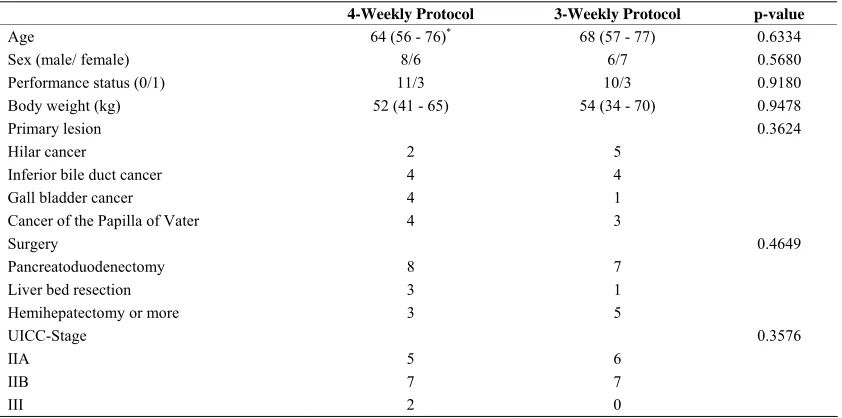
extended or not. There were no differences in the com-pletion rate between the protocols, and we completed the study in 27 patients. The patients were randomized to the 4-weekly protocol (n = 14) and or the 3-weekly protocol (n = 13).The baseline characteristics of the eligible pa-tients are shown in Table 1, and there were no
statisti-cally differences between the two protocols. All patients had adenocarcinoma, the majority had Stage IIB BTC, 15 (56%) underwent pancreatoduodenectomy, and 8 (30%) underwent major liver surgery. The median time from surgery to the start of chemotherapy was 62 days (24 - 86), with no significant difference between the protocols.
3.2. Treatment Delivery
The number of patients in whom the adjuvant therapy could be completed without any omittances and/or dose modifications was 2 (14%) in the 4-weekly protocol and 2 (15%) in the 3-weekly protocol (p = 0.8099, Table 2).
The scheduled treatment cycles could not be completed in 3 patients of the 4-weekly protocol and in 4 patients of the 3-weekly protocol. The median number of admini-strations was16 for both protocols, and the median dura-tions of administration were 168 days and 189 days, de-pending on the protocol bias. The median total dosages of adjuvant gemcitabine were 13,000 mg/m2 in the 4-
weekly protocol, and 14,000 mg/m2 in the 3-weekly
[image:3.595.89.510.501.710.2]pro-tocol. The median relative dose intensities were 72.2% and 77.8%, respectively. The potential need for omit-tance on account of grade 3 hematological or other events occurred first at the 3rd administration in the 4-weekly protocol and at the 10th administration in the 3-weekly protocol.
Table 1. Patient characteristics.
4-Weekly Protocol 3-Weekly Protocol p-value
Age 64 (56 - 76)* 68 (57 - 77) 0.6334
Sex (male/ female) 8/6 6/7 0.5680
Performance status (0/1) 11/3 10/3 0.9180
Body weight (kg) 52 (41 - 65) 54 (34 - 70) 0.9478
Primary lesion 0.3624
Hilar cancer 2 5
Inferior bile duct cancer 4 4
Gall bladder cancer 4 1
Cancer of the Papilla of Vater 4 3
Surgery 0.4649
Pancreatoduodenectomy 8 7
Liver bed resection 3 1
Hemihepatectomy or more 3 5
UICC-Stage 0.3576
IIA 5 6
IIB 7 7
III 2 0
In the subcategory analysis, the completion rates were 26.7% (4/15) and 9.0% (1/11) in pancreatoduodenectomy and other-surgery, respectively (p = 0.5691). The poten-tial need for omittance occurred first at the 8th admini-stration in pancreatoduodenectomy and at the 2nd ad-ministration in other-surgery. The dose intensities were 78% and 73%, respectively. In 4-weekly and 3-weekly protocol after pancreatoduodenectomy, the completion rates were 12.5% (1/8) and 42.9% (3/7), respectively (p = 0.5263). The potential need for omittance occurred first at the 3rd administration in the 4-weekly protocol, and at the 12th in the 3-weekly protocol (p = 0.0188). The dose
intensities were 72% and 86%, respectively (p = 0.1152).
After other-surgery, the completion rateswere 16.7% (1/6) and 0% (0/6), the potential need for omittance occurred first at the 3rd and 2nd administrations, and the dose in-tensities were 71% and 75%, respectively, in the 4-weekly and 3-weekly protocols, with no statistically significant differences between the two protocols.
3.3. Toxicity
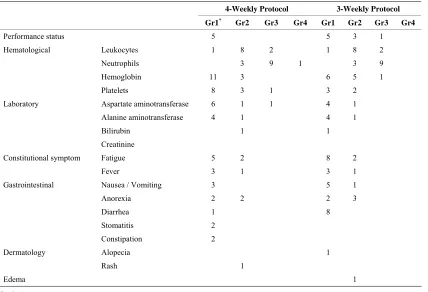
Grade 4 toxicities were encountered only in the 4-weekly protocol (grade 4 neutropenia), while grade 3 neutro-penia was noted at a high frequency (64% and 69%, re-spectively) in both protocols (Table 3). Grade 3/4 non-
[image:4.595.88.511.279.397.2]hematologic toxicity occurred only infrequently in either
Table 2. Completion rate, number of administrations, and total dose.
4-Weekly Protocol 3-Weekly Protocol p-value
n (Pancreatoduodenectomy / other surgery) 14 (8/6) 13 (7/6)
Complete all cycles 2 (1/1) 14% 3 (3/0) 23% 0.8099
Adjuvant therapy completed with omittance
and/ or dose modification 9 (5/4) 64% 6 (2/4) 46%
Could not complete all cycles 2 (1/1) 14% 3 (1/1) 23%
Recurrence during therapy 1 (1/0) 1 (0/1)
Number of administrations 16 16
[image:4.595.88.516.423.715.2]Total dose (mg/m2) 13000 (2600 - 18000) 14000 (2400 - 18000) 0.7017
Table 3. Number of patients with maximum grade of adverse events during the treatment.
4-Weekly Protocol 3-Weekly Protocol
Gr1* Gr2 Gr3 Gr4 Gr1 Gr2 Gr3 Gr4
Performance status 5 5 3 1
Hematological Leukocytes 1 8 2 1 8 2
Neutrophils 3 9 1 3 9
Hemoglobin 11 3 6 5 1
Platelets 8 3 1 3 2
Laboratory Aspartate aminotransferase 6 1 1 4 1
Alanine aminotransferase 4 1 4 1
Bilirubin 1 1
Creatinine
Constitutional symptom Fatigue 5 2 8 2
Fever 3 1 3 1
Gastrointestinal Nausea / Vomiting 3 5 1
Anorexia 2 2 2 3
Diarrhea 1 8
Stomatitis 2
Constipation 2
Dermatology Alopecia 1
Rash 1
Edema 1
Resection for Biliary Tract Cancer: A Prospective Randomized Controlled Trial
protocol. A total of 27 serious adverse events (grade 3/4) were reported in the 21 patients (12 patients of the 4- weekly protocol and 9 patients of the 3-weekly protocol). In regard to the development of constitutional symptoms (PS and general fatigue) and gastrointestinal toxicity (nausea/vomiting), 52% and22% of patients developed grade 1/2 toxicities in the 4-weekly and 3-weekly proto-colsandonly one patient experienced grade 3/4 toxicity (PS 3, just before withdrawal from the study).
3.4. Efficacy
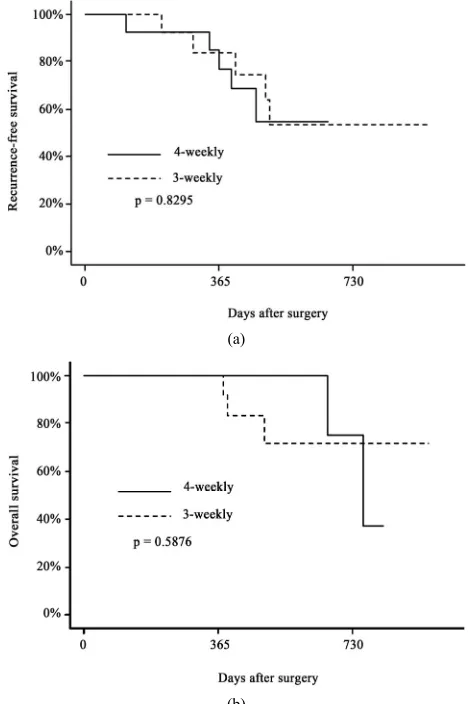
The survival curves are shown in Figure 1. For a median
(a)
[image:5.595.54.290.255.607.2](b)
Figure 1. Recurrence-free survival (a) and overall survival (b) of biliary tract cancer patients after surgical resection. Solid line indicates the survival curve of the patients who received 6 cycles of adjuvant gemcitabine therapy by the 4-weekly protocol (1000 mg/m2 on days 1, 8 and 15 every 4 weeks), and the dotted line indicates that of those who re-ceived 9 cycles of adjuvant therapy by the 3-weekly protocol (1000 mg/m2 on days 1 and 8 every 3 weeks). There were no significant differences in either parameter between the two groups.
follow-up of 17 months, the 1- and 2-year recurrence- free survival rates were 77% and 55% in the 4-weekly protocol, and 84% and 53% in the 3-weekly protocol, respectively (p = 0.8295). The 1- and 2-year overall sur-vival rates were 100% and 75% in the 4-weekly protocol, and 100% and 71% in the 3-weekly protocol, respec-tively (p = 0.5876).
4. Discussion
There is as yet no feasibility-certified adjuvant therapy for BTC, especially when gemcitabine is used. In pancrea to duodenectomy for pancreatic cancer, the CONKO- 001 and JSAP-02 trials revealed that dose modification was frequently necessary for completion [15,16]. In BTC, Murakami et al. presented gemcitabine-based adjuvant
chemotherapy, however, all patients could not complete the protocol, even for biweekly 700 mg/m2 gemcitabine-
based chemotherapy [14]. Clinically, several omittances are necessary in the usual 4-weekly protocol of gemcit-abine after BTC surgery, and it become like the 3-weekly protocol. Therefore, we hypothesized that the 3-weekly protocol may be more feasible and superior (higher com- pletion rate). However, the 3-weekly protocol was not superior to the 4-weekly protocol in the completion rate, frequency of adverse events, or disease-free survival. In other words, the administration protocol did not influ- ence the completion rate of adjuvant gemcitabine therapy for BTC.
aggressive surgery, like major liver resection, neither the 4-weekly nor the 3-weekly protocol might be feasible for adjuvant therapy. This study might not have enough power to mention these speculations. It would be neces-sary to perform phase I study to yield a higher dose in-tensity, followed by phase II/III study in a larger study group.
In relation to treatment toxicity, we encountered a high frequency of grade 3/4 neutropenia, and also of grade 2 constitutional symptoms and gastrointestinal adverse events. Although there is little information about neutro-penia in previous reports [14,15], the JSAP-02 reported a high frequency of grade 3/4 neutropenia [16], similar to our study. This adjuvant therapy seemed to yield a high frequency of not grade 3/4 leukopenia, but of grade 3/4 neutropenia. After surgery for BTC, the patients some-times develop cholangitis, and with the occurrence of severe neutropenia, liver abscess and/or sepsis could oc-cur. Patients must therefore be closely monitored for the development of neutropenia. In regard to constitutional symptoms and gastrointestinal adverse events, approxi-mately 25% of the patients with such adverse events were unable to carry on with their work activities or needed drip infusions (grade 2 toxicity), suggesting that treat-ment of these patients in the outpatient setting might be difficult.
In regard to the efficacy, we compared our historical data [4-6] and the report from the Japanese Society of Biliary Surgery (JSBS) [7,19], and data on gemcitabine- based adjuvant therapy by Murakami et al. [14]. In re-gard to the recurrence-free survival, the data in our pre-sent study (77% - 84% at 1 year and 52% - 55% at 2 years) were similar to those reported by Murakami et al. (recurrence-free survival: 79% at 1 year and 60% at 3 years) [14]. In terms of overall survival, the rate in our study 75% - 71% at 2 years, as compared to historical data (without adjuvant therapy) of approximately 65% at 2 years and 60% - 63% at 3 years. The JSBS reported an overall survival rate of 40% - 65% at 3 years. Based on the above findings, we suggest that there remains the possibility of a survival benefit of adjuvant gemcitabine therapy after BTC surgery.
In conclusion, the 3-weekly gemcitabine treatment protocol was not superior to the 4-weekly protocol in terms of the completion rate, relative dose intensity, ad-verse events or recurrence-free survival, among patients receiving adjuvant therapy following BTC surgery; a high frequency of grade 3/4 neutropenia was found in both the protocols. Furthermore, the treatment could be completed without any interruptions and/or dose modifi-cations in only approximately 10% of the patients. Our
findings suggest the possibility of the dose intensity de-pending on the aggressiveness level of the surgical pro-cedures, and further investigation is warranted. For a precise evaluation of the efficacy in a feasibility study for adjuvant therapy after aggressive BTC surgery, a pro-spective randomized study with a large number of pa-tients would be necessary.
5. Disclosure
The authors have no conflict of interests to declare.
6. Acknowledgements
We are grateful to Dr Y. Sasaki,Yao Municipal Hospital, who served as the chief of the Independent Data Monitoring Committee.
Study sites and investigators (authors not included): Yushikazu Morimoto, Department of Surgery, Osaka Kouseinenkin Hospital; Terumasa Yamada, Department of Surgery, Osaka Medical Center for Cancer and Car-diovascular Diseases. Osakuni Morimoto, Department of Surgery, Ikeda Municipal Hospital, Tameyoshi Yama-moto, Department of Surgery, Sakai Municipal Hospital, Nariaki Fukuchi, Department of Surgery, Higashiosaka Municipal Hospital, and Takashi Deguchi, Departments of Surgery, Osaka General Medical Center.
REFERENCES
[1] National Cancer Center, “Cancer Statistics in Japan,” 2005. http://www.ncc.go.jp/en/statistics/index.html
[2] C. M. Haskelled, “Cancer Treatment,” 5th Edition, WBS- aunders Co., Philadelphia, 2001.
[3] B. Levin, “Gallbladder Carcinoma,” Annals of Oncology,
Vol. 10, No. 3, 1999, pp. 129-130.
doi:10.1023/A:1008325911628
[4] S. Kobayashi, H. Nagano, S. Marubashi, Y. Takeda, M. Tanemura, K. Konishi, Y. Yoshioka, T. Inoue, Y. Doki and M. Mori, “Impact of Postoperative Irradiation after Non-Curative Resection of Hilar Biliary Cancer,” Journal of Surgical Oncology, Vol. 100, No. 8, 2009, pp. 657-
662. doi:10.1002/jso.21409
[5] S. Kobayashi, H. Nagano, S. Marubashi, H. Wada, H. Eguchi, Y. Takeda, M. Tanemura, Y. Doki and M. Mori, “Multi-Detector Computed Tomography for Preoperative Prediction of Postsurgical Prognosis of Patients with Ex-trahepatic Biliary Cancer,” Journal of Surgical Oncol-ogy, Vol. 101, No. 5, 2010, pp. 376-383.
[6] S. Kobayashi, H. Nagano, S. Marubashi, H. Wada, H. Eguchi, Y. Takeda, M. Tanemura, K. Umeshita, Y. Doki and M. Mori, “Treatment of Borderline Cases for Cura-tive Resection of Biliary Tract Cancer,” Journal of Sur-gical Oncology, In Press.
Treat-Resection for Biliary Tract Cancer: A Prospective Randomized Controlled Trial
ment: 5584 Results from the Biliary Tract Cancer Statistics Registry from 1998 to 2004 in Japan,” Journal of Hepato- Biliary-Pancreatic Surgery, Vol. 16, No. 1, 2009, pp. 1-7. doi:10.1007/s00534-008-0015-0
[8] J. Furuse, T. Takada, M. Miyazaki, S. Miyakawa, K. Tsukada, M. Nagino, S. Kondo, H. Saito, T. Tsuyuguchi, K. Hirata, F. Kimura, H. Yoshitomi, S. Nozawa, M. Yo-shida, K. Wada, H. Amano and F. Miura, “Japanese As-sociation of Biliary Surgery; Japanese Society of Hepato- Biliary-Pancreatic Surgery; Japan Society of Clinical On- cology. Guidelines for chemotherapy of biliary tract and ampullary carcinomas,” Journal of Hepato-Biliary-Pan-creatic Surgery, Vol. 15, No. 1, 2008, pp. 55-62.
doi:10.1007/s00534-007-1280-z
[9] F. Eckel and R. M. Schmid, “Chemotherapy in Advanced Biliary Tract Carcinoma: A Pooled Analysis of Clinical Trials,” British Journal of Cancer, Vol. 96, No. 6, 2007,
pp. 896-902. doi:10.1038/sj.bjc.6603648
[10] N. Yonemoto, J. Furuse, T. Okusaka, K. Yamao, A. Fu-nakoshi, S. Ohkawa, N. Boku, K. Tanaka, M. Nagase, H. Saisho and T Sato, “A Multi-Center Retrospective Analy-sis of Survival Benefits of Chemotherapy for Unre-sectable Biliary Tract Cancer,” Japanese Journal of Clini-cal Oncology, Vol. 37, No. 11, 2007, pp. 843-851. doi:10.1093/jjco/hym116
[11] J. W. Valle, H. Wasan, P. Johnson, E. Jones, L. Dixon, R. Swindell, S. Baka, A. Maraveyas, P. Corrie, S. Falk, S. Gollins, F. Lofts, L. Evans, T. Meyer, A. Anthoney, T. Iveson, M. Highley, R. Osborne and J. Bridgewater, “Ge- mcitabine Alone or in Combination with Cisplatin in Pa-tients with Advanced or Metastatic Cholangiocarcinomas or Other Biliary Tract Tumours: A Multicentre Random-ised Phase II Study—The UK ABC-01 Study,” British Journal of Cancer, Vol. 101, No. 4, 2009, pp. 621-527. doi:10.1038/sj.bjc.6605211
[12] J. Valle, H. Wasan, D. H. Palmer, D. Cunningham, A. Anthoney, A. Maraveyas, S. Madhusudan, T. Iveson, S. Hughes, S. P. Pereira, M. Roughton and J. Bridgewater, “ABC-02 Trial Investigators.Cisplatin Plus Gemcitabine versus Gemcitabine for Biliary Tract Cancer,” New Eng-land Journalof Medicine, Vol. 362, No. 14, 2010, pp.
1273-1281.doi:10.1056/NEJMoa0908721
[13] M. S. Aapro, C. Martin and S. Hatty, “Gemcitabine—a Safety Review,” Anticancer Drugs, Vol. 9, No. 3, 1998,
pp. 191-201.doi:10.1097/00001813-199803000-00001
[14] Y. Murakami, K. Uemura, T. Sudo, Y. Hayashidani, Y. Hashimoto, H. Nakamura, A. Nakashima and T. Sueda, “Adjuvant Gemcitabine Plus S-1 Chemotherapy Improves Survival after Aggressive Surgical Resection for Ad-vanced Biliary Carcinoma,” Annals of Surgery, Vol. 250,
No. 6, 2009, pp. 950-956.
doi:10.1097/SLA.0b013e3181b0fc8b
[15] H. Oettle, S. Post, P. Neuhaus, K. Gellert, J. Langrehr, K. Ridwelski, H. Schramm, J. Fahlke, C. Zuelke, C. Burkart, K. Gutberlet, E. Kettner, H. Schmalenberg, K. Weigang- Koehler, W. O. Bechstein, M. Niedergethmann, I. Sch- midtWolf, L. Roll, B. Doerken and H. Riess, “Adjuvant Chemotherapy with Gemcitabine vs. Observation in Pa-tients Undergoing Curative-Intent Resection of Pancreatic Cancer: A Randomized Controlled Trial,” Journal of the American Medical Association, Vol. 297, No. 3, 2007, pp. 267-277.doi:10.1001/jama.297.3.267
[16] H. Ueno, T. Kosuge, Y. Matsuyama, J. Yamamoto, A. Nakao, S. Egawa, R. Doi, M. Monden, T. Hatori, M. Ta-naka, M. Shimada and K. Kanemitsu, “A Randomised Phase III Trial Comparing Gemcitabine with Surgery- Only in Patients with Resected Pancreatic Cancer: Japa- nese Study Group of Adjuvant Therapy for Pancreatic Cancer,” British Journal of Cancer, Vol. 101, No. 6, 2009,
pp. 908-915.doi:10.1038/sj.bjc.6605256
[17] L. H. Sobin and C. Wittekind, “International Union Against Cancer, TNM Classification of Malignant Tumors,” 6th Edition, Wiley-Liss, New York, 2002.
[18] M. M. Oken, R. H. Creech, D. C. Tormey, J. Horton, T. E. Davis, E. T. McFadden and P. P. Carbone, “Toxicity and Response Criteria of the Eastern Cooperative Oncology Group,” American Journal of Clinical Oncology, Vol. 5,
No. 6, 1982, pp. 649-655.
doi:10.1097/00000421-198212000-00014