Research on Evolution Mechanism of Technological
Original Innovation—With Mutation Theory of Respective
Zhi-Ming Zhu1, Jin-Sheng Li2, Tao Chen3
1School of Business, Hohai University, Nanjing, China; 2School of Business, Nanjing Normal University, Nanjing, China; 3School of Management, Harbin Institute of Technology, Harbin, China.
Email: [email protected]
Received November 5th,2011; revised December 17th, 2011; accepted December 29th, 2011
ABSTRACT
Technical innovation is the power and resource for the sustainable and healthy development of enterprises, and is re- lated to the improvement of social productivity and the establishment and improvement of national innovation system. Technical innovation is the process of the enterprise using the original knowledge and transforming it into new tech- nology. The input and output of knowledge of (i.e., creating new technology) presents S curve, experiencing the stage of imitating type, fusion type and original type, which is subjected to the synergistic action of institutional arrangements factor and its operating factors. Through the analysis of evolution mechanism of different stages of technological inno- vation stages, this paper verifies the rationality and scientific nature of the theoretical assumptions.
Keywords: Original Innovation; Mutation Theory; Synergistic Action; Evolution Mechanism
1. Introduction
With the development of science and technology, econo- mic globalization, the competition between enterprises is becoming increasingly fierce, and enterprise’s technical original innovation ability is raised to a new level. It is the enterprise survival the primary motivation source of enterprises’ future sustainable and healthy development, relating to promote and perfect the country and regional productivity development level. Technology for original innovation means that enterprises is at its most directly status in terms of owning and mastering knowledge, and have the final right to the knowledge property and its related interests. The development of technology and the improvement of enterprises need enterprises to evaluate and recognize its own innovation capacity to determine its own competitive advantages with the aim to transform new knowledge into new technology, improve enterprises efficiency and performances. The process of techno- logical original innovation evolution ability is the most interesting problem of politicians and researchers from every country and region. How to improve enterprises original innovation ability and how to understand the concrete influencing factors of original innovation ability is always a key issue for people.
The following points of views are related to technolo- gical original evolution process.
1) Knowledge innovation theory. This theory empha- sizes knowledge is more useful to technological original
innovation. Haider put forward that the stock of know- ledge influences enterprises technological innovation, and enterprise may offset knowledge gap to promote innovation (Haider, 2003) [1]. Enterprise innovation pathway presents different features in different enterprises with different technical levels and mainly embodies in the innovation of product and process performance (Kirner, et al., 2009) [2]. The establishment of knowledge innovation system needs gradually diminishing their knowledge necessary gaps, and decreasing path dependence on the outside of the elimination to absorb external useful knowledge for enterprise development and transform it into practical technological capacity; the combination of knowledge management system and technological innovation system is helpful to the realization of technological original innovation; the network and spread of knowledge can promote the accumulation of technological original in- novation ability; the function of knowledge introductory and knowledge accumulation in technological original innovation can further improve the mechanism revolution of knowledge management on original innovation me- chanism. The evolution of enterprise organization structure from the traditional mechanical organization to organic type realizes the network organization management, which can improve knowledge management systematization, and networking. That is more useful to technological original innovation.
phasizes enterprise clusters agglomeration helps to the communication and diffusion of technology from different types of enterprises. Enterprises within high technology clusters promote technical original innovation in strengthen- ing technology competition (Malmberg, 2001) [3]. High technology industry cluster can promote enterprises to improve the ability of independent innovation, and obtain the industrial clusters’ sustainable development power (Nunzia, 2004) [4]. Tsai and Wang investigated the Taiwan low- and medium-technology firms, and obtain external knowledge construction of 20%, 18%, 8% and 23% through the cooperation of suppliers, customers, competitors and research institutes (Tsai and Wang, 2009) [5]. Enterprise cluster can share some knowledge from different types of enterprises, construct shared systems, rules and procedures, coordinate knowledge absorption and diffusion necessary to the technological original innovation process, and can reduce the socialization process of knowledge transaction cost. The technological original innovation ability integrates the knowledge and resources within the process of the formation of enterprises cluster of enterprises, which consists of the enterprises innovation culture and ability and gradually accumulates inner resource endowment and external incentive mecha- nism.
3) Enterprises financing theory. This theory empha- sizes the important role of investment capital of R&D in technological original innovation. Proper financing me- thods and separate contract construction are necessary to technological original innovation, especially for those high-tech enterprises with problems as followed: infor- mation asymmetry, adverse selection and moral hazard (e.g. Landier, 2002; Winton and Yerramilli, 2004; Bettig- nies and Brander, 2007) [6-8]. The investment input and technological output of R&D have positive effect on tech- nological original innovation. Generally speaking, high input can increase output, but not scale up necessarily. Input and output is disproportionately related, and input may also have negative effect in some few cases. Different types of investors have different understanding for enterprise’s technical original innovation ability, and can produce different effect (Long and Chang, 2008) [9].
The former research results did analysis on how to im- prove original innovation ability from knowledge inno- vation, industrial environment and capital input, and de- signed system to the development of original innovation. However, these researches didn’t consider the inner factors of enterprise technological innovation, and didn’t analyze the inner rules of the improvement of techno- logical innovation ability. In fact, enterprises’ inner factors of technological original innovation ability and its evolution mechanism is of great theoretical meanings for the cultivation and enhancement of enterprises’ techno- logical original innovation ability. Mutations theory by
the French topologists Thom (1973) [10] is proposed to solve the discontinuous, divergent phenomenon, which has the potential to describe the multi-aspects evolution process of the nature, and can describe rules of move- ment or force under different states. The balance of na- tural forces mostly can take smooth surface to describe. Experiencing from balance to imbalance, enterprises technological original innovation sometimes encounter sections, then balance is broken and mutations of tech- nological original innovation happens. Mutation theory can explain development process of the different stages from imitating type, fusion type to original type, and can explain enterprise technological original innovation evo- lution can be improved under the effect of institutional arrangements factor and its operation factors in order to improve enterprises performances. Thus, this paper tries to discuss enterprise technological original innovation evolution mechanism form the respect of enterprises inner ecosystem.
2. Phase Analysis of Technology Original
Innovation of Enterprises
Hamilton et al. from the angle of technical management, think that the new technologies generating need to ex- perience such a process: from scientific research reveal- ing a kind of technical possibilities until this technology into the main commercialization market, and technical model is founded, which thinks that new technology ex- tension primarily lies in the intersection between two regions of “form competition” and “the applied compe- tition” (e.g. Hamilton and Mitchell, 2007; Bowman and Hurry, 1993) [11,12]. Technical innovation is that enter- prise research and development of new products or new service in the process of using the original knowledge or creating knowledge, and is the process of technicaliza- tion of existing knowledge and creative knowledge, in- dustrialization of the techbology and marketization of the product in order to obtain intellectual property with sig- nificant and comprehensive benefits (including techno- logical benefits, economical benefits, social benefits, and environmental benefits). Therefore, knowledge and know- ledge management in technology original innovation is the key factor for original innovation process. Techno- logy original innovation have extremely high technology value, economic value and society value, but have ex- tremely high risk and difficulty for enterprise technology innovation. So, for many enterprises, technological origi- nal innovation is not rely on original high R&D funds or talents converging and development can achieve, but re- quires mastery technology the inherent law of original innovation of evolution.
is a particular historical period of the category, in a con- tinuous evolution and development state. New techno- logy is a product of realization of certain historical period leading edge knowledge under specific conditions tech- nology of the product. TNis the new technology of cur-
rent period obtained by the enterprises from technicali- zaiton of existing knowledge; K0 is the existing know-
ledge of current period used by enterprises for innovation;
KN is the new knowledge of c or using level and tech-
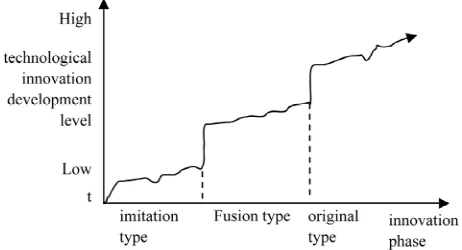
nology innovation value, the enterprises realize the origin urrent period for R&D new technology. According to the knowledge creatingal innovation in technological inno- vation mainly has three evolutionary stages: imitation type of technology innovation, fusion of technical inno- vation and original technological innovation (Figure 1).
2.1. Imitation Type Technology Innovation
Imitation type enterprise technology innovation is the imitation or copy of industrial new technology with high economic value and technological value, which has simi- lar or same functions with the existing technology or product under partly master or completely no access to the new technology. For example, in the pharmaceutical industry, generics means coping main molecular struc- ture of the original medicine, but it is the same as origi- nal developed medicine in safety, efficacy, quality and indications etc. Imitation type technology innovation is the research and development of new products or new service on the basis of making use of knowledge to ana- lyze the existing new technology enterprise. Therefore, imitation type technology innovation is the innovation of using the ready-made knowledge (K0), namely T0 = T(K0); On this basis, the productization of technology
and product marketization process respectively can be expressed as P0 = P(T0) and M0 = M(P0). Therefore, imi-
tation type technology innovation can be expressed as:
0 0 0 0
M M P M P T M P T K (1) Although the technology innovation mainly depends on the ready-made knowledge, this knowledge is rela- tively single, with no creation of new knowledge and low technology content, it is still a kind of technological pro- gress for manufacturing enterprise but rather than just engaged in speaking, it is also, and of certain technical value and economic value.
2.2. The Fusion of Technology Innovation
[image:3.595.307.538.86.211.2]Fusion of technological innovation is the process of en- terprises comprehensively using various existing techno- logy industry to develop new products or new service with high technology value, market value and economic value. From the viewpoint of knowledge management
Figure 1. Enterprises original technological innovations phase.
perspective, the fusion of technology innovation prima- rily integrates and optimizes the ready-made knowledge and information to develop new technology. Compared with imitation type, although fusion of technology also make use of all kinds of ready-made knowledge (KOi to
create new technology, the knowledge range it integrates is wider and the difficulty of fusion is greater, and it re- alizes knowledge and information creative fusion. Mean- while, without clear innovation goal, ready technical fu- sion type technology innovation lack of no ready techni- cal can imitate, eventually developing a unprecedented new techniques and new products. After this period, fu- sion type of innovation optimize and integrate all kinds of ready-made knowledge (KOi) so as to realize industri-
alization. Therefore, fusion type of innovation can be ex- pressed as followed:
1, 2, ,
N N N Oi
M M P M P T M P T K
i n
(2)
Therefore, enterprises have changed the technology or products during the process of fusion type of innovation, and new products in the whole function realized the qualitative leap. As a result, enterprises obtain indepen- dent intellectual property during the process of fusion. However, without creating new knowledge, it has essen- tial difference from imitation types of innovation.
2.3. Original Technological Innovations
and obtains completely new independent intellectual pro- perty. Original innovation has fundamental differences between imitation and fusion types of innovation. Origi- nal technological innovation can be expressed as:
N N N N
M M P M P T M P T K (3)
3. The Organization Collaborative Factor
Analysis for Original Innovation
3.1. Organization Collaborative Factors for Enterprise Original Innovation
Technical innovation is the process that the enterprise uses the original knowledge and transforms them into new technology. Many domestic researches show that the input and output of knowledge (i.e., creation of new tech- nology) presents S curve (Schilling, 2005) [13], namely that when the input of knowledge reached to a certain de- gree, new technology will be researched; while when exceeding that point of level, the possibility of researching new technology is decreasing and is approaching stable. S
curve is expressed by Logistic equation as following:
π
1
N a bK
T
e
(4)
In the equation, TN is developed new technology, K
is the knowledge invested or knowledge used. a and b is estimated coefficient, π is the opportunity output of knowl- edge input or knowledge application when organized effi- ciently. Enterprises in technological innovation system arrangement and innovation management affect the π
size of Logistic equation, which is related to the possibil- ity of original innovation of technology. As a result, the technology of original innovation organization collabora- tive factor mainly includes institutional arrangements fac- tors and its operation factors: institutional arrangements factor is related to the original innovation of enterprise technology business purposes, management strategy, in- novation standard, management organization and the pro- vision of the respect such as business functions, and it is the rule to restraint and incentive primitive innovative personnel behavior, which can be expressed as “s”. Or- ganization operation factor is original innovation of tech- nology enterprise planning, leading, organizing and con- trolling process, expressed as “m”.
Hypothesis 1: institutional arrangements factor, orga- nization operation factor and knowledge factor is key elements that affecting technical original innovation.
3.2. Organization Collaborative of Enterprise Original Innovation
Technology innovation activities are the nonlinear be- haviors that original developers carry on knowledge and knowledge creation, and put the knowledge into new
technology. It is the output of the synergy of institutional arrangements factor and organization operation factor: on one hand, technology original innovation is subject to institutional arrangements factor; on the other hand en-terprises provide dynamic feedbacks according to the ori- ginal innovation stage to increase conversion rate of knowledge to new technology. Thus, three core factors are related to enterprise original innovation: knowledge- technology conversion (rc), institutional arrangements factor
formation institutional constraints (s) and innovation behavior feedback functions by organization operation factor (m). It can be expressed by m f r s m
c, , ,
, cis the first derivative
r
N
T of successful new technology
N
T , ε stands for random disturbance action by other fac- tors of technological original innovation.
In technological original innovation, the mutual coor- dination of these three factors consists of self-organiza- tion system, which forms a gradual to mutation research behavior based on knowledge—technology transforma- tion. Because of the damping term by technological in- novation, and because variables m has great influences on technological original innovation, by ignoring sto- chastic-disturbing factors, with cubical formal represen- tation of the damping effect, m can be expressed by:
3
4 2c
m m r m s (5) Mutations theoretical research the phenomenon and law from a stable configuration warping to another kind of stable configuration. When using mathematical model to describe the continuity of a sudden interruption led to quantum action process, which possesses the feature of process continuity rather than results continuity, inner mechanism from stable state to another state is discov- ered. Just as the fore saying, technological original in- novation is the continuous transformation from one sta- ble stage to another stable stage. Thus, mutation theory is helpful to explain the inner mechanism of technological original innovation. This paper analyzes evolution me- chanism of technological original innovation by mutation theory.
According to mutation theory, combined the function of rc, s and m in technological original innovation, the
organization collaborative function of enterprise techno- logical original innovation can be expressed by
4 2c
V m m r m s m. m is state variable, and c
and
r s are control variables. Thus, V m
can be ex-pressed by
4m3 2r m s 0c
V m
c
r s
m
r
. According to cusps catastrophic model, a curved surface P of three dimensional product space of , c, s and
by one dimensional space by V (m axis), two di-mensional variable space (rc ), and therefore, a tech-nological original innovation evolution picture can be concluded as followed (e.g. Ling, 1987; Thom, 1989; Liu and Gong, 1982) [14-16].
m
In Figure 2, (1) on the smooth surface P, from the
original point (0, 0, 0), within the half space rc≤ 0, there
is a trilobites fold area, and technology develops muta- tion. Upper lobe and lower lobe is the minimal point of potential function V(m), and technological innovation are in stable state (or balance state). Among them, up lobe stands for technological innovation are in a high innova- tion stage, which is imitation technological innovation; while down lobe stands for technological are in low tech- nological stage, which is original technological innova- tion stage. Middle lobe is the great point of potential function V(m), which are in unstable stage, and is un- reachable within the evolution of technological innova- tion. BB1B2 is the division line between up lobe and
down lobe; BAC is the division line between middle lobe and lower lobe. (2) P0 are the plane by control variable
by rc and m. Path a is the projection of a1 (A1A2A) and
a2(B1DH); while path b is the projection b1 (EF).
By differential the equation of , we can get . Then calculate the simultaneous equa- tions, we can get and
V m 3
8
2
12m 2rc0
2
6
c
r m s m . Then we can get
6
c
r
m and m3 s g
. Then put m and
into , we can get
3 m
4 3 2c
V m m r m s 0
4 2
6
c c
r s
r s
g
0
3 2 0
, that is 8rc 27s . The subset obtained by the equation stands for projection of BB1B2 and BAC on the surface of P, that is curve XY
and curve XZ.
Curve XY and curve XZ are the division lines of technological innovation to create mutation. (1) When the change of control variable c and m doesn’t reach to these two lines, the technological innovation of enter- prises only has quantities changes rather than qualitative changes. (2) When control variable c and m reach to
these two lines, the technological innovation has qualita- tive changes, which is a mutation changes. Meanwhile, from Figure 2, the evolution of technological original
innovation has hysterics. For example, when technologi- cal innovation positively evolutes along with path a, that is A1 evolutes toward to A along with path a1, it first
reaches curve XY, but technological mutation doesn’t happen; only when it reaches curve XY, may new muta- tion happen. That is the hysteretic nature of technological original innovation.
r
r
4. Evolution Mechanism of Technological
Original Innovation
[image:5.595.309.534.86.252.2]According to the enterprise technological original inno- vation evolution phrases and mutation theory, combined with organization collaborative factors and its collabora-
Figure 2. The evolution chart of enterprise technological original innovation.
tive mechanism, authors did analysis on the technologi- cal original innovation from imitation innovation, fusion innovation to original innovation, and discover inner laws of technological original innovation.
4.1. Imitation Type of Technological Innovation Evolution
In Figure 2, when enterprises are in low knowledge in-
put level, and with low knowledge—technology conver- sion rate rc≤ 0, which remains stable, the feedback func-
tion (m) by knowledge—technology conversion rate (rc),
regulation restriction by institutional arrangement factors (s) and organizational operating factors (m) moves to- ward A along with curve a1. With the increasing of the
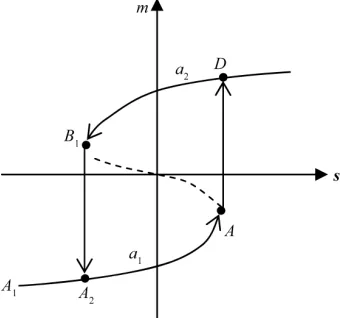
institutional arrangement factors s, the feedback function (m) by organizational operating factors will continuously increase. Then, technological innovation evolution path presents itself as a projection of curve S, that is the A1A2A in Figure 3. Under this circumstances, the tech-
nological innovation is still imitation stage, and still re- main changes, which means the imitation innovation level of enterprises is increasing, but no qualitative changes hap- pens, and original technological changes doesn’t happen.
Hypothesis 2: when rc ≤ 0, institutional arrangement
factors can play a more important role of imitation inno- vation, but mutation can be realized.
4.2. Original Technological Innovation Evolution
In Figure 2, when enterprises are in high knowledge
input level, and with high knowledge—technology con- version rate rc≥ 1, the feedback function (m) by knowl-
edge—technology conversion rate (rc), regulation restric-
tion by institutional arrangement factors (s) and organ- izational operating factors (m) moves toward A along with curve a1 and surpass A. Under the fast function of
Figure 3. Enterprises technological innovation gradual change and mutation chart.
factors (s) and organizational operating factors, the A point, which is on the edge of enterprises technological curve BAC, has a mutation to point E, it snap back from the down lobe to up lobe, and the evolution path presents a projection of S curve on variables m-s, that is the A2AD
part in Figure 3. Under these circumstances, enterprises
technological innovation lies on the basis of creating new knowledge, new technology is created by new knowl- edge, and mutation from imitation innovation to original innovation is realized.
Hypothesis 3: when rc≥ 1, organizational arrangement
factor and organization operating factor can improve the technological innovation level, and mutation to original innovation may be realized.
4.3. Fusion Technological Innovation Evolution
When knowledge—technology conversion rate rc> 0 and
rc < 1, the feedback function by knowledge—technology
conversion rate (rc), regulation restriction by institutional
arrangement factors (s) and organizational operating fac- tors will move from E to F along with curve b1. Techno-
logical innovation evolution path presents another pro- jection of S curve on variable m-s, that is the EF part in
Figure 4. Under this circumstances, on the basis of opti-
mizing and integrating all kinds of ready-made know- ledge, enterprise technological innovation finish the R& D within the continuous gradually changed process. Al- though no new knowledge is created and used, the R&D of new technology is completed, qualitative changes is accomplished during the technological innovation pro- cess.
Hypothesis 4: when rc > 0 and rc < 1, under the mutual
function of organization arrangement factor and organi- zation operating factor, enterprises realizes technological innovation through integrating all kinds of ready-made knowledge, and fusion innovation is accomplished dur- ing the process of gradual change.
Figure 4. Enterprise fusion type of innovation evolution chart.
To sum up, in order to realize original innovation, en- terprises can achieve its goal by mutation form imitation type of innovation, or by gradual change from fusion in- novation.
5. Empirical Analysis
5.1. Investigation Sample Design for Empirical Analysis
In order to verify the rationality and scientific nature of enterprise original innovation, the author mainly select typical representative enterprise with three different stages in technology innovation, in China Yangtze river delta region of Shanghai, Zhejiang and Jiangsu provinces. A sample mainly covers more than 10 industries such as medicine, energy, electronics, IT and so on, and includes 101 enterprises totally. Surveys were issuing 240 copies of questionnaires, and actual recycling 232 question- aires, among which the effective questionnaire is 223 copies and 40,052 effective data, are acquired. Among effective samples, 41% are in imitation technological innovation, 35% are in fusion technological innovation, while 24% belongs to original innovation.
5.2. Investigation Tools Design
[image:6.595.342.504.87.208.2]groups hold negative opinions, with 46 statements. Fi- nally, 20 from high-mark group and 23 from low-mark group were selected. By using Likert 11 scales, with “0 - 10” stands for “extremely in favor of” to “very approve”, Likert scale for the investigation was obtained.
5.3. Reliability Analysis of Investigation Scale
To test the scale reliability of Likert scale, the author first invited 26 technical researchers and development per- sonnel to do questionnaire survey, and then try again to do reliability analysis according to the survey results. In the study, this paper uses SPSS11.5 software to do Reli- ability Analysis. During reliability analysis, item-total correlation of one variable is 0.2661, lower than 0.3, which is eliminated. Then reliability analysis is done again. Another variable, whose item-total correlation is 0.2318, is eliminated. Then 41 variables are left, whose item-total correlation are above 0.39. Cronbach’s α of the total table is 0.9761 (Table 1), which is higher than the
standard of 0.9771. The reliability of this investigation is comparatively high.
5.4. Empirical Analysis for Hypothesis 1
Based on each variable, son variable and related original data, we did factor analysis. Factor Analysis mainly finds out public factor of each variable through variables di- mension reduction of the basic factors that can reflect technological original innovation. Screed Plot is made for factor analysis (Figure 5). In Figure 5, abscissa de-
[image:7.595.308.538.100.227.2]notes factor number, while y-coordinate stands for the corresponding value of each factor. Then draw dot ac- cording to them, and connect line, then scree plot can be obtained. The importance of each factor can be reflected from the slop of the lines. The steeper the line is, the more importance the factor is. Thus, factor 1, factor 2 and fac- tor 3 are the three leading factors (institutional arrange- ment factor, organization operating factor and knowledge factor), and other factors are secondary factor.
Table 2 shows KMO inspection and Bartlett ball de-
grees inspection results for factor analysis. From Table 2,
KMO results is 0.857, very close to 1, which means the sample data is large enough. Bartlett ball degrees inspec- tion results shows that Approx. Chi-Square is 3800.554, df is 861, and inspection of significant probability is 0.000. Thus, through the significant test, four public fac- tors obtained from factor analysis are effective; hypothe- sis 1 is established.
5.5. Empirical Analysis for Hypothesis 2
Input and output of knowledge presents S curve (namely logistic equations). Though Binary Logistic Regression model, the evolution mechanism for imitation type of innovation is tested. With low knowledge input level and
Table 1. Reliability analysis of the investigation table.
Mean Minimum Maximum Range Max/Min Variance Item Means 6.0840 4.5237 7.4429 2.9192 1.6453 0.4220 Item
Variances 6.0259 3.3706 9.9090 6.5383 2.9398 3.2570 Inter-item
Covariances 3.0090 0.0409 7.8943 7.8534 193.2480 1.4250 Inter-item
Correlations 0.5095 0.0058 0.9143 0.9085 158.8413 0.0281 Reliability Coefficients 41 items
[image:7.595.309.535.255.476.2]Alpha = 0.9761 Standardized item alpha = 0.9771
Table 2. KMO and Bartlett’s test of factor analysis.
Kaiser-Meyer-Olkin Measure of Sampling Adequacy. 0.857 Approx. Chi-Square 3800.554
df 861
Bartlett’s Test of Sphericity
Sig. 0.000
Figure 5. Scree plot of factor analysis.
rc ≤ 0, the logistic regression results between imitation
technological innovation and the feedback function (m) of institutional arrangement factor (s) and organization operating factor are showed in Tables 3 and 4.
From Table 3, the Sig. value of m and rc are both lar-
ger than 0.05, without any statistic significance; while regulation restraints (s) by institution arrangement factor and constant are both have significant statistic meanings. Meanwhile, Sig. value of Hosmer and Lemeshow Test in
Table 4 is apparently lower than 0.05, which means that
with low knowledge input level and rc ≤ 0, feedback
function of organization operating factor is compara- tively lower, and regulation restraints of institution ar- rangements factor has greater effect on imitation type of innovation. The model prediction accuracy reaches 87.1%, which shows hypothesis 2 is established.
5.6. Empirical Analysis for Hypothesis 3
Table 3. Variables in the equation.
B S.E. Wald df Sig. Exp(B) Step
1(a) s –1.421 0.354 16.128 1 0.000 0.241
m –0.339 0.323 1.096 1 0.295 0.713
rc –0.192 0.892 0.046 1 0.830 0.825
Constant 10.743 2.579 17.356 1 0.000 46314.726
a Variable(s) entered on step 1: s, m, rc.
Table 4. Hosmer and lemeshow test.
Step Chi-square df Sig.
1 19.321 8 0.013
mechanism for original type of innovation is tested. When the knowledge input level is high, and rc≥ 1, the
results are showed in Tables 5 and 6.
From Table 5, Sig. value of m, s, rc and constant is
lower than 0.05, which is of significant statistic meanings. Meanwhile, Sig. value of Hosmer and Lemeshow Test in
Table 6 is apparently lower than 0.05, which means this
model is of significant statistic meanings. The model pre- diction accuracy reached 88.1%, which shows hypothesis 3 is established.
5.7. Empirical Analysis for Hypothesis 4
Though Binary Logistic Regression model, the evolution mechanism for fusion type of innovation is tested. When
rc > 0 and rc < 1, the results are showed in Tables 7 and
8.
From Table 7, we can see that Sig. value of s, rc and
constant is larger than 0.05, which lack of statistic sig- nificance; while the Sig. value feedback functions of or- ganization operation factor (m) is lower than 0.05, with significant statistic meanings. Meanwhile, Sig. value of Hosmer and Lemeshow Test in Table 6 (0.001) is lower
than 0.05, which shows that this model is of significant statistic meanings. When rc > 0 and rc < 1, that is know-
ledge—technology conversion rate is high, the feedback function (m) of organization operation factor has greater effect on fusion type of innovation. The model prediction accuracy reached 85.3%. It shows that the feedback function (m) of organization operation factor is more im- portant than that of institution restraint (s) of institution arrangements factor. Thus, hypothesis 4 should be mode- rated. “Under the mutual function of institution arrange- ment factor and organization operation factor” should be changed into “under the function of organization opera- tion.”
6. Conclusions
Technological original innovation is that enterprises re-
Table 5. Variables in the equation.
B S.E. Wald df Sig. Exp(B) Step 1 s 1.336 0.357 14.017 1 0.000 3.804
m 0.640 0.337 3.601 1 0.048 1.896
rc 0.353 0.388 3.105 1 0.046 1.823
Constant –13.410 3.114 18.540 1 0.000 0.000
Table 6. Hosmer and lemeshow test.
Step Chi-square df Sig.
1 25.194 8 0.001
Table 7. Variables in the equation.
B S.E. Wald df Sig. Exp(B) Step 1 s 0.299 0.210 2.042 1 0.153 1.349
m –0.506 0.247 4.220 1 0.040 0.603
rc 0.268 0.698 0.148 1 0.701 1.308
Constant 1.215 1.125 1.165 1 0.280 3.369
Table 8. Hosmer and lemeshow test.
Step Chi-square df Sig.
1 7.402 8 0.049
search and develops new products or new technology by the aid of using or creating knowledge. It is the techni- calization of knowledge, productization of technology and marketization of product, which finally obtain the independent intellectual property of significant compre- hensive benefits (including technological benefits, eco- nomic benefits, social benefits and environmental bene- fits). Before the realization of technological original in- novation, imitation innovation and fusion innovation should be realized before.
Technological original innovation is the process of en- terprises making use of knowledge to create new tech- nology. The input and output of knowledge presents S curve. Logistics equation is used to show the evolution mechanism of technological original innovation. Muta- tion theory is used to analyze the evolution mechanism of technological original innovation. 1) when rc≤ 0, institu-
tional arrangement factor has greater effect on imitation innovation, but mutation of technological innovation level can not be realized; 2) when rc≥ 1, institutional arrange-
ment factor and organization operation factor can pro- mote technological innovation level, mutation can be achieved, and original innovation can be obtained; 3) when rc > 0 and rc < 1, under the organization operation
forward hypothesis and verify the scientific nature and rationality of the evolution of technological original in- novation.
7. Acknowledgements
This research was supported by the National Science Foundation under the Grant 71031003; The national mi- nistry of education in humanities and social science re- search project (10YJC630116); 2009 Jiangsu university philosophy social sciences funded projects (09SJB63- 0041).
REFERENCES
[1] S. Haider, “Organizational Knowledge Gaps: Concept and Implications,” Druid Summer Conference, Denmark, 12-14 June 2003, pp. 1-24.
[2] E. Kirner, S. Kinkel and A. Jaeger, “Innovation Paths and the Innovation Performance of Low-Technology Firms— An Empirical Analysis of German Industry,” Research Policy,Vol. 38, No. 3, 2009, pp. 447-458.
doi:10.1016/j.respol.2008.10.011
[3] A. Malmberg, “The Elusive Concept of Localization Economies: Towards a Knowledge-Based Theory of Spa-tial Clustering,” AAG Annual Conference, New York, 27 February-3 March 2001, pp. 429-449.
[4] C. Nunzia, “Innovation Processes within Geographical Clusters: A Cognitive Approach,” Technovation, Vol. 24, No. 1, 2004, pp. 17-28.
doi:10.1016/S0166-4972(02)00046-9
[5] H. Tsai and J. C. Wang, “External Technology Sourcing and Innovation Performance in LMT Sectors: An Analy- sis Based on the Taiwanese Technological Innovation Sur- vey,” Research Policy, Vol. 38, No. 3, 2009, pp. 518-526.
doi:10.1016/j.respol.2008.10.007
[6] A. Landier, “Start-Up Financing: From Banks to Venture Capital,” Working Paper,University of Chicago, Chicago, 2002.
[7] A. Winton and V. Yerramilli, “A Model of Entrepreneu- rial Finance,” Working Paper, University of Minnesota, Minneapolis, 2004.
[8] J. E. Bettignies and J. Brander, “Financing Entrepreneur- ship: Bank Finance Versus Venture Capital,” Journal of Business Venturing, Vol. 22, No. 6, 2007, pp. 808-832.
doi:10.1016/j.jbusvent.2006.07.005
[9] Y. Long and J. H. Chang, “A Study on the Relationships among Types of Innovation, Financing Choice and Mar-ket Strategy in Young High-Tech Firm,” Science of Sci-ence and Management of S. & T, Vol. 10, No. 1, 2008, pp. 70-74.
[10] R. Thom, “Structural Stability and Morphogenesis, Eng- lish Translation of Stabilite Structurelle et Morphogenese,” W. A. Benjamin, Inc., New York, 1973.
[11] E. H. Bowman and D. Hurry, “Strategy through the Op- tions Lens: An Integrated View of Resource Investments and the Incremental-Choice Process,” Academy of Man- agement Review, Vol. 18, No. 4, 1993, pp. 760-782. [12] W. F. Hamilton and G. R. Mitchell, “Managing R&D as a
Strategic Option,” Research & Technology Management, Vol. 50, No. 2, 2007, pp. 41-50.
[13] M. A. Schilling, “Strategic Management of Technological Innovation,”Tsinghua University Press, Beijing, 2005. [14] F. H. Ling, “Mutation Theory and Its Applications,”Shang-
hai Jiao Tong University Press, Shanghai, 1987.
[15] R. Thom, “Mutation Theory: Ideas and Applications,” Shanghai Translation Publishing House, Shanghai, 1989. [16] J. M. Liu and C. D. Gong, “A Justification for the Scaling