A PROPOSED FRAMEWORK FOR GENERATING RANDOM OBJECTIVE EXAMS USING PARAGRAPHS
*Elsaeed
Computer Teacher Preparation Department
ARTICLE INFO ABSTRACT
Objective Exams (OE) plays a major role in educational assessment as well as in Electronic learning. In this paper we present a Framework
(multiple choice questions (MCQ), true
paragraphs of electronic course. The proposed Framework consists of a lot of main stages, it uses both of the Natural Language Processing (NLP) techniques to generate three types of questions (GFQ, T/FQ, and MCQ), and Exam Maker (EM), it uses the generated questions to produce the object exams.
Copyright©2017, Elsaeed Elsaeed Mohamed Abd Elrazek
permits unrestricted use, distribution, and reproduction in any medium, provided the original work is properly cited.
INTRODUCTION
Style currently used in the preparation of the Exam is a traditional style, which is dominated by the nature of the challenge it takes to be a professor of time and effort great in search and review content to create a single model of exam with test questions fit in with educational experiences and training activities for students. Electronic exams
the most prevalent methods of assessment for the purposes of both the evaluation to assess the learners' ability to learn, and to assess the impact of the teaching capabilities of the instructor, and thus E valuation significantly affect the improvement of learning outcomes. Exams play an important role in electronic evaluation, and provide an array of benefits for both the learner and the instructor (Van lent, Gerbe
2009) The Random Objective ExamsGeneration (ROEG) depends on the questions as the main component of any Exam. The task of composing Exam questions is responsibility of the professor who collect their own exam bank in many forms to help them compose future exams RMEPGhas one of the Applications Artificial Intelligence (AAI) that make questions Banka electronic courses and extract data from exams (Fredrik Olsson, 2009)
*Corresponding author: Elsaeed Elsaeed Mohamed Abd Elrazek
Computer Teacher Preparation Department, Faculty of Specific Education, Damietta University, Egypt.
ISSN: 0975-833X
Article History:
Received 16th December, 2016
Received in revised form 17th January, 2017
Accepted 28th February, 2017
Published online 31st March,2017
Key words:
Objective Exams (OE), multiple choice questions (MCQ), true-false question (T/FQ),Complete Questions (CQ), Electronic exams (E-exams), Applications Artificial Intelligence (AAI), Random Objective Exams Generation (ROEG).
Citation: Elsaeed Elsaeed Mohamed Abd Elrazek,
courses”, International Journal of Current Research, 9,(0
RESEARCH ARTICLE
A PROPOSED FRAMEWORK FOR GENERATING RANDOM OBJECTIVE EXAMS USING PARAGRAPHS
OF ELECTRONIC COURSES
Elsaeed Elsaeed Mohamed Abd Elrazek
Computer Teacher Preparation Department, Faculty of Specific Education, Damietta University, Egypt
ABSTRACT
Objective Exams (OE) plays a major role in educational assessment as well as in Electronic learning. In this paper we present a Framework that generates three types of Objective exams questions (multiple choice questions (MCQ), true-false question (T/FQ), and complete Questions (CQ)from paragraphs of electronic course. The proposed Framework consists of a lot of main stages, it uses both the Natural Language Processing (NLP) techniques to generate three types of questions (GFQ, T/FQ, and MCQ), and Exam Maker (EM), it uses the generated questions to produce the object
.
Elsaeed Elsaeed Mohamed Abd Elrazek. This is an open access article distributed under the Creative Commons Att use, distribution, and reproduction in any medium, provided the original work is properly cited.
used in the preparation of the Exam is a traditional style, which is dominated by the nature of the challenge it takes to be a professor of time and effort great in search and review content to create a single model of exam educational experiences and Electronic exams (E-exams) of the most prevalent methods of assessment for the purposes of both the evaluation to assess the learners' ability to learn, and capabilities of the instructor, and thus E valuation significantly affect the Exams play an important role in electronic evaluation, and provide an array of benefits for both the learner and the instructor (Van lent, GerbenGlobal, The Random Objective ExamsGeneration (ROEG) depends on the questions as the main component of any Exam. The task of composing Exam questions is responsibility of the professor who collect their own exam bank in many forms to RMEPGhas one of the Applications Artificial Intelligence (AAI) that make questions Banka electronic courses and extract data from exams (Fredrik
Elsaeed Elsaeed Mohamed Abd Elrazek,
Preparation Department, Faculty of Specific
ROEG can help professors effectively evaluate student's acquisition of essential knowledge and skills
professors to focus on more complex educational acti
the other hand help student focus on the main topics in their study (Javier Sarsa and Rebeca Soler,
an intelligent approaches to exam Generation
of electronic courses will be presented which generates thre types of Objective exams questions (multiple choice questions (MCQ) which require students to select the correct response from several alternatives, true
completeQuestions (CQ) to supply a word or short phrase)
Problem of the research
Traditionally, composing examination is done manually by using the writers’ knowledge, experience and style. Professors need to spend a lot of time and energy in composing examination. Although it, there are still some shortcomings. The main problem is a low quality of exams caused by some human factors such as the traditional method for the development of the exam covers a narrow scope of Curriculum topics. This does nothing for the sep
about the examination process. Therefore, with the use of questions of E-course, automatic generation of exam is amost important exam specifications
2008).
International Journal of Current Research
Vol. 9, Issue, 03, pp.47897-47903, March, 2017
OF CURRENT RESEARCH
ek, 2017. “A proposed framework for generating random objective exams using paragraphs of electronic
, 9,(03), 47897-47903.
A PROPOSED FRAMEWORK FOR GENERATING RANDOM OBJECTIVE EXAMS USING PARAGRAPHS
Damietta University, Egypt
Objective Exams (OE) plays a major role in educational assessment as well as in Electronic learning. that generates three types of Objective exams questions false question (T/FQ), and complete Questions (CQ)from paragraphs of electronic course. The proposed Framework consists of a lot of main stages, it uses both the Natural Language Processing (NLP) techniques to generate three types of questions (GFQ, T/FQ, and MCQ), and Exam Maker (EM), it uses the generated questions to produce the object
is an open access article distributed under the Creative Commons Attribution License, which
ROEG can help professors effectively evaluate student's acquisition of essential knowledge and skills thereby enabling professors to focus on more complex educational activities, On the other hand help student focus on the main topics in their (Javier Sarsa and Rebeca Soler, 2012) In this research, exam Generation from Paragraphs of electronic courses will be presented which generates three types of Objective exams questions (multiple choice questions (MCQ) which require students to select the correct response from several alternatives, true-false question (T/FQ) and completeQuestions (CQ) to supply a word or short phrase)
Traditionally, composing examination is done manually by using the writers’ knowledge, experience and style. Professors need to spend a lot of time and energy in composing Although it, there are still some shortcomings. The main problem is a low quality of exams caused by some human factors such as the traditional method for the development of the exam covers a narrow scope of Curriculum topics. This does nothing for the separation of teaching process about the examination process. Therefore, with the use of bank , automatic generation of exam is amost important exam specifications (Yang Yu, Hongyan Wang,
OF CURRENT RESEARCH
Present research sheds light on bank questions of E-course in higher education and especially the process of Random Objective ExamsGeneration (ROEG), which has become of paramount importance to reduce the processes of leaking exam and cheating student. The main point in this research is how to Design algorithm for Exams generation from an E-course and used in the preparation of different models exam. The generated exams from bank questions of E-course according to a set of rules and content quality assurance standards of the exam and diversity of the questions.
Research questions
1- What stages design of a proposed Framework to Random Objective Exams Generation (ROEG) from questions Bank of Electronic Courses?
2- How can aproposed Framework be developed to help professors in generating Objective Exam from an E-Course?
3- What are the most important used to evaluate the performance of the proposedFramework?
Research objectives
The objectives of this research are:
1- reach to stages of preparing Framework proposal to Random Objective Exams Generation (ROEG) from Paragraphs of Electronic Courses
2- prepering subsystem to query into bank question of E-course aimed at generating random for three types of questions (MCQ,T/FQ, CQ)
3- Preparing subsystem to generate models of the exam includes random questions, which represent the output of the previous subsystem
4- Measuring the impact of the models exam generated by the proposed Framework according to the general shape of the exam
E-Course and Exams Generation
There are many E-Courses producing for students of Educational University, The professor puts a set of questions to create question bank of E-course to assist them in future exam generation for their students. The exam generation process depends often on questions objectivity pattern ,which focus on educational content, where the text is created a lot of objectivity questions related to that specific content (Wolfe, 1976) MCQ,T/FQ and CQ generation is the tasks of generating questions from text inputs, having prospective E-course content. Which are used widely as tools for assessing evaluations for most levels of education as framework conceptual understanding of the students can be boosted by posing MCQs on the concepts just taught (Nicol, 2007) the art of formulating questions is one of the fundamental abilities of a good professor .in practicing professorate, an professor must reach the students hidden levels of knowing and awareness in order To help them to reach a high level of thinking in answering questions. Question bank in E-Courses can be classified into five categories they are as follows: Factual Questions (FQ), Inductive Questions (IQ), Analytical Questions (AQ), objective Questions (OQ) and Tag Questions (TQ) (Michael Heilman, 2011) Objective ExamQuestions (OEQ) are those that require a specific answer. An objective Exam usually has only one potential correct answer (there may
be some room for answers that are close). OEQmay be constructed so that they contain a list of possible answers, so that the student will be expected to recognize the correct one, Objective Exam items are most often used to assess knowledge of a particular topic, and they typically appear on achievement exams, they are so easy to score, easy to analyze, and so easily tied to learning. There are many advantages to objective Exams. They can, for example, significantly reduce marking time and analysis of individual questions is more feasible. This allows Professors to quickly identify areas where only a few candidates respond correctly or where most candidates choose the same incorrect option and try to correct any misconceptions.
Fill-in-the-blank questions are a common type of question due to their ease of creation and usefulness in classes across the curriculum. They are considered an Objective Exam Questions because there is only one possible answer that is correct. They are typically used to measure a wide variety of relatively simple skills and specific knowledge. Also questions can be more easily pre-tested in order to evaluate their effectiveness and level of difficulty. For example, pre-testing may expose questions with design flaws such as good candidates consistently selecting incorrect options. The types of OEQ as follows: Multiple choiceQuestions (MCQ), true or FalseQuestions (T/FQ), Gap fillQuestions (GFQ), and matching Questions (MQ). Most professors attempt to get a mix of these types of questions in order to best cover the objectives that were part of the lecture plan
Generating objectivity questions automatically is a relatively new and important research area and potentially useful in computer teacher. Here we first discuss a few systems for objectivity questions generation Brown. & et. (2005) developed a system for automatic generation of vocabulary assessment questions. They used WordNet for finding definition, synonym, antonym and hyponym in order to generate the Questions focused on attention (Brown et al., 2005)
Aldabe et al. (2006) and Aldabe & Maritxalar (2010) developed systems to generate objectivity questions. They have divided the task into six phases: selectionsentence, filling blanks, generation of distractors, selection of distractors, evaluation with learners and item analysis
For question selection Agarwal and Mannem (2011) used a number of features like: is it first question, contains token that occurs in the title, position of the question in the document, whether it contains abbreviation or superlatives, length, number of nouns and pronouns etc. But they have not clearly reported what should be optimum value of these features or how the features are combined or whether there is any relative weight among the features (Agarwal and Mannem, 2011)
Generation of objectivity questions automatically consists of three major steps; (i) selection of sentences from which question can be generated, (ii) identification of the keyword which is the correct answer and (iii) generation of distractors that are the wrong answers (Bernhard, 2010).
Proposed Framework
Such a system normally establishes a knowledge base to guarantee a high possibility of success and quality of examination. The proposed system to develop criteria as follows: taking into account the relative weight of each educational module within the E-course, taking into account the percentage of representation of each type of the three types of objective Exam Questions, the expense of ease and difficulty of the questions coefficient, avoiding questions repeat within the same test, to avoid generating questions duplicates leaves.
The proposed random models exam Generation
Framework
The proposed Framework consists of a lot of main Stages, it uses both of the Natural Language Processing (NLP) techniques to generate three types of questions (GFQ, T/FQ, and MCQ), and Exam Maker (EM), it uses the generated questions to produce the object exam
The actors in the proposed Framework use case are:
1- Admin, who is responsible for:
- manage the verbs database use case which is responsible for adding, editing and removing verbs on the verbs database.
- manage the system dictionary use case which controls the adding or deleting processes on the system dictionary
- prepare questions model use case which is used in the development of the generated exam use case - Collected Questions Randomly for Preparing Exam
Models which is responsible for providing the professor with Exam
- Login learners Questions bank Management and get their the powers to deal with the proposed system (user name & password)
2- Professor. who is responsible for:
- Divide the course into learning modules, which are the foundation stone for generating Questions - prepare questions, which are considered the main
input to the generated exam
The three types of Objective Exams Questions (MCQ,T/FQ, CQ) goes through many stages, as follow: :data Processing of educational module in E-course, That stage aims to do many processes on the sentences which convey the main part of question; the output of this stage is the part of question tagged sentence and the identified entities on the Educational content of E-course. The proposed question Generation subsystem uses the open natural language processing (NLP) tool at this stage, which is a java library for processing natural text, based on machine learning tools, it supports variety of natural language processing tasks such as the following:
1-Information extracted paragraph stage (IEPS)
The paragraph is a set of interconnected sentences. In terms of meaning and relate to only one idea, each sentence containing a verb that expresses the idea of paragraph in the form of a statement, question, instruction, or exclamation and when typing a paragraph should begin with a capital letter. There are many ways to extract information from the content such as rule learning based method, which use several general rules to extract information from content. The rule-based systems have
been mostly used in information extraction from semi-structured web page. A method is to learn syntactic/semantic constraints with delimiters that bound the text to be extracted, that is to learn rules for boundaries of the target text. Two main rule learning algorithms of these systems are: bottom-up method which learns rules from special cases to general ones, and top-down method which learns rules from general cases to special ones. The (LP)2 algorithms is one of the typical bottom-up methods. It learns two types of rules that respectively identify the start boundary and the end boundary of the text to be extracted from paragraph. The learning is performed from examples in a user-defined corpus (training data set). Training is performed in two steps: initially a set of tagging rules is learned; then additional rules are induced to correct mistakes and imprecision in extraction. Three types of rules are defined in (LP)2: tagging rules, contextual rules, and correction rules
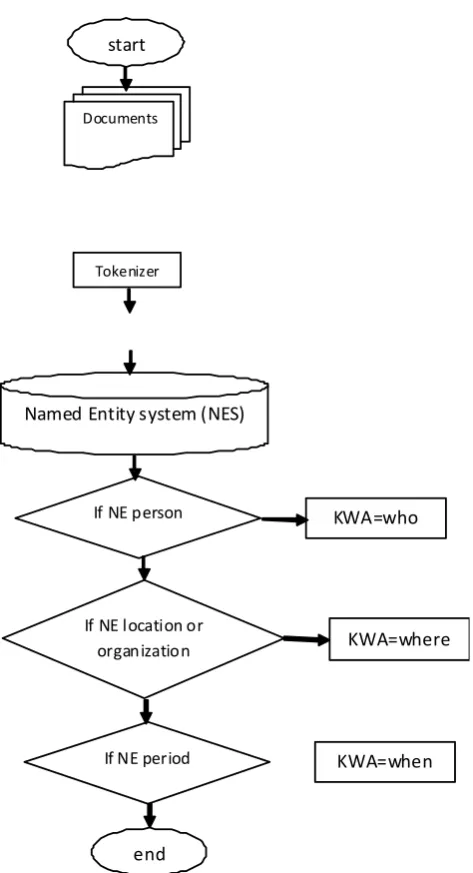
Fig.1. Flow chart of the Random Objective Exams Generation (ROEG)
2-TokenizationStage (TS)
3- Part Of Speech Tagging (POST)
Is the process of marking up a word in a text as corresponding to a particular part of speech, based on both its definition and its context, which is a very important factor on determining the appropriate tag for each token, its relationship with adjacent and related words in a phrase, sentence, or paragraph. There are a number of Maximum Entropy POST developed in an attempt to further improve the accuracy that can be achieved by the tools which use it; such as open natural language processing, Examples include model Ratnaparkhi (Kubler, Sandra, et al., 2010)Ratnaparkhi describes Statistical model which trains from a corpus annotated with Part-Of- Speech tags and assigns them to previously unseen text with state-of-the-art accuracy (96.6%). The model can be classified as a Maximum Entropy model and simultaneously uses many contextual "features" to predict the POS tag. Furthermore, and use of specialized features to model difficult tagging decisions, discusses the corpus consistency problems discovered during the implementation of these features, and proposes a training strategy that mitigates these problems (Ratnaparkhi, Adwait. 1996). Along with contextual features looking at the surrounding words and tags, there are a number of futures based on the form of the word including the nature of affixes and the inclusion of apostrophes, hyphens, capital letters, and numbers. It's also possible to further control the POST by providing it with a POS lookup list which consist of a text file with a word in the sentence and its possible POST on each line. The question generation subsystem uses the maximum entropy model for its POST, it converts the array of tokens to its POST sentence. When the tag is repeated many time in the sentence, it will be distinguished by a number to talk it easy to recognize it later in the process of generation a question
4-Named Entity Recognition Stage (NERS)
Named-entity recognition Stage (NERS) refers to extraction of data directly from text sentences considering that data extraction task is responsible for finding, storing and sorting textual content into categories. NERS used by Question generation subsystem with its embedded open natural language processing library, which contains a set of pre-trained models for finding entity elements from raw data and can determine the category in which the element belongs; there are English Named Entity Recognition (date - location – organization – percentage - person – time). The system reads the sentence and highlights the important entity elements in the text. The question Generation subsystem entity finder uses Maximum
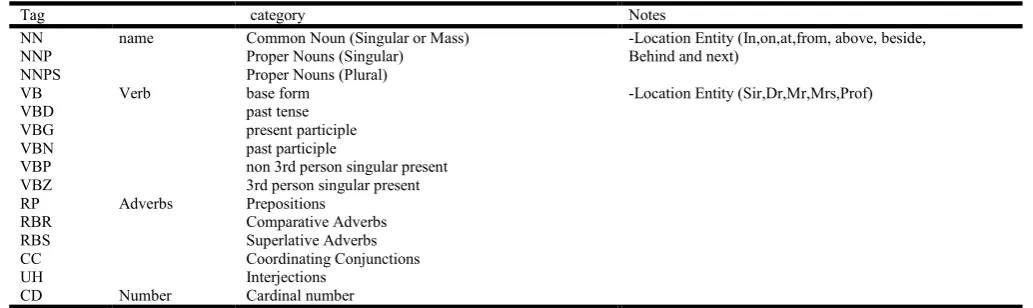
Entropy model to identify each entity .the Maximum Entropy Named Entity Recognition estimates probabilities based on the principle of making as few assumptions as possible, other than the constraints imposed .Such constraints are derived from training data, expressing some relationship between features and outcome (Chieu,Hai Leong, and HweeTou Ng.2002). The question generation adds new constraints to identify more entities, such as the prepositions which are followed by names considers location, and some prefixes such as (Sir,Dr,prof.,….etc) which identifies the person entity.
5-Stage of key word Answer (KWA) determination according to the question type Objective
[image:4.595.306.560.294.364.2]The question Generation Proposed subsystem Generates detect the Answerword required to prepare object question by using the identified entity type contained in the paragraph through some rules as follow:
Table 2. Rules for key word Answer determination
key Word Answer
(KWA) Entity category Tag
POS Tag paragraph who person NN
p Where Location NNP
organization When Period
(Date/time/year/hours) CD
6- Objective Question Generating Stage (OQGS)
This stage aims to generate three types of objective Exams of each Module through the following steps
- division the E-course to many modules
- Restructuring the E-coursemanually to get a single shortened version of sentences that conveys the main piece of information
- Get the tokens of the processed sentence (TS) - Get the Part of Speech tagged sentence (POST)
- Named Entity Recognition to identify entities of each token
- Get the final Objective Exam Questions form
6-Exam maker subsystem (EMS)
A process of preparing the Exam maker requireto be Taken into account the appropriate number of questions in light of the
Table 1. Classification rules of the POS Tags
Tag category Notes
NN name Common Noun (Singular or Mass) -Location Entity (In,on,at,from, above, beside, Behind and next)
-Location Entity (Sir,Dr,Mr,Mrs,Prof) NNP Proper Nouns (Singular)
NNPS Proper Nouns (Plural) VB Verb base form
VBD past tense VBG present participle VBN past participle
VBP non 3rd person singular present VBZ 3rd person singular present RP Adverbs Prepositions
RBR Comparative Adverbs RBS Superlative Adverbs CC Coordinating Conjunctions UH Interjections
[image:4.595.40.557.464.618.2]relative weight of each Module of E-course through the following equation:
Fig.3. Objective Exam question generating stage
Whereas:
NQ: number of questions for each Module TM: total number of pages module TC: total number of pages course TQ: total number of Exam questions
The Exam Maker subsystem should determine the number of each type of questions that have been generated for each module, Taking into account the equivalent percentage of representation for every word of the key Words Answer (KWA) such as (who-where-when)within each Module, where the ratio is equal to 33.3%almost. According to the previous step, the Exam Maker subsystem presents the Exam to the
professor for selecting the date and the duration of the exam, and then be the examination ready for printing
Fig.3. Objective Exam question generating stage
Experimental work
The proposed intelligent system consists of a lot of main subsystems, it uses both of (NLP) techniques to generate three types of questions (GFQ, T/FQ, and MCQ), and Exam Maker (EM), it has been implemented in the computer networks E-course, it taught the four year student in the faculty of specific education, computer Teacher preparation department, Damietta university
The following example illustrates the OEQ process. The sentence:
The best types of network cables are fiber cables and coaxial cables
[image:5.595.320.547.439.568.2]1-The POS tagged: Illustrated in Table 3.
Table 3. The Tokens and its corresponding Tags
Token Tag The Meaning The DT Determiners best JJS Superlative Adjectives types NNS Common Nouns (Plural) of IN Prepositions and Conjunctions network NN Common Nouns (Singular or Mass) cables NNS Common Nouns (Plural)
are VBP Verbs (non 3rd person singular present)
fiber JJ Adjectives
cables NNS Common Nouns (Plural) and CC Coordinating Conjunctions coaxial JJ Adjectives
cables NNS Common Nouns (Plural)
2-The alternatives are:
-[The best ] of [network] cables are [fiber] cables and [coaxial] cables
-……types of network cables are fiber cables and…….. cables The question generate subsystem
That process is done through Getting the Part Of Speech Tagging (POST) sentence and entities, Selection randomly of alternatives that may be either the first name or adjective, and finally empty the selected alternative
RESULTS AND DISCUSSION
The proposed system will be evaluated by the extent of its ability to generate multiple objective questions and Printing exam. The Questions that have been generated from the proposed system was presented to the three of the arbitrators specialists in the field of computer networks to express an opinion on the extent of their relationship to E-course and the
Documents
Tokenizer
Named Entity system (NES)
If NE person
If NE location or organization
If NE period
KWA=who
KWA=where
KWA=when
end start
accuracy of linguistic and scientific formulation. Examining what the arbitrators agree upon, the number of valid question and these types that the program generated for the computer networks E-course illustrated in the Table 4.
Table 4. The numbers of the generated question for the computer networks E-course
Module Type of questions Total MCQ T/FQ CQ
1 10 6 10 26
2 12 9 8 29
3 8 10 6 24
Total 30 25 24 79
To judge the effectiveness of the proposed system in terms of its ability to query and accuracy in generating questions, so we will use the following equations (Kalady et al., 2010) :
Accuracy =
correct
correct +defective
Query = correct
correct +missed
[image:6.595.314.563.212.757.2]Where: correct represents the number of questions that have been generated through the proposed system has been evaluated by the arbitrators to correct it linguistically and scientifically. Defective represents the number of questions that have been generated through the proposed system has been evaluated by the arbitrators as incorrect linguistically or scientifically. Missed represents the number of questions that are not being generated by the proposed system, and that should the proposed system is that they generate from the viewpoint of arbitrators
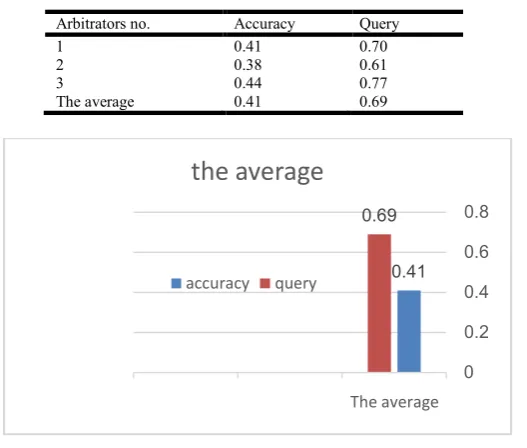
Table 5. The obtained accuracy and query
Arbitrators no. Accuracy Query
1 0.41 0.70
2 0.38 0.61
3 0.44 0.77
The average 0.41 0.69
Fig.4. The average of accuracy and query
Table 5 and the Figure 4. illustrate that, the query rates is greater than accuracy rates because the proposed system passes by each sentence and paragraph in the E-course of computer networks and generates many questions on it. To evaluate the Examination generated by the proposed system, a questionnaire was presented to the five of the arbitrator's
specialists in the field of computer networks and teaching methods, to give their opinion on the availability of educational and academic standards in form and content then apply the following equation:
Agreement Coefficient =
The number of approvers on the standard
The total number of arbitrators *100
Table 6. The results of arbitrator's opinion, values of the agreement coefficient for each standard and the average
Fig.5. the results of arbitrator's opinion and the values of the agreement coefficient for each standard
No. Standard
The Number of consenting to meet the
standard
The agreement Coefficient
The Average
1 Questions fit with the objectives of the module
5 100% 90%
2 the Question covers only one idea
4 80%
3 Clarity wording of the questions
5 100%
4 Cover questions per module
4 80%
5 Questions devoid of grammatical errors
4 80%
6 Questions devoid of exile
5 100%
7 Questions measure cognitive aspects
5 100%
8 Questions measure Analysis capability
5 100%
9 The answer can be inferred directly from the head of the question
4 80%
10 Simplicity of Questions
4 80%
11 Blanks appears at the end of the question
5 100%
12 Questions fit with individual differences among students
4 80%
13 Lack of multi-answer of the question
4 80%
14 Answer of question does not depend on answer of another question
5 100%
Fig.5. The results of arbitrator's opinion and the values of the agreement coefficient for each standard
0.41 0.69
0 0.2 0.4 0.6 0.8
The average
the average
[image:6.595.43.562.230.776.2] [image:6.595.294.561.237.739.2] [image:6.595.35.299.476.700.2]Evident from the Table 6 and Figure 5 arbitrators approval of the exam to achieve educational and academic standards required, average coefficient value of the agreement was 90%. These results agreed with the previous studies in the automatic exam generation evaluation, when always the recall is higher than precision because the generated exams from the proposed system are always more than the Exams generated by the professors, this prove the effeteness of the proposed system
Conclusion
In this paper, an approach to automatically generate exam from a paragraphs of E-course was proposed. This approach is included in a Proposed by the researcher an implemented on the computer Networks which is taught to first year student in faculty of specific education, Damietta University, Egypt Automatic exam generation process has gone through many stages will be summarized as follow: Information extracted paragraph stage (IEPS), Tokenization Stage (TS), Part Of Speech Tagging (POST), Named Entity Recognition Stage (NERS), stage of key word Answer (KWA) determination according to the question type Objective, Objective Question Generating Stage (OQGS), and Exam maker subsystem (EMS)
REFERENCES
Agarwal, M., and Mannem, P., 2011. Automatic gapfill question generation from textbooks. In Proceedings of the 6th Workshop on Innovative Use of NLP for Building Educational Applications, pp. 56-64
Aldabe, I., Lopez de Lacalle, M., Maritxalar, M., Martinez, E., Uria, L., 2006. ArikIturri: An Automatic Question Generator Based on Corpora and NLP Techniques. In ITS. LNCS 4053, pp. 584594
Aldabe, I., Maritxalar, M., 2010. Automatic Distractor Generation for Domain Specific Texts. Proceedings of IceTAL, LNAI 6233. pp. 27-38
Bernhard, D., 2010. Educational Applications of Natural Language Processing. In NATAL. pp. 1-123.
Brown, J. C., Frishkoff, G. A., and Eskenazi, M., 2005. Automatic question generation for vocabulary assessment. In Proceedings of the conference on Human Language Technology and Empirical Methods in Natural Language Processing, Association for Computational Linguistics, pp. 819-826.
Chieu, Hai Leong, and HweeTou Ng. 2002. "Named entity recognition:a maximum entropy approach using global information. "Proceeding of the 19th international conference on computation linguistics, Vol.(1).
Eupopean Quality Observatory (EQO), 2005, Quality in e-learning
Fredrik Olsson, 2009. "A literature survey of active machine learning in the context of natural language processing", SICS Technical Report T2009:06, ISSN: 1100-3154. Javier Sarsa and Rebeca Soler, 2012, E-Learning Quality
Relations and Perceptiions
Kalady, S., Elikkottil.A. and Das, R. Natural language question generation using syntax and keywords. In Kristy Elizabeth Boyer and Paul Piwek, editors, Proceeding of QG2010:The Third Workshop on Question Generation, Pittsburgh, June 2010. Available at: Question generation Org. URLhttp://oro.open.au.uk/22343/.
Kubler, Sandra, et al. 2010."Adding context information to part of speech tagging for dialogues."Ninth International Workshop on Tree banks and Linguistic Theories.
Michael Heilman, 2011. Automatic Faculty Question Generation from Text. PH.D. Dissertation, Carnegie, Mellon University, 2011
Nicol, D., 2007. E-assessment by design: using multiple choice tests to good effect. Journal of Further and Higher
Education, Vol. 31(1), pp. 53-64
Oliver, Ron, 2005, Quality assurance and e-learning :blue skies and pragmatism
Ratnaparkhi, Adwait. 1996. A maximum entropy model for part-of-speech tagging. In Proceedings of the Conference on Empirical Methods in Natural Language Processing, University of Pennsylvania, pp. 133–142
SAUL CARLINER and PATTI SHANK, 2008, THE E-LEARNING HANDBOOK
Vanlent, Gerben GLOBAL, 2009. Risks and benefits of CBT versus PBT in high-stakes testing. The Transition to Computer-Based Assessment, VOL. (83).
Wikipedia. 2010a. Randomization. [online] Available: http://en.wikipedia.org/wiki/Randomization
Wolfe, J. 1976. Automatic question generation from text –an aid to independent study. In Proceedings of ACM SIGCSE.1976 Available at : http://dl.acm.org/citation.cfm? id=803459
Yang Yu, Hongyan Wang, 2008. Adaptive Online Exam Questions Based on Systematic Analysis and Design, vol. 4, Wuhan University of Technology, p. 30