Improving Multi-documents Summarization by Sentence Compression
based on Expanded Constituent Parse Trees
Chen Li1, Yang Liu1, Fei Liu2, Lin Zhao3, Fuliang Weng3 1 Computer Science Department, The University of Texas at Dallas
Richardson, TX 75080, USA
2 School of Computer Science, Carnegie Mellon University
Pittsburgh, PA 15213, USA
3 Research and Technology Center, Robert Bosch LLC
Palo Alto, California 94304, USA
{chenli,[email protected]} {[email protected]}
{lin.zhao,[email protected]}
Abstract
In this paper, we focus on the problem of using sentence compression techniques to improve multi-document summariza-tion. We propose an innovative sentence compression method by considering every node in the constituent parse tree and de-ciding its status – remove or retain. In-teger liner programming with discrimina-tive training is used to solve the problem. Under this model, we incorporate various constraints to improve the linguistic qual-ity of the compressed sentences. Then we utilize a pipeline summarization frame-work where sentences are first compressed by our proposed compression model to ob-tain top-n candidates and then a sentence selection module is used to generate the final summary. Compared with state-of-the-art algorithms, our model has simi-lar ROUGE-2 scores but better linguistic quality on TAC data.
1 Introduction
Automatic summarization can be broadly divided into two categories: extractive and abstractive summarization. Extractive summarization focuses on selecting salient sentences from the document collection and concatenating them to form a sum-mary; while abstractive summarization is gener-ally considered more difficult, involving sophisti-cated techniques for meaning representation, con-tent planning, surface realization, etc.
There has been a surge of interest in recent years on generating compressed document summaries as
a viable step towards abstractive summarization. These compressive summaries often contain more information than sentence-based extractive sum-maries since they can remove insignificant sen-tence constituents and make space for more salient information that is otherwise dropped due to the summary length constraint. Two general strate-gies have been used for compressive summariza-tion. One is a pipeline approach, where sentence-based extractive summarization is followed or pro-ceeded by sentence compression (Lin, 2003; Zajic et al., 2007; Vanderwende et al., 2007; Wang et al., 2013). Another line of work uses joint compres-sion and summarization. Such methods have been shown to achieve promising performance (Daum´e, 2006; Chali and Hasan, 2012; Almeida and Mar-tins, 2013; Qian and Liu, 2013), but they are typi-cally computationally expensive.
In this study, we propose an innovative sen-tence compression model based on expanded con-stituent parse trees. Our model uses integer lin-ear programming (ILP) to slin-earch the entire space of compression, and is discriminatively trained. It is built based on the discriminative sentence compression model from (McDonald, 2006) and (Clarke and Lapata, 2008), but our method uses an expanded constituent parse tree rather than only the leaf nodes in previous work. Therefore we can extract rich features for every node in the con-stituent parser tree. This is an advantage of tree-based compression technique (Knight and Marcu, 2000; Galley and McKeown, 2007; Wang et al., 2013). Similar to (Li et al., 2013a), we use a pipeline summarization framework where multi-ple compression candidates are generated for each pre-selected important sentence, and then an
based summarization model is used to select the final compressed sentences. We evaluate our pro-posed method on the TAC 2008 and 2011 data sets using the standard ROUGE metric (Lin, 2004) and human evaluation of the linguistic quality. Our results show that using our proposed sentence compression model in the summarization system can yield significant performance gain in linguis-tic quality, without losing much performance on the ROUGE metric.
2 Related Work
Summarization research has seen great develop-ment over the last fifty years (Nenkova and McKe-own, 2011). Compared to the abstractive counter-part, extractive summarization has received con-siderable attention due to its clear problem for-mulation: to extract a set of salient and non-redundant sentences from the given document set. Both unsupervised and supervised approaches have been explored for sentence selection. Su-pervised approaches include the Bayesian classi-fier (Kupiec et al., 1995), maximum entropy (Os-borne, 2002), skip-chain CRF (Galley, 2006), dis-criminative reranking (Aker et al., 2010), among others. The extractive summary sentence selec-tion problem can also be formulated in an opti-mization framework. Previous methods include using integer linear programming (ILP) and sub-modular functions to solve the optimization prob-lem (Gillick et al., 2009; Li et al., 2013b; Lin and Bilmes, 2010).
Compressive summarization receives increas-ing attention in recent years, since it offers a vi-able step towards abstractive summarization. The compressed summaries can be generated through a joint model of the sentence selection and compres-sion processes, or through a pipeline approach that integrates a sentence compression model with a summary sentence pre-selection or post-selection step.
Many studies have explored the joint sentence compression and selection setting. Martins and Smith (2009) jointly performed sentence extrac-tion and compression by solving an ILP prob-lem. Berg-Kirkpatrick et al. (2011) proposed an approach to score the candidate summaries ac-cording to a combined linear model of extrac-tive sentence selection and compression. They trained the model using a margin-based objec-tive whose loss captures the final summary
qual-ity. Woodsend and Lapata (2012) presented an-other method where the summary’s informative-ness, succinctinformative-ness, and grammaticality are learned separately from data but optimized jointly using an ILP setup. Yoshikawa et al. (2012) incorporated semantic role information in the ILP model.
Our work is closely related with the pipeline approach, where sentence-based extractive sum-marization is followed or proceeded by sentence compression. There have been many studies on sentence compression, independent of the summa-rization task. McDonald (2006) firstly introduced a discriminative sentence compression model to directly optimize the quality of the compressed sentences produced. Clarke and Lapata (2008) improved the above discriminative model by us-ing ILP in decodus-ing, makus-ing it convenient to add constraints to preserve grammatical structure. Nomoto (2007) treated the compression task as a sequence labeling problem and used CRF for it. Thadani and McKeown (2013) presented an approach for discriminative sentence compression that jointly produces sequential and syntactic rep-resentations for output text. Filippova and Altun (2013) presented a method to automatically build a sentence compression corpus with hundreds of thousands of instances on which deletion-based compression algorithms can be trained.
summa-rizing spoken documents. Unlike the word-based operation, some of these models e.g (Knight and Marcu, 2000; Siddharthan et al., 2004; Turner and Charniak, 2005; Galanis and Androutsopou-los, 2010; Wang et al., 2013), are tree-based ap-proaches that operate on the parse trees and thus the compression decision can be made for a con-stituent, instead of a single word.
3 Sentence Compression Method
Sentence compression is a task of producing a summary for a single sentence. The compressed sentence should be shorter, contain important con-tent from the original sentence, and be grammat-ical. In some sense, sentence compression can be described as a ‘scaled down version of the text summarization problem’ (Knight and Marcu, 2002). Here similar to much previous work on sentence compression, we just focus on how to re-move/select words in the original sentence without using operation like rewriting sentence.
3.1 Discriminative Compression Model by ILP
McDonald (2006) presented a discriminative com-pression model, and Clarke and Lapata (2008) im-proved it by using ILP for decoding. Since our proposed method is based upon this model, in the following we briefly describe it first. Details can be found in (Clarke and Lapata, 2008). In this model, the following score function is used to evaluate each compression candidate:
s(x,y) =
|y|
X
j=2
s(x, L(yj−1), L(yj)) (1)
where x=x1x2, ..., xnrepresents an original sen-tence and y =y1y2, ..., ym denotes a compressed sentence. Because the sentence compression prob-lem is defined as a word deletion task,yjmust oc-cur in x. FunctionL(yi)∈[1...n]maps wordyiin the compression to the word index in the original sentence x. Note thatL(yi)< L(yi+1)is required, that is, each word in x can only occur at most once in compression y. In this model, a first or-der Markov assumption is used for the score func-tion. Decoding this model is to find the combina-tion of bigrams that maximizes the score funccombina-tion in Eq (1). Clarke and Lapata (2008) introduced the following variables and used ILP to solve it:
δi =
(
1 if xiis in the compression
0 otherwise
∀i∈[1..n]
αi =
(
1 if xi starts the compression
0 otherwise
∀i∈[1..n]
βi=
(
1 if xiends the compression
0 otherwise
∀i∈[1..n]
γij =
(
1 if xi, xj are in the compression
0 otherwise
∀i∈[1..n−1]∀j∈[i+ 1..n]
Using these variables, the objective function can be defined as:
maxz =Xn
i=1
αi·s(x,0, i)
+nX−1
i=1
n
X
j=i+1
γij·s(x, i, j)
+Xn
i=1
βi·s(x, i, n+ 1) (2)
The following four basic constraints are used to make the compressed result reasonable:
n
X
i=1
αi = 1 (3)
δj−αj− j
X
i=1
γij = 0 ∀j∈[1..n] (4)
δi− n
X
j=i+1
γij −βi = 0 ∀i∈[1..n] (5)
n
X
i=1
βi = 1 (6)
compressed sentence, it must either end the sen-tence or be followed by another word.
Furthermore, discriminative models are used for the score function:
s(x,y) =
|y|
X
j=2
w·f(x, L(yj−1), L(yj)) (7)
High dimensional features are used and their cor-responding weights are trained discriminatively.
Above is the basic supervised ILP formula-tion for sentence compression. Linguistically and semantically motivated constraints can be added in the ILP model to ensure the correct grammar structure in the compressed sentence. For exam-ple, Clarke and Lapata (2008) forced the introduc-ing term of prepositional phrases and subordinate clauses to be included in the compression if any word from within that syntactic constituent is also included, and vice versa.
3.2 Compression Model based on Expanded Constituent Parse Tree
In the above ILP model, variables are defined for each word in the sentence, and the task is to pre-dict each word’s status. In this paper, we propose to adopt the above ILP framework, but operate di-rectly on the nodes in the constituent parse tree, rather than just the words (leaf nodes in the tree). This way we can remove or retain a chunk of the sentence rather than isolated words, which we ex-pect can improve the readability and grammar cor-rectness of the compressed sentences.
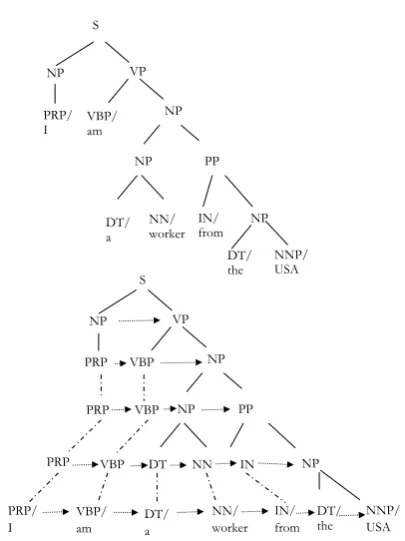
The top part of Fig1 is a standard constituent parse tree. For some levels of the tree, the nodes at that same level can not represent a sentence. We extend the parse tree by duplicating non-POS con-stituents so that leaf nodes (words and their corre-sponding POS tags) are aligned at the bottom level as shown in bottom of as Fig1. In the example tree, the solid lines represent relationship of nodes from the original parse tree, the long dot lines denote the extension of the duplication nodes from the up-per level to the lower level, and the nodes at the same level are connected (arrowed lines) to repre-sent that is a sequence. Based on this expanded constituent parse tree, we can consider every level as a ‘sentence’ and the tokens are POS tags and parse tree labels. We apply the above compression model in Section 3.1 on every level to decide every node’s status in the final compressed sentence. In order to make the compressed parsed tree reason-able, we model the relationship of nodes between
PRP/ I
VBP/ am
DT/ a
NN/ worker
IN/ from
NNP/ USA NP IN PRP
PRP
PRP
DT/ the NNP/ USA IN/
from NN/ worker
PP
NP PRP/
I
DT/ the S
VP NP
VBP NP
NP PP
DT NN VBP
VBP S
VP NP
VBP/ am
NP
NP
[image:4.595.318.521.63.334.2]DT/ a
Figure 1: A regular constituent parse tree and its Expanded constituent tree.
adjacent levels as following: if the parent node is labeled as removed, all of its children will be re-moved; one node will retain if at least one of its children is kept.
Therefore, the objective function in the new ILP formulation is:
maxz =
heightX
l=1
(
nl X
i=1
αli·s(x,0, li)
+
nXl−1
i=1
nl X
j=i+1
γijl ·s(x, li, lj)
+
nl X
i=1
βil·s(x, li, nl+ 1) ) (8)
where height is the depth for a parse tree (starting from level 1 for the tree), andnlmeans the length of level l (for example, n5 = 6 in the example in Fig1). Then every level will have a set of pa-rametersδli, αli, βil, andγijl , and the corresponding constraints as shown in Formula (3) to (6). The re-lationship between nodes from adjacent levels can be expressed as:
δil≥δ(jl+1) (9)
i at level l. In addition, 1 ≤ l ≤ height−1,
1≤i≤nland1≤j≤nl+1.
3.3 Linguistically Motivated Constraints
In our proposed model, we can jointly decide the status of every node in the constituent parse tree at the same time. One advantage is that we can add constraints based on internal nodes or rela-tionship in the parse tree, rather than only using the relationship based on words. In addition to the constraints proposed in (Clarke and Lapata, 2008), we introduce more linguistically motivated constraints to keep the compressed sentence more grammatically correct. The following describes the constraints we used based on the constituent parse tree.
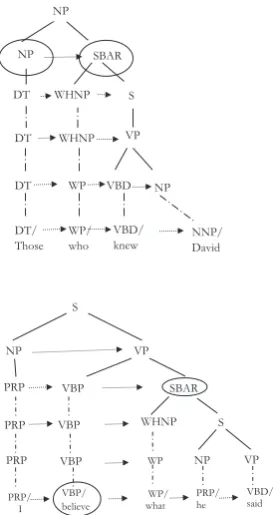
• If a node’s label is ‘SBAR’, its parent’s label is ‘NP’ and its first child’s label is ‘WHNP’ or ‘WHPP’ or ‘IN’, then if we can find a noun in the left siblings of ‘SBAR’, this subordi-nate clause could be an attributive clause or appositive clause. Therefore the found noun node should be included in the compression if the ‘SBAR’ is also included, because the node ‘SBAR’ decorates the noun. For exam-ple, the top part of Fig 2 is part of expanded constituent parse tree of sentence ‘Those who knew David were all dead.’ The nodes in el-lipse should share the same status.
• If a node’s label is ‘SBAR’, its parent’s label is ‘VP’ and its first child’s label is ‘WHNP’, then if we can find a verb in the left siblings of ‘SBAR’, this subordinate clause could be an objective clause. Therefore, the found verb node should be included in the compres-sion if the ‘SBAR’ node is also included, be-cause the node ‘SBAR’ is the object of that verb. An example is shown in the bottom part of Fig 2. The nodes in ellipse should share the same status.
• If a node’s label is ‘SBAR’, its parent’s label is ‘VP’ and its first child’s label is ‘WHADVP’, then if the first leaf for this node is a wh-word (e.g., ‘where, when, why’) or ‘how’, this clause may be an objective clause (when the word is ‘why, how, where’) or at-tributive clause (when the word is ‘where’) or adverbial clause (when the word is ‘when’). Therefore, similar to above, if a verb or noun is found in the left siblings of ‘SBAR’, the
VBD/ knew
NNP/ David NP DT
DT
DT
VP
WP
WP/ who DT/ Those
VBD S NP
PRP/ he PRP/
I VBP/ believe
PRP VBP
WP/ what
WHNP S PRP VBP
VBD/ said
SBAR VP NP
NP VP
WP
PRP VBP
NP
SBAR
WHNP
WHNP
[image:5.595.379.516.68.326.2]S
Figure 2: Expanded constituent parse tree for ex-amples.
found verb or noun node should be included in the compression if the ‘SBAR’ node is also included.
• If a node’s label is ‘SBAR’ and its parent’s la-bel is ‘ADJP’, then if we can find a ‘JJ’, ‘JJR’, or ‘JJS’ in the left siblings of ‘SBAR’, the ‘SBAR’ node should be included in the com-pression if the found ‘JJ’, ‘JJR’ or ’JJS’ node is also included because the node ‘SBAR’ is decorated by the adjective.
• The node with a label of ‘PRN’ can be re-moved without other constraints.
We also include some other constraints based on the Stanford dependency parse tree. Table 1 lists the dependency relations we considered.
• For type I relations, the parent and child node with those relationships should have the same value in the compressed result (both are kept or removed).
Dependency Relation Example
prt: phrase verb particle They shut down the station. prt(shut,down)
prep: prepositional modifier He lives in a small village. prep(lives,in) I pobj: object of a preposition I sat on the chair. pobj(on,chair)
nsubj: nominal subject The boy is cute. nsubj(cute,boy)
cop: copula Bill is big. cop(big,is)
partmod: participial modifier Truffles picked during the spring are tasty. partmod(truffles,picked)
II nn: noun compound modifier Oil price futures. nn(futures,oil)
acomp: adjectival complement She looks very beautiful. acomp(looks,beautiful)
pcomp: prepositional complement He felt sad after learning that tragedy. pcomp(after,learning)
III ccomp: clausal complement I am certain that he did it. ccomp(certain,did)
[image:6.595.93.510.61.191.2]tmod: temporal modifier Last night I swam in the pool. tmod(swam,night)
Table 1: Some dependency relations used for extra constraints. All the examples are from (Marneffe and Manning, 2002)
• For type III relations, if the parent node in these relations is retained, the child node should be kept as well.
3.4 Features
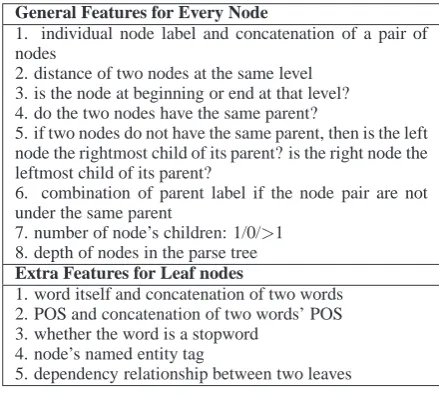
So far we have defined the decoding process and related constraints used in decoding. These all rely on the score function s(x,y) = w · f(x, L(yj−1), L(yj)) for every level in the con-stituent parse tree. We included all the features in-troduced in (Clarke and Lapata, 2008) (those fea-tures are designed for leaves). Table 2 lists the additional features we used in our system.
General Features for Every Node
1. individual node label and concatenation of a pair of nodes
2. distance of two nodes at the same level 3. is the node at beginning or end at that level? 4. do the two nodes have the same parent?
5. if two nodes do not have the same parent, then is the left node the rightmost child of its parent? is the right node the leftmost child of its parent?
6. combination of parent label if the node pair are not under the same parent
7. number of node’s children: 1/0/>1 8. depth of nodes in the parse tree
Extra Features for Leaf nodes
1. word itself and concatenation of two words 2. POS and concatenation of two words’ POS 3. whether the word is a stopword
4. node’s named entity tag
5. dependency relationship between two leaves
Table 2: Features used in our system besides those used in (Clarke and Lapata, 2008).
3.5 Learning
To learn the feature weights during training, we perform ILP decoding on every sentence in the training set, to find the best hypothesis for each node in the expanded constituent parse tree. If the hypothesis is incorrect, we update the feature
weights using the structured perceptron learning strategy (Collins, 2002). The reference label for every node in the expanded constituent parse tree is obtained automatically from the bottom to the top of the tree. Since every leaf node (word) is human annotated (removed or retain), we annotate the internal nodes as removed if all of its children are removed. Otherwise, the node is annotated as retained.
During perceptron training, a fixed learning rate is used and parameters are averaged to prevent overfitting. In our experiment, we observe sta-ble convergence using the held-out development corpus, with best performance usually obtained around 10-20 epochs.
4 Summarization System
Similar to (Li et al., 2013a), our summarization system is , which consists of three key compo-nents: an initial sentence pre-selection module to select some important sentence candidates; the above compression model to generate n-best com-pressions for each sentence; and then an ILP sum-marization method to select the best summary sen-tences from the multiple compressed sensen-tences.
The sentence pre-selection model is a simple su-pervised support vector regression (SVR) model that predicts a salience score for each sentence and selects the top ranked sentences for further pro-cessing (compression and summarization). The target value for each sentence during training is the ROUGE-2 score between the sentence and the human written abstracts. We use three common features: (1) sentence position in the document; (2) sentence length; and (3) interpolated n-gram document frequency as introduced in (Ng et al., 2012).
[image:6.595.71.291.432.629.2]ILP method introduced in (Gillick et al., 2009). Word bi-grams are used as concepts, and their doc-ument frequency is used as weights. Since we use multiple compressions for one sentence, an addi-tional constraint is used: for each sentence, only one of its n-best compressions may be included in the summary.
For the compression module, using the ILP method described above only finds the best com-pression result for a given sentence. To generate n-best compression candidates, we use an iterative approach – we add one more constraints to prevent it from generating the same answer every time af-ter getting one solution.
5 Experimental Results
5.1 Experimental Setup
Summarization Data For summarization
experi-ments, we use the standard TAC data sets1, which have been used in the NIST competitions. In par-ticular, we used the TAC 2010 data set as train-ing data for the SVR sentence pre-selection model, TAC 2009 data set as development set for parame-ter tuning, and the TAC 2008 and 2011 data as the test set for reporting the final summarization re-sults. The training data for the sentence compres-sion module in the summarization system is sum-mary guided compression corpus annotated by (Li et al., 2013a) using TAC2010 data. In the com-pression module, for each word we also used its document level feature.2
Compression Data We also evaluate our
com-pression model using the data set from (Clarke and Lapata, 2008). It includes 82 newswire arti-cles with manually produced compression for each sentence. We use the same partitions as (Martins and Smith, 2009), i.e., 1,188 sentences for training and 441 for testing.
Data Processing We use Stanford CoreNLP
toolkit3to tokenize the sentences, extract name
en-tity tags, and generate the dependency parse tree. Berkeley Parser (Petrov et al., 2006) is adopted to obtain the constituent parse tree for every sen-tence and POS tag for every token. We use Pocket
1
http://www.nist.gov/tac/data/index.html
2Document level features for a word include information
such as the word’s document frequency in a topic. These features cannot be extracted from a single sentence, as in the standard sentence compression task, and are related to the document summarization task.
3
http://nlp.stanford.edu/software/corenlp.shtml
CRF4 to implement the CRF sentence
compres-sion model. SVMlight5 is used for the summary sentence pre-selection model. Gurobi ILP solver6 does all ILP decoding.
5.2 Summarization Results
We compare our summarization system against four recent studies, which have reported some of the highest published results on this task. Berg-Kirkpatrick et al. (2011) introduced a joint model for sentence extraction and compression. Wood-send and Lapata (2012) learned individual sum-mary aspects from data, e.g., informativeness, suc-cinctness, grammaticalness, stylistic writing con-ventions, and jointly optimized the outcome in an ILP framework. Ng et al. (2012) exploited category-specific information for multi-document summarization. Almeida and Martins (2013) pro-posed compressive summarization method by dual decomposition and multi-task learning. Our sum-marization framework is the same as (Li et al., 2013a), except they used a CRF-based compres-sion model. In addition to the four previous stud-ies, we also report the best achieved results in the TAC competitions.
Table 3 shows the summarization results of our method and others. The top part contains the re-sults for TAC 2008 data and bottom part is for TAC 2011 data. We use the ROUGE evaluation metrics (Lin, 2004), with R-2 measuring the bi-gram overlap between the system and reference summaries and R-SU4 measuring the skip-bigram with the maximum gap length of 4. In addition, we evaluate the linguistic quality (LQ) of the sum-maries for our system and (Li et al., 2013a).7 The linguistic quality consists of two parts. One eval-uates the grammar quality within a sentence. For this, annotators marked if a compressed sentence is grammatically correct. Typical grammar errors include lack of verb or subordinate clause. The other evaluates the coherence between sentences, including the order of sentences and irrelevant sen-tences. We invited 3 English native speakers to do this evaluation. They gave every compressed sen-tence a grammar score and a coherence score for
4
http://sourceforge.net/projects/pocket-crf-1/
5
http://svmlight.joachims.org/
6http://www.gurobi.com
7We chose to evaluate the linguistic quality for this system
System R-2 R-SU4 Gram Cohere
TAC’08 Best System 11.03 13.96 n/a n/a
(Berg-Kirk et al., 2011) 11.70 14.38 n/a n/a
(Woodsend et al., 2012) 11.37 14.47 n/a n/a
(Almeida et al.,2013) 12.30 15.18 n/a n/a
(Li et al., 2013a) 12.35 15.27 3.81 3.41
Our System 12.23 15.47 4.29 4.11
TAC’11 Best System 13.44 16.51 n/a n/a
(Ng et al., 2012) 13.93 16.83 n/a n/a
(Li et al., 2013a) 14.40 16.89 3.67 3.32
[image:8.595.322.511.62.139.2]Our System 14.04 16.67 4.18 4.07
Table 3: Summarization results on the TAC 2008 and 2011 data sets.
each topic. The score is scaled and ranges from 1 (bad) to 5 (good). Therefore, in table 3, the gram-mar score is the average score for each sentence and coherence score is the average for each topic. We measure annotators’ agreement in the follow-ing way: we consider the scores from each anno-tator as a distribution and we find that these three distributions are not statistically significantly dif-ferent each other (p>0.05 based on paired t-test). We can see from the table that in general, our system achieves better ROUGE results than most previous work except (Li et al., 2013a) on both
TAC 2008 and TAC 2011 data. However, our
system’s linguistic quality is better than (Li et al., 2013a). The CRF-based compression model used in (Li et al., 2013a) can not well model the grammar. Particularly, our results (ROUGE-2) are statistically significantly (p < 0.05) higher than TAC08 Best system, but are not statistically signif-icant compared with (Li et al., 2013a) (p>0.05). The pattern is similar in TAC 2011 data. Our result (R-2) is statistically significantly (p<0.05) better than TAC11 Best system, but not statistically (p> 0.05) significantly different from (Li et al., 2013a). However, for the grammar and coherence score, our results are statistically significantly (p<0.05) than (Li et al., 2013a). All the above statistics are based on paired t-test.
5.3 Compression Results
The results above show that our summarization system is competitive. In this section we focus on the evaluation of our proposed compression
method. We compare our compression system
against four other models. HedgeTrimmer in Dorr et al. (2003) applied a variety of linguistically-motivated heuristics to guide the sentences
com-System C Rate (%) Uni-F1 Rel-F1
HedgeTrimmer 57.64 0.64 0.50
McDonald (2006) 70.95 0.77 0.55
Martins (2009) 71.35 0.77 0.56
Wang (2013) 68.06 0.79 0.59
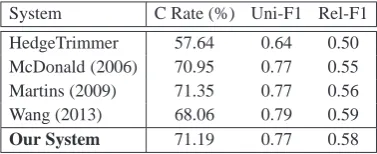
[image:8.595.74.291.62.201.2]Our System 71.19 0.77 0.58
Table 4: Sentence compression results. The hu-man compression rate of the test set is 69%.
pression; McDonald (2006) used the output of two parsers as features in a discriminative model that decomposes over pairs of consecutive words; Mar-tins and Smith (2009) built the compression model in the dependency parse and utilized the relation-ship between the head and modifier to preserve the grammar relationship; Wang et al. (2013) devel-oped a novel beam search decoder using the tree-based compression model on the constituent parse tree, which could find the most probable compres-sion efficiently.
Table 4 shows the compression results of vari-ous systems, along with the compression ratio (C Rate) of the system output. We adopt the com-pression metrics as used in (Martins and Smith, 2009) that measures the macro F-measure for the retained unigrams (Uni-F1), and the one used in (Clarke and Lapata, 2008) that calculates the F1 score of the grammatical relations labeled by (Briscoe and Carroll, 2002) (Rel-F1). We can see that our proposed compression method performs well, similar to the state-of-the-art systems.
two scores ranges from 1(bad) to 5(good).
Table 5 shows that when using lexical features, our system has statistically significantly (p<0.05) higher Grammar value and content importance value than the CRF and the leaves only system. When no lexical features are used, default system can achieve statistically significantly (p < 0.01) higher results than the CRF and the leaves only system.
We can see that using the expanded parse tree performs better than using the leaves only, espe-cially when lexical features are not used. In ad-dition, we observe that our proposed compression method is more generalizable than the CRF-based model. When our system does not use lexical features in the leaves, it achieves better perfor-mance than the CRF-based model. This is impor-tant since such a model is more robust and may be used in multiple domains, whereas a model rely-ing on lexical information may suffer more from domain mismatch. From the table we can see our proposed tree based compression method consis-tently has better linguistic quality. On the other hand, the CRF compression model is the most computationally efficient one among these three compression methods. It is about 200 times faster than our model using the expanded parse tree. Ta-ble 6 shows some examples using different meth-ods.
System C Rate(%) Uni-F1 Rel-F1 Gram Imp
Using lexical features
CRF 79.98 0.80 0.51 3.9 4.0
ILP(I) 80.54 0.79 0.57 4.0 4.2
ILP(II) 79.90 0.80 0.57 4.2 4.4
No lexical features
CRF 77.75 0.78 0.51 3.35 3.5
ILP(I) 77.77 0.78 0.56 3.7 3.9
ILP(II) 77.78 0.80 0.58 4.1 4.2
Table 5: Sentence compression results: effect of lexical features and expanded parse tree. ILP(I) represents the system using only bottom nodes in constituent parse tree. ILP(II) is our system. Imp means the content importance value.
6 Conclusion
In this paper, we propose a discriminative ILP sen-tence compression model based on the expanded constituent parse tree, which aims to improve the linguistic quality of the compressed sentences in the summarization task. Linguistically motivated constraints are incorporated to improve the sen-tence quality. We conduct experiments on the TAC
Using lexical features
Source:
Apart from drugs, detectives believe money is laun-dered from a variety of black market deals involving arms and high technology.
Human compress:
detectives believe money is laundered from a variety of black market deals.
CRF result :
Apart from drugs detectives believe money is laundered from a black market deals involving arms and technol-ogy.
ILP(I) Result:
detectives believe money is laundered from a variety of black deals involving arms.
ILP(II) Result:
detectives believe money is laundered from black mar-ket deals.
No lexical features
Source:
Mrs Allan’s son disappeared in May 1989, after a party during his back packing trip across North America.
Human compress:
Mrs Allan’s son disappeared in 1989, after a party dur-ing his trip across North America.
CRF result :
Mrs Allan’s son disappeared May 1989, after during his packing trip across North America.
ILP(I) Result:
Mrs Allan’s son disappeared in May, 1989, after a party during his packing trip across North America .
ILP(II) Result:
Mrs Allan’s son disappeared in May 1989, after a party during his trip.
Table 6: Examples of original sentences and their compressed sentences from different systems.
2008 and 2011 summarization data sets and show that by incorporating this sentence compression model, our summarization system can yield signif-icant performance gain in linguistic quality with-out losing much ROUGE results. The analysis of the compression module also demonstrates its competitiveness, in particular the better linguistic quality and less reliance on lexical cues.
Acknowledgments
References
Ahmet Aker, Trevor Cohn, and Robert Gaizauskas. 2010. Multi-document summarization using a* search and discriminative training. In Proceedings
of EMNLP.
Miguel B. Almeida and Andre F. T. Martins. 2013. Fast and robust compressive summarization with dual decomposition and multi-task learning. In
Pro-ceedings of ACL.
Taylor Berg-Kirkpatrick, Dan Gillick, and Dan Klein. 2011. Jointly learning to extract and compress. In
Proceedings of ACL.
Ted Briscoe and John Carroll. 2002. Robust accurate statistical annotation of general text. In Proceedings
of LREC.
Yllias Chali and Sadid A. Hasan. 2012. On the effec-tiveness of using sentence compression models for query-focused multi-document summarization. In
Proceedings of COLING.
James Clarke and Mirella Lapata. 2008. Global in-ference for sentence compression an integer linear programming approach. Journal of Artificial
Intelli-gence Research.
Michael Collins. 2002. Discriminative training meth-ods for hidden markov models: Theory and exper-iments with perceptron algorithms. In Proceedings
of EMNLP.
Hal Daum´e. 2006. Practical structured learning tech-niques for natural language processing. Ph.D.
the-sis, University of Southern California.
Bonnie Dorr, David Zajic, and Richard Schwartz. 2003. Hedge trimmer: A parse-and-trim approach to headline generation. In Proceedings of NAACL.
Katja Filippova and Yasemin Altun. 2013. Overcom-ing the lack of parallel data in sentence compression. In Proceedings of EMNLP.
Dimitrios Galanis and Ion Androutsopoulos. 2010. An extractive supervised two-stage method for sentence compression. In Proceedings of NAACL.
Michel Galley and Kathleen McKeown. 2007. Lexi-calized markov grammars for sentence compression. In Processings of NAACL.
Michel Galley. 2006. A skip-chain conditional random field for ranking meeting utterances by importance. In Proceedings of EMNLP.
Dan Gillick, Benoit Favre, Dilek Hakkani-Tur, Berndt Bohnet, Yang Liu, and Shasha Xie. 2009. The icsi/utd summarization system at tac 2009. In
Pro-ceedings of TAC.
Kevin Knight and Daniel Marcu. 2000. Statistics-based summarization - step one: Sentence compres-sion. In Proceedings of AAAI.
Kevin Knight and Daniel Marcu. 2002. Summariza-tion beyond sentence extracSummariza-tion: A probabilistic ap-proach to sentence compression. Artificial
Intelli-gence, 139(1):91–107.
Julian Kupiec, Jan Pedersen, and Francine Chen. 1995. A trainable document summarizer. In Proceedings
of SIGIR.
Chen Li, Fei Liu, Fuliang Weng, and Yang Liu. 2013a. Document summarization via guided sentence com-pression. In Proceedings of the EMNLP.
Chen Li, Xian Qian, and Yang Liu. 2013b. Using su-pervised bigram-based ilp for extractive summariza-tion. In Proceedings of ACL.
Hui Lin and Jeff Bilmes. 2010. Multi-document sum-marization via budgeted maximization of submodu-lar functions. In Proceedings of NAACL.
Chin-Yew Lin. 2003. Improving summarization per-formance by sentence compression - A pilot study. In Proceeding of the Sixth International Workshop
on Information Retrieval with Asian Language.
Chin-Yew Lin. 2004. Rouge: a package for automatic evaluation of summaries. In Proceedings of ACL.
Fei Liu and Yang Liu. 2013. Towards abstractive speech summarization: Exploring unsupervised and supervised approaches for spoken utterance com-pression. IEEE Transactions on Audio, Speech, and
Language Processing.
Marie-Catherine de Marneffe and Christopher D Man-ning. 2002. Stanford typed dependencies manual.
Andre F. T. Martins and Noah A. Smith. 2009. Sum-marization with a joint model for sentence extrac-tion and compression. In Proceedings of the ACL
Workshop on Integer Linear Programming for Natu-ral Language Processing.
Ryan McDonald. 2006. Discriminative sentence com-pression with soft syntactic evidence. In
Proceed-ings of EACL.
Ani Nenkova and Kathleen McKeown. 2011. Auto-matic summarization. Foundations and Trends in
Information Retrieval.
Jun-Ping Ng, Praveen Bysani, Ziheng Lin, Min-Yen
Kan, and Chew-Lim Tan. 2012. Exploiting
category-specific information for multi-document summarization. In Proceedings of COLING.
Tadashi Nomoto. 2007. Discriminative sentence com-pression with conditional random fields.
Informa-tion Processing and Management.
Miles Osborne. 2002. Using maximum entropy for sentence extraction. In Proceedings of the ACL-02
Slav Petrov, Leon Barrett, Romain Thibaux, and Dan Klein. 2006. Learning accurate, compact, and interpretable tree annotation. In Proceedings of
COLING-ACL.
Xian Qian and Yang Liu. 2013. Fast joint compression and summarization via graph cuts. In Proceedings
of EMNLP.
Advaith Siddharthan, Ani Nenkova, and Kathleen McKeown. 2004. Syntactic simplification for im-proving content selection in multi-document sum-marization. In Proceedings of Coling.
Kapil Thadani and Kathleen McKeown. 2013. Sen-tence compression with joint structural inference. In
Proceedings of CoNLL.
Jenine Turner and Eugene Charniak. 2005. Super-vised and unsuperSuper-vised learning for sentence com-pression. In Proceedings of ACL.
Lucy Vanderwende, Hisami Suzuki, Chris Brockett, and Ani Nenkova. 2007. Beyond sumbasic: Task-focused summarization with sentence simplification and lexical expansion. Information Processing &
Management.
Lu Wang, Hema Raghavan, Vittorio Castelli, Radu Flo-rian, and Claire Cardie. 2013. A sentence com-pression based framework to query-focused multi-document summarization. In Proceedings of ACL.
Kristian Woodsend and Mirella Lapata. 2010. Auto-matic generation of story highlights. In Proceedings
of ACL.
Kristian Woodsend and Mirella Lapata. 2012. Mul-tiple aspect summarization using integer linear pro-gramming. In Proceedings of EMNLP-CoNLL.
Katsumasa Yoshikawa, Tsutomu Hirao, Ryu Iida, and Manabu Okumura. 2012. Sentence compression with semantic role constraints. In Proceedings of
ACL.
David Zajic, Bonnie J. Dorr, Jimmy Lin, and Richard Schwartz. 2007. Multi-candidate reduction: Sen-tence compression as a tool for document summa-rization tasks. In Information Processing and