Original Article
Effect of human-oriented management mode on
nursing management in the operating room
Junying Yin1*, Jing Li2*, Guizhi Wang3
1Surgery Center, Shandong Provincial Hospital Affiliated to Shandong University, Jinan, Shandong Province, China; 2Department of Operating Room, Liaocheng Third People’s Hospital, Liaocheng, Shandong Province, China; 3 De-partment of Supervision, Zhucheng People’s Hospital, Zhucheng, Shandong Province, China. *Equal contributors and co-first authors.
Received March 21, 2018; Accepted April 25, 2018; Epub July 15, 2018; Published July 30, 2018
Abstract: Objective: To study and discuss the effect of human-oriented management mode on the satisfaction rate of patients undergoing surgery. Methods: A total of 160 surgical patients admitted to Shandong Provincial Hospital Affiliated to Shandong University from July 2016 to July 2017 were randomly divided into an observation group and a control group, with 80 cases in each group. The observation group adopted human-oriented management mode for nursing management in the operating room, and conventional nursing management mode was performed in the control group. The patient satisfaction rate of nursing, nursing errors, nursing disputes, and the enthusiasm of nurses in the two groups were observed and compared. Results: The operation time and intraoperative bleeding volume in observation group were significantly less than those in the control group (both P<0.001). In the observa-tion group, the rates of perioperative nursing errors (0.00%) and nursing disputes (0.00%) were significantly lower than those in control group (5.00%, P=0.043; 6.25%, P=0.023). The overall satisfaction rate in the observation group was 96.25%, which was significantly higher than that in the control group (80.00%, P=0.002). Conclusion: The application of human-oriented nursing management mode for operating room nursing can significantly improve patient satisfaction of nursing measures as well as reduce perioperative nursing disputes and errors, as a safe and reliable mode. Therefore, it is worthy of clinical application and generalization.
Keywords: Human-oriented management mode, operating room, nursing management
Introduction
The operating room is an important place for treatment in modern hospitals [1, 2]. In operat-ing room, nurses should not only take care of patients and deal with various situations, but also cooperate with the doctors and complete the operation, so that they have heavy medical tasks and mental stress. Nursing disputes and errors occur occasionally, and these carry great importance by hospital managers. Recently, human-oriented nursing management mode has become a popular concept with a core of human-oriented thinking. In this mode, the emotions of medical staff, especially nurses, in operating room is eased, so that a good work-ing environment can be created. Patient satis-faction about nursing can be improved with this approach and the occurrence of disputes between nurses and patients can be decreased
[3, 4]. The management mode has achieved good results and socioeconomic benefits in all disciplines of clinical nursing, but its application in operating room management is not clear yet [5, 6]. Therefore, this study selected 160 pa- tients in the operating room of Shandong Pr- ovincial Hospital Affiliated to Shandong Un- iversity from July 2016 to July 2017 as research subjects and explored the application effect of human-oriented management mode on nursing management in operating room.
Materials and methods
General data
A total of 160 patients in operating room from July 2016 to July 2017 were selected and divid-ed into observation group and control group according to a random number table, with 80 cases in each group. The observation group adopted human-oriented management mode for nursing management in operating room, and conventional nursing management mode was performed in the control group.
Inclusion criteria: Patients who needed surgi- cal treatment according to clinical diagnosis; patients without surgical contraindications; patients with age greater than 18 and younger than 65 years old; patients with normal level of intelligence; patients who could cooperate with satisfaction survey after surgery.
Exclusion criteria: Patients with surgical contra-indications; patients with age younger than 18 or older than 65 years old; patients who were unable to cooperate with subsequent nursing satisfaction survey.
Interventional methods
Conventional nursing management mode was adopted for 80 patients in the control group, which included establishing effective communi-cation mechanism, setting team development goals, defining team code of conduct, and per-fecting rules and regulations, etc.
In the observation group, on the basis of con-ventional nursing management, human-orient-ed management was also carrihuman-orient-ed out, includ- ing 3 specific measures. First, human-oriented care was tested, where large collective staff in the operating room focused on unity and coop-eration. Meanwhile, working in the operating room was stressful with heavy medical tasks and nursing disputes and errors occurred fre-quently, so that managers needed to timely relieve pressure and adjust emotions. They also assessed the mood swing of nurses so that they could be reasonable and caring lead-ers, and so that the working atmosphere of operating room could be harmonious and posi-tive [7]. Second, human-oriented division of labor was tested. Operating room nursing need-ed close cooperation. The relationships be- tween doctors and nurses, between anesthe-tists and nurses, and between nurses needed to be well coordinated. Human-oriented divi-sion of labor could improve work efficiency and
reduce nursing disputes and errors. For exam-ple, surgical materials needed to be well-pre-pared; surgical procedures had to be performed in order; surgical service awareness of nurses needed to be cultivated, so that nurses better understood operating procedures and key sup-porting points. With this approach, surgical related matters could be properly arranged according to the characteristics of different doctors [8]. Third, human-oriented incentives were tested. Operating room managers should communicate with nurses timely to create a harmonious atmosphere and fully mobilize the enthusiasm of nurses in operating room. Also, flexible division of labor should be arranged according to nurses’ specialties and work char-acteristics to ensure the effective implementa-tion of human-oriented nursing management in operating room [9].
Observation index
Patient satisfaction of nursing was the main observation index of this study. The basic oper-ation indices (including operoper-ation time and intraoperative bleeding volume) within one week of nursing and the occurrence rates of perioperative nursing disputes and errors in both groups was observed [10].
Statistical processing
The data were processed by using SPSS18 sta-tistical software. The measurement data are expressed as mean ± standard deviation (_x ± sd), and independent samples t-test was used for those comparison between groups. The count data was expressed as rate, and χ2 test
was used for those comparisons between groups. When P<0.05, the difference was sta-tistical significant.
Results
General data
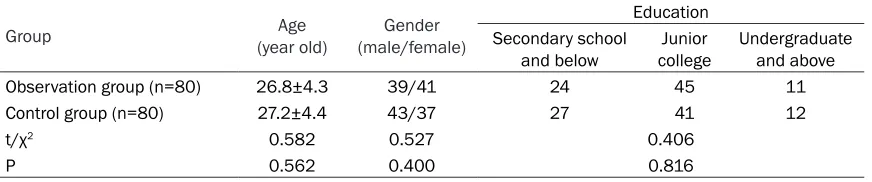
females. The educational level was 27 cases of secondary school or below, 41 cases of junior college and 12 cases of undergraduate or above. The differences of age, gender, educa-tional level and other general data between the two groups were not statistically significant (all P>0.05), so the two groups were comparable. See Table 1.
Comparison of operation index between the two groups
[image:3.612.90.526.86.177.2]The operation time and intraoperative bleeding volume in the observation group were less than those in the control group (both P<0.001). See
Table 2.
Occurrence of nursing errors and disputes in both groups
The rates of nursing errors and nursing dis-putes in the observation group were both 0.00%. The rates of nursing errors and disputes in the control group were 5.00% and 6.25% respectively. The differences between the two
Operating room nursing is one of the important parts of the hospital and the performance appraisal; the quality of nursing in operating room directly affects the recovery speed and quality of patients undergoing surgery. Human-oriented management in operating room not only reduces nursing errors and disputes, improves the patient satisfaction about nurs-ing, but also promotes nurses’ enthusiasm for work [11, 12]. With the improvement of peo-ple’s living standards, new surgical techniques and widespread application of new medical devices, the requirement of nursing quality in operating room is increasingly demanded by patients. Nursing managers should implement human-oriented management mode to encour-age nurses in operating room to fully mobilize their enthusiasm and creativity, also to reduce their psychological pressure and negative emo-tions, so that the work efficiency can be improved [13, 14]. In addition, human-oriented nursing management in operating room also maximizes the cohesion among nursing staff, improves the quality of physical nursing
servic-Table 1. Comparison of the general data between two groups
Group (year old)Age (male/female)Gender
Education Secondary school
and below collegeJunior Undergraduate and above
Observation group (n=80) 26.8±4.3 39/41 24 45 11
Control group (n=80) 27.2±4.4 43/37 27 41 12
t/χ2 0.582 0.527 0.406
[image:3.612.91.332.224.301.2]P 0.562 0.400 0.816
Table 2. Comparison of operation index between the two groups (_x ± sd)
Group time (min)Operation Intraoperative bleed-ing volume (mL) Observation group (n=80) 130.3±36.0 216.0±21.2 Control group (n=80) 153.1±42.0 258.0±31.6
t 3.687 9.872
[image:3.612.90.332.347.415.2]P <0.001 <0.001
Table 3. Comparison of nursing errors and nursing dis-putes rate between the two groups
Group Nursing error Nursing dispute
Observation group (n=80) 0 (0.00) 0 (0.00)
Control group (n=80) 4 (5.00) 5 (6.25)
χ2 4.103 5.161
P 0.043 0.023
groups were statistically significant (P=0.043, P=0.023). See Table 3. Patient satisfaction rate of nursing in two groups
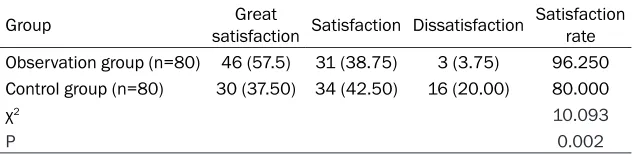
There were 46 cases of great satisfac-tion, 31 cases of satisfaction and 3 cases of dissatisfaction in the observa-tion group, with a total satisfacobserva-tion rate of 96.25%. There were 30 cases of great satisfaction, 34 cases of satisfaction and 16 cases of dissatisfaction in the control group, with a total satisfaction rate of 80.0%. The satisfaction rate in the observation group was significantly higher than that in the control group (P=0.002). See Table 4.
es, and reduces the incidence of adverse nurs-ing events [15, 16]. In addition, it improves the medical procedures and further clarifies the division of labor in operating room, which reduces the waste of human resources and improves the economic and social benefits of hospitals [17, 18].
This study shows that operation time and bleed-ing volume in the observation group were sig-nificantly less than those in the control group, indicating that with the implementation of human-oriented nursing management mode in operating room, the mental pressure of doctors and nurses was relieved, with better mutual cooperation, tacit understanding and surgical efficiency [19, 20].
Wu analyzed 200 surgical patients and found that the patient satisfaction rates of nursing, surgical doctors and nursing staffs in the exper-imental group were significantly higher than those in the control group. The occurrence of disputes in the experimental group was signifi-cant lower than that in the control group (all P<0.05) [21]. Chen’s study about the applica-tion effect of human-oriented management concepts on nursing management in operating room has also suggested favorable results: effective reduction of nurse-patient disputes and improvement of patient satisfaction of treatment and worth of clinical generalization [22]. A study by Li et al. has also pointed out that the concept of human-oriented manage-ment creates favorable conditions for surgery, ensures the safety of surgical patients, and improves the nurse-patient relationship, sug-gesting that it is worthy of clinical application [23]. In this study, there were 46 cases of great satisfaction, 31 cases of satisfaction and 3 cases of dissatisfaction in the observation group, with a total satisfaction rate of 96.25%. There were 30 cases of great satisfaction, 34 cases of satisfaction and 16 cases of disfaction in the control group, with a total
satis-nursing disputes and 5 cases of satis-nursing errors in the control group. The occurrences of nurs-ing disputes and errors in the observation group were significantly lower than those in the control group (P=0.043, P=0.023). These find-ings are consistent with previous studies. We conclude that through huoriented man-agement, the pressure of nurses in operating room are relieved, which leads to a better work-ing condition, higher patient satisfaction rate as well as less nursing errors and disputes, thus, the image of hospital and medical staff was improved.
However, this study also has some limitations, such as insufficient sample size and a small number of observation indicators. Further st- udy of larger sample size and more research indicators is needed. Nevertheless, the current situation of hospital is many hospital beds and surgical patients, but the proportion of nursing staff is small, so that large-scale application of human-oriented nursing is limited by objective conditions.
In summary, implementation of human-orient-ed management in the operating room can sig-nificantly improve patient satisfaction, decrea- se perioperative nursing errors and disputes, as a safe and reliable mode, it is worthy of fur-ther promotion in clinic.
Disclosure of conflict of interest
None.
Address correspondence to: Guizhi Wang, Depart- ment of Supervision, Zhucheng People’s Hospital, No.59 Nanhuan Road, Zhucheng 262200, Shandong Province, China, Tel: +86-0536-6189566; E-mail: [email protected]
References
[image:4.612.90.406.97.174.2][1] Liu HW. Application of huoriented man-agement concept on nursing manman-agement in Table 4. Comparison of patient satisfaction rate of nursing between two
groups
Group satisfaction Satisfaction DissatisfactionGreat Satisfaction rate Observation group (n=80) 46 (57.5) 31 (38.75) 3 (3.75) 96.250 Control group (n=80) 30 (37.50) 34 (42.50) 16 (20.00) 80.000
χ2 10.093
P 0.002
operating room. China Health Standard Man-agement 2015; 9: 299.
[2] Yang L. Application of huoriented man-agement concept on nursing manman-agement in operating room. Continuing Medical Education 2017; 11: 118-120.
[3] Lin Y. Application of human-oriented manage-ment concept on nursing managemanage-ment in op-erating room. China Health Care & Nutrition 2016; 26: 4.
[4] Jia ZQ. Application value of human-oriented management concept in operating room nurs-ing management. Medical Frontier 2017; 7: 27.
[5] Wang H. Application and ananlysis of human-oriented management concept on nursing management in operating room. China Health Industry 2017; 14: 140-141.
[6] Ball JE, Murrells T, Rafferty AM, Morrow E and Griffiths P. ‘Care left undone’ during nursing shifts: associations with workload and per-ceived quality of care. BMJ Qual Saf 2014; 23: 116-125.
[7] Chen FF. Application of huoriented man-agement concept on nursing manman-agement in operating room. China Health Industry 2017; 14: 261.
[8] Sheng XH. Application and observation of hu-oriented management on nursing man-agement in department of general surgery. Modern Diagnosis and Treatment 2017; 28: 8. [9] Goryakin Y, Griffiths P and Maben J. Economic
evaluation of nurse staffing and nurse substi-tution in health care: a scoping review. Int J Nurs Stud 2011; 48: 501-512.
[10] Han XL. Application and analysis of human-oriented management concept on nursing management in operating room. Guide of Chi-na Medicine 2017; 15: 219-220.
[11] Wen XQ and Cao W. Application of huori-ented management concept on nursing man-agement in operating room. Guide of China Medicine 2017; 15: 232-233.
[12] Hao JX. Primarily analysis of the clinical effect of human-oriented managenment on nursing management in operating room. China Health Standard Management 2016; 7: 217-219.
[13] Tan ZH, Xu XZ and Liang AN. Application of hu-man-oriented management concept on nurs-ing management in operatnurs-ing room. Shenzhen Journal of Integrated Traditional Chinese and Western Medicine 2016; 29: 162-163. [14] Bai XJ. Application of human-oriented nursing
in outpatient surgical patients. Henan Journal of Surgery 2017; 23: 176-177.
[15] Wang C. Application of human-oriented nurs-ing management in department of general sur-gery. China Health Industry 2017; 123-124. [16] Sun XL and Liu YP. Application of
human-ori-ented nursing management in internal medi-cine department. China Health Care & Nutri-tion 2017; 27: 22.
[17] He CY and Su M. Effect of human-oriented nursing on surgical nursing quality in operation room. Journal of Clinic Nursing’s Practicality 2017; 2: 10.
[18] Xu P and Yan QX. Central venous pressure test-ing of ICU critically patients and clinical effect of nursing. Diet Care 2017; 4: 1.
[19] Wang XY. Observation of huoriented man-agement concept on nursing manman-agement in operating room. Medicine 2017; 58.
[20] Wang W. The role of human-oriented nursing in improving the nursing quality in operating room. China Health Standard Management 2017; 8: 154-156.
[21] Wu H. Application of human-oriented manage-ment concept on nursing managemanage-ment in op-erating room. Guide of China Medicine 2014; 11: 174.