Proceedings of the 2019 Conference on Empirical Methods in Natural Language Processing
2131
Fusion of Detected Objects in Text for Visual Question Answering
Chris Alberti Jeffrey Ling∗ Michael Collins David Reitter
Google Research
{chrisalberti, jeffreyling, mjcollins, reitter}@google.com
Abstract
To advance models of multimodal context, we introduce a simple yet powerful neural ar-chitecture for data that combines vision and natural language. The “Bounding Boxes in Text Transformer” (B2T2) also leverages ref-erential information binding words to portions of the image in a single unified architecture. B2T2 is highly effective on the Visual Com-monsense Reasoning benchmark1, achieving a
new state-of-the-art with a 25% relative reduc-tion in error rate compared to published base-lines and obtaining the best performance to date on the public leaderboard (as of May 22, 2019). A detailed ablation analysis shows that the early integration of the visual features into the text analysis is key to the effectiveness of the new architecture. A reference implementa-tion of our models is provided2.
1 Introduction
It has long been understood that the meaning of a word is systematically and predictably linked to the context in which it occurs (e.g., Firth 1957;
Harris 1954;Deerwester et al. 1990;Mikolov et al. 2013). Different notions of context have resulted in different levels of success with downstream NLP tasks. Recent neural architectures includ-ing Transformer (Vaswani et al.,2017) and BERT (Devlin et al.,2018) have dramatically increased our ability to include a broad window of potential lexical hints. However, the same capacity allows for multimodal context, which may help model the meaning of words in general, and also sharpen its understanding of instances of words in context (e.g.,Bruni et al. 2014).
∗
Work done as part of the Google AI residency.
1
https://visualcommonsense.com
2https://github.com/google-research/
language/tree/master/language/question_ answering/b2t2
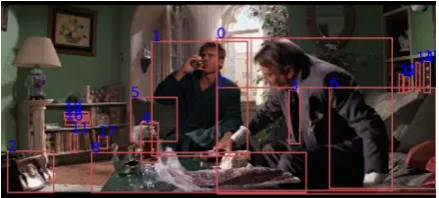
Q: What was [1] doing before he sat in his living room? A1: He was reading [10].
A2: He was taking a shower.X
A3: [0] was sleeping until the noise [1] was making woke him up.
A4: He was sleeping in his bedroom.
R1: His clothes are disheveled and his face is glistening like he’s
sweaty.
R2: [0] does not look wet yet, but [0] looks like his hair is wet, and
bathrobes are what you wear before or after a shower. R3: He is still wearing his bathrobe.X
R4: His hair appears wet and there is clothing hanging in front of him
[image:1.595.307.527.222.321.2]on a line as if to dry.
Figure 1: An example from the VCR dataset. The tasks consists in picking an answer A1−4, and then picking
a rationale R1−4. The data contains explicit pointers in
the text to bounding boxes in the image.
In this work we gather evidence to answer these questions by designing the Bounding Boxes in Text Transformer, B2T2 for short, a neural archi-tecture for multimodal encoding of natural lan-guage and images, and we evaluate B2T2 on the Visual Commonsense Reasoning benchmark (VCR,Zellers et al. 2019).
Figure1shows an illustrative example from the VCR benchmark. VCR is well suited to test rich multimodal representations because it requires the analysis of images depicting people engaged in complex activities; it presents questions, answers and rationales created by human annotators rather than automatic generation; it has a clean multiple-choice interface for evaluation; and yet it is still challenging thanks to a careful selection of answer choices through adversarial matching. VCR has much longer questions and answers compared to other popular Visual Question Answering (VQA) datasets, such as VQA v1 (Antol et al., 2015), VQA v2 (Goyal et al., 2017) and GQA (Hudson and Manning,2019), requiring more modeling ca-pacity for language understanding.
In our experiments, we found that early fusion of co-references between textual tokens and vi-sual features of objects was the most critical fac-tor in obtaining improvements on VCR. We found that the more visual object features we included in the model’s input, the better the model performed, even if they were not explicitly co-referent to the text, and that positional features of objects in the image were also helpful. We finally discovered that our models for VCR could be trained much more reliably when they were initialized from pre-training on Conceptual Captions (Sharma et al.,
2018), a public dataset of about 3M images with captions. From the combination of these model-ing improvements, we obtained a new model for visual question answering that achieves state-of-the-art on VCR, reducing error rates by more than 25% relative to the best published and documented model (Zellers et al.,2019).
2 Problem Formulation
In this work, we assume data comprised of 4-tuples(I, B, T, l)where
1. Iis an image,
2. B = [b1, . . . , bm]is a list of bounding boxes
referring to regions of I, where each bi is
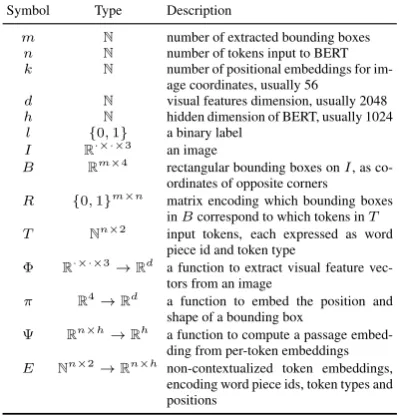
Symbol Type Description
m N number of extracted bounding boxes
n N number of tokens input to BERT
k N number of positional embeddings for im-age coordinates, usually 56
d N visual features dimension, usually 2048
h N hidden dimension of BERT, usually 1024
l {0,1} a binary label
I R·×·×3 an image
B Rm×4 rectangular bounding boxes onI, as co-ordinates of opposite corners
R {0,1}m×n matrix encoding which bounding boxes
inBcorrespond to which tokens inT T Nn×2 input tokens, each expressed as word
piece id and token type
Φ R·×·×3→Rd a function to extract visual feature vec-tors from an image
π R4→Rd a function to embed the position and shape of a bounding box
Ψ Rn×h→Rh a function to compute a passage embed-ding from per-token embedembed-dings
[image:2.595.306.506.69.278.2]E Nn×2→Rn×h non-contextualized token embeddings, encoding word piece ids, token types and positions
Table 1: Glossary of mathematical symbols used in this work.
identified by the lower left corner, height and width,
3. T = [t1, . . . , tn] is a passage of tokenized
text, with the peculiarity that some of the to-kens are not natural language, but explicit ref-erences to elements ofB, and
4. lis a binary label in{0,1}.
While it might seem surprising to mix natural text with explicit references to bounding boxes, this is actually a quite natural way for people to discuss objects in images and the VCR dataset is annotated in exactly this way.
We assume an image representation functionΦ that converts an image, perhaps after resizing and padding, to a fixed size vector representation of dimensiond.
We similarly assume a pretrained textual repre-sentation capable of converting any tokenized pas-sage of text, perhaps after truncating or padding, into a vector representation of dimensionh. We assume a context independent token representa-tion E in the shape of a vector of dimension h
for each token and a passage level representation Ψwhich operates onE(T)and returns a passage level vector representation of dimensionh.
3 Models and Methods
We evaluate two main architectures: “Dual En-coder”, a late fusion architecture where image and text are encoded separately and answer scores are computed as an inner product, and the full B2T2 model, an early fusion architecture where visual features are embedded on the same level as input word tokens. Section5.2 will summarize experi-ments with model variants to answer the research questions laid out in the introduction and to ana-lyze what works, and why.
3.1 Dual Encoder
Dual Encoders, discussed for example byWu et al.
(2018) and Gillick et al. (2018), are models that embed objects of potentially different types into a common representation space where a similarity function can be expressed e.g. as a dot product or a cosine similarity. A notable example of a dual encoder for image classification is WSABIE, pro-posed byWeston et al.(2011).
Our Dual Encoder architecture is shown in Fig-ure2. We model the class distribution as
p(l= 1|I, T) = 1
1 +e−Ψ(E(T))>DΦ(I)
whereDis a learned matrix of sized×h. In this model, co-reference information is completely ig-nored, and the model must rely on fixed dimen-sional vectors for the late fusion of textual and vi-sual contexts. However, we found this to be sur-prisingly competitive on VCR compared to pub-lished baselines, perhaps due to our choice of pow-erful pretrained models.
3.2 B2T2
Our B2T2 architecture is shown in Figure3. We model the class distribution as
p(l|I, B, R, T) = e
Ψ(E0(I,B,R,T))·a
l+bl
P l0eΨ(E
0(I,B,R,T))·a
l0+bl0
where al ∈ Rh and bl ∈ R for l ∈ {0,1}
are learned parameters. E0(I, B, R, T) is a non-contextualized representation for each token and of its position in text, but also of the content and position of the bounding boxes. The key dif-ference from “Dual Encoder” is that text, image and bounding boxes are combined at the level of the non-contextualized token representations rather than right before the classification decision.
The computation of E0(I, B, R, T) is depicted in Figure4. More formally, for a given example, let matrixR ∈ {0,1}m×n encode the references
between the bounding boxes in B and the tokens inT, so thatRij is1if and only if bounding boxi
is referenced by tokenj. Then
E0(I, B, R, T) =
E(T) + m X
i=1
Ri[M(Φ(crop(I, bi)) +π(bi))]>
whereMis a learnedh×dmatrix,Φ(crop(I, bi))
denotes cropping imageI to bounding boxbi and
then extracting a visual feature vector of size d, andπ(bi)denotes the embedding ofbi’s shape and
position information in a vector of sized.
To embed the position and size of a bounding boxb, we introduce two new learnable embedding matrices X andY of dimension k× d
4. Let the
coordinates of the opposite corners ofbbe(x1, y1)
and(x2, y2), after normalizing so that a bounding
box covering the entire image would havex1 = y1 = 0andx2 = y2 = k. Position embeddings
are thus defined to be
π(b) =concat(Xbx1c, Yby1c, Xbx2c, Yby2c)
3.3 Loss
All of our models are trained with binary cross en-tropy loss using label l. Denoting p := p(l = 1|I, B, R, T), we have for each example
LBCE=llogp+ (1−l) log(1−p)
3.4 Pretraining on Conceptual Captions
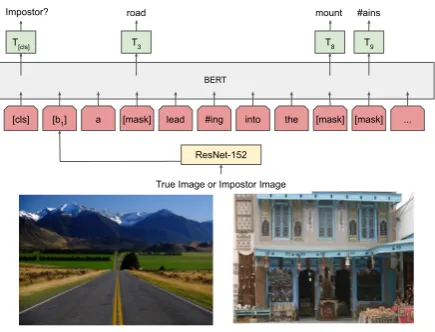
Before training on VCR, we pretrain B2T2 on im-age and caption pairs using a Mask-LM pretrain-ing technique like the one used in BERT (Devlin et al.,2018). The setup used during pretraining is shown in Figure5, where the model uses the im-age as additional context when filling in the mask. We use two tasks for pretraining: (1) impostor identification and (2) masked language model pre-diction. For the impostor task, we sample a ran-dom negative caption for each image and ask the model to predict whether the caption is correctly associated. For mask-LM, we randomly replace tokens in the caption with the[MASK]token, and the model must predict the original token (see De-vlin et al.(2018) for more details).
Formally, the pretraining data consist of images
what is [0] look at [sep] the sea
[cls] #ing [sep]
[cls]
ResNet-152
BERT xTAy
Class Score
[image:4.595.311.525.61.186.2]... ...
Figure 2: Dual Encoder architecture with late fusion. The model extracts a single visual feature vector from the entire image. Bounding boxes are ignored.
[b1] why are [b2] wear #ing the same
[cls] [b3] ...
T[cls]
BERT ... ...
ResNet-152 ResNet-152 ResNet-152
Mx Mx Mx
[image:4.595.75.293.68.184.2]xTA+b Class Score
Figure 3: B2T2 architecture with early fusion. Bound-ing boxes are inserted where they are mentioned in the text and at the end of the input, as described in Sec.4.
boxes during pretraining, soB = ∅. The binary labellindicates whether the caption is an impos-tor or not. The loss for imposimpos-tor identification is binary cross entropy LBCE with label las in 3.3. We denote the loss for mask-LM asLMLM, which is the summed cross entropy of the predicted token distributions against the true tokens.
To ensure that our model correctly grounds the language to the image with the mask LM loss, we only use it for positive captions, zeroing it out for negative captions. Our final objective is the sum of the losses:
L=LBCE+I[l= 1]· LMLM
whereI[l= 1]is an indicator for the labellbeing positive for the image and caption pair.
We pretrain on Conceptual Captions (Sharma et al.,2018), a dataset with over 3M images paired with captions.3 We found empirically that pre-training improves our model slightly on VCR, but more importantly, allows our model to train stably. Without pretraining, results on VCR exhibit much higher variance. We refer the reader to Section5.2
for an ablation analysis on the effect of pretrain-ing.
3.5 Implementation Details
We use ResNet-1524 (He et al.,2016) pretrained on ImageNet for Φ, which yields a vector repre-sentation of sized= 2048. BERT-Large (Devlin et al., 2018) provides both E andΨ. The latter is a pretrained Transformer with 24 layers, 16 at-tention heads, and hidden size 1024. For BERT,
3We also tried pretraining on MS-COCO images and
cap-tions (Lin et al.,2014), but found this to be ineffective. This could be because MS-COCO is smaller (with around 80k im-ages, 400k captions).
4Publicly available attfhub.dev
[b1] where are [b2] [SEP] at work [SEP] [cls] [b3]
E[cls] E[b1] Ewhere Eare E[b2] E[b3] E[SEP] Eat Ework E[SEP]
E0 E1 E2 E3 E4 E5 E6 E7 E8 E9
EA EA EA EA EA EA EA EB EB EB
0 M Φ(b1) 0 0 M Φ(b2) M Φ(b3) 0 0 0 0
0 M π(b1) 0 0 M π(b2) M π(b3) 0 0 0 0 +
+
+
+
+
Figure 4: How input embeddings are computed in our B2T2 architecture.
[b1] a [mask] lead into the [mask] [mask]
[cls] #ing ...
T[cls]
BERT
ResNet-152 Impostor?
T3 T8 T9
road mount #ains
True Image or Impostor Image
Figure 5: Mask-LM pretraining for B2T2.
E corresponds to its token embeddings,Ψto the
[CLS]token representation in the final layer, and
so Ψ(E(T)) corresponds to the BERT passage representation of sizeh= 1024.
We found empirically that it was slightly better to keepΦfixed rather than fine-tuning it, but that it was of critical importance to fine-tuneΨandE
for the new task.
[image:4.595.309.525.255.338.2] [image:4.595.308.526.385.551.2]4, and 5 epochs with a linear learning rate decay, and two random seed for initialization.
To maximize performance on VCR, we also evaluate an ensemble of B2T2 models. Our en-semble is comprised of 5 identical B2T2 models, trained for 3 epochs with an initial learning rate of2·10−5, but initialized with 5 different random seeds. The resulting class logits are then summed to obtain the ensemble scores.
4 Data
Visual Commonsense Reasoning (VCR,
visualcommonsense.com, Zellers et al.
2019) is a corpus that contains a sample of stills from movies. Questions and answers revolve around conclusions or assumptions that require knowledge external to the images. The associated task is to not only select a correct answer but also provide reasoning in line with common sense. Matching our problem formulation given before, a VCR sample is defined as a tuple(I, O, Q, A, R). Here, I is the image, and O is a sequence of objects identified in the image. A question
Q= [q0, . . . , qk]is given, where tokens are either
textual words or deictic references to objects in
O. Each question contains a set of four answers
A = {A1, A2, A3, A4}, with exactly one correct
answerA∗. Each response follows the schema of the queries. Finally, there is a set of four rationales
R={R1, R2, R3, R4}, with exactly one rationale R∗identified as correct in supportingA∗.
Each of the objects in O = [(b1, l1), . . . ,(b|O|, l|O|)] is identified in the image I by bounding boxes bi. The objects are
also labeled with their classes with a text tokenli.
The Q → A task is to choose A∗ given
(I, O, Q, A). TheQA → Rtask is to chooseR∗
given(I, O, Q, A∗, R). Finally, theQ→ARtask is a pipeline of the two, where a model must first correctly chooseA∗fromA, then correctly choose
R∗givenA∗.
We adapt VCR to our problem formulation by converting each VCR example to four instances for theQ→Atask, one per answer inA, and four instances for theQA→ Rtask, one per rationale inR. We construct the text for the instances in the
Q→Atask as
[[CLS],[b0], q0, . . . ,[SEP],
a0, . . . ,[SEP], l1,[b1], . . . , lp,[bp]]
and in theQA→Rtask as
[[CLS],[b0], q0, . . . ,[SEP], a∗0, . . . ,
r0, . . . ,[SEP], l1,[b1], . . . , lp,[bp]].
where [CLS],[SEP] are special tokens for BERT. Here,[b0]is a bounding box referring to the
en-tire input image. q0, . . . are all question tokens, a0, . . .answer tokens,a∗0, . . .answer tokens for the
correct answer, and r0, . . . rationale tokens. We
append the firstpbounding boxes inOwith class labels to the end of the sequence (in our experi-ments, we usep = 8), and for objects referenced inQ, A, R, we prepend the class label token (i.e. [bi]becomesli,[bi]). We assign the binary labell
to every instance to represent whether the answer or rationale choice is the correct one.
5 Experimental Results
5.1 VCR Task Performance
Our final results on the VCR task are shown in Table2. Our Dual Encoder model worked surpris-ingly well compared toZellers et al.(2019), sur-passing the baseline without making use of bound-ing boxes. We also evaluate a Text-Only baseline, which is similar to the Dual Encoder model but ig-nores the image. The ensemble of B2T2 models, pretrained on Conceptual Captions, obtained ab-solute accuracy improvements of8.9%,9.8%and 13.1% compared to the published R2C baseline for the Q → A, QA → R, andQ → AR tasks respectively. At the time of this writing (May 22, 2019), both our single B2T2 and ensemble B2T2 models outperform all other systems in the VCR leaderboard.
5.2 Ablations
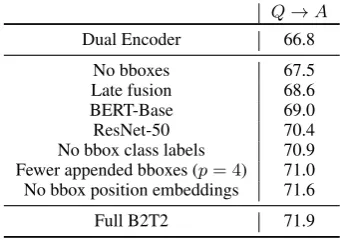
To better understand the reason for our improve-ments, we performed a number of ablation studies on our results, summarized in Table 3. We con-sider ablations in order of decreasing impact on the VCR dev setQ→Aaccuracy.
Q→A QA→R Q→AR
Model Val Test Val Test Val Test Chance 25.0 25.0 25.0 25.0 6.2 6.2 Text-Only BERT (Zellers et al.) 53.8 53.9 64.1 64.5 34.8 35.0 R2C (Zellers et al.) 63.8 65.1 67.2 67.3 43.1 44.0 HCL HGP (unpub.) - 70.1 - 70.8 - 49.8 TNet (unpub.) - 70.9 - 70.6 - 50.4 B-VCR (unpub.) - 70.5 - 71.5 - 50.8 TNet 5-Ensemble (unpub.) - 72.7 - 72.6 - 53.0 Text-Only BERT (ours) 59.5 - 65.6 - 39.3 -Dual Encoder (ours) 66.8 - 67.7 - 45.3 -B2T2 (ours) 71.9 72.6 76.0 75.7 54.9 55.0 B2T2 5-Ensemble (ours) 73.2 74.0 77.1 77.1 56.6 57.1
[image:6.595.75.291.55.194.2]Human 91.0 93.0 85.0
Table 2: Experimental results on VCR, incorporating those reported byZellers et al.(2019). The proposed B2T2 model and the B2T2 ensemble outperform pub-lished and unpubpub-lished/undocumented results found on the VCR leaderboard atvisualcommonsense. com/leaderboardas of May 22, 2019.
Q→A
Dual Encoder 66.8
No bboxes 67.5
Late fusion 68.6
BERT-Base 69.0
ResNet-50 70.4
No bbox class labels 70.9 Fewer appended bboxes (p= 4) 71.0 No bbox position embeddings 71.6
Full B2T2 71.9
Table 3: Ablations for B2T2 on VCR dev. The Dual Encoder and the full B2T2 models are the main mod-els discussed in this work. All other modmod-els represent ablations from the full B2T2 model.
showing that our model can make use of labels for detected objects. Example 1 in Table4shows an example that our models can only get right if bounding box 5 is available.
Late Fusion vs. Early Fusion. The second most important architectural choice in our model is to combine visual information at the level of context independent token embeddings, rather than at the highest levels of the neural representa-tion. If in the the full B2T2 model we add visual embeddings in the last layer of BERT rather than in the first, we lose3.3%accuracy.
Effect of Textual Model Size. The original VCR work by Zellers et al. (2019) made use of BERT-base, while we use BERT-large to initialize our models. To test how much of our improve-ments are simply due to our model being larger, we retrained B2T2 models using BERT-base and found that we lose 2.9% accuracy.
Effect of Visual Model Size.How important is the choice of the visual model in the performance
Pretrain No pretrain 0.2
0.3 0.4 0.5 0.6 0.7 0.8
[image:6.595.310.526.64.202.2]VCR Acc
Figure 6: Boxplot of devQ → Aaccuracy on VCR with and without pretraining. Pretraining on Con-ceptual Captions lowers variance when fine-tuning on VCR, from a grid search on multiple random seeds, learning rates, and VCR training epochs.
of B2T2? As further discussed in the error analysis section of this work, we suspect that B2T2 could be significantly improved by extending the visual features to represent more than just objects, but also activities, expressions and more. However it appears that even the size of the object detection model is important. If we swap out ResNet-152 for ResNet-50, accuracy decreases by1.5%.
Pretraining. We found that performance im-provements from pretraining are quite small, around 0.4% accuracy, but initializing from a pre-trained model heavily reduces variance of results. We show this effect in Figure 6 over the grid of learning rates, random seeds, and training epochs described in Section3.5.
Position of Bounding Boxes We additionally investigated the effect of removing position infor-mation from the model. The benefit of having bounding box positional embeddings is the small-est of the ones we considered. A model trained without positional embeddings only loses 0.3% accuracy compared to the full model.
5.3 Error Analysis
We picked some examples, shown in Table4, to il-lustrate the kinds of correct and incorrect choices that B2T2 is making, compared to our dual en-coder and to a text only model.
[image:6.595.95.268.281.401.2]Example 1
Q: What did [1] do before coming to this location? A1: He took horse riding lessons. (text-only)
A2: He was just shopping. (B2T2)
A3: He found a skeleton.
A4: He came to buy medicine. (dual encoder)
Example 2
Q: How are [2, 4] related?
A1: [2, 4] are partners on the same mission.
A2: [2, 4] are a recently married gay couple. (B2T2)
A3: They are likely acquaintances.
A4: They are siblings. (text-only, dual encoder)
Example 3
Q: What are [0] and the woman doing? A1: Their husbands are doing something dumb.
A2: They are observing the results of an experiment.
(text-only, dual encoder) A3: They are dancing. (B2T2)
A4: They are acting as nurses for the rescued people.
Example 4
Q: How is [2] feeling?
A1: [2] is feeling shocked. (B2T2, dual encoder)
A2: [0] is feeling anxious.
A3: [2] is not feeling well.
A4: [2] is feeling joy and amusement. (text-only)
Example 5
Q: Why is [1] on the floor talking to [0]? A1: The man on the floor was assaulting [1].
A2: He is asking her to help him stand up. (B2T2, dual
encoder)
A3: [1] just dropped all his books on the floor.
[image:7.595.77.532.66.721.2]A4: [1] looks like he is telling [0] a secret. (text-only)
In Examples 2 and 3, no specific bounding box appears to contain critical clues for answering the question, but B2T2 outperforms models without access to the image or without access to bounding boxes. It is possible that B2T2 might be gaining deeper understanding of a scene by combining in-formation from important regions of the image.
In Examples 4 and 5, we see failure cases of both the dual encoder and B2T2 compared to the text only-model. Both these examples appear to point to a limitation in the amount of information that the we are able to extract from the image. In-deed our vision model is trained on ImageNet, and so it might be very good at recognizing objects, but might be unable to recognize human expres-sions and activities. Our models could have cor-rectly answered the question in Example 4 if they were able to recognize smiles. Similarly our mod-els could have ruled out the incorrect answer they picked for the question in Example 5 if they were able to see that both people in the picture are sit-ting down and are not moving.
6 Related Work
Modeling visual contexts can aid in learning use-ful sentence representations (Kiela et al., 2017) and even in training language models (Ororbia et al.,2019). This paper takes these more general ideas to a downstream task that requires model-ing of visual input. Similar to B2T2, VideoBERT (Sun et al., 2019) jointly processes video frames and text tokens with a Transformer architecture. However, VideoBERT cannot answer questions, nor does the model consider bounding boxes.
Our B2T2 model is similar to the Bottom-Up Top-Down attention model (Anderson et al.,2018) in how bounding boxes generated at preprocessing time are attended to by the VQA model. “Bottom-Up” refers to the idea of attending from the text to the bounding boxes of objects detected in the image, while “Top-Down” refers to the idea of at-tending to regions constructed as a regular grid over the image. The Bottom-Up Top-Down model however reduces the text to a fixed length vec-tor representation before attending to image re-gions, while B2T2 instead treats image regions as special visual tokens mixed in the text. In this sense, Bottom-Up Top-Down model is a late fu-sion model, while B2T2 is early fufu-sion.
The Neuro-Symbolic Concept Learner (Mao et al.,2019) also uses bounding boxes to learn
vi-sually grounded concepts through language. The Neuro-Symbolic Concept Learner however relies on a semantic parser to intepret language, while B2T2 uses a Transformer to construct a joint rep-resentation of textual tokens and visual tokens.
Another recently proposed model for VQA is MAC (Hudson and Manning,2018). As presented, MAC does not make use of bounding boxes, which makes it a Top-Down model in the nomenclature of Anderson et al. (2018). MAC also reduces the textual information to a vector of fixed length. However MAC makes use of a new neural archi-tecture designed to perform an explicit multi-step reasoning process and is reported to perform bet-ter thanAnderson et al.(2018) on the GQA dataset (Hudson and Manning,2019).
After the submission of this paper, several new works were published with excellent results on VCR, in some cases exceeding the performance of our system. In particular we mention ViLBERT (Lu et al., 2019), VL-BERT (Su et al., 2019), Unicoder-VL (Li et al., 2019a), and VisualBERT (Li et al.,2019b).
VCR is only one of several recent datasets pertaining to the visual question answering task. VQA (Antol et al.,2015;Zhang et al.,2016;Goyal et al., 2017) contains photos and abstract scenes with questions and several ground-truth answers for each, but the questions are less complex than VCR’s. CLEVR (Johnson et al., 2017) is a vi-sual QA task with compositional language, but the scenes and language are synthetic. GQA (Hudson and Manning,2019) uses real scenes from Visual Genome, but the language is artificially generated. Because VCR has more complex natural language than other datasets, we consider it the best evalu-ation of a model like B2T2, which has a powerful language understanding component.
7 Conclusion
In this work we contrast different ways of com-bining text and images when powerful text and vi-sion models are available. We picked BERT-Large (Devlin et al., 2018) as our text model, ResNet-152 (He et al., 2016) as our vision model, and the VCR dataset (Zellers et al.,2019) as our main benchmark.
an-swering tasks. A control model, implementing late fusion (but the same otherwise), performs substan-tively worse. Thus, grounding words in the visual context should be done early rather than late.
We also demonstrate competitive results with a Dual Encoder model, matching state-of-the-art on the VCR dataset even when textual references to image bounding boxes are ignored. We then showed that our Dual Encoder model can be sub-stantially improved by deeply incorporating in the textual embeddings visual features extracted from the entire image and from bounding boxes. We finally show that pretraining our deep model on Conceptual Captions with a Mask-LM loss yields a small additional improvement as well as much more stable fine-tuning results.
References
Peter Anderson, Xiaodong He, Chris Buehler, Damien Teney, Mark Johnson, Stephen Gould, and Lei Zhang. 2018. Bottom-up and top-down attention for image captioning and visual question answering. In
Proceedings of the IEEE Conference on Computer Vision and Pattern Recognition, pages 6077–6086.
Stanislaw Antol, Aishwarya Agrawal, Jiasen Lu, Mar-garet Mitchell, Dhruv Batra, C. Lawrence Zitnick, and Devi Parikh. 2015. VQA: Visual Question An-swering. InInternational Conference on Computer Vision (ICCV).
Elia Bruni, Nam-Khanh Tran, and Marco Baroni. 2014. Multimodal distributional semantics. Journal of Ar-tificial Intelligence Research, 49:1–47.
Scott Deerwester, Susan T Dumais, George W Fur-nas, Thomas K Landauer, and Richard Harshman. 1990. Indexing by latent semantic analysis. Jour-nal of the American society for information science, 41(6):391–407.
Jacob Devlin, Ming-Wei Chang, Kenton Lee, and Kristina Toutanova. 2018. Bert: Pre-training of deep bidirectional transformers for language understand-ing. arXiv preprint arXiv:1810.04805.
John R Firth. 1957. A synopsis of linguistic theory, 1930-1955. Studies in linguistic analysis.
Daniel Gillick, Alessandro Presta, and Gaurav Singh Tomar. 2018. End-to-end retrieval in continuous space. arXiv preprint arXiv:1811.08008.
Yash Goyal, Tejas Khot, Douglas Summers-Stay, Dhruv Batra, and Devi Parikh. 2017. Making the V in VQA matter: Elevating the role of image un-derstanding in Visual Question Answering. In Con-ference on Computer Vision and Pattern Recognition (CVPR).
Zellig S Harris. 1954. Distributional structure. Word, 10(2-3):146–162.
Kaiming He, Xiangyu Zhang, Shaoqing Ren, and Jian Sun. 2016. Identity mappings in deep residual net-works. InEuropean conference on computer vision, pages 630–645. Springer.
Drew A Hudson and Christopher D Manning. 2018. Compositional attention networks for machine rea-soning. InICLR.
Drew A Hudson and Christopher D Manning. 2019. Gqa: a new dataset for compositional question an-swering over real-world images. arXiv preprint arXiv:1902.09506.
Justin Johnson, Bharath Hariharan, Laurens van der Maaten, Li Fei-Fei, C Lawrence Zitnick, and Ross Girshick. 2017. Clevr: A diagnostic dataset for compositional language and elementary visual rea-soning. In Proceedings of the IEEE Conference on Computer Vision and Pattern Recognition, pages 2901–2910.
Douwe Kiela, Alexis Conneau, Allan Jabri, and Maximilian Nickel. 2017. Learning visually grounded sentence representations. arXiv preprint arXiv:1707.06320.
Diederik P Kingma and Jimmy Ba. 2014. Adam: A method for stochastic optimization. arXiv preprint arXiv:1412.6980.
Gen Li, Nan Duan, Yuejian Fang, Daxin Jiang, and Ming Zhou. 2019a. Unicoder-vl: A universal en-coder for vision and language by cross-modal pre-training. arXiv preprint arXiv:1908.06066.
Liunian Harold Li, Mark Yatskar, Da Yin, Cho-Jui Hsieh, and Kai-Wei Chang. 2019b. Visualbert: A simple and performant baseline for vision and lan-guage. arXiv preprint arXiv:1908.03557.
Tsung-Yi Lin, Michael Maire, Serge Belongie, James Hays, Pietro Perona, Deva Ramanan, Piotr Doll´ar, and C Lawrence Zitnick. 2014. Microsoft coco: Common objects in context. In European confer-ence on computer vision, pages 740–755. Springer.
Jiasen Lu, Dhruv Batra, Devi Parikh, and Stefan Lee. 2019. Vilbert: Pretraining task-agnostic visi-olinguistic representations for vision-and-language tasks.arXiv preprint arXiv:1908.02265.
Jiayuan Mao, Chuang Gan, Pushmeet Kohli, Joshua B Tenenbaum, and Jiajun Wu. 2019. The neuro-symbolic concept learner: Interpreting scenes, words, and sentences from natural supervision. In
ICLR.
Alexander G. Ororbia, Ankur Mali, Matthew A. Kelly, and David Reitter. 2019. Like a baby: Visually sit-uated neural language acquisition. InProceedings of the 57th Annual Meeting of the Association for Computational Linguistics.
Piyush Sharma, Nan Ding, Sebastian Goodman, and Radu Soricut. 2018. Conceptual captions: A cleaned, hypernymed, image alt-text dataset for au-tomatic image captioning. In Proceedings of the 56th Annual Meeting of the Association for Compu-tational Linguistics, pages 2556–2565.
Weijie Su, Xizhou Zhu, Yue Cao, Bin Li, Lewei Lu, Furu Wei, and Jifeng Dai. 2019. Vl-bert: Pre-training of generic visual-linguistic representations.
arXiv preprint arXiv:1908.08530.
Chen Sun, Austin Myers, Carl Vondrick, Kevin Mur-phy, and Cordelia Schmid. 2019. Videobert: A joint model for video and language representation learn-ing. arXiv preprint arXiv:1904.01766.
Ashish Vaswani, Noam Shazeer, Niki Parmar, Jakob Uszkoreit, Llion Jones, Aidan N Gomez, Łukasz Kaiser, and Illia Polosukhin. 2017. Attention is all you need. InAdvances in neural information pro-cessing systems, pages 5998–6008.
Jason Weston, Samy Bengio, and Nicolas Usunier. 2011. Wsabie: Scaling up to large vocabulary image annotation. In Twenty-Second International Joint Conference on Artificial Intelligence.
Ledell Yu Wu, Adam Fisch, Sumit Chopra, Keith Adams, Antoine Bordes, and Jason Weston. 2018. Starspace: Embed all the things! InThirty-Second AAAI Conference on Artificial Intelligence.
Rowan Zellers, Yonatan Bisk, Ali Farhadi, and Yejin Choi. 2019. From recognition to cognition: Visual
commonsense reasoning. In Conference on
Com-puter Vision and Pattern Recognition (CVPR).
Peng Zhang, Yash Goyal, Douglas Summers-Stay, Dhruv Batra, and Devi Parikh. 2016. Yin and Yang: Balancing and answering binary visual questions. In